Gender and health
financing
PROFESSOR SOPHIE WITTER
INSTITUTE FOR GLOBAL HEALTH AND DEVELOPMENT,
QUEEN MARGARET UNIVERSITY EDINBURGH
IHEA 2023
What’s the link?
Health financing is about resource generation, allocation and use
Inherently distributional, but equity analysis has traditionally focused on SES and location, more
than gender
ReBUILD/RiNGS webinar in 2015 highlighted this gap area: Minding the gaps: health financing,
universal health coverage and gender
Highlighted lack of research in this area – some pockets of conversations linked to user fees and
to some extent health insurance; also to some areas of SRH in health packages, but broader
understanding limited
How far has the field moved on since then?
Examples of gendered HF questions
Revenue raising
Fairness of financial contributions: who is paying for health care? How is that changing over time
How far does the burden fall disproportionately on one sex?
What is the gender implication of changing revenue sources (e.g. out of pocket likely to fall
heavily on women; prepaid mechanisms may be more protective)?
How are they affected by household arrangements (livelihoods, access to cash, decision making
power etc.) and how do they affect these in turn?
What is the pattern of private and public funding and what does that mean for meeting the
needs of different population groups?
Gender and health financing questions (2)
Risk pooling
Who is protected under different risk pooling systems (tax-based, insurance, prepaid mechanisms
etc.)?
How effective are the risks pools in protecting different genders against health shocks (ensuring
access and also financial protection)?
Purchasing
Which programmes are being prioritised for funding and how do these reflect different gender
needs?
Does the public/private mix serve the interests of men and women effectively?
Are gender-sensitive services being purchased (e.g. facilities which provide confidentiality, sensitivity,
right staffing mix, at appropriate opening times etc.)?
Are provider payment mechanisms incentivising appropriate and high quality services for all sexes?
Gender and health financing questions (3)
Resource allocation
How do patterns of resource allocation at different levels (national, regional, district) and within different systems
and schemes affect equity of access and use for all genders, as well as quality of care? (Not just allocation of
funding, but also infrastructure, HR etc.)
Benefits package
Is there a clear and fair entitlement to services?
Are different genders equally aware of them and able to access without stigma?
Do utilisation patterns suggest that needs are being fairly met across the genders, or are there remaining financial
and social barriers?
Health financing governance
Is there adequate and fair representation of different genders in health financing governance structures? Who is
represented in health facility management committees, for example? Who decides on resource allocations? Etc.
Does the regulatory system ensure fairness and quality of care for all genders?
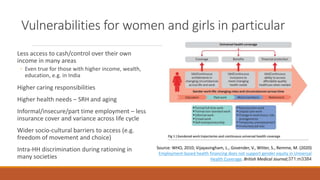
Vulnerabilities for women and girls in particular
Less access to cash/control over their own
income in many areas
◦ Even true for those with higher income, wealth,
education, e.g. in India
Higher caring responsibilities
Higher health needs – SRH and aging
Informal/insecure/part time employment – less
insurance cover and variance across life cycle
Wider socio-cultural barriers to access (e.g.
freedom of movement and choice)
Intra-HH discrimination during rationing in
many societies
Source: WHO, 2010; Vijayasingham, L., Govender, V., Witter, S., Remme, M. (2020)
Employment-based health financing does not support gender equity in Universal
Health Coverage. British Medical Journal;371:m3384
Protective policy features
Higher public investment in the health sector
Coverage decoupled from financial
contribution
Broad package covering whole household
and whole life-cycle
Gender-sensitive care package (including SRH/MCH but also delivered through appropriate provider mix,
addressing socio-cultural barriers)
In some cases, demand-side financing, such as targeted vouchers or cash transfers, may be needed to
address non-facility financial barriers to accessing care
Ensuring that human rights are protected (e.g. by stopping coercive practices such as the detention of
women or babies when facility bills are unsettled)
Policies considering intersectional issues (not just targeting poor)
Given high use of private sector in many settings, ensuring respectful, non-abusive, appropriate, high
quality care in private providers as well as public (though payment systems, regulation etc) is key
8
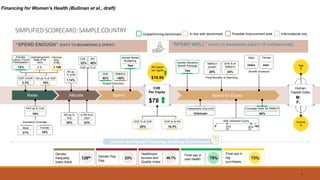
SIMPLIFIED SCORECARD: SAMPLE COUNTRY Possible improvement area
Outperforming benchmark In line with benchmark Informational only
“SPEND WELL” (PATH TO MAXIMIZING EQUITY OF EXPENDITURE)
“SPEND ENOUGH” (PATH TO MAXIMIZING $ SPENT)
Gender and Health Financing Enabling Environment
M:
F:
Human
Capital Index
126th
Gender
Inequality
Index Rank
23%
Gender Pay
Gap
48.7%
Healthcare
Access and
Quality Index
79%
Final say in
own health 73%
Final say in
big
purchases
CHE
Per Capita
$78
Female
Labour Force
Participation
72%
Informal
emp.
(F/M)
1.148
Budget Execution
GHE RMNCH
92% <50%
Unemployment
Rate (F/M
ratio)
1.1
GDP CAGR
3.3%
Tax as % of GDP
15%
33% 40%
GHE as % of
CHE RH
RH spend
per capita
$19.96
Income
%
Age
%
Benefit Incidence
Male Female
Unkn own
Gender-Based
Budgeting
Yes
Coverage Index for RMNCH
68%
RH as
% GHE
1.14%
RH as %
THE
25%
% RH from
DAH
22%
Raise Allocate Spend Spend for Equity
Male
Insurance Coverage
Female
21% 18%
OOP % of CHE
28%
OOP % of RH
19.3%
Catastrophic Exp (m/f)
Unknown
Gender-Sensitive
Benefit Package
Yes
SBA Utilization Equity
Q1
0 100
93%
Q5
34%
Proportionality of Spending
RMNCH
burden
28%
GHE $ on
RMNCH
24%
PPP as % CHE
19%
Financing for Women’s Health (Bullman et al., draft)
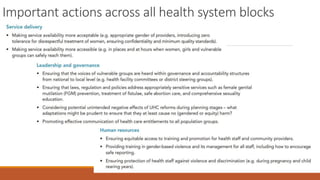
Important actions across all health system blocks
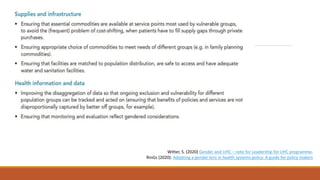
Witter, S. (2020) Gender and UHC – note for Leadership for UHC programme.
RinGs (2020): Adopting a gender lens in health systems policy: A guide for policy makers
11
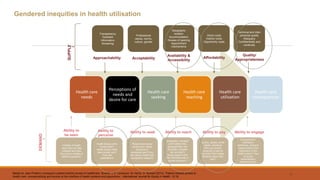
Based on Jean-Frederic Levesque’s patient-centred access to healthcare. Source: J.-F. Levesque, M. Harris, G. Russell (2013). ‘Patient-centred access to
health care: conceptualizing and access at the interface of health systems and populations’, International Journal for Equity in Health, 12:18.
Gendered inequities in health utilisation
Health care
needs
Perceptions of
needs and
desire for care
Health care
seeking
Health care
reaching
Health care
utilisation
Health care
consequences
Ability to
be seen
Ability to
perceive
Ability to seek Ability to reach Ability to pay Ability to engage
Visibility of health
need (how are data
collected and does
this ensure visibility of
different genders)?
Health literacy (who
knows what?)
Health beliefs (what
does society say?)
Trust and
expectations
Personal and social
values (who makes
decisions on
accessing care? How
are values, beliefs and
perceptions shaped?)
Geography, transport
and mobility (how
geographically and
physically available
are services?)
Social support (who
has time/resources to
access services?)
Income, assets, social
capital, insurance
(who can access
resources to pay for
services? Who makes
decisions about their
use?)
Empowerment,
information,
adherence, caregiver
support (what is the
experience of the
health system? How
do social
characteristics
determine this?)
Approachability Acceptability
Availability &
Accessibility
Affordability
Quality/
Appropriateness
Transparency
Outreach
Information
Screening
Professional
values, norms,
culture, gender
Geographic
location
Accommodation
Houses of opening
Appointment
mechanisms
Direct costs
Indirect costs
Opportunity costs
Technical and inter-
personal quality
Adequacy
Confidentiality and
continuity
DEMAND
SUPPLY
Last updated: August 10, 2023 12
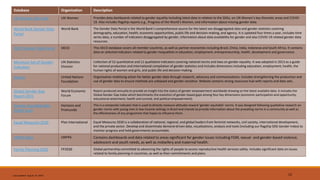
Useful Databasesand Reports for GenderResearch
Database Organisation Description
UN Women Data Hub UN Women Provides data dashboards related to gender equality including latest data in relation to the SDGs, on UN Women’s key thematic areas and COVID-
19. Also includes flagship reports e.g., Progress of the World’s Women, and information about missing gender data.
World Bank Gender Data
Portal
World Bank The Gender Data Portal is the World Bank’s comprehensive source for the latest sex-disaggregated data and gender statistics covering
demography, education, health, economic opportunities, public life and decision-making, and agency. It is updated four times a year, includes time
series data, a number of indicators disaggregated by gender, information about data availability for gender and also COVID-19 related gender data
resources.
OECD Gender Data Portal OECD This OECD database covers all member countries, as well as partner economies including Brazil, China, India, Indonesia and South Africa. It contains
data on selected indicators related to gender inequalities in education, employment, entrepreneurship, health, development and governance.
Minimum Set of Gender
Indicators
UN Statistics
Division
Collection of 52 quantitative and 11 qualitative indicators covering national norms and laws on gender equality. It was adopted in 2013 as a guide
for national production and international compilation of gender statistics and includes dimensions including education, employment, health, the
human rights of women and girls, and public life and decision-making.
Data2x United Nations
Foundation
Organisation mobilising action for better gender data through research, advocacy and communications. Includes strengthening the production and
use of gender data to ensure methods are unbiased and gender-sensitive. Website contains strong resources hub with reports and data sets.
Global Gender Gap
Report 2021
World Economic
Forum
Report produced annually to provide an insight into the status of gender empowerment worldwide drawing on the latest available data. It includes the
Global Gender Gap Index which benchmarks the evolution of gender-based gaps among four key dimensions (economic participation and opportunity,
educational attainment, health and survival, and political empowerment).
Gender-Equitable Men
(GEM) Scale
Horizons and
Promundo
This is a composite indicator that is used to directly measure attitudes toward ‘gender-equitable’ norms. It was designed following qualitative research on
gender norms with young men in low-income settings in Brazil and intends to provide information about the prevailing norms in a community as well as
the effectiveness of any programme that hopes to influence them.
Equal Measures 2030 Plan International Equal Measures 2030 is a collaboration of national, regional, and global leaders from feminist networks, civil society, international development,
and the private sector. Develop and disseminate demand-driven data, visualizations, analysis and tools (including our flagship SDG Gender Index) to
monitor progress and hold governments accountable.
UNFPA Data UNFPA Contains dashboards and data related to areas significant for gender issues including FGM, sexual- and gender-based violence,
adolescent and youth needs, as well as midwifery and maternal health.
Family Planning 2030 FP2030 Global partnership committed to advancing the rights of people to access reproductive health services safely. Includes significant data on issues
related to family planning in countries, as well as their commitments and plans.
Final thoughts: minding the research gap
Overall observations:
Some interesting thinking but still relatively little published
Still a challenge of siloed conversations
For discussion:
What work is ongoing? What are you learning in this space/new themes?
How can we generate more momentum here?

Gender and health financing

  • 1.
    Gender and health financing PROFESSORSOPHIE WITTER INSTITUTE FOR GLOBAL HEALTH AND DEVELOPMENT, QUEEN MARGARET UNIVERSITY EDINBURGH IHEA 2023
  • 2.
    What’s the link? Healthfinancing is about resource generation, allocation and use Inherently distributional, but equity analysis has traditionally focused on SES and location, more than gender ReBUILD/RiNGS webinar in 2015 highlighted this gap area: Minding the gaps: health financing, universal health coverage and gender Highlighted lack of research in this area – some pockets of conversations linked to user fees and to some extent health insurance; also to some areas of SRH in health packages, but broader understanding limited How far has the field moved on since then?
  • 3.
    Examples of genderedHF questions Revenue raising Fairness of financial contributions: who is paying for health care? How is that changing over time How far does the burden fall disproportionately on one sex? What is the gender implication of changing revenue sources (e.g. out of pocket likely to fall heavily on women; prepaid mechanisms may be more protective)? How are they affected by household arrangements (livelihoods, access to cash, decision making power etc.) and how do they affect these in turn? What is the pattern of private and public funding and what does that mean for meeting the needs of different population groups?
  • 4.
    Gender and healthfinancing questions (2) Risk pooling Who is protected under different risk pooling systems (tax-based, insurance, prepaid mechanisms etc.)? How effective are the risks pools in protecting different genders against health shocks (ensuring access and also financial protection)? Purchasing Which programmes are being prioritised for funding and how do these reflect different gender needs? Does the public/private mix serve the interests of men and women effectively? Are gender-sensitive services being purchased (e.g. facilities which provide confidentiality, sensitivity, right staffing mix, at appropriate opening times etc.)? Are provider payment mechanisms incentivising appropriate and high quality services for all sexes?
  • 5.
    Gender and healthfinancing questions (3) Resource allocation How do patterns of resource allocation at different levels (national, regional, district) and within different systems and schemes affect equity of access and use for all genders, as well as quality of care? (Not just allocation of funding, but also infrastructure, HR etc.) Benefits package Is there a clear and fair entitlement to services? Are different genders equally aware of them and able to access without stigma? Do utilisation patterns suggest that needs are being fairly met across the genders, or are there remaining financial and social barriers? Health financing governance Is there adequate and fair representation of different genders in health financing governance structures? Who is represented in health facility management committees, for example? Who decides on resource allocations? Etc. Does the regulatory system ensure fairness and quality of care for all genders?
  • 6.
    Vulnerabilities for womenand girls in particular Less access to cash/control over their own income in many areas ◦ Even true for those with higher income, wealth, education, e.g. in India Higher caring responsibilities Higher health needs – SRH and aging Informal/insecure/part time employment – less insurance cover and variance across life cycle Wider socio-cultural barriers to access (e.g. freedom of movement and choice) Intra-HH discrimination during rationing in many societies Source: WHO, 2010; Vijayasingham, L., Govender, V., Witter, S., Remme, M. (2020) Employment-based health financing does not support gender equity in Universal Health Coverage. British Medical Journal;371:m3384
  • 7.
    Protective policy features Higherpublic investment in the health sector Coverage decoupled from financial contribution Broad package covering whole household and whole life-cycle Gender-sensitive care package (including SRH/MCH but also delivered through appropriate provider mix, addressing socio-cultural barriers) In some cases, demand-side financing, such as targeted vouchers or cash transfers, may be needed to address non-facility financial barriers to accessing care Ensuring that human rights are protected (e.g. by stopping coercive practices such as the detention of women or babies when facility bills are unsettled) Policies considering intersectional issues (not just targeting poor) Given high use of private sector in many settings, ensuring respectful, non-abusive, appropriate, high quality care in private providers as well as public (though payment systems, regulation etc) is key
  • 8.
    8 SIMPLIFIED SCORECARD: SAMPLECOUNTRY Possible improvement area Outperforming benchmark In line with benchmark Informational only “SPEND WELL” (PATH TO MAXIMIZING EQUITY OF EXPENDITURE) “SPEND ENOUGH” (PATH TO MAXIMIZING $ SPENT) Gender and Health Financing Enabling Environment M: F: Human Capital Index 126th Gender Inequality Index Rank 23% Gender Pay Gap 48.7% Healthcare Access and Quality Index 79% Final say in own health 73% Final say in big purchases CHE Per Capita $78 Female Labour Force Participation 72% Informal emp. (F/M) 1.148 Budget Execution GHE RMNCH 92% <50% Unemployment Rate (F/M ratio) 1.1 GDP CAGR 3.3% Tax as % of GDP 15% 33% 40% GHE as % of CHE RH RH spend per capita $19.96 Income % Age % Benefit Incidence Male Female Unkn own Gender-Based Budgeting Yes Coverage Index for RMNCH 68% RH as % GHE 1.14% RH as % THE 25% % RH from DAH 22% Raise Allocate Spend Spend for Equity Male Insurance Coverage Female 21% 18% OOP % of CHE 28% OOP % of RH 19.3% Catastrophic Exp (m/f) Unknown Gender-Sensitive Benefit Package Yes SBA Utilization Equity Q1 0 100 93% Q5 34% Proportionality of Spending RMNCH burden 28% GHE $ on RMNCH 24% PPP as % CHE 19% Financing for Women’s Health (Bullman et al., draft)
  • 9.
    Important actions acrossall health system blocks
  • 10.
    Witter, S. (2020)Gender and UHC – note for Leadership for UHC programme. RinGs (2020): Adopting a gender lens in health systems policy: A guide for policy makers
  • 11.
    11 Based on Jean-FredericLevesque’s patient-centred access to healthcare. Source: J.-F. Levesque, M. Harris, G. Russell (2013). ‘Patient-centred access to health care: conceptualizing and access at the interface of health systems and populations’, International Journal for Equity in Health, 12:18. Gendered inequities in health utilisation Health care needs Perceptions of needs and desire for care Health care seeking Health care reaching Health care utilisation Health care consequences Ability to be seen Ability to perceive Ability to seek Ability to reach Ability to pay Ability to engage Visibility of health need (how are data collected and does this ensure visibility of different genders)? Health literacy (who knows what?) Health beliefs (what does society say?) Trust and expectations Personal and social values (who makes decisions on accessing care? How are values, beliefs and perceptions shaped?) Geography, transport and mobility (how geographically and physically available are services?) Social support (who has time/resources to access services?) Income, assets, social capital, insurance (who can access resources to pay for services? Who makes decisions about their use?) Empowerment, information, adherence, caregiver support (what is the experience of the health system? How do social characteristics determine this?) Approachability Acceptability Availability & Accessibility Affordability Quality/ Appropriateness Transparency Outreach Information Screening Professional values, norms, culture, gender Geographic location Accommodation Houses of opening Appointment mechanisms Direct costs Indirect costs Opportunity costs Technical and inter- personal quality Adequacy Confidentiality and continuity DEMAND SUPPLY
  • 12.
    Last updated: August10, 2023 12 Useful Databasesand Reports for GenderResearch Database Organisation Description UN Women Data Hub UN Women Provides data dashboards related to gender equality including latest data in relation to the SDGs, on UN Women’s key thematic areas and COVID- 19. Also includes flagship reports e.g., Progress of the World’s Women, and information about missing gender data. World Bank Gender Data Portal World Bank The Gender Data Portal is the World Bank’s comprehensive source for the latest sex-disaggregated data and gender statistics covering demography, education, health, economic opportunities, public life and decision-making, and agency. It is updated four times a year, includes time series data, a number of indicators disaggregated by gender, information about data availability for gender and also COVID-19 related gender data resources. OECD Gender Data Portal OECD This OECD database covers all member countries, as well as partner economies including Brazil, China, India, Indonesia and South Africa. It contains data on selected indicators related to gender inequalities in education, employment, entrepreneurship, health, development and governance. Minimum Set of Gender Indicators UN Statistics Division Collection of 52 quantitative and 11 qualitative indicators covering national norms and laws on gender equality. It was adopted in 2013 as a guide for national production and international compilation of gender statistics and includes dimensions including education, employment, health, the human rights of women and girls, and public life and decision-making. Data2x United Nations Foundation Organisation mobilising action for better gender data through research, advocacy and communications. Includes strengthening the production and use of gender data to ensure methods are unbiased and gender-sensitive. Website contains strong resources hub with reports and data sets. Global Gender Gap Report 2021 World Economic Forum Report produced annually to provide an insight into the status of gender empowerment worldwide drawing on the latest available data. It includes the Global Gender Gap Index which benchmarks the evolution of gender-based gaps among four key dimensions (economic participation and opportunity, educational attainment, health and survival, and political empowerment). Gender-Equitable Men (GEM) Scale Horizons and Promundo This is a composite indicator that is used to directly measure attitudes toward ‘gender-equitable’ norms. It was designed following qualitative research on gender norms with young men in low-income settings in Brazil and intends to provide information about the prevailing norms in a community as well as the effectiveness of any programme that hopes to influence them. Equal Measures 2030 Plan International Equal Measures 2030 is a collaboration of national, regional, and global leaders from feminist networks, civil society, international development, and the private sector. Develop and disseminate demand-driven data, visualizations, analysis and tools (including our flagship SDG Gender Index) to monitor progress and hold governments accountable. UNFPA Data UNFPA Contains dashboards and data related to areas significant for gender issues including FGM, sexual- and gender-based violence, adolescent and youth needs, as well as midwifery and maternal health. Family Planning 2030 FP2030 Global partnership committed to advancing the rights of people to access reproductive health services safely. Includes significant data on issues related to family planning in countries, as well as their commitments and plans.
  • 13.
    Final thoughts: mindingthe research gap Overall observations: Some interesting thinking but still relatively little published Still a challenge of siloed conversations For discussion: What work is ongoing? What are you learning in this space/new themes? How can we generate more momentum here?