Health System and Financing
WHO Definition of Health System
Health system: All actors, institutions and
resources that undertake health actions.
Health actions: all actions whose primary intent
is to improve health.
Primary Intent
Not all policies and actions that have an important influence
on health, such as educating young girls or poverty
reduction programs, are part of the health system
according to this definition.
A wide range of actions targeting individuals and
communities would meet this definition: from surgery to
campaigns to raise tobacco taxes to random breath testing
for drunk driving.
Social Goals to Which Health
Systems Contribute
Societies collectively have many goals such as raising
purchasing power, reducing poverty, raising educational
levels, ensuring democratic participation and improving
health.
Health systems can positively or negatively affect many
social goals. Likewise, many social systems such as
education can have a positive or negative impact on
health.
Harvard University Initiative for Global
Health
Stewardship
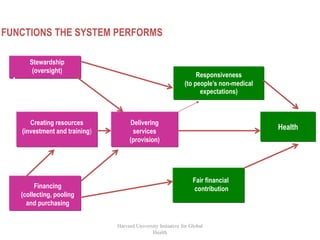
(oversight)
Financing
(collecting, pooling
and purchasing
FUNCTIONS THE SYSTEM PERFORMS GOALS / OUTCOMES OF
THE SYSTEM
Health
Fair financial
contribution
Responsiveness
(to peopleโ€™s non-medical
expectations)
Creating resources
(investment and training)
Delivering
services
(provision)
Stewardship
โ€ข The careful and responsible management of
the well-being of the population.
โ€ข Responsibility of government working with a
wide range of partners.
โ€ข Stewardship does not necessarily mean direct
provision of services but influencing the
behaviour of health system actors, public and
private.
Harvard University Initiative for Global
Health
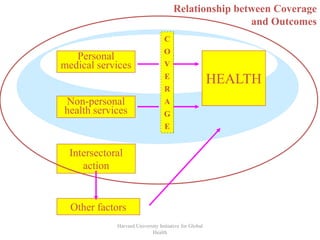
Relationship between Coverage
and Outcomes
Intersectoral
action
Other factors
Non-personal
health services
Personal
medical services
C
O
V
E
R
A
G
E
HEALTH
Stewardship
โ€ข The careful and responsible management of
the well-being of the population.
โ€ข Responsibility of government working with a
wide range of partners.
โ€ข Stewardship does not necessarily mean direct
provision of services but influencing the
behaviour of health system actors, public and
private.
Health System Effective Coverage
โ€ข Fraction of potential health gain that could be
delivered by the health system that is
delivered.
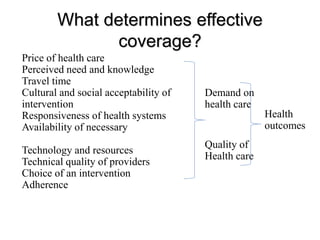
What determines effective
coverage?
Price of health care
Perceived need and knowledge
Travel time
Cultural and social acceptability of
intervention
Responsiveness of health systems
Availability of necessary
Technology and resources
Technical quality of providers
Choice of an intervention
Adherence
Demand on
health care
Quality of
Health care
Health
outcomes
Consideration of cross-
cutting issues:
How can funding from the Global
Fund contribute towards
strengthening health systems?
What happens if investments are not
based on a sound national health plan
โ€ข Extra burden on government to manage many
partners
โ€ข Creation of complexity in systems and
procedures
โ€ข Distortion of incentive systems and undermining
of government leadership
โ€ข Unbalanced investment
โ€ข Fragmented funding and/or funding
outside the national budget and plan
โ€ข Undermines government capacity
โ€ข too many proposals,
โ€ข too many meetings,
โ€ข too many monitoring demands
โ€ข Duplication of services and supplies
โ€“ or even competition between
projects and donors
โ€ข Waste of scarce
resources
โ€ข Inefficient use of
funds
โ€ข Lack of country
leadership and
ownership
Why we need health financing
Health systems strengthening (HSS) in
Global Fund Strategy 2012-2016
Maximizing effectiveness of Global Fund
investments in HSS with the following priorities:
โ€ขStrategic targeting of HSS investments towards
most-in-need countries and high-impact HSS
interventions
โ€ขBetter alignment, harmonization, and tracking of
HSS outcomes and impact
โ€ขExplicit provision for community systems
strengthening
Concept of health financing
Three serious questions:
โ€ข Is a nation spending a reasonable amount for its health?
โ€ข Does a nation have the capacity to transform money in to
effective services for the rural poor population?
โ€ข Can out-of-pocket resources be mobilized and organized so they
will be used in a efficient and effective way?
Concept
One of our colleagues, a health workers like nurse, Public
health Officer talks about the area of healthcare finance as โ€œa
method of getting money in and out of the business.โ€ It is not a
bad description. As we shall see, rev-venues represent inflow
and expenses represent outflow. Thus, โ€œgetting money inโ€
represents the inflow (revenues), whereas โ€œgetting money outโ€
(expenses) represents the outflow.
Definition
Health care financing means the approaches to mobilize fund for
health care. According to this definition, health care financing is
a means to an end; an instruments chosen to achieve specific
societal goal. Financing means from where comes and where
money it goes. The approach to generate and mobilize funds for
health care.
What are the features of good health financing?
โ€ข Sufficient funding to provide for the health care need of the
community
โ€ข Process of redistribution ( rich contribute to poor)
โ€ข Each person makes a fair contribution.
โ€ข The community is able to prevent health care costs using up an
excessive proportion of the government budget.
Components for health care financing? The flow of funds for
health care system consists of three basic components
1.Financing function: It includes the collection and
pooling of revenues and their use by allocating
resources or purchasing services from providers.
2.Input generate function : it includes the production ,
import , export , distribution, retail of human resources,
knowledge , pharmaceuticals , medicals equipment ,
other consumables and capital
3.Service delivery function: It includes both population
based public health services and clinical services
through public and private facilities.
Why is health care financing an important subject?
Philosophical reasons:
โ€ข Egalitarian point of view:
โ€ข Fundamental necessity for human well-beings.
โ€ข Emphasis on equity
โ€ข Efficient approach to mobilize the necessary fund for every citizenโ€™s health care.
Policy Reason:
โ€ข Determine resources flows, distribution of resources and incentive structures for
health providers.
โ€ข Control and manage health care cost inflation.
โ€ข Reduce financial burden of the government by covering through insurance and old age
pension to senior people.
โ€ข Increase the access of basis health care services.
โ€ข Assure quality of health care services.
Market failure reason:
โ€ข Motivate the consumers for insurance plan.
โ€ข Develop infrastructure for private insurance like as: uniform accounting procedures
for hospitals, accurate and uniform clinical record system, and computerized claim
auditing procedures
Contd
Macro โ€“environmental reason:
โ€ข Debt burden through stabilization and structural adjustment policy
(devaluation, of currencies reduction in government spending and
implementation of measure to improve public sector efficiency.
Demographic reason:
โ€ข For population management to reduced fertility and growth rate
โ€ข To reduced the dependency ratio.
Epidemiological changes:
โ€ข Reduce morbidity, hospitalization ,accidents and mortality
Social and cultural change: to
โ€ข Managed the demand for health care
โ€ข Improved the access for health care and managed life style
โ€ข Bridge between traditional and modern network.
Importance of health care financing
โ€ข Health care financing has an important role to play in transforming the
health care system into one which provides efficient and effective health
care to poor and vulnerable people in Nepal.
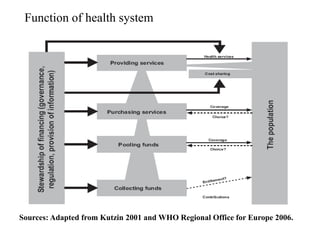
โ€ข The functions of health care financing - the collection of revenue, risk
pooling and purchasing - are all critical to policy design.
โ€ข The function of revenue collection deals with how financial contributions
to the health system are collected from different sources.
โ€ข There are domestic sources and external (or international) sources of
financing for health.
โ€ข Domestic resources, including the collection of contributions and taxes,
finance the majority to health care services. Private spending on health
from households an companies complements these public domestic
resources.
โ€ข External resources, including official development aid as well as foreign
loans and grants, contribute a significant share of total funding for health
care in Nepal.
Sources: Adapted from Kutzin 2001 and WHO Regional Office for Europe 2006.
Function of health system
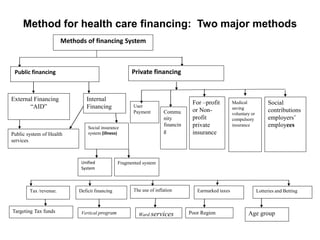
Method for health care financing: Two major methods
Tax /revenue. Deficit financing The use of inflation Earmarked taxes Lotteries and Betting
For โ€“profit
or Non-
profit
private
insurance
Methods of financing System
Public system of Health
services
Social insurance
system (illness)
User
Payment
Public financing Private financing
External Financing
โ€œAIDโ€
Internal
Financing
Unified
System
Fragmented system
Medical
saving
voluntary or
compulsory
insurance
Social
contributions
employersโ€™
employees
Commu
nity
financin
g
Targeting Tax funds Vertical program Ward services Poor Region Age group
Methods of Health care financing
1 Government financing / revenue
General tax, (targeting tax funds through the vertical program, and
by increasing facilities like as door to door services)
โ€ข By adjusting inflation rate (Persistence increases in the general level of
price)
โ€ข Embarked tax ( particular tax for health care e.g alcohol, tobacco, and
cares)
โ€ข Enhance the equity of health care system through insurance plan
โ€ข Insurance ( social and private)
2. Health Insurance ( Social and private insurance)
โ€ข Health insurance is stable source of health care financing.
โ€ข Health insurances serves two principle functions โ€“for economics welfare
of nations
(a) Insurance pools together the financial risks facing a large group of
people.-(risk sharing)
(b) Insurance enables individuals to transfer their risks to an insurance plan.
3.User fees : patients pay a fee to the provider at the point of service use
six ways to increase user fees:
โ€ข Make an effort to explain medical charge to patients,
โ€ข To motivate health facility staff to administrator and collect fees,
โ€ข To set up systematic collection procedures to improve hospital cost
โ€“recovery rates,
โ€ข structures prices so that patients believes they are receiving value
their money ,
โ€ข Adjust user fees for inflation and invest revenue appropriately
โ€ข Permit alternative forms of payment for low income household)

Health system and financing

  • 1.
  • 2.
    WHO Definition ofHealth System Health system: All actors, institutions and resources that undertake health actions. Health actions: all actions whose primary intent is to improve health.
  • 3.
    Primary Intent Not allpolicies and actions that have an important influence on health, such as educating young girls or poverty reduction programs, are part of the health system according to this definition. A wide range of actions targeting individuals and communities would meet this definition: from surgery to campaigns to raise tobacco taxes to random breath testing for drunk driving.
  • 4.
    Social Goals toWhich Health Systems Contribute Societies collectively have many goals such as raising purchasing power, reducing poverty, raising educational levels, ensuring democratic participation and improving health. Health systems can positively or negatively affect many social goals. Likewise, many social systems such as education can have a positive or negative impact on health.
  • 5.
    Harvard University Initiativefor Global Health Stewardship (oversight) Financing (collecting, pooling and purchasing FUNCTIONS THE SYSTEM PERFORMS GOALS / OUTCOMES OF THE SYSTEM Health Fair financial contribution Responsiveness (to peopleโ€™s non-medical expectations) Creating resources (investment and training) Delivering services (provision)
  • 6.
    Stewardship โ€ข The carefuland responsible management of the well-being of the population. โ€ข Responsibility of government working with a wide range of partners. โ€ข Stewardship does not necessarily mean direct provision of services but influencing the behaviour of health system actors, public and private.
  • 7.
    Harvard University Initiativefor Global Health Relationship between Coverage and Outcomes Intersectoral action Other factors Non-personal health services Personal medical services C O V E R A G E HEALTH
  • 8.
    Stewardship โ€ข The carefuland responsible management of the well-being of the population. โ€ข Responsibility of government working with a wide range of partners. โ€ข Stewardship does not necessarily mean direct provision of services but influencing the behaviour of health system actors, public and private.
  • 9.
    Health System EffectiveCoverage โ€ข Fraction of potential health gain that could be delivered by the health system that is delivered.
  • 10.
    What determines effective coverage? Priceof health care Perceived need and knowledge Travel time Cultural and social acceptability of intervention Responsiveness of health systems Availability of necessary Technology and resources Technical quality of providers Choice of an intervention Adherence Demand on health care Quality of Health care Health outcomes
  • 11.
    Consideration of cross- cuttingissues: How can funding from the Global Fund contribute towards strengthening health systems?
  • 12.
    What happens ifinvestments are not based on a sound national health plan โ€ข Extra burden on government to manage many partners โ€ข Creation of complexity in systems and procedures โ€ข Distortion of incentive systems and undermining of government leadership โ€ข Unbalanced investment
  • 13.
    โ€ข Fragmented fundingand/or funding outside the national budget and plan โ€ข Undermines government capacity โ€ข too many proposals, โ€ข too many meetings, โ€ข too many monitoring demands โ€ข Duplication of services and supplies โ€“ or even competition between projects and donors โ€ข Waste of scarce resources โ€ข Inefficient use of funds โ€ข Lack of country leadership and ownership Why we need health financing
  • 14.
    Health systems strengthening(HSS) in Global Fund Strategy 2012-2016 Maximizing effectiveness of Global Fund investments in HSS with the following priorities: โ€ขStrategic targeting of HSS investments towards most-in-need countries and high-impact HSS interventions โ€ขBetter alignment, harmonization, and tracking of HSS outcomes and impact โ€ขExplicit provision for community systems strengthening
  • 15.
    Concept of healthfinancing Three serious questions: โ€ข Is a nation spending a reasonable amount for its health? โ€ข Does a nation have the capacity to transform money in to effective services for the rural poor population? โ€ข Can out-of-pocket resources be mobilized and organized so they will be used in a efficient and effective way? Concept One of our colleagues, a health workers like nurse, Public health Officer talks about the area of healthcare finance as โ€œa method of getting money in and out of the business.โ€ It is not a bad description. As we shall see, rev-venues represent inflow and expenses represent outflow. Thus, โ€œgetting money inโ€ represents the inflow (revenues), whereas โ€œgetting money outโ€ (expenses) represents the outflow.
  • 16.
    Definition Health care financingmeans the approaches to mobilize fund for health care. According to this definition, health care financing is a means to an end; an instruments chosen to achieve specific societal goal. Financing means from where comes and where money it goes. The approach to generate and mobilize funds for health care. What are the features of good health financing? โ€ข Sufficient funding to provide for the health care need of the community โ€ข Process of redistribution ( rich contribute to poor) โ€ข Each person makes a fair contribution. โ€ข The community is able to prevent health care costs using up an excessive proportion of the government budget.
  • 17.
    Components for healthcare financing? The flow of funds for health care system consists of three basic components 1.Financing function: It includes the collection and pooling of revenues and their use by allocating resources or purchasing services from providers. 2.Input generate function : it includes the production , import , export , distribution, retail of human resources, knowledge , pharmaceuticals , medicals equipment , other consumables and capital 3.Service delivery function: It includes both population based public health services and clinical services through public and private facilities.
  • 18.
    Why is healthcare financing an important subject? Philosophical reasons: โ€ข Egalitarian point of view: โ€ข Fundamental necessity for human well-beings. โ€ข Emphasis on equity โ€ข Efficient approach to mobilize the necessary fund for every citizenโ€™s health care. Policy Reason: โ€ข Determine resources flows, distribution of resources and incentive structures for health providers. โ€ข Control and manage health care cost inflation. โ€ข Reduce financial burden of the government by covering through insurance and old age pension to senior people. โ€ข Increase the access of basis health care services. โ€ข Assure quality of health care services. Market failure reason: โ€ข Motivate the consumers for insurance plan. โ€ข Develop infrastructure for private insurance like as: uniform accounting procedures for hospitals, accurate and uniform clinical record system, and computerized claim auditing procedures
  • 19.
    Contd Macro โ€“environmental reason: โ€ขDebt burden through stabilization and structural adjustment policy (devaluation, of currencies reduction in government spending and implementation of measure to improve public sector efficiency. Demographic reason: โ€ข For population management to reduced fertility and growth rate โ€ข To reduced the dependency ratio. Epidemiological changes: โ€ข Reduce morbidity, hospitalization ,accidents and mortality Social and cultural change: to โ€ข Managed the demand for health care โ€ข Improved the access for health care and managed life style โ€ข Bridge between traditional and modern network.
  • 20.
    Importance of healthcare financing โ€ข Health care financing has an important role to play in transforming the health care system into one which provides efficient and effective health care to poor and vulnerable people in Nepal. โ€ข The functions of health care financing - the collection of revenue, risk pooling and purchasing - are all critical to policy design. โ€ข The function of revenue collection deals with how financial contributions to the health system are collected from different sources. โ€ข There are domestic sources and external (or international) sources of financing for health. โ€ข Domestic resources, including the collection of contributions and taxes, finance the majority to health care services. Private spending on health from households an companies complements these public domestic resources. โ€ข External resources, including official development aid as well as foreign loans and grants, contribute a significant share of total funding for health care in Nepal.
  • 21.
    Sources: Adapted fromKutzin 2001 and WHO Regional Office for Europe 2006. Function of health system
  • 22.
    Method for healthcare financing: Two major methods Tax /revenue. Deficit financing The use of inflation Earmarked taxes Lotteries and Betting For โ€“profit or Non- profit private insurance Methods of financing System Public system of Health services Social insurance system (illness) User Payment Public financing Private financing External Financing โ€œAIDโ€ Internal Financing Unified System Fragmented system Medical saving voluntary or compulsory insurance Social contributions employersโ€™ employees Commu nity financin g Targeting Tax funds Vertical program Ward services Poor Region Age group
  • 23.
    Methods of Healthcare financing 1 Government financing / revenue General tax, (targeting tax funds through the vertical program, and by increasing facilities like as door to door services) โ€ข By adjusting inflation rate (Persistence increases in the general level of price) โ€ข Embarked tax ( particular tax for health care e.g alcohol, tobacco, and cares) โ€ข Enhance the equity of health care system through insurance plan โ€ข Insurance ( social and private) 2. Health Insurance ( Social and private insurance) โ€ข Health insurance is stable source of health care financing. โ€ข Health insurances serves two principle functions โ€“for economics welfare of nations (a) Insurance pools together the financial risks facing a large group of people.-(risk sharing) (b) Insurance enables individuals to transfer their risks to an insurance plan.
  • 24.
    3.User fees :patients pay a fee to the provider at the point of service use six ways to increase user fees: โ€ข Make an effort to explain medical charge to patients, โ€ข To motivate health facility staff to administrator and collect fees, โ€ข To set up systematic collection procedures to improve hospital cost โ€“recovery rates, โ€ข structures prices so that patients believes they are receiving value their money , โ€ข Adjust user fees for inflation and invest revenue appropriately โ€ข Permit alternative forms of payment for low income household)