‘Human subjects in research must be
protected’:
Joost Groot Kormelink, HREC
Jan. 2019
Human research ethics has developed in both
theory and practice from experiences in medical
research
Helsinki declaration 1964
The subject's welfare must always take
precedence over the interests of science
and society and ethical considerations must
always take precedence over laws and
regulations
Mandate HREC (IRB) TU Delft
• Check all research by staff and students that
includes involvement of Humans (during experiments
and/or data collection) for ethical issues, e.g.:
 Informed consent
 Data & privacy issues
 Safety equipment (certification)
Additional safeguards:
 Participation vulnerable group's (including children)
 Medical experiments
 Experiments which involve own students
 Experiments based on deception
Also students have to apply IC principle
IC-form must:
• Clearly state the purpose and benefits of the
research/study without jargon
• Include any foreseeable risk and discomfort
• Describe how data will be secured, including
privacy issues and procedures for data
withdrawal
• Clearly state that participation is voluntary
and that withdrawal will not result in any
negative consequences.
• Formalization depends on type of research
Data collection:
• Convert methods
• Access
• Anonymization
• Storage
• Privacy
• Alignment with GDPR , i.e. when sensitive info is
involved
What do we check: Data
Important for HRE:
• Whether any personal information about the participant will be collected,
processed and stored and how long this will be stored;
• Right to of the participant to request access, rectification or erasure of personal
data
• Procedures for safeguarding personal information, maintaining confidentiality and
de-identifying (anonymising) data, especially in relation to data archiving and
reuse maintaining confidentiality of information
• Future publishing, archiving and reuse of the data
Data stewards can always advise, i.e. in complicated situations. Jurisdiction is still
needed
New GDPR: stricter rules for privacy and secure
data storage!
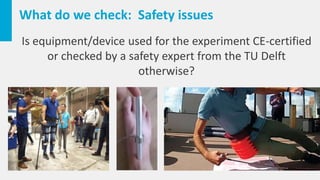
What do we check: Safety issues
Is equipment/device used for the experiment CE-certified
or checked by a safety expert from the TU Delft
otherwise?
What we expect from teachers
• Make students aware of the regulations
• Course related research: only Minimal Risk
• BSc and MSc thesis: let students ask for advice for difficult
cases
• Report databreaches/violations
Special cases: students should seek advice!
• Medical experiments
• Deception (Social software, cybersecurity)
• Vulnerable people (children, subordinate position)
Examples..
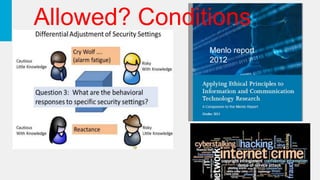
Menlo report
2012
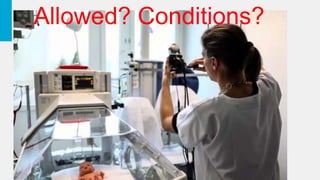
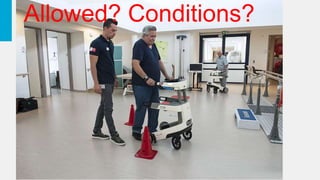
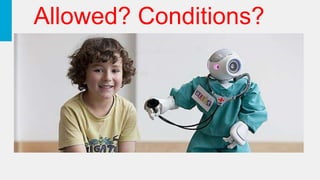
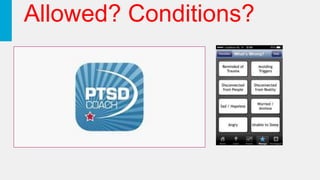
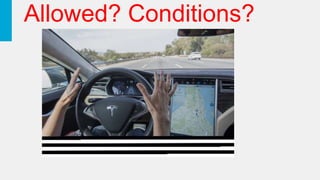
Allowed? Conditions
Allowed? Conditions?

Human Research Ethics: guidelines for students

  • 1.
    ‘Human subjects inresearch must be protected’: Joost Groot Kormelink, HREC Jan. 2019
  • 2.
    Human research ethicshas developed in both theory and practice from experiences in medical research
  • 3.
    Helsinki declaration 1964 Thesubject's welfare must always take precedence over the interests of science and society and ethical considerations must always take precedence over laws and regulations
  • 4.
    Mandate HREC (IRB)TU Delft • Check all research by staff and students that includes involvement of Humans (during experiments and/or data collection) for ethical issues, e.g.:  Informed consent  Data & privacy issues  Safety equipment (certification) Additional safeguards:  Participation vulnerable group's (including children)  Medical experiments  Experiments which involve own students  Experiments based on deception
  • 5.
    Also students haveto apply IC principle IC-form must: • Clearly state the purpose and benefits of the research/study without jargon • Include any foreseeable risk and discomfort • Describe how data will be secured, including privacy issues and procedures for data withdrawal • Clearly state that participation is voluntary and that withdrawal will not result in any negative consequences. • Formalization depends on type of research
  • 6.
    Data collection: • Convertmethods • Access • Anonymization • Storage • Privacy • Alignment with GDPR , i.e. when sensitive info is involved What do we check: Data
  • 7.
    Important for HRE: •Whether any personal information about the participant will be collected, processed and stored and how long this will be stored; • Right to of the participant to request access, rectification or erasure of personal data • Procedures for safeguarding personal information, maintaining confidentiality and de-identifying (anonymising) data, especially in relation to data archiving and reuse maintaining confidentiality of information • Future publishing, archiving and reuse of the data Data stewards can always advise, i.e. in complicated situations. Jurisdiction is still needed New GDPR: stricter rules for privacy and secure data storage!
  • 8.
    What do wecheck: Safety issues Is equipment/device used for the experiment CE-certified or checked by a safety expert from the TU Delft otherwise?
  • 9.
    What we expectfrom teachers • Make students aware of the regulations • Course related research: only Minimal Risk • BSc and MSc thesis: let students ask for advice for difficult cases • Report databreaches/violations
  • 10.
    Special cases: studentsshould seek advice! • Medical experiments • Deception (Social software, cybersecurity) • Vulnerable people (children, subordinate position) Examples..
  • 11.
  • 12.
  • 13.
  • 14.
  • 15.
  • 16.

Editor's Notes

  • #4 https://www.flickr.com/photos/desiitaly/2201907500/
  • #5 https://www.flickr.com/photos/desiitaly/2201907500/
  • #7 http://en.wikipedia.org/wiki/Closed-circuit_television#mediaviewer/File:Three_Surveillance_cameras.jpg
  • #8 http://en.wikipedia.org/wiki/Closed-circuit_television#mediaviewer/File:Three_Surveillance_cameras.jpg
  • #9 https://www.flickr.com/photos/desiitaly/2201907500/