Human Geography
Group 1
IX- Krypton
Created by Roiden Fredrich M. Fernandez
What is Human Geography?
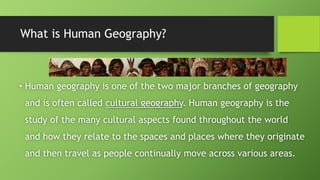
• Human geography is one of the two major branches of geography
and is often called cultural geography. Human geography is the
study of the many cultural aspects found throughout the world
and how they relate to the spaces and places where they originate
and then travel as people continually move across various areas.
What is Human Geography?
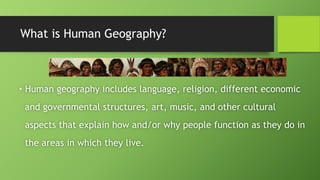
• Human geography includes language, religion, different economic
and governmental structures, art, music, and other cultural
aspects that explain how and/or why people function as they do in
the areas in which they live.
Religion
Human Geography
Religion
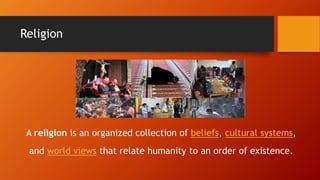
A religion is an organized collection of beliefs, cultural systems,
and world views that relate humanity to an order of existence.
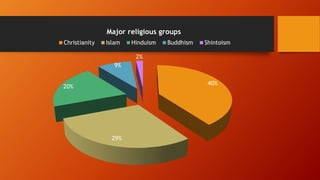
40%
29%
20%
9%
2%
Major religious groups
Christianity Islam Hinduism Buddhism Shintoism
Economic Systems
Human Geography
What is Economic System?
An economic system is a system of production and distribution of
goods and services as well as allocation of resources in a society. It
includes the combination of the various institutions, agencies,
entities (or even sectors as described by some authors) and
consumers that comprise the economic structure of a given
community. A related concept is the mode of production.
Traditional Economic System
The work that people do, the goods and services they provide, how they
use and exchange resources… all tend to follow long-established
patterns. These economic systems are not very dynamic—things don’t
change very much. Standards of living are static; individuals don’t enjoy
much financial or occupational mobility. But economic behaviors and
relationships are predictable. You know what you are supposed to do,
who you trade with, and what to expect from others.
Command Economic System
The government controls the economy. The state decides how to use
and distribute resources. The government regulates prices and wages; it
may even determine what sorts of work individuals do. Socialism is a
type of command economic system. Historically, the government has
assumed varying degrees of control over the economy in socialist
countries. In some, only major industries have been subjected to
government management; in others, the government has exercised far
more extensive control over the economy.
Market Economies
The economic decisions are made by individuals. The unfettered
interaction of individuals and companies in the marketplace determines
how resources are allocated and goods are distributed. Individuals
choose how to invest their personal resources—what training to pursue,
what jobs to take, what goods or services to produce. And individuals
decide what to consume. Within a pure market economy the
government is entirely absent from economic affairs.
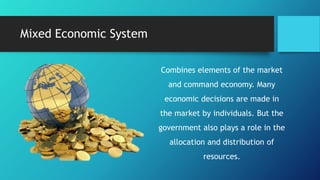
Mixed Economic System
Combines elements of the market
and command economy. Many
economic decisions are made in
the market by individuals. But the
government also plays a role in the
allocation and distribution of
resources.
Goverment
Human Geography
Government
A government is the system by which a state or community
is governed
Social Classes
Human Geography
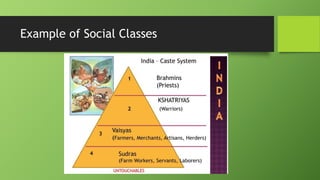
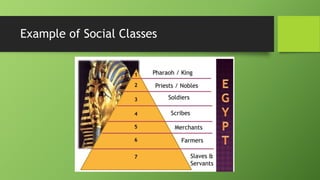
What is Social Classes
• Social class (or simply "class"), as in a class society, is a set
of concepts in the social sciences and political
theory centered on models of social stratification in which
people are grouped into a set of hierarchical social
categories,[1] the most common being the upper, middle, and
lower classes.
Example of Social Classes
Languages
Human Geography
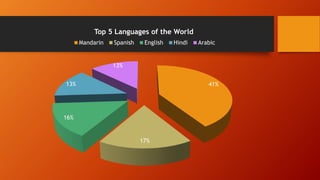
Language
Language is the human capacity for acquiring and using complex
systems of communication, and a language is any specific example
of such a system. The scientific study of language is
called linguistics.
41%
17%
16%
13%
13%
Top 5 Languages of the World
Mandarin Spanish English Hindi Arabic
Music
Human Geography
Music
Music is an art form whose medium is sound and silence. Its
common elements are pitch (which
governs melody and harmony),rhythm (and its associated
concepts tempo, meter, and articulation), dynamics, and the
sonic qualities of timbre and texture.

Human Geography

  • 1.
    Human Geography Group 1 IX-Krypton Created by Roiden Fredrich M. Fernandez
  • 2.
    What is HumanGeography? • Human geography is one of the two major branches of geography and is often called cultural geography. Human geography is the study of the many cultural aspects found throughout the world and how they relate to the spaces and places where they originate and then travel as people continually move across various areas.
  • 3.
    What is HumanGeography? • Human geography includes language, religion, different economic and governmental structures, art, music, and other cultural aspects that explain how and/or why people function as they do in the areas in which they live.
  • 4.
  • 5.
    Religion A religion isan organized collection of beliefs, cultural systems, and world views that relate humanity to an order of existence.
  • 6.
  • 7.
  • 8.
    What is EconomicSystem? An economic system is a system of production and distribution of goods and services as well as allocation of resources in a society. It includes the combination of the various institutions, agencies, entities (or even sectors as described by some authors) and consumers that comprise the economic structure of a given community. A related concept is the mode of production.
  • 9.
    Traditional Economic System Thework that people do, the goods and services they provide, how they use and exchange resources… all tend to follow long-established patterns. These economic systems are not very dynamic—things don’t change very much. Standards of living are static; individuals don’t enjoy much financial or occupational mobility. But economic behaviors and relationships are predictable. You know what you are supposed to do, who you trade with, and what to expect from others.
  • 10.
    Command Economic System Thegovernment controls the economy. The state decides how to use and distribute resources. The government regulates prices and wages; it may even determine what sorts of work individuals do. Socialism is a type of command economic system. Historically, the government has assumed varying degrees of control over the economy in socialist countries. In some, only major industries have been subjected to government management; in others, the government has exercised far more extensive control over the economy.
  • 11.
    Market Economies The economicdecisions are made by individuals. The unfettered interaction of individuals and companies in the marketplace determines how resources are allocated and goods are distributed. Individuals choose how to invest their personal resources—what training to pursue, what jobs to take, what goods or services to produce. And individuals decide what to consume. Within a pure market economy the government is entirely absent from economic affairs.
  • 12.
    Mixed Economic System Combineselements of the market and command economy. Many economic decisions are made in the market by individuals. But the government also plays a role in the allocation and distribution of resources.
  • 13.
  • 14.
    Government A government isthe system by which a state or community is governed
  • 15.
  • 16.
    What is SocialClasses • Social class (or simply "class"), as in a class society, is a set of concepts in the social sciences and political theory centered on models of social stratification in which people are grouped into a set of hierarchical social categories,[1] the most common being the upper, middle, and lower classes.
  • 17.
  • 18.
  • 19.
  • 20.
    Language Language is thehuman capacity for acquiring and using complex systems of communication, and a language is any specific example of such a system. The scientific study of language is called linguistics.
  • 21.
    41% 17% 16% 13% 13% Top 5 Languagesof the World Mandarin Spanish English Hindi Arabic
  • 22.
  • 23.
    Music Music is anart form whose medium is sound and silence. Its common elements are pitch (which governs melody and harmony),rhythm (and its associated concepts tempo, meter, and articulation), dynamics, and the sonic qualities of timbre and texture.

Editor's Notes