Mapping Race Critical Approaches To Health Disparities Research
Mapping Race Critical Approaches To Health Disparities Research
Mapping Race Critical Approaches To Health Disparities Research
Mapping Race Critical Approaches To Health Disparities Research
Mapping Race Critical Approaches To Health Disparities Research
1.
Mapping Race CriticalApproaches To Health
Disparities Research download
https://ebookbell.com/product/mapping-race-critical-approaches-
to-health-disparities-research-51902676
Explore and download more ebooks at ebookbell.com
2.
Here are somerecommended products that we believe you will be
interested in. You can click the link to download.
Mapping Race Critical Approaches To Health Disparities Research 1st
Laura E Gmez Ed
https://ebookbell.com/product/mapping-race-critical-approaches-to-
health-disparities-research-1st-laura-e-gmez-ed-5207600
Critical Race Spatial Analysis Mapping To Understand And Address
Educational Inequity 1st Edition Deb Morrison Subini Ancy Annamma
Darrell D Jackson
https://ebookbell.com/product/critical-race-spatial-analysis-mapping-
to-understand-and-address-educational-inequity-1st-edition-deb-
morrison-subini-ancy-annamma-darrell-d-jackson-51607032
Mapping The New African Diaspora In China Race And The Cultural
Politics Of Belonging Shanshan Lan
https://ebookbell.com/product/mapping-the-new-african-diaspora-in-
china-race-and-the-cultural-politics-of-belonging-shanshan-lan-7018438
Discourses Of Race And Rising China Mapping Global Racisms 1st Ed 2019
Cheng
https://ebookbell.com/product/discourses-of-race-and-rising-china-
mapping-global-racisms-1st-ed-2019-cheng-55522354
3.
Mapping Human HistoryGenes Race And Our Common Origins Steve Olson
Olson
https://ebookbell.com/product/mapping-human-history-genes-race-and-
our-common-origins-steve-olson-olson-27033110
Divine Regeneration And Ethnic Identity In 1 Peter Mapping Metaphors
Of Family Race And Nation Society For New Testament Studies Monograph
Series Vol 180 Katie Marcar
https://ebookbell.com/product/divine-regeneration-and-ethnic-identity-
in-1-peter-mapping-metaphors-of-family-race-and-nation-society-for-
new-testament-studies-monograph-series-vol-180-katie-marcar-50258208
Saturation Race Art And The Circulation Of Value Illustrated C Riley
Snorton Editor
https://ebookbell.com/product/saturation-race-art-and-the-circulation-
of-value-illustrated-c-riley-snorton-editor-44912146
Critical Race Media Literacy Themes And Strategies For Media Education
Jayne Cubbage
https://ebookbell.com/product/critical-race-media-literacy-themes-and-
strategies-for-media-education-jayne-cubbage-46240574
Fractured Race Class Gender And The Hatred Of Identity Politics 1st
Edition Richmond Michael
https://ebookbell.com/product/fractured-race-class-gender-and-the-
hatred-of-identity-politics-1st-edition-richmond-michael-46642916
Critical Issues inHealth and Medicine
Edited by Rima D. Apple, University of Wisconsin–
Madison,
and Janet Golden, Rutgers University, Camden
Growing criticism of the U.S. health care system is coming from consumers,
politicians, the media, activists, and healthcare professionals. Critical Issues in
Health and Medicine is a collection of books that explores these contemporary
dilemmas from a variety of perspectives, among them political, legal, histori-
cal, sociological, and comparative, and with attention to crucial dimensions
such as race, gender, ethnicity, sexuality, and culture.
For a list of titles in the series, see the last page of the book.
7.
Rutgers University Press
NewBrunswick, New Jersey, and London
Edited by
Laura E. Gómez and Nancy López
Mapping “Race”
Critical Approaches to Health
Disparities Research
v
List of Figuresand Tables vii
Foreword ix
R. Burciaga Valdez
Preface xiii
Chapter 1 Introduction: Taking the Social Construction of Race
Seriously in Health Disparities Research 1
Laura E. Gómez
Part I Charting the Problem 23
Chapter 2 The Politics of Framing Health Disparities:
Markets and Justice 25
Jonathan Kahn
Chapter 3 Looking at the World through “Race”-
Colored Glasses:
The Fallacy of Ascertainment Bias in Biomedical
Research and Practice 39
Joseph L. Graves Jr.
Chapter 4 Ethical Dilemmas in Statistical Practice:
The Problem of Race in Biomedicine 53
Jay S. Kaufman
Chapter 5 A Holistic Alternative to Current Survey Research
Approaches to Race 67
John A. Garcia
Part II Navigating Diverse Empirical Settings 85
Chapter 6 Organizational Practice and Social Constraints:
Problems of Racial Identity Data Collection in
Cancer Care and Research 87
Simon J. Craddock Lee
Contents
10.
vi Contents
Chapter 7Lessons from Political Science: Health
Status and Improving How We Study Race 104
Gabriel R. Sanchez and Vickie D. Ybarra
Chapter 8 Advancing Asian American Mental Health
Research by Enhancing Racial Identity Measures 117
Derek Kenji Iwamoto, Mai M. Kindaichi,
and Matthew Miller
Part III Surveying Solutions 131
Chapter 9 Representing the Multidimensionality
of Race in Survey Research 133
Aliya Saperstein
Chapter 10 How Racial-
Group Comparisons Create Misinformation
in Depression Research: Using Racial Identity Theory to
Conceptualize Health Disparities 146
Janet E. Helms and Ethan H. Mereish
Chapter 11 Jedi Public Health: Leveraging Contingencies of Social
Identity to Grasp and Eliminate Racial Health Inequality 163
Arline T. Geronimus
Chapter 12 Contextualizing Lived Race-
Gender and the Racialized-
Gendered Social Determinants of Health 179
Nancy López
Notes on Contributors 213
Index 217
11.
vii
Figures andTables
Figures
3.1 Age-
SpecificMortality, Selected Years (1963–
2004),
Black/White Americans 40
4.1 Mary Gets a Score of 100 on a Verbal Ability Test 62
6.1 Conceptual Schematic of Identity Data Collection in a Cancer
Service Line 99
12.1 Multidimensional “Race” Data at the Individual, Micro-level 192
12.2 Multidimensional Ethnicity as Distinct from “Race” 198
12.3 Racialized and Gendered Social Determinants of Health:
Multilevel “Race” Data at the Micro-
, Meso-
, and Macro-
levels 200
Tables
3.1 Life of Homo sapiens Condensed into a Calendar Year 46
5.1 Heuristic Chart of Holistic Race Measures 70
6.1 Initial Draft Policy Categories 92
7.1 Determinants of Health Status among Full/Latino Sample
(Ordered Logistic Regression) 111
8.1 PRIAS-
15 and PRIAS-
12 Items Derived from Confirmatory
Factor Analysis on the Original PRIAS 122
8.2 Multiple Regression Using the PRIAS, PRIAS-
15, and
PRIAS-
12 Measures as Predictors and Psychological
Well-
Being as the Outcome 123
10.1 Some Examples of Risk Factors Used as Proxies for Race in
Depression Research 150
10.2 Racial Identity Schemas for People of Color and White People 156
13.
ix
Foreword
In 2008, theNational Institutes of Health hosted over five thousand scholars
at its first Science of Eliminating Health Disparities Summit. The subsequent
annual summits were designed to encourage integration of science, practice,
and policy to build a healthier society. As the opening plenary keynote speaker
for the first one, I was asked to address “Health Disparities and the Intersection
of Science and Policy.” I deliberately anchored my talk in an explanation of
health disparities as a reflection of social stratification and inequitable resource
allocations along “racial” and “ethnic” lines. But what do we mean by “racial”
and “ethnic” lines?
The scholars in this volume challenge us to be more precise about how we
define and operationalize this type of stratification. Why? Because individuals
are born into our society that neither treats people nor distributes opportunity
equally. We observe discrimination, poverty, and other forms of oppression
play out at the community level affecting overall community environment and
opportunities. Especially in resource-
poor communities, the stresses of daily
life bear down on the minds and bodies of residents, inviting illness through
environmental exposures and other types of stress that are expressed biologi-
cally in what we recognize as disease.
While Congress has required documenting these “racial” and “ethnic” dis-
parities annually by the Agency for Health Research and Quality, it has done
little to remedy the situation. Over the last few years, private philanthropies,
such as the Robert Wood Johnson Foundation and the California Endowment,
have recognized the need to prevent disparities by addressing the inequities in
our society as well as addressing health care disparities—
creating a more just
society and thus a more healthy nation.
Interdisciplinary research plays an increasingly important role in address-
ing highly complex social issues such as health disparities. It allows schol-
ars to reach beyond the boundaries of their own disciplines and to adapt or
develop new methods of analysis. Institutional policies that support integrat-
ing the social and biological sciences could represent the twenty-
first-
century
breakthrough similar to what we experienced in the twentieth century when
biological and chemical scientists developed the fields of biochemistry, molec-
ular biology, and molecular genetics that led to the sequencing of the human
genome. Supporting interdisciplinary health and social science investigations
14.
x R. BurciagaValdez
and the development of transdisciplinary fields requires our nation’s funding
institutions and universities to be more flexible and open to new ways of see-
ing things. The Institute for the Study of “Race” and Social Justice within the
RWJF Center for Health Policy at the University of New Mexico is one example
of such efforts.
Sequencing the human genome provided definitive proof that there is no
genetic or biological evidence for the concept of “race.” Yet in our society we
often rely on assumptions about “race” that erroneously assume that it is inter-
changeable with genes to explain the world and our understanding of it. Scien-
tists are not immune from using the myth of race as biology in dangerous ways.
When I arrived in New Mexico in 2008, I had the opportunity to participate in
the annual Cancer Center retreat. Researchers shared the marvelous molecu-
lar discoveries brought about by genomic research advances, which offer pros-
pects for innovations in treatment for a wide variety of cancers; however, I was
taken aback when colleagues resorted to explaining statistical propensities for
groups of people in New Mexico using wildly inaccurate racial stereotypes.
These genetic reductionist interpretations of health disparities denied Ameri-
can Indian spiritual beliefs, challenged the history of Hispanic settlement in
the region, and posed findings in ways that could be misinterpreted in policy
implementation.
Despite all the problems inherent in the erroneous assumptions associated
with the concept of “race,” it is imperative that we continue to collect data that
captures the lived experiences and practices that contribute to the racialized
inequality that is reproduced at all levels of society. While some may argue for
a color-
blind society and an end to the collection of “race” or “ethnic” data,
this book deliberately understands “race” as a social construction that can be
mapped vis-
à-
vis legal efforts to eliminate racism in all its forms—
individual,
institutional, and systemic. For example, in the areas of banking and housing
we have largely eliminated public policies restricting groups of people from
living in certain areas; however, informal practices in the mortgage and real
estate industries continue to produce de facto segregation.
Over the last several decades, we have negligently accepted racial catego-
ries in our work without the typical scrutiny we use to define variables for
our analyses. Instead of interrogating and capturing the social construction of
race in our research, we have at times blindly treated race as if it were a static
characteristic that allows for the comparison of the health of different groups
in our society. Or we have misused race as a proxy for many unmeasured fac-
tors in our studies, for example, class or culture, thereby masking what may be
amenable to clinical intervention or social policy intervention.
15.
Foreword xi
It isimportant that a paradigm shift take place in health disparities
research, and Mapping “Race” helps catalyze it. Researchers should depart
from the premise that racial and ethnic identities are fluid in both governmen-
tal and social settings. In order to combat discrimination, in 1976 Congress
created the term “Hispanic” to group together a population that differs enor-
mously by history, nationality, social class, legal status, and generation in the
United States; it has little or no meaning outside of the U.S. political context.
As scholars, scientists, and policy makers, we must challenge ourselves to be
more precise with our categories of analysis and interpretation. The subjective
meaning of such labels and whether they are situationally asserted are open
empirical questions that need to be investigated.
R. Burciaga Valdez
July 2012
17.
xiii
Preface
The story ofhow this book came to exist is somewhat unusual, and thus we
include it here as a way of charting the intellectual genesis of Mapping “Race.”
We intentionally invoke the word “mapping” in the book’s title as a metaphor
to capture the complexity of “race” and to emphasize the need for research-
ers to grapple with that complexity. In early 2010, we received funding from
National Institutes of Health (NIH) National Center on Minority Health and
Health Disparities (NCMHHD) to hold a workshop called “Mapping ‘Race’ and
Inequality: Best Practices for Theorizing and Operationalizing ‘Race’ in Health
Policy Research.”1
Under the auspices of the Institute for the Study of “Race”
and Social Justice at the University of New Mexico, which we co-
founded in
2009 and then co-
directed (2009–
2011), and which López now directs, we con-
vened a group of nineteen scholars for a meeting in Albuquerque held April
29–30, 2011.
The participants in that intensive dialogue included scholars from the
health, social, and biological sciences. They were an almost even mix of schol-
ars whose primary methodological orientation was quantitative analysis versus
those who used mixed methods or purely qualitative methods. Beyond those
parameters, we self-
consciously sought to include scholars who represented
diverse race, gender, and ethnic backgrounds, as well as scholars at varied
career stages. It is from that initial group of nineteen scholars that the contribu-
tors to Mapping “Race” emerged.2
Mapping “Race” has benefitted from the collective excitement and synergy
we experienced leading up to the workshop, during our two-
day meeting, and
in our subsequent conversations. One of the striking things was the degree to
which scholars from different disciplines and different methodological tradi-
tions were vexed about the same phenomenon: the frequent refusal by scholars
doing research on race-
based disparities to explicitly conceptualize (much less
define) “race” and the accompanying problem of how to most effectively opera-
tionalize socially constructed “race.” We were stunned by the similar stories
told by participating scholars in the biological sciences (including biology and
genetics), the medical sciences (including epidemiology, medicine, and pub-
lic health), and the social sciences (including anthropology, political science,
psychology, and sociology) about how existing research in their fields typically
engages race in superficial ways that largely ignores theoretical insights relating
18.
xiv The Editors
toconceptualizing race as socially constructed and, therefore, as historically
contingent, dynamic, and multifaceted.
And yet, while we agreed on the problem, it was not obvious what the
solutions were. Over the course of many conversations, disagreements, and
even heated intellectual exchanges, we pushed each other to identify potential
solutions and to speak across the traditional boundaries that separated us, such
as method, discipline and scientific domain. Mapping “Race” embodies our
progress and signals our desire to take this important conversation to a broader
audience. We hope that it encompasses the voices of the original workshop
participants and the exciting synergy of that collective conversation, as well as
the contributions of the authors whose work has evolved into these chapters.
We are grateful to many people for helping us realize this publication. We
are deeply indebted to the faculty, fellows, administrators, and staff at the Rob-
ert Wood Johnson Foundation (RWJF) Center for Health Policy at UNM. At the
Center, we found a generous intellectual community that welcomed us as rela-
tive outsiders to health research when we began this journey and that encour-
aged our efforts to cross disciplinary, science, and methodological boundaries.
We are especially grateful to Executive Director Robert Valdez for seeing early
promise in our ideas and for supporting us at each step of the way, including
in our working group and speakers’ series and symposium on topics related
to this research.3
Many Center staffpersons played a role in helping us at vari-
ous stages, and we are especially grateful to Lia Abeita-
Sanchez, Lila Chavez,
Sheri Lessanese, Thu Luu, Anita Parmar, Gina Sandoval, Vanessa Tafoya, Maria
Vahtel, and Denise Wallen. Antoinette Maestas was especially helpful, work-
ing closely with us at several different stages. We thank Cirila Estela Vasquez
Guzman, an RWJF Center for Health Policy doctoral fellow in sociology and our
research assistant at the Institute (2010–
2012), for her assistance on multiple
facets of this project. Estela and three other RWJF doctoral fellows contributed
immensely as observers at the NIH workshop: Sonia Bettez (sociology), Yahaira
Pena-
Esparza (psychology), and Vickie Ybarra (political science).
We would also like to thank chairs and staff at the School of Law and in the
Department of Sociology at the University of New Mexico for their assistance
at various stages of this project, including Beverly Burris, Dorothy Esquivel,
David Fricke, Margaret Harrington, Cyndi Johnson, Dona Lewis, Melissa
Lobato, and Richard Santos. We thank our deans at UNM and University of
California, Los Angeles (UCLA) for supporting our research, including Brenda
Claiborne, Rachel Moran, Mark Peceny, and Kevin Washburn. For research
assistance during various stages of this project, we thank librarians and student
assistants at the UNM School of Law and the UCLA School of Law. For help
19.
Preface xv
getting thismanuscript to the final stages of production, we thank Tal Grietzer
and especially Rusty Klibaner at the UCLA School of Law.
It has been a pleasure to work with the editors and staff at Rutgers Univer-
sity Press, and we thank acquisitions editor Peter Mickulas, David Takeuchi
and other reviewers of our manuscript, and the entire staffs in the production
and marketing departments. We are honored that Mapping “Race” is included
in the Rutgers University Press series “Critical Issues in Health and Medicine,”
edited by Rima D. Apple and Janet Golden.
Last, but certainly not least, we thank our families for their love and patience
(and for putting up with too many early mornings, late nights, and weekends
when they expected us to be “free”): Alejandro Gómez, Antonio Gómez, Eloyda
Gómez, Luna Romero, Sierra Romero, Emma Romero and Augustine Romero.
Laura Gómez and Nancy López
July 2012
Notes
1. Funding for the workshop (April 29–
30, 2011) that made this book possible (in part)
was by 1R13MD006054–
01 from the National Center on Minority Health and Health
Disparities (NCMHD), the Agency for Healthcare Research and Quality (AHRQ), and
the Eunice Kennedy Schriver National Institute of Child Health and Human Devel-
opment (NICHD). The views expressed in written conference materials or publica-
tions and by speakers and moderators do not necessarily reflect the official policies
of the Department of Health and Human Services; nor does mention by trade names,
commercial practices, or organizations imply endorsement by the U.S. government.
2. The participating scholars and their institutional affiliations were the following:
John Garcia, University of Michigan; Arline Geronimus, University of Michigan;
Laura Gómez, (then) University of New Mexico; Joseph Gone, University of Michi-
gan; Joseph Graves Jr., North Carolina AT State University and University of North
Carolina, Greensboro; Clarence Gravlee, University of Florida; Janet Helms, Boston
College; Kimberly Huyser, University of New Mexico; Derek Iwamoto, University of
Maryland; Camara Jones, Centers for Disease Control; Jonathan Kahn, Hamline Uni-
versity School of Law; Jay Kaufman, McGill University; Sandra Lee, Stanford Uni-
versity; Simon J. Craddock Lee, University of Texas Southwestern Medical Center;
Nancy López, University of New Mexico; Michael Montoya, University of Califor-
nia, Irvine; Maribel Rodriguez-
Torres, Fundación de Investigación and Universidad
de Ponce; Gabriel Sanchez, University of New Mexico; Aliya Saperstein, (then) Uni-
versity of Oregon.
3. For more information, see Trans-
disciplinary Guidelines for Researching “Race,”
Institute for the Study of Race and Social Justice, RWJF Center for Health Policy,
University of New Mexico, http://healthpolicy.unm.edu/about/initiatives/isrsj, last
accessed July 25, 2012.
1
Laura E. Gómez
Typingthe word “disparities” into the search engine of the American Diabetes
Association web site generates nearly 1,700 hits that relate to racial and/or
ethnic gaps in diabetes rates and care (http://www.diabetes.org, accessed July
5, 2012). Similarly, an agency of the U.S. Health and Human Services Depart-
ment proclaims that the risk of diabetes is “much greater for minority popu-
lations than the white population” (“Diabetes Disparities among Racial and
Ethnic Minorities Fact Sheet” 2012). These warnings reflect multiple biomedi-
cal studies that have identified differential rates of diabetes among Whites (6.2
percent), American Indians (9 percent), Mexican Americans (10.6 percent), and
African Americans (10.8 percent; Mokdad et al. 2000), as well as those that
have reported that some non-White groups have diabetes-related complications
at rates as much as 50 percent higher than Whites (Carter et al. 1996). The temp-
tation is to attribute such disparities to genetic differences because people often
assume that “racial” groups correspond to biological differences. Moreover, in a
capitalist society in which much medical research is driven by pharmaceutical
companies’ pursuit of individualized solutions to health problems (see Kahn,
this volume), we often look for a genetic basis for health outcomes.
Yet much data suggests that the notion of biological race is a poor proxy
for other social dynamics. For example, epidemiologist Thomas LaVeist and
colleagues have challenged the conventional wisdom that differential rates of
diabetes reflect essential, biological differences (2009). They studied diabetes
in a racially mixed Baltimore neighborhood that included large numbers of
both African American and White residents who were of the same socioeco-
nomic class and who had comparable access to healthcare. In contrast to the
Introduction
Taking the Social Construction of Race
Seriously in Health Disparities Research
Chapter 1
24.
2 Laura E.Gómez
government studies previously referenced, they found that African Americans
and Whites in this neighborhood had quite similar rates of diabetes (LaVeist et
al. 2009). “I don’t mean to suggest that genetics play no role in race differences
in health,” LaVeist said, explaining the study’s conclusions, “but before we can
conclude that health disparities are mainly a matter of genetics we need to first
identify a gene, polymorphism or gene mutation that exists in one race group
and not others. And when that gene is found we need to then demonstrate that
that gene is also associated with diabetes. On the other hand, there is [already]
overwhelming evidence that behavior, medical care and the environment are
huge drivers of race differences in health” (“Racial Disparities . . .” 2009). In
other words, looking for race-
based health disparities may at best jump-
start
a productive scientific inquiry when it leads researchers, policy makers,
and health care providers to ask further questions about why race seems to
be important in the context of a specific disease or health problem. But, at
its worst, looking for race-
based health disparities blinds us to seeing the full
range of possible causes of health inequalities.
The broader point that we collectively make in this book goes a step further:
we must be skeptical of claims about race-
based health disparities precisely
because “race” is the product of historically rooted ideas and political contes-
tation (Gómez 2012). Anthropologist Michael Montoya puts it this way: “the
ascertainment of ethnicity or race is a profoundly social enterprise anchored in
contemporary history,” and racial categories, both historically and today, “cor-
respond best to the imaginations of the scientists and not the presumably defin-
ing and stable features being measured” (Montoya 2007). Using the example
of diabetes in his book Making the Mexican Diabetic, Montoya explores how
the process of racializing diabetes—
that is, the process of scientists and health
professionals learning to take for granted that diabetes has a distinct impact
and perhaps even etiology in people of different races—
has occurred in labora-
tories, in government funding circles, in peer-
reviewed scientific publications,
and in the practice of medicine (2011). What explains biomedical researchers’
categorization of humans into groups, and then the linkage of those groups
to specific health problems such as diabetes, is the social process of making
race—
of constituting race as socially, politically, and scientifically important.
Thus, our research agenda must include actively studying this racialization
process; says Montoya: “when we carefully examine the selection of a group to
study, the labeling of that group, the representation of that group in scientific
papers, we see a science of population labeling based squarely on sociocultural
factors particular to each group, each region, and each historical period” (Mon-
toya 2007).
25.
Introduction 3
As thediabetes example shows, there is a thriving literature documenting
what appear to be enduring race-
based health disparities in the United States.
In their comprehensive review of the literature on health disparities, sociologist
David Williams and his colleagues confirm that the long-
standing gap between
health outcomes among Whites and other racial groups has persisted into the
twenty-
first century (2010). In particular, a wide variety of data sources show a
continuing gulf between Whites and Blacks; for example, as a general measure
of health, consider life expectancy. Whites’ life expectancy is 78.3 years, com-
pared to 73.1 years for Blacks, so that it would take another quarter-
century to
close the current White/Black life expectancy gap (Williams et al. 2010, 70).
Similarly, the data show widening contemporary disparities between Native
Americans and Whites (Williams et al. 2010, 74). Although, for a variety of
reasons, the data is more limited than for African Americans and Native Ameri-
cans, other data show that Latinos and Asian Americans have inferior health
outcomes relative to Whites in many categories (Williams et al. 2010, 71).1
To a large extent, the current boom in the study of race-
based health dis-
parities is the result of the process of institutionalizing, at the federal level,
research and data collection along gender and racial lines. Since 1990, Con-
gress has mandated a number of policy changes that have impacted how
biomedical researchers and social scientists study health disparities (C. Lee
2009). For example, in 1990 the National Institutes of Health (NIH) created
the Office of Research on Minority Health (C. Lee 2009, 1185).2
In 1993, when
Congress funded the NIH, it directed the agency to require all grant awardees
to include women of all races and minority men in clinical research (C. Lee
2009, 1185). During the same era, the federal government also created special-
ized departments to explore racial disparities within the Department of Health
and Human Services and the Centers for Disease Control (Abu El-
Haj 2007,
292–
93). Sociologist Stephen Epstein (2007) has documented the fascinating
political context and institutional dynamics that produced these changes, but
no one doubts that these norms have become entrenched in today’s biomedical
research establishment.
If the federal government mandates various types of data collection to
document such gaps and that data show racial gaps in health outcomes, what
is wrong with health disparities research on race? Nothing, so long as that
research is scientifically rigorous and accurate. The purpose of Mapping “Race”
is to improve how health disparities research is conducted by challenging some
central premises. The book’s core argument is that biomedical researchers and
social scientists have not sufficiently grappled with how the conceptualization
of race as socially constructed implicates how we operationalize and analyze
26.
4 Laura E.Gómez
race in health disparities research. Although they represent a variety of disci-
plines across the branches of the medical, biological, and social sciences and
take varied methodological approaches, the authors in this book agree that seri-
ous negative consequences will result if researchers continue to follow the cur-
rent course. Significantly, it is not our claim that research on race or race-
based
health disparities is illegitimate or inappropriate. We align ourselves with
those scholars who have called for more and better research on race and racism
(American Sociological Association 2003), rather than with those who have
argued that the race is too complicated and fraught to be effectively studied
scientifically (American Anthropological Association 1998).
Thinking Critically about Racial Disparities
In order to make the point that researchers must chart a different course, let
us start with an example that seems to be a classic case of a race-
based health
disparity. While White women in Chicago are slightly more likely than Black
women in Chicago to get breast cancer, Black women are twice as likely to die
from it. As legal scholar Dorothy Roberts has noted, what is most shocking
about this fact is that the Black/White gap emerged after 1980, when public
awareness of breast cancer was at an apex and when there were great advances
in detection and treatment (2011, 123). What happened between 1980 and the
turn of the twenty-
first century to widen the gap between White and Black
women’s breast cancer outcomes? If we were to think in narrow terms about
“race,” we might be tempted to explore genetic (or epigenetic) differences as
a symbol of what many people believe to be the biological differences among
racial groups.
A different approach is to think about the social context that produces
racial disparities, which in turn involves thinking about race and racial
dynamics as socially constructed. In Chicago, that means understanding the
difference in access to health care that White and non-
White women typically
receive. When Roberts interviewed Dr. Steven Whitman, whose research first
documented the breast cancer survival disparity, she did so in his office at
Mount Sinai Hospital, which she described as “small and shabby” and with-
out air conditioning. Roberts noted that the hospital is located in “an all-
black
community called North Lawndale on Chicago’s West Side, a block from the
border of South Lawndale, which is predominantly Mexican . . . The patient
population here at Mount Sinai is about half black and half Mexican,” Whit-
man told Roberts (2011, 124). He went on to say that Mount Sinai has, at most,
one day of cash on hand to operate the hospital, compared to Northwestern
University Hospital (located in majority-
White, affluent Evanston, a northern
27.
Introduction 5
suburb ofChicago), which he estimated has four hundred days of cash on
hand (and daily spends $5 to $10 million; Roberts 2011, 125); in the health
care sector, hospitals are rated by bond agencies according to how many days
of cash they have on hand.
Whitman interprets the data as showing that while Black women’s breast
cancer treatment stayed stagnant in the last two decades of the twentieth cen-
tury, White women’s breast cancer prognoses dramatically improved due to early
detection via mammograms and advances in treatment including radiation ther-
apy and new medication regimes (Roberts 2011, 125). Roberts found that Black
neighborhoods in Chicago had few facilities with mammograms (so that women
had to travel long distances to get them, decreasing the likelihood that they
would do so); that public hospitals used older, inferior mammogram equipment
(often lacking both digital technology and trained mammographers); that until
the 2010 Patient Protection and Affordability Act (President Barack Obama’s
healthcare initiative), even middle-
class women with insurance were deterred
from getting mammograms because of high insurance copayments (the 2010
law mandated the elimination of payments for women over age fifty); and that
racially segregated neighborhoods meant that White women more frequently
had access to the best breast cancer treatment facilities, which Whitman said
were usually located in “the fancy institutions—
they are all in white neighbor-
hoods” (2011, 125–
27).
How are we to understand the role of race in the Chicago breast cancer
example? The typical approach is to view race as an individual characteristic.
For example, researchers often speak of self-
identified race, wherein a research
subject selects her or his racial category from a list of limited options (which
almost always correspond to the Office of Management and Budget [OMB] racial
categories, themselves derived from U.S. Census categories). The OMB categories
include “five racial categories (White, Black, American Indian or Alaskan Native,
Asian, and Native Hawaiian and other Pacific Islander) and one ethnic category
(Hispanic),” which most biomedical researchers collapse into six categories of
“self-
identified race” that respondents may choose from among (Williams et al.
2010, 70). When researchers view race as an individual characteristic, they often
fall into the pattern of biologizing race in terms of ancestry or genetics. This in
turn invites the tendency to view health disparities as a question of individual
failure (for less healthy individuals) or individual success (for more healthy indi-
viduals) and to identify solutions to disparities that focus on the individual body,
such as pharmaceutical solutions (see Kahn, this volume).
But Roberts tells a very different story about the racial disparity in breast
cancer survival in Chicago. She urges us to think about how racial discrimination
28.
6 Laura E.Gómez
has structured all sorts of inequalities, including health inequities. In her nar-
rative, the emphasis is on how Chicago’s existing pattern of residential segrega-
tion of African Americans produces tangible gaps at every stage of healthcare.
In a similar way, Williams and colleagues offer a nuanced picture of how neigh-
borhood segregation leads to poor health via six “pathways”:
First, segregation limits socioeconomic mobility by limiting access to
quality elementary and high school education, preparation for higher
education and employment opportunities. Second, the conditions cre-
ated by concentrated poverty and segregation make it more difficult for
residents to adhere to good health practices. . . . Third, the concentration
of poverty can lead to exposure to elevated levels of economic hard-
ship and acute stressors at the individual, household and neighborhood
level. Fourth, the weakened community and neighborhood infrastruc-
ture in segregated areas can also adversely affect interpersonal relation-
ships and trust among neighbors. Fifth, the institutional neglect and
disinvestment in poor, segregated communities contributes to increased
exposure to environmental toxins, poor quality housing and criminal
victimization. Finally, segregation adversely affects both access to care
and the quality of care. (2010, 79)
An even broader context would situate current residential segregation as
part of a larger history of government-
sponsored, legally enforced policies that
created today’s urban spaces. In this broader narrative, today’s health dispar-
ities are inextricably intertwined with the past because that past has direct
impacts today—
via laws that restricted Blacks, other non-
Whites (and some-
times Jews) from buying houses in certain neighborhoods (racially restrictive
covenants); via federal housing policies and agencies that created White-
only
suburbs, supported the redlining of Black neighborhoods by banks and insur-
ance companies, and that destroyed vibrant minority neighborhoods with the
placement of highways and public transportation axes; and via neighborhood-
based public schools that created a system of “naturally” occurring segregated
schools that themselves became a self-
fulfilling prophecy for marking neighbor-
hoods as “good” (White) and “bad” (non-
White).
The starting point for Dorothy Roberts’s analysis is the claim that “race is
not a biological category that is politically charged [but rather it] is a political
category that has been disguised as a biological one” (2011, 4). It is the cumu-
lative, social meaning of race in particular times and places that has shaped
and continues to shape both racial discrimination (and racism) and racial
meaning. To put it another way, we should not consider racial disparities in
29.
Introduction 7
any isolatedsense but instead consider the social context of racial categories
and racial discrimination. Thinking about race-
based health disparities, then,
must also involve engaging the social meaning of race and racism—
the objec-
tive of this book.3
Mapping “Race” asserts that we must think critically about how ideas
about race are used in making claims about health disparities. We focus on
three common deficits in the health disparities literature: (1) the failure to ade-
quately define and/or conceptualize “race;”4
(2) the frequent and uncritical use
of race as a control variable; and (3) the analytical slippage that often results
when scholars (who have often engaged in the first two problematic steps) over-
state or misrepresent the effects of race. The combined effect of these three
weaknesses in the current literature on race-
based health disparities is to lead
researchers and policymakers to think of race as fixed and biologically rooted.
And this, in turn, leads to two major flaws that have significant public
health implications. First, as Pamela Sankar and colleagues have noted, there
are real dangers in taking an overly simplistic view of race, including the ten-
dency to privilege genetics rather than environmental factors and the tendency
to “blame the victim” by attributing poor health outcomes to particular racial
groups (2004, 2987–
88). Moreover, at the level of large-
scale public health
interventions, misidentifying race as the culprit leads to misplaced govern-
ment resources coupled with the failure to implement genuine solutions. Let
me illustrate the problem by returning to the example of diabetes that opened
the chapter. Today, our approach is largely one of education to encourage
early medical intervention, testing, and treatment; in other words, we spend
a great deal of money widely publicizing to African Americans, Latinos, and
Native Americans that they are especially susceptible to diabetes. But if LaVeist
and colleagues are correct that diabetes rates more likely reflect patterns of
social class and neighborhood/environmental factors that often are linked to
race and racial discrimination at the macro-
, meso-
, and micro levels, then we
are not effectively addressing the problem. Instead, an overly simplistic focus
on individual-
level race masks the actual causes of health disparities—
the
racialized-
gendered social determinants of health (see López, this volume)—
that policies should address. Our education efforts would be better spent tar-
geting the populations most vulnerable to poor access to healthcare, rather
than using racial group membership as a crude proxy. Moreover, this approach
involves thinking about how racial status and racism interact with socioeco-
nomic status and discrimination in a complex, mutually constitutive way
(rather than thinking about social class as determining race, as has been histori-
cally prevalent in the literature; see Takeuchi and Gage 2003, 439).
30.
8 Laura E.Gómez
Mapping “Race” asks students and scholars of health inequalities to make
the following four commitments in their research. First, they should work hard
to understand what it means to say that race is socially constructed as part
of interrogating and explicating their own conception of race. Second, they
should understand the substantial scientific costs of continuing to mismea-
sure race in their research; in other words, they must be accountable for the
limitations of their findings, given their reliance on a cramped measurement of
race rather than one that corresponds to a robust notion of socially constructed
race. Third, no matter what toolbox of methods they deploy, researchers must
become proactive in seeking ways to measure race that more accurately reflect
their chosen conceptualization. Finally, scholars of health disparities should be
cautious when they make claims about race-
based disparities. In other words,
they should avoid making claims that attribute causation to race without suffi-
ciently exhausting other causes—
particularly social and environmental causes
and structural racism—
and they should acknowledge the ways in which race is
inextricably intertwined with other causes of health inequalities.
Flaws in the Current Approach
Much empirical research on race shares a common problem—
the tendency to
conceptualize race narrowly as phenotype and to crudely measure race via sub-
ject self-
identification from a closed list of options. This is a weakness in health
disparities research as well as in a variety of other subfields and disciplines.5
In
essence, there are two problems. The first is that scholars use race without say-
ing what they mean by the term, without articulating a particular conception of
race, and without justifying why race matters in their analysis. The second is
that, when they attempt to operationalize race in the context of their research,
too many scholars fall into a default mode in which race is a “control variable”
or, in qualitative studies, a background variable that has not been adequately
conceptualized and specified (C. Lee 2009).
For example, in their review of more than one thousand articles published
in the American Sociological Review (ASR), Martin and Yeung found that,
between 1937 and 1999, the number of ASR articles became increasingly quan-
titative (mostly relying on regression analyses) and that these studies increas-
ingly used race as a control variable. The rise of regression methods increased
the likelihood that scholars would take race into account, and yet scholars’ ten-
dency to “simply add race as a control variable in a regression model” implic-
itly is a very narrow way of conceptualizing race. They conclude that this way
of introducing race into the analysis “implies that, while race makes a differ-
ence, it is not a profound one, in that race does not affect the relationships
31.
Introduction 9
between othervariables” (Martin and Yeung 2003, 532). Anthropologists Clar-
ence Gravlee and Elizabeth Sweet contend that similar problems characterize
the health disparities literature, where many researchers reflexively (rather
than self-
consciously) use race as a proxy “for some unspecified combination
of environmental, behavioral, and genetic factors” (2008, 49). They identify
two resulting problems as the tendency to obscure the actual causes of health
inequities and the promotion (explicit or implicit) of the idea that racial differ-
ences are genetic and innate (Gravlee and Sweet 2008, 49).
Studies that use race in this or similarly narrow ways have had several, per-
haps unintended, consequences. For one thing, these studies have cumulatively
contributed to the popularization of a simplistic measure of race as a dichotomous
variable (Black/White or White/non-
White) usually based on either bureaucratic
assignment (racial assignment by someone collecting government data, such as
a county coroner) or subject self-
identification. This common approach to race
has in turn contributed to the idea, accreted over time, that race is fixed and bio-
logically rooted. In this respect, scholars’ frequent, but unremarked upon use of
race (especially as an independent variable) mimics the social phenomenon of
Americans being repeatedly asked to report their race in a variety of life contexts,
as noted by sociologist Ann Morning (2011). Framing the question as a simple
one (with which of these listed groups do you identify racially?) and asking it
repeatedly have led Americans to see race “as a permanent and individual char-
acteristic: something that is embedded within us and [that] does not change over
time” (Morning 2011, 3–
4)—
in other words, to reify race, rather than to see race
as a complex and dynamic set of social processes.
The problem of failing to conceptualize and/or define race spans the meth-
odological spectrum. Sociologist Edward Morris argues for “greater transpar-
ency in how race is measured in qualitative studies and increased reflection on
this concept as it is socially situated” (2007, 411). It is not enough, he contends,
to simply declare that race is a social construction; he urges scholars to go fur-
ther by expressly acknowledging “how they choose to identify race as well as
recognizing the limitations of this choice and being attentive to the enactment
of race in a particular context” (Morris 2007, 422). In other words, scholars who
include race as a facet of their studies (whether a major or minor facet) should
deliberately conceptualize race, regardless of their chosen methods.
While such problems certainly transcend methodological orientation, there
appear to be particular limitations with the tendency, in quantitative research,
to use race as a control variable or as a crude proxy for some other social fact
or process. Political scientist Taeku Lee has characterized the fundamental
problem succinctly: “Although we acknowledge that race, like ethnicity, is a
32.
10 Laura E.Gómez
social construct marked by fluidity, multiplicity, and contingency, we continue
to measure racial and ethnic identities as fixed, categorical variables” (T. Lee
2009, 113). He has been most critical of his own brand of quantitative political
science—
“multivariate statistical models in which some political variable of
interest is explained by including a dummy variable for a given racial/ethnic
category” (T. Lee 2008, 462)—
due to the trio of methodological problems it
presents. First, this logic assumes that self-
identified race influences the depen-
dent variable (such as the health outcome), without any explanation or justifi-
cation (T. Lee 2008, 462). Second, it makes the unwarranted assumption that
self-
identified race does not covary with other independent variables in the
model (T. Lee 2008, 462). Third, such research typically fails to consider how
self-
identified race (or some other measure of race) could be unreliable because
of such factors as how the subject’s racial self-
identification might vary depend-
ing on the race of the person asking the question (same or other race of subject),
the place where the question was asked (home, work, or school), the language
of the question, or myriad other circumstances (T. Lee 2008, 463).
Some scholars make the mistake of assuming that what “race” means is obvi-
ous. Yet we should make the opposite assumption: what “race” means is highly
contested in popular culture, politics, law, and, as a result, science. In her research
on how laypeople and scientists conceptualize race, sociologist Ann Morn-
ing (2009) finds three popular, contemporary conceptions of race: a biological
notion, a culture-
based notion, and the idea that race is socially constructed.
Moreover, she finds that people do not hold one conception of race to the exclu-
sion of others but move back and forth between these three conceptions in
order to explain different situations they encounter where race is relevant. In a
similar way, major institutions such as the federal and state courts move back
and forth among several conceptions of race, even within a particular time
period or legal area (see Gotanda 1991; Haney López 1996; Pascoe 2009).
Without making a conscious effort to do so, scholars are no more able to put
aside folk notions of race than are laypeople. As Morning contends, “Despite
the special authority that scientists enjoy, their beliefs are by no means inde-
pendent of the broader society in which they train and practice. If lay people
are influenced by what ‘experts’ say about race, the reverse is true too: scientific
notions of race are informed by the broader political and social currents of their
times” (2011, 4; see also Almaguer and Jung 1999, 234). In the context of the
contemporary assault on race-
conscious law and policy and the entrenchment
of color-
blind ideology in law and politics, it becomes all the more important
for scholars to make clear the conception of race that they employ. Research
that fails to expressly define race implicitly endorses a notion of race as fixed
33.
Introduction 11
and biologicallyrooted—
a position that does not fit comfortably with the con-
ception of race as socially constructed.
Benefits of Viewing Race as Socially Constructed
Thinking of race as socially constructed presents a stark alternative to this way
of thinking about race (or, more accurately, the default mode of not thinking
carefully about race). To say that race is socially constructed is to acknowl-
edge that we use phenotype or other visible characteristics to sort people into
social groups, that we impute qualities of good and bad to these groups, and
that the resulting racial order structurally and ideological supports a system of
racial stratification that is socially contingent and historically rooted (Omi and
Winant 1994). Rather than conceiving of race as shorthand for some essential,
biologically rooted human difference, the constructionist view of race fore-
grounds the use of racial categories to justify racial hierarchy and inequality in
particular times and places. This should lead us to focus on the effects of racial
categories and racial ideology, namely, racial stratification, racial discrimina-
tion, and racism.
An important aspect of the constructionist account has to do with histori-
cally situating scientific racism (in the social, biological, and medical sciences)
as having played a critical role by creating and promoting biological claims
about race in order to justify Whites’ racial domination of people of color (Har-
tigan 2008, 185; Taekuchi and Gage 2003, 436). Anthropologist John Hartigan
Jr. makes the point that from “the earliest developments of colonialism to
the current, emergent operations of biocapital,” the effort to differentiate the
world’s populations on the basis of usually racialized biological characteris-
tics has been the basis for justifying the sorting of distinctly racial labor pools
(2008, 185). According to him, “Current assertions that race is socially con-
structed do important work by keeping both this history and these contempo-
rary misuses of race in view, while also challenging the evidentiary ground for
making claims about linkages between race and genetics” (Hartigan 2008, 185).
This is a point worth emphasizing: viewing race as socially constructed fore-
grounds the racist nature of past conceptions of race, including those embraced
by scientists.
From the sociological vantage point, the claim that race is socially con-
structed has salience at all three levels of analysis: micro (individual), meso
(community and organizational), and macro (institutional and structural). At
the micro level, a constructionist approach acknowledges that race is dynamic
over the life course (as one ages and develops) and that race varies by situation
(for example, one might describe one’s racial identity differently at work or at
34.
12 Laura E.Gómez
school than one would in the context of one’s neighborhood or extended fam-
ily). At the meso level, a constructionist approach treats race as the product
of organizational policies and practices that institutionalize ideas about race
and that form a racial hierarchy that, over time, become natural and taken for
granted by members of the organization. At the macro level, a constructionist
approach to race directs our attention to aspects of the social structure that help
reproduce the racial order and that justify that racial order as both right and
inevitable. Let me illustrate each with an example.
Consider a study by sociologists Andrew Penner and Aliya Saperstein;
they used a random sample of nearly 13,000 Americans to test whether racial
perceptions were, in fact, fixed or fluid (Penner and Saperstein 2008; see also
Saperstein and Penner 2010). Respondents were interviewed annually over
two decades and were asked to self-
identify their race, and Penner and Saper-
stein used these responses to code the subjects as “White,” “Black,” or “Other”
(2008, 19630). In addition to this measure of racial self-
identification in the
dataset, interviewers were instructed to classify the subjects’ race at the end of
the interview, using the same categories (“White,” “Black,” or “Other) (2008,
19629–
30). If race was fixed and rooted in objectively understood phenotype,
we would expect little change in the interviewer-
ascribed race of the 13,000
respondents. Instead, 20 percent of the individuals experienced at least one
change in how interviewers classified them (2008, 19628). Penner and Saper-
stein found that, even when controlling for a wide array of possible factors,
three characteristics of the respondent stood out as statistically significant pre-
dictors of the interviewers’ switching a respondent’s racial category: incarcera-
tion, unemployment, and income below the poverty line. The study suggests,
then, that knowing one of those facts (about incarceration history, unemploy-
ment status, or poverty status) changed whether the interviewer saw the study
participant as more or less “White” or more or less “Black,” suggesting that
racial status is far from fixed and uncontested in one-
on-
one interactions. More-
over, the magnitude of change in racial perception was significant, affecting
two in ten study participants in this large, random sample.
As an example of meso-
level dynamics, sociologist Nancy López’s eth-
nographic research on New York City schools illustrates how socially con-
structed race works—
via “formal and informal institutional practices within
schools”—
to racialize students (2003, 41). For example, she found that hyper-
segregated urban schools usually had “dumbed down curriculums” boring to
students who responded by “engaging in willful laziness,” thereby perpetuat-
ing a cycle in which mostly White teachers thought of their students, all of
whom were people of color in this school, as intellectually incapable (2003,
35.
Introduction 13
42). Anotherway that schools harden racial and gender boundaries is under the
guise of “discipline.” López spent extensive time at a Manhattan high school
that was characterized by hyper-
policing despite the fact that security officials
told her that most student-
to-
student disputes were fights about property and
that there had not been a single gun incident in more than five years. For exam-
ple, the school’s head of security explained that enforcement of the rule against
wearing hats was motivated by his need to demand respect from students. The
rule was enforced selectively, only against male students (all of whom were
Black and Latino), and it became a site for hardening racial categories because
the boys took as many opportunities as they could to resist the rule (2003,
76–
77). Overall, López concludes that the school’s discipline policies consti-
tute a pipeline between over-
policed public urban high schools and the larger
society’s criminalization of men of color via the prison industrial complex
(2003, 76–
77). In this way, we see schools’ powerful work to reproduce racial
hierarchy and racial ideology. One by-
product is that young men of color are
primed to experience greater stress and racist microaggressions that will con-
tribute to a lifetime of stress that will feed into various mental and physical
health problems (for example, see the chapters by Geronimus and Helms and
Mereish, this volume).
The dynamic nature of racial categories and racial ideology is also observ-
able at the macro, or societywide, level. For example, my analysis of how
Mexican Americans were incorporated into the American racial hierarchy in
the nineteenth-
century Southwest shows that time and place matter and that
“race” is not the same across space, time, or groups (Gómez 2007). Largely
because doing so served the interests of the national campaign to invade Mex-
ico and take its northern territory in order to reach the Pacific (often justified
by the rhetoric of Manifest Destiny), 115,000 Mexican Americans living in the
former Mexico became naturalized American citizens overnight in 1848. This
occurred despite the fact that, at the time, U.S. laws excluded all non-
Whites
from becoming citizens; in this sense, Mexican Americans were recognized as
legally White. At the same time, there were multiple ways in which Mexican
Americans and Mexicans were treated as racially subordinate and non-
White
between 1848, when the war with Mexico came to an end, and 1912, when
Congress made New Mexico a state despite its majority-
Mexican, Spanish-
speaking population (Gómez 2007). Mexican Americans came to play a role as
what I term an off-
White wedge group on the national scene, between African
Americans below them (who were both socially and legally marked as racially
inferior) and Whites above them (who were both socially and legally marked as
racially superior), as well as in the more specific racial order in New Mexico, in
36.
14 Laura E.Gómez
which Mexican Americans were an intermediate group between Native Ameri-
cans below them and Whites above them.
To say that race is socially constructed means to acknowledge that racial
status is dynamic and situational: rather than being fixed at birth, life has any
number of feedback loops that can change one’s race at the level of individual
interactions, at the level of how organizations and communities operate, and at
the level of societywide structure and ideology. The view that race is socially
constructed has become the dominant approach in the social sciences (Ameri-
can Anthropological Association 1998; American Sociological Association
2003; Hartigan 2008; C. Lee 2009), and the idea has gained traction in many
other fields and even in popular discourse (Morning 2009, 1171).6
Indeed, the
constructionist view of race has become so popular that it has been embraced
by proponents of a color-
blind perspective in many domains, from popular
culture to medicine and law. According to this color-
blind world view, the fact
that race is socially constructed means that race is not “real,” and therefore it
should never be the basis of government policies such as affirmative action.
This position deeply misunderstands the basic premise of sociology and
anthropology: the fact that how we collectively understand the world pow-
erfully shapes how we interact in it and therefore reality as we know and
experience it (Berger and Luckmann 1967). For example, proponents of the
color-
blind view often emphasize the role of individual preferences and mar-
ket behavior, and yet, these aspects of social life are themselves key aspects of
the socially constructed social fabric: Ideas, norms, and rituals evolve at the
group or societal level and help to constitute individual identities, needs, pref-
erences, and behavior. Individual action cannot be understood apart from the
social environment that gives meaning to that action. Both “preferences” and
market behavior are governed by taken-
for-
granted notions of what is natural,
right, and rational (Edelman 2004, 186). With respect to race, enduring notions
about the biological basis for race support and interact with other racial ideas
to create the taken-
for-
granted, natural world in which racial identity and racial
categories persist, in which we routinely (and often without thinking) classify
people whom we encounter into racial categories, and in which we make a host
of decisions (conscious and unconscious) based on those categorizations. Or,
as epidemiologist Jay Kaufman puts it, “Despite this widespread understanding
that racial categories are a product of our cultural imagination, we are still no
more able to dismiss them. Race is not in our heads because it is real, but rather
it is real because it is in our heads” (1999, 101).
The fact that biology—
or what we often use as proxies for biology, such
as ancestry, phenotype, genes—
is seen as related to race and even, in many
37.
Introduction 15
people’s contemporaryunderstandings of race, what produces racial differ-
ence, is indeed an important part of the social meaning of race. Yet biology is
no less socially constructed, as sociologist Troy Duster has noted, emphasizing
that the social meanings of race and racial interactions themselves have “feed-
back loops” into the biochemical, neurophysiological, and cellular aspects of
bodies that can just as readily be studied scientifically (Duster 2003; Duster
2004). In other words, when human beings define situations as real, they can
and often do have real social and biological consequences, consequences that
can be translated into social facts that we as researchers can attempt to study
and understand. Thus, saying race is socially constructed is not the same as
saying that biology is irrelevant to race.
As Hartigan suggests, rather “than deploying ‘social construction’ to reas-
sert a distinction between the ‘biological’ and the ‘social’ or to assail the return
of ‘atavistic beliefs’ about race, the more important move is to establish the
primacy of cultural dynamics at work in shaping not just the genetic evidence
and its interpretation, but the very interests and desires related to race that
inform how this controversy unfolds both within and outside of the lab” (2008,
186; see also Gravlee 2009). Anthropologist Michael Montoya (2011) does some
of this work in the context of unpacking how scientists, Mexican-
origin DNA
donors, and health professionals all came together in recent decades to con-
struct diabetes as “a Mexican problem,” with the pharmacogentic implications
that such a view entails. Montoya warns,
What requires explanation are not the processes and practices that tech-
noscientists reiterate in the making of the three or five “races of man.”
Although necessary, this is an unsatisfactory level of resolution if we are
to understand and transform those material and semiotic assemblages
that perpetuate inequity. Rather, what demands explanations are why
this occurs in spite of the scientific, ethical, social, and political conse-
quences so carefully detailed by scholars and analysts from a spectrum
of fields across the social and biological sciences and humanities. (Mon-
toya 2011, 180)
Implications for Health Disparities Research
Consider that, of nearly 136,000 articles published in biomedicine (human
research studies only), a whopping 51,039 used the concept “Negroid,” while
37,044 used the concept “Caucasian,” and 20,656 used the term “Mongoloid”
(Graves 2010, 43). As biologist Joseph Graves has pointed out, while we know
today that, on the one hand, these terms do not correspond to any discrete
38.
16 Laura E.Gómez
population groups (so they could not correspond to mutually exclusive catego-
ries that scientists could study), on the other hand, biomedical researchers (and
laypersons) continue to deploy these terms ubiquitously and casually. Building
on the just noted calls by Hartigan and Montoya, and in response to scientists’
continued use of these terms despite their lack of validity, our agenda should
be to ask a different set of scientific questions: why do these terms persist (in
science and in the popular imagination) as racial designations? What political
work does continuing to talk in terms of “Negroids,” “Caucasians,” and “Mon-
goloids” do in the contemporary discourse about race and racial difference?
As an intellectual inquiry, such an analysis would involve conceiving of race
as socially constructed—
as a product of a particular place and time—
as well
as considering how racism and racial subordination have been and are pro-
moted by this kind of language and categorization that is anything but scien-
tifically neutral.
This way of thinking about race as principally about socially created (and
politically sustained) hierarchy and subordination differs dramatically from
an approach that emphasizes race as an essential individual characteristic.
Consider Dr. Sally Satel, who has gained notoriety by describing herself as a
doctor who engages in “racial profiling”: “In practicing medicine, I am not col-
orblind. I always take note of my patient’s race. So do most of my colleagues.
We do it because certain diseases and treatment responses cluster by ethnicity.
Recognizing these patterns can help us diagnose disease more efficiently and
prescribe medications more effectively. When it comes to practicing medicine,
stereotyping often works” (Satel 2002, 56). Satel’s comments in the New York
Times deserve unpacking, for they have the potential to do serious damage. In
an era when racial stereotyping is decried by almost everyone and when color-
blindness has become the mantra of conservatives in politics, law, and popular
culture (Bonilla-
Silva 2010), Satel makes the provocative claim that race mat-
ters.7
Yet Satel’s claim that race improves disease diagnosis and medication
treatment is largely unsupported by the biomedical research.
It is precisely the type of claim that Mapping “Race” seeks to counter:
the evidence simply does not suggest that self-
identified race today maps onto
disease and treatment models in meaningful ways. We must recognize that
what Satel is really asking us to do is think about race-
based health dispari-
ties in a simplistic, scientifically crude way that has fundamental implications.
This way of seeing “race” presupposes that race is an individual characteristic
about a patient that tells a health care provider something meaningful, imply-
ing that race is an essential characteristic, a fixed characteristic, and a biologi-
cally rooted characteristic (conjuring notions, in Satel’s narrative, of genetic
39.
Introduction 17
or ancestralsignificance). As biologists Joseph Graves and Michael Rose have
noted, this view of race in the clinical context may be quite dangerous because,
“in addition to fostering social inequality by underscoring racial classification,
racial medicine might kill people by neglecting the substantial genetic varia-
tion within, and genetic overlap between, human populations” (2006, 492).
Furthermore, and as many chapters in this book illustrate, it is no simple matter
for a doctor to assign her patient to a racial category or even to ask a patient to
self-
identify racially, making the act of racial categorization in the biomedical
context challenging (see López, this volume). For example, research shows that
physicians and other health care personnel often are embarrassed or otherwise
unwilling to directly ask a patient to identify her or his race, so that a health
care provider might well be guessing a patient’s race based on inappropriate
criteria (see Lee, this volume).
An alternative approach to health inequalities that departs from the con-
structionist viewpoint is founded on two different realities. First, “race” is com-
plex and inherently hard for researchers to measure or operationalize. Second,
health disparities researchers must be extremely cautious about attributing out-
comes to self-
identified race because seeming racially inflected dynamics often
reflect larger process of racism and other forms of social inequality. For example,
best practices for doing research on health disparities should include avoiding
the assumption that race is important in favor of the premise that race is hard
to measure and might be significant (for other approaches to making race more
complicated, see the chapters by Garcia, López, and Saperstein, this volume).
Consider the strategy taken by anthropologist Clarence Gravlee, whose
research team set out to explore the connections between hypertension and
race and, specifically, the claim that Blacks are more likely than Whites to
experience high blood pressure and associated health problems (see Gravlee
and Dressler 2005; Gravlee et al. 2005). Once they picked their research site
in southeastern Puerto Rico, they implemented a three-
stage, multi-
method
research design: first, using ethnographic methods, they assessed social norms
about color and race in Puerto Rico; second, using interviews and surveys,
they measured those ideas in the subject sample; and, third, using reflectom-
etry, they objectively measured subjects’ skin pigment. Gravlee and his col-
leagues conclude that: “both self-
rated and culturally ascribed color—
but not
skin pigmentation—
were associated with blood pressure through an interac-
tion with income and education” (Gravlee and Dressler 2005). In other words,
middle-and high-
income people perceived by others as Black were more likely
than those with objectively darker skin tone (at least as measured by the objec-
tive reflectometry test) or than those who were perceived as Black but who were
40.
18 Laura E.Gómez
low-
income, to have hypertension. This finding suggests many public health
questions about how we ought to think about identifying those at risk for high
blood pressure and treating the disease. The authors also suggest that more
research needs to be done to explore the dynamics of race-
based microaggres-
sions and structural racism that affect the mental and physical well-
being of
people of color, including hypertension, in ways that we are only beginning to
understand.
But the caution that a constructionist account raises is, who is in what
“racial” category? “Whether people from Syria or the Indian subcontinent are
placed in the ‘white’ group, whether Haitains, West Africans, or Cubans are cat-
egorized as ‘black’—
these are questions for which there are no materially valid
answers, only vagarious compromises of one kind or another” (Kaufman 1999,
102). Kaufman would revert to self-
identified race as “the gold standard”—
“that people are who they say they are” (1999, 103), but this too has its limits,
as I have noted.
At the end of the day, one of the main reasons for thinking about race as
socially constructed is so that we can recognize the ways in which race think-
ing operates to solidify stratification and racial subordination. In particular, in
the health context, the focus on race as measured via static self-
identification
obscures the ways in which racism operates to create inequities in health out-
comes and access to health care. If we understand racial categories as socially
constructed to serve political purposes, then we are better positioned to identify
and combat racism. Epidemiologist and physician Camara Jones and colleagues
counsel that “it is vitally important that we develop a detailed understanding
of the characteristics and manifestations of racism,” including institutionalized
racism, personally mediated racism, and internalized racism (1991; see also
Williams et al. 2010). At least part of the solution lies in adjusting our research
studies in order to make race more complex so that it looks more like race in
the real world.
Acknowledgments
I thank Aliya Saperstein for helpful comments on an earlier draft of this
chapter. I am grateful to Nancy López for many conversations about race
and health disparities (often over good food), as well as for her sharp editing
skills, both of which made this chapter better. For research assistance, I thank
the librarians and student assistants at the libraries at the UNM School of Law
and UCLA School of Law. Thanks to Rusty Klibaner for help with manuscript
production.
41.
Introduction 19
Notes
1. Arange of limitations plague federal data collection for non-
Black minority
group members, and especially for Latinos and Asian Americans. Williams and
colleagues report that “national data on mortality are more accurate for blacks
and whites than for Hispanics, Asians, and Native Americans. A major problem
affecting the quality of mortality data is related to the undercount in the num-
ber of deaths because of misclassification of nontrivial proportions of Hispanics,
Asians, and especially American Indians as white on death certificates” (2010,
71). Nationwide data for Latinos and Asian Americans was not systematically col-
lected before 1980, when immigrants from Latin America and Asia became signifi-
cant nationally after the lifting of pre-
1965 restrictions on immigration from these
regions (see also Takeuchi and Gage 2003, 440 [noting that social scientists did not
historically treat Latinos and Asians in a racial framework]). Moreover, since both
groups combine many different national origin subgroups, the data is subject to
more variation and interpretive debate (for two studies that explore intragroup dif-
ferences with the Latino and Asian American categories, respectively, see Sanchez
and Ybarra and Iwamato, Kindaichi, and Miller, this volume). There are a variety
of structural reasons for ongoing misclassification, however, including the histori-
cal racial ambiguity of Mexican Americans (see Gómez 2007) and other non-
Black
minority groups. In addition, data such as that on birth and death certificates is
subject to substantial regional variation in the United States (Pascoe 2009), further
adding to the possible misclassification by race.
2. As noted in the preface, the NIH Office of Research on Minority Health funded the
2011 workshop that was the catalyst for this book.
3. Note that this inequality or social justice view of the cause (and solution) to race-
based health disparities is the minority view in both the scientific literature and
the popular media. One study of almost four thousand articles on health dispari-
ties that appeared in forty major newspapers between 1996 and 2005 concluded
that only rarely were race-
based health disparities framed by the media as a ques-
tion of social injustice—
that theme appeared in less than 4 percent of the articles
(Kim et al. 2010, S229).
4. Sociologist Catherine Lee makes the important point that the failure of research-
ers to define race is simply bad science because it is “antithetical to the tenets of
scientific research, which, in its ideal form, demands that analytical variables be
consistent and their categories mutually exclusive” (2009, 1183).
5. For example, these authors have identified this weakness in the following fields:
Gómez 2012 (socio-
legal studies); Gravlee and Sweet 2008 (medical anthropology);
Harrison 1999 (cultural anthropology); Helms 2007 (psychology); Jones et al. 1991
(epidemiology); C. Lee 2009 (biomedical research); T. Lee 2009 (political science);
Martin and Yeung 2003 (sociology); Morris 2007 (sociology); Mukhopadhyay and
Moses 1997 (cultural anthropology); Saperstein 2008 (demography).
6. At the same time, Morning contends that the social constructionist conception of
race has by no means completely displaced essentialist views of race rooted in
biology. In fact, she finds that, among scientists who teach at the university level,
an essentialist view of race as rooted in biology remains alive and well (2011, 6,
38–47, 221).
7. Of course, this claim has been made historically by those advocating for race-
conscious legal remedies and government policies to alleviate racial discrimination.
42.
20 Laura E.Gómez
References
Abu El-
Haj, Nadia. 2007.“The Genetic Reinscription of Race.” Annual Review of Anthro-
pology 36: 283–
300.
Almaguer, Tomas, and Moon-
Kie Jung.1999. “The Enduring Ambiguities of Race in the
United States.” In Sociology for the Twenty-
first Century: Continuities and Cutting
Edges, edited by Janet L. Abu-
Kughod. Chicago: University of Chicago Press.
American Anthropological Association. 1998. “Statement on ‘Race.’” Accessed Decem-
ber 29, 2009. http://www.aaanet.org/stmts/racepp.htm.
American Sociological Association. 2003. Statement of the American Sociological Asso-
ciation on the Importance of Collecting Data and Doing Social Scientific Research on
Race. Washington, DC: American Sociological Association.
Berger, Peter L., and Thomas Luckmann. 1967. The Social Construction of Reality. Gar-
den City, NY: Anchor Books.
Bonilla-
Silva, Eduardo. 2010. Racism without Racists: Color-
Blind Racism and Racial
Inequality in Contemporary America. 3d edition. Lanham, MD: Rowman and Littlefield.
Carter, Janette S., Jacqueline A. Pugh, and Ana Monterrosa. 1996. “Non-
Insulin Depen-
dent Diabetes Mellitus in Minorities in the United States.” Annals of Internal Medi-
cine 125 (3): 221–
32.
“Diabetes Disparities among Racial and Ethnic Minorities Fact Sheet.” 2012. Agency for
Healthcare Research and Quality, U.S. Department of Health and Human Services.
Accessed July 4. http://www.ahrq/gov/research/diabdisp/htm.
Duster, Troy. 2003. “Buried Alive: The Concept of Race in Science.” In Genetic Nature/
Culture: Anthropology and Science Beyond the Two-
Culture Divide, edited by Alan H.
Goodman, Deborah Heath, and M. Susan Lindee. Berkeley: University of California
Press.
———. 2004. “Feedback Loops in the Politics of Knowledge Production. In The Gover-
nance of Knowledge, edited by Nico Stehr, 139–
60. New Brunswick, NJ: Transaction
Publishers.
Edelman, Lauren. 2004. “Rivers of Law and Contested Terrain: A Law and Society
Approach to Economic Rationality.” Law and Society Review 38: 181–
97.
Epstein, Stephen. 2007. Inclusion: The Politics of Difference in Medical Research. Chi-
cago: University of Chicago Press.
Gómez, Laura E. 2007. Manifest Destinies: The Making of the Mexican American Race.
New York: New York University Press.
———. 2012. “Looking for Race in All the Wrong Places: Presidential Address.” Law and
Society Review 46: 221–
45.
Gotanda, Neil. 1991. “A Critique of ‘Our Constitution Is Color-
Blind.’” Stanford Law
Review 44: 1–
68.
Graves, Joseph L., Jr. 2010. “Biological v. Social Definition of Race: Implications for Mod-
ern Biomedical Research.” Review of Black Political Economy 37: 43–
60.
Graves, Joseph L., Jr., and Michael R. Rose. 2006. “Against Racial Medicine.” Patterns of
Prejudice 40: 481–
93.
Gravlee, Clarence. 2009. “How Race Becomes Biology: Embodiment of Social Inequality.”
American Journal of Physical Anthropology 139: 47–
57.
Gravlee, Clarence C., and William W. Dressler. 2005. “Skin Pigmentation, Self-
Perceived
Color, and Arterial Blood Pressure in Puerto Rico.” American Journal of Human Biol-
ogy 17: 195–
206.
Gravlee, Clarence, and Elizabeth Sweet. 2008. “Race, Ethnicity, and Racism in Medical
Anthropology, 1977–2002.” Medical Anthropology Quarterly 22: 27–
51.
43.
Introduction 21
Gravlee, ClarenceC., William W. Dressler, and H. Russell Bernard. 2005. “Skin Color,
Social Classification, and Blood Pressure in Southeastern Puerto Rico.” American
Journal of Public Health 95 (12): 2191–
97.
Haney López, Ian F. 1996. White by Law: The Legal Construction of Race. New York: New
York University Press.
Harrison, Faye V. 1995. “The Persistent Power of ‘Race’ in the Cultural and Political
Economy of Racism.” Annual Review of Anthropology 24: 47–
74.
———. 1999. “Introduction: Expanding the Discourse on ‘Race.’” American Anthropolo-
gist 100: 609–
31.
Hartigan, John, Jr. 2008. “Is Race Still Socially Constructed? The Recent Controversy over
Race and Medical Genetics.” Science as Culture 17: 163–
93.
Helms, Janet. 2007. “Some Better Practices for Measuring Racial and Ethnic Identity Con-
structs.” Journal of Counseling Psychology 54: 235–
46.
Jones, Camara Phyllis, Thomas A. LaVeist, and Marsha Lillie-
Blanton. 1991. “‘Race’ in
the Epidemiologic Literature: An Examination of the American Journal of Epidemiol-
ogy, 1921–1990.” American Journal of Epidemiology 134: 1079–
84.
Kaufman, Jay S. 1999. “How Inconsistencies in Racial Classification Demystify the Race
Construct in Public Health Statistics” (editorial). Epidemiology 10 (2): 101–
3.
———. 2008. “Epidemiologic Analysis of Racial/Ethnic Disparities: Some Fundamental
Issues and a Cautionary Example.” Social Science and Medicine 66: 1659–
69.
Kim, Annice E., Shiriki Kumanyika, Daniel Shive, UzyIgweatu, and Son-
Ho Kim. 2010.
“Coverage and Framing of Racial and Ethnic Health Disparities in U.S. Newspapers,
1996–2005.” American Journal of Public Health 100: S224–
31.
LaVeist, Thomas, Roland J. Thorpe Jr., Jessica E. Galarraga, Kelly M. Bower, and Tiffany L.
Gary-
Webb. 2009. “Environmental and Socio-
Economic Factors as Contributors to
Racial Disparities in Diabetes Prevalence.” Journal of General Internal Medicine 24
(10): 1144–48.
Lee, Catherine. 2009. “‘Race’ and ‘Ethnicity’ in Biomedical Research: How Do Scien-
tists Construct and Explain Difference in Health?” Social Science and Medicine 68:
1183–90.
Lee, Taeku. 2008. “Race, Immigration, and the Identity-
to-
Politics Link.” Annual Review
of Political Science 11: 457–
78.
———. 2009. “Between Social Theory and Social Science Practice: Toward a New
Approach to the Survey Measurement of ‘Race.’” In Measuring Identity: A Guide for
Social Scientists, edited by Rawi Abdelal, Yoshiko M. Herrerra, Alastair Iain Johnston,
and Rose McDermott, 113–
44. Cambridge: Cambridge University Press.
López, Nancy. 2003. Hopeful Girls, Troubled Boys: Race and Gender Disparity in Urban
Education. New York: Routledge.
Martin, John Levi, and King-
To Yeung. 2003. “The Use of the Conceptual Category of
Race in American Sociology, 1937–
99.” Sociological Forum 18: 521–
43.
Mokdad, Ali H., Earl S. Ford, Barbara A. Bowman, David E. Nelson, Michael M. Engel-
gau, Frank Vinicor, and James S. Marks. 2000. “Diabetes Trends in the U.S.: 1990–
1998.” Diabetes Care 23 (9): 1278–
83.
Montoya, Michael J. 2007. “Do Genes Explain Diabetes Health Disparities between Ethnic
Groups?” Endocrine Today (online edition). http://www.healio.com/Endocrinology/
news/print/endocrine-today/ percent7B00295910-DDE1–4643-B3D7–3D3DC6D046C0
percent7D/Do-genes-explain-diabetes-health-disparities-between-ethnic-groups.
———. 2011. Making the Mexican Diabetic: Race, Science, and the Genetics of Inequal-
ity. Berkeley: University of California Press.
44.
22 Laura E.Gómez
Morning, Ann. 2009. “Toward a Sociology of Racial Conceptualization for the Twenty-
first Century.” Social Forces 87: 1167–
92.
———. 2011. The Nature of Race: How Scientists Think and Teach about Human Differ-
ence. Berkeley: University of California Press.
Morris, Edward. 2007. “Researching Race: Identifying a Social Construction through Quali-
tative Methods and an Interactionist Perspective.” Symbolic Interaction 30: 409–
25.
Mukhopadhyay, Carol C., and Yolanda T. Moses. 1997. “Reestablishing ‘Race’ in Anthro-
pological Discourse.” American Anthropologist 99: 517–
33.
Omi, Michael, and Howard Winant. 1994. Racial Formation in the United States: From
the 1960s to the 1990s. New York: Routledge.
Pascoe, Peggy. 2009. What Comes Naturally: Miscegenation Law and the Making of Race
in America. Oxford: Oxford University Press.
Penner, Andrew, and Aliya Saperstien. 2008. “How Social Status Shapes Race.” Proceed-
ings of the National Academy of Sciences 105: 19628–
30.
“Racial Disparities in Diabetes Prevalence Linked to Living Conditions.” 2009. Press
release, Bloomberg School of Public Health, Johns Hopkins University, September 21.
Roberts, Dorothy. 2011. Fatal Invention: How Science, Politics, and Big Business Re-
create Race in the Twenty-
first Century. New York: New Press.
Sankar, Pamela, Mildred K. Cho, Celeste M. Condit, Linda M. Hunt, Barbara Koenig,
Patricia Marshall, Sandra Soo-
Jin Lee, and Paul Spicer. 2004. “Genetic Research and
Health Disparities.” Journal of the American Medical Association 291 (24): 2985–
89.
Saperstein, Aliya. 2008. “(Re)Modeling Race: Moving from Intrinsic Characteristic to Mul-
tidimensional Marker of Status.” In Racism in Post-
Race America: New Theories, New
Directions, edited by Charles Gallagher. Chapel Hill, NC: Social Forces Publishing.
Saperstein, Aliya, and Andrew M. Penner. 2010. “The Race of a Criminal Record: How
Incarceration Colors Racial Perceptions.” Social Problems 57: 92–
113.
Satel, Sally. 2002. “I Am a Racially Profiling Doctor.” New York Times Sunday Magazine,
May 5.
Takeuchi, David T., and Sue-
Je Lee Gage. 2003. “What to Do with Race? Changing Notions
of Race in the Social Sciences.” Culture, Medicine, and Psychiatry 27: 435–
45.
Williams, David R., Selina A. Mohammed, Jacinta Leavell, and Chiquita Collins. 2010.
“Race, Socioeconomic Status, and Health: Complexities, Ongoing Challenges, and
Research Opportunities.” Annals of the New York Academy of Sciences 1186: 69–
101.
45.
25
Jonathan Kahn
The increaseof using race as a biological construct in biomedical research and
practice raises concerns over the dangers of reifying race in a manner that leads
to new forms of discrimination. The most prominent example of racialized
medicine is BiDil, the first drug ever approved by the FDA with a race-
specific
indication on its label—
for use in “Black” patients. BiDil, however, is part of a
much larger dynamic in which the purported “reality of race” as genetic is used
to obscure the social reality of racism (Kahn 2008; Kahn 2012). To the extent
that this dynamic succeeds in reductively reconfiguring health (and other types
of) disparities in terms of genetic difference, it casts personal responsibility and
the market as the appropriate arenas for addressing differential outcomes. It
also undermines the rationale for deliberate state or institutional interventions
that could more effectively address discrimination (Kahn 2005a; Kahn 2012).
This is not to advocate “color-
blind” medicine. To the contrary, there are very
real health disparities in the United States that correlate with race. African Ameri-
cans suffer a disproportionate burden of a number of diseases, including hyperten-
sion and diabetes. Like heart failure, these are complex conditions caused by an
array of environmental, social, and economic as well as genetic factors. Central
among these is the fact that African Americans experience discrimination, both in
society at large and in the health care system specifically. The question, once you
identify these disparities in health outcomes, is how to address the underlying
causes. Of course, outcomes can have multiple causes, both social and genetic. But
health disparities are not caused by an absence of “Black” drugs. As studies by the
Institute of Medicine (IOM) among others make clear, they are caused by social
discrimination and economic inequality (Smedley, Stith, and Nelson 2003). The
The Politics of Framing Health Disparities
Markets and Justice
Chapter 2
46.
26 Jonathan Kahn
problemwith marketing race-
specific drugs is that it becomes easier to ignore the
social realities and instead focus on the molecules.
Frames for “Disparities” and “Difference”
Contemporary debates over the meaning and significance of racial dispari-
ties in health have deep roots (Washington 2006; Williams and Jackson 2005).
Tracing their development over the past century, particularly in relation to the
legal construction of racial difference, elucidates a history of tension between
two competing frames for characterizing social understandings and responses
to disparities. I characterize these frames here as a distinct binary, but they
really exist as a continuum with one side or another gaining different degrees
of prominence in different eras or contexts. One the one side I place “markets,”
on the other, “justice.”
First, when identifying a race-
based health disparity, one can locate its
source or cause in human bodies or in social conditions. The former tends to
biologize race, marking racialized bodies as somehow defective, weak, or dis-
eased, often at the molecular level; examples would include characterizations of
heart failure as a “different disease” in African Americans (Yancy 2002), framing
the resulting health disparities as due more to biology than social or historical
context. The latter tends to racialize social dynamics, marking society as some-
how discriminatory or unjust; examples would include many of the findings of
the IOM report Unequal Treatment: Confronting Racial and Ethnic Disparities
in Healthcare that explicitly examined diverse social, historical, and economic
factors as contributing to health disparities (Smedley, Stith, and Nelson 2003).
Second, having identified the source of the problem, the next step is to
frame a locus of responsibility for addressing it. If the source has been located
in racialized human bodies, then the tendency is to situate responsibility for
addressing the problem in the individuals whose bodies are affected. This
often takes the form of calls for “personal responsibility” in taking care of one-
self. Examples would include action in 2003 by the Department of Health and
Human Services (DHHS) to emphasize personal responsibility when it reported
to Congress on the IOM study (Kahn 2005a). DHHS also pushed to replace mul-
tiple references to “disparities” with the term “difference,” thereby also focus-
ing more on a biological basis for disparities. If the source of the problem is
located in society, then the tendency is to situate responsibility for addressing
the problem in the polity. Examples would include characterizations of health
equality as a civil right, going back at least to Dr. Martin Luther King Jr.’s 1966
declaration that “of all the forms of inequality, injustice in health care is the
most shocking and inhumane” (King 1966).
47.
The Politics ofFraming 27
Third, having identified the source or the problem and located responsibil-
ity for it, the final step is to formulate an approach to solving it. Going down
one track, if you have located the source of the problem in human bodies, per-
haps at the genetic level, and situated responsibility in the individuals whose
bodies are affected, then the tendency is to formulate privatized, market-
based
approaches to address the problem. Examples would include BiDil, a drug for-
mulated to address purported disparities in heart failure at the molecular level,
to be purchased from a pharmaceutical corporation by individual consumers tak-
ing responsibility for their condition (Kahn 2005a). This approach was evident
in a 2006 statement by Alan Levine, secretary of Florida’s Agency for Healthcare
Administration, declaring that “in the case of BiDil, we have clearly identified
a product targeted toward closing the racial disparity gap” (AHCA 2006). Going
down the other track, if you have located the source of the problem in social
conditions, and situated responsibility in the political community as a matter
of justice, then the tendency is to formulate government-
based policy initiatives
to address the problem. Examples would include any of an array of civil rights–
related laws that seek to improve the social or economic conditions of minority
populations thereby improving health (Epstein 2007; Omi and Winant 1994).
Of course, many responses reflect different mixes of these frames of health
disparities. Thus, for example, a federal program may encourage market-
based
mechanisms to improve minority access to drugs in the marketplace. The dis-
parities frame of “access” often emerges as an area around which Democrats
and Republicans share a measure of agreement as it implicates both government
initiatives to reduce disparities and personal responsibility for individualized
health care choices in the market. The “access” approach involves the political
community in formulating policy responses to a problem, but it also ultimately
locates the problem of disparities in the individual bodies of the affected peo-
ple. Calls for improved access to health care, then, may involve federal ini-
tiatives to help historically disadvantaged groups, but they are double-
edged
insofar as they promote market solutions to health disparities that characterize
health care as a consumer good rather than as a civil right. Moreover, diverse
well-
intentioned federal initiatives have both directly and indirectly promoted
the framing of health disparities in terms that locate the problem in the bod-
ies of individual members of geneticized racial groups (Sankar 2004). In the
context of using social identities such as race in public health research, Ellison
and Jones have expressed the concern that recent “expansion in genetic tech-
nology will lead to a further focusing of the medical gaze onto individual risk
factors and away from social, environmental and ecological factors” (Ellison
and Jones 2002). The critical point, then, is to be sensitive to which frame is
48.
28 Jonathan Kahn
beingdeployed at any given point in a debate over the source, responsibility, or
response to health disparities.
This chapter will proceed by exploring the historical background to framing
issues of racial inequality and justice with particular attention to legal develop-
ments manifest in key Supreme Court decisions, from Plessy v. Ferguson in 1896,
to Brown v. Board of Education in 1954, to the 2007 case of Parents Involved
in Community Schools. I show how arguments about racial inequality over the
course of more than a century have been critically shaped according to how they
locate responsibility for such inequality at the individual or social level, with
consequent implications for constructing (or ignoring) appropriate remedies to
the situation. The chapter considers how this long-
standing dynamic is manifest
today in the politics of health disparities. I argue that during the first decade
of the twenty-
first century, concerted efforts were made to cast health care as a
consumer good and health disparities as a function of biological difference best
addressed through market-
oriented, rather than political, means.
Markets and Justice: The Historical Background
At the turn of the twentieth century, Fredrick Hoffman published Race Traits
and Tendencies of the American Negro for the American Economic Associa-
tion (Hoffman 1896). Hoffman, a statistician at the Prudential Life Insurance
Company, wrote the article for Prudential in response to a wave of state legisla-
tion banning discrimination against African Americans. Hoffman’s aim was to
establish the biological inferiority of the Negro as a basis for justifying Pruden-
tial’s decision to exclude African Americans from access to insurance cover-
age. Prudential had begun cutting back on providing life insurance to African
Americans as early as 1881 on the grounds that they suffered higher rates of
mortality. Other insurance companies soon followed suit. State legislatures,
particularly in the North, were wary of the growing power of the insurance
industry and soon enacted new statutes to regulate the industry; some of these
included antidiscrimination provisions. Prudential decided to resist the new
laws by asserting a “natural” biological basis for their discrimination. Leslie
Ward, the vice president of Prudential, declared “We are quite sure that mortal-
ity, even amongst the best of colored lives, would not compare favorably with
the mortality amongst whites” (Wolff 2006, 89).
Hoffman’s task was to provide rigorous scientific analysis to undergird
such claims. In his 330-
page treatise, Hoffman compiled statistics, anecdotal
observations, and eugenic theories in order to argue that “it is not in the con-
ditions of life, but in the race traits and tendencies that we find the causes
of excessive mortality” (Hoffman 1896, 95). Hoffman’s work is replete with
49.
The Politics ofFraming 29
charts, measurements, and statistical observations all purporting to establish
the biological inferiority of the “American Negro” not only in basic mortality
but in such physiological traits as “chest expansion,” “physical strength,” or
resistance to disease. Such observations built on Hoffman’s prior conclusion
that “the time will come, if it has not already come, when the negro, like the
Indian, will be a vanishing race” (Hoffman 1892, 542).
Of course, academics and expert commentators had been declaring the
inferiority of the “negro race” for decades before Hoffman came on the scene
(Braun 2002, 160–
63). What is distinctive about his work for Prudential is that
it demonstrates the use of actuarial data to provide a gloss of objective scien-
tific rigor to the construction of biological racial difference in a legal context in
order to gain economic advantage in a competitive marketplace. This is the flip
side of the BiDil story, where the drug’s developers used a purported race-
based
biological difference to include African Americans in a patent (Kahn 2004).
Here, Prudential was using biological difference to exclude African Americans
from insurance coverage. Both strategies involve constructing race as biological
in order to serve underlying commercial interests.
Hoffman’s work did not go unchallenged. W.E.B. Du Bois, in particular, pre-
sented a powerful critique, questioning Hoffman’s methodology and noting that
the health outcomes of African Americans were comparable to those of immi-
grant groups with similar economic resources. Acknowledging “that in certain
diseases the Negroes have a much higher rate than the whites,” Du Bois asked,
“the question is: Is this racial? Mr. Hoffman would lead us to say yes, and to
infer that it means that Negroes are inherently inferior in physique to whites”
(Du Bois 1906, 275). Du Bois asserted, however, that such differences “can be
explained on other grounds than upon race” (Du Bois 1906, 275). Examining the
data behind various differentials in morbidity and mortality, Du Bois concluded
“that the Negro death rate and sickness are largely matters of [social] condition
and not due to racial traits and tendencies” (Du Bois 1906, 276).
Hoffman’s thesis was published in 1896, the same year that the U.S.
Supreme Court issued its infamous “separate but equal” decision in the case
of Plessy v. Ferguson (163 U.S. 537 [1896]). Homer Plessy, a resident of New
Orleans, was seven-
eighths White and one-
eighth Black—
an “octoroon.” On
June 7, 1892, he bought a first-
class ticket on the East Louisiana Railway for
passage from New Orleans to Covington, Louisiana, and took a seat reserved
for White passengers. He was arrested for violating the Separate Accommoda-
tions Act of 1890, which required “all railway companies carrying passengers
on their trains, in this state, to provide equal, but separate, accommodations for
the white and colored races” (11 So. 948 [La. 1892]).
50.
30 Jonathan Kahn
TheSupreme Court ultimately upheld the Louisiana law, rejecting Plessy’s
argument “that the enforced separation of the two races stamps the colored race
with a badge of inferiority,” concluding that “if this be so, it is not by reason of
anything found in the act, but solely because the colored race chooses to put that
construction upon it” (163 U.S. 537 [1896]). Writing for the majority, Justice Henry
Brown declared “Legislation is powerless to eradicate racial instincts, or to abolish
distinctions based upon physical differences, and the attempt to do so can only
result in accentuating the difficulties of the present situation. . . . If one race be
inferior to the other socially, the constitution of the United States cannot put them
upon the same plane” (163 U.S. 537). Just as Du Bois offered a trenchant critique
of Hoffman’s work that placed social forces front and center in analyzing mortality
differentials, Justice John Harlan’s eloquent dissent in Plessy argued that the social
consequences of state action must be accorded constitutional recognition. “The
arbitrary separation of citizens, on the basis of race,” Harlan declared, “while they
are on a public highway, is a badge of servitude wholly inconsistent with the civil
freedom and the equality before the law established by the constitution. It cannot
be justified upon any legal grounds” (163 U.S. 562).
Legal scholar J. Allen Douglas argues that Plessy and its progeny can be under-
stood as attempts “to locate racial identity in the body in the form of an object or
property—
an immutable, natural ‘thing’ possessed—
to ensure a means for ‘quiet-
ing title’ in whiteness” (Douglas 2003, 889). In its attempt to locate racial identity
in the “immutable, natural” object of Plessy’s body, Brown’s brief opinion echoed
Hoffman’s massive compilation of statistics, which similarly grounded its defense
of a “segregated” approach to life insurance underwriting by locating racial dif-
ference in the bodies of African Americans. Brown also located responsibility for
stigma that might result from the law in the social realm, beyond the purview
of the Court. As Brown declared, “Legislation is powerless to eradicate racial
instincts, or to abolish distinctions based upon physical differences” (163 U.S. 551
[1896]). Louisiana could draw legal distinctions based upon such physical differ-
ences without violating the Equal Protection clause of the Fourteenth Amendment,
but if African Americans felt degraded by the law, that was their problem. The
state could act on biological difference but had no responsibility to redress harms
related to social difference. The Supreme Court’s opinion in Plessy thus legiti-
mated the racial segregation of physical space by denying the legal significance of
social differences that might be engendered by the law. Hoffman similarly tried to
justify the social (that is, non-
state-
sponsored) segregation of insurance coverage
by asserting the legal significance of purported biological differences among races.
Each of these foundational documents of twentieth-
century race theory
characterized the relative legal significance of social and biological difference
51.
The Politics ofFraming 31
in commercial contexts. In justifying racial subordination, they deny or obscure
the significance of social or political forces while elevating biological difference
as a justification for state-
sanctioned discrimination. This schema naturalizes
racial difference and places any responsibility for addressing its implications
beyond the purview of the state, more appropriately addressed by individual
action or structured by commercial market considerations. For the past century,
this characterization of racial difference has existed in tension (and often direct
conflict) with the approach of those like Du Bois and Harlan who have sought to
foreground the social basis of racial difference and assert a public, state responsi-
bility for both creating and redressing inequalities embedded in such differences.
The 1954 case of Brown v. Board of Education repudiated Plessy’s con-
cept of “separate but equal” as “inherently unequal” (347 U.S. 483 [1954]). It
did so by upending the logic that relegated the “social” beyond legal consid-
eration, noting that “to separate [school children] from others of similar age
and qualifications solely because of their race generates a feeling of inferiority
as to their status in the community that may affect their hearts and minds in
a way unlikely ever to be undone” (347 U.S. 494). The opinion also marked a
transition in the social sciences, away from Hoffman’s biologization of racial
difference toward Du Bois’s focus on the impact of social forces on the status
and situation of racial groups. The Warren Court famously cited the work of
social scientists such as Kenneth Clark and Gunnar Myrdal in supporting its
legal recognition of the impact of segregation upon the hearts and minds of
African American children (347 U.S. 494 fn. 11; Hovenkamp 1985, 671–
72).
Where Hoffman and Justice Brown foregrounded race as a biological concept
in order to locate the responsibility for inequality in Black bodies and minds,
Clark, Myrdal, and the Warren Court foregrounded the social dynamics of race
to locate responsibility for inequality in the state and the polity.
From Brown to the passage of the Civil Rights Act in 1964 and the Voting
Rights Act of 1965, the emergent civil rights revolution focused on securing gov-
ernment guarantees of fundamental citizenship rights for African Americans.
Journalists Thomas and Mary Edsall, in their influential book Chain Reaction,
have argued that the politics of this first era focused on equality of opportunity
in a manner that galvanized a majority of the country and overcame conser-
vative forces of racial resistance. After 1965, however, the civil rights agenda
shifted its focus to “broader goals of emphasizing equal outcomes or results
for Blacks” (Edsall and Edsall 1992, 7). Statistics were necessary for measur-
ing such outcomes, and it is around this time that race-
specific data from the
Census Bureau became essential for gauging social, economic, and political
discrimination in this country (Robbin 2000b, 435; Robbin 2000a, 129). It is in
52.
32 Jonathan Kahn
thiscontext, speaking before the Second National Convention of the Medical
Committee for Human Rights that Dr. Martin Luther King Jr. made his statement
about injustice in health care being shocking and inhumane (King 1966).
The civil rights shift in focus from access to fundamental rights of citizen-
ship to outcomes secured through affirmative government action also gave rise to
a conservative backlash, operationalized via Richard Nixon’s “southern strategy”
that used race as a wedge issue to “divide voters over values, and to isolate one
disproportionately poor segment of the population from the rest of the elector-
ate” (Edsall and Edsall 1992, 5). The new Republican strategy, carried to its acme
by Ronald Reagan in the 1980s, focused on the concept of “equal opportunity”
as opposed to “affirmative action” and included among its supporters “radical
conservatives, including those who were in fact anti-
black, as well as much of
the moderate center and the ideological right” (Edsall and Edsall 1992, 143). As
the Edsalls note, “The changing politics of civil rights permitted the Republican
Party to achieve its central goal—
the establishment of a putatively egalitarian,
ideologically respectable, conservatism. In 1980, Reagan and the GOP portrayed
opposition to central elements of civil rights enforcement—
opposition to the use
of race and sex preferences in hiring and in college admittance, to court-
ordered
busing, and to the introduction of means-
tested programs for the poor—
as deriv-
ing from a principled concern for fairness: as a form of populist opposition to
the granting of special privilege” (Edsall and Edsall 1992, 144). The language of
equal opportunity—
often framed in terms of access—
was clearly more accept-
able than the language of affirmative action to the “emerging Republican major-
ity” (Phillips 1969). This was part of a broader shift from a “‘liberal’ paradigm
centered on ‘social responsibility,’ in favor of a conservative paradigm centered
around ‘legitimate self-
interest’” (Edsall and Edsall 1992, 97).
In the legal arena, this approach manifested itself in the Reagan Department
of Justice (DOJ) position on school desegregation and affirmative action, charac-
terized as follows by the Edsalls: “the function of government intervention was
not to correct contemporary employment, or contracting, or student assignment
patterns that grew out of historic discrimination . . . Instead, the function of gov-
ernment was to protect individuals from specific acts of discrimination” (Edsall
and Edsall 1992, 188). The Reagan DOJ’s assault on the 1971 Supreme Court
decision in Griggs v. Duke Power (401 U.S. 424 [1971]) was emblematic of this
shift. In Griggs, the Court found that employment policies that are facially neu-
tral with regard to race—
such as aptitude test scores—
that nonetheless resulted
in a highly disparate impact on a minority racial group could violate Title VII of
the Civil Rights Act. To justify such tests, an employer would have to meet the
high standard that there was a “business necessity for such test” (401 U.S. 431).
53.
The Politics ofFraming 33
The critique was framed in terms of individual merit being subordinated to racial
quotas. For example, Linda Gottfredson of the University of Delaware argued that
the logic of Griggs ignored “the whole issue of individual rights, and individual
fairness . . . there is no provision for the constitutional rights, the civil rights of
whites” (qtd. in Edsall and Edsall 1992, 252).
Ultimately the Reagan DOJ’s approach made headway with the Supreme
Court, as more conservative appointees shifted the Court’s ideological balance
to the right. Later cases, beginning with City of Richmond v. J. A. Croson Com-
pany (488 U.S. 469 [1989], decided under Chief Justice William Rehnquist) and
culminating in Parents Involved in Community Schools v. Seattle School District
No. 1 (551 U.S. 701 [2007], decided under Chief Justice John Roberts), effec-
tively rolled back affirmative mandates in employment and school desegregation
reaching back to Brown. A particular focus of these cases was on individuals
as a locus for constitutional protection. In cases such as Richmond v. Croson,
this meant requiring institutions wishing to implement affirmative action pro-
grams to show particularized injury suffered by identifiable minority groups in
the recent past. In her opinion for the majority, Justice Sandra Day O’Connor
expressed the concern that “to accept [a] claim that past societal discrimination
alone can serve as the basis for rigid racial preferences would be to open the
door to competing claims for ‘remedial relief’ for every disadvantaged group. . . .
Those whose societal injury is thought to exceed some arbitrary level of tolerabil-
ity then would be entitled to preferential classification. We think such a result
would be contrary to both the letter and the spirit of a constitutional provision
whose central command is equality” (488 U.S. 505–
6 [1989]; emphasis added).
O’Connor’s dismissal of the legal significance of the “societal injury” “thought”
to be experienced by “minority groups” echoes Justice Brown’s similar dismissal,
in Plessy, of claims about the stigma of segregation by asserting “if this be so, it
is not by reason of anything found in the act, but solely because the colored race
chooses to put that construction upon it” (163 U.S. 551 [1896]). He might just
as easily have said that African Americans’ claims to “societal injury” resulting
from enforced segregation were merely “thought to exceed some arbitrary level
of tolerability” and hence did not deserve constitutional consideration. Despite
writing nearly a century apart, both Justices Brown and O’Connor characterized
the social realities of racial discrimination as troublesome intrusions into legal
analysis. Brown wants to ignore them, O’Connor to transcend them. Both saw
race as obscuring a more proper focus on individual rights and identities.
Similarly, in Parents Involved, Chief Justice Roberts used a rhetoric of indi-
vidual rights to strike down race-
specific school assignments meant to achieve
the ideal of desegregation called for in Brown v. Board of Education. Roberts
54.
34 Jonathan Kahn
struckdown the assignment plans because they did not “provide for a meaning-
ful individualized review of applicants but instead rely on racial classifications
in a ‘nonindividualized, mechanical’ way” (551 U.S. 701 [2007]). The state,
here, was forbidden from considering race as a primary basis for assigning stu-
dents to public schools. At first blush, this might seem to be the logical culmi-
nation of Brown’s repudiation of Plessy’s state-
mandated racial segregation. On
closer examination, however, it is revealed to be quite the opposite. In mandat-
ing a “color-
blind” approach to remedying the past effects of racial discrimina-
tion, Roberts effectively locates responsibility for addressing the consequences
of racial discrimination in the private sphere of social life, beyond the purview
of the state—
exactly where Justice Brown located it in his Plessy opinion. This
“privatization” of discrimination is fully in line with the Reagan-
era legacy of
neoliberal (or neoconservative) valorization of private, market-
based solutions
as the appropriate means to address social problems.
To the extent that the Rehnquist or Roberts courts accord any legal recogni-
tion to the social conditions of racial discrimination, they have done so as an
interim concept that is to be transcended. Thus, in City of Richmond v. Croson,
Justice O’Connor juxtaposed group-
based racial remedies against “the dream of a
Nation of equal citizens in a society where race is irrelevant to personal opportu-
nity and achievement” (488 U.S. 505–
6 [1989]). O’Connor reiterated her dream of
a world where race was “irrelevant” in her 2003 opinion in Grutter v. Bollinger,
where she anticipated that “25 years from now, the use of racial preferences will
no longer be necessary to further the interest approved today” (539 U.S. 306, 343
[2003]). O’Connor’s dream of a country where “race is irrelevant” resonates with
contemporary promises by biomedical researchers and clinicians yearning for a
time when genetic information will similarly render race irrelevant. O’Connor,
though, was speaking of making race socially and legally irrelevant, whereas
pharmacogenomic experts now speak of making race biologically irrelevant.
The two sentiments are connected, though, by their common disdain for
the social realities of group-
based racial harms. Both view social concepts of
race as impediments to progress, to be transcended and left to the dustbin of
history. Both also valorize the individual as the ultimate target of intervention,
whether legal or medical. Neoconservative race theorists tolerate the use of race
only where such schemes retain a primary focus on considering the individual
attributes of persons being classified. As Justice Scalia wrote in his concur-
ring opinion in the 1995 case of Adarand v. Pena, “Individuals who have been
wronged by unlawful racial discrimination should be made whole; but under
our Constitution there can be no such thing as either a creditor or a debtor
race” (515 U.S. 200, 239 [1995]). Similarly, biomedical researchers using race
The capital ofMysore was now at the mercy of the conquerors—
and the general’s first care was to seek out the dishonoured body of
its once haughty master. As it was suspected that Tippoo had fallen
in the northern gateway, the bodies that lay heaped within it were
hastily removed. For a time the search was unsuccessful, and
torches were obtained, as the archway was low and gloomy. At last,
beneath a heap of slain Mussulmans, their ruler’s body was
discovered. The heat had not yet left the corpse; and though
despoiled of sword and belt, sash and turban,
8
the well-known
talisman that encircled his right arm was soon recognised by the
conquerors. The amulet, formed of some metallic substance of
silvery hue, was surrounded by magic scrolls in Arabic and Persian
characters, and sewed carefully in several pieces of richly-flowered
silk. The eyes were unclosed; the countenance wore that
appearance of stern composure, which induced the lookers-on for a
time to fancy that the proud spirit of the haughty Sultaun was still
lingering in its tenement of clay.
9
The pulse was examined—its
throbs were ended—and life was totally extinct.
The body was directly removed to the palace, and there
respectfully deposited until the necessary preparations for an
honourable interment were completed—the funeral being conducted
with all the ceremonies which Eastern forms require. As the
procession moved slowly through the city, a “keeraut” of five
thousand rupees was distributed to the fakirs—and verses from the
Koran were repeated by the chief of the priests, and responded by
the assistants. Minute-guns were fired from the batteries; and a
guard of honour, composed of European flank companies, followed
the remains of the late ruler of Mysore to the sepulchre of his once
haughty father.
Tippoo, notwithstanding his cruelty and despotism, was highly
regarded by his Mussulman subjects. His was no common character,
—brave, munificent, and a bigot to his faith, he was just the
sovereign to excite Eastern admiration. A rigid observer of the
Prophet’s ordinances, he attended strictly to the formulae of his
57.
religion—wine was strictlyinhibited—and every unbeliever, not
excepting his favourite employées, were treated with scorn and
distrust. His establishment and household were formed on a scale of
regal splendour; and when, by accident or age, their services were
no longer efficient, Tippoo never permitted a servant to be
discharged, although their numbers became incredible.
With all the sternness of character and high-souled energy for
which the departed Sultaun was remarkable, it would appear that he
was prone to superstition, and not endued with that blind reliance
upon Providence which, among Mussulmans, distinguishes the true
believer. It is said, that the day doomed to be fatal to his empire and
himself had been announced; and that, forewarned of impending
calamity, he had vainly endeavoured to avert misfortune by resorting
to magic ceremonies, and obtaining the interference of the Brahmins
with their gods. Though a devoted follower of Mahomet, he offered
these priests an oblation of money, buffaloes, an elephant, black
she-goat, and dresses of cloth-beseeching them to use their
influence with Heaven for his prosperity. A presentiment of coming
danger had evidently cast its shadows before, and those
immediately around the Sultaun’s person
10
remarked that he was
heavily depressed. Yet his confidence in the strength of the city and
the matériel of its garrison was unbounded. He believed that
Seringapatam was impregnable, and laughed to scorn the idea that
the British would ever dream of carrying it by assault.
His funeral was marked by natural occurrences, that seemed in
happy keeping with the obsequies of him who had left an empire for
a tomb. On the evening when Tippoo was committed to his kindred
dust, the sky became overcast, and a storm broke suddenly in a
torrent of rain, while heaven seemed in a blaze,
11
and peal after peal
of thunder appeared to shake the city to its very foundations, and
added to the fearful uproar. A tempest of more violence was hardly
recollected; and it seemed as if an elemental convulsion had been
decreed, to announce that the once haughty tyrant of Mysore was
nothing now but dust and ashes.
58.
The storming ofSeringapatam was certainly a bold and
hazardous attempt—it was nobly executed, and deserved the
success it gained. The moment for action was happily selected. An
Indian sun, when in meridian power, obliges man to avoid its
exhausting influence, and hence, that period of the day is habitually
made in Hindoostan an hour of repose and sleep. Never supposing
that at this season of relaxation any attempt upon the fortress would
be made, with the exception of the guards alone, the Sultaun’s
troops were sleeping in their respective barracks. When the alarm
was given, a panic spread; and profiting by the confusion, the
assailants increased it, and prevented any attempt being made for
an efficient rally and defence.
To other circumstances, however, the fortunate result of the
attack may in a great measure be attributed. By an unpardonable
oversight the breach was unprovided with a retrenchment, and the
workmen’s passage, between the ditch and rampart, left
undefended. Had the breach been properly retrenched, it could not
have been surmounted in the face of such a garrison; and traverses,
that could have been, and were, most obstinately defended, were
lost to the besieged by their stupid neglect in having left a means of
escalade from the ditch, which the labour of a dozen men would
have rendered impracticable. How frequently in war do great results
arise from trifling causes.
Every care was taken to prevent plunder and violence in the
night. The inhabitants were assured of protection; and the Sultaun’s
children kindly received by General Baird, and for better security
sent from the fortress to the camp. Even before Tippoo’s death was
ascertained, great delicacy was observed in searching the palace,
where it was supposed he had concealed himself. The zenana, which
contained his women, was scrupulously respected—and a guard was
merely drawn around it to prevent the Sultaun’s escape, in the event
of his having made that his place of refuge.
Though eight thousand of Tippoo’s garrison fell in the assault,
very few of the inhabitants suffered. The British loss during the siege
59.
and storm was,of course, severe; twenty-five officers were killed or
wounded in the assault; and the total casualties were, of Europeans,
twenty-two officers killed, forty-five wounded, eighty-one rank and
file killed, six hundred and twenty-two wounded, and twenty-two
missing; of the native army, one hundred and nineteen were killed,
four hundred and twenty wounded, and one hundred missing,
making a general total of one thousand five hundred and thirty-one
hors de combat.
Having made necessary arrangements for the protection of the
town, Baird marched the 33rd and 74th regiments to the palace, and
in one of its magnificent courts the soldiers piled arms, and
established their bivouac.
12
Sentries were placed around the zenana
for its security; and the general slept on a carpet spread for his
accommodation under the verandah. There lay the conqueror of
Seringapatam, surrounded by his victorious soldiers, and dispensing
protection to the helpless family of the fallen Sultaun. There he lay,
on whose breath hung life and death—yet but a few years back, and
within three hundred yards of the spot he rested on, that man had
occupied a dungeon, dragging on a cheerless captivity, and waiting
until the poisoned cup should be presented by “the bondsman of a
slave,” or the order delivered for his midnight murder.
Is not the romance of real life oftentimes wilder far than any
creation of the imagination?
60.
Sir H. Raeburn.H. Cook.
D. Baird
The tyrant of Mysore was gone to his account, and “how his
audit stood none knew save Heaven;” but assuredly a more tiger-
hearted monster never disgraced the musnud. His conduct to the
European prisoners after Hyder’s death was atrocious. Of those
taken with Bailey, the greater proportion perished from starvation
and disease; while Matthews and his officers, who had surrendered
61.
under the usualconditions granted in honourable warfare, and
guaranteed by Tippoo himself, were savagely murdered. Some of
them were led out at night, taken to a retired spot, and hewn in
pieces—while seventeen were poisoned with the milk of the cocoa-
nut tree. The death of the unhappy general was probably the most
horrible of all. Apprised by some means of the fate that was
impending, he refused the food sent by the keeladar, and obtained,
from the compassion of the guard and servants, as much of theirs as
merely sustained existence—the havildar who had him in charge
humanely conniving at the proceeding. But when Tippoo learned
that his victim still lived, the havildar was sent for, and it was
intimated that if his prisoner existed beyond a certain time, his own
life should pay the penalty of his humanity. The wretched instrument
of tyranny communicated what had passed to the devoted general,
and gave him the alternative of death from poison or starvation. “For
a few days the love of life maintained a struggle with the
importunate calls of hunger. These, however, prevailed in the issue
of the contest—he ate of the poisoned food, and drank too—whether
to quench the rage of inflamed thirst, or to drown the torments of
his soul in utter insensibility—of the poisoned cup; and in six hours
after the fatal repast he was found dead.”
13
The last acts of Tippoo’s life were in fit keeping with a career
marked throughout by perfidy and bloodshed. In the confusion of
the night of the 5th, when Colonel Wellesley’s attack on Sultaunpet
failed from darkness and the intricacy of the betel tope, twelve
grenadiers of the 33rd were made prisoners, and brought into
Seringapatam. At midnight they were murdered by threes—“the
mode of killing them was by twisting their heads, while their bodies
were held fast, and thus breaking their necks.”
14
The fact was
ascertained beyond doubt, for a peon pointed out the place where
these ill-fated soldiers were interred, and they were examined and
identified by their own officers. Other English soldiers who had been
taken in assaulting outposts during the siege, had also been put to
death, “having nails driven through their skulls.”
15
62.
In alluding tothe Sultaun’s death, the regretted biographer of Sir
David Baird says, “One cannot but regret, for the honour of human
nature, and even for the sake of England, the end of such a man as
Tippoo, shot in cold blood by a man endeavouring to rob him. Let us
hope the man was a sepoy.” The man was an Irish soldier, who
many years afterwards stated the fact in confession, and when in
articulo mortis. “Cold blood!” Could blood be cold during the storm
of a defended city, and under an Indian sun almost at noon?
The tyrant only met the doom he merited. For his talents we
give him credit—his courage obtains our admiration—his munificence
we admit—but for the murderer of the brave we feel neither
sympathy nor regret.
63.
ASSAYE.
Effect of Tippoo’sdeath upon the Native Princes.—
Dhoondia’s rise and fall.—War between Scindia and
Holkar.—Their differences accommodated.—Hostilities
commence again.—Operations.—Camp at Assaye.—
Battle.—Death of Colonel Maxwell.—Results of the Victory
at Assaye.—Honours conferred on General Wellesley.—He
returns to England.
The death of Tippoo Saib, and the fall of Seringapatam, were
astounding tidings for the native chiefs. Their delusory notions
regarding their individual importance were ended—and a striking
proof had been given of what little reliance could be placed on
Indian mercenaries and places of strength, when England went forth
in wrath and sent her armies to the field.
As the fear of Britain became confirmed, so did the hatred of the
native princes to every thing connected with her name. A power that
had proved herself so formidable was to be dreaded, fixed as she
was in the very heart of India: and, as the difficulty increased, so did
the desire of freeing themselves from that thrall, which daily
appeared to press upon them more heavily.
With political history we have no business, farther than regards
the military operations we detail; but, as warfare originates in state
policy, the elucidation of the one will occasionally require that brief
allusions should be made to the other.
Among the prisoners delivered by the British from their
dungeons after the reduction of the capital of Mysore, was a
64.
Mahratta trooper, whohad commenced his predatory career in the
cavalry of Hyder Aly, and, after his death, continued in the service of
his son. For some cause he deserted, headed a band of marauders,
was enticed back by the false promises of Tippoo, flung into a
dungeon, and there made a Mussulman, greatly against his own will,
and much to the glory of the Prophet. “No sooner were his fetters
off, than his feet were again in the stirrup; and many of Tippoo’s
horsemen, men of desperate fortunes, without a country, a service,
or a master, became his willing followers.” His predatory band
became so numerous that he overran the district of Biddenore—and
at last he became so formidable, that a strong British force was sent
to crush him and his robber horde. It was effected—six hundred and
fifty of his followers were cut to pieces, and himself driven across
the Toombudra into the country of the Peishwah. But here he was
not permitted to rest. Ghokla surprised him, and routed him totally,
taking his cannon, elephants, tents, and baggage. With difficulty the
freebooter escaped, fled none knew where, and in a short time,
Dhoondia was almost forgotten.
Suddenly, however, the daring freebooter appeared again; and
moving south at the head of five thousand horse, threatened the
frontier of the Mysore, and naturally occasioned immense alarm over
a country so open to his predatory visits. No time was lost in
despatching a sufficient force to crush him altogether, or compel him
to retire, and Colonel Wellesley was intrusted with the command.
Another force was directed to co-operate with that of the colonel;
but fearing the marauder would escape unless promptly
encountered, Wellesley pushed on alone, and by forced marches
succeeded in coming up with him, while Dhoondia was encamped,
as he imagined, in perfect security. The fellow, naturally daring, took
up a strong position, and boldly waited for the British assault.
Colonel Wellesley led the charge—it was admirably made, and the
marauder’s fate was decided. His cavalry were cut to pieces or
dispersed, Dhoondia himself sabred, and his body, secured upon a
gun, was brought in triumph to the camp. Thus perished the king of
65.
“the two worlds,”—forsuch was the unassuming title by which the
freebooter was pleased to have himself designated by his banditti.
An intended expedition against Batavia, in which Colonel
Wellesley was promised a command, was for some reasons
abandoned. Baird, with a division, was despatched to Egypt by the
Desert rout; and Wellesley reappointed to the government of the
Mysore.
Affairs again began to assume a threatening look. The Mahratta
chiefs exhibited an unfriendly attitude; and to cement an alliance
with the Peishwah, and thus tranquillize the country, a portion of
Tippoo’s territory was offered and rejected. Scindia, with his army,
was at Poona—and his influence directed every act of that
dependent court.
A misunderstanding between Scindia and Holkar brought on a
war between those chiefs. Holkar advanced on Poona, compelling
Scindia to accept battle, in which he was defeated—the Peishwah
deserting his ally in the hour of need, and concluding a treaty with
the British. To effectuate this, Wellesley, now a major-general, took
the field, with orders to drive Holkar from Poona, and secure the
Peishwah’s return to his capital—and learning that the Mahrattas
intended to plunder Poona, the general saved it by an extraordinary
forced march, accomplishing sixty miles in thirty hours—a marvellous
exertion indeed to be made under an Indian sun.
All for a short time was quiet; but those restless chiefs again
assumed a hostile position. Scindia and the Rajah of Berar moved
towards the Nizam’s frontier; while the former was negotiating with
Holkar, his late enemy, to arrange their differences, and make
common cause against the English.
To prepare for the threatened attack, the Marquis Wellesley
invested the officers commanding the armies of Hindoostan and the
Deccan with full powers; and to General Wellesley a special authority
was given to make peace, or commence hostilities, as his own
judgment should determine. In accordance with this power, a
66.
demand was madeon Scindia that he should separate from the
Rajah of Berar, and re-cross the Nerbuddah. To this demand an
evasive reply was returned—and Eastern cunning was employed to
obtain such delay as should permit the chieftains’ plans to be
matured, and enable them to take the field in force. This shuffling
policy was, however, quite apparent; and on the first information
that his political agent had quitted Scindia’s camp, Wellesley
suddenly broke up his cantonments, and marched directly on
Ahmednuggur.
This ancient town was defended in the Eastern fashion with a
high wall, flanked at its bends and angles by a tower, and garrisoned
by some of Scindia’s infantry and an auxiliary force of Arabs, while a
body of the chieftain’s cavalry occupied the space between the
pettah and the fort. Wellesley, without delay, assaulted the town,
and carried it by escalade. On the 10th, the British cannon opened
on the fort—the keeladar in command proposed terms, and the
English general expressed a readiness to listen to his propositions,
but the guns continued working. Indian diplomacy has no chance
when batteries are open; and, on the 12th, a garrison of fourteen
hundred marched out, and the place was delivered up. This fortress,
from its locality, was valuable; it secured the communications with
Poona, made a safe depôt for military stores, and was centrically
placed in a district whose revenue was above 600,000 rupees.
With a short delay, Wellesley moved on Aurungabad, and
entered that splendid city on the 29th. The enemy moved in a south-
easterly direction, threatening Hyderabad—while the British,
marching by the left bank of the Godaverey, secured their convoys
from Moodgul, and obliged Scindia to retire northwards. As yet the
Mahratta chiefs were moving a cavalry force north, with but a few
matchlock-men; but they were joined now by their whole artillery
and sixteen battalions of infantry, officered chiefly by Frenchmen.
On the 21st, at a conference at Budnapoor, General Wellesley
and Colonel Stevenson arranged a combined attack for the 24th.
They were to move east and west, pass the defiles on the same day,
67.
and thus preventany movement of the enemy southward. A
mistake, in distance, brought General Wellesley much sooner to his
halting-place than had been calculated; and learning that the
Mahratta army were already breaking up to retire, he sent orders to
Colonel Stevenson to advance; and announcing his immediate march
on Scindia, begged his colleague to hurry forward to his assistance.
The cavalry consisted of the 19th Light Dragoons, and three
native regiments, under the command of Colonel Maxwell, a bold
and skilful officer. General Wellesley accompanied the horse—the
infantry following in light marching order. After passing a league and
half of ground, the advance reached an eminence; and on the right,
and covering an immense extent of country, the Mahratta army
appeared.
In brilliant sunshine, nothing could be more picturesque than
Scindia’s encampment. The varied colours of the tents, each
disposed around its own chieftain’s banner without order or
regularity, with “streets crossing and winding in every direction,
displayed a variety of merchandise, as in a great fair. Jewellers,
smiths, and mechanics were all attending as minutely to their
occupations, and all as busily employed, as if they were at Poona,
and in peace.”
16
In this enormous camp, fifty thousand men were collected—the
river Kaitna running in their front—the Suah in their rear. These
rivers united their waters at some distance beyond the left of the
camp, forming a flat peninsula of considerable extent. The native
infantry and all the guns were in position on the left, retired upon
the Suah, and appuied on the village of Assaye—the cavalry were
entirely on the right. The position was naturally strong; for the banks
of the Kaitna are steep and broken, and the front very difficult to
attack.
As the British cavalry formed line on the heights, it presented a
strange but glorious contrast to the countless multitude of Mahratta
horsemen, who were seen in endless array below. The English
brigade, scarcely numbering three thousand sabres, took its position
68.
with all theboldness of a body having an equal force opposed. In
number Scindia’s cavalry were fully ten to one; as it was ascertained
that, with his allies, the horsemen actually on the field exceeded
thirty thousand. Having made a careful reconnaissance, General
Wellesley determined to attack—and, when the infantry came up, it
was instantly executed.
While examining the position, immense masses of Scindia’s
cavalry moved forward, and threw out skirmishers, which were
directly driven in. Wellesley having discovered a neglected ford,
decided on crossing over, and, by attacking the infantry and guns,
embarrass the immense cavalry force of Scindia, and oblige it to
manœuvre to disadvantage, and act on the confined space the ill-
selected ground afforded.
The infantry had now come up, and, in column, they were
directed on the river. A fire from the Mahratta guns immediately
opened, but the range was far too distant to permit the cannonade
to be effective, or check the forward movement of the columns. The
whole were now across the river; the infantry formed into two
brigades, and the cavalry in reserve behind them, ready to rush on
any part of the battle-ground where advantage could be gained, or
support should be required. The Mysore horse and the contingent of
the Peishwah were merely left in observation of the enemy’s right.
This flank attack obliged Scindia to change his front. He did so
with less confusion than was expected; and by his new disposition
rested his right upon the Kaitna, and his left upon the Suah and
Assaye. His whole front bristled with cannon—and the ground
immediately around the village seemed, from the number of guns,
like one great battery.
The fire from this powerful artillery was of course destructive;
and the British guns were completely overpowered, and in a very
few minutes silenced entirely. This was the crisis; and on the
determination of a moment hung the fortune of a very doubtful day.
Without hesitation Wellesley abandoned his guns, and advanced
69.
with the bayonet.The charge was gallantly made, the enemy’s right
forced back, and his guns captured.
While this movement was being executed, the 74th and light
infantry pickets in front of Assaye, were severely cut up by the fire
from that place. Perceiving the murderous effect of the fusilade, a
strong body of the Mahratta horse moved swiftly round the village,
and made a furious onset on the 74th. Maxwell had watched the
progress of the battle, and now was his moment of action. The word
was given,—the British cavalry charged home—down went the
Mahrattas in hundreds beneath the fiery assault of the brave 19th,
and their gallant supporters the sepoys; while, unchecked by a
tremendous storm of grape and musketry, Maxwell pressed his
advantage, and cut through Scindia’s left. The 74th and the light
infantry reformed, and, pushing boldly on, completed the disorder of
the enemy, preventing any effective attempt to renew a battle, the
doubtful result of which was thus in a few minutes decided by the
promptitude of the general.
Some of Scindia’s troops fought bravely—and the desperate
obstinacy with which his gunners stood to the cannon, was almost
incredible. They remained to the last—and were bayoneted around
the guns, which they refused, even in certain defeat, to abandon.
The British charge was, indeed, resistless; but in the enthusiasm
of success, at times there is a lack of prudence. The sepoys rushed
wildly on—their elated ardour was uncontrollable—while a mass of
the Mahratta horse arrayed upon the hill, were ready to rush upon
ranks disordered by their own success.
But Wellesley foresaw, and guarded against the evil
consequences that a too excited courage might produce. The 78th
were kept in hand; and cool, steady, and with a perfect formation,
they offered an imposing front, that the Mahratta cavalry perceived
was unassailable.
A strong column of the enemy, however, that had been only
partially engaged, now rallied and renewed the battle, joined by a
70.
number of Scindia’sgunners and infantry, who had flung themselves
as dead upon the ground, and thus escaped the sabres of the British
cavalry. Maxwell’s brigade, who had re-formed their ranks and
breathed their horses, dashed into the still disordered ranks of these
half-rallied troops—a desperate slaughter ensued, and the Mahrattas
were totally routed; but the British lost their chivalrous leader—and
in the moment of victory, Maxwell died in front of the battle, “and,
fighting foremost, fell.”
The last effort of the day was made by a part of the artillery who
were in position near the village of Assaye—and in person Wellesley
led on the 78th Highlanders and the 7th native cavalry. In the attack
the general’s horse was killed under him; but the enemy declined the
charge, broke, fled, and left a field cumbered with their dead, and
crowded with cannon, bullocks, caissons, and all the matériel of an
Eastern army, to the conquerors.
The evening had fallen before the last struggle at Assaye was
over—but the British victory was complete. Twelve hundred of
Scindia’s dead were found upon the field; while, of his wounded,
scarcely an estimate could be hazarded, for all the villages and
adjacent country were crowded with his disabled soldiery. The British
loss was of necessity severe, and it might be estimated that one-
third of the entire army was rendered hors de combat.
To call Assaye a brilliant victory, is only using a term simply
descriptive of what it was. It was a magnificent display of skill, moral
courage, and perfect discipline, against native bravery and an
immense numerical superiority. But it was not a mass of men, rudely
collected, ignorant of military tactics, and unused to combinations,
that Wellesley overthrew. Scindia’s army was respectable in every
arm, his cavalry excellent of their kind, and his artillery well served.
His infantry were for a long time under the training of French
officers; and the ease and precision with which he changed his front
when the British crossed the Kaitna to assail his flank, shewed that
the lessons of the French disciplinarians had not been given in vain.
71.
The total dérouteof Assaye was followed by a tide of conquest.
Fortress after fortress was reduced, and Scindia sought and obtained
a truce. The British arms were next turned against the Rajah of
Berar—General Wellesley marched against him—for the truce was
ended suddenly, and Scindia joined his colleague with all his
disposable force.
On the plains of Argaum Wellesley found the confederated chiefs
drawn up in order of battle. Scindia’s immense cavalry formed the
right—on the left were the Berar infantry and guns, flanked by the
Rajah’s cavalry—while a cloud of Pindaries were observed on the
extreme right of the whole array.
The British moved down and formed line, the infantry in front,
and the cavalry in reserve. The battle was short and decisive. The
Berar’s Persian infantry attacked the 74th and 78th regiments, and
were literally annihilated; while Scindia’s cavalry charge failed totally,
the 26th native regiment repulsing it most gloriously. The British now
rushed forward—and the Mahrattas broke and fled in every direction,
abandoning their entire park;
17
while the cavalry pursued by
moonlight the scattered host, and captured an immense number of
elephants and beasts of burden, the entire baggage, and stores and
arms of every description.
The fall of some places of strength, and the total defeat of their
armies in the field, humbled Scindia and his ally, the Rajah, and
obliged them to sue and obtain a peace. The brilliant career of
General Wellesley had gained him a name in arms, which future
victories were to immortalize. To commemorate the battle of Assaye,
a monument was erected in Calcutta, a sword presented to the
victor by the citizens, and a gold vase by the officers he
commanded. He was also made a Knight Companion of the Bath,
and honoured by the thanks of Parliament. Even from the
inhabitants of Seringapatam he received an address, remarkable for
its simplicity and affection, committing him to the care of “the God
of all castes,” and invoking for him “health, glory, and happiness.” In
1805 he returned to his native land, “with war’s red honours on his
72.
crest,” bearing withhim from the scene of his glory the high
estimation and affectionate wishes of every caste and colour.
73.
EGYPTIAN EXPEDITION.
British armyemployed in useless expeditions.—Finally
ordered to Egypt.—Voyage thither.—Arrival in the Bay of
Aboukir.—Preparations for disembarkation.—Landing.—
Attack and repulse of the French.—Sir Ralph Abercrombie
advances—forces the French position—attempts the lines
in front of Alexandria by a coup-de-main, and is repulsed.
—Falls back, and takes up a position.
Whether the employment of a British force in Egypt, under the
circumstances Europe then presented, was a judicious disposal of it,
is a question that would involve too large a political inquiry; “but
certain it is that any positive object would have been preferable to
the indeterminate counsels and feebly executed plans which wasted
the soldiers’ health and spirits, compromised the honour of the army,
and so materially prejudiced the interests of a country.”
18
In 1800, an attempt on Cadiz was planned and abandoned; and
an army, the corps élite of Britain, was kept idly afloat in transports
at an enormous expense, suffering from tempestuous weather, and
losing their energies and discipline, while one scheme was proposed
after another, only to be considered and rejected. By turns Italy and
South America were named as countries where they might be
successfully employed—but to both designs, on mature deliberation,
strong objections were found; and on the 25th of October final
orders were received from England, directing the fleet and army
forthwith to rendezvous at Malta, and thence proceed to Egypt.
74.
The troops onreaching the island were partially disembarked
while the ships were refitting; and the fresh provisions and
salubrious air of Valetta soon restored many who had suffered from
long confinement and salt rations. Five hundred Maltese were
enlisted to serve as pioneers. Water-casks were replenished, stores
laid in, the troops re-embarked; and on the 20th of December, the
first division got under weigh, followed by the second on the
succeeding day.
Instead of sailing direct for their destination, the fleet proceeded
to the Bay of Macri. Finding that roadstead too open, the admiral
shaped his course for the coast of Caramania. There he was
overtaken by a gale of wind,—and though close to the magnificent
harbour of Marmorrice, its existence appears to have been known,
out of a fleet of two hundred vessels, only to the captain of a brig of
war. As the fleet were caught in a heavy gale on a lee shore, the
result might have been most disastrous to the transports, who could
not carry sufficient canvas to work off the land. Fortunately,
Marmorrice proved a haven of refuge; and the surprise and pleasure
of the soldiers can scarcely be described, when they found
themselves in smooth water, and surrounded by the grandest
scenery imaginable, “though, the instant before, the fleet was
labouring in a heavy gale, and rolling in a tremendous sea.”
19
Another landing of the troops took place, and no advantages
resulted from it to compensate the loss of time which allowed the
French to obtain strong reinforcements. Goat’s flesh was abundant,
and poultry plentiful; but the Turks had probably been apprised
beforehand of the munificence of the English, as every article was
advanced on the arrival of the fleet four hundred per cent. in price.
The remount of the cavalry formed an ostensible, almost an only
reason, for the expedition visiting Asia Minor, and consuming time
that might have been so successfully employed. The horses arrived,
but from their wretched quality and condition they proved a sorry
equivalent for the expense and trouble their acquisition cost.
20
75.
While the expeditionwas in the harbour of Marmorrice, an awful
tempest came suddenly on, and raged with unintermitting fury for
two days. It thundered violently—hailstones fell as large as walnuts
—deluges of water rushed from the mountains, sweeping every
thing away. The horses broke loose—the ships drove from their
anchors—the Swiftsure, a seventy-four, was struck with lightning—
and many others lost masts, spars, and were otherwise disabled.
Amid this elemental war, signal-guns fired from vessels in distress,
and the howling of wolves and other wild animals in the woods,
added to the uproar.
After a protracted delay in waiting for the Turkish armament,
which was expected to have been in perfect readiness, the
expedition left the harbour without it on the 23rd of February. The
sight, when the fleet got under weigh, was most imposing; the men-
of-war, transports, and store-ships amounting to one hundred and
seventy-five sail.
The British army was composed of the whole or portions of
twenty-seven regiments, exclusive of artillery and pioneers.
21
Its
total strength in rank and file, including one thousand sick and five
hundred Maltese, was fifteen thousand three hundred and thirty
men. In this number all the attachés of the army were reckoned—
and consequently the entire force that could have been combatant in
the field would not exceed twelve thousand bayonets and sabres.
This was certainly a small army with which to attack an enemy in
possession of the country, holding fortified posts, with a powerful
artillery, a numerous cavalry, and having a perfect acquaintance with
the only places on the coast where it was practicable to disembark in
safety.
On the 1st of March the Arab’s tower was in sight,—and next
morning the whole fleet entered Aboukir Bay.
22
On the following
morning a French frigate was seen running into Alexandria, having
entered the bay in company with the British fleet.
23
76.
The weather wasunfavourable for attempting a landing of the
troops. This was a serious disappointment, and an accidental
occurrence added to the inconvenience it would have otherwise
caused. Two engineer officers, engaged in reconnoitring the coast,
advanced too far into the bay through an over-zealous anxiety to
mark out a landing-place. They were seen and overtaken by a
French gun-boat, who fired into the cutter, killing one of the
engineers and making the other prisoner. The survivor was brought
ashore, and forwarded to Cairo to General Menou; and thus, had the
British descent been before doubtful, this unfortunate discovery
would have confirmed the certainty of an intended landing, and
allowed ample time for preparations being made to oppose it.
The weather moderated in the morning of the 7th, and the
signal was made by the flag-ship “to prepare for landing.” But the
sea was still so much up that the attempt was postponed,—and with
the exception of an affair between the boats of the Foudroyant and
a party of the enemy, whom they drove from a block-house, that day
passed quietly over.
The 8th was more moderate—the swell had abated—and
preparations for the landing commenced. At two o’clock the first
division were in the boats, amounting to five thousand five hundred
men, under General Coote; while the ships, on board of which the
remainder of the army still remained, were anchored as near the
shore as possible, to allow the landing brigades their immediate
support. The right and left flanks of the boats were protected by
launches and gun-brigs; three sloops of war, with springs upon their
cables, had laid their broadsides towards the beach; and the Fury
and Tartarus had taken a position to cover the troops with the fire of
their mortars.
The French were drawn up on a ridge of sandhills, with an
elevated hillock in their centre, and twelve pieces of artillery in
position along their line. The moment was one of absorbing interest
—and many a heart beat fast as, in half-companies, the soldiers
77.
stood under armsin the launches, impatiently waiting for the signal
to advance.
A gun was fired; off sprang the boats, while the men-of-war
opened their batteries, and the bomb-vessels commenced throwing
shells. The cannonade from the shipping was promptly returned by
the French lines and Castle of Aboukir; while on swept the regiments
towards the beach, under a furious discharge of shot and shells, and
a torrent of grape and musketry, that ploughed the surface of the
water,
24
or carried death into the dense masses of men crowded in
the launches. But nothing could exceed the glorious rivalry displayed
by both services in advancing: while shot was hailing on the water,
the sailors, as the spray flashed from their oar-blades, nobly
emulated each other in trying who should first beach his boat. Each
cheered the other forward,—while the soldiers caught the
enthusiastic spirit and answered them with loud huzzas. The beach
was gained,—the 23rd and 40th jumped into the surf, reached the
shore, formed as they cleared the water, and rushed boldly up the
sandhills, never attempting to draw a trigger, but leaving all to be
decided by the bayonet. The French regiments that confronted them
were driven from the heights; while pressing on, the Nole hills in the
rear, with three pieces of artillery, were captured.
The 42nd were equally successful; they formed with beautiful
regularity in the face of a French battalion protected by two guns—
and after defeating a charge of two hundred cavalry, stormed and
occupied the heights.
While these brilliant attacks had been in progress, the Guards
were charged by the French dragoons in the very act of landing, and
a temporary disorder ensued. The 58th had formed on the right,
and, by a well-directed fire, repulsed the cavalry with loss. The
Guards corrected their line, and instantly showed front—while the
French, unable to shake the formation of the British, retired behind
the sandhills.
The transport boats had been outstripped by those of the men-
of-war—and consequently, the Royals and 54th only touched the
78.
shore as thedragoons rode off. Their landing was, however,
admirably timed; for a French column, under cover of the sandhills,
was advancing with fixed bayonets on the left flank of the Guards.
On perceiving these newly-landed regiments, its courage failed; it
halted, delivered a volley, and then hastily retreated.
The British had now possession of the heights; the brigade of
Guards was formed and advancing, and the boats returning to the
ships for the remainder of the army. Observing this, the enemy
abandoned their position on the ridge, and, retiring behind the
sandhills in the rear, for some time kept up a scattered fire. But on
the British moving forward they deserted the ground entirely, leaving
three hundred killed and wounded, eight pieces of cannon, and a
number of horses to the victors. The remainder of the brigades were
safely disembarked—Sir Ralph Abercrombie landed—and a position
taken up, the right upon the sea, and the left on Lake Maadie.
A landing in the face of an enemy, prepared and in position like
the French, under a heavy cannonade, and effected on a dangerous
beach, would naturally occasion a severe loss of life; and several
promising officers, and nearly five hundred men, were killed,
wounded, and missing. The only surprise is, that the casualties were
not greater. The mode in which an army is debarked exposes it
unavoidably to fire—and troops, packed by fifties in a launch, afford
a striking mark for an artillerist. Guns, already in position on the
shore, enable those who work them to obtain the range of an
approaching object with great precision; and the effect of a well-
directed shot upon a boat crowded with troops is necessarily most
destructive.
25
After the army had been united, it advanced by slow marches,
some trifling skirmishing daily occurring between the advanced
posts. On the 12th, the British bivouac was at the town of Mandora,
and on the 13th Sir Ralph moved forward to attack the enemy, who
were posted on a ridge of heights.
The French, reinforced by two half brigades of infantry, a
regiment of cavalry from Cairo, and a corps from Rosetta, mustered
79.
about five thousandfive hundred of that arm, with five hundred
horse, and five-and-twenty pieces of artillery. Their position was well
chosen, as it stood on a bold eminence having an extensive glacis in
its front, which would allow full sweep for the fire of its numerous
and well-appointed artillery. The English attack was directed against
the right wing,—and in two lines, the brigades advanced in columns
of regiments, the reserve covering the movements, and marching
parallel with the first.
Immediately on debouching from a date-wood, the enemy
descended from the heights, and the 92nd—the leading regiment on
the left—was attacked by a furious discharge of grape and musketry;
while the French cavalry charged down the hill, and threw
themselves upon the 90th, which led the right column. Though the
charge was most gallantly made, Latour Maubourg leading the
dragoons at a gallop, a close and shattering volley from the 90th
obliged them to turn along the front of the regiment, and retreat
with a heavy loss. A few of the leading files, however, had actually
reached the line, and were bayoneted in a desperate effort to break
it. The attempt failed—and in executing his duty gloriously, their
gallant leader was desperately wounded. The British pushed the
reserve into action on the right; the Guards, in the rear, to support
the centre, and Doyle’s brigade, in column, behind the left. The
French were on every point forced from their position—but, covered
by the fire of their numerous guns and the fusilade of their
voltigeurs, they retreated across the plain, and occupied their own
lines on the heights of Alexandria.
Dillon’s regiment, during this movement, made a brilliant
bayonet charge, captured two guns, and turned them instantly on
the enemy. Wishing to follow up this success, Sir Ralph attempted to
carry the position by a coup de main; and advancing across the
plain, he directed the brigades of Moore and Hutchinson to assault
the flanks of the French position simultaneously. To attempt
dislodging a force, posted as the enemy were, could only end in
certain discomfiture. The troops could make no way
26
—a murderous
80.
fire of artillerymowed them down—“the French, no longer in danger,
had only to load and fire; aim was unnecessary, the bullets could not
but do their office, and plunge into the lines.” For several hours the
English remained, suffering this exterminating fire patiently; and at
sunset, the order being given to fall back, the army retired and took
up a position for the night.
27
The British loss, its strength considered, was immense. Eleven
hundred men were killed and wounded,—while that of the enemy
amounted barely to a third, with four field-pieces, which they were
obliged to abandon.
A strong position was now taken by Sir Ralph; the right reached
the sea, resting on the ruins of a Roman palace, and projecting a
quarter of a mile over heights in front. This promontory of sandhills
and ruins was some three hundred yards across, sloping gradually to
a valley, which divided it from the hills which formed the rest of the
lines. The extreme left appuied on two batteries—and Lake Maadie
protected the rear—and the whole, from sea to lake, extended about
a mile. In front of the right, the ground was uneven; but that before
the centre would admit cavalry to act. The whole space had once
been a Roman colony—and, on its ruined site, a hard-fought day
was now about to be decided.
81.
BATTLE OF ALEXANDRIA.
Frenchposition.—The English fortify their camp.—
Occurrences.—Menou attacks the British lines.—Battle of
the 21st.—The English commander wounded.—Casualties
of both armies.—Remarks.—Death of Sir Ralph
Abercrombie.
The French position was still stronger than the English lines, as it
stretched along a ridge of lofty hills, extending from the sea on one
side to the canal of Alexandria on the other. A tongue of land in the
advance of their right, ran nearly for a mile parallel with the canal,
and had obliged the British posts to be thrown considerably back,
and thus obliqued their line. In a classic and military view, nothing
could be more imposing than the ground on which Menou’s army
were encamped. In the centre stood Fort Cretin; on the left, Fort
Caffarelli; Pompey’s Pillar showed boldly on the right; Cleopatra’s
Needle on the left; while Alexandria appeared in the background,
with its walls extending to the sea; and at the extremity of a long
low neck of land, the ancient Pharos was visible. Wherever the eye
ranged, objects of no common interest met it: some of the “wonders
of the world” were contiguous; and “the very ruins under foot were
sacred from their antiquity.”
The British army had little leisure, and probably as little
inclination, to indulge in classic recollections. The men were busily
engaged in fortifying the position, bringing up guns for the batteries,
and collecting ammunition and stores. The magazines were
inconveniently situated; and to roll weighty spirit-casks through the
deep sands was a most laborious task, and it principally devolved
82.
upon the seamen.The fuel was particularly bad, the billets being
obtained from the date-tree, which it is almost impossible to ignite,
and whose smoke, when kindling, pains, by its pungency, the eyes
of all within its influence. Water was abundant, but of indifferent
quality;
28
and as Menou, with a most unjustifiable severity, inflicted
death upon the Arabs who should be found bringing sheep to the
camp, the price of fresh provisions was high, and the supply
precarious.
On the 10th, an affair took place between an enemy’s patrol and
a detachment of British cavalry, under Colonel Archdale. It was a
very gallant, but very imprudent encounter—a third of the men, and
half the officers, being killed or taken. Another casualty occurred
also, to the great regret of all. Colonel Brice, of the Guards, in going
his rounds, was deceived by a mirage; and coming unexpectedly on
an enemy’s post, received a wound of which he died the third day, a
prisoner.
Menou was reported to be advancing; and an Arab chief
apprised Sir Sydney Smith, that the French intended an attack upon
the British camp next morning. The information was discredited; but
the result proved that it was authentic.
On the 21st of March, the army, at three o’clock, as usual, stood
to their arms—and for half an hour all was undisturbed. Suddenly, a
solitary musket was fired, a cannon-shot succeeded it, and a
spattering fusilade, broken momentarily with the heavier booming of
a gun, announced that an attack was being made. The feebleness of
the fire rendered it doubtful against what point the real effort of the
French would be directed. All looked impatiently for daybreak, which,
though faintly visible in the east, seemed to break more tardily the
more its assistance was desired.
On the right, a noise was heard; all listened in breathless
expectation; shouts and a discharge of musketry succeeded; the
roar increased; momentarily it became louder,—there indeed the
enemy were in force—and there the British line was seriously
assailed.
83.
Favoured by brokenground, and covered by the haze of
morning, the French had partially surprised the videts, attacked the
pickets, and following them quickly, drove them back upon the line.
One column advanced upon the ruin field by the 58th, their drums
beating the pas de charge, and the officers cheering the men
forward. Colonel Houston, who commanded the regiment, fearing
lest his own pickets might have been retiring in front of the enemy’s
column, reserved his fire, until the glazed hats of the French were
distinguishable in the doubtful light. The 58th lined a wall partly
dilapidated, but which in some places afforded them an excellent
breastwork; and the twilight allowed the French column to be only
distinctly seen when within thirty yards of the post. As the regiment
occupied detached portions of the wall, where its greater ruin
exposed it to attack, an irregular but well-sustained fusilade was
kept up, until the enemy’s column, unable to bear the quick and
well-directed musketry of the British, retired into a hollow for shelter.
There they reformed, and wheeling to the right endeavoured to turn
the left of the redoubt, while another column marched against the
battery occupied by the 28th. On the front attack the regiment
opened a heavy fire—but part of the enemy had gained the rear, and
another body penetrated through the ruined wall. Thus assailed on
every side, the 58th wheeled back two companies, who, after
delivering three effective volleys, rushed forward with the bayonet.
The 23rd now came to support the 58th—while the 42nd moved
round the exterior of the ruins, cutting off the French retreat; and of
the enemy, all who entered the redoubt were killed or taken.
The situation of the 28th and 58th was, for a time, as
extraordinary as it was dangerous—for at the same moment they
were actually repelling three separate attacks, and were assailed
simultaneously on their front, flanks, and rear.
The 42nd, in relieving the 28th, was exposed to a serious charge
of French cavalry. Nearly unperceived, the dragoons wheeled
suddenly round the left of the redoubt, and though the ground was
full of holes, rode furiously over tents and baggage, and, charging
en masse, completely overthrew the Highlanders. In this desperate
84.
emergency, the 42nd,with broken ranks, and in that unavoidable
confusion which, when it occurs, renders cavalry so irresistible,
fought furiously hand to hand, and opposed their bayonets fearlessly
to the sabres of the French. The flank companies of the 40th,
immediately beside them, dared not, for a time, deliver their fire, the
combatants were so intermingled in the mêlée. At this moment
General Stuart brought up the foreign brigade in beautiful order, and
their heavy and well-sustained fusilade decided the fate of the day
“Nothing could withstand it, and the enemy fled or perished.”
During this charge of cavalry, Sir Ralph Abercrombie, who had
ridden to the right on finding it seriously engaged, advanced to the
ruins where the contest was raging, after having despatched his
aide-de-camp
29
with orders to the more distant brigades. He was
quite alone; and some French dragoons having penetrated to the
spot, one, remarking that he was a superior officer, charged and
overthrew the veteran commander. In an attempt to cut him down,
the old man, nerved with a momentary strength, seized the uplifted
sword, and wrested it from his assailant, while a Highland soldier
transfixed the Frenchman with his bayonet. Unconscious that he was
wounded in the thigh, Sir Ralph complained only of a pain in his
breast, occasioned, as he supposed, by a blow from the pommel of
the sword during his recent struggle with the dragoon. The first
officer that came up was Sir Sydney Smith, who, having broken the
blade of his sabre, received from Sir Ralph the weapon of which he
had despoiled the French hussar.
The cavalry being completely repulsed, Sir Ralph walked firmly to
the redoubt on the right of the Guards, from which a commanding
view of the entire battle-field could be obtained. The French, though
driven from the camp, still maintained the battle on the right, and
charging with their reserve cavalry, attacked the foreign brigade.
Here, too, they were resolutely repulsed; and their infantry, finding
their efforts everywhere unsuccessful, changed their formation and
acted en tirailleur, with the exception of one battalion, which still
85.
held a flèche
30
infront of the redoubt, on either flank of which the
Republican colours were planted.
At this time the ammunition of the British was totally exhausted;
some regiments, particularly the reserve, had not a single cartridge;
and in the battery the supply for the guns was reduced to a single
round. In consequence, the British fire on the right had nearly
ceased, but in the centre the engagement still continued.
There the attack had commenced at daybreak; a column of
grenadiers, supported by a heavy line of infantry, furiously assailing
the Guards, and driving in the flankers which had been thrown out
to check their advance. Observing the echelon
31
formation of the
British, the French general instantly attempted to turn their left; but
the officer commanding on that flank as promptly prevented it, by
throwing some companies sharply back, while Coote’s brigade
having come up, and opening its musketry, obliged the enemy to
give way and retire. Finding the attack in column fail, the French
broke into extended order and opened a scattered fusilade, while
every gun that could be brought to bear by their artillery was turned
on the English position. But all was vain; though suffering heavily
from this murderous fire, the formation of the Guards was coolly
corrected when disturbed by the cannonade—while the fine and
imposing attitude of these regiments removed all hope that they
could be shaken, and prevented any renewal of attack.
The British left had never been seriously attempted,
consequently its casualties were very few, and occasioned by a
distant fire from the French guns, and a trifling interchange of
musketry.
While the British right was, from want of ammunition, nearly
hors de combat, the French approached the redoubt once more.
They, too, had expended their cartridges—and both the assailants
and assailed actually pelted the other with stones,
32
of which
missiles there was a very abundant supply upon the ground. A
sergeant of the 28th had his skull beaten in by a blow, and died
86.
upon the spot.The grenadiers of the 40th, however, not relishing
this novel mode of attack and defence, moved out to end the
business with the bayonet. Instantly the assailants ran—the
sharpshooters abandoned the hollows—and the battalion, following
their example, evacuated the flèche, leaving the battle-ground in
front unoccupied by any save the dead and dying.
Menou’s attempts had all been signally defeated. He perceived
that the British lines had sustained no impression that would justify
a continuation of the attack, and he determined to retreat. His
brigades accordingly moved off under the heights of their position in
excellent order; and though, for a considerable distance, they were
forced to retire within an easy range of cannon-shot, the total want
of ammunition obliged the English batteries to remain silent, and
permit the French march to be effected with trifling molestation. The
cannon on the British left, and the guns of some men-of-war cutters,
which had anchored close in with the land upon the right, kept up a
galling fire, their shots plunging frequently into the French ranks,
and particularly into those of a corps of cavalry posted on a bridge
over the canal of Alexandria, to observe any movement the British
left might threaten.
At ten o’clock the action had ended. Sir Ralph Abercrombie
previously refused to quit the field, and remained exposed to the
heavy cannonade directed on the battery where he stood, until
perfectly assured that the French defeat had been decisive. From
what proved a fatal wound he appeared at first to feel but little
inconvenience, complaining only of the contusion on his breast.
33
When, however, the day was won, and exertion no longer necessary,
nature yielded, and in an exhausted state he was carried in a
hammock off the field, accompanied by the tears and blessings of
the soldiery. In the evening he was removed, for better care, on
board the flag-ship, where he continued until his death.
Immediate attention was bestowed upon the wounded, who,
from the confined nature of the ground on which the grand struggles
of the day had occurred, were lying in fearful numbers all around.
87.
Welcome to ourwebsite – the perfect destination for book lovers and
knowledge seekers. We believe that every book holds a new world,
offering opportunities for learning, discovery, and personal growth.
That’s why we are dedicated to bringing you a diverse collection of
books, ranging from classic literature and specialized publications to
self-development guides and children's books.
More than just a book-buying platform, we strive to be a bridge
connecting you with timeless cultural and intellectual values. With an
elegant, user-friendly interface and a smart search system, you can
quickly find the books that best suit your interests. Additionally,
our special promotions and home delivery services help you save time
and fully enjoy the joy of reading.
Join us on a journey of knowledge exploration, passion nurturing, and
personal growth every day!
ebookbell.com






![Library of Congress Cataloging-
in-
Publication Data
Mapping race : critical approaches to health disparities research / edited by Laura E. Gómez
and Nancy López.
p. ; cm. —(Critical issues in health and medicine)
Includes bibliographical references and index.
ISBN 978–
0–
8135–
6137–
0 (hardcover : alk. paper) —ISBN 978–
0–
8135–
6136–
3 (pbk. :
alk. paper) — ISBN 978–0–8135–6138–7 (e-book)
I. Gómez, Laura E., 1964–II. López, Nancy, 1969–III. Series: Critical issues in health
and medicine. [DNLM: 1. Continental Population Groups—
United States. 2. Health Status
Disparities—
United States. 3. Health Services Accessibility—
United States. WA 300 AA1]
362.1'0973—dc23 2012042036
A British Cataloging-
in-
Publication record for this book is available from the British Library.
This collection copyright © 2013 by Rutgers, The State University
Individual chapters copyright © 2013 in the names of their authors
All rights reserved
No part of this book may be reproduced or utilized in any form or by any means, electronic
or mechanical, or by any information storage and retrieval system, without written permis-
sion from the publisher. Please contact Rutgers University Press, 106 Somerset Street, New
Brunswick, NJ 08901. The only exception to this prohibition is “fair use” as defined by U.S.
copyright law.
Visit our website: http://rutgerspress.rutgers.edu
Manufactured in the United States of America](https://image.slidesharecdn.com/25951338-250520021900-90df3686/75/Mapping-Race-Critical-Approaches-To-Health-Disparities-Research-8-2048.jpg)


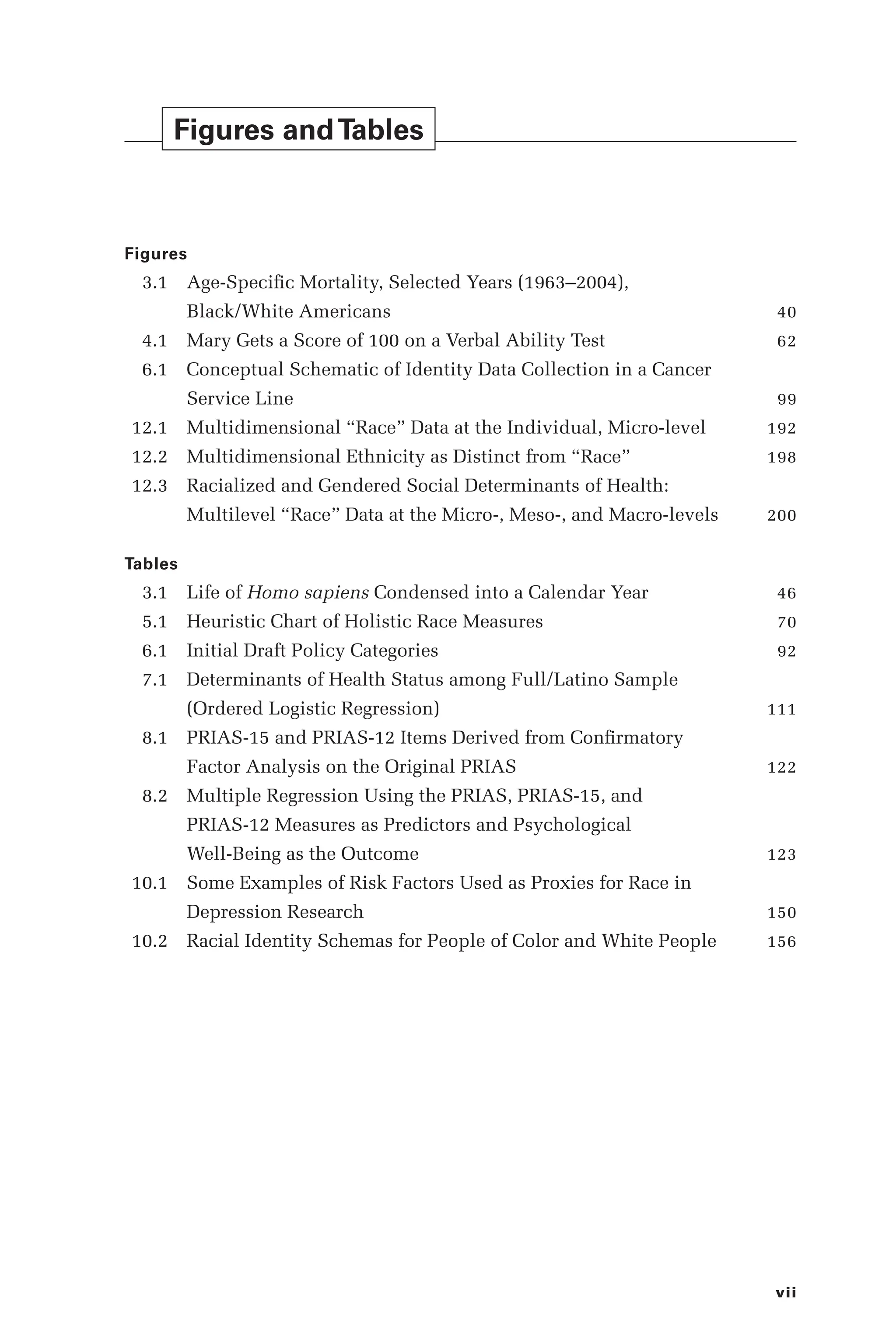






![2 Laura E. Gómez
government studies previously referenced, they found that African Americans
and Whites in this neighborhood had quite similar rates of diabetes (LaVeist et
al. 2009). “I don’t mean to suggest that genetics play no role in race differences
in health,” LaVeist said, explaining the study’s conclusions, “but before we can
conclude that health disparities are mainly a matter of genetics we need to first
identify a gene, polymorphism or gene mutation that exists in one race group
and not others. And when that gene is found we need to then demonstrate that
that gene is also associated with diabetes. On the other hand, there is [already]
overwhelming evidence that behavior, medical care and the environment are
huge drivers of race differences in health” (“Racial Disparities . . .” 2009). In
other words, looking for race-
based health disparities may at best jump-
start
a productive scientific inquiry when it leads researchers, policy makers,
and health care providers to ask further questions about why race seems to
be important in the context of a specific disease or health problem. But, at
its worst, looking for race-
based health disparities blinds us to seeing the full
range of possible causes of health inequalities.
The broader point that we collectively make in this book goes a step further:
we must be skeptical of claims about race-
based health disparities precisely
because “race” is the product of historically rooted ideas and political contes-
tation (Gómez 2012). Anthropologist Michael Montoya puts it this way: “the
ascertainment of ethnicity or race is a profoundly social enterprise anchored in
contemporary history,” and racial categories, both historically and today, “cor-
respond best to the imaginations of the scientists and not the presumably defin-
ing and stable features being measured” (Montoya 2007). Using the example
of diabetes in his book Making the Mexican Diabetic, Montoya explores how
the process of racializing diabetes—
that is, the process of scientists and health
professionals learning to take for granted that diabetes has a distinct impact
and perhaps even etiology in people of different races—
has occurred in labora-
tories, in government funding circles, in peer-
reviewed scientific publications,
and in the practice of medicine (2011). What explains biomedical researchers’
categorization of humans into groups, and then the linkage of those groups
to specific health problems such as diabetes, is the social process of making
race—
of constituting race as socially, politically, and scientifically important.
Thus, our research agenda must include actively studying this racialization
process; says Montoya: “when we carefully examine the selection of a group to
study, the labeling of that group, the representation of that group in scientific
papers, we see a science of population labeling based squarely on sociocultural
factors particular to each group, each region, and each historical period” (Mon-
toya 2007).](https://image.slidesharecdn.com/25951338-250520021900-90df3686/75/Mapping-Race-Critical-Approaches-To-Health-Disparities-Research-24-2048.jpg)

![Introduction 5
suburb of Chicago), which he estimated has four hundred days of cash on
hand (and daily spends $5 to $10 million; Roberts 2011, 125); in the health
care sector, hospitals are rated by bond agencies according to how many days
of cash they have on hand.
Whitman interprets the data as showing that while Black women’s breast
cancer treatment stayed stagnant in the last two decades of the twentieth cen-
tury, White women’s breast cancer prognoses dramatically improved due to early
detection via mammograms and advances in treatment including radiation ther-
apy and new medication regimes (Roberts 2011, 125). Roberts found that Black
neighborhoods in Chicago had few facilities with mammograms (so that women
had to travel long distances to get them, decreasing the likelihood that they
would do so); that public hospitals used older, inferior mammogram equipment
(often lacking both digital technology and trained mammographers); that until
the 2010 Patient Protection and Affordability Act (President Barack Obama’s
healthcare initiative), even middle-
class women with insurance were deterred
from getting mammograms because of high insurance copayments (the 2010
law mandated the elimination of payments for women over age fifty); and that
racially segregated neighborhoods meant that White women more frequently
had access to the best breast cancer treatment facilities, which Whitman said
were usually located in “the fancy institutions—
they are all in white neighbor-
hoods” (2011, 125–
27).
How are we to understand the role of race in the Chicago breast cancer
example? The typical approach is to view race as an individual characteristic.
For example, researchers often speak of self-
identified race, wherein a research
subject selects her or his racial category from a list of limited options (which
almost always correspond to the Office of Management and Budget [OMB] racial
categories, themselves derived from U.S. Census categories). The OMB categories
include “five racial categories (White, Black, American Indian or Alaskan Native,
Asian, and Native Hawaiian and other Pacific Islander) and one ethnic category
(Hispanic),” which most biomedical researchers collapse into six categories of
“self-
identified race” that respondents may choose from among (Williams et al.
2010, 70). When researchers view race as an individual characteristic, they often
fall into the pattern of biologizing race in terms of ancestry or genetics. This in
turn invites the tendency to view health disparities as a question of individual
failure (for less healthy individuals) or individual success (for more healthy indi-
viduals) and to identify solutions to disparities that focus on the individual body,
such as pharmaceutical solutions (see Kahn, this volume).
But Roberts tells a very different story about the racial disparity in breast
cancer survival in Chicago. She urges us to think about how racial discrimination](https://image.slidesharecdn.com/25951338-250520021900-90df3686/75/Mapping-Race-Critical-Approaches-To-Health-Disparities-Research-27-2048.jpg)
![6 Laura E. Gómez
has structured all sorts of inequalities, including health inequities. In her nar-
rative, the emphasis is on how Chicago’s existing pattern of residential segrega-
tion of African Americans produces tangible gaps at every stage of healthcare.
In a similar way, Williams and colleagues offer a nuanced picture of how neigh-
borhood segregation leads to poor health via six “pathways”:
First, segregation limits socioeconomic mobility by limiting access to
quality elementary and high school education, preparation for higher
education and employment opportunities. Second, the conditions cre-
ated by concentrated poverty and segregation make it more difficult for
residents to adhere to good health practices. . . . Third, the concentration
of poverty can lead to exposure to elevated levels of economic hard-
ship and acute stressors at the individual, household and neighborhood
level. Fourth, the weakened community and neighborhood infrastruc-
ture in segregated areas can also adversely affect interpersonal relation-
ships and trust among neighbors. Fifth, the institutional neglect and
disinvestment in poor, segregated communities contributes to increased
exposure to environmental toxins, poor quality housing and criminal
victimization. Finally, segregation adversely affects both access to care
and the quality of care. (2010, 79)
An even broader context would situate current residential segregation as
part of a larger history of government-
sponsored, legally enforced policies that
created today’s urban spaces. In this broader narrative, today’s health dispar-
ities are inextricably intertwined with the past because that past has direct
impacts today—
via laws that restricted Blacks, other non-
Whites (and some-
times Jews) from buying houses in certain neighborhoods (racially restrictive
covenants); via federal housing policies and agencies that created White-
only
suburbs, supported the redlining of Black neighborhoods by banks and insur-
ance companies, and that destroyed vibrant minority neighborhoods with the
placement of highways and public transportation axes; and via neighborhood-
based public schools that created a system of “naturally” occurring segregated
schools that themselves became a self-
fulfilling prophecy for marking neighbor-
hoods as “good” (White) and “bad” (non-
White).
The starting point for Dorothy Roberts’s analysis is the claim that “race is
not a biological category that is politically charged [but rather it] is a political
category that has been disguised as a biological one” (2011, 4). It is the cumu-
lative, social meaning of race in particular times and places that has shaped
and continues to shape both racial discrimination (and racism) and racial
meaning. To put it another way, we should not consider racial disparities in](https://image.slidesharecdn.com/25951338-250520021900-90df3686/75/Mapping-Race-Critical-Approaches-To-Health-Disparities-Research-28-2048.jpg)

![Introduction 9
between other variables” (Martin and Yeung 2003, 532). Anthropologists Clar-
ence Gravlee and Elizabeth Sweet contend that similar problems characterize
the health disparities literature, where many researchers reflexively (rather
than self-
consciously) use race as a proxy “for some unspecified combination
of environmental, behavioral, and genetic factors” (2008, 49). They identify
two resulting problems as the tendency to obscure the actual causes of health
inequities and the promotion (explicit or implicit) of the idea that racial differ-
ences are genetic and innate (Gravlee and Sweet 2008, 49).
Studies that use race in this or similarly narrow ways have had several, per-
haps unintended, consequences. For one thing, these studies have cumulatively
contributed to the popularization of a simplistic measure of race as a dichotomous
variable (Black/White or White/non-
White) usually based on either bureaucratic
assignment (racial assignment by someone collecting government data, such as
a county coroner) or subject self-
identification. This common approach to race
has in turn contributed to the idea, accreted over time, that race is fixed and bio-
logically rooted. In this respect, scholars’ frequent, but unremarked upon use of
race (especially as an independent variable) mimics the social phenomenon of
Americans being repeatedly asked to report their race in a variety of life contexts,
as noted by sociologist Ann Morning (2011). Framing the question as a simple
one (with which of these listed groups do you identify racially?) and asking it
repeatedly have led Americans to see race “as a permanent and individual char-
acteristic: something that is embedded within us and [that] does not change over
time” (Morning 2011, 3–
4)—
in other words, to reify race, rather than to see race
as a complex and dynamic set of social processes.
The problem of failing to conceptualize and/or define race spans the meth-
odological spectrum. Sociologist Edward Morris argues for “greater transpar-
ency in how race is measured in qualitative studies and increased reflection on
this concept as it is socially situated” (2007, 411). It is not enough, he contends,
to simply declare that race is a social construction; he urges scholars to go fur-
ther by expressly acknowledging “how they choose to identify race as well as
recognizing the limitations of this choice and being attentive to the enactment
of race in a particular context” (Morris 2007, 422). In other words, scholars who
include race as a facet of their studies (whether a major or minor facet) should
deliberately conceptualize race, regardless of their chosen methods.
While such problems certainly transcend methodological orientation, there
appear to be particular limitations with the tendency, in quantitative research,
to use race as a control variable or as a crude proxy for some other social fact
or process. Political scientist Taeku Lee has characterized the fundamental
problem succinctly: “Although we acknowledge that race, like ethnicity, is a](https://image.slidesharecdn.com/25951338-250520021900-90df3686/75/Mapping-Race-Critical-Approaches-To-Health-Disparities-Research-31-2048.jpg)




![Introduction 19
Notes
1. A range of limitations plague federal data collection for non-
Black minority
group members, and especially for Latinos and Asian Americans. Williams and
colleagues report that “national data on mortality are more accurate for blacks
and whites than for Hispanics, Asians, and Native Americans. A major problem
affecting the quality of mortality data is related to the undercount in the num-
ber of deaths because of misclassification of nontrivial proportions of Hispanics,
Asians, and especially American Indians as white on death certificates” (2010,
71). Nationwide data for Latinos and Asian Americans was not systematically col-
lected before 1980, when immigrants from Latin America and Asia became signifi-
cant nationally after the lifting of pre-
1965 restrictions on immigration from these
regions (see also Takeuchi and Gage 2003, 440 [noting that social scientists did not
historically treat Latinos and Asians in a racial framework]). Moreover, since both
groups combine many different national origin subgroups, the data is subject to
more variation and interpretive debate (for two studies that explore intragroup dif-
ferences with the Latino and Asian American categories, respectively, see Sanchez
and Ybarra and Iwamato, Kindaichi, and Miller, this volume). There are a variety
of structural reasons for ongoing misclassification, however, including the histori-
cal racial ambiguity of Mexican Americans (see Gómez 2007) and other non-
Black
minority groups. In addition, data such as that on birth and death certificates is
subject to substantial regional variation in the United States (Pascoe 2009), further
adding to the possible misclassification by race.
2. As noted in the preface, the NIH Office of Research on Minority Health funded the
2011 workshop that was the catalyst for this book.
3. Note that this inequality or social justice view of the cause (and solution) to race-
based health disparities is the minority view in both the scientific literature and
the popular media. One study of almost four thousand articles on health dispari-
ties that appeared in forty major newspapers between 1996 and 2005 concluded
that only rarely were race-
based health disparities framed by the media as a ques-
tion of social injustice—
that theme appeared in less than 4 percent of the articles
(Kim et al. 2010, S229).
4. Sociologist Catherine Lee makes the important point that the failure of research-
ers to define race is simply bad science because it is “antithetical to the tenets of
scientific research, which, in its ideal form, demands that analytical variables be
consistent and their categories mutually exclusive” (2009, 1183).
5. For example, these authors have identified this weakness in the following fields:
Gómez 2012 (socio-
legal studies); Gravlee and Sweet 2008 (medical anthropology);
Harrison 1999 (cultural anthropology); Helms 2007 (psychology); Jones et al. 1991
(epidemiology); C. Lee 2009 (biomedical research); T. Lee 2009 (political science);
Martin and Yeung 2003 (sociology); Morris 2007 (sociology); Mukhopadhyay and
Moses 1997 (cultural anthropology); Saperstein 2008 (demography).
6. At the same time, Morning contends that the social constructionist conception of
race has by no means completely displaced essentialist views of race rooted in
biology. In fact, she finds that, among scientists who teach at the university level,
an essentialist view of race as rooted in biology remains alive and well (2011, 6,
38–47, 221).
7. Of course, this claim has been made historically by those advocating for race-
conscious legal remedies and government policies to alleviate racial discrimination.](https://image.slidesharecdn.com/25951338-250520021900-90df3686/75/Mapping-Race-Critical-Approaches-To-Health-Disparities-Research-41-2048.jpg)


![The Politics of Framing 29
charts, measurements, and statistical observations all purporting to establish
the biological inferiority of the “American Negro” not only in basic mortality
but in such physiological traits as “chest expansion,” “physical strength,” or
resistance to disease. Such observations built on Hoffman’s prior conclusion
that “the time will come, if it has not already come, when the negro, like the
Indian, will be a vanishing race” (Hoffman 1892, 542).
Of course, academics and expert commentators had been declaring the
inferiority of the “negro race” for decades before Hoffman came on the scene
(Braun 2002, 160–
63). What is distinctive about his work for Prudential is that
it demonstrates the use of actuarial data to provide a gloss of objective scien-
tific rigor to the construction of biological racial difference in a legal context in
order to gain economic advantage in a competitive marketplace. This is the flip
side of the BiDil story, where the drug’s developers used a purported race-
based
biological difference to include African Americans in a patent (Kahn 2004).
Here, Prudential was using biological difference to exclude African Americans
from insurance coverage. Both strategies involve constructing race as biological
in order to serve underlying commercial interests.
Hoffman’s work did not go unchallenged. W.E.B. Du Bois, in particular, pre-
sented a powerful critique, questioning Hoffman’s methodology and noting that
the health outcomes of African Americans were comparable to those of immi-
grant groups with similar economic resources. Acknowledging “that in certain
diseases the Negroes have a much higher rate than the whites,” Du Bois asked,
“the question is: Is this racial? Mr. Hoffman would lead us to say yes, and to
infer that it means that Negroes are inherently inferior in physique to whites”
(Du Bois 1906, 275). Du Bois asserted, however, that such differences “can be
explained on other grounds than upon race” (Du Bois 1906, 275). Examining the
data behind various differentials in morbidity and mortality, Du Bois concluded
“that the Negro death rate and sickness are largely matters of [social] condition
and not due to racial traits and tendencies” (Du Bois 1906, 276).
Hoffman’s thesis was published in 1896, the same year that the U.S.
Supreme Court issued its infamous “separate but equal” decision in the case
of Plessy v. Ferguson (163 U.S. 537 [1896]). Homer Plessy, a resident of New
Orleans, was seven-
eighths White and one-
eighth Black—
an “octoroon.” On
June 7, 1892, he bought a first-
class ticket on the East Louisiana Railway for
passage from New Orleans to Covington, Louisiana, and took a seat reserved
for White passengers. He was arrested for violating the Separate Accommoda-
tions Act of 1890, which required “all railway companies carrying passengers
on their trains, in this state, to provide equal, but separate, accommodations for
the white and colored races” (11 So. 948 [La. 1892]).](https://image.slidesharecdn.com/25951338-250520021900-90df3686/75/Mapping-Race-Critical-Approaches-To-Health-Disparities-Research-49-2048.jpg)
![30 Jonathan Kahn
The Supreme Court ultimately upheld the Louisiana law, rejecting Plessy’s
argument “that the enforced separation of the two races stamps the colored race
with a badge of inferiority,” concluding that “if this be so, it is not by reason of
anything found in the act, but solely because the colored race chooses to put that
construction upon it” (163 U.S. 537 [1896]). Writing for the majority, Justice Henry
Brown declared “Legislation is powerless to eradicate racial instincts, or to abolish
distinctions based upon physical differences, and the attempt to do so can only
result in accentuating the difficulties of the present situation. . . . If one race be
inferior to the other socially, the constitution of the United States cannot put them
upon the same plane” (163 U.S. 537). Just as Du Bois offered a trenchant critique
of Hoffman’s work that placed social forces front and center in analyzing mortality
differentials, Justice John Harlan’s eloquent dissent in Plessy argued that the social
consequences of state action must be accorded constitutional recognition. “The
arbitrary separation of citizens, on the basis of race,” Harlan declared, “while they
are on a public highway, is a badge of servitude wholly inconsistent with the civil
freedom and the equality before the law established by the constitution. It cannot
be justified upon any legal grounds” (163 U.S. 562).
Legal scholar J. Allen Douglas argues that Plessy and its progeny can be under-
stood as attempts “to locate racial identity in the body in the form of an object or
property—
an immutable, natural ‘thing’ possessed—
to ensure a means for ‘quiet-
ing title’ in whiteness” (Douglas 2003, 889). In its attempt to locate racial identity
in the “immutable, natural” object of Plessy’s body, Brown’s brief opinion echoed
Hoffman’s massive compilation of statistics, which similarly grounded its defense
of a “segregated” approach to life insurance underwriting by locating racial dif-
ference in the bodies of African Americans. Brown also located responsibility for
stigma that might result from the law in the social realm, beyond the purview
of the Court. As Brown declared, “Legislation is powerless to eradicate racial
instincts, or to abolish distinctions based upon physical differences” (163 U.S. 551
[1896]). Louisiana could draw legal distinctions based upon such physical differ-
ences without violating the Equal Protection clause of the Fourteenth Amendment,
but if African Americans felt degraded by the law, that was their problem. The
state could act on biological difference but had no responsibility to redress harms
related to social difference. The Supreme Court’s opinion in Plessy thus legiti-
mated the racial segregation of physical space by denying the legal significance of
social differences that might be engendered by the law. Hoffman similarly tried to
justify the social (that is, non-
state-
sponsored) segregation of insurance coverage
by asserting the legal significance of purported biological differences among races.
Each of these foundational documents of twentieth-
century race theory
characterized the relative legal significance of social and biological difference](https://image.slidesharecdn.com/25951338-250520021900-90df3686/75/Mapping-Race-Critical-Approaches-To-Health-Disparities-Research-50-2048.jpg)
![The Politics of Framing 31
in commercial contexts. In justifying racial subordination, they deny or obscure
the significance of social or political forces while elevating biological difference
as a justification for state-
sanctioned discrimination. This schema naturalizes
racial difference and places any responsibility for addressing its implications
beyond the purview of the state, more appropriately addressed by individual
action or structured by commercial market considerations. For the past century,
this characterization of racial difference has existed in tension (and often direct
conflict) with the approach of those like Du Bois and Harlan who have sought to
foreground the social basis of racial difference and assert a public, state responsi-
bility for both creating and redressing inequalities embedded in such differences.
The 1954 case of Brown v. Board of Education repudiated Plessy’s con-
cept of “separate but equal” as “inherently unequal” (347 U.S. 483 [1954]). It
did so by upending the logic that relegated the “social” beyond legal consid-
eration, noting that “to separate [school children] from others of similar age
and qualifications solely because of their race generates a feeling of inferiority
as to their status in the community that may affect their hearts and minds in
a way unlikely ever to be undone” (347 U.S. 494). The opinion also marked a
transition in the social sciences, away from Hoffman’s biologization of racial
difference toward Du Bois’s focus on the impact of social forces on the status
and situation of racial groups. The Warren Court famously cited the work of
social scientists such as Kenneth Clark and Gunnar Myrdal in supporting its
legal recognition of the impact of segregation upon the hearts and minds of
African American children (347 U.S. 494 fn. 11; Hovenkamp 1985, 671–
72).
Where Hoffman and Justice Brown foregrounded race as a biological concept
in order to locate the responsibility for inequality in Black bodies and minds,
Clark, Myrdal, and the Warren Court foregrounded the social dynamics of race
to locate responsibility for inequality in the state and the polity.
From Brown to the passage of the Civil Rights Act in 1964 and the Voting
Rights Act of 1965, the emergent civil rights revolution focused on securing gov-
ernment guarantees of fundamental citizenship rights for African Americans.
Journalists Thomas and Mary Edsall, in their influential book Chain Reaction,
have argued that the politics of this first era focused on equality of opportunity
in a manner that galvanized a majority of the country and overcame conser-
vative forces of racial resistance. After 1965, however, the civil rights agenda
shifted its focus to “broader goals of emphasizing equal outcomes or results
for Blacks” (Edsall and Edsall 1992, 7). Statistics were necessary for measur-
ing such outcomes, and it is around this time that race-
specific data from the
Census Bureau became essential for gauging social, economic, and political
discrimination in this country (Robbin 2000b, 435; Robbin 2000a, 129). It is in](https://image.slidesharecdn.com/25951338-250520021900-90df3686/75/Mapping-Race-Critical-Approaches-To-Health-Disparities-Research-51-2048.jpg)
![32 Jonathan Kahn
this context, speaking before the Second National Convention of the Medical
Committee for Human Rights that Dr. Martin Luther King Jr. made his statement
about injustice in health care being shocking and inhumane (King 1966).
The civil rights shift in focus from access to fundamental rights of citizen-
ship to outcomes secured through affirmative government action also gave rise to
a conservative backlash, operationalized via Richard Nixon’s “southern strategy”
that used race as a wedge issue to “divide voters over values, and to isolate one
disproportionately poor segment of the population from the rest of the elector-
ate” (Edsall and Edsall 1992, 5). The new Republican strategy, carried to its acme
by Ronald Reagan in the 1980s, focused on the concept of “equal opportunity”
as opposed to “affirmative action” and included among its supporters “radical
conservatives, including those who were in fact anti-
black, as well as much of
the moderate center and the ideological right” (Edsall and Edsall 1992, 143). As
the Edsalls note, “The changing politics of civil rights permitted the Republican
Party to achieve its central goal—
the establishment of a putatively egalitarian,
ideologically respectable, conservatism. In 1980, Reagan and the GOP portrayed
opposition to central elements of civil rights enforcement—
opposition to the use
of race and sex preferences in hiring and in college admittance, to court-
ordered
busing, and to the introduction of means-
tested programs for the poor—
as deriv-
ing from a principled concern for fairness: as a form of populist opposition to
the granting of special privilege” (Edsall and Edsall 1992, 144). The language of
equal opportunity—
often framed in terms of access—
was clearly more accept-
able than the language of affirmative action to the “emerging Republican major-
ity” (Phillips 1969). This was part of a broader shift from a “‘liberal’ paradigm
centered on ‘social responsibility,’ in favor of a conservative paradigm centered
around ‘legitimate self-
interest’” (Edsall and Edsall 1992, 97).
In the legal arena, this approach manifested itself in the Reagan Department
of Justice (DOJ) position on school desegregation and affirmative action, charac-
terized as follows by the Edsalls: “the function of government intervention was
not to correct contemporary employment, or contracting, or student assignment
patterns that grew out of historic discrimination . . . Instead, the function of gov-
ernment was to protect individuals from specific acts of discrimination” (Edsall
and Edsall 1992, 188). The Reagan DOJ’s assault on the 1971 Supreme Court
decision in Griggs v. Duke Power (401 U.S. 424 [1971]) was emblematic of this
shift. In Griggs, the Court found that employment policies that are facially neu-
tral with regard to race—
such as aptitude test scores—
that nonetheless resulted
in a highly disparate impact on a minority racial group could violate Title VII of
the Civil Rights Act. To justify such tests, an employer would have to meet the
high standard that there was a “business necessity for such test” (401 U.S. 431).](https://image.slidesharecdn.com/25951338-250520021900-90df3686/75/Mapping-Race-Critical-Approaches-To-Health-Disparities-Research-52-2048.jpg)
![The Politics of Framing 33
The critique was framed in terms of individual merit being subordinated to racial
quotas. For example, Linda Gottfredson of the University of Delaware argued that
the logic of Griggs ignored “the whole issue of individual rights, and individual
fairness . . . there is no provision for the constitutional rights, the civil rights of
whites” (qtd. in Edsall and Edsall 1992, 252).
Ultimately the Reagan DOJ’s approach made headway with the Supreme
Court, as more conservative appointees shifted the Court’s ideological balance
to the right. Later cases, beginning with City of Richmond v. J. A. Croson Com-
pany (488 U.S. 469 [1989], decided under Chief Justice William Rehnquist) and
culminating in Parents Involved in Community Schools v. Seattle School District
No. 1 (551 U.S. 701 [2007], decided under Chief Justice John Roberts), effec-
tively rolled back affirmative mandates in employment and school desegregation
reaching back to Brown. A particular focus of these cases was on individuals
as a locus for constitutional protection. In cases such as Richmond v. Croson,
this meant requiring institutions wishing to implement affirmative action pro-
grams to show particularized injury suffered by identifiable minority groups in
the recent past. In her opinion for the majority, Justice Sandra Day O’Connor
expressed the concern that “to accept [a] claim that past societal discrimination
alone can serve as the basis for rigid racial preferences would be to open the
door to competing claims for ‘remedial relief’ for every disadvantaged group. . . .
Those whose societal injury is thought to exceed some arbitrary level of tolerabil-
ity then would be entitled to preferential classification. We think such a result
would be contrary to both the letter and the spirit of a constitutional provision
whose central command is equality” (488 U.S. 505–
6 [1989]; emphasis added).
O’Connor’s dismissal of the legal significance of the “societal injury” “thought”
to be experienced by “minority groups” echoes Justice Brown’s similar dismissal,
in Plessy, of claims about the stigma of segregation by asserting “if this be so, it
is not by reason of anything found in the act, but solely because the colored race
chooses to put that construction upon it” (163 U.S. 551 [1896]). He might just
as easily have said that African Americans’ claims to “societal injury” resulting
from enforced segregation were merely “thought to exceed some arbitrary level
of tolerability” and hence did not deserve constitutional consideration. Despite
writing nearly a century apart, both Justices Brown and O’Connor characterized
the social realities of racial discrimination as troublesome intrusions into legal
analysis. Brown wants to ignore them, O’Connor to transcend them. Both saw
race as obscuring a more proper focus on individual rights and identities.
Similarly, in Parents Involved, Chief Justice Roberts used a rhetoric of indi-
vidual rights to strike down race-
specific school assignments meant to achieve
the ideal of desegregation called for in Brown v. Board of Education. Roberts](https://image.slidesharecdn.com/25951338-250520021900-90df3686/75/Mapping-Race-Critical-Approaches-To-Health-Disparities-Research-53-2048.jpg)
![34 Jonathan Kahn
struck down the assignment plans because they did not “provide for a meaning-
ful individualized review of applicants but instead rely on racial classifications
in a ‘nonindividualized, mechanical’ way” (551 U.S. 701 [2007]). The state,
here, was forbidden from considering race as a primary basis for assigning stu-
dents to public schools. At first blush, this might seem to be the logical culmi-
nation of Brown’s repudiation of Plessy’s state-
mandated racial segregation. On
closer examination, however, it is revealed to be quite the opposite. In mandat-
ing a “color-
blind” approach to remedying the past effects of racial discrimina-
tion, Roberts effectively locates responsibility for addressing the consequences
of racial discrimination in the private sphere of social life, beyond the purview
of the state—
exactly where Justice Brown located it in his Plessy opinion. This
“privatization” of discrimination is fully in line with the Reagan-
era legacy of
neoliberal (or neoconservative) valorization of private, market-
based solutions
as the appropriate means to address social problems.
To the extent that the Rehnquist or Roberts courts accord any legal recogni-
tion to the social conditions of racial discrimination, they have done so as an
interim concept that is to be transcended. Thus, in City of Richmond v. Croson,
Justice O’Connor juxtaposed group-
based racial remedies against “the dream of a
Nation of equal citizens in a society where race is irrelevant to personal opportu-
nity and achievement” (488 U.S. 505–
6 [1989]). O’Connor reiterated her dream of
a world where race was “irrelevant” in her 2003 opinion in Grutter v. Bollinger,
where she anticipated that “25 years from now, the use of racial preferences will
no longer be necessary to further the interest approved today” (539 U.S. 306, 343
[2003]). O’Connor’s dream of a country where “race is irrelevant” resonates with
contemporary promises by biomedical researchers and clinicians yearning for a
time when genetic information will similarly render race irrelevant. O’Connor,
though, was speaking of making race socially and legally irrelevant, whereas
pharmacogenomic experts now speak of making race biologically irrelevant.
The two sentiments are connected, though, by their common disdain for
the social realities of group-
based racial harms. Both view social concepts of
race as impediments to progress, to be transcended and left to the dustbin of
history. Both also valorize the individual as the ultimate target of intervention,
whether legal or medical. Neoconservative race theorists tolerate the use of race
only where such schemes retain a primary focus on considering the individual
attributes of persons being classified. As Justice Scalia wrote in his concur-
ring opinion in the 1995 case of Adarand v. Pena, “Individuals who have been
wronged by unlawful racial discrimination should be made whole; but under
our Constitution there can be no such thing as either a creditor or a debtor
race” (515 U.S. 200, 239 [1995]). Similarly, biomedical researchers using race](https://image.slidesharecdn.com/25951338-250520021900-90df3686/75/Mapping-Race-Critical-Approaches-To-Health-Disparities-Research-54-2048.jpg)