DEPARTMENT OF COMPUTER SCIENCE AND DESIGN
22CD402- HUMAN COMPUTER INTERACTION
MODULE : I
MODULE NAME : INTRODUCTION TO INTERACTIVE
SYSTEMS
TOPIC : HCI in the software process
FACULTY : Dr. S. JOTHI LAKSHMI,
ASSOCIATE PROFESSOR, M.Tech CSE
1
HCI in the software process
• Software engineering and the design process
for interactive systems
• Usability engineering
• Iterative design and prototyping
• Design rationale
the software lifecycle
• Software engineering is the discipline for
understanding the software design process, or
life cycle
• Designing for usability occurs at all stages of
the life cycle, not as a single isolated activity
The waterfall model
Requirements
specification
Architectural
design
Detailed
design
Coding and
unit testing
Integration
and testing
Operation and
maintenance
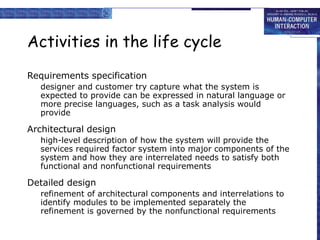
Activities in the life cycle
Requirements specification
designer and customer try capture what the system is
expected to provide can be expressed in natural language or
more precise languages, such as a task analysis would
provide
Architectural design
high-level description of how the system will provide the
services required factor system into major components of the
system and how they are interrelated needs to satisfy both
functional and nonfunctional requirements
Detailed design
refinement of architectural components and interrelations to
identify modules to be implemented separately the
refinement is governed by the nonfunctional requirements
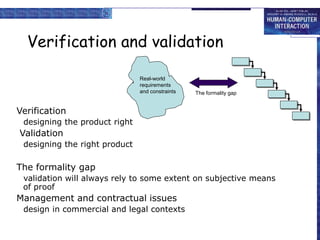
Verification and validation
Verification
designing the product right
Validation
designing the right product
The formality gap
validation will always rely to some extent on subjective means
of proof
Management and contractual issues
design in commercial and legal contexts
Real-world
requirements
and constraints The formality gap
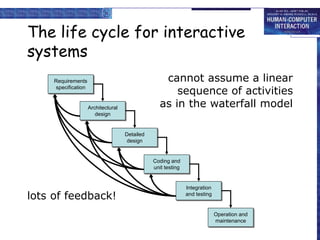
The life cycle for interactive
systems
cannot assume a linear
sequence of activities
as in the waterfall model
lots of feedback!
Requirements
specification
Architectural
design
Detailed
design
Coding and
unit testing
Integration
and testing
Operation and
maintenance
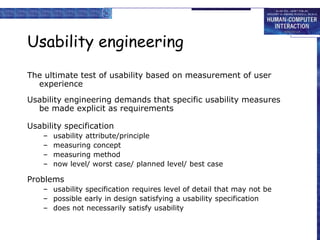
Usability engineering
The ultimate test of usability based on measurement of user
experience
Usability engineering demands that specific usability measures
be made explicit as requirements
Usability specification
– usability attribute/principle
– measuring concept
– measuring method
– now level/ worst case/ planned level/ best case
Problems
– usability specification requires level of detail that may not be
– possible early in design satisfying a usability specification
– does not necessarily satisfy usability
part of a usability
specification for a VCR
Attribute: Backward recoverability
Measuring concept: Undo an erroneous programming
sequence
Measuring method: Number of explicit user actions
to undo current program
Now level: No current product allows such an undo
Worst case: As many actions as it takes to
program-in mistake
Planned level: A maximum of two explicit user actions
Best case: One explicit cancel action
ISO usability standard 9241
adopts traditional usability categories:
• effectiveness
– can you achieve what you want to?
• efficiency
– can you do it without wasting effort?
• satisfaction
– do you enjoy the process?
some metrics from ISO 9241
Usability Effectiveness Efficiency Satisfaction
objective measures measures measures
Suitability Percentage of Time to Rating scale
for the task goals achieved complete a task for satisfaction
Appropriate for Number of power Relative efficiency Rating scale for
trained users features used compared with satisfaction with
an expert user power features
Learnability Percentage of Time to learn Rating scale for
functions learned criterion ease of learning
Error tolerance Percentage of Time spent on Rating scale for
errors corrected correcting errors error handling
successfully
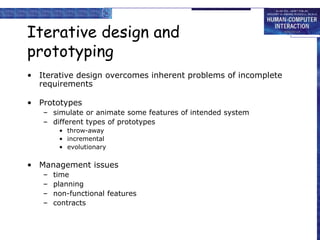
Iterative design and
prototyping
• Iterative design overcomes inherent problems of incomplete
requirements
• Prototypes
– simulate or animate some features of intended system
– different types of prototypes
• throw-away
• incremental
• evolutionary
• Management issues
– time
– planning
– non-functional features
– contracts
Techniques for prototyping
Storyboards
need not be computer-based
can be animated
Limited functionality simulations
some part of system functionality provided by designers
tools like HyperCard are common for these
Wizard of Oz technique
Warning about iterative design
design inertia – early bad decisions stay bad
diagnosing real usability problems in prototypes….
…. and not just the symptoms
Design rationale
Design rationale is information that explains why
a computer system is the way it is.
Benefits of design rationale
– communication throughout life cycle
– reuse of design knowledge across products
– enforces design discipline
– presents arguments for design trade-offs
– organizes potentially large design space
– capturing contextual information
Design rationale (cont’d)
Types of DR:
• Process-oriented
– preserves order of deliberation and decision-making
• Structure-oriented
– emphasizes post hoc structuring of considered
design alternatives
• Two examples:
– Issue-based information system (IBIS)
– Design space analysis
Issue-based information
system (IBIS)
• basis for much of design rationale research
• process-oriented
• main elements:
issues
– hierarchical structure with one ‘root’ issue
positions
– potential resolutions of an issue
arguments
– modify the relationship between positions and issues
• gIBIS is a graphical version
structure of gIBIS
Sub-issue
Issue
Sub-issue
Sub-issue
Position
Position
Argument
Argument
responds to
responds to
objects to
supports
questions
generalizes
specializes
Design space analysis
• structure-oriented
• QOC – hierarchical structure:
questions (and sub-questions)
– represent major issues of a design
options
– provide alternative solutions to the question
criteria
– the means to assess the options in order to make a choice
• DRL – similar to QOC with a larger language
and more formal semantics
the QOC notation
Question
Option
Option
Option
Criterion
Criterion
Criterion
Question … Consequent
Question
…
Psychological design rationale
• to support task-artefact cycle in which user tasks are
affected by the systems they use
• aims to make explicit consequences of design for users
• designers identify tasks system will support
• scenarios are suggested to test task
• users are observed on system
• psychological claims of system made explicit
• negative aspects of design can be used to improve next
iteration of design
Summary
The software engineering life cycle
– distinct activities and the consequences for
interactive system design
Usability engineering
– making usability measurements explicit as
requirements
Iterative design and prototyping
– limited functionality simulations and animations
Design rationale
– recording design knowledge
– process vs. structure

Human Computer Interaction in software process.ppt

  • 1.
    DEPARTMENT OF COMPUTERSCIENCE AND DESIGN 22CD402- HUMAN COMPUTER INTERACTION MODULE : I MODULE NAME : INTRODUCTION TO INTERACTIVE SYSTEMS TOPIC : HCI in the software process FACULTY : Dr. S. JOTHI LAKSHMI, ASSOCIATE PROFESSOR, M.Tech CSE 1
  • 2.
    HCI in thesoftware process • Software engineering and the design process for interactive systems • Usability engineering • Iterative design and prototyping • Design rationale
  • 3.
    the software lifecycle •Software engineering is the discipline for understanding the software design process, or life cycle • Designing for usability occurs at all stages of the life cycle, not as a single isolated activity
  • 4.
    The waterfall model Requirements specification Architectural design Detailed design Codingand unit testing Integration and testing Operation and maintenance
  • 5.
    Activities in thelife cycle Requirements specification designer and customer try capture what the system is expected to provide can be expressed in natural language or more precise languages, such as a task analysis would provide Architectural design high-level description of how the system will provide the services required factor system into major components of the system and how they are interrelated needs to satisfy both functional and nonfunctional requirements Detailed design refinement of architectural components and interrelations to identify modules to be implemented separately the refinement is governed by the nonfunctional requirements
  • 6.
    Verification and validation Verification designingthe product right Validation designing the right product The formality gap validation will always rely to some extent on subjective means of proof Management and contractual issues design in commercial and legal contexts Real-world requirements and constraints The formality gap
  • 7.
    The life cyclefor interactive systems cannot assume a linear sequence of activities as in the waterfall model lots of feedback! Requirements specification Architectural design Detailed design Coding and unit testing Integration and testing Operation and maintenance
  • 8.
    Usability engineering The ultimatetest of usability based on measurement of user experience Usability engineering demands that specific usability measures be made explicit as requirements Usability specification – usability attribute/principle – measuring concept – measuring method – now level/ worst case/ planned level/ best case Problems – usability specification requires level of detail that may not be – possible early in design satisfying a usability specification – does not necessarily satisfy usability
  • 9.
    part of ausability specification for a VCR Attribute: Backward recoverability Measuring concept: Undo an erroneous programming sequence Measuring method: Number of explicit user actions to undo current program Now level: No current product allows such an undo Worst case: As many actions as it takes to program-in mistake Planned level: A maximum of two explicit user actions Best case: One explicit cancel action
  • 10.
    ISO usability standard9241 adopts traditional usability categories: • effectiveness – can you achieve what you want to? • efficiency – can you do it without wasting effort? • satisfaction – do you enjoy the process?
  • 11.
    some metrics fromISO 9241 Usability Effectiveness Efficiency Satisfaction objective measures measures measures Suitability Percentage of Time to Rating scale for the task goals achieved complete a task for satisfaction Appropriate for Number of power Relative efficiency Rating scale for trained users features used compared with satisfaction with an expert user power features Learnability Percentage of Time to learn Rating scale for functions learned criterion ease of learning Error tolerance Percentage of Time spent on Rating scale for errors corrected correcting errors error handling successfully
  • 12.
    Iterative design and prototyping •Iterative design overcomes inherent problems of incomplete requirements • Prototypes – simulate or animate some features of intended system – different types of prototypes • throw-away • incremental • evolutionary • Management issues – time – planning – non-functional features – contracts
  • 13.
    Techniques for prototyping Storyboards neednot be computer-based can be animated Limited functionality simulations some part of system functionality provided by designers tools like HyperCard are common for these Wizard of Oz technique Warning about iterative design design inertia – early bad decisions stay bad diagnosing real usability problems in prototypes…. …. and not just the symptoms
  • 14.
    Design rationale Design rationaleis information that explains why a computer system is the way it is. Benefits of design rationale – communication throughout life cycle – reuse of design knowledge across products – enforces design discipline – presents arguments for design trade-offs – organizes potentially large design space – capturing contextual information
  • 15.
    Design rationale (cont’d) Typesof DR: • Process-oriented – preserves order of deliberation and decision-making • Structure-oriented – emphasizes post hoc structuring of considered design alternatives • Two examples: – Issue-based information system (IBIS) – Design space analysis
  • 16.
    Issue-based information system (IBIS) •basis for much of design rationale research • process-oriented • main elements: issues – hierarchical structure with one ‘root’ issue positions – potential resolutions of an issue arguments – modify the relationship between positions and issues • gIBIS is a graphical version
  • 17.
    structure of gIBIS Sub-issue Issue Sub-issue Sub-issue Position Position Argument Argument respondsto responds to objects to supports questions generalizes specializes
  • 18.
    Design space analysis •structure-oriented • QOC – hierarchical structure: questions (and sub-questions) – represent major issues of a design options – provide alternative solutions to the question criteria – the means to assess the options in order to make a choice • DRL – similar to QOC with a larger language and more formal semantics
  • 19.
  • 20.
    Psychological design rationale •to support task-artefact cycle in which user tasks are affected by the systems they use • aims to make explicit consequences of design for users • designers identify tasks system will support • scenarios are suggested to test task • users are observed on system • psychological claims of system made explicit • negative aspects of design can be used to improve next iteration of design
  • 21.
    Summary The software engineeringlife cycle – distinct activities and the consequences for interactive system design Usability engineering – making usability measurements explicit as requirements Iterative design and prototyping – limited functionality simulations and animations Design rationale – recording design knowledge – process vs. structure