Human-Computer
Interaction
Fall 2018
Lecture 3
Dr. Mohamed M. Saad
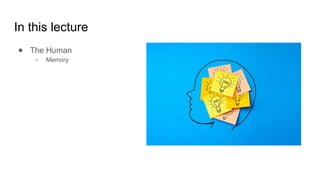
In this lecture
● The Human
○ Memory
Memory Types
● Sensory Memories
● Short Term Memory (or working memory)
● Long Term Memory
Sensory Memories
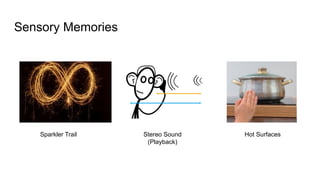
Buffers for stimuli received through senses
● Iconic memory: visual stimuli
● Echoic memory: aural stimuli
● Haptic memory: tactile stimuli
Sensory Memories
Sparkler Trail Stereo Sound
(Playback)
Hot Surfaces
Sensory Memories
Properties
- Continuously overwritten (Buffer)
- Information Decay (~ 0.5 seconds)
Attention
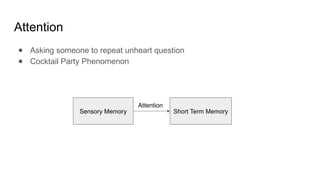
● Asking someone to repeat unheart question
● Cocktail Party Phenomenon
Sensory Memory Short Term Memory
Attention
Short-Term Memory (or working memory)
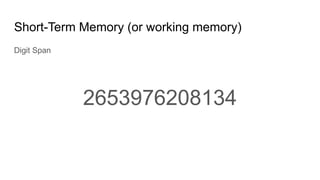
Digit Span
2653976208134
Short-Term Memory (or working memory)
Digit Span [7 +/- 2]
Short-Term Memory (or working memory)
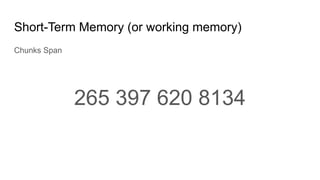
Chunks Span
265 397 620 8134
Chunks Span [7 +/- 2] that is near the Digit Span!!!
Our subconscious desire to create chunks to optimize memory capacity
The successful formation of a chunk is known as “Closure”
Short-Term Memory (or working memory)
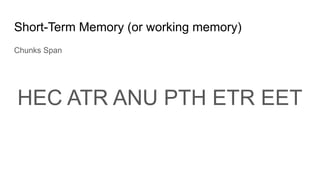
Chunks Span
HEC ATR ANU PTH ETR EET
Short-Term Memory (or working memory)
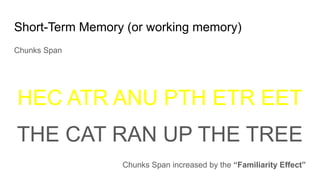
Chunks Span
HEC ATR ANU PTH ETR EET
THE CAT RAN UP THE TREE
Chunks Span increased by the “Familiarity Effect”
Short-Term Memory (or working memory)
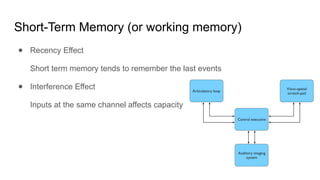
● Recency Effect
Short term memory tends to remember the last events
● Interference Effect
Inputs at the same channel affects capacity
Short-Term Memory (or working memory)
Properties
- Scratch Pad for temporary recall
- Limited Capacity (7 +/- 2)
- Rapid access ~ 70ms
- Rapid decay ~ 200ms
- Increased with Familiarity Effect
- Increased with Recency Effect
- Affected by interference at the same channel
Short-Term Memory (or working memory)
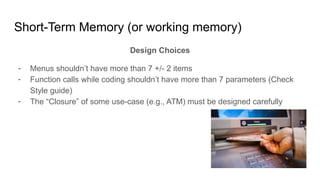
Design Choices
- Menus shouldn’t have more than 7 +/- 2 items
- Function calls while coding shouldn’t have more than 7 parameters (Check
Style guide)
- The “Closure” of some use-case (e.g., ATM) must be designed carefully
Rehearsal
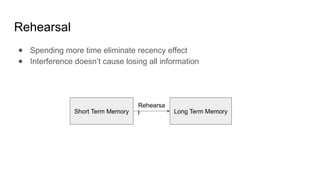
● Spending more time eliminate recency effect
● Interference doesn’t cause losing all information
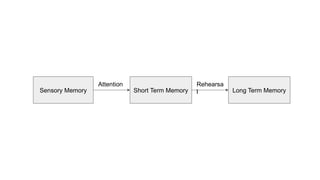
Short Term Memory Long Term Memory
Rehearsa
l
Long Term Memory
There are two types:
- Episodic: represents our memory of events and experiences in a serial form
- Semantic: skills, concepts and facts extracted from the Episodic.
There are several theories to model how it works:
- Network Model
- Frames Model
- Scripts Model
Long Term Memory
Properties
- Huge (or infinite)
- Slow access time 0.1 second
- Slow (or no) decay
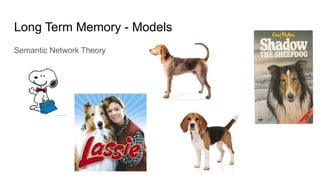
Long Term Memory - Models
Semantic Network Theory
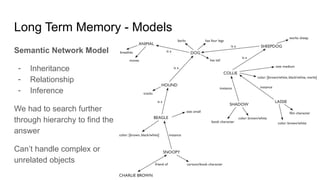
Long Term Memory - Models
Semantic Network Model
- Inheritance
- Relationship
- Inference
We had to search further
through hierarchy to find the
answer
Can’t handle complex or
unrelated objects
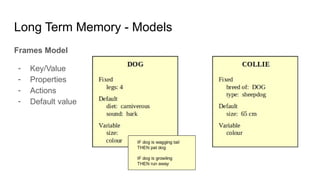
Long Term Memory - Models
Frames Model
- Key/Value
- Properties
- Actions
- Default value
Long Term Memory - Models
Scripts Model
“John took his dog to the surgery.
After seeing the vet, he left.”
Long Term Memory - Models
Scripts Model
“She went shopping. After trying out
the dress, she left.”
Long Term Memory - Models
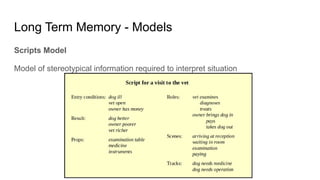
Scripts Model
Model of stereotypical information required to interpret situation
Long Term Memory - Models
Scripts Model
● Entry conditions: Conditions that must be satisfied for the script to be activated.
● Result: Conditions that will be true after the script is terminated.
● Props: Objects involved in the events described in the script.
● Roles: Actions performed by particular participants.
● Scenes: The sequences of events that occur.
● Tracks: A variation on the general pattern representing an alternative scenario.
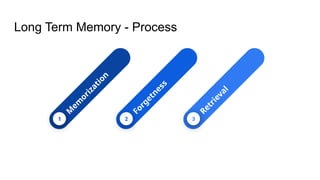
Long Term Memory - Process
1
M
e
m
o
r
i
z
a
t
i
o
n
2
F
o
r
g
e
t
n
e
s
s
3
R
e
t
r
i
e
v
a
l
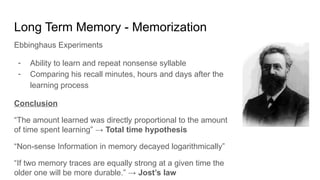
Long Term Memory - Memorization
Ebbinghaus Experiments
- Ability to learn and repeat nonsense syllable
- Comparing his recall minutes, hours and days after the
learning process
Conclusion
“The amount learned was directly proportional to the amount
of time spent learning” → Total time hypothesis
“Non-sense Information in memory decayed logarithmically”
“If two memory traces are equally strong at a given time the
older one will be more durable.” → Jost’s law
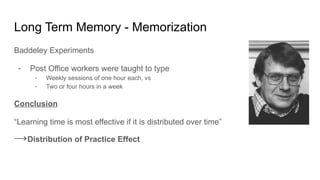
Long Term Memory - Memorization
Baddeley Experiments
- Post Office workers were taught to type
- Weekly sessions of one hour each, vs
- Two or four hours in a week
Conclusion
“Learning time is most effective if it is distributed over time”
→Distribution of Practice Effect
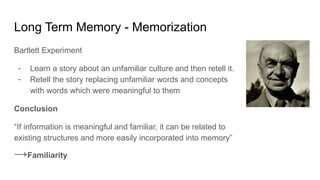
Long Term Memory - Memorization
Bartlett Experiment
- Learn a story about an unfamiliar culture and then retell it.
- Retell the story replacing unfamiliar words and concepts
with words which were meaningful to them
Conclusion
“If information is meaningful and familiar, it can be related to
existing structures and more easily incorporated into memory”
→Familiarity
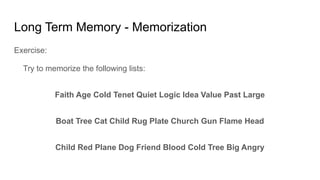
Long Term Memory - Memorization
Exercise:
Try to memorize the following lists:
Faith Age Cold Tenet Quiet Logic Idea Value Past Large
Boat Tree Cat Child Rug Plate Church Gun Flame Head
Child Red Plane Dog Friend Blood Cold Tree Big Angry
Long Term Memory - Memorization
Summary
Information Memorization is affected by
- Structure (non-sense or sense),
- Familiarity,
- Concreteness, and
- Time spent
- Time span/distribution
Long Term Memory - Forgetness
Theory #1: Decay
● Ebbinghaus Experiments
● Jost’s law
Theory #2: Interference
“If we acquire new information it
causes the loss of old information”
● Retroactive interference
● Proactive inhibition
Forgetting is also affected by
emotional factors. “Nostalgia”
Long Term Memory - Forgetness
Theory #3: We don’t forget!
“Just becomes increasingly difficult to
access certain items from memory”
● Proactive inhibition
● Tip of the tongue (or TOT)
● Information may not be recalled
but may be recognized
Long Term Memory - Retrieval
Recall: information is reproduced from memory
Recognition: the presentation of the information provides the knowledge that the
information has been seen before
Long Term Memory - Retrieval
Exercise:
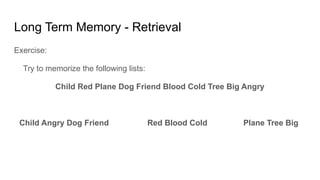
Try to memorize the following lists:
Child Red Plane Dog Friend Blood Cold Tree Big Angry
Child Angry Dog Friend Red Blood Cold Plane Tree Big
Long Term Memory - Retrieval
Exercise:
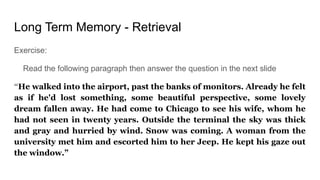
Read the following paragraph then answer the question in the next slide
“He walked into the airport, past the banks of monitors. Already he felt
as if he'd lost something, some beautiful perspective, some lovely
dream fallen away. He had come to Chicago to see his wife, whom he
had not seen in twenty years. Outside the terminal the sky was thick
and gray and hurried by wind. Snow was coming. A woman from the
university met him and escorted him to her Jeep. He kept his gaze out
the window.”
Long Term Memory - Retrieval
Exercise - cont:
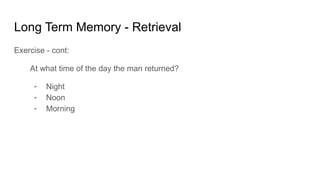
At what time of the day the man returned?
- Night
- Noon
- Morning
Long Term Memory - Retrieval
Exercise - cont:
If you could answer that question you have visualized the scene, including the
time of the scene. In fact, that is not mentioned in the description at all.
Long Term Memory
Design Choices
- Memorizing passwords:
- What people usually use?
- How to balance between security and memorability
Sensory Memory Short Term Memory
Attention
Long Term Memory
Rehearsa
l
References
- Chapter 1, The human, “Human-Computer Interaction”, 3rd edition
Homework
Reading
- Chapter 1, The human, “Human-Computer Interaction”, 3rd edition
- Section 1.3
Exercise
- There are some techniques to improve our memorization procedure. Explain
and demonstrate one. (Hint: the textbook presented one)

Human-Computer Interaction, a multidisciplinary field HCI Lecture 3.pptx

  • 1.
  • 2.
    In this lecture ●The Human ○ Memory
  • 3.
    Memory Types ● SensoryMemories ● Short Term Memory (or working memory) ● Long Term Memory
  • 4.
    Sensory Memories Buffers forstimuli received through senses ● Iconic memory: visual stimuli ● Echoic memory: aural stimuli ● Haptic memory: tactile stimuli
  • 5.
    Sensory Memories Sparkler TrailStereo Sound (Playback) Hot Surfaces
  • 6.
    Sensory Memories Properties - Continuouslyoverwritten (Buffer) - Information Decay (~ 0.5 seconds)
  • 7.
    Attention ● Asking someoneto repeat unheart question ● Cocktail Party Phenomenon Sensory Memory Short Term Memory Attention
  • 8.
    Short-Term Memory (orworking memory) Digit Span 2653976208134
  • 9.
    Short-Term Memory (orworking memory) Digit Span [7 +/- 2]
  • 10.
    Short-Term Memory (orworking memory) Chunks Span 265 397 620 8134
  • 11.
    Chunks Span [7+/- 2] that is near the Digit Span!!! Our subconscious desire to create chunks to optimize memory capacity The successful formation of a chunk is known as “Closure” Short-Term Memory (or working memory)
  • 12.
    Short-Term Memory (orworking memory) Chunks Span HEC ATR ANU PTH ETR EET
  • 13.
    Short-Term Memory (orworking memory) Chunks Span HEC ATR ANU PTH ETR EET THE CAT RAN UP THE TREE Chunks Span increased by the “Familiarity Effect”
  • 14.
    Short-Term Memory (orworking memory) ● Recency Effect Short term memory tends to remember the last events ● Interference Effect Inputs at the same channel affects capacity
  • 15.
    Short-Term Memory (orworking memory) Properties - Scratch Pad for temporary recall - Limited Capacity (7 +/- 2) - Rapid access ~ 70ms - Rapid decay ~ 200ms - Increased with Familiarity Effect - Increased with Recency Effect - Affected by interference at the same channel
  • 16.
    Short-Term Memory (orworking memory) Design Choices - Menus shouldn’t have more than 7 +/- 2 items - Function calls while coding shouldn’t have more than 7 parameters (Check Style guide) - The “Closure” of some use-case (e.g., ATM) must be designed carefully
  • 17.
    Rehearsal ● Spending moretime eliminate recency effect ● Interference doesn’t cause losing all information Short Term Memory Long Term Memory Rehearsa l
  • 18.
    Long Term Memory Thereare two types: - Episodic: represents our memory of events and experiences in a serial form - Semantic: skills, concepts and facts extracted from the Episodic. There are several theories to model how it works: - Network Model - Frames Model - Scripts Model
  • 19.
    Long Term Memory Properties -Huge (or infinite) - Slow access time 0.1 second - Slow (or no) decay
  • 20.
    Long Term Memory- Models Semantic Network Theory
  • 21.
    Long Term Memory- Models Semantic Network Model - Inheritance - Relationship - Inference We had to search further through hierarchy to find the answer Can’t handle complex or unrelated objects
  • 22.
    Long Term Memory- Models Frames Model - Key/Value - Properties - Actions - Default value
  • 23.
    Long Term Memory- Models Scripts Model “John took his dog to the surgery. After seeing the vet, he left.”
  • 24.
    Long Term Memory- Models Scripts Model “She went shopping. After trying out the dress, she left.”
  • 25.
    Long Term Memory- Models Scripts Model Model of stereotypical information required to interpret situation
  • 26.
    Long Term Memory- Models Scripts Model ● Entry conditions: Conditions that must be satisfied for the script to be activated. ● Result: Conditions that will be true after the script is terminated. ● Props: Objects involved in the events described in the script. ● Roles: Actions performed by particular participants. ● Scenes: The sequences of events that occur. ● Tracks: A variation on the general pattern representing an alternative scenario.
  • 27.
    Long Term Memory- Process 1 M e m o r i z a t i o n 2 F o r g e t n e s s 3 R e t r i e v a l
  • 28.
    Long Term Memory- Memorization Ebbinghaus Experiments - Ability to learn and repeat nonsense syllable - Comparing his recall minutes, hours and days after the learning process Conclusion “The amount learned was directly proportional to the amount of time spent learning” → Total time hypothesis “Non-sense Information in memory decayed logarithmically” “If two memory traces are equally strong at a given time the older one will be more durable.” → Jost’s law
  • 29.
    Long Term Memory- Memorization Baddeley Experiments - Post Office workers were taught to type - Weekly sessions of one hour each, vs - Two or four hours in a week Conclusion “Learning time is most effective if it is distributed over time” →Distribution of Practice Effect
  • 30.
    Long Term Memory- Memorization Bartlett Experiment - Learn a story about an unfamiliar culture and then retell it. - Retell the story replacing unfamiliar words and concepts with words which were meaningful to them Conclusion “If information is meaningful and familiar, it can be related to existing structures and more easily incorporated into memory” →Familiarity
  • 31.
    Long Term Memory- Memorization Exercise: Try to memorize the following lists: Faith Age Cold Tenet Quiet Logic Idea Value Past Large Boat Tree Cat Child Rug Plate Church Gun Flame Head Child Red Plane Dog Friend Blood Cold Tree Big Angry
  • 32.
    Long Term Memory- Memorization Summary Information Memorization is affected by - Structure (non-sense or sense), - Familiarity, - Concreteness, and - Time spent - Time span/distribution
  • 33.
    Long Term Memory- Forgetness Theory #1: Decay ● Ebbinghaus Experiments ● Jost’s law Theory #2: Interference “If we acquire new information it causes the loss of old information” ● Retroactive interference ● Proactive inhibition Forgetting is also affected by emotional factors. “Nostalgia”
  • 34.
    Long Term Memory- Forgetness Theory #3: We don’t forget! “Just becomes increasingly difficult to access certain items from memory” ● Proactive inhibition ● Tip of the tongue (or TOT) ● Information may not be recalled but may be recognized
  • 35.
    Long Term Memory- Retrieval Recall: information is reproduced from memory Recognition: the presentation of the information provides the knowledge that the information has been seen before
  • 36.
    Long Term Memory- Retrieval Exercise: Try to memorize the following lists: Child Red Plane Dog Friend Blood Cold Tree Big Angry Child Angry Dog Friend Red Blood Cold Plane Tree Big
  • 37.
    Long Term Memory- Retrieval Exercise: Read the following paragraph then answer the question in the next slide “He walked into the airport, past the banks of monitors. Already he felt as if he'd lost something, some beautiful perspective, some lovely dream fallen away. He had come to Chicago to see his wife, whom he had not seen in twenty years. Outside the terminal the sky was thick and gray and hurried by wind. Snow was coming. A woman from the university met him and escorted him to her Jeep. He kept his gaze out the window.”
  • 38.
    Long Term Memory- Retrieval Exercise - cont: At what time of the day the man returned? - Night - Noon - Morning
  • 39.
    Long Term Memory- Retrieval Exercise - cont: If you could answer that question you have visualized the scene, including the time of the scene. In fact, that is not mentioned in the description at all.
  • 40.
    Long Term Memory DesignChoices - Memorizing passwords: - What people usually use? - How to balance between security and memorability
  • 41.
    Sensory Memory ShortTerm Memory Attention Long Term Memory Rehearsa l
  • 42.
    References - Chapter 1,The human, “Human-Computer Interaction”, 3rd edition
  • 43.
    Homework Reading - Chapter 1,The human, “Human-Computer Interaction”, 3rd edition - Section 1.3 Exercise - There are some techniques to improve our memorization procedure. Explain and demonstrate one. (Hint: the textbook presented one)

Editor's Notes

  • #21 ‘Can a collie breathe?’, ‘Is a beagle a hound?’ and ‘Does a hound track?’