Guide to Human Activity System (HAS) Mapping
David Alman
Version 4
2
Guide to Human Activity System (HAS) Mapping Version 4 by David Alman May 2014
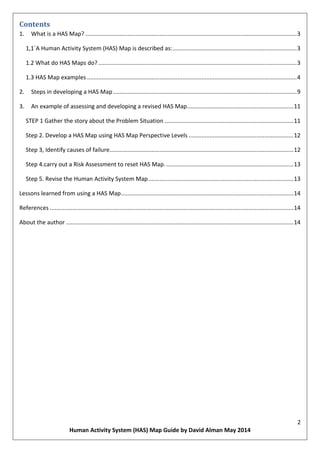
Contents
1. What is a “System”? ...................................................................................................................................3
Please note that Attachment 1 replicates Table 1 Systems Thinking Matrix and includes References with
reference numbers 2 to 6 supporting different system types in Table 1..........................................................3
2 What is a Human Activity System (HAS) Map?...........................................................................................4
2.1 A Human Activity System (HAS) Map is described as:.............................................................................4
2.2 What do HAS Maps do? ...........................................................................................................................4
2.3 HAS Map examples ..................................................................................................................................5
3. Steps in developing a HAS Map................................................................................................................10
4. An example of assessing, developing, and revising a HAS Map..............................................................12
Step 1. Gather the story about the Problem Situation...............................................................................12
Step 2. Develop a HAS Map using HAS Map Perspective Levels .................................................................13
Step 3. Identify causes of failure (e.g. Constraints, Conflicts, Unmet expectations) ..................................13
Step 4. Carry out a Risk Assessment to reset the HAS Map. .......................................................................14
Step 5. Revise the Human Activity System Map..........................................................................................15
5. Lessons learned from using a HAS Map ...................................................................................................16
Attachment 1 Systems Thinking Matrix with References included.................................................................17
References .......................................................................................................................................................18
About the author .............................................................................................................................................18
3
Guide to Human Activity System (HAS) Mapping Version 4 by David Alman May 2014
1. What is a “System”?
“A system is a collection of elements connected together to form a purposeful whole with properties that
differ from those of its component parts”
Reference [1].
There are many forms of systems such as computers; computer software; machinery equipment; work
groups, financial budgets, HR recruitment processes, corporate plans and programs; projects; and much
more. These are exampled in the Systems Thinking Matrix in Table 1, which indicates that systems differ
because of their:
System Type. That is whether the system type is either:
a) Systematic. Logical, rational, “linear” cause and effects. Where “this causes that”.
OR
b) Systemic. Multiple “non linear” cause and effects that result in either expected or unexpected
outcomes.
Perspective Level. That is whether the perspective, or way of seeing an issue, is either:
a) “Hierarchical” Frameworks or Networks with multiple ways (perspectives) to consider what is
involved in an issue;
OR
b) “Flat” processes, transactions, and network exchanges with a single way (perspective) to consider
an issue.
PERSPECTIVE LEVEL
System Type
SYSTEMATIC SYSTEM
Linear “this causes that” systems
SYSTEMIC SYSTEM
Multiple “non linear” cause & effects
Multiple Perspectives
“Hierarchical” frameworks
and networks
 Triple loop of learning model  Soft Systems Methodology (SSM)
 AcciMaps
 Human Activity Systems (HAS)
Single Perspective
“Flat” processes,
transactions, and network
exchanges
 ISO Management Systems
 IT systems and frameworks
 IM Systems
 Engineering & production systems
 Customer service systems
 HR Recruitment
 Performance and Diminished
performance management
 “Lean”
 Value Network Analysis (VNA)
 Theory of Constraints (TOC)
 Viable System Model (VSM)
 System Archetypes
 System Dynamics
Table 1. Systems Thinking Matrix
Please note that Attachment 1 replicates Table 1 Systems Thinking Matrix and includes References with
reference numbers 2 to 6 supporting different system types in Table 1.
4
Guide to Human Activity System (HAS) Mapping Version 4 by David Alman May 2014
2 What is a Human Activity System (HAS) Map?
2.1 A Human Activity System (HAS) Map is described as:
“A visual flow map illustrating a situation as a whole through interrelated, interacting, and interdependent
elements, that are also viewed from different perspectives”
2.2 What do HAS Maps do?
 Identify causes of unwanted consequences for an organisation;
Identify causes to unintended consequences
Use a “Systemic” system model to link causes to consequences. These causes are direct or indirect -
“hidden” – causes that if not addressed can result in repeated unwanted consequences.
This is exampled in the Human Activity System (HAS) model shown in Diagram 1.
Diagram 1. Human Activity System (HAS) Model
A HAS Map also recognises and assesses different focus, attention, or perspectives when looking at
problems to understand issues involved. In this respect there are three perspectives used in HAS Mapping.
Reference [7]:
Referential perspectives such as values, assumptions, attitudes, and beliefs that cause appreciation of
particular priorities and intentions and not others.
Governance Perspective How things are organised, directed, structured such as plans, organisation
structures, accountability reporting.
 Transactional Perspective How people (e.g. individuals and groups), processes, and physical
environment interact.
Referential Level
E.g. Values, priorities, assumptions
Transactional Level
Social, process, physical
interactions
Governance Level
Designed processes, practices,
structures, systems, rules, policies
etc
Outcomes
Either purposeful or unintended
consequences
5
Guide to Human Activity System (HAS) Mapping Version 4 by David Alman May 2014
Table 2 examples “problem situations” that HAS Maps can map in terms of (non linear - systemic) cause
and effects.
Table 2. Example of problem situations that can be HAS Mapped
2.3 HAS Map examples
HAS Map examples are provided over the next pages where event causes and consequences are flow
mapped through Perspective Levels. Please refer to Table 3.
Table 3. HAS Map Examples
Examples of problem situations that a Human Activity System (HAS) can assess and “map” include:
In Human Resource Management (HRM):
• Accidents & Incidents
• Harassment & bullying & (work environment) stress related matters
• Grievance & conflict management issues
• Role and workplace performance & productivity
• Change management program performance
In IT and IM
• Implementation of IT frameworks e.g. ITIL
• IT changes
• Project management performance
• Client complaint management
In Organisational Services
• Service quality and efficiency
• Customer/client dissatisfaction
• Environmental risks
HAS Map Examples
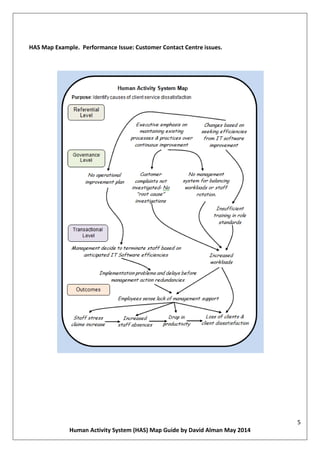
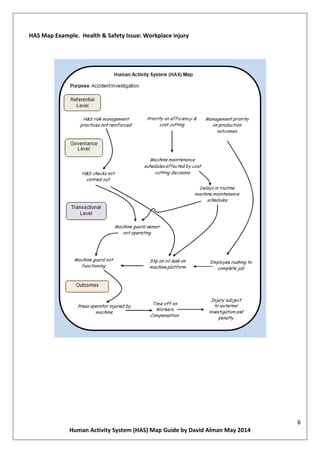
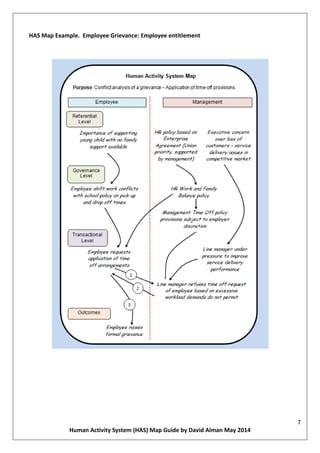
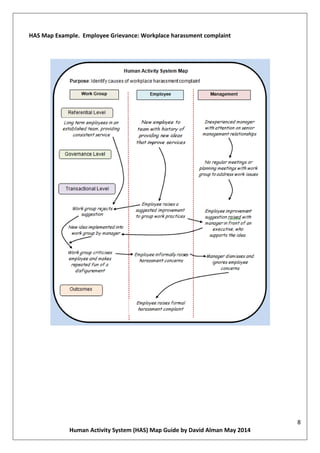
The following pages example HAS Maps covering a range of different problem situations, as follows:
 Performance Issue: Customer Contact Centre Service issues;
 Health & Safety Issue: Workplace injury;
 Employee Grievance: Employee entitlement;
 Employee Grievance: Workplace harassment complaint;
 Performance issue: IT Division performance issues
6
Guide to Human Activity System (HAS) Mapping Version 4 by David Alman May 2014
HAS Map Example. Performance Issue: Customer Contact Service.
7
Guide to Human Activity System (HAS) Mapping Version 4 by David Alman May 2014
HAS Map Example. Health & Safety Issue: Workplace injury
8
Guide to Human Activity System (HAS) Mapping Version 4 by David Alman May 2014
HAS Map Example. Employee Grievance: Employee entitlement
9
Guide to Human Activity System (HAS) Mapping Version 4 by David Alman May 2014
HAS Map Example. Employee Grievance: Workplace harassment complaint
10
Guide to Human Activity System (HAS) Mapping Version 4 by David Alman May 2014
3. Steps in developing a HAS Map
Step 1. Gather the story (to be used to develop the HAS Map) using, for example, the following question
about the problem situation’s events: What led/leads to what?
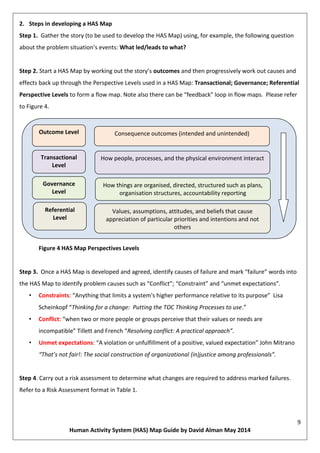
Step 2. Start a HAS Map by working out the story’s outcomes and then progressively work out causes and
effects back up through the Perspective Levels in a HAS Map: Transactional; Governance; Referential
Perspective Levels to form a flow map. Note also there can be “feedback” loops in flow maps. Please refer
to Diagram 2.
Diagram 2. HAS Map Perspectives Levels
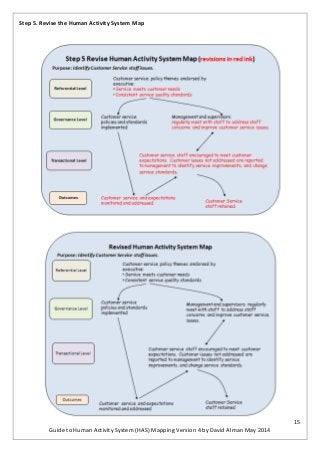
Step 3. Once a HAS Map is developed and agreed, identify causes of failure and mark “failure” words into
the HAS Map to identify problem causes such as “Conflict”; “Constraint” and “unmet expectations”.
• Constraints: “Anything that limits a system's higher performance relative to its purpose”.
Reference [6].
• Conflict: “when two or more people or groups perceive that their values or needs are
incompatible”. Reference [8].
• Unmet expectations: “A violation or unfulfillment of a positive, valued expectation”. Reference [9].
Outcome Level Consequence outcomes (intended and unintended)
Transactional
Level
How people, processes, and the physical environment interact
Governance
Level
How things are organised, directed, structured such as plans,
organisation structures, accountability reporting
Referential
Level
Values, assumptions, attitudes, and beliefs that cause
appreciation of particular priorities and intentions and not
others
11
Guide to Human Activity System (HAS) Mapping Version 4 by David Alman May 2014
Step 4. Carry out a risk assessment to determine what changes are required to address marked failures.
Refer to a Risk Assessment format in Table 4.
Perspective Level Causes of failure Risk Assessment Alternative options
Referential
Governance
Transactional
Outcomes
Table 4 Risk Assessment Template
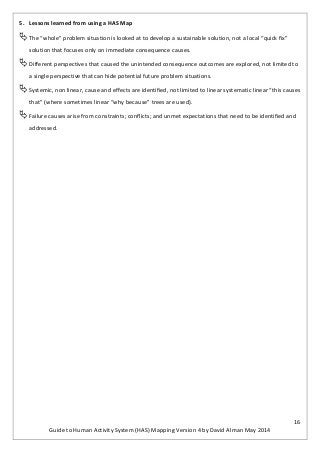
Step 5. Based on the risk assessment, develop a solutions based revised HAS Map.
In summary:
Step 1 Gather the story about the problem situation;
Step 2. Develop a HAS Map using HAS Map Perspective Levels
Step 3. Identify causes of failure
Step 4. Carry out a Risk Assessment to reset the HAS Map.
Step 5. Revise the Human Activity System (HAS) Map
The following pages provide an example of going through each Step in developing a HAS Map around a
problem situation.
12
Guide to Human Activity System (HAS) Mapping Version 4 by David Alman May 2014
4. An example of assessing, developing, and revising a HAS Map
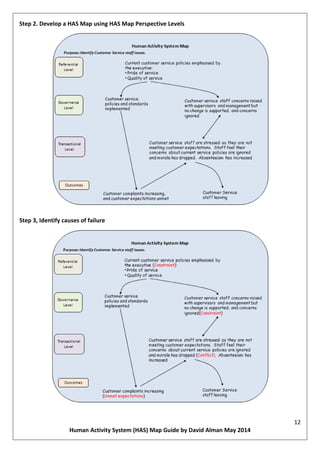
Step 1. Gather the story about the Problem Situation
The Story’s Consequences: Staff have faced increased customer dissatisfaction over the last few months.
This has increased employee absenteeism, dissatisfaction, and turnover.
The Story’s Key issues
 Customer complaints have caused employee stress and distress, and associated increased
employee disengagement, and absenteeism.
 Staff have raised their concerns with supervisors and more senior management both formally and
through e-mails and group meetings. No action is perceived to have been taken by management.
 Employees have also highlighted and expressed the view that the current customer service policies
and standards are poor and better offered by a competitor that is in the next building. This is
ignored by senior management whose view is that everyone works for a successful company that
values “pride of service” and “quality of service” as a priority. Employees also point out that their
competitor’s priority is “speed of service” and “meeting customer needs” that seems to meet
customer expectations.
See Step 2 HAS Map as a translation of this story’s key issues.
See Step 3 where the HAS Map identifies causes of failure in the story’s key issues. Words in red ink
reflect 3 aspects affecting the “Story” in terms of Interpersonal Conflicts; Work Constraints; and unmet
or violated expectations in a HAS Mapped problem situation.
13
Guide to Human Activity System (HAS) Mapping Version 4 by David Alman May 2014
Step 2. Develop a HAS Map using HAS Map Perspective Levels
Step 3. Identify causes of failure (e.g. Constraints, Conflicts, Unmet expectations)
14
Guide to Human Activity System (HAS) Mapping Version 4 by David Alman May 2014
Step 4. Carry out a Risk Assessment to reset the HAS Map.
Perspective
Level
Causes of failure Risk Assessment Alternative options
Referential Executive support
current policies
Current policies
increases loss of
customers and sales
Customer service policy themes
endorsed by executive:
• Service meets customer needs
• Consistent service quality
standards
Governance Managers and
supervisors do not
question reported
problems of
Customer Service
Policies
Lack of dialogue (and
records) can cause
additional conflict with
employees, and not
improve customer
service.
Management and supervisors regularly
meet with staff to address staff
concerns and improve customer service
issues.
Transactional Employee stress and
morale dropping
Absenteeism, drop in
confidence, and loss of
staff
Customer service staff encouraged to
meet customer expectations. Customer
issues not addressed are reported to
management to identify service
improvements, and change service
standards.
Outcomes Customer complaints
increasing
Loss of customers and
perception of services
Customer service and expectations
monitored and addressed
Customer Service
staff leaving
Employee resource
losses
Address Customer Service staff
concerns and complaints.
15
Guide to Human Activity System (HAS) Mapping Version 4 by David Alman May 2014
Step 5. Revise the Human Activity System Map
16
Guide to Human Activity System (HAS) Mapping Version 4 by David Alman May 2014
5. Lessons learned from using a HAS Map
The “whole” problem situation is looked at to develop a sustainable solution, not a local “quick fix”
solution that focuses only on immediate consequence causes.
Different perspectives that caused the unintended consequence outcomes are explored, not limited to
a single perspective that can hide potential future problem situations.
Systemic, non linear, cause and effects are identified, not limited to linear systematic linear “this causes
that” (where sometimes linear “why because” trees are used).
Failure causes arise from constraints; conflicts; and unmet expectations that need to be identified and
addressed.
17
Guide to Human Activity System (HAS) Mapping Version 4 by David Alman May 2014
Attachment 1 Systems Thinking Matrix with References included
PERSPECTIVE LEVELS
System Type
SYSTEMATIC SYSTEM
Linear “this causes that” systems
SYSTEMIC SYSTEM
Multiple “non linear” cause & effects
Multiple Perspectives
“Hierarchical” frameworks
and networks
 Triple loop of learning model
Reference Thorsten Wiki [2]
 Soft System Methodology (SSM)
Reference Alman [5]
 AcciMaps Reference Hopkins [3]
 Human Activity System Reference
Patching [4]
Single Perspective
“Flat” processes,
transactions, and network
exchanges
 ISO Management Systems
 IT systems and frameworks
 IM Systems
 Engineering & production systems
 Customer Service Systems
 HR Recruitment
 Performance and Diminished
performance management
 “Lean”
 Value Network Analysis (VNA)
 Theory of Constraints (TOC)
Reference Alman [5]
 System Archetypes
 System Dynamics
 Viable System Model (VSM)
Reference Alman [5]
18
Guide to Human Activity System (HAS) Mapping Version 4 by David Alman May 2014
References
[1] Rosalind Armson Growing wings on the way: Systems thinking for messy situations.
[2] Thorsten Wiki on the Triple Loop of Learning ref
http://www.thorsten.org/wiki/index.php?title=Triple_Loop_Learning
[3] Andrew Hopkins AcciMaps in use
http://www.efcog.org/wg/ism_pmi/docs/Safety_Culture/Hopkins_ACCIMAPS_in_use.pdf
[4] David Patching Practical Soft Systems Analysis.
[5] David Alman Using Systems Thinking to Improve Organisations ref
http://www.slideshare.net/davidalman/using-systems-thinking-to-improve-organisations
[6] Lisa Scheinkopf “Thinking for a change: Putting the TOC Thinking Processes to use.”
[7] Naiker, Hopcroft, and Moylan. Work domain analysis: Theoretical concepts and methodology
http://www.dtic.mil/dtic/tr/fulltext/u2/a449707.pdf . From this “Perspective Levels” are adapted from
Jens Rasmussen “Levels of abstraction” as explained in Notation 5 of the Human Activity System (HAS)
Mapping article by David Alman ref http://www.slideshare.net/davidalman/human-activity-system-has-
mapping
[8] Tillett and French “Resolving conflict: A practical approach”.
[9] John Mitrano “That’s not fair!: The social construction of organizational (in)justice among
professionals”.
About the author
David Alman is based in Brisbane, Queensland, Australia and has written a
number of blogs, articles, and, slides mainly based on Systems Thinking.
These can be found at his:
Google Site. Please refer to:
https://sites.google.com/site/proventivesolutions/human-activity-
system-has-mapping
And his
WordPress site, please refer to
http://davidalman.wordpress.com/human-activity-system-has-mapping/

Guide to Human Activity System (HAS) Mapping

  • 1.
    Guide to HumanActivity System (HAS) Mapping David Alman Version 4
  • 2.
    2 Guide to HumanActivity System (HAS) Mapping Version 4 by David Alman May 2014 Contents 1. What is a “System”? ...................................................................................................................................3 Please note that Attachment 1 replicates Table 1 Systems Thinking Matrix and includes References with reference numbers 2 to 6 supporting different system types in Table 1..........................................................3 2 What is a Human Activity System (HAS) Map?...........................................................................................4 2.1 A Human Activity System (HAS) Map is described as:.............................................................................4 2.2 What do HAS Maps do? ...........................................................................................................................4 2.3 HAS Map examples ..................................................................................................................................5 3. Steps in developing a HAS Map................................................................................................................10 4. An example of assessing, developing, and revising a HAS Map..............................................................12 Step 1. Gather the story about the Problem Situation...............................................................................12 Step 2. Develop a HAS Map using HAS Map Perspective Levels .................................................................13 Step 3. Identify causes of failure (e.g. Constraints, Conflicts, Unmet expectations) ..................................13 Step 4. Carry out a Risk Assessment to reset the HAS Map. .......................................................................14 Step 5. Revise the Human Activity System Map..........................................................................................15 5. Lessons learned from using a HAS Map ...................................................................................................16 Attachment 1 Systems Thinking Matrix with References included.................................................................17 References .......................................................................................................................................................18 About the author .............................................................................................................................................18
  • 3.
    3 Guide to HumanActivity System (HAS) Mapping Version 4 by David Alman May 2014 1. What is a “System”? “A system is a collection of elements connected together to form a purposeful whole with properties that differ from those of its component parts” Reference [1]. There are many forms of systems such as computers; computer software; machinery equipment; work groups, financial budgets, HR recruitment processes, corporate plans and programs; projects; and much more. These are exampled in the Systems Thinking Matrix in Table 1, which indicates that systems differ because of their: System Type. That is whether the system type is either: a) Systematic. Logical, rational, “linear” cause and effects. Where “this causes that”. OR b) Systemic. Multiple “non linear” cause and effects that result in either expected or unexpected outcomes. Perspective Level. That is whether the perspective, or way of seeing an issue, is either: a) “Hierarchical” Frameworks or Networks with multiple ways (perspectives) to consider what is involved in an issue; OR b) “Flat” processes, transactions, and network exchanges with a single way (perspective) to consider an issue. PERSPECTIVE LEVEL System Type SYSTEMATIC SYSTEM Linear “this causes that” systems SYSTEMIC SYSTEM Multiple “non linear” cause & effects Multiple Perspectives “Hierarchical” frameworks and networks  Triple loop of learning model  Soft Systems Methodology (SSM)  AcciMaps  Human Activity Systems (HAS) Single Perspective “Flat” processes, transactions, and network exchanges  ISO Management Systems  IT systems and frameworks  IM Systems  Engineering & production systems  Customer service systems  HR Recruitment  Performance and Diminished performance management  “Lean”  Value Network Analysis (VNA)  Theory of Constraints (TOC)  Viable System Model (VSM)  System Archetypes  System Dynamics Table 1. Systems Thinking Matrix Please note that Attachment 1 replicates Table 1 Systems Thinking Matrix and includes References with reference numbers 2 to 6 supporting different system types in Table 1.
  • 4.
    4 Guide to HumanActivity System (HAS) Mapping Version 4 by David Alman May 2014 2 What is a Human Activity System (HAS) Map? 2.1 A Human Activity System (HAS) Map is described as: “A visual flow map illustrating a situation as a whole through interrelated, interacting, and interdependent elements, that are also viewed from different perspectives” 2.2 What do HAS Maps do?  Identify causes of unwanted consequences for an organisation; Identify causes to unintended consequences Use a “Systemic” system model to link causes to consequences. These causes are direct or indirect - “hidden” – causes that if not addressed can result in repeated unwanted consequences. This is exampled in the Human Activity System (HAS) model shown in Diagram 1. Diagram 1. Human Activity System (HAS) Model A HAS Map also recognises and assesses different focus, attention, or perspectives when looking at problems to understand issues involved. In this respect there are three perspectives used in HAS Mapping. Reference [7]: Referential perspectives such as values, assumptions, attitudes, and beliefs that cause appreciation of particular priorities and intentions and not others. Governance Perspective How things are organised, directed, structured such as plans, organisation structures, accountability reporting.  Transactional Perspective How people (e.g. individuals and groups), processes, and physical environment interact. Referential Level E.g. Values, priorities, assumptions Transactional Level Social, process, physical interactions Governance Level Designed processes, practices, structures, systems, rules, policies etc Outcomes Either purposeful or unintended consequences
  • 5.
    5 Guide to HumanActivity System (HAS) Mapping Version 4 by David Alman May 2014 Table 2 examples “problem situations” that HAS Maps can map in terms of (non linear - systemic) cause and effects. Table 2. Example of problem situations that can be HAS Mapped 2.3 HAS Map examples HAS Map examples are provided over the next pages where event causes and consequences are flow mapped through Perspective Levels. Please refer to Table 3. Table 3. HAS Map Examples Examples of problem situations that a Human Activity System (HAS) can assess and “map” include: In Human Resource Management (HRM): • Accidents & Incidents • Harassment & bullying & (work environment) stress related matters • Grievance & conflict management issues • Role and workplace performance & productivity • Change management program performance In IT and IM • Implementation of IT frameworks e.g. ITIL • IT changes • Project management performance • Client complaint management In Organisational Services • Service quality and efficiency • Customer/client dissatisfaction • Environmental risks HAS Map Examples The following pages example HAS Maps covering a range of different problem situations, as follows:  Performance Issue: Customer Contact Centre Service issues;  Health & Safety Issue: Workplace injury;  Employee Grievance: Employee entitlement;  Employee Grievance: Workplace harassment complaint;  Performance issue: IT Division performance issues
  • 6.
    6 Guide to HumanActivity System (HAS) Mapping Version 4 by David Alman May 2014 HAS Map Example. Performance Issue: Customer Contact Service.
  • 7.
    7 Guide to HumanActivity System (HAS) Mapping Version 4 by David Alman May 2014 HAS Map Example. Health & Safety Issue: Workplace injury
  • 8.
    8 Guide to HumanActivity System (HAS) Mapping Version 4 by David Alman May 2014 HAS Map Example. Employee Grievance: Employee entitlement
  • 9.
    9 Guide to HumanActivity System (HAS) Mapping Version 4 by David Alman May 2014 HAS Map Example. Employee Grievance: Workplace harassment complaint
  • 10.
    10 Guide to HumanActivity System (HAS) Mapping Version 4 by David Alman May 2014 3. Steps in developing a HAS Map Step 1. Gather the story (to be used to develop the HAS Map) using, for example, the following question about the problem situation’s events: What led/leads to what? Step 2. Start a HAS Map by working out the story’s outcomes and then progressively work out causes and effects back up through the Perspective Levels in a HAS Map: Transactional; Governance; Referential Perspective Levels to form a flow map. Note also there can be “feedback” loops in flow maps. Please refer to Diagram 2. Diagram 2. HAS Map Perspectives Levels Step 3. Once a HAS Map is developed and agreed, identify causes of failure and mark “failure” words into the HAS Map to identify problem causes such as “Conflict”; “Constraint” and “unmet expectations”. • Constraints: “Anything that limits a system's higher performance relative to its purpose”. Reference [6]. • Conflict: “when two or more people or groups perceive that their values or needs are incompatible”. Reference [8]. • Unmet expectations: “A violation or unfulfillment of a positive, valued expectation”. Reference [9]. Outcome Level Consequence outcomes (intended and unintended) Transactional Level How people, processes, and the physical environment interact Governance Level How things are organised, directed, structured such as plans, organisation structures, accountability reporting Referential Level Values, assumptions, attitudes, and beliefs that cause appreciation of particular priorities and intentions and not others
  • 11.
    11 Guide to HumanActivity System (HAS) Mapping Version 4 by David Alman May 2014 Step 4. Carry out a risk assessment to determine what changes are required to address marked failures. Refer to a Risk Assessment format in Table 4. Perspective Level Causes of failure Risk Assessment Alternative options Referential Governance Transactional Outcomes Table 4 Risk Assessment Template Step 5. Based on the risk assessment, develop a solutions based revised HAS Map. In summary: Step 1 Gather the story about the problem situation; Step 2. Develop a HAS Map using HAS Map Perspective Levels Step 3. Identify causes of failure Step 4. Carry out a Risk Assessment to reset the HAS Map. Step 5. Revise the Human Activity System (HAS) Map The following pages provide an example of going through each Step in developing a HAS Map around a problem situation.
  • 12.
    12 Guide to HumanActivity System (HAS) Mapping Version 4 by David Alman May 2014 4. An example of assessing, developing, and revising a HAS Map Step 1. Gather the story about the Problem Situation The Story’s Consequences: Staff have faced increased customer dissatisfaction over the last few months. This has increased employee absenteeism, dissatisfaction, and turnover. The Story’s Key issues  Customer complaints have caused employee stress and distress, and associated increased employee disengagement, and absenteeism.  Staff have raised their concerns with supervisors and more senior management both formally and through e-mails and group meetings. No action is perceived to have been taken by management.  Employees have also highlighted and expressed the view that the current customer service policies and standards are poor and better offered by a competitor that is in the next building. This is ignored by senior management whose view is that everyone works for a successful company that values “pride of service” and “quality of service” as a priority. Employees also point out that their competitor’s priority is “speed of service” and “meeting customer needs” that seems to meet customer expectations. See Step 2 HAS Map as a translation of this story’s key issues. See Step 3 where the HAS Map identifies causes of failure in the story’s key issues. Words in red ink reflect 3 aspects affecting the “Story” in terms of Interpersonal Conflicts; Work Constraints; and unmet or violated expectations in a HAS Mapped problem situation.
  • 13.
    13 Guide to HumanActivity System (HAS) Mapping Version 4 by David Alman May 2014 Step 2. Develop a HAS Map using HAS Map Perspective Levels Step 3. Identify causes of failure (e.g. Constraints, Conflicts, Unmet expectations)
  • 14.
    14 Guide to HumanActivity System (HAS) Mapping Version 4 by David Alman May 2014 Step 4. Carry out a Risk Assessment to reset the HAS Map. Perspective Level Causes of failure Risk Assessment Alternative options Referential Executive support current policies Current policies increases loss of customers and sales Customer service policy themes endorsed by executive: • Service meets customer needs • Consistent service quality standards Governance Managers and supervisors do not question reported problems of Customer Service Policies Lack of dialogue (and records) can cause additional conflict with employees, and not improve customer service. Management and supervisors regularly meet with staff to address staff concerns and improve customer service issues. Transactional Employee stress and morale dropping Absenteeism, drop in confidence, and loss of staff Customer service staff encouraged to meet customer expectations. Customer issues not addressed are reported to management to identify service improvements, and change service standards. Outcomes Customer complaints increasing Loss of customers and perception of services Customer service and expectations monitored and addressed Customer Service staff leaving Employee resource losses Address Customer Service staff concerns and complaints.
  • 15.
    15 Guide to HumanActivity System (HAS) Mapping Version 4 by David Alman May 2014 Step 5. Revise the Human Activity System Map
  • 16.
    16 Guide to HumanActivity System (HAS) Mapping Version 4 by David Alman May 2014 5. Lessons learned from using a HAS Map The “whole” problem situation is looked at to develop a sustainable solution, not a local “quick fix” solution that focuses only on immediate consequence causes. Different perspectives that caused the unintended consequence outcomes are explored, not limited to a single perspective that can hide potential future problem situations. Systemic, non linear, cause and effects are identified, not limited to linear systematic linear “this causes that” (where sometimes linear “why because” trees are used). Failure causes arise from constraints; conflicts; and unmet expectations that need to be identified and addressed.
  • 17.
    17 Guide to HumanActivity System (HAS) Mapping Version 4 by David Alman May 2014 Attachment 1 Systems Thinking Matrix with References included PERSPECTIVE LEVELS System Type SYSTEMATIC SYSTEM Linear “this causes that” systems SYSTEMIC SYSTEM Multiple “non linear” cause & effects Multiple Perspectives “Hierarchical” frameworks and networks  Triple loop of learning model Reference Thorsten Wiki [2]  Soft System Methodology (SSM) Reference Alman [5]  AcciMaps Reference Hopkins [3]  Human Activity System Reference Patching [4] Single Perspective “Flat” processes, transactions, and network exchanges  ISO Management Systems  IT systems and frameworks  IM Systems  Engineering & production systems  Customer Service Systems  HR Recruitment  Performance and Diminished performance management  “Lean”  Value Network Analysis (VNA)  Theory of Constraints (TOC) Reference Alman [5]  System Archetypes  System Dynamics  Viable System Model (VSM) Reference Alman [5]
  • 18.
    18 Guide to HumanActivity System (HAS) Mapping Version 4 by David Alman May 2014 References [1] Rosalind Armson Growing wings on the way: Systems thinking for messy situations. [2] Thorsten Wiki on the Triple Loop of Learning ref http://www.thorsten.org/wiki/index.php?title=Triple_Loop_Learning [3] Andrew Hopkins AcciMaps in use http://www.efcog.org/wg/ism_pmi/docs/Safety_Culture/Hopkins_ACCIMAPS_in_use.pdf [4] David Patching Practical Soft Systems Analysis. [5] David Alman Using Systems Thinking to Improve Organisations ref http://www.slideshare.net/davidalman/using-systems-thinking-to-improve-organisations [6] Lisa Scheinkopf “Thinking for a change: Putting the TOC Thinking Processes to use.” [7] Naiker, Hopcroft, and Moylan. Work domain analysis: Theoretical concepts and methodology http://www.dtic.mil/dtic/tr/fulltext/u2/a449707.pdf . From this “Perspective Levels” are adapted from Jens Rasmussen “Levels of abstraction” as explained in Notation 5 of the Human Activity System (HAS) Mapping article by David Alman ref http://www.slideshare.net/davidalman/human-activity-system-has- mapping [8] Tillett and French “Resolving conflict: A practical approach”. [9] John Mitrano “That’s not fair!: The social construction of organizational (in)justice among professionals”. About the author David Alman is based in Brisbane, Queensland, Australia and has written a number of blogs, articles, and, slides mainly based on Systems Thinking. These can be found at his: Google Site. Please refer to: https://sites.google.com/site/proventivesolutions/human-activity- system-has-mapping And his WordPress site, please refer to http://davidalman.wordpress.com/human-activity-system-has-mapping/