HTML Bootcamp

 MAYECREATE DESIGN
What We’ll be Going Over:

 How a website works
 What HTML is
 How to write HTML
 CSS, HTML’s stylish best friend
 HTML in WordPress
 What NOT to do with your new skills
 Beyond Bootcamp
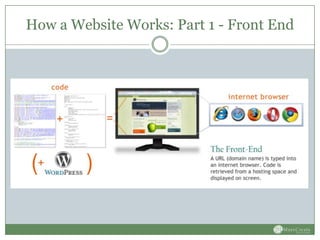
How a Website Works: Part 1 - Front End
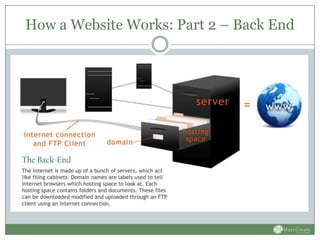
How a Website Works: Part 2 – Back End
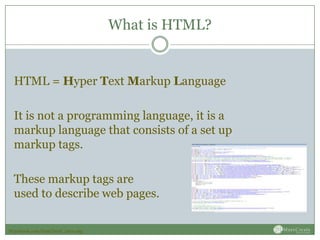
What is HTML?


  HTML = Hyper Text Markup Language

  It is not a programming language, it is a
  markup language that consists of a set up
  markup tags.

  These markup tags are
  used to describe web pages.

W3schools.com/html/html_intro.asp
What are tags?


   Tags surround plain text and describe web pages.
   They are keywords or letters surrounded by angle
      brackets like:
                                    <html>
   They normally come in pairs:
                                    <body>   </body>
   The first tag is a start tag (aka an opening tag)
      & the second is an end tag (aka closing tag)


W3schools.com/html/html_intro.asp
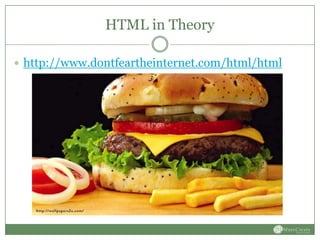
HTML in Theory

 http://www.dontfeartheinternet.com/html/html
What You’ll Need:

To Write:
 Text Editing Program
    We use Dreamweaver
    TextWrangler for Mac or Komodo Edit for PC users (free)
    Notepad also works

                          To Publish:
                           Hosting Space
                           FTP Credentials
                           FTP Program
Do You Have What You Need?


   ARE THERE ANY QUESTIONS SO FAR?
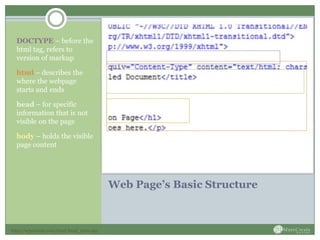
DOCTYPE – before the
  html tag, refers to
  version of markup

  html – describes the
  where the webpage
  starts and ends

  head – for specific
  information that is not
  visible on the page

  body – holds the visible
  page content


                                           Web Page’s Basic Structure


http://w3schools.com/html/html_intro.asp
Common Tags

  a                                                  head
  address                                            html
  blockquote                                         img
  body                                               li
  br                                                 link
  div                                                ol
  em                                                 p
  h1                                                 span
  h2                                                 strong
  h3                                                 style
  h4                                                 strong
  h5                                                 title
  h6                                                 ul


http://www.dontfeartheinternet.com/html/html
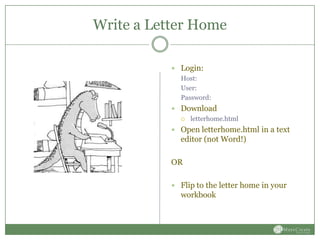
Write a Letter Home

            Login:
             Host:
             User:
             Password:
            Download
              letterhome.html

            Open letterhome.html in a text
             editor (not Word!)

           OR

            Flip to the letter home in your
             workbook
Add Tags To Your Letter Home


 Start your document <html>


 Start and End your head and body:

 <head></head> and <body></body>

 End your document </html>
Edit Your Letter Home


             Fill in the blanks/replace the
              all CAPS text
             Insert the following tags where you
              think they go:
                 title
                 h1
                 h2
                 p
                 strong
                 ol
                 ul
                 li
                 a
                 em
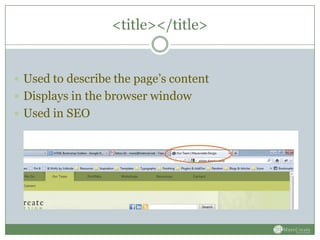
<title></title>


 Used to describe the page’s content
 Displays in the browser window
 Used in SEO
<h1></h1>


 Most important title on the page
 Only use it once per page!
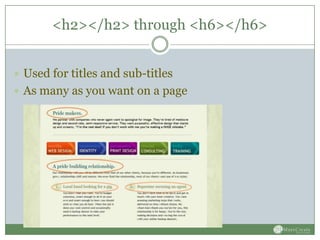
<h2></h2> through <h6></h6>


 Used for titles and sub-titles
 As many as you want on a page
<p></p>


 Used to create paragraphs
 As many as you want on a page
 Often has other tags within it
<strong></strong> & <em></em>


 Used to create bold or italicized text
 Can be used within other tags
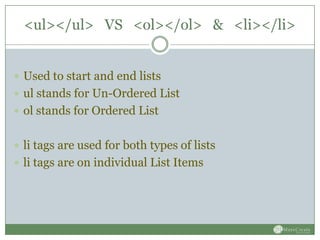
<ul></ul> VS <ol></ol> & <li></li>


 Used to start and end lists
 ul stands for Un-Ordered List
 ol stands for Ordered List


 li tags are used for both types of lists
 li tags are on individual List Items
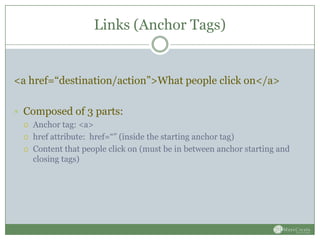
Links (Anchor Tags)


<a href=“destination/action”>What people click on</a>

 Composed of 3 parts:
    Anchor tag: <a>
    href attribute: href=“” (inside the starting anchor tag)
    Content that people click on (must be in between anchor starting and
     closing tags)
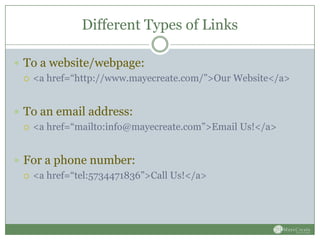
Different Types of Links

 To a website/webpage:
   <a href=“http://www.mayecreate.com/”>Our Website</a>


 To an email address:
   <a href=“mailto:info@mayecreate.com”>Email Us!</a>


 For a phone number:
   <a href=“tel:5734471836”>Call Us!</a>
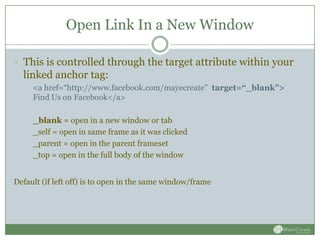
Open Link In a New Window

 This is controlled through the target attribute within your
  linked anchor tag:
     <a href=“http://www.facebook.com/mayecreate” target=“_blank”>
     Find Us on Facebook</a>

     _blank = open in a new window or tab
     _self = open in same frame as it was clicked
     _parent = open in the parent frameset
     _top = open in the full body of the window


Default (if left off) is to open in the same window/frame
Images

<img src=“http://mayecreate.com/images/filename.jpg”
height=“150” width=“100” />

 Composed of 3 parts:
    tag: <img />
        *Self-closing tag – don’t need </img>
    src attribute: src=“”
        inside the address of exactly where the image lives online
    dimensions: height=“” width=“”
        if left off, image will display at full size
        this is in pixels automatically, but percent can also be used
Images


 Image are great for adding interest
 If they are too big, they can increase loading time


 Keep loading time down by making images for web:
   72 ppi (pixels per inch) = web resolution

   Less than 700 pixels tall or 700 pixels wide
Image File Types


 JPG = white background, best for gradients


 GIF = for web, not really useable by other programs,
        can have transparent background, or not

 PNG = best for transparent backgrounds
Common Mistakes

 It is very common for the following mistakes to
 happen when using HTML:
    Mis-spellings (reference your tags list)
    Brackets are missing
    Tags don’t close
     </tag>            tag = whatever tag you are trying to close
    Tags open and close, but don’t match
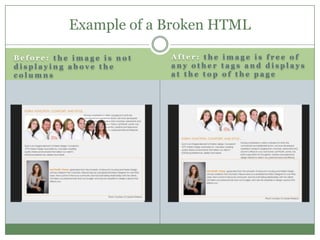
Example of a Broken HTML

Before: the image is not   After: the image is free of
displaying above the       any other tags and displays
columns                    at the top of the page
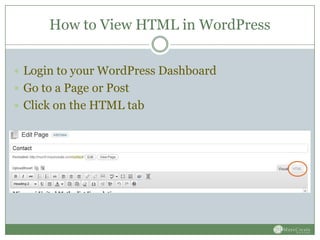
How to View HTML in WordPress


 Login to your WordPress Dashboard
 Go to a Page or Post
 Click on the HTML tab
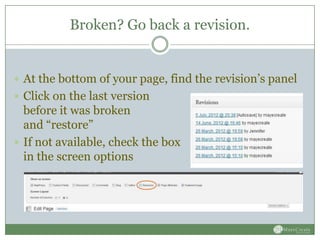
Broken? Go back a revision.


 At the bottom of your page, find the revision’s panel
 Click on the last version
  before it was broken
  and “restore”
 If not available, check the box
  in the screen options
Practice Proofing


 Mistakes happen… using what you’ve learned so
 far, can you find the 7 mistakes in the
 proof_letterhome.html file? (see workbook)
    Hints:
      If it opens, it must close
      It must be spelled correctly
      All tags need to be held in < >
HTML’s Stylish Best Friend: CSS


 All web browsers have default styles for the standard
  html tags.
 We use CSS to style elements so they look cleaner
  and fit the style of the website/client

 This is accomplished through CSS
What is CSS?


 CSS stands for: Cascading Style Sheets
 It is a language of styles that tell browsers how to
 display HTML elements
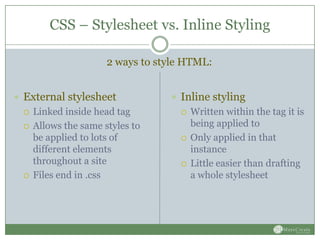
CSS – Stylesheet vs. Inline Styling
                      2 ways to style HTML:


 External stylesheet              Inline styling
    Linked inside head tag            Written within the tag it is
    Allows the same styles to          being applied to
     be applied to lots of             Only applied in that
     different elements                 instance
     throughout a site                 Little easier than drafting
    Files end in .css                  a whole stylesheet
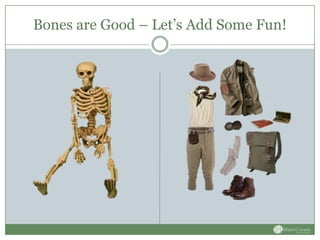
Bones are Good – Let’s Add Some Fun!
Inline Styles


 Within the tag you are wanting to change, you must
 add the style attribute:

       <p style=“ ”>Text I want to change</p>

 This is where we will be telling it how to look
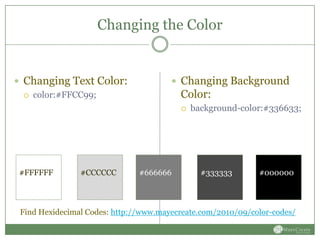
Changing the Color


 Changing Text Color:                  Changing Background
    color:#FFCC99;                      Color:
                                            background-color:#336633;


 #FFFFFF        #CCCCCC        #666666         #333333       #000000


 Find Hexidecimal Codes: http://www.mayecreate.com/2010/09/color-codes/
Typeface Changes

 This can be done by defining your font family using:


  font-family: Trebuchet MS, Arial, Helvetica, sans-serif;


 Its important to list several typefaces, so if the device being
  used to view your page doesn’t have it, it depreciates to the
  next best thing.

 There are several fonts that are considered universal
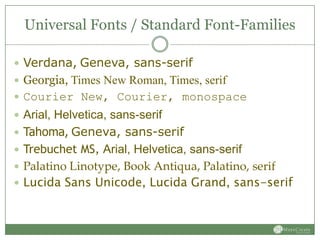
Universal Fonts / Standard Font-Families

 Verdana, Geneva, sans-serif
 Georgia, Times New Roman, Times, serif
 Courier New, Courier, monospace
 Arial, Helvetica, sans-serif
 Tahoma, Geneva, sans-serif
 Trebuchet MS, Arial, Helvetica, sans-serif
 Palatino Linotype, Book Antiqua, Palatino, serif
 Lucida Sans Unicode, Lucida Grand, sans-serif
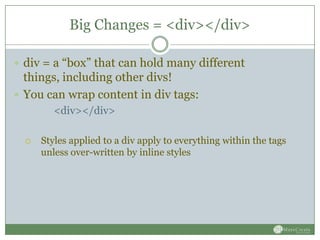
Big Changes = <div></div>

 div = a “box” that can hold many different
  things, including other divs!
 You can wrap content in div tags:
         <div></div>

     Styles applied to a div apply to everything within the tags
      unless over-written by inline styles
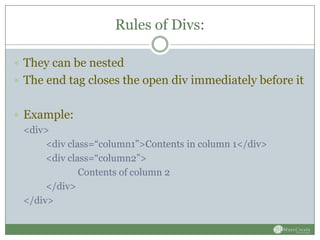
Rules of Divs:

 They can be nested
 The end tag closes the open div immediately before it


 Example:
  <div>
       <div class=“column1”>Contents in column 1</div>
       <div class=“column2”>
               Contents of column 2
       </div>
  </div>
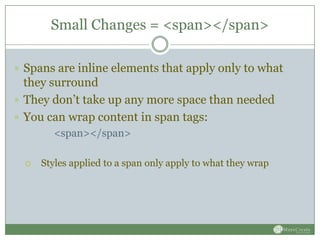
Small Changes = <span></span>

 Spans are inline elements that apply only to what
  they surround
 They don’t take up any more space than needed
 You can wrap content in span tags:
        <span></span>

     Styles applied to a span only apply to what they wrap
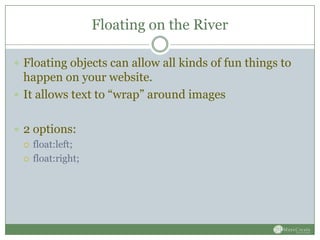
Floating on the River

 Floating objects can allow all kinds of fun things to
  happen on your website.
 It allows text to “wrap” around images


 2 options:
   float:left;

   float:right;
Rules of the River


 Float left unless absolutely necessary.


 If you float left, the text or other content that needs
 to move up to the right of the floating object can go
 before or after it.

 If floating right, the content that you want to appear
 to the left of the floating object must come after it.
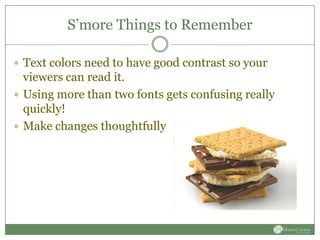
S’more Things to Remember

 Text colors need to have good contrast so your
  viewers can read it.
 Using more than two fonts gets confusing really
  quickly!
 Make changes thoughtfully
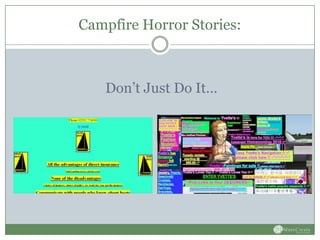
Campfire Horror Stories:


   Don’t Just Do It…
Questions?
What We Covered:

 How a website works
 What HTML is
 How to write HTML
 CSS, HTML’s stylish best friend
 HTML in WordPress
 What NOT to do with your new skills
 Beyond Bootcamp
Learn More @ Columbia Area Career Center


 This Fall, I’m teaching several classes:
     Designing Effective Publications
     Digital Publishing Standards
     Adobe InDesign Modules 1-4


 If interested, sign up at career-center.org/adult

HTML Bootcamp

  • 1.
  • 2.
    What We’ll beGoing Over:  How a website works  What HTML is  How to write HTML  CSS, HTML’s stylish best friend  HTML in WordPress  What NOT to do with your new skills  Beyond Bootcamp
  • 3.
    How a WebsiteWorks: Part 1 - Front End
  • 4.
    How a WebsiteWorks: Part 2 – Back End
  • 5.
    What is HTML? HTML = Hyper Text Markup Language It is not a programming language, it is a markup language that consists of a set up markup tags. These markup tags are used to describe web pages. W3schools.com/html/html_intro.asp
  • 6.
    What are tags?  Tags surround plain text and describe web pages.  They are keywords or letters surrounded by angle brackets like: <html>  They normally come in pairs: <body> </body>  The first tag is a start tag (aka an opening tag) & the second is an end tag (aka closing tag) W3schools.com/html/html_intro.asp
  • 7.
    HTML in Theory http://www.dontfeartheinternet.com/html/html
  • 8.
    What You’ll Need: ToWrite:  Text Editing Program  We use Dreamweaver  TextWrangler for Mac or Komodo Edit for PC users (free)  Notepad also works To Publish:  Hosting Space  FTP Credentials  FTP Program
  • 9.
    Do You HaveWhat You Need? ARE THERE ANY QUESTIONS SO FAR?
  • 10.
    DOCTYPE – beforethe html tag, refers to version of markup html – describes the where the webpage starts and ends head – for specific information that is not visible on the page body – holds the visible page content Web Page’s Basic Structure http://w3schools.com/html/html_intro.asp
  • 11.
    Common Tags a  head  address  html  blockquote  img  body  li  br  link  div  ol  em  p  h1  span  h2  strong  h3  style  h4  strong  h5  title  h6  ul http://www.dontfeartheinternet.com/html/html
  • 12.
    Write a LetterHome  Login: Host: User: Password:  Download  letterhome.html  Open letterhome.html in a text editor (not Word!) OR  Flip to the letter home in your workbook
  • 13.
    Add Tags ToYour Letter Home  Start your document <html>  Start and End your head and body: <head></head> and <body></body>  End your document </html>
  • 14.
    Edit Your LetterHome  Fill in the blanks/replace the all CAPS text  Insert the following tags where you think they go:  title  h1  h2  p  strong  ol  ul  li  a  em
  • 15.
    <title></title>  Used todescribe the page’s content  Displays in the browser window  Used in SEO
  • 16.
    <h1></h1>  Most importanttitle on the page  Only use it once per page!
  • 17.
    <h2></h2> through <h6></h6> Used for titles and sub-titles  As many as you want on a page
  • 18.
    <p></p>  Used tocreate paragraphs  As many as you want on a page  Often has other tags within it
  • 19.
    <strong></strong> & <em></em> Used to create bold or italicized text  Can be used within other tags
  • 20.
    <ul></ul> VS <ol></ol>& <li></li>  Used to start and end lists  ul stands for Un-Ordered List  ol stands for Ordered List  li tags are used for both types of lists  li tags are on individual List Items
  • 21.
    Links (Anchor Tags) <ahref=“destination/action”>What people click on</a>  Composed of 3 parts:  Anchor tag: <a>  href attribute: href=“” (inside the starting anchor tag)  Content that people click on (must be in between anchor starting and closing tags)
  • 22.
    Different Types ofLinks  To a website/webpage:  <a href=“http://www.mayecreate.com/”>Our Website</a>  To an email address:  <a href=“mailto:info@mayecreate.com”>Email Us!</a>  For a phone number:  <a href=“tel:5734471836”>Call Us!</a>
  • 23.
    Open Link Ina New Window  This is controlled through the target attribute within your linked anchor tag: <a href=“http://www.facebook.com/mayecreate” target=“_blank”> Find Us on Facebook</a> _blank = open in a new window or tab _self = open in same frame as it was clicked _parent = open in the parent frameset _top = open in the full body of the window Default (if left off) is to open in the same window/frame
  • 24.
    Images <img src=“http://mayecreate.com/images/filename.jpg” height=“150” width=“100”/>  Composed of 3 parts:  tag: <img />  *Self-closing tag – don’t need </img>  src attribute: src=“”  inside the address of exactly where the image lives online  dimensions: height=“” width=“”  if left off, image will display at full size  this is in pixels automatically, but percent can also be used
  • 25.
    Images  Image aregreat for adding interest  If they are too big, they can increase loading time  Keep loading time down by making images for web:  72 ppi (pixels per inch) = web resolution  Less than 700 pixels tall or 700 pixels wide
  • 26.
    Image File Types JPG = white background, best for gradients  GIF = for web, not really useable by other programs, can have transparent background, or not  PNG = best for transparent backgrounds
  • 27.
    Common Mistakes  Itis very common for the following mistakes to happen when using HTML:  Mis-spellings (reference your tags list)  Brackets are missing  Tags don’t close </tag> tag = whatever tag you are trying to close  Tags open and close, but don’t match
  • 28.
    Example of aBroken HTML Before: the image is not After: the image is free of displaying above the any other tags and displays columns at the top of the page
  • 29.
    How to ViewHTML in WordPress  Login to your WordPress Dashboard  Go to a Page or Post  Click on the HTML tab
  • 30.
    Broken? Go backa revision.  At the bottom of your page, find the revision’s panel  Click on the last version before it was broken and “restore”  If not available, check the box in the screen options
  • 31.
    Practice Proofing  Mistakeshappen… using what you’ve learned so far, can you find the 7 mistakes in the proof_letterhome.html file? (see workbook)  Hints:  If it opens, it must close  It must be spelled correctly  All tags need to be held in < >
  • 32.
    HTML’s Stylish BestFriend: CSS  All web browsers have default styles for the standard html tags.  We use CSS to style elements so they look cleaner and fit the style of the website/client  This is accomplished through CSS
  • 33.
    What is CSS? CSS stands for: Cascading Style Sheets  It is a language of styles that tell browsers how to display HTML elements
  • 34.
    CSS – Stylesheetvs. Inline Styling 2 ways to style HTML:  External stylesheet  Inline styling  Linked inside head tag  Written within the tag it is  Allows the same styles to being applied to be applied to lots of  Only applied in that different elements instance throughout a site  Little easier than drafting  Files end in .css a whole stylesheet
  • 35.
    Bones are Good– Let’s Add Some Fun!
  • 36.
    Inline Styles  Withinthe tag you are wanting to change, you must add the style attribute: <p style=“ ”>Text I want to change</p>  This is where we will be telling it how to look
  • 37.
    Changing the Color Changing Text Color:  Changing Background  color:#FFCC99; Color:  background-color:#336633; #FFFFFF #CCCCCC #666666 #333333 #000000 Find Hexidecimal Codes: http://www.mayecreate.com/2010/09/color-codes/
  • 38.
    Typeface Changes  Thiscan be done by defining your font family using: font-family: Trebuchet MS, Arial, Helvetica, sans-serif;  Its important to list several typefaces, so if the device being used to view your page doesn’t have it, it depreciates to the next best thing.  There are several fonts that are considered universal
  • 39.
    Universal Fonts /Standard Font-Families  Verdana, Geneva, sans-serif  Georgia, Times New Roman, Times, serif  Courier New, Courier, monospace  Arial, Helvetica, sans-serif  Tahoma, Geneva, sans-serif  Trebuchet MS, Arial, Helvetica, sans-serif  Palatino Linotype, Book Antiqua, Palatino, serif  Lucida Sans Unicode, Lucida Grand, sans-serif
  • 40.
    Big Changes =<div></div>  div = a “box” that can hold many different things, including other divs!  You can wrap content in div tags: <div></div>  Styles applied to a div apply to everything within the tags unless over-written by inline styles
  • 41.
    Rules of Divs: They can be nested  The end tag closes the open div immediately before it  Example: <div> <div class=“column1”>Contents in column 1</div> <div class=“column2”> Contents of column 2 </div> </div>
  • 42.
    Small Changes =<span></span>  Spans are inline elements that apply only to what they surround  They don’t take up any more space than needed  You can wrap content in span tags: <span></span>  Styles applied to a span only apply to what they wrap
  • 43.
    Floating on theRiver  Floating objects can allow all kinds of fun things to happen on your website.  It allows text to “wrap” around images  2 options:  float:left;  float:right;
  • 44.
    Rules of theRiver  Float left unless absolutely necessary.  If you float left, the text or other content that needs to move up to the right of the floating object can go before or after it.  If floating right, the content that you want to appear to the left of the floating object must come after it.
  • 45.
    S’more Things toRemember  Text colors need to have good contrast so your viewers can read it.  Using more than two fonts gets confusing really quickly!  Make changes thoughtfully
  • 46.
    Campfire Horror Stories: Don’t Just Do It…
  • 47.
  • 48.
    What We Covered: How a website works  What HTML is  How to write HTML  CSS, HTML’s stylish best friend  HTML in WordPress  What NOT to do with your new skills  Beyond Bootcamp
  • 49.
    Learn More @Columbia Area Career Center  This Fall, I’m teaching several classes:  Designing Effective Publications  Digital Publishing Standards  Adobe InDesign Modules 1-4  If interested, sign up at career-center.org/adult