HTML
Source: https://www.w3schools.com/html/default.asp
Prepared by: Engr. Juvywen M. Pollentes
TOPICS:
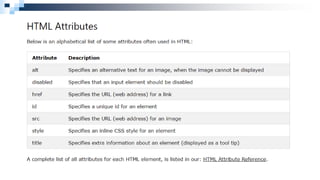
HTML Attributes
HTML Headings
HTML Paragraphs
HTML Styles
HTML Attributes
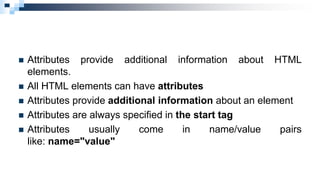
 Attributes provide additional information about HTML
elements.
 All HTML elements can have attributes
 Attributes provide additional information about an element
 Attributes are always specified in the start tag
 Attributes usually come in name/value pairs
like: name="value"
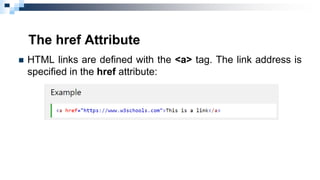
The href Attribute
 HTML links are defined with the <a> tag. The link address is
specified in the href attribute:
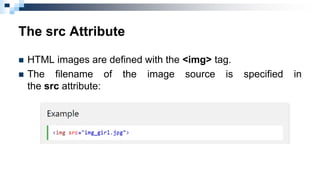
The src Attribute
 HTML images are defined with the <img> tag.
 The filename of the image source is specified in
the src attribute:
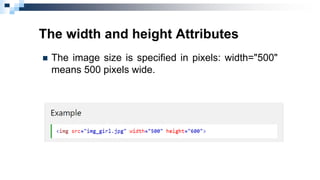
The width and height Attributes
 The image size is specified in pixels: width="500"
means 500 pixels wide.
The alt Attribute
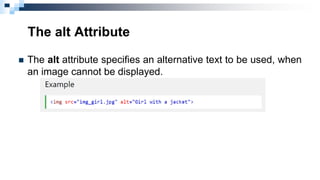
 The alt attribute specifies an alternative text to be used, when
an image cannot be displayed.
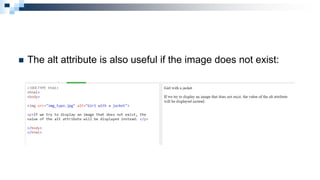
 The alt attribute is also useful if the image does not exist:
The style Attribute
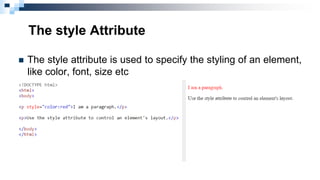
 The style attribute is used to specify the styling of an element,
like color, font, size etc
The lang Attribute
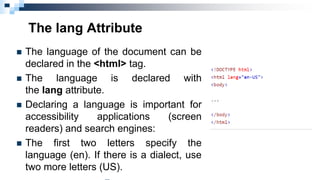
 The language of the document can be
declared in the <html> tag.
 The language is declared with
the lang attribute.
 Declaring a language is important for
accessibility applications (screen
readers) and search engines:
 The first two letters specify the
language (en). If there is a dialect, use
two more letters (US).
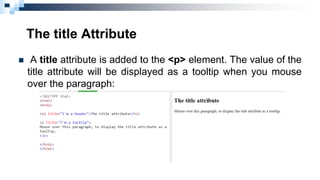
The title Attribute
 A title attribute is added to the <p> element. The value of the
title attribute will be displayed as a tooltip when you mouse
over the paragraph:
We Suggest: Use Lowercase Attributes
 The HTML5 standard does not require lowercase attribute
names.
 The title attribute can be written with uppercase or lowercase
like title or TITLE.
 W3C recommends lowercase in HTML,
and demands lowercase for stricter document types like
XHTML.
We Suggest: Quote Attribute Values
 The HTML5 standard does not require quotes around
attribute values.
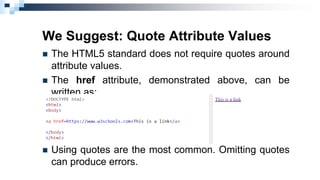
 The href attribute, demonstrated above, can be
written as:
 Using quotes are the most common. Omitting quotes
can produce errors.
Single or Double Quotes?
 Double quotes around attribute values are the most
common in HTML, but single quotes can also be used.
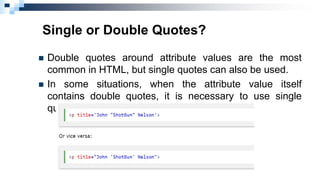
 In some situations, when the attribute value itself
contains double quotes, it is necessary to use single
quotes:
HTML Headings
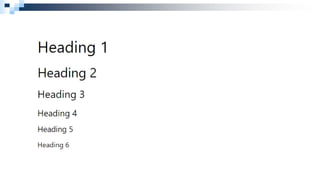
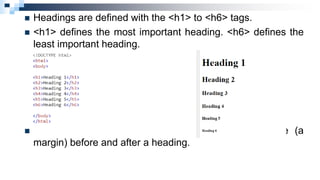
 Headings are defined with the <h1> to <h6> tags.
 <h1> defines the most important heading. <h6> defines the
least important heading.
 Note: Browsers automatically add some white space (a
margin) before and after a heading.
Headings Are Important
 Search engines use the headings to index the structure and
content of your web pages.
 Users skim your pages by its headings. It is important to use
headings to show the document structure.
 <h1> headings should be used for main headings, followed by
<h2> headings, then the less important <h3>, and so on.
 Note: Use HTML headings for headings only. Don't use
headings to make text BIG or bold.
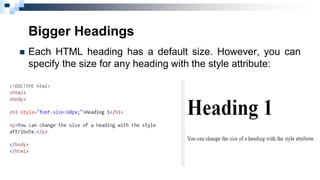
Bigger Headings
 Each HTML heading has a default size. However, you can
specify the size for any heading with the style attribute:
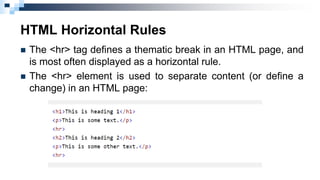
HTML Horizontal Rules
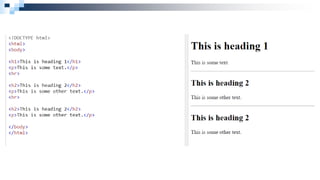
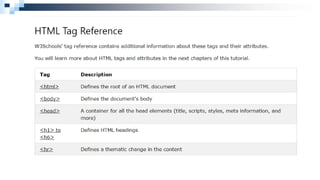
 The <hr> tag defines a thematic break in an HTML page, and
is most often displayed as a horizontal rule.
 The <hr> element is used to separate content (or define a
change) in an HTML page:
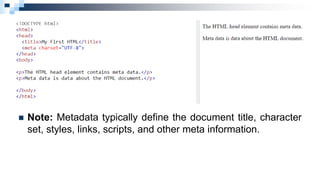
The HTML <head> Element
 The HTML <head> element has nothing to do with HTML
headings.
 The <head> element is a container for metadata. HTML
metadata is data about the HTML document. Metadata is not
displayed.
 The <head> element is placed between the <html> tag and
the <body> tag:
 Note: Metadata typically define the document title, character
set, styles, links, scripts, and other meta information.
How to View HTML Source?
View HTML Source Code:
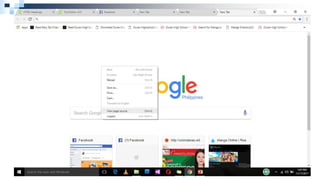
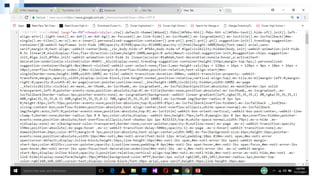
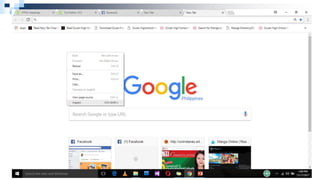
 To find out, right-click in the page and select "View Page
Source" (in Chrome) or "View Source" (in IE), or similar in
other browsers. This will open a window containing the HTML
source code of the page.
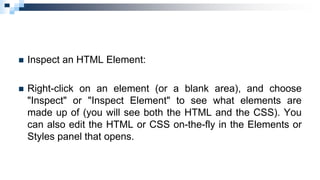
 Inspect an HTML Element:
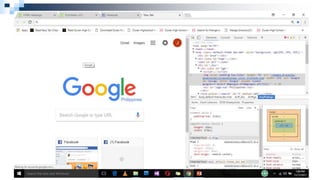
 Right-click on an element (or a blank area), and choose
"Inspect" or "Inspect Element" to see what elements are
made up of (you will see both the HTML and the CSS). You
can also edit the HTML or CSS on-the-fly in the Elements or
Styles panel that opens.
HTML Paragraphs
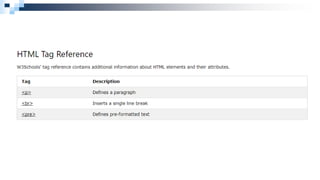
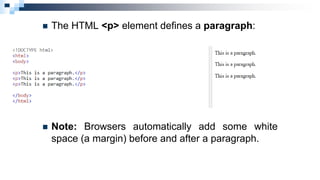
 The HTML <p> element defines a paragraph:
 Note: Browsers automatically add some white
space (a margin) before and after a paragraph.
HTML Display
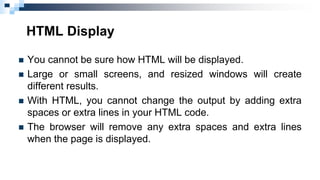
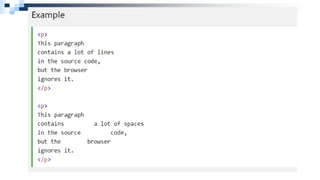
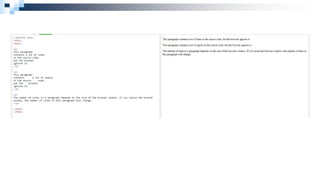
 You cannot be sure how HTML will be displayed.
 Large or small screens, and resized windows will create
different results.
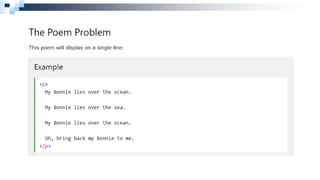
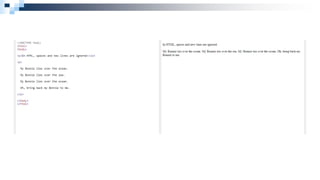
 With HTML, you cannot change the output by adding extra
spaces or extra lines in your HTML code.
 The browser will remove any extra spaces and extra lines
when the page is displayed.
Don't Forget the End Tag
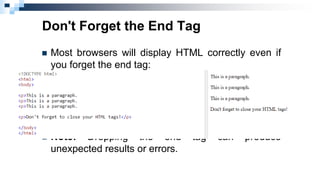
 Most browsers will display HTML correctly even if
you forget the end tag:
 Note: Dropping the end tag can produce
unexpected results or errors.
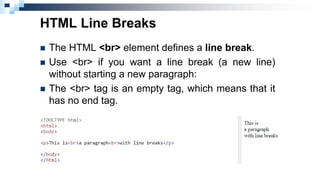
HTML Line Breaks
 The HTML <br> element defines a line break.
 Use <br> if you want a line break (a new line)
without starting a new paragraph:
 The <br> tag is an empty tag, which means that it
has no end tag.
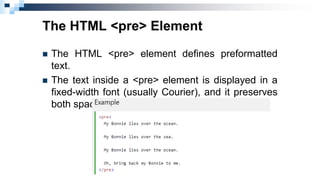
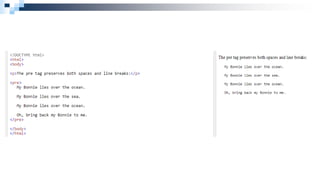
The HTML <pre> Element
 The HTML <pre> element defines preformatted
text.
 The text inside a <pre> element is displayed in a
fixed-width font (usually Courier), and it preserves
both spaces and line breaks:
HTML Styles
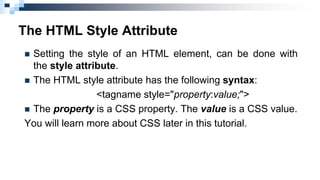
The HTML Style Attribute
 Setting the style of an HTML element, can be done with
the style attribute.
 The HTML style attribute has the following syntax:
<tagname style="property:value;">
 The property is a CSS property. The value is a CSS value.
You will learn more about CSS later in this tutorial.
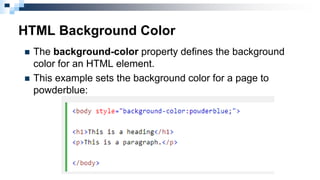
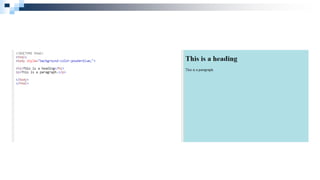
HTML Background Color
 The background-color property defines the background
color for an HTML element.
 This example sets the background color for a page to
powderblue:
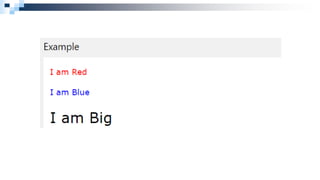
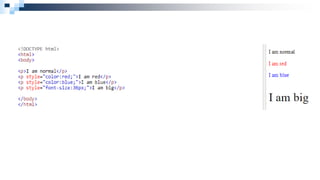
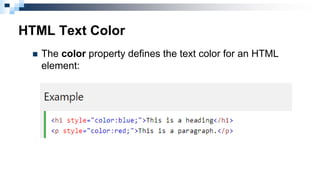
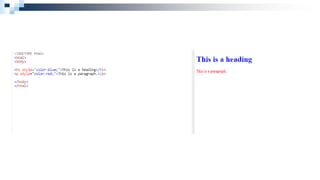
HTML Text Color
 The color property defines the text color for an HTML
element:
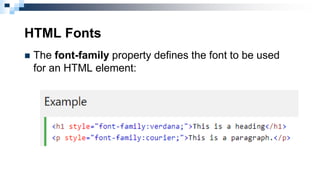
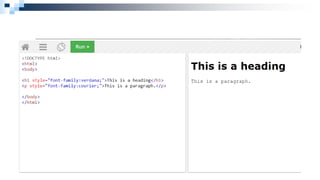
HTML Fonts
 The font-family property defines the font to be used
for an HTML element:
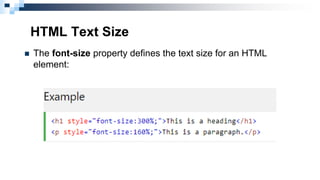
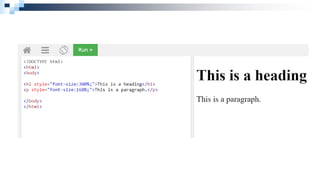
HTML Text Size
 The font-size property defines the text size for an HTML
element:
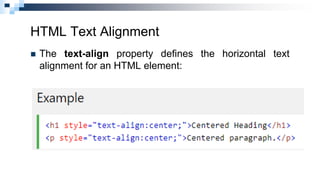
HTML Text Alignment
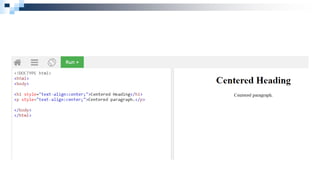
 The text-align property defines the horizontal text
alignment for an HTML element:
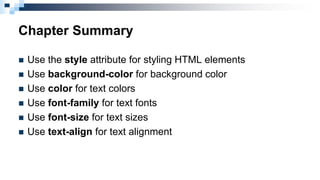
Chapter Summary
 Use the style attribute for styling HTML elements
 Use background-color for background color
 Use color for text colors
 Use font-family for text fonts
 Use font-size for text sizes
 Use text-align for text alignment

HTML 5 Topic 2

  • 1.
  • 2.
  • 3.
  • 4.
     Attributes provideadditional information about HTML elements.  All HTML elements can have attributes  Attributes provide additional information about an element  Attributes are always specified in the start tag  Attributes usually come in name/value pairs like: name="value"
  • 5.
    The href Attribute HTML links are defined with the <a> tag. The link address is specified in the href attribute:
  • 6.
    The src Attribute HTML images are defined with the <img> tag.  The filename of the image source is specified in the src attribute:
  • 7.
    The width andheight Attributes  The image size is specified in pixels: width="500" means 500 pixels wide.
  • 8.
    The alt Attribute The alt attribute specifies an alternative text to be used, when an image cannot be displayed.
  • 9.
     The altattribute is also useful if the image does not exist:
  • 10.
    The style Attribute The style attribute is used to specify the styling of an element, like color, font, size etc
  • 11.
    The lang Attribute The language of the document can be declared in the <html> tag.  The language is declared with the lang attribute.  Declaring a language is important for accessibility applications (screen readers) and search engines:  The first two letters specify the language (en). If there is a dialect, use two more letters (US).
  • 12.
    The title Attribute A title attribute is added to the <p> element. The value of the title attribute will be displayed as a tooltip when you mouse over the paragraph:
  • 13.
    We Suggest: UseLowercase Attributes  The HTML5 standard does not require lowercase attribute names.  The title attribute can be written with uppercase or lowercase like title or TITLE.  W3C recommends lowercase in HTML, and demands lowercase for stricter document types like XHTML.
  • 14.
    We Suggest: QuoteAttribute Values  The HTML5 standard does not require quotes around attribute values.  The href attribute, demonstrated above, can be written as:  Using quotes are the most common. Omitting quotes can produce errors.
  • 15.
    Single or DoubleQuotes?  Double quotes around attribute values are the most common in HTML, but single quotes can also be used.  In some situations, when the attribute value itself contains double quotes, it is necessary to use single quotes:
  • 17.
  • 19.
     Headings aredefined with the <h1> to <h6> tags.  <h1> defines the most important heading. <h6> defines the least important heading.  Note: Browsers automatically add some white space (a margin) before and after a heading.
  • 20.
    Headings Are Important Search engines use the headings to index the structure and content of your web pages.  Users skim your pages by its headings. It is important to use headings to show the document structure.  <h1> headings should be used for main headings, followed by <h2> headings, then the less important <h3>, and so on.  Note: Use HTML headings for headings only. Don't use headings to make text BIG or bold.
  • 21.
    Bigger Headings  EachHTML heading has a default size. However, you can specify the size for any heading with the style attribute:
  • 22.
    HTML Horizontal Rules The <hr> tag defines a thematic break in an HTML page, and is most often displayed as a horizontal rule.  The <hr> element is used to separate content (or define a change) in an HTML page:
  • 24.
    The HTML <head>Element  The HTML <head> element has nothing to do with HTML headings.  The <head> element is a container for metadata. HTML metadata is data about the HTML document. Metadata is not displayed.  The <head> element is placed between the <html> tag and the <body> tag:
  • 25.
     Note: Metadatatypically define the document title, character set, styles, links, scripts, and other meta information.
  • 26.
    How to ViewHTML Source? View HTML Source Code:  To find out, right-click in the page and select "View Page Source" (in Chrome) or "View Source" (in IE), or similar in other browsers. This will open a window containing the HTML source code of the page.
  • 29.
     Inspect anHTML Element:  Right-click on an element (or a blank area), and choose "Inspect" or "Inspect Element" to see what elements are made up of (you will see both the HTML and the CSS). You can also edit the HTML or CSS on-the-fly in the Elements or Styles panel that opens.
  • 33.
  • 34.
     The HTML<p> element defines a paragraph:  Note: Browsers automatically add some white space (a margin) before and after a paragraph.
  • 35.
    HTML Display  Youcannot be sure how HTML will be displayed.  Large or small screens, and resized windows will create different results.  With HTML, you cannot change the output by adding extra spaces or extra lines in your HTML code.  The browser will remove any extra spaces and extra lines when the page is displayed.
  • 38.
    Don't Forget theEnd Tag  Most browsers will display HTML correctly even if you forget the end tag:  Note: Dropping the end tag can produce unexpected results or errors.
  • 39.
    HTML Line Breaks The HTML <br> element defines a line break.  Use <br> if you want a line break (a new line) without starting a new paragraph:  The <br> tag is an empty tag, which means that it has no end tag.
  • 42.
    The HTML <pre>Element  The HTML <pre> element defines preformatted text.  The text inside a <pre> element is displayed in a fixed-width font (usually Courier), and it preserves both spaces and line breaks:
  • 45.
  • 48.
    The HTML StyleAttribute  Setting the style of an HTML element, can be done with the style attribute.  The HTML style attribute has the following syntax: <tagname style="property:value;">  The property is a CSS property. The value is a CSS value. You will learn more about CSS later in this tutorial.
  • 49.
    HTML Background Color The background-color property defines the background color for an HTML element.  This example sets the background color for a page to powderblue:
  • 51.
    HTML Text Color The color property defines the text color for an HTML element:
  • 53.
    HTML Fonts  Thefont-family property defines the font to be used for an HTML element:
  • 55.
    HTML Text Size The font-size property defines the text size for an HTML element:
  • 57.
    HTML Text Alignment The text-align property defines the horizontal text alignment for an HTML element:
  • 59.
    Chapter Summary  Usethe style attribute for styling HTML elements  Use background-color for background color  Use color for text colors  Use font-family for text fonts  Use font-size for text sizes  Use text-align for text alignment

Editor's Notes

  • #2 HTML5 Tutorial With HTML you can create your own Web site.
  • #6  HREF. HREF. (Hypertext REFerence) The HTML code used to create a link to another page. The HREF is an attribute of the anchor tag, which is also used to identify sections within a document.
  • #13 Attribute-characteristics, qulity, feature
  • #21 Index-guide Skim-glance
  • #27 Have you ever seen a Web page and wondered "Hey! How did they do that?"
  • #57 <h1 style = "color:blue; font-size:1000%;"> This is a heading</h1>