


HTML
Team Emertxe
Defining HTML
 HTML – HyperText Markup Language –
The Language of Web Pages on the World
Wide Web. HTML is a text formatting
language.
Tags
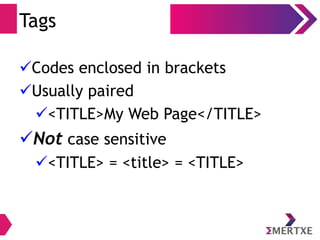
Codes enclosed in brackets
Usually paired
<TITLE>My Web Page</TITLE>
Not case sensitive
<TITLE> = <title> = <TITLE>
Creating a Basic
Starting Document
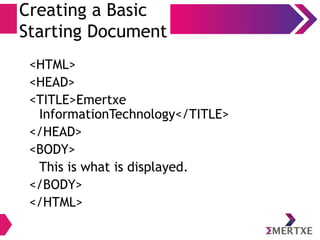
<HTML>
<HEAD>
<TITLE>Emertxe
InformationTechnology</TITLE>
</HEAD>
<BODY>
This is what is displayed.
</BODY>
</HTML>
Creating a Basic
Starting Document
The HEAD of your document point to above
window part. The TITLE of your document
appears in the very top line of the user’s
browser. If the user chooses to “Bookmark”
your page or save as a “Favorite”; it is the
TITLE that is added to the list.
The text in your TITLE should be as
descriptive as possible because this is what
many search engines, on the internet, use
for indexing your site.
Creating a Basic
Starting Document
Document properties are controlled by
attributes of the BODY element. For
example, there are color settings for the
background color of the page, the
document’s text and different states of
links.
What are HTML
forms?
 <form> is just another kind of HTML tag
 HTML forms are used to create (rather primitive) GUIs on Web pages
 Usually the purpose is to ask the user for information
 The information is then sent back to the server
 A form is an area that can contain form elements
 The syntax is: <form parameters> ...form elements... </form>
 Form elements include: buttons, checkboxes, text fields, radio
buttons, drop-down menus, etc
 Other kinds of HTML tags can be mixed in with the form
elements
 A form usually contains a Submit button to send the information in
he form elements to the server
 The form’s parameters tell JavaScript how to send the information
to the server (there are two different ways it could be sent)
 Forms can be used for other things, such as a GUI for simple
programs
The <form> tag
 The <form arguments> ... </form> tag encloses form elements (and
probably other HTML as well)
 The arguments to form tell what to do with the user input
 action="url" (required)
 Specifies where to send the data when the Submit button is
clicked
 method="get" (default)
 Form data is sent as a URL with ?form_data info appended to
the end
 Can be used only if data is all ASCII and not more than 100
characters
 method="post"
 Form data is sent in the body of the URL request
 Cannot be bookmarked by most browsers
 target="target"
 Tells where to open the page sent as a result of the request
 target= _blank means open in a new window
 target= _top means use the same window
The <input> tag
 Most, but not all, form elements use the input tag, with
a type="..." argument to tell which kind of element it is
 type can be text, checkbox, radio, password, hidden, submit,
reset, button, file, or image
 Other common input tag arguments include:
 name: the name of the element
 value: the “value” of the element; used in different ways for
different values of type
 readonly: the value cannot be changed
 disabled: the user can’t do anything with this element
 Other arguments are defined for the input tag but have
meaning only for certain values of type
Text Input
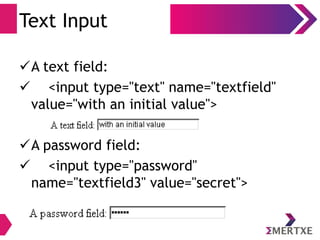
A text field:
 <input type="text" name="textfield"
value="with an initial value">
A password field:
 <input type="password"
name="textfield3" value="secret">
Buttons
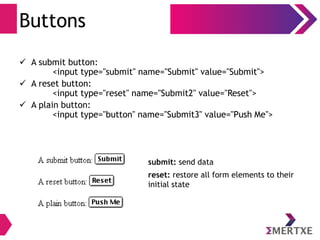
 A submit button:
<input type="submit" name="Submit" value="Submit">
 A reset button:
<input type="reset" name="Submit2" value="Reset">
 A plain button:
<input type="button" name="Submit3" value="Push Me">
submit: send data
reset: restore all form elements to their
initial state
Checkbox
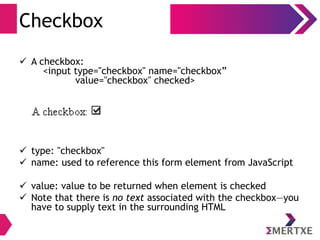
 A checkbox:
<input type="checkbox" name="checkbox”
value="checkbox" checked>
 type: "checkbox"
 name: used to reference this form element from JavaScript
 value: value to be returned when element is checked
 Note that there is no text associated with the checkbox—you
have to supply text in the surrounding HTML
Radio Buttons
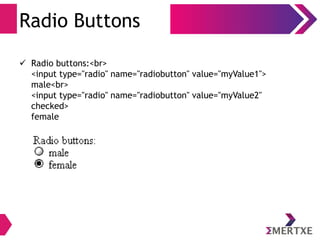
 Radio buttons:<br>
<input type="radio" name="radiobutton" value="myValue1">
male<br>
<input type="radio" name="radiobutton" value="myValue2"
checked>
female
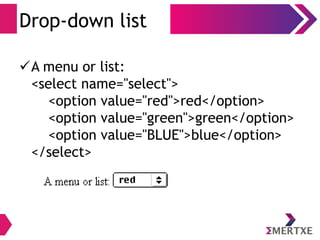
Drop-down list
A menu or list:
<select name="select">
<option value="red">red</option>
<option value="green">green</option>
<option value="BLUE">blue</option>
</select>
Hidden Fields
<input type="hidden" name="hiddenField"
value="nyah">
 What good is this?
 All input fields are sent back to the server, including hidden
fields
 This is a way to include information that the user doesn’t need
to see (or that you don’t want her to see)
 The value of a hidden field can be set programmatically (by
JavaScript) before the form is submitted
THANK YOU

HTML

  • 1.
  • 2.
    Defining HTML  HTML– HyperText Markup Language – The Language of Web Pages on the World Wide Web. HTML is a text formatting language.
  • 3.
    Tags Codes enclosed inbrackets Usually paired <TITLE>My Web Page</TITLE> Not case sensitive <TITLE> = <title> = <TITLE>
  • 4.
    Creating a Basic StartingDocument <HTML> <HEAD> <TITLE>Emertxe InformationTechnology</TITLE> </HEAD> <BODY> This is what is displayed. </BODY> </HTML>
  • 5.
    Creating a Basic StartingDocument The HEAD of your document point to above window part. The TITLE of your document appears in the very top line of the user’s browser. If the user chooses to “Bookmark” your page or save as a “Favorite”; it is the TITLE that is added to the list. The text in your TITLE should be as descriptive as possible because this is what many search engines, on the internet, use for indexing your site.
  • 6.
    Creating a Basic StartingDocument Document properties are controlled by attributes of the BODY element. For example, there are color settings for the background color of the page, the document’s text and different states of links.
  • 7.
    What are HTML forms? <form> is just another kind of HTML tag  HTML forms are used to create (rather primitive) GUIs on Web pages  Usually the purpose is to ask the user for information  The information is then sent back to the server  A form is an area that can contain form elements  The syntax is: <form parameters> ...form elements... </form>  Form elements include: buttons, checkboxes, text fields, radio buttons, drop-down menus, etc  Other kinds of HTML tags can be mixed in with the form elements  A form usually contains a Submit button to send the information in he form elements to the server  The form’s parameters tell JavaScript how to send the information to the server (there are two different ways it could be sent)  Forms can be used for other things, such as a GUI for simple programs
  • 8.
    The <form> tag The <form arguments> ... </form> tag encloses form elements (and probably other HTML as well)  The arguments to form tell what to do with the user input  action="url" (required)  Specifies where to send the data when the Submit button is clicked  method="get" (default)  Form data is sent as a URL with ?form_data info appended to the end  Can be used only if data is all ASCII and not more than 100 characters  method="post"  Form data is sent in the body of the URL request  Cannot be bookmarked by most browsers  target="target"  Tells where to open the page sent as a result of the request  target= _blank means open in a new window  target= _top means use the same window
  • 9.
    The <input> tag Most, but not all, form elements use the input tag, with a type="..." argument to tell which kind of element it is  type can be text, checkbox, radio, password, hidden, submit, reset, button, file, or image  Other common input tag arguments include:  name: the name of the element  value: the “value” of the element; used in different ways for different values of type  readonly: the value cannot be changed  disabled: the user can’t do anything with this element  Other arguments are defined for the input tag but have meaning only for certain values of type
  • 10.
    Text Input A textfield:  <input type="text" name="textfield" value="with an initial value"> A password field:  <input type="password" name="textfield3" value="secret">
  • 11.
    Buttons  A submitbutton: <input type="submit" name="Submit" value="Submit">  A reset button: <input type="reset" name="Submit2" value="Reset">  A plain button: <input type="button" name="Submit3" value="Push Me"> submit: send data reset: restore all form elements to their initial state
  • 12.
    Checkbox  A checkbox: <inputtype="checkbox" name="checkbox” value="checkbox" checked>  type: "checkbox"  name: used to reference this form element from JavaScript  value: value to be returned when element is checked  Note that there is no text associated with the checkbox—you have to supply text in the surrounding HTML
  • 13.
    Radio Buttons  Radiobuttons:<br> <input type="radio" name="radiobutton" value="myValue1"> male<br> <input type="radio" name="radiobutton" value="myValue2" checked> female
  • 14.
    Drop-down list A menuor list: <select name="select"> <option value="red">red</option> <option value="green">green</option> <option value="BLUE">blue</option> </select>
  • 15.
    Hidden Fields <input type="hidden"name="hiddenField" value="nyah">  What good is this?  All input fields are sent back to the server, including hidden fields  This is a way to include information that the user doesn’t need to see (or that you don’t want her to see)  The value of a hidden field can be set programmatically (by JavaScript) before the form is submitted
  • 16.