HT24W / HT28 Smart
System User’s Manual _ V3.X
Release, 10/2003
Contacting Onity
Indonesia
Tel. +62 (361) 499092
Fax. +62 (361) 499041
Indonesia@onity.biz
Worldwide Headquarters
Atlanta GA, USA
Tel. +1 770 935 4228
+1 800 424 1433
moreinfo@onity.biz
Europe / Middle East / Africa
Tel. +34 943 448 300
emea@onity.biz
Latin America
Tel. +55 11 3031 1909
lam@onity.biz
North America
Tel. +1 770 935 4228
+1 800 424 1433
noram@onity.biz
International Sales
Tel. +34 943 448 300
electronic_div@onity.biz
International Technical Support
intl.tech.support@onity.biz
The information contained within this manual is subject to change. In no way does Onity warrant that the operation of this system
will be entirely error free or perform precisely as described within this documentation, or that the functions and features of this
system will meet your specific requirements. Additi onally, this system has not been designed for use in life-critical situations and
must not be used for this purpose
Windows is a registered trademark of Microsoft Corporation
Documentation © 2003 Onity
HT24W / HT28 Smart System User’s Manual Contents • III
Contents
Contacting Onity......................................................................................................................................II
Worldwide Headquarters........................................................................................................II
Asia / Pacific ......................................................................Error! Bookmark not defined.
Europe / Middle East / Africa ................................................................................................II
Latin America...........................................................................................................................II
North America..........................................................................................................................II
International Sales ...................................................................................................................II
International Technical Support ............................................................................................II
Introduction 1
Who is Onity..............................................................................................................................................1
Problems with Metal Key Systems ........................................................................................................1
Benefits of Onity Electronic Locking Systems ....................................................................................1
About this Manual....................................................................................................................................2
What's New................................................................................................................................................2
Software - HT24W / HT28 Smart 3
General........................................................................................................................................................3
HT24W vs. HT28 Smart ..........................................................................................................................3
HT24W .......................................................................................................................................3
HT28 Smart................................................................................................................................3
Reception Menu (F10).............................................................................................................................4
New Guest Check-In (F5) .......................................................................................................4
Copy Guest (F6)........................................................................................................................7
Check-Out (F7) .........................................................................................................................9
Single Opening Card (F8) .....................................................................................................10
Read a Card (F3) .....................................................................................................................13
Erase a Card (F4) ....................................................................................................................14
Hotel Information (F2)...........................................................................................................15
Groups.......................................................................................................................................17
Peripheral Openings...............................................................................................................22
Logout / Login (F9) ................................................................................................................24
Exit ............................................................................................................................................24
Masters Menu..........................................................................................................................................25
Revalidation.............................................................................................................................25
Master Users (F11).................................................................................................................26
Master Canceling Card ..........................................................................................................36
Special Cards Menu................................................................................................................................38
Encode Guest Canceling Card ..............................................................................................38
Encode Blocking Card ...........................................................................................................38
Encode Diagnostic Card ........................................................................................................38
Encode Spare Cards................................................................................................................39
Encode Safe Emergency Card ..............................................................................................40
Maintenance Menu .................................................................................................................................41
Load Portable Programmer ...................................................................................................41
Peripheral Diagnosis ..............................................................................................................45
Station Diagnosis ....................................................................................................................47
Room Out of Service..............................................................................................................48
Mastering Changes .................................................................................................................48
IV • Contents HT24W / HT28 Smart System User’s Manual
Backup Data.............................................................................................................................50
Emphasized Authorizations Data.........................................................................................50
Move to Historic .....................................................................................................................52
Security Menu .........................................................................................................................................54
System Auditor........................................................................................................................54
Lock Openings ........................................................................................................................56
Door Transactions...................................................................................................................57
Card Activity Report ..............................................................................................................59
Lock Status Report .................................................................................................................61
Operators ..................................................................................................................................63
Operator Levels Required .....................................................................................................66
XPP Mastering ........................................................................................................................66
Configuration...........................................................................................................................................68
Language..................................................................................................................................68
Change Date and Time ...........................................................................................................68
Station Configuration.............................................................................................................68
Change Encoder......................................................................................................................69
Config. Emergency Reval. ....................................................................................................70
Check-Out Warning ...............................................................................................................71
PMS Enabled ...........................................................................................................................71
Show PMS Communications................................................................................................71
Hardware 73
HT24W System Components ...............................................................................................................73
HT24 Magnetic Stripe Lockset ............................................................................................73
Magnetic Cards .......................................................................................................................75
HT24 Card Readers ................................................................................................................76
Encoders ...................................................................................................................................77
HT28 Smart System Components........................................................................................................79
HT28 Dual Technology Lockset..........................................................................................79
Smart Cards..............................................................................................................................81
Smart Card Encoder ...............................................................................................................82
General Components..............................................................................................................................85
Portable Programmer..............................................................................................................85
Extended Portable Programmer (XPP) ...............................................................................89
Communications Distributor.................................................................................................94
Terminal Mode Encoders ......................................................................................................................96
Online Revalidator..................................................................................................................................98
Revalidator Options................................................................................................................98
Using the Revalidator..........................................................................................................100
Emergency Mode - Revalidator ........................................................................................101
Quick Reference Guide 102
Lockset Light Indications...................................................................................................................102
HT24W / HT28 Smart Software Icons.............................................................................................103
HT24W / HT28 Smart Shortcut Function Keys.............................................................................103
What to Do If …..................................................................................................................................105
A staff member has lost a master card …........................................................................105
Our PMS interface is down …..........................................................................................105
Power is out and our encoders don't work ….................................................................106
A guest needs a late check-out time …............................................................................106
Daylight Savings Time is next week …...........................................................................106
We want to provide our own cards …..............................................................................106
We want to punch holes in our master cards to wear them on a chain ….................106
When should we replace our cards …..............................................................................107
Troubleshooting...................................................................................................................................107
Guest card will not open the door – red light..................................................................107
Guest card will not open the door – flashing red light ..................................................107
Guest and staff cards will not open the door – flashing red and green lights............107
HT24W / HT28 Smart System User’s Manual Contents • V
Guest and staff cards will not open the door – solid green, flashing red light ..........107
Card has broken in lock ......................................................................................................108
The programmer will not turn on......................................................................................108
The programmer beeps, but the screen is blank .............................................................108
The screen on our encoder is blank ..................................................................................108
We get encoding errors when making cards ...................................................................108
Our PMS says that Onity is not responding....................................................................109
Appendix A – Import Users 110
Add User Command............................................................................................................................110
Glossary of Terms 113
Index 115
HT24W / HT28 Smart System User’s Manual Contents • 1
Introduction
Who is Onity
Onity (formerly TESA Entry Systems), the leading global provider of electronic
locking systems, offers innovative technological solutions and services for the
Hospitality, Corporate, Education, Government and Marine markets. The
company’s ever-expanding family of electronic solutions today includes
electronic locks, related Smart card technology, in-room safes, closed-circuit
television (CCTV) security surveillance and Senercomm energy management
systems. Onity has R&D and manufacturing operations in Spain, Mexico and the
U.S., as well as an extensive sales and service network that spans more than 115
countries around the globe. With innovative solutions specially designed to meet
clients’ changing needs, Onity continues to provide real progress —
technological advancements in facility management and maintenance for
unparalleled convenience and time and cost savings.
Problems with Metal Key Systems
Traditional metal key lock systems are vulnerable in a variety of ways. A guest
may simply keep a key or have a copy made so that he can return to the room at
a later time. When keys are missing, the locks are often not re-keyed due to the
cost and time requirements. An experienced criminal can study several keys or
look inside the key cylinders and decode the key system, allowing him to create
a grand master key to the property.
Benefits of Onity Electronic Locking Systems
Onity locks do not require re-keying if a guest keeps a card. Each new guest card
issued automatically re-keys the lock to prevent access by the previous guests, so
your guests are secure. Additionally, the guest cards will expire at the date and
time designated during check-in. There are no mechanical parts able to be
decoded that will allow criminals into the rooms; the lock is unlocked only
through an encrypted code. Onity locks also store the most recent openings in
non-volatile memory, allowing the hotelier to know exactly who has been in the
room, and when.
2 • Introduction HT24W / HT28 Smart System User’s Manual
About this Manual
This manual is a guide to help you understand the Onity system, including locks,
software, and peripherals. The system is very flexible and can utilize traditional
magnetic stripe cards as well as the latest in smart card technology.
There are many smart cards available today. Onity has selected several cards
with features that most benefit the hospitality industry. These cards are detailed
later in this manual and are available from Onity.
Throughout this manual, the term 'smart card' will refer to any contact type
memory cards or microprocessor cards. Though there are many technical
differences between the types of available cards, the Onity system handles the
differences transparently to the user. In cases where the differences are notable,
detailed explanations will point out the differences.
What's New
Expanded system auditor records even more operations.
Audits retrieved from offline locks are stored in the database.
System now allows the system auditor, employee tracking, and lock audit
databases to be archived.
All reports can now be exported to XML format.
New user management features make controlling master keys even easier than
before. Included in these changes are the ability to import users, batch edit
users, delete users, and improved search capabilities.
With version 3, the extended portable programmer (XPP) can be used which
increases productivity and security, and has features not available in the standard
portable programmer.
Enables the use of the full functionality of the HT22M encoder, which can
encode on all three tracks of the magnetic stripe keycard as well as encoding
smart cards using the same encoding deck.
HT24W / HT28 Smart System User’s Manual Software - HT24W / HT28 Smart • 3
Software - HT24W / HT28 Smart
General
The HT24W / HT28 Smart system is a revolutionary step in locking systems.
The following sections will take you step by step through all of the features and
functions of the software. Some features are only available in the HT28 Smart
system that uses smart cards.
Available only with
HT28 Smart!
• In this manual, the Smart only features will be indicated with this symbol in the
left-hand margin.
Designed for keyboard use! • The front desk functions that are used most frequently have been designed so
that the operator can quickly complete the process without requiring the mouse.
The keyboard image shown to the left indicates the functions designed for
keyboard use.
HT24W vs. HT28 Smart
This manual applies to the software and hardware that makes up the HT24W and
HT28 Smart systems. The systems are identical in many ways, but there are
several important differences.
HT24W
The HT24W system uses Windows based software to manage and control the
HT24 series magnetic stripe locks.
HT28 Smart
The HT28 Smart system uses Windows based software to manage and control
HT28 dual technology, smart card and magnetic stripe, locks. There are several
features in the software that can only be used with HT28 locks and smart cards.
The primary feature difference is that card transactions can be stored on the
smart card.
4 • Software - HT24W / HT28 Smart HT24W / HT28 Smart System User’s Manual
Reception Menu (F10)
The Reception Menu includes the most frequently used functions, including New
Guest Check-In, Copy Guest and Check-Out. Many functions on the Reception
Menu have been designed to be used without the use of a mouse. Although a
mouse can be used in these functions, the operations will be completed more
quickly by using only the keyboard.
The primary functions of the Reception Menu can be accessed from the main
screen through the Hot Buttons. These buttons are shown in the figure below.
For quick access to the full Reception Menu, press the F10 key.
New Guest Check-In (F5)
New Guest Check-In
Designed for keyboard use!
This function is used when a new guest is to be checked into a room. When the
new card is used in the lock, the card of the previous guest will automatically be
canceled.
The New Guest Check-In function of the system allows you to make guest cards
that will work in up to four guestroom doors, depending on the type of encoder
used to make the card. The HT24 motorized encoder can encode up to four
rooms. Manual insertion encoders can encode a maximum of three rooms on
one card. As an example, if a family checked into the hotel, and the parents
requested one room for themselves and another room for the children, the cards
can be made to work in both locks.
HT24W / HT28 Smart System User’s Manual Software - HT24W / HT28 Smart • 5
To check in a new guest, perform the following steps:
1. From the Reception Menu, click on New Guest (Check-In), press
F5, or click on the New Guest Check-In Tool.
2. Enter a room number, and press the ENTER key. The cursor will
move to the next Room field in the display, and allow you to enter
a second room number. By pressing the F2 key, you can select a
room from a pick screen that shows vacant, occupied and out of
service rooms. Simply use the ARROW keys to select a room from
this list and press the SPACE BAR or double click with the mouse
to confirm.
6 • Software - HT24W / HT28 Smart HT24W / HT28 Smart System User’s Manual
3. The cursor will move to the next Room field in the display and
allow you to enter another room number, or select from the list. If
you do not want to add another room to the card, press ENTER
again. Repeat this step until you have entered all of the rooms you
want to encode on this card. When you are finished entering all of
the rooms, press the ENTER key again to continue to
authorizations.
4. If your property is using Emphasized Authorizations to promote the
sale of amenities such as the use of an in-room safe, a message box
will appear asking you to confirm this authorization. To select the
authorization, press the SPACE BAR and press the ENTER key to
continue.
5. If your property offers optional authorizations for other amenities,
such as access to the pool or covered parking, you will be given the
opportunity to either grant or deny the use of these items, as shown
below:
Use the UP/DOWN ARROW keys to navigate through the list of
available authorizations. By pressing the SPACE BAR you can
grant or deny each authorization and press the ENTER key to
continue to the length of stay.
6. Once the authorizations section is completed, the cursor will move
to the area of the screen to enter the number of nights the guest will
be staying.
Type a number or use the UP/DOWN ARROW keys to set the
number of nights for the stay and press the ENTER key.
7. If your property uses a starting date on guest cards, the cursor will
highlight the start date. The default start date is today. You can
use the number pad to set the starting date of the card. To change
the starting time, press the TAB key to move the cursor to the time
and use the number keys to change the time. Press ENTER to
continue to the Expiration date and time.
8. The software will convert the number of nights into the expiration
date. You may make any changes you wish to the check-out date
and time by using the number keys to enter the new hour, day,
month or year. Press ENTER to continue to Track 1 and 2 data.
9. If you are using magnetic cards and a motorized encoder, you are
able to encode information on tracks 1 and 2 of your card. This
information is not needed to operate the Onity locks, but is
commonly used for Point Of Sale (POS) systems. Track 1 data can
contain letters or numbers and track 2 data can contain only
numbers.
10. The last thing to do before encoding your cards is to tell the
software how many cards your guest will need. You can type the
number or use the UP/DOWN ARROW keys. When you are ready
to encode the cards, press the ENTER key.
HT24W / HT28 Smart System User’s Manual Software - HT24W / HT28 Smart • 7
A message will appear on the screen instructing you to insert the
card. When encoding is complete, a message will instruct you to
take the card.
If more than one card was requested, the screen will repeat the
prompts until all of the requested cards are made. When you are
finished making cards, select another function, or press the F9 key
to log out of the system.
Copy Guest (F6)
Copy Guest
Designed for keyboard use!
This function is used to encode extra cards for an occupied guestroom after the initial
check-in procedure. These cards will not affect the use of the existing guest card.
WARNING: Never make a copy of a guest card if the guest has LOST their
card. Make a NEW GUEST CARD to void out a lost card.
To encode a copy of a guest card, perform the following steps:
1. Select Copy Guest from the Reception Menu, press F6, or click on
the Copy Guest Tool.
2. Enter a room number, and press the ENTER key. The cursor will
move to the next Room field in the display, and allow you to enter
a second room number. By pressing the F2 key, you can select a
room from a pick screen that shows vacant, occupied and out of
service rooms. Simply use the ARROW keys to select a room from
this list and press the SPACE BAR or double click with the mouse
8 • Software - HT24W / HT28 Smart HT24W / HT28 Smart System User’s Manual
to confirm.
3. The cursor will move to the next Room field in the display and
allow you to enter another room number, or select from the list. If
you do not want to add another room to the card, press ENTER
again. Repeat this step until you have entered all of the rooms you
want to encode on this card. When you are finished entering all of
the rooms, press the ENTER key again to continue to
authorizations.
4. If your property is using Emphasized Authorizations to promote the
sale of amenities such as the use of an in-room safe, a message box
will appear asking you to confirm this authorization. To select the
authorization, press the SPACE BAR and press the ENTER key to
continue.
5. If your property offers optional authorizations for other amenities,
such as access to the pool or covered parking, you will be given the
opportunity to either grant or deny the use of these items, as shown
below:
Use the UP/DOWN ARROW keys to navigate through the list of
available authorizations. By pressing the SPACE BAR you can
grant or deny each authorization and press the ENTER key to
continue to the length of stay.
6. Once the authorizations section is completed, the cursor will move
to the area of the screen to enter the number of nights the guest will
be staying.
HT24W / HT28 Smart System User’s Manual Software - HT24W / HT28 Smart • 9
Type a number or use the UP/DOWN ARROW keys to set the
number of nights for the stay and press the ENTER key.
7. If your property uses a starting date on guest cards, the cursor will
highlight the start date. The default start date is today. You can
use the number pad to set the starting date of the card. To change
the starting time, press the TAB key to move the cursor to the time
and use the number keys to change the time. Press ENTER to
continue to the Expiration date and time.
8. The software will convert the number of nights into the expiration
date. You may make any changes you wish to the check-out date
and time by using the number keys to enter the new hour, day,
month or year. Press ENTER to continue to Track 1 and 2 data.
9. If you are using magnetic cards and a motorized encoder, you are
able to encode information on tracks 1 and 2 of your card. This
information is not needed to operate the Onity locks, but is
commonly used for Point Of Sale (POS) systems. Track 1 data can
contain letters or numbers and track 2 data can contain only
numbers.
10. The last thing to do before encoding your cards is to tell the
software how many cards your guest will need. You can type the
number or use the UP/DOWN ARROW keys. When you are ready
to encode the cards, press the ENTER key.
A message will appear on the screen instructing you to insert the
card. When encoding is complete, a message will instruct you to
take the card.
If more than one card was requested, the screen will repeat the
prompts until all of the requested cards are made. When you are
finished making cards, select another function, or press the F9 key
to log out of the system.
Note: The original and 4 copies can be uniquely identified in the audit record
of the lock. If you encode more than 5 cards, the audit report will indicate that
a 'Redundant Card' was used.
Check-Out (F7)
Check-Out
Designed for keyboard use!
The Check-Out function is used at the end of a guest's stay to indicate that the room
is now vacant and available for use by a new guest.
To check a guest out of a room, perform the following steps:
1. Select Check-Out from the Reception menu, press the F7 key or
click on the Check-Out Tool.
2. The screen will prompt you to enter the room number for the guest
to be Checked-Out. Type in the room number or select it from the
list.
10 • Software - HT24W / HT28 Smart HT24W / HT28 Smart System User’s Manual
3. Once the room number has been selected, press the ENTER key to
complete the operation.
4. When the Check-Out is complete, select another function or press
F9 to log out.
Single Opening Card (F8)
Single Opening Card
Designed for keyboard use!
This function is used to make a card that will work in a guestroom lock only once.
The single opening card is commonly used by the hotelier to allow a guest to
preview a room, or to allow a vendor to place an item inside of a room. Once the
card is used in the lock, it is no longer valid. A maximum of four Single Opening
Cards may be made for a single guestroom between new guest Check-Ins.
To make a single opening card, perform the following steps:
1. From the Reception Menu, click on Single Opening Card, press F8,
or click on the Single Opening Card Tool
2. Enter a room number, and press the ENTER key. The cursor will
move to the next Room field in the display, and allow you to enter
a second room number. By pressing the F2 key, you can select a
room from a pick screen that shows vacant, occupied and out of
service rooms. Simply use the ARROW keys to select a room from
this list and press the SPACE BAR or double click with the mouse
HT24W / HT28 Smart System User’s Manual Software - HT24W / HT28 Smart • 11
to confirm.
3. Note: Unlike other cards, a single opening card can only be
encoded for one room.
4. If your property is using Emphasized Authorizations to promote the
sale of amenities such as the use of an in-room safe, a message box
will appear asking you to confirm this authorization. To select the
authorization, press the SPACE BAR and press the ENTER key to
continue.
5. If your property offers optional authorizations for other amenities,
such as access to the pool or covered parking, you will be given the
opportunity to either grant or deny the use of these items, as shown
below:
Use the UP/DOWN ARROW keys to navigate through the list of
available authorizations. By pressing the SPACE BAR you can
grant or deny each authorization and press the ENTER key to
continue to the length of stay.
6. Once the authorizations section is completed, the cursor will move
to the area of the screen to enter the number of nights the guest will
be staying.
Type a number or use the UP/DOWN ARROW keys to set the
number of nights for the stay and press the ENTER key.
7. If your property uses a starting date on guest cards, the cursor will
highlight the start date. The default start date is today. You can
12 • Software - HT24W / HT28 Smart HT24W / HT28 Smart System User’s Manual
use the number pad to set the starting date of the card. To change
the starting time, press the TAB key to move the cursor to the time
and use the number keys to change the time. Press ENTER to
continue to the Expiration date and time.
8. The software will convert the number of nights into the expiration
date. You may make any changes you wish to the check-out date
and time by using the number keys to enter the new hour, day,
month or year. Press ENTER to continue to Track 1 and 2 data.
9. If you are using magnetic cards and a motorized encoder, you are
able to encode information on tracks 1 and 2 of your card. This
information is not needed to operate the Onity locks, but is
commonly used for Point Of Sale (POS) systems. Track 1 data can
contain letters or numbers and track 2 data can contain only
numbers.
When you are ready to encode the card, press the ENTER key.
A message will appear on the screen instructing you to insert the card. When
encoding is complete, a message will instruct you to take the card. When you
are finished making the card, select another function, or press the F9 key to log
out of the system.
HT24W / HT28 Smart System User’s Manual Software - HT24W / HT28 Smart • 13
Read a Card (F3)
Read a Card
Designed for Keyboard Use!
This function is used to identify an unknown card and to examine the information
encoded on the card.
To read a card, perform the following steps:
1. From the Reception menu, click Read, press the F3 key, or click on
the Read Card Tool.
2. The screen will prompt you to insert the card. Insert and remove
the card in the encoder.
3. Once the card has been read, the screen will display all of the guest
information encoded on the card, such as the authorizations and the
expiration date and time. In the example in the figure above, the
card is for room 256 and 258, and it is the original card (not a
copy). The card was authorized to operate the guestroom safe,
garage, pool, and the concierge lounge. This card will not override
guest privacy or the blocking card, and it cannot place a door into
office mode. The card will expire at 3:00 p.m. on June 17, 1999
and was encoded by Sally on June 12 at 3:30 PM.
You may read another card by pressing the READ button located in
the bottom left of the window. When you are finished reading
cards, press the ESCAPE key and select another function, or press
the F9 key to log out of the system.
14 • Software - HT24W / HT28 Smart HT24W / HT28 Smart System User’s Manual
Erase a Card (F4)
Erase a Card
Designed for Keyboard Use!
This function will read a card, erase it, and check out the room if the card is still
valid. Use this function if a group of cards is left at the front desk by the guests or the
housekeeping staff for Check-Out. This feature can be used to enhance the hotel’s
Express Check-Out function.
To use the Read and Erase a Card function, perform the following steps:
1. From the Reception menu click Erase Card, press F4, or click on
the Erase Card Tool.
2. The screen will prompt you to insert the card.
3. Once the card has been read, the screen will display all of the guest
information encoded on the card, such as the authorizations and the
expiration date and time. In the example in the figure above, the
card is for room 256 and 258, and it is the original card (not a
copy). The card was authorized to operate the guestroom safe,
garage, pool, and the concierge lounge. This card will not override
guest privacy or the blocking card, and it cannot place a door into
office mode. The card will expire at 3:00 p.m. on June 17, 1999
and was encoded by Sally on June 12 at 3:30 PM.
4. If you wish to erase the card, click on the Erase button at the
bottom of the window. The screen will prompt you to insert and
remove the card. Insert and remove the card in the encoder. Once
this is done, the card is now erased and may be re-used in the
system at any time.
After a card is erased, the system will ask you if you wish to
perform a Check-Out for this room. If you select yes, the room
will appear vacant in the rooms list and can be used again. After a
Check-Out, you can read another card, press ESCAPE and select
another function, or log out of the system by pressing F9.
HT24W / HT28 Smart System User’s Manual Software - HT24W / HT28 Smart • 15
If you do not want to erase the card, press ESCAPE or click the
eject button at the bottom of the window.
5. You may read another card by pressing the READ button located in
the bottom left of the window. When you are finished reading
cards, press the ESCAPE key and select another function, or press
the F9 key to log out of the system.
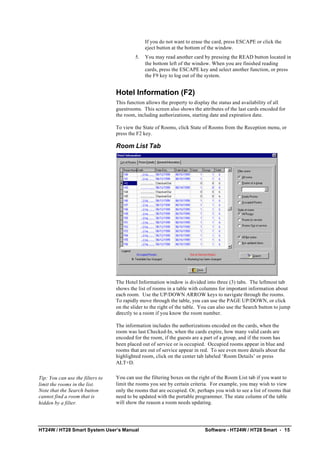
Hotel Information (F2)
This function allows the property to display the status and availability of all
guestrooms. This screen also shows the attributes of the last cards encoded for
the room, including authorizations, starting date and expiration date.
To view the State of Rooms, click State of Rooms from the Reception menu, or
press the F2 key.
Room List Tab
The Hotel Information window is divided into three (3) tabs. The leftmost tab
shows the list of rooms in a table with columns for important information about
each room. Use the UP/DOWN ARROW keys to navigate through the rooms.
To rapidly move through the table, you can use the PAGE UP/DOWN, or click
on the slider to the right of the table. You can also use the Search button to jump
directly to a room if you know the room number.
The information includes the authorizations encoded on the cards, when the
room was last Checked-In, when the cards expire, how many valid cards are
encoded for the room, if the guests are a part of a group, and if the room has
been placed out of service or is occupied. Occupied rooms appear in blue and
rooms that are out of service appear in red. To see even more details about the
highlighted room, click on the center tab labeled ‘Room Details’ or press
ALT+D.
Tip: You can use the filters to
limit the rooms in the list.
Note that the Search button
cannot find a room that is
hidden by a filter.
You can use the filtering boxes on the right of the Room List tab if you want to
limit the rooms you see by certain criteria. For example, you may wish to view
only the rooms that are occupied. Or, perhaps you wish to see a list of rooms that
need to be updated with the portable programmer. The state column of the table
will show the reason a room needs updating.
16 • Software - HT24W / HT28 Smart HT24W / HT28 Smart System User’s Manual
Room Details Tab
The Room Details tab shows all of the information from the room list table as
well as the starting date, if any single opening cards have been encoded, what
type of lock hardware is installed, and which mastering scheme is being used.
Multiple mastering schemes are optional, so your property may not display this
information.
Navigation Buttons If you wish to see details of other rooms, you can return to the room list or use the
navigation buttons at the bottom of the window. From left to right, the buttons
perform the following task: view the first room in the list, view the previous room in
the list, view the next room in the list, view the last room in the list.
Additional Information Tab
The right tab of this window shows general information about yourproperty. At
times, it may be useful to know the number of guests that have access to a
particular amenity. The Additional Information tab shows each of the
authorizations declared for your property and how many valid guest cards are
HT24W / HT28 Smart System User’s Manual Software - HT24W / HT28 Smart • 17
encoded with access to these authorizations. This tab also shows a chart with the
percentage occupancy and the percentage of rooms that are out of service.
When you have finished viewing the room information, click the close button at
the bottom of the window, or press the ESCAPE key.
Groups
Groups
This function provides a convenient method of encoding cards for a large group of
guests in advance so that the group is not delayed by this operation when they arrive.
Group cards are encoded with a special code so that the new group cards do not
cancel current cards, and group cards will not affect the ability to replace lost cards
of current guests.
To manage groups, select Groups from the Reception menu or click on the
Groups Tool.
Tip: Make Group cards in
advance so large groups don’t
have to wait when they arrive.
There are several steps necessary to successfully manage groups of guests. First, a
group must be created and given a name. Attributes and rooms must be assigned.
Then, the cards must be encoded. Finally, once the group arrives at your property,
everything is ready for Check-In.
Creating New Groups
New Group Button
To create a New Group, follow these steps:
18 • Software - HT24W / HT28 Smart HT24W / HT28 Smart System User’s Manual
1. Click the New button.
2. The New Group window is where you will enter all of the group
information. The first piece of information that you should enter is
a group name. If you make your group names meaningful, it will
help to manage them later. Once you have entered the group name,
press ENTER to continue.
If you are using Emphasized Authorizations, message boxes will
appear prompting you to promote these amenities. Press the
SPACE bar or click the check box to select access to this amenity.
After the Emphasized Authorizations are finished, you can select
any standard authorizations the guests may need. Press ENTER
when you are finished selecting authorizations.
3. Now it is time to enter the number of nights this group will be
staying at your property. Set the Starting Date to the expected
arrival date of this group. By checking the starting date, you can be
sure that any group cards made in advance will not work until the
day the group is expected to arrive.
Once the starting date is set, the expiration date will automatically
be calculated based on the number of nights you selected. You can
always manually set the expiration date, if you prefer.
4. Press ENTER when you have finished entering the dates.
5. To select the rooms for the group, click on the Select Rooms button
or press ALT+E. When the roomlist appears, you can select
individual rooms by Double Clicking or pressing the SPACE bar.
6. To select several rooms, hold the left mouse button and drag the
mouse to create a rectangular block of rooms. Press the SPACE
bar to select the highlighted rooms. Selected rooms will be colored
red.
There are a few rules to be aware of when selecting rooms.
• If a room is out of service, you will be warned, but you will be
allowed to proceed.
HT24W / HT28 Smart System User’s Manual Software - HT24W / HT28 Smart • 19
• If the room has been reserved by another group that has not
arrived yet, you are not allowed to select these rooms for a
new group.
• If the room is currently occupied by a regular guest, it is OK to
select this room for a group. When the group arrives and is
Checked-In, all other guest cards will be voided.
7. When you are finished selecting rooms, click on the OK button. If
you are not sure which rooms you want to select, click on the
Cancel button.
After you have selected rooms click the OK button to save the group. If you
choose not to select rooms now, save the group now and come back later to
select the rooms. If you decide not to finish creating this group, click the Cancel
button.
Modifying Groups
Modify Group Button To modify an existing group, select a group from the list and click the Modify
button or Double Click the group.
The steps to modify an existing group are exactly the same as creating a new one.
Any detail of the group can be modified until you encode the first card for the
group. Refer to the steps for creating a new group to see details about group
features.
Encoding Group Cards
Encode Group Card Button Cards can be encoded well in advance of Check-In so large groups of guests are not
inconvenienced by having to wait for cards. Since you will not be handing the cards
to the guest right after encoding, you must take care to keep the cards organized.
Place the cards in marked envelopes or sleeves when you encode them. The time
you take to stay organized now will prevent you from upsetting guests who are using
the wrong card in the door.
Remember that once the first
card for a group is encoded,
the group can no longer be
modified.
Follow these steps to encode the cards for this group.
1. Select the group from the list and click on the Encode button. A
screen will appear with a list of the rooms assigned to this group.
Each room has a box beside it that indicates if cards have been
encoded for this room. To help you stay organized, the rooms are
listed in order. There is no way to encode cards out of order.
2. Enter the number of cards to make for this room. The default is
one card. If you make multiple cards for a room, the next room in
the list will go back to the default of one card. Press the ENTER
key until the screen appears prompting you to insert a card.
3. Insert and remove the card in the encoder.
20 • Software - HT24W / HT28 Smart HT24W / HT28 Smart System User’s Manual
Continue encoding cards until all of the rooms in the list have check marks
beside them. All of the cards do not have to be encoded at one time, but they
must be encoded before the group can Check-In.
HT24W / HT28 Smart System User’s Manual Software - HT24W / HT28 Smart • 21
Group Check-In
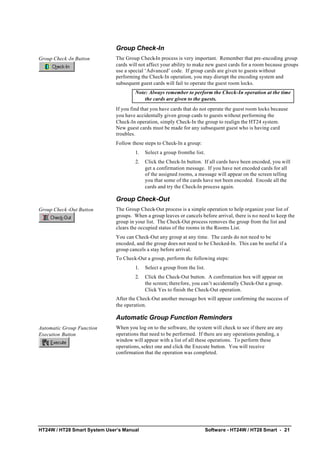
Group Check -In Button The Group Check-In process is very important. Remember that pre-encoding group
cards will not affect your ability to make new guest cards for a room because groups
use a special ‘Advanced’ code. If group cards are given to guests without
performing the Check-In operation, you may disrupt the encoding system and
subsequent guest cards will fail to operate the guest room locks.
Note: Always remember to perform the Check-In operation at the time
the cards are given to the guests.
If you find that you have cards that do not operate the guest room locks because
you have accidentally given group cards to guests without performing the
Check-In operation, simply Check-In the group to realign the HT24 system.
New guest cards must be made for any subsequent guest who is having card
troubles.
Follow these steps to Check-In a group:
1. Select a group fromthe list.
2. Click the Check-In button. If all cards have been encoded, you will
get a confirmation message. If you have not encoded cards for all
of the assigned rooms, a message will appear on the screen telling
you that some of the cards have not been encoded. Encode all the
cards and try the Check-In process again.
Group Check-Out
Group Check -Out Button The Group Check-Out process is a simple operation to help organize your list of
groups. When a group leaves or cancels before arrival, there is no need to keep the
group in your list. The Check-Out process removes the group from the list and
clears the occupied status of the rooms in the Rooms List.
You can Check-Out any group at any time. The cards do not need to be
encoded, and the group does not need to be Checked-In. This can be useful if a
group cancels a stay before arrival.
To Check-Out a group, perform the following steps:
1. Select a group from the list.
2. Click the Check-Out button. A confirmation box will appear on
the screen; therefore, you can’t accidentally Check-Out a group.
Click Yes to finish the Check-Out operation.
After the Check-Out another message box will appear confirming the success of
the operation.
Automatic Group Function Reminders
Automatic Group Function
Execution Button
When you log on to the software, the system will check to see if there are any
operations that need to be performed. If there are any operations pending, a
window will appear with a list of all these operations. To perform these
operations, select one and click the Execute button. You will receive
confirmation that the operation was completed.
22 • Software - HT24W / HT28 Smart HT24W / HT28 Smart System User’s Manual
If you prefer not to perform the operation, click the Close button or press the
ESCAPE key. You will be prompted every time you log in until the operation is
performed.
Operations that will prompt the reminder screen include:
• Check-In a group that has all cards encoded and the starting date is
today. Remember to double check the Starting Date of your groups
before you begin encoding cards. Once you encode a single card,
this information cannot be changed.
• Check-Out a group that has expired. If cards were encoded with a
date that has passed and the group has not been checked out, the
group will be listed in the reminder list.
Peripheral Openings
Peripheral Openings
The purpose of the Peripheral Openings window is to allow a quick and easy way
to see the number of times a particular guest used a particular door or amenity.
For example, you may wish to have front desk operators examine this list at
Check-Out and charge the guest based on the number of trips to the sauna.
The Peripheral Openings function will display or print the openings from any on-
line card reader, a door whose auditor has been collected by the portable
programmer, or an insertion identifier.
To view this list, select Peripheral Openings from the Reception Menu, or click
the Peripheral Openings Tool.
The Peripheral Openings List will not include invalid access attempts. If you
wish to view the full audit recorded in an on-line reader, including invalid
attempts, select Door Transactions from the Security menu.
Filtering the Peripheral Openings Report
Follow these steps to set up the definition of the openings you wish to see:
1. Select Peripheral Openings from the Reception Menu, or click on
the Peripheral Openings Tool.
HT24W / HT28 Smart System User’s Manual Software - HT24W / HT28 Smart • 23
2. Using the date filter, you can limit the openings you see to only
those in the time frame that interests you. The default dates are the
beginning of this year and today, but you can set these limits to any
dates you choose. Type a date or use the UP/DOWN ARROW keys
to change the dates to limit your search. Only those openings that
fall between the dates will be shown.
3. The Function Filter can further limit your search to only those
openings that interest you. You can view all openings, only the
openings for a particular guest room card, special operations, or
openings of a particular master card. Special operations include the
use of the Exit Button, Spare Cards, Programming Cards,
Canceling Cards, and other operations that might interest you.
4. When you are satisfied with your filter criteria, click the OK button
to view the openings. If the list of openings does not contain the
event you were searching for, you can modify your filter at any
time. To reset all the filters back to the default, click the Reset
button.
The Openings List
Valid uses of an entrance
reader appear in black, and
valid uses of an exit reader
are in green.
The openings list is a table showing all of the openings from the selected
peripherals or doors that match your filter criteria. The table shows the date,
time, and which card was used.
The table shows the openings in Real Time. This means that if someone uses
their card in an online peripheral, you will see a record of the opening within
moments of the actual event. The system will scan the peripheral every few
seconds and any new openings will be added to the bottom of the list. If your list
is long, you may wish to turn this feature off while you look at your list so that
the list is not changing. To turn off the Real Time feature, click the check box at
the top of the window so that there is no check in the box.
Navigation Buttons With the Real Time feature turned off, you can use the special navigation buttons to
move to the first record at the top of the list, to the previous record, to the next
record, or to the last record at the bottom of the list.
To print your list, click on the Print button at the top of the window.
24 • Software - HT24W / HT28 Smart HT24W / HT28 Smart System User’s Manual
Logout / Login (F9)
Designed for keyboard use! This function logs the current operator out of the system and locks the system so that
an operator must enter a valid password before any new function can be performed.
Workstations, terminal encoders and other on-line devices will still function properly
while no one is logged in to the software on the server.
When logged out, this function key is used to login an operator. Simply press F9 and
enter your password to log into the system.
To logout of the software, press the F9 key or select Logout from the Reception
Menu.
Exit
This function logs the current operator out and closes the software. PC
workstations will still function properly if this function is performed on the
server, but terminal encoders and the PMS interface are shut down.
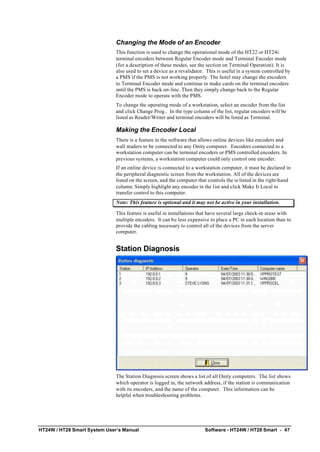
Task List
If there is a task running in an encoder, such as a PMS command waiting for the
desk clerk to perform the operation, the system will display them before you exit
the software. You can complete these tasks or discard them. This warning is to
prevent you from accidentally losing information or commands from the PMS
HT24W / HT28 Smart System User’s Manual Software - HT24W / HT28 Smart • 25
Masters Menu
Managing master cards is one of the most important tools to keeping tight
security at any facility. A lost master card is dangerous because it can open
many, if not all, of the doors at a facility. There are three features of the Onity
system that reduce the risk of a lost master card – sequential encoding, master
canceling cards, and expiration dates.
• Sequential encoding means that an old card is locked out by using
any new card in a lock. This is the same principle that works with
the guest cards.
• Master canceling cards will also lock out a lost master card. To be
sure that a lost master cannot be used, make a canceling card and
dip it in all the locks and readers. The canceling card will not
unlock the doors, it will only cancel the appropriate master type.
• The expiration date is an easy way to limit the risk of a lost master.
If a master expires in a few hours you may feel that a notification
to all employees and a watchful eye will get you through those
hours.
The software makes managing masters simple and allows various levels of risk
management. This section explains all of the details about managing master
cards, master users and the security of your facility.
Revalidation
Revalidation is a new feature in the system that allows you to manage your
master users simply and effectively while maintaining the security of your
facility. This section will explain the basic philosophy of revalidation and the
flexibility it offers. First we will briefly discuss the traditional method of
managing master cards.
Traditionally, master cards are encoded with an expiration date that will allow
the card to operate for several months. If a card is lost it poses a significant
threat because the card can enter all or nearly all of the doors in a hotel. To
prevent an incident the management must cancel the card using a master
canceling card in all of the Onity locks and by encoding new master cards for all
users who hold that type of card. For example, if a housekeeping master (HK) is
lost, a canceling card should be used in all of the locks, and all staff members
who carry an HK master card must be located to have their cards re-encoded.
This process is time consuming and inconvenient because all of the users must
be found and their cards updated or they will be locked out of the guest rooms.
To reduce some of the logistical problems you could issue daily cards to your
staff. These cards would work for only one day and then they expire. This
reduces some of the problems because everyone gets a new card at the same time
each day, but someone must encode all of those cards.
Suppose that each employee encoded their own card each day – automatically.
That is what the revalidation system does. Every day when an employee arrives
for work he inserts his card into the revalidation unit which reads the card and
identifies the user. If the user is still employed, the card is re-encoded, or
revalidated, to operate for one more day. If a card is lost it can be canceled as
usual and the new information automatically gets encoded on the proper cards
the next morning.
26 • Software - HT24W / HT28 Smart HT24W / HT28 Smart System User’s Manual
With the flexibility of the revalidation system you can set the cards to work for a
week at a time or only a few hours. The choice is yours. Revalidating more
frequently obviously offers more security, but it may also be more inconvenient
for your staff. Revalidating daily at the beginning of the work day is a
compromise that does not cause much inconvenience and maintains a very high
level of security.
Revalidation is not only about expiration dates and security. Because the users
must update their cards on a regular basis, the revalidation system provides a
simple way to distribute information about assignments, schedules, or special
events. This is also a convenient way to change an employee's shift or other
attributes such as office mode.
The following sections will provide details about how to set up the parameters
for revalidation. See page 85 for additional information.
Note: The parameters for revalidation can be different for each master user.
Master Users (F11)
Master Users
The Master Users List is a table that shows many of the attributes of your master
users and the cards they hold. From this screen, you can perform all of the
functions necessary to manage all of your master card holders. These functions,
create, modify, encode, update and cancel, are accessed with the buttons at the
bottom of the screen.
To view this list, Select Master Users List from the Masters menu or click the
Master Users List Tool to open the Masters window.
Master Users List Details
The Master User list provides an overview of the parameters assigned to every
master user. This section explains each field in the list.
• ID – The software assigns each master an ID number for easy
reference.
• User Name – This field should hold the name of the person who
has been issued a card. It is this name that is displayed in the lock
audit report to indicate who has entered a room.
HT24W / HT28 Smart System User’s Manual Software - HT24W / HT28 Smart • 27
• User Type – The user type field indicates the function and locking
plan of the master user. For example, a GM template typically has
access to all or most of the doors on a property, while a Floor
Master template will only have access to doors on one floor.
• Up-to-date – If a master user has been modified since the time the
card was encoded, the card is not considered up-to-date. The next
time the card is revalidated, the card will be encoded with the new
parameters. An X indicates that the card is up-to-date.
• Enabled – An X indicates that this master user is allowed to
revalidate if there is an X in this column.
• Authorization – All authorizations that are granted to this master
user are listed in this column.
• Date Encoded – This is the most recent date that a card has been
issued to this user.
• Expiration Date – The card will no longer operate the locks after
this date.
• Copy – The number of copies of that have been made for this user.
User Toolbar
When the main Users screen is displayed, there are several icons available which
allow for quick navigation to a specific task. They are briefly explained now,
and covered in detail in the pages that follow.
• New – Used to create a new user.
• Edit – Used to Edit an existing user.
• Cancel / Reactivate – Used to cancel an active user, or
reactivate a previously canceled user.
• Encode – Used to encode a user card.
• View – Used to view the details of a user without the ability
to change any details.
• Enable / Disable – Used to enable or disable the ability of a
user to revalidate.
• Delete / Undelete – Used to delete a user, or undelete a
previously deleted user.
• Update – Enters the revalidation screen to allow users to
update their cards at the computer.
• Batch Edit – Allows the modification of several users at the
same time.
• Print – Used to print the user list.
28 • Software - HT24W / HT28 Smart HT24W / HT28 Smart System User’s Manual
• Filter – Used to filter the user list.
• Find – Used to search for a user.
• Mastering – Shows the keying information for a user.
Filter – How to Show Only a Few Master Users
The filter screen allows you to select which masters appear in the Master Users
List. If you have a lot of master users you may find that this is a handy tool. For
example, you can use the filter to see which users have expired cards, or cards
that need to be re-encoded because of a change in a shift or some other
parameter.
Note: The top of the master users list will indicate if a filter is being applied.
Find – How to Search for a Specific User
To save time searching for a specific user, use the Find icon. Click on the icon,
then type in the full user name, or a portion of the name and click the ‘Find First’
button. If there is more than one match, click the ‘Find Next’ button to go to the
next match. You can also perform exact match and case sensitive searches by
checking the appropriate boxes.
HT24W / HT28 Smart System User’s Manual Software - HT24W / HT28 Smart • 29
Mastering – Which Doors Can This Card Enter?
It is challenging to remember which master cards can access which doors,
especially in larger hotels. To easily see which doors a master card can enter,
simply highlight a master user on the Master Users list and click the Mastering
button.
If the list of doors is lengthy, you can check a particular door by typing it in the
text box and clicking the Search button. If this master can enter that door, the
list will jump to that door and highlight it. A message will be shown if this
master cannot open that door.
New – Create New Master Users
When new employees come in to work to fill new positions, you need to create new
master users. These users will have access to doors based on the template you
choose for them.
The New Master screen is divided into two tabs – General and Revalidation.
The General tab contains the standard master user information such as card type,
shift, and other attributes. The Revalidation tab allows you to set and manage
the revalidation attributes for this user. Each user can have different revalidation
attributes.
30 • Software - HT24W / HT28 Smart HT24W / HT28 Smart System User’s Manual
General Tab
1. Enter the name of this user. Entering the full and correct name will
help you to find this user in the list in the future when you need to
encode a new card or cancel this user.
2. The Master Template determines where this master card can be
used. For example, a master template called 2nd
FLOOR HM,
would be used to access guest rooms and housekeeping closets on
the second floor.
3. Now you must select a shift for this Master User. The shift limits
the time that a card will work in the locks to a specific time
window. Enter shift number 0 to allow 24 hour access or refer to
your property paperwork to select the appropriate shift number for
this user.
4. Next, you can choose if this Master User has certain special
privileges. To select a privilege, clic k the appropriate option
button or press the space bar when the option is hi-lighted. All
special privileges are explained below.
• Override Privacy – This privilege allows the card to enter
guest rooms even if a guest has activated the privacy indicator.
• With Office Function – This privilege allows the Master User
to place certain doors into Office Mode so that they remain
unlocked.
• Override Blocking – This privilege allows the master card to
enter a room that has been blocked by the Blocking Card.
5. Now, select any authorizations that this user will have.
Authorizations allow access to amenity areas, such as pools or
exercise facilities.
HT24W / HT28 Smart System User’s Manual Software - HT24W / HT28 Smart • 31
6. Next, choose a time at which point the user card will be active.
This option will only appear if you are using user card activation
dates.
7. Finally, if you want the master card to expire make sure the Use
Expiration Date box is checked and the date is the way you want it.
By default, the card will expire in one day.
Note: Onity recommends that you encode all master cards with an expiration
date. This can be the best way to reduce the threat of a lost card.
Revalidation Tab
The Revalidation tab contains the settings for using the revalidation system. If
you are not using this system in your facility the information on this tab is not
important.
1. The PIN information section applies when the master user uses a
revalidation terminal. If your facility is not using the revalidation
function, leave the PIN Information section completely blank.
• PIN – This is the Personal Identification Number that may be
required for the user to use a re-validation terminal.
• Ask PIN to revalidate card – If this box is checked, the user
will be required to enter the PIN to use the re-validation
terminal.
• User MUST modify PIN – This box indicates that a user must
change his or her PIN during the next use of the revalidator.
• User CAN modify PIN – If this box is checked, the user has
the option to change his or her PIN during the next
revalidation session.
2. The Revalidation Information section contains parameters used to
determine when the card will expire and what will happen when the
card is encoded again.
32 • Software - HT24W / HT28 Smart HT24W / HT28 Smart System User’s Manual
• Increment – This field is used in the revalidation process. It
indicates the length of time the exp iration date of a card will be
extended the next time it is revalidated.
• If the increment is set in days or months the card always
expires at the same time of day. If the expiration time set on
the general information tab is set to 6 PM for example, it does
not matter if a user revalidates at 8 AM or 3 PM. The card will
always expire at 6 PM.
• If the increment is set in hours, the revalidator acts as a
'recharger' and the card is encoded so that it will expire in X
hours. If the setting is 24 hours, a user revalidating at 8 AM
will extend her expiration until tomorrow at 8 AM.
Note: All expiration times are on the hour. When the card is
revalidated, the time is rounded to the nearest hour. For
example, when the revalidation increment is set to 1 hour and a
card is revalidated at 9:15, the new expiration time will be 10:00.
If the card is revalidated at 9:45, the new expiration time will be
11:00.
• Expiration Date – The expiration date encoded on the current
master card is displayed below the Increment field. Use this
information to determine when a lost card will expire.
• Next Expiration Date – This would be the expiration date if the
master user revalidated her card right now.
• Enable revalidation – If this check box is not checked, the
master user is not allowed to revalidate the card. This is
commonly used to temporarily prevent a user from using the
card. To permanently prevent usage, cancel the master.
Note: Even though revalidation has been disabled for a user, the card
will operate normally until it expires.
• Revalidation Shift – If you wish, you can limit the time of day
that the master users can revalidate their cards. To do this,
simply enter the beginning and end times that they are allowed
to revalidate. By default, these times are set to 00:00 and
24:00 so users can revalidate at any time.
3. Message for the user – This section is again used in the revalidation
system. You can enter a message in this section that will be
displayed to the master user each time the card is revalidated, for
the number of times indicated. The message text can be printed
from the revalidation terminals with the printer option enabled.
4. When you have finished making all of your selections, click the
OK button at the bottom of the window. If you choose not to finish
creating this user, click the Cancel button.
Import Users
It is possible to import users into the system using a plain text file. Referto
Appendix A for details on this function.
HT24W / HT28 Smart System User’s Manual Software - HT24W / HT28 Smart • 33
Modify – Edit Master User Data
Note: Changes do not take effect
until the card is encoded or
updated.
From time to time, you may wish to change the shift, authorizations, or other
attributes of a master user. You may modify the attributes of a Master User at any
time. The steps and the screen to modify a user are exactly the same as those to
create a user.
Because most of the master user attributes are stored on the card, most changes will
not take effect until you encode a new card for this user.
Batch Edit – Master User Data
To modify the data of more than one user at the same time, use the Batch Edit
function.
Note: Be very careful using this function. Improper use will cause
undesired results
To use the Batch Edit function, choose Batch Edit from the Tools menu of the
Users screen or click on the Batch Edit icon.
Select the users you wish to edit. To select multiple users in the list, hold down
the CTRL key and click on the desired users. To select a range of users, click on
the first user in the range, then hold down the SHIFT key and click on the last
user on the range. When you have selected the desired users, click the single
arrow key.
To select all the users of a particular master type, click on the Select button in
the Master section.
Now choose the desired master type to select all the users that carry that master
card.
34 • Software - HT24W / HT28 Smart HT24W / HT28 Smart System User’s Manual
The selected users will be moved to the list box on the right side of the screen.
Click OK to continue.
Now select the options you wish to change and set the parameters of that option.
Remember, this change will be made to all the users selected. When finished,
click OK to accept the changes.
HT24W / HT28 Smart System User’s Manual Software - HT24W / HT28 Smart • 35
Cancel – Disable Master Cards
There are many reasons you may wish to cancel a master card. The most
common reason is a lost card. When a card is lost, you need to cancel the lost
card in the guest room locks. There are three ways to do this.
• Let the card expire. To check the expiration date of a lost card, highlight the
master user in the list and click the View button. The expiration date is on the
Revalidation tab.
• Cancel the lost card and create new master cards that lock out the lost card.
• Encode a canceling card and use it in all of the locks. See the next section for
details about canceling cards.
Hint: All canceled master cards
are shown in RED in the Master
Users List.
Canceling a master affects every user that has this type of master card. Let us
say, for example, that Sandra, a GM type master card holder, loses her card and
you wish to cancel it. Follow these steps:
1. Highlight the lost master card in the list – in this example, Sandra.
2. Click the Cancel button.
3. Answer Yes to confirm that you wish to cancel this user.
A name in red letters indicates that she is canceled in the systems and no new
cards can be made for her. But to cancel her in the locks, either a GM card with the
updated code or the master canceling card must be inserted in the locks. You must
update the cards for all of the other GM type master users, or one of them might
get locked out of a room. Use the Update function to re-encode the other GM
master cards with the new code. If you are using the revalidation system, the cards
will be updated the next time they are revalidated.
Since Sandra lost her card and is still an employee, she needs a new card to
continue working. You must re-activate her to encode a new card.
1. Highlight Sandra in the list and click the Cancel/Reactivate button to
reactivate the user.
2. Use the Encode button to make a new card for her.
Encode – Create or Copy Master Cards
When you create new master users or re-activate canceled users, a new card must
be made. Simply highlight the user and click the Encode button to make a card for
a new or re-activated user.
If your system allows copies of master cards, you can use the Encode button to
make copies. Note that copies of master cards make it impossible to tell which
card has been in a room, because all copies are assigned to the same user.
Never make a copy of a Master card that was lost. Always cancel the user,
re-activate and issue new cards. Master copies are exact duplicates and
cannot be individually identified.
36 • Software - HT24W / HT28 Smart HT24W / HT28 Smart System User’s Manual
Update – Encode Master Cards With New Data
The Update function is a simple way to bring existing cards up-to-date with any
attribute changes or a new expiration date. The following steps explain how the
update function operates.
1. Click the Update button.
2. Press any key to begin.
3. Insert and remove the card. If you are using smart cards, insert the card and
leave it in. This step reads the information on the card to see if there are any
changes.
4. If you require a PIN, you must enter the correct PIN when prompted.
5. If the card is not up-to-date, insert the card again to re-encode the card with the
new data.
6. If there is a message for the user, it is displayed along with a list of the new data.
View – Show Master User Data
It may be useful for some operators to be able to see the attributes given to a master
user, but not be able to make changes. For example, anyone could answer "When
does my card expire?", but only a few operators could actually change that attribute.
The View screen allows operators to see everything about a master user, but no
changes can be made.
Disable/Enable – Deny/Allow Card Updates
If you disable a master user, that user will not be allowed to revalidate the card.
Disabling a master user does not prevent you from encoding cards or making
privilege modifications.
You may want to disable a user if you want the user to see a manager before he is
able to revalidate.
Delete - Remove a User from the List
To remove unneeded users from the list, highlight the canceled user and click on
the Delete icon. This will remove the user from the view. If necessary, you can
recover a deleted user. First select ‘View Deleted Users’ from the View menu.
Highlight the user to be undeleted and click the Delete icon to reinstate the user.
Note: Deleted users are not actually removed from the database. This is done to
keep the integrity of the lock audit reports. If you reach the limit of users
allowed in the system (5,000) you will be prompted to overwrite a deleted user
the next time a new user is added.
Master Canceling Card
This function is used to cancel a lost master card in the locks. When a master is
lost, cancel the master user in the Master Users List (F11) and then encode a
master canceling card for that type of master. Insert the master canceling card
into each lock that can be accessed by the lost master. Once the master card is
canceled in the locks, you must modify the master user that was canceled to
reinstate the master user, then re-encode the master cards for all cardholders with
that type of master. If using revalidation, users cards not canceled will be re-
encoded upon revalidation. The lower portion of the screen will indicate which
master users need new cards.
HT24W / HT28 Smart System User’s Manual Software - HT24W / HT28 Smart • 37
To encode a master canceling card, select Master Canceling Card from the
Masters menu. Select a master template from the list. The lower list will show
all the active users holding a copy of the master. All of these people will need a
new card once you encode and use the canceling card. If these users revalidate
their cards, they will be encoded automatically – unless the master user has been
canceled in the Master Users List.
When you have selected the master you want to cancel, click the Encode Card
button.
38 • Software - HT24W / HT28 Smart HT24W / HT28 Smart System User’s Manual
Special Cards Menu
Encode Guest Canceling Card
Encode Guest
Canceling Card
This function is used to encode a guest canceling card. The guest canceling card is
a card with a special code that will lock the current guest card out of a guestroom
lock. Once the guest canceling card has been used in a lock, the guest must receive
a new guest card in order to get into the room.
To encode a guest canceling card, perform the following steps:
1. Select Encode Guest Canceling Card from the Special Cards menu
or click on the Canceling Card Tool.
2. The screen will prompt you to decide if the code of the card should
be changed, or if a copy of the existing code should be used. Make
a selection by clicking one of the option buttons and press the
ENTER key or click the OK button.
Using a guest cancelling card with a new code in a lock will void
any previous guest cancelling cards
3. You will be prompted to insert a card into the encoder. When you
have finished encoding the card, your canceling card is ready to
use.
4. Insert this card into any guest room lock where you wish to
invalidate the cards of the current guest.
Encode Blocking Card
Encode Block ing Card
This function is used to encode a blocking card. The blocking card is used to take a
room out of service for an off season or to seal a room after a criminal incident.
When a blocking card is used in a lock, no other card will operate that lock, unless
it has the blocking override privilege. Typically, only high level master cards have
the blocking override privilege. The lock is restored to normal operation by using
the blocking card a second time in the lock.
1. Select Encode Blocking Card fromthe Special Cards menu or click
on the Blocking Card Tool.
2. The screen will prompt you to decide if the code of the card should
be changed or if a copy of the existing code should be used. Make
a selection by clicking one of the option buttons and press the
ENTER key or click the OK button.
Using a blocking card with a new code in a lock will void any
previous blocking cards
3. You will be prompted to insert a card into the encoder. When you
have finished encoding the card, your blocking card is ready to use.
Encode Diagnostic Card
This function is used to encode a Diagnostic Card. The diagnostic card is a card
that is used to check the batteries and read head of a lock. The card is encoded
with a low magnetic level and a special code that the locks will recognize. The
HT24W / HT28 Smart System User’s Manual Software - HT24W / HT28 Smart • 39
lock will respond with a quick green light if it is functioning normally, a solid
green light and flashing red light if the batteries are low, or a delayed red light if
the read head is inoperative. The diagnostic card will not open any doors.
To encode a diagnostic card, perform the following steps:
1. Select Encode Blocking Card from the Special Cards menu.
2. You will be prompted to insert a card into the encoder. When you
have finished encoding the card, your diagnostic card is ready to
use.
Encode Spare Cards
Remember that when you
need the Spare Cards or a
Programming Card urgently,
you will not be able to
encode them.
This function is used to encode Spare Cards. Spare Cards are used in conjunction
with the programming cards to allow new guests to check in to a room in the event
that the front desk card issuing system is completely down. The spare cards must be
pre-encoded and stored in a safe place that is accessible to the front desk staff in the
event of an emergency, such as a power outage. Spare cards are not assigned to a
room until the programming card is used. Continue reading for further operating
instructions.
Remember that when you need the Spare Cards or a Programming Card
urgently, you will not be able to encode them.
Encoding Programming and Spare Cards
The programming card is used to enable the spare cards in the locks in the event
that the front desk card issuing system is completely down. It is very important
to keep the programming cards and spare cards together in a safe place that is
accessible to the front desk staff in the event of an emergency, such as an
extended power failure in the hotel.
To encode programming and spare cards, perform the following steps:
1. Select Encode Spare Cards from the Special Cards menu.
2. You must decide if you need to encode new programming cards or
if you only need spare cards. To encode programming cards, click
on the check box and enter the number of cards in the appropriate
field. Make as many copies as you think you will need because
making new programming cards invalidates any existing
programming cards.
3. Then enter the number of spare cards you want to encode and press
the ENTER key or click the OK button.
4. You will be prompted to encode programming cards first. When
you have encoded all the programming cards you selected, you will
be prompted to encode the spare cards.
40 • Software - HT24W / HT28 Smart HT24W / HT28 Smart System User’s Manual
Using the Spare Card System
Allowing a guest into a room is a very simple process. Once the spare card is
assigned to the door, the guest can continue using the spare card until a new
guest card is encoded for this guest or the next guest, or until a guest canceling
card is used.
To assign the Spare Card, a hotel employee, such as a bellman, must walk with
the guest to the proper room. The employee will insert and remove the
Programming Card. At this point, the Green and Red lights will both be on. The
lock is now programmed to accept a Spare Card. The employee then inserts the
Spare Card into the lock. If the Spare Card is accepted, only the Green light will
be on. At this point, the lock is now ready to use this Spare Card.
If a guest is staying in multiple rooms or a suite, all of the locks can be
programmed to accept the same Spare Card.
Note: You cannot program a lock to accept more than one Spare Card.
Encode Safe Emergency Card
This function allows you to make a temporary master card that will work in
conjunction with an existing guest card to open an HTCombo Model guestroom
safe in the event that the guest has forgotten the PIN for the safe. Once the safe is
opened this way, the guest must be given a new guest card, and the guest must
enter a new PIN to use the safe.
To encode a Safe Emergency card perform the following steps:
1. Select Safe Emergency from the Special Cards menu.
2. You will be asked to confirm that you really wish to encode a Safe
Emergency Card. Press the ENTER key or click the OK button to
confirm.
3. Next, you will be prompted to insert a card in the encoder. When
encoding is finished, your Safe Emergency Card is ready to use.
Using the Safe Emergency Card
In the event that a guest forgets the PIN for a guestroom safe, simply accompany
the guest to the guestroom.
1. Insert the Safe Emergency card into the safe. The green and red
lights should illuminate.
2. While the lights are on, insert the guest card into the safe and the
safe will open.
3. Issue a new guest card and the guest can enter a new PIN and
continue using the safe normally.
HT24W / HT28 Smart System User’s Manual Software - HT24W / HT28 Smart • 41
Maintenance Menu
The Maintenance Menu provides the most useful functions for monitoring and
maintaining the software and locks.
Load Portable Programmer
Load Portable
Programmer
This function is used to transfer current data to the Portable Programmer (PP), or to
the Extended Portable Programmer (XPP). This device is then used to update the
data in the stand-alone locks.
When you select this options, you will be asked to select the type of programmer
to load.
Choose the appropriate option and then click OK.
Portable Programmer (PP)
To load the PP with current data from the front desk console, perform the
following steps:
4. Connect the Portable Programmer and turn it on. See the System
Components section of this manual for details about connecting the
Portable Programmer.
42 • Software - HT24W / HT28 Smart HT24W / HT28 Smart System User’s Manual
5. Select Load Portable Programmer from the Maintenance menu or
click on the Load Portable Programmer tool and choose Regular
Programmer.
6. Before you load data into the programmer, you must decide what
data you need to load. You can choose one of three choices. To
select one, click on the option button beside your choice.
• All Doors – Loads data for all of the stand alone Onity locks
for your hotel, or as much data as the Portable Programmer can
hold.
• Select Doors – Loads only the data for the doors you select.
This option can save you time if you only need to visit a few
doors. Click on the Select Doors button to pick from the list.
• Doors Needing Updates – Loads data for any doors that need
updating. Doors can need updates because of changes in
mastering schemes, changed master, blocking, or
programming card codes, or time changes.
7. The PP can be loaded with timetable and code information or only
timetable data. For example, if you only need to set the time in the
locks, for Daylight Savings Time or after changing batteries you
only need timetable data.
8. If you want to be able to open doors with the PP, select this option.
If selected, you must enter a four-digit password. This password
may be different every time you load the programmer. The
password is used to protect the Open function of the portable
programmer from being used by someone else should the PP be
lost or stolen. Use the number keys to enter a password which you
will use to unlock doors and press the ENTER key or click OK.
9. Loading the PP can take a few moments, so wait until the system
confirms that the PP is loaded before you disconnect it from the
computer.
HT24W / HT28 Smart System User’s Manual Software - HT24W / HT28 Smart • 43
Extended Portable Programmer (XPP) – No XPP
Operators
To load the XPP with current data from the front desk console, perform the
following steps:
1. Connect the XPP and turn it on. See the System Components
section of this manual for details about connecting the Extended
Portable Programmer.
2. Select Load Portable Programmer from the Maintenance menu or
click on the Load Portable Programmer tool and choose Extended
Portable Programmer.
3. Before you load data into the programmer, you must decide what
data you need to load. You can choose one of three choices. To
select one, click on the option button beside your choice.
• All Doors – Loads data for all of the stand alone Onity locks
for your hotel, or as much data as the Portable Programmer can
hold.
• Select Doors – Loads only the data for the doors you select.
This option can save you time if you only need to visit a few
doors. Click on the Select Doors button to pick from the list.
• Doors Needing Updates – Loads data for any doors that need
updating. Doors can need updates because of changes in
mastering schemes, changed master, blocking, or
programming card codes, or time changes.
4. Now select the functions that the XPP will be allowed to perform.
The choices are as follows:
• Update Locks – Allows locks to be updated by the XPP
44 • Software - HT24W / HT28 Smart HT24W / HT28 Smart System User’s Manual
• Initialize Locks – Allows locks to be initialized by the XPP
• Modifies State of Locks – This feature will allow the XPP user
to change the state of a lock, such as setting a lock to office
mode. This feature is not active as of the writing of this
manual.
• Clear Data of XPP – Allows the XPP user to delete locking
plan information fromthe XPP. It is advisable to clear the
XPP data when you have finished using it. Doing so will
protect the property in the event the XPP is lost of stolen.
• Read Openings – Allows the XPP user to collect openings
reports from the locks.
• See Openings – Allows the XPP user to see the openings
reports on the XPP display.
• Open Locks – Allows the XPP user to open locks.
• Open All Locks – If the XPP is loaded with a selection of
rooms only, the XPP will still be able to open all the locks if
this option is selected.
• Auxiliary Lock 1 – Allows the XPP to open the Auxiliary lock
for a room, typically the in room safe if using HTCombo safes.
5. If you have selected the Open function, you must enter a four-digit
password. This password may be different every time you load the
programmer. The password is used to protect the Open function of
the XPP from being used by unauthorized persons should the XPP
be lost or stolen. Use the number keys to enter a password which
you will use to unlock doors and press the ENTER key or click
OK.
6. Loading the PP can take a few moments, so wait until the system
confirms that the PP is loaded before you disconnect it from the
computer.
Extended Portable Programmer (XPP) – With Operators
HT24W / HT28 Smart System User’s Manual Software - HT24W / HT28 Smart • 45
If your system has set up XPP operators, you will have to option to load all
operators, or select the operators to load from the list.
If you do not intend to view
lock openings directly on
the XPP, deselect the View
Openings check box. This
will decrease the time it
takes to load the XPP.
Simpley select the operators you wish to load and click OK. Now, choose whether
or not you want to be able to view lock openings reports directly on the XPP. If you
do not choose to view the openings, the xpp will load faster because it does not need
to load user names. Click the Load button to load the XPP. The functionality of the
operator is given when the operator is set up. See Operators on page 63 for details
on setting up XPP operators.
Peripheral Diagnosis
This function is used to establish and monitor communications with all on-line
devices. There are four functions within the peripherals screen – Address, Change
Mode, Update, and Make it local. These three functions are used to keep the data
current and determine the operating parameters in the on-line devices. The
peripherals that may be connected to the System include insertion and motorized
encoders, guest card identifiers, revalidators, and on-line card readers.
The main peripherals window maintains a list of these units and their current
status. The list shows the peripheral name, type, address, communication status,
and the computer that the device is attached to. To open the peripherals window,
select Peripheral Diagnostics from the Maintenance menu, or click on the
Peripheral Diagnostics Tool.
46 • Software - HT24W / HT28 Smart HT24W / HT28 Smart System User’s Manual
The Address field shows the address of the device, and shows some visual
information about the device. First, there is a light that will show either Red,
Yellow, or Green. A Red light indicates that the device is offline, a yellow light
indicates that the device is connected to a different computer, and a Green light
indicates that the device is connected to the local computer and is
communicating properly. Next is a visual reference to the type of device:
Encoder , Wallreader , or Card Identifier .
Addressing a Peripheral
This function is used to establish communications between the system and the
peripheral the first time it is connected.
To initialize a peripheral device, perform the following steps:
1. Prepare one unit to be initialized. Consult your unit’s technical
manual for instructions on proper wiring and preparations for
initialization. There should be a message in the diagnostic
messages box showing that there is one peripheral asking for an
address.
2. Select the peripheral from the list that corresponds to the unit you
just cleared. Click on the Address Peripheral button at the bottom
of the window.
3. If you are addressing an identifier, you will see a screen asking you
to enter the identifier password. This password prevents
unauthorized people from reading the information encoded on
guest and master cards. Press ESCAPE to load the Identifier
without a password.
Updating a Peripheral
This function is used to transfer the current console data into an on-line reader
or identifier.
To update an on-line card reader or identifier, select a peripheral from the list
and click the Update Peripheral button. Updating can take a few moments for
larger hotels, so be patient.
HT24W / HT28 Smart System User’s Manual Software - HT24W / HT28 Smart • 47
Changing the Mode of an Encoder
This function is used to change the operational mode of the HT22 or HT24i
terminal encoders between Regular Encoder mode and Terminal Encoder mode
(for a description of these modes, see the section on Terminal Operation). It is
also used to set a device as a revalidator. This is useful in a system controlled by
a PMS if the PMS is not working properly. The hotel may change the encoders
to Terminal Encoder mode and continue to make cards on the terminal encoders
until the PMS is back on-line. Then they simply change back to the Regular
Encoder mode to operate with the PMS.
To change the operating mode of a workstation, select an encoder from the list
and click Change Prog.. In the type column of the list, regular encoders will be
listed as Reader/Writer and terminal encoders will be listed as Terminal.
Making the Encoder Local
There is a feature in the software that allows online devices like encoders and
wall readers to be connected to any Onity computer. Encoders connected to a
workstation computer can be terminal encoders or PMS controlled encoders. In
previous systems, a workstation computer could only control one encoder.
If an online device is connected to a workstation computer, it must be declared in
the peripheral diagnostic screen from the workstation. All of the devices are
listed on the screen, and the computer that controls the is listed in the right-hand
column. Simply highlight any encoder in the list and click Make It Local to
transfer control to this computer.
Note: This feature is optional and it may not be active in your installation.
This feature is useful in installations that have several large check-in areas with
multiple encoders. It can be less expensive to place a PC in each location than to
provide the cabling necessary to control all of the devices from the server
computer.
Station Diagnosis
The Station Diagnosis screen shows a list of all Onity computers. The list shows
which operator is logged in, the network address, if the station is communication
with its encoders, and the name of the computer. This information can be
helpful when troubleshooting problems.
48 • Software - HT24W / HT28 Smart HT24W / HT28 Smart System User’s Manual
When Onity technicians are making changes to the system, to add new doors for
example, the server must be the only computer accessing the files. This tool is
useful for determining which stations, if any, are logged in to the system.
Room Out of Service
This function is used to take a guestroom lock out of service for an indefinite
period of time. When the room is marked as Out of Service, cards cannot be
encoded for that guestroom. Once the room is placed back in service, cards may
once again be issued for that room. Taking a room out of service does not affect
the operation of the guestroom lock itself. Master cards will still operate the
lock, allowing renovations or repairs during the out of service period.
To take a room Out of Service or return a room to active service, perform the
following steps:
1. Select Rooms Out Of Service from the Maintenance menu.
2. You can use the ARROWS or the mouse to select a room. To take
a room out of service or to bring it back into service, Double Click
or press the SPACE bar. To select rooms in a rectangular block,
hold down the left mouse button or hold down the SHIFT key and
press the SPACE bar to toggle.
3. Press the ENTER key or click OK for the changes to take affect.
Mastering Changes
Your hotel may have different mastering schemes set up. Having different
schemes allows you to change the way your guest and master cards operate the
locks. It is easiest to understand the way mastering schemes work with a good
example.
Example:
If you occasionally have imp ortant visitors at your hotel, you may wish to have a
mastering scheme that only allows guest keys and emergency keys to operate the
guestroom lock.
You may also wish to lock rooms down if they are out of service such that only
the maintenance staff can enter the room.
With these scenarios in mind, we could create the following mastering scheme.
HT24W / HT28 Smart System User’s Manual Software - HT24W / HT28 Smart • 49
A. Standard – Guest cards and master cards function normally.
B. VIP – Guest cards and the EK card are the only functioning cards.
C. Maintenance – Maintenance master cards are the only cards that
operate the lock.
You can have a maximum of 3 different mastering schemes and you can switch
between these modes of operation at any time without requiring any action from
Onity. The schemes must be set up by Onity before they are available. If you do
not have mastering schemes set up and you would like to have this feature, call
Onity.
To make a mastering change, follow these steps:
1. Select Mastering Changes from the Maintenance menu.
2. The Mastering Changes window shows all of the rooms in the hotel
and the current scheme for each room. The three schemes are
labeled A, B, and C and the description of each can be found in the
legend at the bottom of the window.
You can use the ARROWS or the mouse to select a room. To
change the mastering scheme, Double Click, press the SPACE bar,
or press the letter of the scheme. To select rooms in a rectangular
block, hold down the left mouse button or hold down the SHIFT
key and press the SPACE bar to toggle.
3. Press the ENTER key or click OK for the changes to take affect.
4. You will be asked to confirm that you really want to make the
changes. Click OK to confirm.
5. To inform the locks of the changes, you must load the PP with the
new information and update each lock. A message box will appear
asking if you want to load the PP at this time. If you say no, the
changes will not occur until you update the locks.
Note: You must update the locks with the PP before any changes will take
affect.
50 • Software - HT24W / HT28 Smart HT24W / HT28 Smart System User’s Manual
Backup Data
Backup Data
The Onity system requires many data files to function properly. If these files are
ever corrupted by a hardware failure of the computer system or some other anomaly,
it is important to have a recent backup copy of the data files. The software has a
built-in function to make it easy to maintain these files.
Onity recommends that you back up your data files every day to maintain the
performance of the system.
To use the Backup function, follow these steps.
1. Select Backup Data from the Maintenance menu or click on the
Backup Tool.
2. You can choose the directory that you want to put the backup file
in by clicking the Browse button, or you can use the default
directory. If you want to copy the files to a floppy disk, select 3½
Floppy from the browse list. Regularly scheduled backups to a
floppy disk are highly recommended to prevent unnecessary down-
time in the event of a computer failure.
3. You can elect not to copy the system auditor in your backup
because this file can get very large over time. If you are copying to
a floppy disk, you probably don’t want to check this box because
this file can grow very large and ,may require several floppy disks.
4. When you have selected the directory, click the Copy button to
initiate the Backup process. The process may take a few moments
and the system will notify you when it is finished.
Emphasized Authorizations Data
The sale of certain amenities provided by your hotel through the use of special
authorizations, called Emphasized Authorizations, can be tracked by the Onity
system. You can generate reports of ‘per day’ usage of these amenities based on
Check-In and Check-Out dates.
HT24W / HT28 Smart System User’s Manual Software - HT24W / HT28 Smart • 51
Generating Reports
To generate an Emphasized Authorization report, follow these instructions.
1. Select Emphasized Authorizations from the Maintenance menu.
2. Select one authorization from the list of Emphasized
Authorizations for your hotel.
3. Select the month and year of the data for the report.
4. Press the ENTER key or click OK.
What it Means
The Emphasized Authorization report contains enough information to accurately
track the usage of an amenity on a ‘per day’ basis. Each line in the report shows:
• The Check-In date and time.
• The operator that ‘sold’ the amenity during the Check-In process.
• The room number of the card with the specified authorization.
• The expiration date and time of the card.
• The total number of nights the card was valid for the amenity.
If a guest leaves before the expiration date on the card, it is important to perform
the Check-Out operation. This will credit the guest for any unused nights. Early
Check-Outs will be designated in red by a negative number of nights in the
report.
52 • Software - HT24W / HT28 Smart HT24W / HT28 Smart System User’s Manual
The report can be printed or saved to a file so that it can be imported into another
system or examined at a later time.
Move to Historic
If desired, certain auditor databases can be archived to text files by using the
Move to Historic feature. This will not only move the records to a text file, it
will also erase those records from the live database.
Select Move to Historic, then the type of data to move to historic.
Select the destination folder and name the file, then select the cut off date for
moving the data. All records previous to the data entered will be archived and
deleted from the live database.
Once a record has been moved to historic, it can still be viewed by selecting
View Historic from the Maintenance Menu; however, there is no indexing or
filtering capability on this data.
HT24W / HT28 Smart System User’s Manual Software - HT24W / HT28 Smart • 53
54 • Software - HT24W / HT28 Smart HT24W / HT28 Smart System User’s Manual
Security Menu
The Security Menu contains the functions most helpful in monitoring and
maintaining the security of the system and locks.
System Auditor
System Auditor
This function is used to view the transactions that have occurred on the computers.
The system records all the transactions that have occurred in the system, who made
them, and when they were made. These transactions may be viewed on the screen, or
printed out.
To view the System Auditor, click the System Auditor Tool.
System Auditor Filter
To generate an audit report, perform the following steps:
1. Select System Auditor from the Security menu or click on the
System Auditor Tool.
2. The software has the ability to show you only the audits you wish
to see. To select audits from a particular time period, enter the
dates in the Date Filter section. The default dates will show you
the whole history of your system.
3. The Operator Filter section allows you to view the audits from a
particular system operator.
• All Operators shows you the operations performed by any
operator, current or deleted, on your system.
HT24W / HT28 Smart System User’s Manual Software - HT24W / HT28 Smart • 55
• Specific Operator will show only the operations performed by
one particular operator selected from the pick list.
• PMS shows any operations performed as a result of a Property
Management System request.
• Onity Maintenance shows any operations performed while a
Onity trainer or technician is logged into your system.
• Deleted Operators shows any actions performed by operators
who are no longer active in your system. This allows you to
immediately secure your system and analyze the auditor at a
later time.
4. With the Function Filter, you can view only the operations you
wish to see. For example, you may only wish to view the system
history for room 101.
• All Functions will show any operation made on the system.
• Specific Guest Room will show only operations regarding a
particular guest room, selected from the pick list.
• Special Operations shows operations that are not related to
guestrooms, such as encoding a programming card. Select a
specific operation from the pick list.
• Master Cards shows operations regarding any master card
function. Note that changing a generic master code and
encoding master canceling cards must be viewed with the
Special Operations option.
5. The Encoder Filter will allow you to view the transactions of a
specific workstation, terminal, or PMS encoder.
• All encoders will show transactions regardless of location.
• At Workstation PC - will show any transactions at a specific
workstation computer, selected from the pick list.
• At Terminal - will show any operations performed at a specific
HT22i or HT24i terminal encoder, selected from the pick list.
• By the PMS on encoder - will show operations of a specific
PMS encoder, selected from the pick list.
6. When all of your filters are selected, click the OK button and the
software will combine all of your criteria and display a report.
56 • Software - HT24W / HT28 Smart HT24W / HT28 Smart System User’s Manual
System Auditor Report
The System Auditor Report shows all of the transactions that matched the
criteria set up in the Filters window. If the list does not contain the information
you are looking for, you can adjust the filter at any time by clicking the Filter
button.
The report shows the date, time, operator, operation, and location of each
transaction. If the transaction is a New Guest Check-In or a Guest Copy, the
Details button will show all the attributes of the card, including expiration date,
authorizations, and special privileges encoded on the card.
Note: If you need to scroll
through a long list, turn the
Real Time feature off.
You can view a Real Time report of transactions if you check the Real Time check
box. As soon as a transaction takes place that fits your Filter criteria, an entry will
appear at the bottom of the list. The lis t will refresh every few seconds even if there
are no new events. After each refresh, the last transaction will be selected.
Lock Openings
This function is used to display or print the audit trail from a guestroom lock or
off-line card reader. This data is retrieved from the locks using the portable
HT24W / HT28 Smart System User’s Manual Software - HT24W / HT28 Smart • 57
programmer.
To view the openings of a lock, follow these steps:
1. Connect the portable programmer and turn it on.
2. Select Lock Openings from the Security menu.
3. A list will appear with all of the locks that have been read by the
PP. If you read a lock more than once, there will be two entries in
this list. Select one entry and press ENTER or click the Read
button.
4. Now a window will appear with all of the recorded events from the
lock you selected. You can view the whole list on screen or print it
for inspection.
To view the openings record of another lock, click the Close button and return to
Step 3 above.
Door Transactions
This function is used to display or print the audit trail from an on-line card reader
or a lock whose auditor has been retrieved by the portable programmer. The
audit trail of the on-line reader will include both valid access entries and invalid
access attempts.
58 • Software - HT24W / HT28 Smart HT24W / HT28 Smart System User’s Manual
Filtering the Door Transactions Report
Filter Icon
Follow these steps to set up the definition of the openings you wish to see:
1. Select Door Transactions from the Security Menu. Then select the
Filter button
2. Use the drop down box next to Door to select the door or doors you
would like to see..
3. Using the date filter, you can limit the openings you see to only
those in the time frame that interests you.
4. The Function Filter can further limit your search to only those
openings that interest you. You can view all openings, only the
openings for a particular guest room, special operations, or
openings of a particular master card. Special operations include the
use of the Exit Button, Spare Cards, Programming Cards,
Canceling Cards, and other operations that might interest you. All
available options are included in the selection list.
5. Select whether you want to show all transactions, only openings, or
only events. Events include cards denied for many reasons. You
can select which types of events you want to see by checking the
boxes to the right of the screen.
6. When you are satisfied with your filter criteria, click the OK button
to view the openings. If the list of openings does not contain the
event you were searching for, you can modify your filter at any
time. To reset all the filters back to the default, click the Reset
button.
The Openings List
The openings list is a table showing all of the openings from the selected
peripheral that match your filter criteria. The table shows the date, time, and
which card was used.
HT24W / HT28 Smart System User’s Manual Software - HT24W / HT28 Smart • 59
The table shows the openings in Real Time. This means that if someone uses
their card in this peripheral, you will see a record of the opening within moments
of the actual event. The system will scan the peripheral every few seconds, and
any new openings will be added to the bottom of the list. If your list is long, you
may wish to turn this feature off while you look at your list so that the list is not
changing. To turn off the Real Time feature, click the check box at the top of the
window so that there is no check in the box.
Navigation Buttons With the Real Time feature turned off, you can use the special navigation buttons to
move to the first record at the top of the list, to the previous record, to the next
record, or to the last record at the bottom of the list.
To print your list, click on the Print button at the top of the window.
Card Activity Report
Available only with
HT28 Smart!
When smart cards are used by guests or staff in an HT28 smart lock, the lock can
write information onto the smart card after each use. This is one of the most
powerful features of the HT28 smart locks. This information can be very useful in
recognizing problems in the locks or with the cardholders. The information includes
which doors the card has been used to open, when those doors were opened, and if
those doors had low batteries or other maintenance issues.
To see a report of all the collected card information select Card Activity Report from
the Security Menu or click the tool.
Filtering the Card Activity Report
The card activity report can be filtered to show only the data that is interesting to
you. You can view the activity of a particular master user, or the traffic through
a particular door, or any combination. The report can also be filtered by date so
that you get exactly what you want to see.
60 • Software - HT24W / HT28 Smart HT24W / HT28 Smart System User’s Manual
The Report – What It Means
The Card Activity report shows a lot of useful data. Perhaps the most interesting
is the time and date that a user unlocked a door. This data is shown with the
user's name and the type of master card they used, the door name, and a lock
status indicator. If the lock status indicator shows 'Changed' you can view
details of the parameters stored inside the lock memory.
Lock Status Detail
The lock status indicator will show if anything has changed in the parameters
stored inside the lock. If all parameters are normal there are no details to show.
Each parameter is explained below.
• Office Mode status – reports whether the lock is in office mode or
not.
• Blocked status – reports whether the door has been blocked with
the blocking card
• Battery status – reports if the battery level is good.
• Code status - reports whether the card that was used has a new code
or the same code. When a lost master card is replaced, the new
card gets a new code.
HT24W / HT28 Smart System User’s Manual Software - HT24W / HT28 Smart • 61
• Guest status – reports whether a guest canceling card has been used
in the lock, if a spare card is currently being used, if a suite card is
being used, or if a normal guest card is being used.
Other Options – Real Time
If you are using several revalidation units around your property, the system
continually checks for updates from the devices. Each time an update occurs the
new information is placed at the bottom of the list.
If you want to scroll through the list be sure the Real Time box is unchecked so
your data will not be changing while you are browsing through it.
Other Options – Count
By clicking the Count button you can see the numb er of records that matched
your filter criteria.
Lock Status Report
Available only with
HT28 Smart!
The lock status report will show you the most recent information about the locks in
your hotel based on the collection of all of the data on the smart cards carried by the
master users or guests.
Although in most cases you only need to see the most recently collected
information, this report will show you up to 9 records per lock. For example,
you may want to view more than one record to know if you have had low battery
indications for several days.
The report displays the following information:
• Room number
• Office function status
• Blocking card status
• Battery level
• Guest status - reports whether a guest canceling card has been used
in the lock, if a spare card is currently being used, if a suite card is
being used, or if a normal guest card is being used.
62 • Software - HT24W / HT28 Smart HT24W / HT28 Smart System User’s Manual
• Reading Date – this is the most recent opening known to the
system.
HT24W / HT28 Smart System User’s Manual Software - HT24W / HT28 Smart • 63
Filtering the Lock Status Report
You can use this filter to view only the records with certain features, such as low
battery or only reports from this morning.
To narrow the view, check one or more of the filter boxes. Then select the
records you want to see from the list boxes on the right side of the screen. If a
check box is unchecked, the report will show all records for that category.
Unknown Rooms
Unknown button In some cases there may be rooms that do not appear in the list so their status is
unknown. Maybe the rooms did not fit the filter criteria, or maybe the room is not
accessed very often and there is no reading in the system. If you want to see the
rooms that do not appear in the list, simply press the Unknown button.
Operators
This function is used to enter system operators, XPP operators, their passwords,
and their access levels into the system.
64 • Software - HT24W / HT28 Smart HT24W / HT28 Smart System User’s Manual
Adding Operators
To add a new operator to the system, perform the following steps:
1. Select Operators from the Security menu.
2. Click the Append button at the bottom of the Operators window.
3. Enter the operator’s name in the appropriate. Each operator must
have a unique operator name because this name is recorded in the
System Auditor.
4. Enter a password for this operator. Each operator must have a
unique pas sword. If you enter a password that matches an existing
password you will get an error message.
5. Select the type of operator to setup. If this operator will have
access to the system, choose System operator. If this operator will
be an XPP user, choose XPP operator. If this user will be both a
system and an XPP operator, choose System and XPP Operator.
6. Next, choose the Access level and Language for this operator.
7. If this operator is an XPP operator, choose the appropriate XPP
group and select the XPP functions this operator will have access
to.
8. Click OK when finished.
HT24W / HT28 Smart System User’s Manual Software - HT24W / HT28 Smart • 65
Modifying Operators
Click the Modify button to change the attributes of an existing operator. The
steps to change attributes are the same as those to add a new operator.
Deleting Operators
To delete an operator, select Operators List from the Security menu. Select an
operator from the list and click the Delete button. You cannot delete operators
that have the same level as you or a higher level. You may only delete operators
with a level lower than your own.
66 • Software - HT24W / HT28 Smart HT24W / HT28 Smart System User’s Manual
Operator Levels Required
There are nine levels
available, but in the US most
properties only use five.
Operators in the system are only allowed to access certain menu items or functions.
This control is managed by the level of the operator and the level of the function.
The level required to use each function can be customized by the hotel management.
To view or modify the operator levels required to perform functions, select
Levels Required from the security menu. Every function is listed with the current
level required to access it. The functions are listed in the order they appear on the
menus starting with the Reception menu and working down and then across.
Also included in the list are some function buttons that are not in menus. Create
New Master is an example of one of these function button items. To change the
level required to use a feature, simply highlight the feature and type a new
number between 1 and 9.
XPP Mastering
Select the XPP Mastering menu option to set up XPP groups. Doing this will
allow you to set up XPP operators that only have access to a certain group of
rooms.
To set up an XPP group, select XPP Mastering from the Security Menu, then
clickthe Insert button.
HT24W / HT28 Smart System User’s Manual Software - HT24W / HT28 Smart • 67
On this screen, key in the Name of the group and a description in the appropriate
fields. Next, select the rooms that belong to this group and click the right arrow
button. These selection buttons are described below:
• Use this button to select a single room, or to select all of the
highlighted rooms.
• Use this button to select all rooms.
• Use this button to deselect a single room, or to deselect all of
the highlighted rooms.
• Use this button to deselect all rooms.
Once the XPP groups have been configured, you can assign XPP operators to a
specific group.
68 • Software - HT24W / HT28 Smart HT24W / HT28 Smart System User’s Manual
Configuration
Language
The language option allows the system operator to view messages and screen
text in any of the loaded languages. To change the language of the system,
simply select the Language option from the configuration screen and pick a
language from the list. If a required language is not loaded with your system,
contact a Onity representative to check the list of available languages.
Change Date and Time
The locks in the system and most computers will adjust automatically for
Daylight Savings Time, but occasionally it may be necessary to update the time
on your computer. The Change Date and Time function will allow you to make
updates without exiting the system. Onity recommends that only high level
operators have access to this function because an incorrect time could prevent
cards from opening doors or prevent a PMS system from making cards at Check-
In.
Station Configuration
There are a few parameters that must be set for your system to function properly.
These parameters can be adjusted by using the Station Configuration selection
on the Configuration Menu.
HT24W / HT28 Smart System User’s Manual Software - HT24W / HT28 Smart • 69
• Auto Log-Off – This option lets you choose whether the system
will log users out after a certain period of not being used. If the
Enable Auto Log-Off check box is selected, the system will lock
the screen after the number of minutes entered in the box below.
• HTCOM Communication Port – This is the serial port that the
system uses to control any encoders, PPs or other online
peripherals. Encoding cards is impossible if this parameter is set
wrong.
• PMS Communications Port – This setting defines how the PMS is
connected to the Onity system. The port type setting defines if the
connection is through an RS232 serial connection or through
TCP/IP over an Ethernet connection. If the connection is serial, the
port and baud rate must be set to match the settings of the PMS
system. If the setting is Ethernet, the PMS system will need to
know the port setting in order to communicate properly.
• XPP Communication Port – This is the serial port that the system
uses to communicate with the XPP. In addition to selecting the
port, also select the XPP Baud Rate. Typically, this is set to
115200.
Change Encoder
There is a feature in the software that allows online devices like encoders and
wall readers to be connected to any Onity computer. Encoders connected to a
70 • Software - HT24W / HT28 Smart HT24W / HT28 Smart System User’s Manual
workstation computer can be terminal encoders or PMS controlled encoders. In
previous systems, a workstation computer could only control one encoder.
If using this system, you must declare which encoder each workstation will use
locally. Choose Change Encoder from the Configuration Menu, and select the
encoder to be used by the local workstation.
This encoder will be used when making keys from the workstation.
Config. Emergency Reval.
If your system uses the online revalidators, it is necessary to configure the way
these revalidators will operate in case of a system failure causing a loss of
communication between the PC and the revalidator.
To parameters that must be set are:
• Emergency Password – This is the password that must be entered at
the revalidator to enter emergency mode in the case of a loss of
communication with the PC. This password can be up to 8 alpha-
numeric characters long.
• Expiration Date Increment – If it is necessary to use the
revalidators in emergency mode, all users will use the same date
increment. Choose an increment that works best for your property.
This increment can be a number of hours or a number of days.
• PIN – Finally, you must decide if users will be required to enter
their PIN when operating in emergency mode.
Once communication with the PC has been reestablished, the revalidators will
automatically exit emergency mode and begin working as normal. If you have
disabled any users manually on the revalidators, you must do so again on the PC,
as these changes do not automatically update the PC.
HT24W / HT28 Smart System User’s Manual Software - HT24W / HT28 Smart • 71
Note: It is imperative that the Emergency Password be remembered.
There is no alternative way to enter emergency revalidation if the password
is forgotten, and your user keys will have no way of being updated.
Check-Out Warning
The system can warn you if you are about to perform a New Guest Check-In for
a room that has not Checked-Out. If you would like to use this feature, select
Check-Out Warning on the configuration Menu. If the feature is active, there
will be a check mark next to the menu item. To deactivate the feature, click
again and the check mark will disappear.
PMS Enabled
If your hotel has a Property Management System that is interfacing to Onity, the
PMS Enabled item on the Configuration menu must be checked. To change the
setting, simply click on the menu item.
Show PMS Communications
When troubleshooting a connection with a PMS, it is often useful to see the data
that flows between the systems. The Show PMS Communications window does
this. All of the valid commands that the system receives and all of the responses
it sends to the PMS are displayed here.
HT24W / HT28 Smart System User’s Manual Hardware • 73
Hardware
HT24W System Components
HT24 Magnetic Stripe Lockset
1. Rear View 8. Battery Access Cover
2. Side View 9. Battery Access Cover Screw
3. Front View 10. Portable Programmer Connection
4. Privacy Indicator Connection 11. Mounting Posts
5. Clear Button 12. Spindle
6. Light Indicators 13. Escutcheon Screws
7. Card Insertion Slot 14. Back Cover Screws
Modes of Operation and Capabilities – HT24 Lock
• Standard Guestroom Mode / Suite Mode
The standard operation of an HT24 lock is normal guest room
74 • Hardware HT24W / HT28 Smart System User’s Manual
mode. In this mode, a single guest card code is allowed to enter
along with any selected master cards. To gain access, the card
must have the proper site code, the correct card code, any
applicable authorization, and within the activation and expiration
dates.
• Foyer Mode
A foyer lock does not keep an audit trail or card codes. To gain
access, the card must have the proper site code, any applicable
authorization, and within the activation and expiration dates.
• Selective Mode
The selective lock is a combination of corridor and back-of-house
locks found in HT24 systems. Essentially, a selective lock is a
freely keyed lock that can accept as many as 250 users with an
audit trail, or 500 users without (when equipped with the CT20
circuit board). Guest room keys and staff cards can be set to have
access in the locking plan. To gain access, the card must have the
proper site code, the correct card code, any applicable
authorization, and within the activation and expiration dates.
Automatic Code Change – HT24 Lock
The most important feature of the Onity electronic lock is that it changes its code
automatically for each new guest that checks into the room. Each new guest card
used in a lock will automatically void the previous guest card.
In a similar manner, the lock will also accept a new master card. Any new master
card used in a lock will automatically void the previous master card.
Battery Operation – HT24 Lock
Onity locks are powered by 4 AA size alkaline batteries. These batteries are
expected to last between 2 and 4 years, depending on a number of factors.
Factors that can shorten battery life are:
• The freshness of the batteries when they are purchased.
• The number of transactions per day.
• Extreme cold weather.
• Battery quality.
Onity recommends the use of major brand batteries in the locks, such as
Energizer, Duracell, and Panasonic batteries. In installations where the lock will
be subjected to extremely cold temperatures, use 4 AA size Lithium batteries.
Both Alkaline and Lithium batteries may be purchased through Onity.
A low battery indication is given to staff cards for approximately one month
prior to the batteries being completely dead. The hand-held Portable Programmer
can also be used to check the level of the batteries.
Audit Trail – HT24 Lock
Onity locks use non-volatile memory to store a record of the most recent
openings. The Onity HT24 lock records the last 100 openings. This means that
the locks will not lose the audit trail, even if the batteries are removed. Reading
the lock will produce a list of all cards used in the lock and the date and time
they were used.
Real Time Clock – HT24 Lock
The Onity lock circuitry contains a "real time" clock. This means that the lock is
able to determine if a card should be admitted based not only on the code of the
card, but also the date and time.
HT24W / HT28 Smart System User’s Manual Hardware • 75
Daylight Savings Time Change – HT24 Lock
With the software, Onity locks can be loaded to automatically change for
Daylight Savings Time. The lock will remember the date of the next change.
This means that the lock must be loaded twice each year with the date of the next
change.
Panic Operation – HT24 Lock
Onity locks feature panic retraction of the deadbolt from inside the guestroom.
Operation of the lever from inside the guestroom retracts both the deadbolt and
the latch, fulfilling the requirements of various building codes, life safety codes,
and the ADA.
Magnetic Cards
The standard Onity magnetic keycard is an ISO standard three-track, low-
coercivity, flush mount magnetic stripe keycard. The card complies with the
ABA requirements for keycard dimensions and materials. The Onity information
is encoded on track three in an encrypted and proprietary format, leaving tracks
one and two open for use in another system, such as a point-of-sale system.
The card is re-usable. When the card is re-encoded with new information, the
previous information is destroyed, much like taping over an old movie on
videotape.
If the card becomes dirty, scratched, or cracked, you must discard it. Dirty cards
can contaminate the heads in the locks and encoding equipment which will result
in those units requiring more maintenance. Scratched cards may not operate
reliably. Cracked cards might break off inside the locks or encoding equipment,
again requiring immediate maintenance and causing inconvenience to your
guests.
Replacement keycards are available from Onity in both a generic format and
with custom graphics. Replacement keycards may also be purchased from
another vendor who can guarantee adherence to the ISO standards and the
quality of the card. As a benchmark indicator of keycard vendors, Onity rejects
cards from over 90% of the keycard vendors because of poor quality.
Card Care – Magnetic Card
Magnetic cards can be re-used many times without affecting the card. There are
a few precautions that can extend the life of the cards even further.
• Make sure the cards are clean. This is very important because dirt
and grime can scratch the surface of the magnetic stripe affecting
the ability of the lock to read the information. Dirty cards can also
cause damage to the reader of the lock and the encoding
equipment.
• Make sure the cards are flat. The lock cannot read a card that has
been folded or creased.
• Keep the cards away from magnets. Because the information is
encoded on a magnetic stripe, magnets can destroy the data. Direct
contact with a small refrigerator magnet will erase all or part of a
card.
In some instances powerful motors, such as the kind that drive
some elevators, can damage cards that are stored nearby.
76 • Hardware HT24W / HT28 Smart System User’s Manual
• Throw away worn out cards. Eventually any card will become
worn out. The magnetic material will become thin and the
information cannot be properly encoded on the card.
HT24 Card Readers
HT24 Off-line readers
Off-line readers are stand-alone units that do not require connections to a central
computer. The off-line readers do require a 12-volt DC power supply to operate.
The off-line reader acts as a switch to control an electrical locking device, such
as an electric strike, magnetic lock, automatic door, or gate operator. In all other
regards, the off-line reader behaves like the stand-alone lock. The off-line reader
can operate in three modes – Standard mode, Selective mode, and Foyer mode.
• Standard Guestroom Mode / Suite Mode
The reader is declared as a door to a single room or suite. The
reader will only open to master cards or cards made specifically for
its room designation and will store the last 500 events.
• Selective Mode
The reader will recognize the individual codes for up to 1000 cards.
If there are 250 cards or less with access assigned, the reader will
record the last 500 events. If there are more than 250 cards, then no
audit trail will be kept by the reader.
• Foyer Mode
The reader is declared as a common entrance door for a section of
the property. The reader will check the card for valid site data,
proper authorizations (if any), valid time shift, and expiration date.
If the card meets these criteria, then the reader will allow access to
the property.
Off-line readers can be set up to perform actions automatically. At pre-specified
times, the reader may lock and unlock the door it controls. As an example, the
reader may be programmed to unlock the lobby doors at 6:00a.m. and lock the
lobby doors at 11:00p.m. Cards with the office attribute may also be used to
toggle the off-line reader from locked to unlocked, and back again.
HT24 On-line readers
On-line readers are devices that are connected to the front desk main console for
instantaneous update and audit capability. Each reader is connected to a
controller, which in turn is connected through the Onity HTCOM network to the
front desk main console. All Check-In and Check-Out information is
immediately relayed to the reader, so that access privileges can be granted or
denied on a minute-by-minute basis.
HT24W / HT28 Smart System User’s Manual Hardware • 77
The on-line reader acts as a switch to control an electrical locking device, such
as an electric strike, magnetic lock, automatic door, or gate operator. If the
locking device requires 12VDC power, and draws less than one Amp of current,
the internal power supply of the reader control unit may be used to power the
locking device.
The on-line reader has a much larger capacity for data than the stand-alone locks.
The on-line reader can recognize the codes for up to 8000 rooms and masters,
and will store the last 8000 openings. If communication with the front desk
console is interrupted, the on-line controller continues operating normally with
the last access data received from the front desk console. Once communications
are restored, the front desk console will update the on-line reader with any
changes made during the interruption.
The on-line reader has a feature called anti-passback. This feature allows
connection of a second reader to the controller. The second reader is used to
record exits. Anti-passback only allows cards to re-enter an area if the card was
used to exit the area. As an example, if an on-line reader was used to control the
gates in a parking deck, users may freely enter the deck the first time. Once they
use their card to exit the deck, they may re-enter at a later time. However, if they
were to enter the deck, then give the card to a friend to allow them to park in the
deck, the card will not allow the second entry, because no exit has been
recorded. This feature is optional; it is not active unless requested at the time of
setup.
Encoders
Encoders are used to create working guestroom and master cards for your Onity
locks. They can operate with a Property Management system or directly from
the software. There are several varieties of encoder available from Onity, each
with different features, but they all serve the same basic purpose.
HT22 Encoder
The HT22i insertion encoder is a single-track manual insertion encoder. No
information can be encoded on track 1 or 2. When used with the HT24W/HT28
system, the HT22i insertion encoder is controlled directly by a PC or through
HTCOM in a PMS network. In addition, the HT22i can use the onboard display
and keypad to function as a terminal on the HTCOM network. From an HT22i
in terminal mode, users can create new keys and perform other transactions
directly with only one PC acting as the server. Refer to the section of this
manual about Terminals for details.
The HT22M has an internal 3-track motorized encoding deck with integrated
smart card encoder. This deck is capable of encoding HICO, LOCO, and Smart
cards. This encoder can encode information on all 3 tracks of a magnetic stripe
card when connected to the PC based system.
HT22 Display and keypad
The display on the HT22 encoder provides instructions and messages to the front
desk operator. The eight-line display is back-lit when messages are displayed
for easy viewing. The characters on the display can be made lighter or darker by
adjusting the contrast knob under the left rear ledge of the unit.
78 • Hardware HT24W / HT28 Smart System User’s Manual
HT22 Connections
The DB9 connectors (8 and 9) are used to connect the encoder to the
communication distributor through the HTCOM network
.
1. Not Used With This System 6. On/Off Switch
2. HTCOM Connection – AB Format 7. Not Used With This System
3. Firmware Update Connection 8. HTCOM Connection
4. 12VDC Power Input 9. HTCOM Connection
5. Strain Relief
HT24W / HT28 Smart System User’s Manual Hardware • 79
HT28 Smart System Components
HT28 Dual Technology Lockset
1. Rear View 8. Battery Access Cover
2. Side View 9. Battery Access Cover Screw
3. Front View 10. Portable Programmer Connection
4. Privacy Indicator Connection 11. Mounting Posts
5. Clear Button 12. Spindle
6. Light Indicators 13. Escutcheon Screws
7. Card Insertion Slot 14. Back Cover Screws
Modes of Operation and Capabilities – HT28 Lock
• Standard Guestroom Mode / Suite Mode
The standard operation of an HT28 lock is normal guest room
mode. In this mode, a single guest card code is allowed to enter
along with any selected master cards. To gain access, the card
must have the proper site code, the correct card code, any
applicable authorization, and within the activation and expiration
dates.
• Foyer Mode
A foyer lock does not keep an audit trail or card codes. To gain
access, the card must have the proper site code, any applicable
authorization, and within the activation and expiration dates.
• Selective Mode
The selective lock is a combination of corridor and back-of-house
locks found in HT24 systems. Essentially, a selective lock is a
80 • Hardware HT24W / HT28 Smart System User’s Manual
freely keyed lock that can accept as many as 250 users with an
audit trail, or 500 users without. Guest room keys and staff cards
can be set to have access in the locking plan. To gain access, the
card must have the proper site code, the correct card code, any
applicable authorization, and within the activation and expiration
dates.
Automatic Code Change – HT28 Lock
The most important feature of the Onity electronic lock is that it changes its code
automatically for each new guest that checks into the room. Each new guest card
used in a lock will automatically void the previous guest card.
In a similar manner, the lock will also accept a new master card. Any new master
card used in a lock will automatically void the previous master card.
Battery Operation – HT28 Lock
Onity locks are powered by 4 AA size alkaline batteries. These batteries are
expected to last between 2 and 4 years, depending on a number of factors.
Factors that can shorten battery life are:
• The freshness of the batteries when they are purchased.
• The number of transactions per day.
• Extreme cold weather.
• Battery quality.
Onity recommends the use of major brand batteries in the locks, such as
Energizer, Duracell, and Panasonic batteries. In installations where the lock will
be subjected to extremely cold temperatures, use 4 AA size Lithium batteries.
Both Alkaline and Lithium batteries may be purchased through Onity.
A low battery indication is given to staff cards for approximately one month
prior to the batteries being completely dead. The hand-held Portable Programmer
can also be used to check the level of the batteries.
Audit Trail – HT28 Lock
Onity locks use non-volatile memory to store a record of the most recent
openings. The Onity HT28 lock records the last 500 openings. This means that
the locks will not lose the audit trail, even if the batteries are removed. Reading
the lock will produce a list of all cards used in the lock and the date and time
they were used.
Real Time Clock – HT28 Lock
The Onity lock circuitry contains a "real time" clock. This means that the lock is
able to determine if a card should be admitted based not only on the code of the
card, but also the date and time.
Daylight Savings Time Change – HT28 Lock
With the software, Onity locks can be loaded to automatically change for
Daylight Savings Time. The lock will remember the date of the next change.
This means that the lock must be loaded twice each year with the date of the next
change.
Panic Operation – HT28 Lock
Onity locks feature panic retraction of the deadbolt from inside the guestroom.
Operation of the lever from inside the guestroom retracts both the deadbolt and
HT24W / HT28 Smart System User’s Manual Hardware • 81
the latch, fulfilling the requirements of various building codes, life safety codes,
and the ADA.
Smart Cards
In addition to traditional magnetic stripe cards, the HT28 lockset will read and
write to microprocessor cards and memory cards. Smart cards can store a great
deal more data than magnetic stripe cards, and magnets or small scratches that
will destroy the information on a magnetic card cannot damage smart cards.
A variety of smart cards are available on the market today and all of them have
different features and capabilities. The Onity HT28 Smart system can work with
several different types of smart cards and memory cards – each with its own
features and costs. The section below offers a brief description of the cards
offered and approved by Onity.
Memory Cards
Memory cards, like magnetic cards, can be freely written or read. Data on the
card is not password protected. Because of the lack of special security features,
memory cards are usually less expensive than microprocessor cards. It is for this
reason that memory cards should only be used for guest cards, NEVER for staff
cards.
Microprocessor Cards
Microprocessor cards are really 'smart' cards. They are equipped with a tiny
microprocessor chip that can perform fairly complicated tasks such as password
protection and data encryption. Microprocessor cards can typically handle a
much larger amount of data than memory cards. Microprocessor cards are the
only cards that should be used for staff cards.
Card Care – Smart Card
Smart cards have the benefit of having powerful electronics in a convenient
package, and they should last for many uses. However, cards may become
damaged quickly without proper care. A smart card is a small computer and
needs to be treated with reasonable care.
• Make sure the cards are clean. Dirt and grime can scratch the gold
colored contacts on the card. If the readers and encoders cannot
make proper contact with the card, no data can be transferred.
82 • Hardware HT24W / HT28 Smart System User’s Manual
• Make sure the cards are flat. The contacts of the card can become
loose or completely separated from the plastic if the cards are bent
excessively. . For example, storing the card in an overstuffed wallet
and then sitting on the wallet will cause damage over time.
• Keep the cards away from static electricity. Although the internal
electronics of smart cards are well protected from the ele ments,
there is a chance that static electricity will damage the card. This
is, after all, a very tiny computer inside the card.
• Do not keep the smart card on a key chain with metal keys. The
metal keys may damage the chip by constantly rubbing against it.
• If the card is used constantly throughout the day, consider the use
of a neck lanyard with a plastic pouch for the card. This will keep
the card close and handy for quick use, and also protect it at the
same time.
• Educate the cardholder. Each cardholder needs to be educated on
the proper care of the smart card to avoid misuse and damage to the
card.
Note: Magnets cannot damage or erase smart cards.
Smart Card Encoder
If using the HT22M encoder, there is no need for additional equipment to encode
the Smart Cards. If using the HT22i encoder, an additional piece of equipment is
needed to allow for the encoding of the smart cards.
The HT22i insertion encoder uses an external encoder to encode smart cards.
Connections – External Smart Card Encoder
The external encoder connects to the RS-232 port on the rear of the HT22i
encoder.
HT24W / HT28 Smart System User’s Manual Hardware • 83
Power Requirements for the External Smart Card
Encoder
The external encoder requires a separate 5 VDC power transformer. The
transformer plugs into the DB9 connector at the rear of the HT22i.
84 • Hardware HT24W / HT28 Smart System User’s Manual
Encoding Smart Cards
Smart cards can hold a very large amount of data, so the encoding process is
longer than with magnetic cards. The security features used by microprocessor
cards can also lengthen the encoding time. Overall, the time to encode a smart
card is still only a few seconds.
Because of the memory structure of smart cards, brand new cards require an
initialization process to claim an area of memory for use by Onity. This process,
called personalization, may take a few seconds.
If using the HT22M encoder, the process for encoding the smart card is the same
as for encoding the magnetic stripe cards. Insert the smart card into the encoding
deck of the HT22M with the chip facing up.
If using the external smart card encdoder, the cards are inserted into the external
encoder as shown in the picture below, with the gold contacts facing the
GCR410 logo.
HT24W / HT28 Smart System User’s Manual Hardware • 85
General Components
Portable Programmer
The Portable Programmer, commonly called the PP, is used to carry information
between the lock and the front desk equipment. It can also be used to open a
guestroom and to test the operation of a lock.
When the locks are first installed, the PP is used to initialize each lock to a
particular room number, load its table of room codes, and set the internal clock.
Note: Since the PP can be used to unlock a door, it should be secured when
not in use.
If you are unable to secure the PP, remove and reinstall one battery after use.
This will clear the memory and require that the PP be connected to the console
before it can be used again. Connection to the console requires a management
level password; therefore, proper security is maintained.
Batteries – Portable Programmer
The PP uses 4 AA batteries which are expected to provide about 50 hours of use.
If the display is not visible, the batteries must be replaced.
Connecting the PP to the Lock
The PP is connected to the lock with the plug on the attached cable. On the
bottom of the lock, to the right, you will see a hole (called a jack). Insert the end
of the cable (the plug) into the jack. Before you connect the PP to the lock,
however, you may first need to connect it to the console. This generally depends
upon the operation you wish to perform. In fact, the PP may inform you if it
needs to be connected to the console first. The reasons for this will become clear
as you read further in this section.
Connecting the PP to the Front Desk System
The PP is connected to the front desk system witha DB9 male cable. Plug one end
of the cable into the connector on the PP. Plug the other end of the cable into the
connector on the front of the Communication Distributor labeled PP. The connector
86 • Hardware HT24W / HT28 Smart System User’s Manual
will only go in one way. Refer to the sections called Lock Openings for the steps
required to perform each specific operation
Portable Programmer Buttons
ON/CLR (red)
The ON/CLR key turns the PP on. It also is used to clear or abort an
operation and return to the menu.
OFF
The OFF key turns the PP off. The PP will turn itself off after about 30
seconds of inactivity.
MENU
The MENU key selects the various menu choices. Each time you press the
MENU key it will advance to show you the next menu choice.
TX (green)
The TX key is the "transmit" or "GO" button. It is used to start the
communication with the lock once the correct menu selection has been
made.
UP & DOWN ARROWS
The UP / DOWN ARROW keys scroll through the options within a menu
choice. For example, if you have used the MENU key to select the
UPDATE menu, then the UP / DOWN ARROW keys will allow you to
select the proper door to be updated.
Portable Programmer Menu Options
UPDATE Option
Update is used to make the data in the lock match the data in the front desk
console. You will update a lock for the following reasons:
• Twice each year to load the daylight savings time information.
• If you change the code of a Programming Card, a Canceling Card,
or a Blocking Card.
• If a change is made to the locking plan such as adding new doors or
new master cards.
Update will also notify a lock if a master card has been changed.
To update the information in a lock, you must first download the data from the
front desk computer to the PP.
After the PP is loaded with data, go to the door that is being updated and follow
these steps:
1. Plug the PP into the lock.
2. Press the ON/CLR key to turn on the PP.
3. Press the MENU key until UPDATE appears.
4. Press the UP or DOWN arrow key to select the desired room. (see
note)
5. Press the green TX key.
6. Unplug the PP when it is finished.
READ Openings Option
HT24W / HT28 Smart System User’s Manual Hardware • 87
The lock contains an audit trail of the last 100 openings. To view this audit trail
you must use the READ OPENINGS function of the PP.
To read a lock, follow these steps:
1. Go to the desired door and connect the PP.
2. Turn the PP on and select READ OPENINGS by pressing the
MENU key.
3. Press the green TX key.
4. Unplug the PP and take it to the front desk console.
5. Refer to the section on Lock Openings to print this report.
NOTE: You may read the openings of more than one lock. You will be allowed
to select which lock openings to print at the front desk
console.
TEST Option
The TEST function will test most functions of the lock, including the batteries,
the electronics, and the handle switches. It will also indicate the reason a card
was rejected in a lock. A good time to test each lock is during the time change
that occurs twice each year, since you are at the door with the PP.
To test each lock, follow these steps:
1. Connect the PP to the lock, turn it on and select TEST with the
MENU key.
2. Press the green TX key. This will show you the room number of
this lock, the lock type and version, the door number and will test
the red and green lights.
3. Press the TX key again, this will show the date and time in the lock
and test the batteries. You should see "Batteries OK". If not,
replace
the batteries.
4.
88 • Hardware HT24W / HT28 Smart System User’s Manual
Press the TX key again and operate the outside handle, the
deadbolt, and insert a card. For each of these operations you should
see a message that indicates that the corresponding switch in the
lock was activated. If you do NOT see a message for any of these
operations, or if the message remains on the screen after you have
completed the operation, the lock needs to be repaired.
5. Press the TX key again. If your lock has a keyboard, press the
buttons. The character you press should be displayed.
6. Press the TX key again. You will see “MAN. DATE” and the
manufacturing date of the lock electronics.
7. Disconnect the PP.
8. Insert and remove the Diagnostic Card. You should see a green
light. Go to the next door.
NOTE: It is a good idea to use the Diagnostic Card during this test. You will
need a card anyway to perform the card switch test and the Diagnostic Card
can be used for this purpose.
NOTE: The TEST function may also be used to indicate why a card was
rejected by the lock. Simply connect the PP to the lock, select the TEST
function, and insert the card in the lock. The PP will display the reason the
card was rejected.
INITIALIZE Option
The INITIALIZE function is generally used the first time a lock is installed. It
establishes the room number for the lock and loads all the lock data. You should
only use this function if you have replaced a lock on a door.
To initialize a lock, follow these steps:
1. Turn the PP ON and select INITIALIZE with the MENU key.
2. Use the UP or DOWN arrow keys to select the room number. Make
certain to select the CORRECT room number.
3. Press the green TX key.
4. Disconnect the PP when it is finished.
This lock is now initialized. Make a guest card for the lock and test it. Also, be
sure to test the master card(s).
HT24W / HT28 Smart System User’s Manual Hardware • 89
OPEN Option
The OPEN function can be used to unlock a door that will not respond to a guest
card or any master cards. It will even open a door that has missing or dead
batteries.
To OPEN a door with the PP, follow these steps:
1. Connect the PP to the lock and turn it ON.
2. Select OPEN by pressing the MENU button.
3. The message "Access Code:" will be displayed on the screen. Press
the UP arrow key to find the first digit of the code, and then press
the TX key. Press the UP arrow key again to find the second digit,
and press the TX key. Repeat this procedure for digits 3 and 4.
Upon entering the fourth digit, the PP will display "Transmitting"
and the lock should open.
Just like an Emergency key, the OPEN function will unlock a door that is locked
with the deadbolt. For this reason the PP should be secured when not in use. If
you cannot secure the PP, remove and reinstall one battery after each use. This
will require that you connect the PP to the console load the programmer prior to
performing the three steps above.
Extended Portable Programmer (XPP)
The Extended Portable Programmer (XPP) performs the same task as the
standard Portable Programmer, but has features that the standard PP does not
have. These include the ability to set up Operators to use the XPP, Allow or
disallow various functions based on operator level or at the time of loading,
greatly increased capacity, and the ability to load via directly connecting to the
serial port of the computer which allows for faster loading of the unit.
90 • Hardware HT24W / HT28 Smart System User’s Manual
Batteries – Extended Portable Programmer
The uses 4 AA rechargeable batteries (Nickel – Metal-hydride NiMH). To
charge the unit, plug in a 12VDC power supply to the connector on the top of the
unit. There are 2 charging modes:
• Fast Charge – When the XPP is inactive and the batteries charge in
about 1 hour. The green LED is illuminated when the XPP is in
Fast Charge.
• Maintenance Mode Charge (Slow Charge) – When the XPP is
active and the power supply is plugged in.
XPP Connections
The XPP connects to the HT28 System via the PC serial port using a DB9F –
DB9F serial cable. It can also be connected to a USB port using a USB – RS232
adapter (sold separately). Plug one end of the connector into the PC serial port
and the other into the 9 pin connector of the XPP.
The XPP can also be connected to the HTCOM when used in Standard PP
emulation mode. This is done using the DB9M – DB15F cable supplied with the
unit. The DB9M connector is connected to the PP connection of the
Communication Distributor and the DB15F connector to the 15 pin connection
on the XPP. Note: When used in this mode, the extended features are not
available.
The XPP is connected to the lock with the XPP to Lock communication cable
(DB15F – 2.1mm Barrel connector). Plug the DB15F connector into the 15 pin
connector of the XPP and the barrel connector into the PP Jack of the lock.
XPP Keypad
The XPP has an easy to use and easy to understand keypad. The function of the
keys is described below:
• Use to power the XPP on.
• Alpha Numeric keys, used to enter letters or numbers.
• The Enter key is used to complete a transaction, select an
item in a list, or answer YES to a choice on the screen.
HT24W / HT28 Smart System User’s Manual Hardware • 91
• The Exit key is used to cancel a transaction, or to answer
NO to a choice on the screen.
• The four arrow keys are used to scroll through the menu
options and selection lists on the XPP
XPP Soft Keys
The four keys at the top of the XPP keypad are called Soft Keys. The
functionality of these soft keys changes based on the menu or option that is
currently selected. On the screen above these soft keys, the current function is
displayed.
XPP Menu Options
Update Lock
Update is used to make the data in the lock match the data in the front desk
console. You will update a lock for the following reasons:
• Twice each year to load the daylight savings time information.
• If you change the code of a Programming Card, a Canceling Card,
or a Blocking Card.
• If a change is made to the locking plan such as adding new doors or
new master cards.
Update will also notify a lock if a master card has been changed.
To update the information in a lock, you must first download the data from the
front desk computer to the PP.
After the XPP is loaded with data, go to the door that is being updated and
follow these steps:
1. Plug the XPP into the lock using the XPP to Lock cable.
2. Press the ON key to turn on the XPP.
3. Enter your password if using XPP operators.
4. Select Update Lock and press Enter.
5. Press the green Enter key again. It is not necessary to choose a
room number at this point because the XPP will read the number
from the lock.
6. Unplug the XPP when it is finished.
Initialize Lock
The INITIALIZE function is generally used the first time a lock is installed. It
establishes the room number for the lock and loads all the lock data. You should
only use this function if you have replaced a lock on a door.
To initialize a lock, follow these steps:
1. Turn the XPP ON, enter password if applicable, and select
INITIALIZE with using the arrow key and press Enter.
2. Use the arrow keys to select the room number. Make certain to
select the CORRECT room number.
3. Press the green Enter key.
4. Disconnect the XPP when it is finished.
92 • Hardware HT24W / HT28 Smart System User’s Manual
This lock is now initialized. Make a guest card for the lock and test it. Also, be
sure to test the master card(s).
Read Openings
To view the audit trail of a lock or safe, you must use the READ OPENINGS
function of the XPP.
To read a lock, follow these steps:
1. Go to the desired door and connect the PP.
2. Turn the PP on, enter password if applicaable, and select READ
OPENINGS by using the arrow keys.
3. Press the green Enter key.
4. Unplug the PP and take it to the Onity computer to view the
openings on the computer. You can also view the openings
directly on the screen of the XPP, using the Show openings
options.
5. Refer to the section on Lock Openings to print this report.
NOTE: You may read the openings of more than one lock. You will be allowed
to select which lock openings to print at the front desk
console.
Show Openings
After reading the openings of a lock, it is possible to view those openings
directly on the XPP by selecting the show openings function. If there are
multiple openings reports in the XPP, select the desired report and press Enter to
view.
Test Option
The TEST function will test most functions of the lock, including the batteries,
the electronics, and the handle switches. It will also indicate the reason a card
was rejected in a lock. A good time to test each lock is during the time change
that occurs twice each year, since you are at the door with the PP.
To test each lock, follow these steps:
1. Connect the XPP to the lock, turn it on, enter password if
applicable, and select Test Lock using the arrow keys.
2. Press the green Enter key. This will show you the room number of
this lock, the lock type and version, the door number and will test
the red and green lights.
3. Press the Enter key again, this will show the date and time in the
lock and test the batteries. You should see "Batteries OK". If not,
replace the batteries.
4.
HT24W / HT28 Smart System User’s Manual Hardware • 93
Press the Enter key again and operate the outside handle, the
deadbolt, and insert a card. For each of these operations you should
see a message that indicates that the corresponding switch in the
lock was activated. If you do NOT see a message for any of these
operations, or if the message remains on the screen after you have
completed the operation, the lock needs to be repaired.
5. Press the Enter key again. If your lock has a keyboard, press the
buttons. The character you press should be displayed.
6. Press the Enter key again. You will see “MAN. DATE” and the
manufacturing date of the lock electronics.
7. Disconnect the XPP.
8. Insert and remove the Diagnostic Card. You should see a green
light. Go to the next door.
NOTE: It is a good idea to use the Diagnostic Card during this test. You will
need a card anyway to perform the card switch test and the Diagnostic Card
can be used for this purpose.
NOTE: The TEST function may also be used to indicate why a card was
rejected by the lock. Simply connect the PP to the lock, select the TEST
function, and insert the card in the lock. The PP will display the reason the
card was rejected.
94 • Hardware HT24W / HT28 Smart System User’s Manual
Open Lock
The OPEN function can be used to unlock a door that will not respond to a guest
card or any master cards. It will even open a door that has missing or dead
batteries.
To OPEN a door with the XPP, follow these steps:
1. Connect the XPP to the lock and turn it ON.
2. Enter your password if applicable.
3. Select Open Lock using the arrow keys and press Enter.
4. If you are not using XPP operators, The message "Access Code:"
will be displayed on the screen. Enter the Access code that was
loaded into the XPP when the it was loaded from the computer,
then press Enter.
Power the Lock
In the event that the batteries are dead in a lock, the XPP can be used to power
the lock, which will allow you to use a keycard to open the lock. To do this,
follow these steps:
1. Connect the XPP to the lock and turn it on.
2. Enter your password if applicable.
3. Select Power the Lock using the arrow keys and press Enter.
4. Use a valid key to open the lock.
Use of this function would typically be by XPP operators who do not have
access to the Open function.
Clear Locking Plan
When finished using the XPP, it is recommended that you use the Clear Locking
Plan function to delete the information in the XPP. This should be done to
protect the property in the event the XPP is lost or stolen. To clear the locking
plan, follow these steps:
1. Turn the XPP on and enter your password if applicable.
2. Use the arrow keys to select Clear Locking Plan and press Enter.
3. Press Enter again to answer yes to the question ‘Are you sure?’.
4. All information about the locks will be erased from the unit. The
test function and the power the lock function are still available to
use.
Communications Distributor
The communications distributor is one of the most important pieces of the Onity
system. Without it you cannot load the Portable Programmer or encode cards.
The communications distributor converts signals from the serial port of a
computer to a secure proprietary communications network called HTCOM.
HTCOM Network
The HTCOM network has a total distance limit of 4500 feet. That is the entire
distance from the communications distributor to the very last device on the
HT24W / HT28 Smart System User’s Manual Hardware • 95
network. This distance limitation can be extended by using repeaters in the
network. If you require online devices with cable distances over 4500 feet,
contact Onity technical support for assistance in configuring your HTCOM
network.
Connections and Light Indications – Comm. Distributor
The following picture shows all of the connections of the distributor. It also
shows the location of lights that may be useful in troubleshooting HTCOM
network problems. When the distributor has power, the power LED should be
on and steady. When the distributor is connected to the PC and the software is
running properly, the LED labeled IN should be flashing rapidly. When the
HTCOM network is active and devices are connected properly, the OUT LED
should also be flashing rapidly.
1. Power – 12VDC 6. Portable Programmer Connection
2. PC Connection 7. HTCOM OUT LED
3. Repeater Connection 8. HTCOM IN LED
4. HTCOM Output – DB9 connection 9. Power LED
5. HTCOM Output – 2-wire terminal block
96 • Hardware HT24W / HT28 Smart System User’s Manual
Terminal Mode Encoders
Terminals are HT22 encoders that are able to perform basic reception operations
without a PC workstation. All terminals are connected back to the main server
PC through the HTCOM network, just like standard encoders and other online
devices.
The 25-button keypad on the HT22 is used when the unit is in terminal mode to
perform common front desk operations. Menus allow the operator to select the
desired function and “Hot Keys” provide quick access to the most common front
desk operations: New Guest Check-In, Copy Guest, Check Out and Read. A
Single Opening Card can also be made by using a menu system. The following
paragraphs will explain the steps necessary to perform each of these tasks. To
access any of these functions, you must enter your user password. This is the
same password used to access the software.
New Guest Check-In Using Terminal Mode
1. Enter a room number and press the DOWN ARROW. You may
enter another room if this key is to open multiple guestroom locks.
A card can have as many as 3 rooms on it. When you have entered
all of the rooms, press the DOWN ARROW again to continue.
2. If your hotel is using authorizations, the screen will prompt you to
grant or deny access for each one. To grant access, press the green
ENTER button. To deny access, press the red CLR button.
Continue this until all authorizations have been completed.
3. The screen will now prompt you to enter the number of nights this
guest will be staying. You may change the default by using the
number pad. Press ENTER when the screen shows the correct
number of nights.
4. The unit will calculate the expiration date based on the number of
nights you entered. Check this to make sure it is correct. You may
use the LEFT/RIGHT ARROW keys and the number pad to make
changes. Press ENTER when it is correct.
5. Now, you must enter the number of cards you wish to issue to this
guest. To change the default, use the number pad. Press ENTER
when you are ready to encode cards.
6. The screen will prompt you to insert and remove each card. If
there is an error in the encoding process, the screen will let you
know to re-insert the card.
Copy Guest using Terminal Mode
The steps to make an additional card for a guest are exactly the same as for a
new guest. Refer to the New Guest Check-In procedure above.
WARNING: Never make a copy for a guest who has lost a room card. Always
perform a New Guest Check-In to void the lost card.
Check-Out using Terminal Mode
To check a guest out of the hotel and mark the room as vacant, follow this one
step procedure. Using the number pad, enter the room number you wish to
Check-Out, then press ENTER. The screen will inform you when the operation
is complete.
HT24W / HT28 Smart System User’s Manual Hardware • 97
Read Card using Terminal Mode
To read a card, press the READ hot key at the top of the keypad. The screen will
prompt you to insert a card. When you do this, the information about the card
will be displayed on the screen. Reading Master cards and special cards will not
give you any information except that it is a master or special card.
Single Opening Card using Terminal Mode
1. To access the Single Opening Card operation, press the MENU
button. Press the DOWN ARROW until Single Opening Card is
highlighted and press ENTER.
2. Enter a room number to check the guest into and press the DOWN
ARROW. You may only make a Single Opening Card for one
guest room.
3. If your hotel is using authorizations, the screen will prompt you to
grant or deny access for each one. To grant access, press the green
ENTER button. To deny access, press the red CLR button.
Continue this until all authorizations have been completed.
4. The screen will now prompt you to enter the number of nights this
guest will be staying. You may change the default by using the
number pad. Press ENTER when the screen shows the correct
number of nights.
5. The unit will calculate the expiration date based on the number of
nights you entered. Check this to make sure it is correct. You may
use the LEFT/RIGHT ARROW keys and the number pad to make
changes. Press ENTER when it is correct.
6. The screen will prompt you to insert and remove a card. If there is
an error in the encoding process, the screen will let you know to re-
insert the card.
98 • Hardware HT24W / HT28 Smart System User’s Manual
Online Revalidator
The Onity Revalidator provides a way to securely manage staff cards following a
very simple philosophy. If each master card is encoded to expire in six months,
the risk associated with a lost master card is large. Each master card of that type,
Housekeeping masters for example, must be re-encoded with a new code to lock
out the lost card. This could involve many cardholders and could be very
inconvenient.
However, if each master card expires at the end of each shift, the risk associated
with a lost master card is reduced, especially if the lost master card is reported at
the end of the day.
To easily manage cards that expire daily a system is needed to extend the
expiration date of master cards without inconveniencing security personnel or
managers. This is the beauty of the revalidation system. Each morning, master
users simply perform a quick operation at a revalidation device and the master
cards are extended for another day.
The revalidation system can be used for much more than just extending the
expiration date on the master cards. You can also change any master user
parameter, such as shift or authorizations, and office mode or privacy override
attributes. You can also use this system as a communications tool to get
messages to your staff such as weekly schedules, daily task lists, benefits updates
or a simple birthday greeting.
If you are using smart cards with card activity reporting, the revalidation process
can be an extremely effective way of retrieving usage reports and information
about lock proble ms such as low batteries.
Revalidator Options
There are many options available when using the revalidation system. Most
options can be different for each master user and the options are enabled on the
Revalidation tab of the Master Users screen.
PIN – Personal Identification Number
Because the revalidation station may be in an unattended area and master cards
can have access to a large number of guest rooms and other secure areas, you
may decide that extra protection is required to be sure that the system is secure.
To add some extra security to the revalidation system, you can require that
master users enter a 4-digit personal identification number to ensure that the
person revalidating the card is actually the staff member assigned to that card.
Each master user can have a unique PIN that you assign, or you can allow the
master user to change the PIN whenever they revalidate. You could even require
that a staff member change their PIN the next time he or she revalidates the
master card.
For detailed instructions on setting these features, please refer to the Master User
screen described earlier in this manual.
Revalidation Increment
The revalidation increment is the length of time the expiration date of the card
can be extended when it is revalidated. The highest level of security is achieved
with the shortest revalidation increment. However, this could be very
inconvenient for your staff, so the option is left for management to decide for
each specific card holder.
HT24W / HT28 Smart System User’s Manual Hardware • 99
The revalidation increment can be in hours or days, and the operation of the
system is slightly different depending on this setting.
Use revalidation increments
in hours to "recharge" the
master cards.
• Hours
With the revalidation increment in hours, master cards are "recharged" with the
number of hours you set. That is, the new expiration time is based on the time
the card is revalidated.
For example, the increment is set for 8 hours and a master user revalidates at
2:30 PM. The expiration date of that card would be extended to 10:30 PM
regardless of the expiration date on the card. If the staff member revalidates
again at 4:00 PM, the expiration would be extended to midnight.
Use revalidation increments
in days to maintain consistent
expiration times.
• Days
If the revalidation increment is set in days, the card will always expire at the
same time, only the expiration date will change. It does not matter what time
the card is revalidated.
For example, the increment is set for 1 day and a master card is set to expire at
7:00 Tuesday evening. If the staff member revalidates at 4:30 PM on Tuesday
the expiration date will be extended to 7:00 PM on Wednesday. If the staff
member revalidates again at 8:00 PM, the expiration date is not changed, as it is
already set for the next day.
Note: We recommend that you set the revalidation increment less than or
equal to the shift that a card holder works. For example, if a card holder
works an 8 hour shift, the revalidation increment should be set to 8 hours or
less.
Enable Revalidation
You can prevent a master user from revalidating his card by simply disabling the
revalidation option. For example, you may need to speak with the staff member
or there may be a disciplinary reason to prevent revalidation. Whatever the case,
the card cannot be revalidated until you change this setting.
Revalidation Shift
The revalidation shift can be used to limit the time of day a master user can
revalidate his/her master card. This can be a useful tool to prevent large groups
of staff members from trying to use the revalidation station at the same time. It
can also allow you to maintain a tighter level of security over the master cards
carried by your staff.
Messages for Users
Because your staff members must revalidate their master cards frequently, the
revalidation system can be a very useful communications tool. You can provide
room lists for your housekeepers, or task lists for your maintenance personnel.
There are many reasons you may wish to get some information to your
employees.
Messages for each master user are entered in the Master Users screen on the
Revalidation tab. Messages can be up to 1,000 characters long including spaces.
Remember though that the on-line revalidation station has a small screen, so
long messages may be difficult to communicate.
Users can print messages when they revalidate if revalidator unit is attached to
any standard parallel printer or the special revalidator printer available from
Onity as an option.
100 • Hardware HT24W / HT28 Smart System User’s Manual
Using the Revalidator
From the staff member's point of view, the revalidation process is very simple
and quick. In its idle state, the revalidator will display "Press any Key".
• To revalidate a master key, first press any key on the revalidator.
• The revalidator will then prompt the user to insert the card. If
using a magnetic stripe key, the stripe on the key should be facing
upward and on the left side of the keycard as you insert the
keycard. If using a smart card, the chip should be facing down as
you insert the keycard into the slot.
• Once the card has been inserted, do not remove the card until the
display prompts you to do so. If using a smart card, this process
may take a few seconds for the system to recover the card activity
information.
• If a message has been entered for this user, the screen will beep and
prompt the user to press enter to see the message. The message
will be displayed on the screen.
• If the optional printer component is installed, the user may press
the star key (*) to print the message.
HT24W / HT28 Smart System User’s Manual Hardware • 101
The following list gives a description of the revalidation process.
1. Read the card. The first step in the process is to identify the card
and check the attributes of the master user.
2. Recover card activity information. If the card is a smart card, the
system will recover card activity and lock status reports.
3. Encode new information onto the card. New information includes
extended expiration date and any attribute changes.
4. Display messages. If there is a message for this user it is displayed
now. The user can scroll through a long message and print it out if
an optional printer is connected.
Emergency Mode - Revalidator
If the revalidator loses communication with the main Onity server, the
revalidation process can continue in Emergency Mode. When this happens, the
system has fewer features and is intended to maintain active master cards until
the connection can be re-established.
To maintain the security of the revalidation system, a revalidation station will
not enter Emergency mode without a password.
Configuring Emergency Mode of the Revalidator
In order to use emergency mode, it must first be set up in the Onity software.
From the Configuration Menu, select Config. Emergency Reval. Enter the
password that must be used to set an encoder into emergency mode. You must
also choose the Expiration Date increment that will be used while in emergency
mode, as all masters are extended for the same revalidation increment. If a PIN
is required, check the box labled "Ask PIN to revalidate" and the user must enter
a PIN in order to revalidate.
Note: It is very important to remember the password that is set up in this
step. Without this password, it will be impossible to use the Revalidator if
communication is lost.
Revalidator Emergency Menu
Being in Emergency Mode does not prevent you from disabling revalidation for
users or changing the revalidation parameters. When the revalidation station is
in Emergency Mode, press the MENU button and enter the Emergency mode
password.
The menu has several options and allows you to modify the expiration
increment, the PIN Required option, manage users, and set the date and time.
To disable revalidation for a user, highlight the Mast. Users option and press
ENTER. Scroll through the lis t until you find the user you are looking for.
Press the * button to enable or disable revalidation for this user. Enabled users
are marked "OK”, and disabled users are marked "off."
Any changes made during Emergency Mode should be made identically at all
revalidation stations. When the connection to the main Onity server is re -
established, highlight Quit Emerg. Mode on the menu and press ENTER.
Revalidator Emergency Mode Limitations
In emergency mode, all users have the same revalidation increment and PIN
required attribute. Also, card activity and lock status reports are not collected
because there is no connection to the main Onity server. When Emergency
Mode ends, all functions will return to the previous settings.
102 • Quick Reference Guide HT24W / HT28 Smart System User’s Manual
Quick Reference Guide
Lockset Light Indications
• Green Light – Valid Opening. Operate the handle to gain access to
the room.
• Red Light – Invalid Attempt. Card may have expired, been voided
by a new guest card, or may be for a different room.
• Alternating Red and Green Lights – Privacy indication or card out
of shift.
• Flashing Red Light – Blocked.
• Flashing Green Light – Office Mode.
• Delayed Red Light (Illuminates six seconds after card insertion) –
Card not encoded or incorrectly inserted.
• Green Light with Flashing Red Light – Low battery indication.
• Flashing Green and Red Lights – A Canceling card has been used
for this guest or master card.
HT24W / HT28 Smart System User’s Manual Quick Reference Guide • 103
HT24W / HT28 Smart Software Icons
• - New Guest Check-In
• - Guest Copy
• - Check-Out
• - Single Opening Card
• - Read Card
• - Erase Card
• - Groups
• - Peripheral Openings
• - Master Users
• - Encode Canceling Card
• - Encode Blocking Card
• - Portable Programmer
• - Peripheral Diagnostics
• - Back Up Data
• - System Audit
• - Card Activity Repor t
HT24W / HT28 Smart Shortcut Function Keys
These keys can be pressed from the main screen any time an operator is logged
in to quickly access the most frequently used functions. Some functions may not
be available to all operators because their password level does not allow access
to the operation.
104 • Quick Reference Guide HT24W / HT28 Smart System User’s Manual
• F1 - Help
• F2 - Rooms List
• F3 - Read Card
• F4 - Erase a Card
• F5 - New Guest Check-In
• F6 - Guest Copy
• F7 - Check-Out
• F8 - Single Opening Card
• F9 - Logout
• F10 - Reception Menu
• F11 - Master Users
HT24W / HT28 Smart System User’s Manual Quick Reference Guide • 105
What to Do If …
The following section provides a quick reference answering common questions
concerning the system. The answers to these questions provide step by step
instructions to solve the problems and may refer you to other sections of this
manual for more details on a particular step.
A staff member has lost a master card …
If a staff member has lost a master card you need to make sure that the card
cannot be used if found. There are several options described in the Master cards
section of this manual.
The most secure way to lock out a lost master card is to follow these steps.
• Enter the Master Users List (F11)
• Highlight the lost master user in the list
• Click the Cancel button at the bottom of the screen
• Answer Yes to confirm that you wish to cancel this user
• Select Master Canceling Card from the Masters Menu
• Highlight the type of master that was lost, GM for example.
The master user that list the card will be displayed in the lower
section of the screen
• Click the Encode button to make the card.
• Use this card in any lock that the lost master card could open.
• If the staff member needs a new card, you can re-enable (or un-
cancel) her.
• Highlight the name in the Master Users List and click the
Modify button.
• Click OK on the Modify screen and answer Yes to re-enable.
• Now you can make a new card for the staff member.
Note: Any other cardholders of this type (GM in the previous example) will be
locked out of the doors by the canceling card. These users need to update their
cards with new information. This can be done at a revalidation unit or at a
Onity computer.
Our PMS interface is down …
If you have multiple encoders that are normally controlled by the PMS you can
easily convert them to operate as terminal mode encoders. Go to the Peripheral
Diagnostics option on the Maintenance Menu. Use the Change Mode feature to
change the PMS encoders to terminal mode encoders. Then, operators can log
into the terminals with their normal operator password. Once logged in, they can
encode guest keys, make copies, read cards and perform other functions that will
keep the front desk operational until the PMS is back online.
There is an entire section in this manual dedicated to explaining the operation of
terminal mode encoders.
Note: Motorized encoders cannot be used as terminals because they do not
have keypads or displays.
106 • Quick Reference Guide HT24W / HT28 Smart System User’s Manual
Power is out and our encoders don't work …
Although all Onity encoders have battery backup, except for the motorized
encoder, if the power goes out for an extended period of time the encoders may
stop working. If this happens, you can still get new guests into their rooms by
using the Spare Card system. The Spare Cards will operate the guest rooms until
you are able to issue new cards to the guest.
Note: Spare Cards and Programming Cards must be prepared in advance
because you will not be able to make them when you need to use them.
To review the use of the Spare Card system and how to prepare for a power
outage, refer to the section of this manual titled Using the Spare Card System.
A guest needs a late check-out time …
Typically, the ex
piration time on the card is shortly after your standard check-out
time. If a guest needs to stay for a late check-out you should make a copy for
that room and adjust the expiration time to be long enough for the guest's needs.
Daylight Savings Time is next week …
Planning for Daylight Savings Time changes does not only involve changing the
time on your front desk console. This is the time to make sure all of your
systems are set to the correct time and date and are functioning normally. The
following list will help guide you at this time:
1. Your Onity computer may adjust for daylight savings time
automatically. If it does not, you can manually adjust the time in
your Onity front desk system. Refer to the section of this manual
titled Change Date and Time for step by step instructions on this
procedure. A message box may automatically pop up to confirm
the time change. If you have a PMS interface, make sure to
change the time on both systems.
2. Load the Portable Programmer. Refer to the section of this manual
titled Load Portable Programmer for step by step instructions on
this procedure.
3. If the dates of the time change are set up in your system, the locks
will automatically make the time adjustment on the correct day.
The locks must be updated within the six months prior to a time
change to be loaded with the proper information.
We want to provide our own cards …
Onity rejects over 90% of the
magnetic keycard vendors
who submit samples.
Technical Support recommends purchasing magnetic stripe cards from Onity. Onity
uses only the highest quality mag-stripe cards available. Onity’s quality requirements
are so strict that over 90% of the vendors who apply to supply cards through Onity
fail to meet the requirements.
Because it is impossible for Onity locks to work with all varieties of smart cards
they are only available through Onity. Our smart cards are pre-configured by the
manufacturer with special information that is required for operation.
We want to punch holes in our master cards to
wear them on a chain …
The trick with punching a hole in the card is picking a non-vital area for the hole.
Place the card in front of you with the graphic facing you, just like you would
HT24W / HT28 Smart System User’s Manual Quick Reference Guide • 107
insert it into a lock. Punch the hole within ½ inch of the top right corner of the
card.
When should we replace our cards …
When the cards become scratched, or the plastic can be seen through the
magnetic stripe, they should be replaced. It is important to note that many times,
the leading edge of the magnetic stripe will wear before the rest of the stripe. If
you have a question, comp are the card to a new card. If the stripe has receded
from the edge, replace it.
Troubleshooting
Guest card will not open the door – red light
A quick red light indicates that the lock has properly read the card, and made an
informed decision to reject the card. Begin by using the READ function of the
front desk console. Most problems of this nature begin with the encoding
process. As a final step, you may proceed to the door with the guest card and the
Portable Programmer. Use the following checklist to assist you:
1. Read the card. What is the expiration date and time? Has the card
expired?
2. Was the card made for the proper room number?
3. Has another guest been checked into the same room, voiding the
original guest card?
4. Take the Portable Programmer to the door. Connect the PP to the
lock, turn it on, and press the MENU key until the word Test
appears on the display. Do not push any buttons. Insert the guest
card in the lock. The PP will display the reason that the card does
not work in the lock.
Guest card will not open the door – flashing red
light
This means that the lock was blocked with a blocking card. Assign the guest to
another room or use the blocking card again to unblock the lock.
Guest and staff cards will not open the door –
flashing red and green lights
A flashing red and green indicator means the privacy indication has been
activated. Since this is only accomplished from inside the room, the room is
probably occupied. If you know for a fact that the room is not occupied, use the
PP to test the function of the privacy indicator. If the indicator is faulty, replace
the lock.
Guest and staff cards will not open the door –
solid green, flashing red light
This is the low battery indication for the lock. The lock has two levels of low
battery detection:
108 • Quick Reference Guide HT24W / HT28 Smart System User’s Manual
1. A warning level indicating that the batteries are weak but the lock
remains operational. This indication is typically displayed to staff
cards only.
2. A low battery shut down level indicating that the batteries may be
too weak for the lock to function properly. This indication is
displayed to any valid card.
Replace the batteries in the lock with fresh AA Alkaline batteries.
Card has broken in lock
Use the point of a knife and pry the broken card up from the slot. When the card
is removed, make a new card for the guest. If the card cannot be removed from
the lock, use the Portable Programmer to open the door, and then replace the
lock.
The programmer will not turn on
The Portable Programmer runs on 4 AA Alkaline batteries, which are good for
about 50 hours of usage. If the unit will not turn on, make sure that the batteries
are fully seated in the battery compartment. If they are, then replace the batteries.
The programmer beeps, but the screen is blank
Replace the batteries in the Portable Programmer.
The screen on our encoder is blank
Make sure that the power cord is plugged in and the unit is turned on. Double-
check your power by installing 6 AA Alkaline batteries in the encoder and
checking all of the functions.
We get encoding errors when making cards
Make sure that the cards are not worn or dirty. The front desk area of a hotel is a
very busy area, and debris can build up around the encoders. Make sure the card
slot is free of debris by gently blowing air through the slot. If the problem
persists, purchase cleaning cards from Onity, and use one in the encoding slot.
HT24W / HT28 Smart System User’s Manual Quick Reference Guide • 109
Our PMS says that Onity is not responding
The most common problem with the PMS interface is the inability to make keys.
Some of these issues relate to the PMS companies and how they code the
software, but the vast majority of these issues can be solved using common
sense. If the PMS appears to be operating normally, and the Onity system
appears to be operating normally, but the two systems are not working together,
check the following items:
1. Make sure the PMS interface cable is fully connected to the back of
the Onity server. If the connector is installed at an angle, straighten
it so that all of the pins may make contact.
2. Make sure the PMS interface cable is fully connected to the PMS
terminals. If there is also an intermediate connection, make sure it
is fully connected.
3. Make sure that the Onity server is not running a process that will
temporarily halt PMS communications, such as viewing the
Peripheral Diagnostic screen.
4. Make sure that the PMS server is not running a process that will
temporarily halt communications, like a batch reporting process.
Make sure the baud rate settings for the two systems are set the same. Consult
your PMS manuals for the proper settings, and refer to the section of this manual
titled Station Configuration to set the Onity baud rate.
If the PMS connection is through Ethernet, be sure the Port Number is set
properly in both systems.
110 • Appendix A – Import Users HT24W / HT28 Smart System User’s Manual
Appendix A – Import Users
Add User Command
It is possible to import users into the system using a plain text file. Each line of
this file contains a command to execute. The lines that begin with character “#”
are considered comments.
The message itself has two fields: the command and the command parameters or
fields. The command is the first character of the line and must be separated from
the fields by a space character. Spaces at the beginning or end of a line are
disregarded.
Separators delimit every field within the message. The separator is the comma
character represented as ‘,’ in this document. If a field is missing, its separators
will still be part of the message.
If a comma is to be present within a given field, e.g. user names (Smith, John),
the field is enclosed in double quotes.
Each command that cannot be executed correctly will create an error line.
Following is the format of the import command (note the ‘_’ character represents
a space):
Command Description
A Adds a new user to the database.
HT24W / HT28 Smart System User’s Manual Appendix A – Import Users • 111
Format:
A Name,Type,Mast,P,O,B,Shift,Aut,Dexp,Texp,Tinc,Inc,Pin,Apin,Mpin,Cpin,Rev,RS,NID,Dep,C,Dact,
Tact
The data fields may contain data conforming to the following specifications. Refer to Add/Edit
Users for more information on these fields.
Field Description Mandatory Comments
Name User Name * User name
Type Type of User * H – Hotel users
Mast Master Code * Must be the name of an existing master
P Privacity 0 – No; 1 – Yes
O Office 0 – No; 1 – Yes
B Block 0 – No; 1 – Yes
Shift Shift From 0 to 8
Aut Authoriza A string with the numbers of the assigned authorisations
Dexp Date
Expiration
A string with the expiration date for the user in format
YYYYMMDD.
TExp Time
Expiration
Time of expiration from 0 to 23
Tinc Type
Increment
0 – None;
1 – Hours
2 – Days
3 – Months
Inc Increment Depends on the type of increment
Pin Pin A number from 1 to 9999
Apin AskPin 0 – No; 1 – Yes
Mpin Must Modify
Pin
0 – No; 1 – Yes
Cpin User Can
Modify Pin
0 – No; 1 – Yes
Rev User can be
Revalidated
0 – No; 1 – Yes
RS Revalidation
Shift
Format : HH:MM-HH:MM
Including the “:” and the “-“
NID Number Id This field is not used for this system
Dep Department This field is not used for this system
C CardNumber This field is not used for this system
DAct Date
Activation
A string with the activation date for the user in format
YYYYMMDD. If a user has activation date, it must have an
expiration date.
TAct Time
Activation
Time of activation from 0 to 23
HT24W / HT28 Smart System User’s Manual Glossary of Terms • 113
Glossary of Terms
Amenity
An item or service that a hotel offers to some guests but not to all guests. There
may be a charge for the use of this service. Concierge lounges, guestroom safes
and fitness centers are some common amenities.
Grand Master Key
In a conventional metal key system the grand master key will open every door in
the system.
HTCOM
The proprietary communications network between Onity computers and
peripheral devices like encoders, revalidators and on-line readers.
ISO
International Standards Organization - This group defines standards such as
magnetic card encoding. Onity Motorized encoders can encode magnetic tracks
1 and 2 with ISO information.
Memory Card
A smart card with memory that can be written or read without requiring a
password.
Microprocessor Card
A type of smart card with built in data security features such as encryption and
password protection.
Office Function
The ability of a lock to be unlocked for unrestricted access. This may be
accomplished by using an authorized card or automatically at predefined times.
The lock will remain in office mode until manually or automatically changed
back into standard mode.
114 • Glossary of Terms HT24W / HT28 Smart System User’s Manual
Panic Retraction
The ability to retract both the deadbolt and the latch on a lockset by simply using
the lever handle or knob.
PMS
Property Management System - A computer system used by hotels to control and
monitor the operation of the property such as reservations, billing and guest
reception.
Revalidation
A system used to effectively manage master card holders that reduces the
inconvenience associated with lost cards and the staff members who carry the
cards.
Smart Card
A general term used in this manual to refer to any contact type memory card or
microprocessor card.
Terminal Mode Encoders
Onity encoders that can be used to encode and read guest cards without being
controlled by the PMS or a Onity computer. Room number and other
information is entered by using the keypad of the encoder.
HT24W / HT28 Smart System User’s Manual Index • 115
Index
A
A guest needs a late check-out time … 113
A staff member has lost a master card … 112
B
Backup Data 53
C
Card Activity Report 63
Card has broken in lock 115
Change Date and Time 72
Change Encoder 74
Check-Out (F7) 10
Check-Out Warning 75
Communications Distributor 100
Config. Emergency Reval. 74
Copy Guest (F6) 7
D
Daylight Savings Time is next week … 113
Door Transactions 60
E
Emergency Mode - Revalidator 107
Emphasized Authorizations Data 53
Encode Blocking Card 40
Encode Diagnostic Card 41
Encode Guest Canceling Card 40
Encode Safe Emergency Card 42
Encode Spare Cards 41
Encoders 81
Erase a Card (F4) 15
Exit 25
Extended Portable Programmer (XPP) 95
G
Groups 18
Guest and staff cards will not open the door - flashing
red and green lights 114
Guest and staff cards will not open the door - solid
green, flashing red light 115
Guest card will not open the door - flashing red light
114
Guest card will not open the door - red light 114
H
Hotel Information (F2) 16
HT24 Card Readers 80
HT24 Magnetic Stripe Lockset 77
HT24W 3
HT28 Dual Technology Lockset 85
HT28 Smart 3
L
Language 72
Load Portable Programmer 43
Lock Openings 60
Lock Status Report 65
Logout / Login (F9) 25
M
Magnetic Cards 79
Master Canceling Card 38
Master Users (F11) 27
Mastering Changes 51
Move to Historic 55
N
New Guest Check-In (F5) 4
O
Operator Levels Required 70
Operators 67
Our PMS interface is down … 112
Our PMS says that Onity is not responding 116
P
Peripheral Diagnosis 48
Peripheral Openings 23
PMS Enabled 75
Portable Programmer 91
Power is out and our encoders don't work … 113
R
Read a Card (F3) 14
Revalidation 26
Revalidator Options 104
Room Out of Service 50
S
Show PMS Communications 75
Single Opening Card (F8) 11
116 • Index HT24W / HT28 Smart System User’s Manual
Smart Card Encoder 88
Smart Cards 87
Station Configuration 72
Station Diagnosis 50
System Auditor 57
T
The programmer beeps, but the screen is blank 115
The programmer will not turn on 115
The screen on our encoder is blank 115
U
Using the Revalidator 106
W
We get encoding errors when making cards 115
We want to provide our own cards … 113
We want to punch holes in our master cards to wear
them on a chain … 114
When should we replace our cards … 114
X
XPP Mastering 70

HT28 User Manual - Release 10-2004 - En.pdf

  • 1.
    HT24W / HT28Smart System User’s Manual _ V3.X Release, 10/2003
  • 2.
    Contacting Onity Indonesia Tel. +62(361) 499092 Fax. +62 (361) 499041 Indonesia@onity.biz Worldwide Headquarters Atlanta GA, USA Tel. +1 770 935 4228 +1 800 424 1433 moreinfo@onity.biz Europe / Middle East / Africa Tel. +34 943 448 300 emea@onity.biz Latin America Tel. +55 11 3031 1909 lam@onity.biz North America Tel. +1 770 935 4228 +1 800 424 1433 noram@onity.biz International Sales Tel. +34 943 448 300 electronic_div@onity.biz International Technical Support intl.tech.support@onity.biz The information contained within this manual is subject to change. In no way does Onity warrant that the operation of this system will be entirely error free or perform precisely as described within this documentation, or that the functions and features of this system will meet your specific requirements. Additi onally, this system has not been designed for use in life-critical situations and must not be used for this purpose Windows is a registered trademark of Microsoft Corporation Documentation © 2003 Onity
  • 3.
    HT24W / HT28Smart System User’s Manual Contents • III Contents Contacting Onity......................................................................................................................................II Worldwide Headquarters........................................................................................................II Asia / Pacific ......................................................................Error! Bookmark not defined. Europe / Middle East / Africa ................................................................................................II Latin America...........................................................................................................................II North America..........................................................................................................................II International Sales ...................................................................................................................II International Technical Support ............................................................................................II Introduction 1 Who is Onity..............................................................................................................................................1 Problems with Metal Key Systems ........................................................................................................1 Benefits of Onity Electronic Locking Systems ....................................................................................1 About this Manual....................................................................................................................................2 What's New................................................................................................................................................2 Software - HT24W / HT28 Smart 3 General........................................................................................................................................................3 HT24W vs. HT28 Smart ..........................................................................................................................3 HT24W .......................................................................................................................................3 HT28 Smart................................................................................................................................3 Reception Menu (F10).............................................................................................................................4 New Guest Check-In (F5) .......................................................................................................4 Copy Guest (F6)........................................................................................................................7 Check-Out (F7) .........................................................................................................................9 Single Opening Card (F8) .....................................................................................................10 Read a Card (F3) .....................................................................................................................13 Erase a Card (F4) ....................................................................................................................14 Hotel Information (F2)...........................................................................................................15 Groups.......................................................................................................................................17 Peripheral Openings...............................................................................................................22 Logout / Login (F9) ................................................................................................................24 Exit ............................................................................................................................................24 Masters Menu..........................................................................................................................................25 Revalidation.............................................................................................................................25 Master Users (F11).................................................................................................................26 Master Canceling Card ..........................................................................................................36 Special Cards Menu................................................................................................................................38 Encode Guest Canceling Card ..............................................................................................38 Encode Blocking Card ...........................................................................................................38 Encode Diagnostic Card ........................................................................................................38 Encode Spare Cards................................................................................................................39 Encode Safe Emergency Card ..............................................................................................40 Maintenance Menu .................................................................................................................................41 Load Portable Programmer ...................................................................................................41 Peripheral Diagnosis ..............................................................................................................45 Station Diagnosis ....................................................................................................................47 Room Out of Service..............................................................................................................48 Mastering Changes .................................................................................................................48
  • 4.
    IV • ContentsHT24W / HT28 Smart System User’s Manual Backup Data.............................................................................................................................50 Emphasized Authorizations Data.........................................................................................50 Move to Historic .....................................................................................................................52 Security Menu .........................................................................................................................................54 System Auditor........................................................................................................................54 Lock Openings ........................................................................................................................56 Door Transactions...................................................................................................................57 Card Activity Report ..............................................................................................................59 Lock Status Report .................................................................................................................61 Operators ..................................................................................................................................63 Operator Levels Required .....................................................................................................66 XPP Mastering ........................................................................................................................66 Configuration...........................................................................................................................................68 Language..................................................................................................................................68 Change Date and Time ...........................................................................................................68 Station Configuration.............................................................................................................68 Change Encoder......................................................................................................................69 Config. Emergency Reval. ....................................................................................................70 Check-Out Warning ...............................................................................................................71 PMS Enabled ...........................................................................................................................71 Show PMS Communications................................................................................................71 Hardware 73 HT24W System Components ...............................................................................................................73 HT24 Magnetic Stripe Lockset ............................................................................................73 Magnetic Cards .......................................................................................................................75 HT24 Card Readers ................................................................................................................76 Encoders ...................................................................................................................................77 HT28 Smart System Components........................................................................................................79 HT28 Dual Technology Lockset..........................................................................................79 Smart Cards..............................................................................................................................81 Smart Card Encoder ...............................................................................................................82 General Components..............................................................................................................................85 Portable Programmer..............................................................................................................85 Extended Portable Programmer (XPP) ...............................................................................89 Communications Distributor.................................................................................................94 Terminal Mode Encoders ......................................................................................................................96 Online Revalidator..................................................................................................................................98 Revalidator Options................................................................................................................98 Using the Revalidator..........................................................................................................100 Emergency Mode - Revalidator ........................................................................................101 Quick Reference Guide 102 Lockset Light Indications...................................................................................................................102 HT24W / HT28 Smart Software Icons.............................................................................................103 HT24W / HT28 Smart Shortcut Function Keys.............................................................................103 What to Do If …..................................................................................................................................105 A staff member has lost a master card …........................................................................105 Our PMS interface is down …..........................................................................................105 Power is out and our encoders don't work ….................................................................106 A guest needs a late check-out time …............................................................................106 Daylight Savings Time is next week …...........................................................................106 We want to provide our own cards …..............................................................................106 We want to punch holes in our master cards to wear them on a chain ….................106 When should we replace our cards …..............................................................................107 Troubleshooting...................................................................................................................................107 Guest card will not open the door – red light..................................................................107 Guest card will not open the door – flashing red light ..................................................107 Guest and staff cards will not open the door – flashing red and green lights............107
  • 5.
    HT24W / HT28Smart System User’s Manual Contents • V Guest and staff cards will not open the door – solid green, flashing red light ..........107 Card has broken in lock ......................................................................................................108 The programmer will not turn on......................................................................................108 The programmer beeps, but the screen is blank .............................................................108 The screen on our encoder is blank ..................................................................................108 We get encoding errors when making cards ...................................................................108 Our PMS says that Onity is not responding....................................................................109 Appendix A – Import Users 110 Add User Command............................................................................................................................110 Glossary of Terms 113 Index 115
  • 7.
    HT24W / HT28Smart System User’s Manual Contents • 1 Introduction Who is Onity Onity (formerly TESA Entry Systems), the leading global provider of electronic locking systems, offers innovative technological solutions and services for the Hospitality, Corporate, Education, Government and Marine markets. The company’s ever-expanding family of electronic solutions today includes electronic locks, related Smart card technology, in-room safes, closed-circuit television (CCTV) security surveillance and Senercomm energy management systems. Onity has R&D and manufacturing operations in Spain, Mexico and the U.S., as well as an extensive sales and service network that spans more than 115 countries around the globe. With innovative solutions specially designed to meet clients’ changing needs, Onity continues to provide real progress — technological advancements in facility management and maintenance for unparalleled convenience and time and cost savings. Problems with Metal Key Systems Traditional metal key lock systems are vulnerable in a variety of ways. A guest may simply keep a key or have a copy made so that he can return to the room at a later time. When keys are missing, the locks are often not re-keyed due to the cost and time requirements. An experienced criminal can study several keys or look inside the key cylinders and decode the key system, allowing him to create a grand master key to the property. Benefits of Onity Electronic Locking Systems Onity locks do not require re-keying if a guest keeps a card. Each new guest card issued automatically re-keys the lock to prevent access by the previous guests, so your guests are secure. Additionally, the guest cards will expire at the date and time designated during check-in. There are no mechanical parts able to be decoded that will allow criminals into the rooms; the lock is unlocked only through an encrypted code. Onity locks also store the most recent openings in non-volatile memory, allowing the hotelier to know exactly who has been in the room, and when.
  • 8.
    2 • IntroductionHT24W / HT28 Smart System User’s Manual About this Manual This manual is a guide to help you understand the Onity system, including locks, software, and peripherals. The system is very flexible and can utilize traditional magnetic stripe cards as well as the latest in smart card technology. There are many smart cards available today. Onity has selected several cards with features that most benefit the hospitality industry. These cards are detailed later in this manual and are available from Onity. Throughout this manual, the term 'smart card' will refer to any contact type memory cards or microprocessor cards. Though there are many technical differences between the types of available cards, the Onity system handles the differences transparently to the user. In cases where the differences are notable, detailed explanations will point out the differences. What's New Expanded system auditor records even more operations. Audits retrieved from offline locks are stored in the database. System now allows the system auditor, employee tracking, and lock audit databases to be archived. All reports can now be exported to XML format. New user management features make controlling master keys even easier than before. Included in these changes are the ability to import users, batch edit users, delete users, and improved search capabilities. With version 3, the extended portable programmer (XPP) can be used which increases productivity and security, and has features not available in the standard portable programmer. Enables the use of the full functionality of the HT22M encoder, which can encode on all three tracks of the magnetic stripe keycard as well as encoding smart cards using the same encoding deck.
  • 9.
    HT24W / HT28Smart System User’s Manual Software - HT24W / HT28 Smart • 3 Software - HT24W / HT28 Smart General The HT24W / HT28 Smart system is a revolutionary step in locking systems. The following sections will take you step by step through all of the features and functions of the software. Some features are only available in the HT28 Smart system that uses smart cards. Available only with HT28 Smart! • In this manual, the Smart only features will be indicated with this symbol in the left-hand margin. Designed for keyboard use! • The front desk functions that are used most frequently have been designed so that the operator can quickly complete the process without requiring the mouse. The keyboard image shown to the left indicates the functions designed for keyboard use. HT24W vs. HT28 Smart This manual applies to the software and hardware that makes up the HT24W and HT28 Smart systems. The systems are identical in many ways, but there are several important differences. HT24W The HT24W system uses Windows based software to manage and control the HT24 series magnetic stripe locks. HT28 Smart The HT28 Smart system uses Windows based software to manage and control HT28 dual technology, smart card and magnetic stripe, locks. There are several features in the software that can only be used with HT28 locks and smart cards. The primary feature difference is that card transactions can be stored on the smart card.
  • 10.
    4 • Software- HT24W / HT28 Smart HT24W / HT28 Smart System User’s Manual Reception Menu (F10) The Reception Menu includes the most frequently used functions, including New Guest Check-In, Copy Guest and Check-Out. Many functions on the Reception Menu have been designed to be used without the use of a mouse. Although a mouse can be used in these functions, the operations will be completed more quickly by using only the keyboard. The primary functions of the Reception Menu can be accessed from the main screen through the Hot Buttons. These buttons are shown in the figure below. For quick access to the full Reception Menu, press the F10 key. New Guest Check-In (F5) New Guest Check-In Designed for keyboard use! This function is used when a new guest is to be checked into a room. When the new card is used in the lock, the card of the previous guest will automatically be canceled. The New Guest Check-In function of the system allows you to make guest cards that will work in up to four guestroom doors, depending on the type of encoder used to make the card. The HT24 motorized encoder can encode up to four rooms. Manual insertion encoders can encode a maximum of three rooms on one card. As an example, if a family checked into the hotel, and the parents requested one room for themselves and another room for the children, the cards can be made to work in both locks.
  • 11.
    HT24W / HT28Smart System User’s Manual Software - HT24W / HT28 Smart • 5 To check in a new guest, perform the following steps: 1. From the Reception Menu, click on New Guest (Check-In), press F5, or click on the New Guest Check-In Tool. 2. Enter a room number, and press the ENTER key. The cursor will move to the next Room field in the display, and allow you to enter a second room number. By pressing the F2 key, you can select a room from a pick screen that shows vacant, occupied and out of service rooms. Simply use the ARROW keys to select a room from this list and press the SPACE BAR or double click with the mouse to confirm.
  • 12.
    6 • Software- HT24W / HT28 Smart HT24W / HT28 Smart System User’s Manual 3. The cursor will move to the next Room field in the display and allow you to enter another room number, or select from the list. If you do not want to add another room to the card, press ENTER again. Repeat this step until you have entered all of the rooms you want to encode on this card. When you are finished entering all of the rooms, press the ENTER key again to continue to authorizations. 4. If your property is using Emphasized Authorizations to promote the sale of amenities such as the use of an in-room safe, a message box will appear asking you to confirm this authorization. To select the authorization, press the SPACE BAR and press the ENTER key to continue. 5. If your property offers optional authorizations for other amenities, such as access to the pool or covered parking, you will be given the opportunity to either grant or deny the use of these items, as shown below: Use the UP/DOWN ARROW keys to navigate through the list of available authorizations. By pressing the SPACE BAR you can grant or deny each authorization and press the ENTER key to continue to the length of stay. 6. Once the authorizations section is completed, the cursor will move to the area of the screen to enter the number of nights the guest will be staying. Type a number or use the UP/DOWN ARROW keys to set the number of nights for the stay and press the ENTER key. 7. If your property uses a starting date on guest cards, the cursor will highlight the start date. The default start date is today. You can use the number pad to set the starting date of the card. To change the starting time, press the TAB key to move the cursor to the time and use the number keys to change the time. Press ENTER to continue to the Expiration date and time. 8. The software will convert the number of nights into the expiration date. You may make any changes you wish to the check-out date and time by using the number keys to enter the new hour, day, month or year. Press ENTER to continue to Track 1 and 2 data. 9. If you are using magnetic cards and a motorized encoder, you are able to encode information on tracks 1 and 2 of your card. This information is not needed to operate the Onity locks, but is commonly used for Point Of Sale (POS) systems. Track 1 data can contain letters or numbers and track 2 data can contain only numbers. 10. The last thing to do before encoding your cards is to tell the software how many cards your guest will need. You can type the number or use the UP/DOWN ARROW keys. When you are ready to encode the cards, press the ENTER key.
  • 13.
    HT24W / HT28Smart System User’s Manual Software - HT24W / HT28 Smart • 7 A message will appear on the screen instructing you to insert the card. When encoding is complete, a message will instruct you to take the card. If more than one card was requested, the screen will repeat the prompts until all of the requested cards are made. When you are finished making cards, select another function, or press the F9 key to log out of the system. Copy Guest (F6) Copy Guest Designed for keyboard use! This function is used to encode extra cards for an occupied guestroom after the initial check-in procedure. These cards will not affect the use of the existing guest card. WARNING: Never make a copy of a guest card if the guest has LOST their card. Make a NEW GUEST CARD to void out a lost card. To encode a copy of a guest card, perform the following steps: 1. Select Copy Guest from the Reception Menu, press F6, or click on the Copy Guest Tool. 2. Enter a room number, and press the ENTER key. The cursor will move to the next Room field in the display, and allow you to enter a second room number. By pressing the F2 key, you can select a room from a pick screen that shows vacant, occupied and out of service rooms. Simply use the ARROW keys to select a room from this list and press the SPACE BAR or double click with the mouse
  • 14.
    8 • Software- HT24W / HT28 Smart HT24W / HT28 Smart System User’s Manual to confirm. 3. The cursor will move to the next Room field in the display and allow you to enter another room number, or select from the list. If you do not want to add another room to the card, press ENTER again. Repeat this step until you have entered all of the rooms you want to encode on this card. When you are finished entering all of the rooms, press the ENTER key again to continue to authorizations. 4. If your property is using Emphasized Authorizations to promote the sale of amenities such as the use of an in-room safe, a message box will appear asking you to confirm this authorization. To select the authorization, press the SPACE BAR and press the ENTER key to continue. 5. If your property offers optional authorizations for other amenities, such as access to the pool or covered parking, you will be given the opportunity to either grant or deny the use of these items, as shown below: Use the UP/DOWN ARROW keys to navigate through the list of available authorizations. By pressing the SPACE BAR you can grant or deny each authorization and press the ENTER key to continue to the length of stay. 6. Once the authorizations section is completed, the cursor will move to the area of the screen to enter the number of nights the guest will be staying.
  • 15.
    HT24W / HT28Smart System User’s Manual Software - HT24W / HT28 Smart • 9 Type a number or use the UP/DOWN ARROW keys to set the number of nights for the stay and press the ENTER key. 7. If your property uses a starting date on guest cards, the cursor will highlight the start date. The default start date is today. You can use the number pad to set the starting date of the card. To change the starting time, press the TAB key to move the cursor to the time and use the number keys to change the time. Press ENTER to continue to the Expiration date and time. 8. The software will convert the number of nights into the expiration date. You may make any changes you wish to the check-out date and time by using the number keys to enter the new hour, day, month or year. Press ENTER to continue to Track 1 and 2 data. 9. If you are using magnetic cards and a motorized encoder, you are able to encode information on tracks 1 and 2 of your card. This information is not needed to operate the Onity locks, but is commonly used for Point Of Sale (POS) systems. Track 1 data can contain letters or numbers and track 2 data can contain only numbers. 10. The last thing to do before encoding your cards is to tell the software how many cards your guest will need. You can type the number or use the UP/DOWN ARROW keys. When you are ready to encode the cards, press the ENTER key. A message will appear on the screen instructing you to insert the card. When encoding is complete, a message will instruct you to take the card. If more than one card was requested, the screen will repeat the prompts until all of the requested cards are made. When you are finished making cards, select another function, or press the F9 key to log out of the system. Note: The original and 4 copies can be uniquely identified in the audit record of the lock. If you encode more than 5 cards, the audit report will indicate that a 'Redundant Card' was used. Check-Out (F7) Check-Out Designed for keyboard use! The Check-Out function is used at the end of a guest's stay to indicate that the room is now vacant and available for use by a new guest. To check a guest out of a room, perform the following steps: 1. Select Check-Out from the Reception menu, press the F7 key or click on the Check-Out Tool. 2. The screen will prompt you to enter the room number for the guest to be Checked-Out. Type in the room number or select it from the list.
  • 16.
    10 • Software- HT24W / HT28 Smart HT24W / HT28 Smart System User’s Manual 3. Once the room number has been selected, press the ENTER key to complete the operation. 4. When the Check-Out is complete, select another function or press F9 to log out. Single Opening Card (F8) Single Opening Card Designed for keyboard use! This function is used to make a card that will work in a guestroom lock only once. The single opening card is commonly used by the hotelier to allow a guest to preview a room, or to allow a vendor to place an item inside of a room. Once the card is used in the lock, it is no longer valid. A maximum of four Single Opening Cards may be made for a single guestroom between new guest Check-Ins. To make a single opening card, perform the following steps: 1. From the Reception Menu, click on Single Opening Card, press F8, or click on the Single Opening Card Tool 2. Enter a room number, and press the ENTER key. The cursor will move to the next Room field in the display, and allow you to enter a second room number. By pressing the F2 key, you can select a room from a pick screen that shows vacant, occupied and out of service rooms. Simply use the ARROW keys to select a room from this list and press the SPACE BAR or double click with the mouse
  • 17.
    HT24W / HT28Smart System User’s Manual Software - HT24W / HT28 Smart • 11 to confirm. 3. Note: Unlike other cards, a single opening card can only be encoded for one room. 4. If your property is using Emphasized Authorizations to promote the sale of amenities such as the use of an in-room safe, a message box will appear asking you to confirm this authorization. To select the authorization, press the SPACE BAR and press the ENTER key to continue. 5. If your property offers optional authorizations for other amenities, such as access to the pool or covered parking, you will be given the opportunity to either grant or deny the use of these items, as shown below: Use the UP/DOWN ARROW keys to navigate through the list of available authorizations. By pressing the SPACE BAR you can grant or deny each authorization and press the ENTER key to continue to the length of stay. 6. Once the authorizations section is completed, the cursor will move to the area of the screen to enter the number of nights the guest will be staying. Type a number or use the UP/DOWN ARROW keys to set the number of nights for the stay and press the ENTER key. 7. If your property uses a starting date on guest cards, the cursor will highlight the start date. The default start date is today. You can
  • 18.
    12 • Software- HT24W / HT28 Smart HT24W / HT28 Smart System User’s Manual use the number pad to set the starting date of the card. To change the starting time, press the TAB key to move the cursor to the time and use the number keys to change the time. Press ENTER to continue to the Expiration date and time. 8. The software will convert the number of nights into the expiration date. You may make any changes you wish to the check-out date and time by using the number keys to enter the new hour, day, month or year. Press ENTER to continue to Track 1 and 2 data. 9. If you are using magnetic cards and a motorized encoder, you are able to encode information on tracks 1 and 2 of your card. This information is not needed to operate the Onity locks, but is commonly used for Point Of Sale (POS) systems. Track 1 data can contain letters or numbers and track 2 data can contain only numbers. When you are ready to encode the card, press the ENTER key. A message will appear on the screen instructing you to insert the card. When encoding is complete, a message will instruct you to take the card. When you are finished making the card, select another function, or press the F9 key to log out of the system.
  • 19.
    HT24W / HT28Smart System User’s Manual Software - HT24W / HT28 Smart • 13 Read a Card (F3) Read a Card Designed for Keyboard Use! This function is used to identify an unknown card and to examine the information encoded on the card. To read a card, perform the following steps: 1. From the Reception menu, click Read, press the F3 key, or click on the Read Card Tool. 2. The screen will prompt you to insert the card. Insert and remove the card in the encoder. 3. Once the card has been read, the screen will display all of the guest information encoded on the card, such as the authorizations and the expiration date and time. In the example in the figure above, the card is for room 256 and 258, and it is the original card (not a copy). The card was authorized to operate the guestroom safe, garage, pool, and the concierge lounge. This card will not override guest privacy or the blocking card, and it cannot place a door into office mode. The card will expire at 3:00 p.m. on June 17, 1999 and was encoded by Sally on June 12 at 3:30 PM. You may read another card by pressing the READ button located in the bottom left of the window. When you are finished reading cards, press the ESCAPE key and select another function, or press the F9 key to log out of the system.
  • 20.
    14 • Software- HT24W / HT28 Smart HT24W / HT28 Smart System User’s Manual Erase a Card (F4) Erase a Card Designed for Keyboard Use! This function will read a card, erase it, and check out the room if the card is still valid. Use this function if a group of cards is left at the front desk by the guests or the housekeeping staff for Check-Out. This feature can be used to enhance the hotel’s Express Check-Out function. To use the Read and Erase a Card function, perform the following steps: 1. From the Reception menu click Erase Card, press F4, or click on the Erase Card Tool. 2. The screen will prompt you to insert the card. 3. Once the card has been read, the screen will display all of the guest information encoded on the card, such as the authorizations and the expiration date and time. In the example in the figure above, the card is for room 256 and 258, and it is the original card (not a copy). The card was authorized to operate the guestroom safe, garage, pool, and the concierge lounge. This card will not override guest privacy or the blocking card, and it cannot place a door into office mode. The card will expire at 3:00 p.m. on June 17, 1999 and was encoded by Sally on June 12 at 3:30 PM. 4. If you wish to erase the card, click on the Erase button at the bottom of the window. The screen will prompt you to insert and remove the card. Insert and remove the card in the encoder. Once this is done, the card is now erased and may be re-used in the system at any time. After a card is erased, the system will ask you if you wish to perform a Check-Out for this room. If you select yes, the room will appear vacant in the rooms list and can be used again. After a Check-Out, you can read another card, press ESCAPE and select another function, or log out of the system by pressing F9.
  • 21.
    HT24W / HT28Smart System User’s Manual Software - HT24W / HT28 Smart • 15 If you do not want to erase the card, press ESCAPE or click the eject button at the bottom of the window. 5. You may read another card by pressing the READ button located in the bottom left of the window. When you are finished reading cards, press the ESCAPE key and select another function, or press the F9 key to log out of the system. Hotel Information (F2) This function allows the property to display the status and availability of all guestrooms. This screen also shows the attributes of the last cards encoded for the room, including authorizations, starting date and expiration date. To view the State of Rooms, click State of Rooms from the Reception menu, or press the F2 key. Room List Tab The Hotel Information window is divided into three (3) tabs. The leftmost tab shows the list of rooms in a table with columns for important information about each room. Use the UP/DOWN ARROW keys to navigate through the rooms. To rapidly move through the table, you can use the PAGE UP/DOWN, or click on the slider to the right of the table. You can also use the Search button to jump directly to a room if you know the room number. The information includes the authorizations encoded on the cards, when the room was last Checked-In, when the cards expire, how many valid cards are encoded for the room, if the guests are a part of a group, and if the room has been placed out of service or is occupied. Occupied rooms appear in blue and rooms that are out of service appear in red. To see even more details about the highlighted room, click on the center tab labeled ‘Room Details’ or press ALT+D. Tip: You can use the filters to limit the rooms in the list. Note that the Search button cannot find a room that is hidden by a filter. You can use the filtering boxes on the right of the Room List tab if you want to limit the rooms you see by certain criteria. For example, you may wish to view only the rooms that are occupied. Or, perhaps you wish to see a list of rooms that need to be updated with the portable programmer. The state column of the table will show the reason a room needs updating.
  • 22.
    16 • Software- HT24W / HT28 Smart HT24W / HT28 Smart System User’s Manual Room Details Tab The Room Details tab shows all of the information from the room list table as well as the starting date, if any single opening cards have been encoded, what type of lock hardware is installed, and which mastering scheme is being used. Multiple mastering schemes are optional, so your property may not display this information. Navigation Buttons If you wish to see details of other rooms, you can return to the room list or use the navigation buttons at the bottom of the window. From left to right, the buttons perform the following task: view the first room in the list, view the previous room in the list, view the next room in the list, view the last room in the list. Additional Information Tab The right tab of this window shows general information about yourproperty. At times, it may be useful to know the number of guests that have access to a particular amenity. The Additional Information tab shows each of the authorizations declared for your property and how many valid guest cards are
  • 23.
    HT24W / HT28Smart System User’s Manual Software - HT24W / HT28 Smart • 17 encoded with access to these authorizations. This tab also shows a chart with the percentage occupancy and the percentage of rooms that are out of service. When you have finished viewing the room information, click the close button at the bottom of the window, or press the ESCAPE key. Groups Groups This function provides a convenient method of encoding cards for a large group of guests in advance so that the group is not delayed by this operation when they arrive. Group cards are encoded with a special code so that the new group cards do not cancel current cards, and group cards will not affect the ability to replace lost cards of current guests. To manage groups, select Groups from the Reception menu or click on the Groups Tool. Tip: Make Group cards in advance so large groups don’t have to wait when they arrive. There are several steps necessary to successfully manage groups of guests. First, a group must be created and given a name. Attributes and rooms must be assigned. Then, the cards must be encoded. Finally, once the group arrives at your property, everything is ready for Check-In. Creating New Groups New Group Button To create a New Group, follow these steps:
  • 24.
    18 • Software- HT24W / HT28 Smart HT24W / HT28 Smart System User’s Manual 1. Click the New button. 2. The New Group window is where you will enter all of the group information. The first piece of information that you should enter is a group name. If you make your group names meaningful, it will help to manage them later. Once you have entered the group name, press ENTER to continue. If you are using Emphasized Authorizations, message boxes will appear prompting you to promote these amenities. Press the SPACE bar or click the check box to select access to this amenity. After the Emphasized Authorizations are finished, you can select any standard authorizations the guests may need. Press ENTER when you are finished selecting authorizations. 3. Now it is time to enter the number of nights this group will be staying at your property. Set the Starting Date to the expected arrival date of this group. By checking the starting date, you can be sure that any group cards made in advance will not work until the day the group is expected to arrive. Once the starting date is set, the expiration date will automatically be calculated based on the number of nights you selected. You can always manually set the expiration date, if you prefer. 4. Press ENTER when you have finished entering the dates. 5. To select the rooms for the group, click on the Select Rooms button or press ALT+E. When the roomlist appears, you can select individual rooms by Double Clicking or pressing the SPACE bar. 6. To select several rooms, hold the left mouse button and drag the mouse to create a rectangular block of rooms. Press the SPACE bar to select the highlighted rooms. Selected rooms will be colored red. There are a few rules to be aware of when selecting rooms. • If a room is out of service, you will be warned, but you will be allowed to proceed.
  • 25.
    HT24W / HT28Smart System User’s Manual Software - HT24W / HT28 Smart • 19 • If the room has been reserved by another group that has not arrived yet, you are not allowed to select these rooms for a new group. • If the room is currently occupied by a regular guest, it is OK to select this room for a group. When the group arrives and is Checked-In, all other guest cards will be voided. 7. When you are finished selecting rooms, click on the OK button. If you are not sure which rooms you want to select, click on the Cancel button. After you have selected rooms click the OK button to save the group. If you choose not to select rooms now, save the group now and come back later to select the rooms. If you decide not to finish creating this group, click the Cancel button. Modifying Groups Modify Group Button To modify an existing group, select a group from the list and click the Modify button or Double Click the group. The steps to modify an existing group are exactly the same as creating a new one. Any detail of the group can be modified until you encode the first card for the group. Refer to the steps for creating a new group to see details about group features. Encoding Group Cards Encode Group Card Button Cards can be encoded well in advance of Check-In so large groups of guests are not inconvenienced by having to wait for cards. Since you will not be handing the cards to the guest right after encoding, you must take care to keep the cards organized. Place the cards in marked envelopes or sleeves when you encode them. The time you take to stay organized now will prevent you from upsetting guests who are using the wrong card in the door. Remember that once the first card for a group is encoded, the group can no longer be modified. Follow these steps to encode the cards for this group. 1. Select the group from the list and click on the Encode button. A screen will appear with a list of the rooms assigned to this group. Each room has a box beside it that indicates if cards have been encoded for this room. To help you stay organized, the rooms are listed in order. There is no way to encode cards out of order. 2. Enter the number of cards to make for this room. The default is one card. If you make multiple cards for a room, the next room in the list will go back to the default of one card. Press the ENTER key until the screen appears prompting you to insert a card. 3. Insert and remove the card in the encoder.
  • 26.
    20 • Software- HT24W / HT28 Smart HT24W / HT28 Smart System User’s Manual Continue encoding cards until all of the rooms in the list have check marks beside them. All of the cards do not have to be encoded at one time, but they must be encoded before the group can Check-In.
  • 27.
    HT24W / HT28Smart System User’s Manual Software - HT24W / HT28 Smart • 21 Group Check-In Group Check -In Button The Group Check-In process is very important. Remember that pre-encoding group cards will not affect your ability to make new guest cards for a room because groups use a special ‘Advanced’ code. If group cards are given to guests without performing the Check-In operation, you may disrupt the encoding system and subsequent guest cards will fail to operate the guest room locks. Note: Always remember to perform the Check-In operation at the time the cards are given to the guests. If you find that you have cards that do not operate the guest room locks because you have accidentally given group cards to guests without performing the Check-In operation, simply Check-In the group to realign the HT24 system. New guest cards must be made for any subsequent guest who is having card troubles. Follow these steps to Check-In a group: 1. Select a group fromthe list. 2. Click the Check-In button. If all cards have been encoded, you will get a confirmation message. If you have not encoded cards for all of the assigned rooms, a message will appear on the screen telling you that some of the cards have not been encoded. Encode all the cards and try the Check-In process again. Group Check-Out Group Check -Out Button The Group Check-Out process is a simple operation to help organize your list of groups. When a group leaves or cancels before arrival, there is no need to keep the group in your list. The Check-Out process removes the group from the list and clears the occupied status of the rooms in the Rooms List. You can Check-Out any group at any time. The cards do not need to be encoded, and the group does not need to be Checked-In. This can be useful if a group cancels a stay before arrival. To Check-Out a group, perform the following steps: 1. Select a group from the list. 2. Click the Check-Out button. A confirmation box will appear on the screen; therefore, you can’t accidentally Check-Out a group. Click Yes to finish the Check-Out operation. After the Check-Out another message box will appear confirming the success of the operation. Automatic Group Function Reminders Automatic Group Function Execution Button When you log on to the software, the system will check to see if there are any operations that need to be performed. If there are any operations pending, a window will appear with a list of all these operations. To perform these operations, select one and click the Execute button. You will receive confirmation that the operation was completed.
  • 28.
    22 • Software- HT24W / HT28 Smart HT24W / HT28 Smart System User’s Manual If you prefer not to perform the operation, click the Close button or press the ESCAPE key. You will be prompted every time you log in until the operation is performed. Operations that will prompt the reminder screen include: • Check-In a group that has all cards encoded and the starting date is today. Remember to double check the Starting Date of your groups before you begin encoding cards. Once you encode a single card, this information cannot be changed. • Check-Out a group that has expired. If cards were encoded with a date that has passed and the group has not been checked out, the group will be listed in the reminder list. Peripheral Openings Peripheral Openings The purpose of the Peripheral Openings window is to allow a quick and easy way to see the number of times a particular guest used a particular door or amenity. For example, you may wish to have front desk operators examine this list at Check-Out and charge the guest based on the number of trips to the sauna. The Peripheral Openings function will display or print the openings from any on- line card reader, a door whose auditor has been collected by the portable programmer, or an insertion identifier. To view this list, select Peripheral Openings from the Reception Menu, or click the Peripheral Openings Tool. The Peripheral Openings List will not include invalid access attempts. If you wish to view the full audit recorded in an on-line reader, including invalid attempts, select Door Transactions from the Security menu. Filtering the Peripheral Openings Report Follow these steps to set up the definition of the openings you wish to see: 1. Select Peripheral Openings from the Reception Menu, or click on the Peripheral Openings Tool.
  • 29.
    HT24W / HT28Smart System User’s Manual Software - HT24W / HT28 Smart • 23 2. Using the date filter, you can limit the openings you see to only those in the time frame that interests you. The default dates are the beginning of this year and today, but you can set these limits to any dates you choose. Type a date or use the UP/DOWN ARROW keys to change the dates to limit your search. Only those openings that fall between the dates will be shown. 3. The Function Filter can further limit your search to only those openings that interest you. You can view all openings, only the openings for a particular guest room card, special operations, or openings of a particular master card. Special operations include the use of the Exit Button, Spare Cards, Programming Cards, Canceling Cards, and other operations that might interest you. 4. When you are satisfied with your filter criteria, click the OK button to view the openings. If the list of openings does not contain the event you were searching for, you can modify your filter at any time. To reset all the filters back to the default, click the Reset button. The Openings List Valid uses of an entrance reader appear in black, and valid uses of an exit reader are in green. The openings list is a table showing all of the openings from the selected peripherals or doors that match your filter criteria. The table shows the date, time, and which card was used. The table shows the openings in Real Time. This means that if someone uses their card in an online peripheral, you will see a record of the opening within moments of the actual event. The system will scan the peripheral every few seconds and any new openings will be added to the bottom of the list. If your list is long, you may wish to turn this feature off while you look at your list so that the list is not changing. To turn off the Real Time feature, click the check box at the top of the window so that there is no check in the box. Navigation Buttons With the Real Time feature turned off, you can use the special navigation buttons to move to the first record at the top of the list, to the previous record, to the next record, or to the last record at the bottom of the list. To print your list, click on the Print button at the top of the window.
  • 30.
    24 • Software- HT24W / HT28 Smart HT24W / HT28 Smart System User’s Manual Logout / Login (F9) Designed for keyboard use! This function logs the current operator out of the system and locks the system so that an operator must enter a valid password before any new function can be performed. Workstations, terminal encoders and other on-line devices will still function properly while no one is logged in to the software on the server. When logged out, this function key is used to login an operator. Simply press F9 and enter your password to log into the system. To logout of the software, press the F9 key or select Logout from the Reception Menu. Exit This function logs the current operator out and closes the software. PC workstations will still function properly if this function is performed on the server, but terminal encoders and the PMS interface are shut down. Task List If there is a task running in an encoder, such as a PMS command waiting for the desk clerk to perform the operation, the system will display them before you exit the software. You can complete these tasks or discard them. This warning is to prevent you from accidentally losing information or commands from the PMS
  • 31.
    HT24W / HT28Smart System User’s Manual Software - HT24W / HT28 Smart • 25 Masters Menu Managing master cards is one of the most important tools to keeping tight security at any facility. A lost master card is dangerous because it can open many, if not all, of the doors at a facility. There are three features of the Onity system that reduce the risk of a lost master card – sequential encoding, master canceling cards, and expiration dates. • Sequential encoding means that an old card is locked out by using any new card in a lock. This is the same principle that works with the guest cards. • Master canceling cards will also lock out a lost master card. To be sure that a lost master cannot be used, make a canceling card and dip it in all the locks and readers. The canceling card will not unlock the doors, it will only cancel the appropriate master type. • The expiration date is an easy way to limit the risk of a lost master. If a master expires in a few hours you may feel that a notification to all employees and a watchful eye will get you through those hours. The software makes managing masters simple and allows various levels of risk management. This section explains all of the details about managing master cards, master users and the security of your facility. Revalidation Revalidation is a new feature in the system that allows you to manage your master users simply and effectively while maintaining the security of your facility. This section will explain the basic philosophy of revalidation and the flexibility it offers. First we will briefly discuss the traditional method of managing master cards. Traditionally, master cards are encoded with an expiration date that will allow the card to operate for several months. If a card is lost it poses a significant threat because the card can enter all or nearly all of the doors in a hotel. To prevent an incident the management must cancel the card using a master canceling card in all of the Onity locks and by encoding new master cards for all users who hold that type of card. For example, if a housekeeping master (HK) is lost, a canceling card should be used in all of the locks, and all staff members who carry an HK master card must be located to have their cards re-encoded. This process is time consuming and inconvenient because all of the users must be found and their cards updated or they will be locked out of the guest rooms. To reduce some of the logistical problems you could issue daily cards to your staff. These cards would work for only one day and then they expire. This reduces some of the problems because everyone gets a new card at the same time each day, but someone must encode all of those cards. Suppose that each employee encoded their own card each day – automatically. That is what the revalidation system does. Every day when an employee arrives for work he inserts his card into the revalidation unit which reads the card and identifies the user. If the user is still employed, the card is re-encoded, or revalidated, to operate for one more day. If a card is lost it can be canceled as usual and the new information automatically gets encoded on the proper cards the next morning.
  • 32.
    26 • Software- HT24W / HT28 Smart HT24W / HT28 Smart System User’s Manual With the flexibility of the revalidation system you can set the cards to work for a week at a time or only a few hours. The choice is yours. Revalidating more frequently obviously offers more security, but it may also be more inconvenient for your staff. Revalidating daily at the beginning of the work day is a compromise that does not cause much inconvenience and maintains a very high level of security. Revalidation is not only about expiration dates and security. Because the users must update their cards on a regular basis, the revalidation system provides a simple way to distribute information about assignments, schedules, or special events. This is also a convenient way to change an employee's shift or other attributes such as office mode. The following sections will provide details about how to set up the parameters for revalidation. See page 85 for additional information. Note: The parameters for revalidation can be different for each master user. Master Users (F11) Master Users The Master Users List is a table that shows many of the attributes of your master users and the cards they hold. From this screen, you can perform all of the functions necessary to manage all of your master card holders. These functions, create, modify, encode, update and cancel, are accessed with the buttons at the bottom of the screen. To view this list, Select Master Users List from the Masters menu or click the Master Users List Tool to open the Masters window. Master Users List Details The Master User list provides an overview of the parameters assigned to every master user. This section explains each field in the list. • ID – The software assigns each master an ID number for easy reference. • User Name – This field should hold the name of the person who has been issued a card. It is this name that is displayed in the lock audit report to indicate who has entered a room.
  • 33.
    HT24W / HT28Smart System User’s Manual Software - HT24W / HT28 Smart • 27 • User Type – The user type field indicates the function and locking plan of the master user. For example, a GM template typically has access to all or most of the doors on a property, while a Floor Master template will only have access to doors on one floor. • Up-to-date – If a master user has been modified since the time the card was encoded, the card is not considered up-to-date. The next time the card is revalidated, the card will be encoded with the new parameters. An X indicates that the card is up-to-date. • Enabled – An X indicates that this master user is allowed to revalidate if there is an X in this column. • Authorization – All authorizations that are granted to this master user are listed in this column. • Date Encoded – This is the most recent date that a card has been issued to this user. • Expiration Date – The card will no longer operate the locks after this date. • Copy – The number of copies of that have been made for this user. User Toolbar When the main Users screen is displayed, there are several icons available which allow for quick navigation to a specific task. They are briefly explained now, and covered in detail in the pages that follow. • New – Used to create a new user. • Edit – Used to Edit an existing user. • Cancel / Reactivate – Used to cancel an active user, or reactivate a previously canceled user. • Encode – Used to encode a user card. • View – Used to view the details of a user without the ability to change any details. • Enable / Disable – Used to enable or disable the ability of a user to revalidate. • Delete / Undelete – Used to delete a user, or undelete a previously deleted user. • Update – Enters the revalidation screen to allow users to update their cards at the computer. • Batch Edit – Allows the modification of several users at the same time. • Print – Used to print the user list.
  • 34.
    28 • Software- HT24W / HT28 Smart HT24W / HT28 Smart System User’s Manual • Filter – Used to filter the user list. • Find – Used to search for a user. • Mastering – Shows the keying information for a user. Filter – How to Show Only a Few Master Users The filter screen allows you to select which masters appear in the Master Users List. If you have a lot of master users you may find that this is a handy tool. For example, you can use the filter to see which users have expired cards, or cards that need to be re-encoded because of a change in a shift or some other parameter. Note: The top of the master users list will indicate if a filter is being applied. Find – How to Search for a Specific User To save time searching for a specific user, use the Find icon. Click on the icon, then type in the full user name, or a portion of the name and click the ‘Find First’ button. If there is more than one match, click the ‘Find Next’ button to go to the next match. You can also perform exact match and case sensitive searches by checking the appropriate boxes.
  • 35.
    HT24W / HT28Smart System User’s Manual Software - HT24W / HT28 Smart • 29 Mastering – Which Doors Can This Card Enter? It is challenging to remember which master cards can access which doors, especially in larger hotels. To easily see which doors a master card can enter, simply highlight a master user on the Master Users list and click the Mastering button. If the list of doors is lengthy, you can check a particular door by typing it in the text box and clicking the Search button. If this master can enter that door, the list will jump to that door and highlight it. A message will be shown if this master cannot open that door. New – Create New Master Users When new employees come in to work to fill new positions, you need to create new master users. These users will have access to doors based on the template you choose for them. The New Master screen is divided into two tabs – General and Revalidation. The General tab contains the standard master user information such as card type, shift, and other attributes. The Revalidation tab allows you to set and manage the revalidation attributes for this user. Each user can have different revalidation attributes.
  • 36.
    30 • Software- HT24W / HT28 Smart HT24W / HT28 Smart System User’s Manual General Tab 1. Enter the name of this user. Entering the full and correct name will help you to find this user in the list in the future when you need to encode a new card or cancel this user. 2. The Master Template determines where this master card can be used. For example, a master template called 2nd FLOOR HM, would be used to access guest rooms and housekeeping closets on the second floor. 3. Now you must select a shift for this Master User. The shift limits the time that a card will work in the locks to a specific time window. Enter shift number 0 to allow 24 hour access or refer to your property paperwork to select the appropriate shift number for this user. 4. Next, you can choose if this Master User has certain special privileges. To select a privilege, clic k the appropriate option button or press the space bar when the option is hi-lighted. All special privileges are explained below. • Override Privacy – This privilege allows the card to enter guest rooms even if a guest has activated the privacy indicator. • With Office Function – This privilege allows the Master User to place certain doors into Office Mode so that they remain unlocked. • Override Blocking – This privilege allows the master card to enter a room that has been blocked by the Blocking Card. 5. Now, select any authorizations that this user will have. Authorizations allow access to amenity areas, such as pools or exercise facilities.
  • 37.
    HT24W / HT28Smart System User’s Manual Software - HT24W / HT28 Smart • 31 6. Next, choose a time at which point the user card will be active. This option will only appear if you are using user card activation dates. 7. Finally, if you want the master card to expire make sure the Use Expiration Date box is checked and the date is the way you want it. By default, the card will expire in one day. Note: Onity recommends that you encode all master cards with an expiration date. This can be the best way to reduce the threat of a lost card. Revalidation Tab The Revalidation tab contains the settings for using the revalidation system. If you are not using this system in your facility the information on this tab is not important. 1. The PIN information section applies when the master user uses a revalidation terminal. If your facility is not using the revalidation function, leave the PIN Information section completely blank. • PIN – This is the Personal Identification Number that may be required for the user to use a re-validation terminal. • Ask PIN to revalidate card – If this box is checked, the user will be required to enter the PIN to use the re-validation terminal. • User MUST modify PIN – This box indicates that a user must change his or her PIN during the next use of the revalidator. • User CAN modify PIN – If this box is checked, the user has the option to change his or her PIN during the next revalidation session. 2. The Revalidation Information section contains parameters used to determine when the card will expire and what will happen when the card is encoded again.
  • 38.
    32 • Software- HT24W / HT28 Smart HT24W / HT28 Smart System User’s Manual • Increment – This field is used in the revalidation process. It indicates the length of time the exp iration date of a card will be extended the next time it is revalidated. • If the increment is set in days or months the card always expires at the same time of day. If the expiration time set on the general information tab is set to 6 PM for example, it does not matter if a user revalidates at 8 AM or 3 PM. The card will always expire at 6 PM. • If the increment is set in hours, the revalidator acts as a 'recharger' and the card is encoded so that it will expire in X hours. If the setting is 24 hours, a user revalidating at 8 AM will extend her expiration until tomorrow at 8 AM. Note: All expiration times are on the hour. When the card is revalidated, the time is rounded to the nearest hour. For example, when the revalidation increment is set to 1 hour and a card is revalidated at 9:15, the new expiration time will be 10:00. If the card is revalidated at 9:45, the new expiration time will be 11:00. • Expiration Date – The expiration date encoded on the current master card is displayed below the Increment field. Use this information to determine when a lost card will expire. • Next Expiration Date – This would be the expiration date if the master user revalidated her card right now. • Enable revalidation – If this check box is not checked, the master user is not allowed to revalidate the card. This is commonly used to temporarily prevent a user from using the card. To permanently prevent usage, cancel the master. Note: Even though revalidation has been disabled for a user, the card will operate normally until it expires. • Revalidation Shift – If you wish, you can limit the time of day that the master users can revalidate their cards. To do this, simply enter the beginning and end times that they are allowed to revalidate. By default, these times are set to 00:00 and 24:00 so users can revalidate at any time. 3. Message for the user – This section is again used in the revalidation system. You can enter a message in this section that will be displayed to the master user each time the card is revalidated, for the number of times indicated. The message text can be printed from the revalidation terminals with the printer option enabled. 4. When you have finished making all of your selections, click the OK button at the bottom of the window. If you choose not to finish creating this user, click the Cancel button. Import Users It is possible to import users into the system using a plain text file. Referto Appendix A for details on this function.
  • 39.
    HT24W / HT28Smart System User’s Manual Software - HT24W / HT28 Smart • 33 Modify – Edit Master User Data Note: Changes do not take effect until the card is encoded or updated. From time to time, you may wish to change the shift, authorizations, or other attributes of a master user. You may modify the attributes of a Master User at any time. The steps and the screen to modify a user are exactly the same as those to create a user. Because most of the master user attributes are stored on the card, most changes will not take effect until you encode a new card for this user. Batch Edit – Master User Data To modify the data of more than one user at the same time, use the Batch Edit function. Note: Be very careful using this function. Improper use will cause undesired results To use the Batch Edit function, choose Batch Edit from the Tools menu of the Users screen or click on the Batch Edit icon. Select the users you wish to edit. To select multiple users in the list, hold down the CTRL key and click on the desired users. To select a range of users, click on the first user in the range, then hold down the SHIFT key and click on the last user on the range. When you have selected the desired users, click the single arrow key. To select all the users of a particular master type, click on the Select button in the Master section. Now choose the desired master type to select all the users that carry that master card.
  • 40.
    34 • Software- HT24W / HT28 Smart HT24W / HT28 Smart System User’s Manual The selected users will be moved to the list box on the right side of the screen. Click OK to continue. Now select the options you wish to change and set the parameters of that option. Remember, this change will be made to all the users selected. When finished, click OK to accept the changes.
  • 41.
    HT24W / HT28Smart System User’s Manual Software - HT24W / HT28 Smart • 35 Cancel – Disable Master Cards There are many reasons you may wish to cancel a master card. The most common reason is a lost card. When a card is lost, you need to cancel the lost card in the guest room locks. There are three ways to do this. • Let the card expire. To check the expiration date of a lost card, highlight the master user in the list and click the View button. The expiration date is on the Revalidation tab. • Cancel the lost card and create new master cards that lock out the lost card. • Encode a canceling card and use it in all of the locks. See the next section for details about canceling cards. Hint: All canceled master cards are shown in RED in the Master Users List. Canceling a master affects every user that has this type of master card. Let us say, for example, that Sandra, a GM type master card holder, loses her card and you wish to cancel it. Follow these steps: 1. Highlight the lost master card in the list – in this example, Sandra. 2. Click the Cancel button. 3. Answer Yes to confirm that you wish to cancel this user. A name in red letters indicates that she is canceled in the systems and no new cards can be made for her. But to cancel her in the locks, either a GM card with the updated code or the master canceling card must be inserted in the locks. You must update the cards for all of the other GM type master users, or one of them might get locked out of a room. Use the Update function to re-encode the other GM master cards with the new code. If you are using the revalidation system, the cards will be updated the next time they are revalidated. Since Sandra lost her card and is still an employee, she needs a new card to continue working. You must re-activate her to encode a new card. 1. Highlight Sandra in the list and click the Cancel/Reactivate button to reactivate the user. 2. Use the Encode button to make a new card for her. Encode – Create or Copy Master Cards When you create new master users or re-activate canceled users, a new card must be made. Simply highlight the user and click the Encode button to make a card for a new or re-activated user. If your system allows copies of master cards, you can use the Encode button to make copies. Note that copies of master cards make it impossible to tell which card has been in a room, because all copies are assigned to the same user. Never make a copy of a Master card that was lost. Always cancel the user, re-activate and issue new cards. Master copies are exact duplicates and cannot be individually identified.
  • 42.
    36 • Software- HT24W / HT28 Smart HT24W / HT28 Smart System User’s Manual Update – Encode Master Cards With New Data The Update function is a simple way to bring existing cards up-to-date with any attribute changes or a new expiration date. The following steps explain how the update function operates. 1. Click the Update button. 2. Press any key to begin. 3. Insert and remove the card. If you are using smart cards, insert the card and leave it in. This step reads the information on the card to see if there are any changes. 4. If you require a PIN, you must enter the correct PIN when prompted. 5. If the card is not up-to-date, insert the card again to re-encode the card with the new data. 6. If there is a message for the user, it is displayed along with a list of the new data. View – Show Master User Data It may be useful for some operators to be able to see the attributes given to a master user, but not be able to make changes. For example, anyone could answer "When does my card expire?", but only a few operators could actually change that attribute. The View screen allows operators to see everything about a master user, but no changes can be made. Disable/Enable – Deny/Allow Card Updates If you disable a master user, that user will not be allowed to revalidate the card. Disabling a master user does not prevent you from encoding cards or making privilege modifications. You may want to disable a user if you want the user to see a manager before he is able to revalidate. Delete - Remove a User from the List To remove unneeded users from the list, highlight the canceled user and click on the Delete icon. This will remove the user from the view. If necessary, you can recover a deleted user. First select ‘View Deleted Users’ from the View menu. Highlight the user to be undeleted and click the Delete icon to reinstate the user. Note: Deleted users are not actually removed from the database. This is done to keep the integrity of the lock audit reports. If you reach the limit of users allowed in the system (5,000) you will be prompted to overwrite a deleted user the next time a new user is added. Master Canceling Card This function is used to cancel a lost master card in the locks. When a master is lost, cancel the master user in the Master Users List (F11) and then encode a master canceling card for that type of master. Insert the master canceling card into each lock that can be accessed by the lost master. Once the master card is canceled in the locks, you must modify the master user that was canceled to reinstate the master user, then re-encode the master cards for all cardholders with that type of master. If using revalidation, users cards not canceled will be re- encoded upon revalidation. The lower portion of the screen will indicate which master users need new cards.
  • 43.
    HT24W / HT28Smart System User’s Manual Software - HT24W / HT28 Smart • 37 To encode a master canceling card, select Master Canceling Card from the Masters menu. Select a master template from the list. The lower list will show all the active users holding a copy of the master. All of these people will need a new card once you encode and use the canceling card. If these users revalidate their cards, they will be encoded automatically – unless the master user has been canceled in the Master Users List. When you have selected the master you want to cancel, click the Encode Card button.
  • 44.
    38 • Software- HT24W / HT28 Smart HT24W / HT28 Smart System User’s Manual Special Cards Menu Encode Guest Canceling Card Encode Guest Canceling Card This function is used to encode a guest canceling card. The guest canceling card is a card with a special code that will lock the current guest card out of a guestroom lock. Once the guest canceling card has been used in a lock, the guest must receive a new guest card in order to get into the room. To encode a guest canceling card, perform the following steps: 1. Select Encode Guest Canceling Card from the Special Cards menu or click on the Canceling Card Tool. 2. The screen will prompt you to decide if the code of the card should be changed, or if a copy of the existing code should be used. Make a selection by clicking one of the option buttons and press the ENTER key or click the OK button. Using a guest cancelling card with a new code in a lock will void any previous guest cancelling cards 3. You will be prompted to insert a card into the encoder. When you have finished encoding the card, your canceling card is ready to use. 4. Insert this card into any guest room lock where you wish to invalidate the cards of the current guest. Encode Blocking Card Encode Block ing Card This function is used to encode a blocking card. The blocking card is used to take a room out of service for an off season or to seal a room after a criminal incident. When a blocking card is used in a lock, no other card will operate that lock, unless it has the blocking override privilege. Typically, only high level master cards have the blocking override privilege. The lock is restored to normal operation by using the blocking card a second time in the lock. 1. Select Encode Blocking Card fromthe Special Cards menu or click on the Blocking Card Tool. 2. The screen will prompt you to decide if the code of the card should be changed or if a copy of the existing code should be used. Make a selection by clicking one of the option buttons and press the ENTER key or click the OK button. Using a blocking card with a new code in a lock will void any previous blocking cards 3. You will be prompted to insert a card into the encoder. When you have finished encoding the card, your blocking card is ready to use. Encode Diagnostic Card This function is used to encode a Diagnostic Card. The diagnostic card is a card that is used to check the batteries and read head of a lock. The card is encoded with a low magnetic level and a special code that the locks will recognize. The
  • 45.
    HT24W / HT28Smart System User’s Manual Software - HT24W / HT28 Smart • 39 lock will respond with a quick green light if it is functioning normally, a solid green light and flashing red light if the batteries are low, or a delayed red light if the read head is inoperative. The diagnostic card will not open any doors. To encode a diagnostic card, perform the following steps: 1. Select Encode Blocking Card from the Special Cards menu. 2. You will be prompted to insert a card into the encoder. When you have finished encoding the card, your diagnostic card is ready to use. Encode Spare Cards Remember that when you need the Spare Cards or a Programming Card urgently, you will not be able to encode them. This function is used to encode Spare Cards. Spare Cards are used in conjunction with the programming cards to allow new guests to check in to a room in the event that the front desk card issuing system is completely down. The spare cards must be pre-encoded and stored in a safe place that is accessible to the front desk staff in the event of an emergency, such as a power outage. Spare cards are not assigned to a room until the programming card is used. Continue reading for further operating instructions. Remember that when you need the Spare Cards or a Programming Card urgently, you will not be able to encode them. Encoding Programming and Spare Cards The programming card is used to enable the spare cards in the locks in the event that the front desk card issuing system is completely down. It is very important to keep the programming cards and spare cards together in a safe place that is accessible to the front desk staff in the event of an emergency, such as an extended power failure in the hotel. To encode programming and spare cards, perform the following steps: 1. Select Encode Spare Cards from the Special Cards menu. 2. You must decide if you need to encode new programming cards or if you only need spare cards. To encode programming cards, click on the check box and enter the number of cards in the appropriate field. Make as many copies as you think you will need because making new programming cards invalidates any existing programming cards. 3. Then enter the number of spare cards you want to encode and press the ENTER key or click the OK button. 4. You will be prompted to encode programming cards first. When you have encoded all the programming cards you selected, you will be prompted to encode the spare cards.
  • 46.
    40 • Software- HT24W / HT28 Smart HT24W / HT28 Smart System User’s Manual Using the Spare Card System Allowing a guest into a room is a very simple process. Once the spare card is assigned to the door, the guest can continue using the spare card until a new guest card is encoded for this guest or the next guest, or until a guest canceling card is used. To assign the Spare Card, a hotel employee, such as a bellman, must walk with the guest to the proper room. The employee will insert and remove the Programming Card. At this point, the Green and Red lights will both be on. The lock is now programmed to accept a Spare Card. The employee then inserts the Spare Card into the lock. If the Spare Card is accepted, only the Green light will be on. At this point, the lock is now ready to use this Spare Card. If a guest is staying in multiple rooms or a suite, all of the locks can be programmed to accept the same Spare Card. Note: You cannot program a lock to accept more than one Spare Card. Encode Safe Emergency Card This function allows you to make a temporary master card that will work in conjunction with an existing guest card to open an HTCombo Model guestroom safe in the event that the guest has forgotten the PIN for the safe. Once the safe is opened this way, the guest must be given a new guest card, and the guest must enter a new PIN to use the safe. To encode a Safe Emergency card perform the following steps: 1. Select Safe Emergency from the Special Cards menu. 2. You will be asked to confirm that you really wish to encode a Safe Emergency Card. Press the ENTER key or click the OK button to confirm. 3. Next, you will be prompted to insert a card in the encoder. When encoding is finished, your Safe Emergency Card is ready to use. Using the Safe Emergency Card In the event that a guest forgets the PIN for a guestroom safe, simply accompany the guest to the guestroom. 1. Insert the Safe Emergency card into the safe. The green and red lights should illuminate. 2. While the lights are on, insert the guest card into the safe and the safe will open. 3. Issue a new guest card and the guest can enter a new PIN and continue using the safe normally.
  • 47.
    HT24W / HT28Smart System User’s Manual Software - HT24W / HT28 Smart • 41 Maintenance Menu The Maintenance Menu provides the most useful functions for monitoring and maintaining the software and locks. Load Portable Programmer Load Portable Programmer This function is used to transfer current data to the Portable Programmer (PP), or to the Extended Portable Programmer (XPP). This device is then used to update the data in the stand-alone locks. When you select this options, you will be asked to select the type of programmer to load. Choose the appropriate option and then click OK. Portable Programmer (PP) To load the PP with current data from the front desk console, perform the following steps: 4. Connect the Portable Programmer and turn it on. See the System Components section of this manual for details about connecting the Portable Programmer.
  • 48.
    42 • Software- HT24W / HT28 Smart HT24W / HT28 Smart System User’s Manual 5. Select Load Portable Programmer from the Maintenance menu or click on the Load Portable Programmer tool and choose Regular Programmer. 6. Before you load data into the programmer, you must decide what data you need to load. You can choose one of three choices. To select one, click on the option button beside your choice. • All Doors – Loads data for all of the stand alone Onity locks for your hotel, or as much data as the Portable Programmer can hold. • Select Doors – Loads only the data for the doors you select. This option can save you time if you only need to visit a few doors. Click on the Select Doors button to pick from the list. • Doors Needing Updates – Loads data for any doors that need updating. Doors can need updates because of changes in mastering schemes, changed master, blocking, or programming card codes, or time changes. 7. The PP can be loaded with timetable and code information or only timetable data. For example, if you only need to set the time in the locks, for Daylight Savings Time or after changing batteries you only need timetable data. 8. If you want to be able to open doors with the PP, select this option. If selected, you must enter a four-digit password. This password may be different every time you load the programmer. The password is used to protect the Open function of the portable programmer from being used by someone else should the PP be lost or stolen. Use the number keys to enter a password which you will use to unlock doors and press the ENTER key or click OK. 9. Loading the PP can take a few moments, so wait until the system confirms that the PP is loaded before you disconnect it from the computer.
  • 49.
    HT24W / HT28Smart System User’s Manual Software - HT24W / HT28 Smart • 43 Extended Portable Programmer (XPP) – No XPP Operators To load the XPP with current data from the front desk console, perform the following steps: 1. Connect the XPP and turn it on. See the System Components section of this manual for details about connecting the Extended Portable Programmer. 2. Select Load Portable Programmer from the Maintenance menu or click on the Load Portable Programmer tool and choose Extended Portable Programmer. 3. Before you load data into the programmer, you must decide what data you need to load. You can choose one of three choices. To select one, click on the option button beside your choice. • All Doors – Loads data for all of the stand alone Onity locks for your hotel, or as much data as the Portable Programmer can hold. • Select Doors – Loads only the data for the doors you select. This option can save you time if you only need to visit a few doors. Click on the Select Doors button to pick from the list. • Doors Needing Updates – Loads data for any doors that need updating. Doors can need updates because of changes in mastering schemes, changed master, blocking, or programming card codes, or time changes. 4. Now select the functions that the XPP will be allowed to perform. The choices are as follows: • Update Locks – Allows locks to be updated by the XPP
  • 50.
    44 • Software- HT24W / HT28 Smart HT24W / HT28 Smart System User’s Manual • Initialize Locks – Allows locks to be initialized by the XPP • Modifies State of Locks – This feature will allow the XPP user to change the state of a lock, such as setting a lock to office mode. This feature is not active as of the writing of this manual. • Clear Data of XPP – Allows the XPP user to delete locking plan information fromthe XPP. It is advisable to clear the XPP data when you have finished using it. Doing so will protect the property in the event the XPP is lost of stolen. • Read Openings – Allows the XPP user to collect openings reports from the locks. • See Openings – Allows the XPP user to see the openings reports on the XPP display. • Open Locks – Allows the XPP user to open locks. • Open All Locks – If the XPP is loaded with a selection of rooms only, the XPP will still be able to open all the locks if this option is selected. • Auxiliary Lock 1 – Allows the XPP to open the Auxiliary lock for a room, typically the in room safe if using HTCombo safes. 5. If you have selected the Open function, you must enter a four-digit password. This password may be different every time you load the programmer. The password is used to protect the Open function of the XPP from being used by unauthorized persons should the XPP be lost or stolen. Use the number keys to enter a password which you will use to unlock doors and press the ENTER key or click OK. 6. Loading the PP can take a few moments, so wait until the system confirms that the PP is loaded before you disconnect it from the computer. Extended Portable Programmer (XPP) – With Operators
  • 51.
    HT24W / HT28Smart System User’s Manual Software - HT24W / HT28 Smart • 45 If your system has set up XPP operators, you will have to option to load all operators, or select the operators to load from the list. If you do not intend to view lock openings directly on the XPP, deselect the View Openings check box. This will decrease the time it takes to load the XPP. Simpley select the operators you wish to load and click OK. Now, choose whether or not you want to be able to view lock openings reports directly on the XPP. If you do not choose to view the openings, the xpp will load faster because it does not need to load user names. Click the Load button to load the XPP. The functionality of the operator is given when the operator is set up. See Operators on page 63 for details on setting up XPP operators. Peripheral Diagnosis Peripheral Diagnosis This function is used to establish and monitor communications with all on-line devices. There are four functions within the peripherals screen – Address, Change Mode, Update, and Make it local. These three functions are used to keep the data current and determine the operating parameters in the on-line devices. The peripherals that may be connected to the System include insertion and motorized encoders, guest card identifiers, revalidators, and on-line card readers. The main peripherals window maintains a list of these units and their current status. The list shows the peripheral name, type, address, communication status, and the computer that the device is attached to. To open the peripherals window, select Peripheral Diagnostics from the Maintenance menu, or click on the Peripheral Diagnostics Tool.
  • 52.
    46 • Software- HT24W / HT28 Smart HT24W / HT28 Smart System User’s Manual The Address field shows the address of the device, and shows some visual information about the device. First, there is a light that will show either Red, Yellow, or Green. A Red light indicates that the device is offline, a yellow light indicates that the device is connected to a different computer, and a Green light indicates that the device is connected to the local computer and is communicating properly. Next is a visual reference to the type of device: Encoder , Wallreader , or Card Identifier . Addressing a Peripheral This function is used to establish communications between the system and the peripheral the first time it is connected. To initialize a peripheral device, perform the following steps: 1. Prepare one unit to be initialized. Consult your unit’s technical manual for instructions on proper wiring and preparations for initialization. There should be a message in the diagnostic messages box showing that there is one peripheral asking for an address. 2. Select the peripheral from the list that corresponds to the unit you just cleared. Click on the Address Peripheral button at the bottom of the window. 3. If you are addressing an identifier, you will see a screen asking you to enter the identifier password. This password prevents unauthorized people from reading the information encoded on guest and master cards. Press ESCAPE to load the Identifier without a password. Updating a Peripheral This function is used to transfer the current console data into an on-line reader or identifier. To update an on-line card reader or identifier, select a peripheral from the list and click the Update Peripheral button. Updating can take a few moments for larger hotels, so be patient.
  • 53.
    HT24W / HT28Smart System User’s Manual Software - HT24W / HT28 Smart • 47 Changing the Mode of an Encoder This function is used to change the operational mode of the HT22 or HT24i terminal encoders between Regular Encoder mode and Terminal Encoder mode (for a description of these modes, see the section on Terminal Operation). It is also used to set a device as a revalidator. This is useful in a system controlled by a PMS if the PMS is not working properly. The hotel may change the encoders to Terminal Encoder mode and continue to make cards on the terminal encoders until the PMS is back on-line. Then they simply change back to the Regular Encoder mode to operate with the PMS. To change the operating mode of a workstation, select an encoder from the list and click Change Prog.. In the type column of the list, regular encoders will be listed as Reader/Writer and terminal encoders will be listed as Terminal. Making the Encoder Local There is a feature in the software that allows online devices like encoders and wall readers to be connected to any Onity computer. Encoders connected to a workstation computer can be terminal encoders or PMS controlled encoders. In previous systems, a workstation computer could only control one encoder. If an online device is connected to a workstation computer, it must be declared in the peripheral diagnostic screen from the workstation. All of the devices are listed on the screen, and the computer that controls the is listed in the right-hand column. Simply highlight any encoder in the list and click Make It Local to transfer control to this computer. Note: This feature is optional and it may not be active in your installation. This feature is useful in installations that have several large check-in areas with multiple encoders. It can be less expensive to place a PC in each location than to provide the cabling necessary to control all of the devices from the server computer. Station Diagnosis The Station Diagnosis screen shows a list of all Onity computers. The list shows which operator is logged in, the network address, if the station is communication with its encoders, and the name of the computer. This information can be helpful when troubleshooting problems.
  • 54.
    48 • Software- HT24W / HT28 Smart HT24W / HT28 Smart System User’s Manual When Onity technicians are making changes to the system, to add new doors for example, the server must be the only computer accessing the files. This tool is useful for determining which stations, if any, are logged in to the system. Room Out of Service This function is used to take a guestroom lock out of service for an indefinite period of time. When the room is marked as Out of Service, cards cannot be encoded for that guestroom. Once the room is placed back in service, cards may once again be issued for that room. Taking a room out of service does not affect the operation of the guestroom lock itself. Master cards will still operate the lock, allowing renovations or repairs during the out of service period. To take a room Out of Service or return a room to active service, perform the following steps: 1. Select Rooms Out Of Service from the Maintenance menu. 2. You can use the ARROWS or the mouse to select a room. To take a room out of service or to bring it back into service, Double Click or press the SPACE bar. To select rooms in a rectangular block, hold down the left mouse button or hold down the SHIFT key and press the SPACE bar to toggle. 3. Press the ENTER key or click OK for the changes to take affect. Mastering Changes Your hotel may have different mastering schemes set up. Having different schemes allows you to change the way your guest and master cards operate the locks. It is easiest to understand the way mastering schemes work with a good example. Example: If you occasionally have imp ortant visitors at your hotel, you may wish to have a mastering scheme that only allows guest keys and emergency keys to operate the guestroom lock. You may also wish to lock rooms down if they are out of service such that only the maintenance staff can enter the room. With these scenarios in mind, we could create the following mastering scheme.
  • 55.
    HT24W / HT28Smart System User’s Manual Software - HT24W / HT28 Smart • 49 A. Standard – Guest cards and master cards function normally. B. VIP – Guest cards and the EK card are the only functioning cards. C. Maintenance – Maintenance master cards are the only cards that operate the lock. You can have a maximum of 3 different mastering schemes and you can switch between these modes of operation at any time without requiring any action from Onity. The schemes must be set up by Onity before they are available. If you do not have mastering schemes set up and you would like to have this feature, call Onity. To make a mastering change, follow these steps: 1. Select Mastering Changes from the Maintenance menu. 2. The Mastering Changes window shows all of the rooms in the hotel and the current scheme for each room. The three schemes are labeled A, B, and C and the description of each can be found in the legend at the bottom of the window. You can use the ARROWS or the mouse to select a room. To change the mastering scheme, Double Click, press the SPACE bar, or press the letter of the scheme. To select rooms in a rectangular block, hold down the left mouse button or hold down the SHIFT key and press the SPACE bar to toggle. 3. Press the ENTER key or click OK for the changes to take affect. 4. You will be asked to confirm that you really want to make the changes. Click OK to confirm. 5. To inform the locks of the changes, you must load the PP with the new information and update each lock. A message box will appear asking if you want to load the PP at this time. If you say no, the changes will not occur until you update the locks. Note: You must update the locks with the PP before any changes will take affect.
  • 56.
    50 • Software- HT24W / HT28 Smart HT24W / HT28 Smart System User’s Manual Backup Data Backup Data The Onity system requires many data files to function properly. If these files are ever corrupted by a hardware failure of the computer system or some other anomaly, it is important to have a recent backup copy of the data files. The software has a built-in function to make it easy to maintain these files. Onity recommends that you back up your data files every day to maintain the performance of the system. To use the Backup function, follow these steps. 1. Select Backup Data from the Maintenance menu or click on the Backup Tool. 2. You can choose the directory that you want to put the backup file in by clicking the Browse button, or you can use the default directory. If you want to copy the files to a floppy disk, select 3½ Floppy from the browse list. Regularly scheduled backups to a floppy disk are highly recommended to prevent unnecessary down- time in the event of a computer failure. 3. You can elect not to copy the system auditor in your backup because this file can get very large over time. If you are copying to a floppy disk, you probably don’t want to check this box because this file can grow very large and ,may require several floppy disks. 4. When you have selected the directory, click the Copy button to initiate the Backup process. The process may take a few moments and the system will notify you when it is finished. Emphasized Authorizations Data The sale of certain amenities provided by your hotel through the use of special authorizations, called Emphasized Authorizations, can be tracked by the Onity system. You can generate reports of ‘per day’ usage of these amenities based on Check-In and Check-Out dates.
  • 57.
    HT24W / HT28Smart System User’s Manual Software - HT24W / HT28 Smart • 51 Generating Reports To generate an Emphasized Authorization report, follow these instructions. 1. Select Emphasized Authorizations from the Maintenance menu. 2. Select one authorization from the list of Emphasized Authorizations for your hotel. 3. Select the month and year of the data for the report. 4. Press the ENTER key or click OK. What it Means The Emphasized Authorization report contains enough information to accurately track the usage of an amenity on a ‘per day’ basis. Each line in the report shows: • The Check-In date and time. • The operator that ‘sold’ the amenity during the Check-In process. • The room number of the card with the specified authorization. • The expiration date and time of the card. • The total number of nights the card was valid for the amenity. If a guest leaves before the expiration date on the card, it is important to perform the Check-Out operation. This will credit the guest for any unused nights. Early Check-Outs will be designated in red by a negative number of nights in the report.
  • 58.
    52 • Software- HT24W / HT28 Smart HT24W / HT28 Smart System User’s Manual The report can be printed or saved to a file so that it can be imported into another system or examined at a later time. Move to Historic If desired, certain auditor databases can be archived to text files by using the Move to Historic feature. This will not only move the records to a text file, it will also erase those records from the live database. Select Move to Historic, then the type of data to move to historic. Select the destination folder and name the file, then select the cut off date for moving the data. All records previous to the data entered will be archived and deleted from the live database. Once a record has been moved to historic, it can still be viewed by selecting View Historic from the Maintenance Menu; however, there is no indexing or filtering capability on this data.
  • 59.
    HT24W / HT28Smart System User’s Manual Software - HT24W / HT28 Smart • 53
  • 60.
    54 • Software- HT24W / HT28 Smart HT24W / HT28 Smart System User’s Manual Security Menu The Security Menu contains the functions most helpful in monitoring and maintaining the security of the system and locks. System Auditor System Auditor This function is used to view the transactions that have occurred on the computers. The system records all the transactions that have occurred in the system, who made them, and when they were made. These transactions may be viewed on the screen, or printed out. To view the System Auditor, click the System Auditor Tool. System Auditor Filter To generate an audit report, perform the following steps: 1. Select System Auditor from the Security menu or click on the System Auditor Tool. 2. The software has the ability to show you only the audits you wish to see. To select audits from a particular time period, enter the dates in the Date Filter section. The default dates will show you the whole history of your system. 3. The Operator Filter section allows you to view the audits from a particular system operator. • All Operators shows you the operations performed by any operator, current or deleted, on your system.
  • 61.
    HT24W / HT28Smart System User’s Manual Software - HT24W / HT28 Smart • 55 • Specific Operator will show only the operations performed by one particular operator selected from the pick list. • PMS shows any operations performed as a result of a Property Management System request. • Onity Maintenance shows any operations performed while a Onity trainer or technician is logged into your system. • Deleted Operators shows any actions performed by operators who are no longer active in your system. This allows you to immediately secure your system and analyze the auditor at a later time. 4. With the Function Filter, you can view only the operations you wish to see. For example, you may only wish to view the system history for room 101. • All Functions will show any operation made on the system. • Specific Guest Room will show only operations regarding a particular guest room, selected from the pick list. • Special Operations shows operations that are not related to guestrooms, such as encoding a programming card. Select a specific operation from the pick list. • Master Cards shows operations regarding any master card function. Note that changing a generic master code and encoding master canceling cards must be viewed with the Special Operations option. 5. The Encoder Filter will allow you to view the transactions of a specific workstation, terminal, or PMS encoder. • All encoders will show transactions regardless of location. • At Workstation PC - will show any transactions at a specific workstation computer, selected from the pick list. • At Terminal - will show any operations performed at a specific HT22i or HT24i terminal encoder, selected from the pick list. • By the PMS on encoder - will show operations of a specific PMS encoder, selected from the pick list. 6. When all of your filters are selected, click the OK button and the software will combine all of your criteria and display a report.
  • 62.
    56 • Software- HT24W / HT28 Smart HT24W / HT28 Smart System User’s Manual System Auditor Report The System Auditor Report shows all of the transactions that matched the criteria set up in the Filters window. If the list does not contain the information you are looking for, you can adjust the filter at any time by clicking the Filter button. The report shows the date, time, operator, operation, and location of each transaction. If the transaction is a New Guest Check-In or a Guest Copy, the Details button will show all the attributes of the card, including expiration date, authorizations, and special privileges encoded on the card. Note: If you need to scroll through a long list, turn the Real Time feature off. You can view a Real Time report of transactions if you check the Real Time check box. As soon as a transaction takes place that fits your Filter criteria, an entry will appear at the bottom of the list. The lis t will refresh every few seconds even if there are no new events. After each refresh, the last transaction will be selected. Lock Openings This function is used to display or print the audit trail from a guestroom lock or off-line card reader. This data is retrieved from the locks using the portable
  • 63.
    HT24W / HT28Smart System User’s Manual Software - HT24W / HT28 Smart • 57 programmer. To view the openings of a lock, follow these steps: 1. Connect the portable programmer and turn it on. 2. Select Lock Openings from the Security menu. 3. A list will appear with all of the locks that have been read by the PP. If you read a lock more than once, there will be two entries in this list. Select one entry and press ENTER or click the Read button. 4. Now a window will appear with all of the recorded events from the lock you selected. You can view the whole list on screen or print it for inspection. To view the openings record of another lock, click the Close button and return to Step 3 above. Door Transactions This function is used to display or print the audit trail from an on-line card reader or a lock whose auditor has been retrieved by the portable programmer. The audit trail of the on-line reader will include both valid access entries and invalid access attempts.
  • 64.
    58 • Software- HT24W / HT28 Smart HT24W / HT28 Smart System User’s Manual Filtering the Door Transactions Report Filter Icon Follow these steps to set up the definition of the openings you wish to see: 1. Select Door Transactions from the Security Menu. Then select the Filter button 2. Use the drop down box next to Door to select the door or doors you would like to see.. 3. Using the date filter, you can limit the openings you see to only those in the time frame that interests you. 4. The Function Filter can further limit your search to only those openings that interest you. You can view all openings, only the openings for a particular guest room, special operations, or openings of a particular master card. Special operations include the use of the Exit Button, Spare Cards, Programming Cards, Canceling Cards, and other operations that might interest you. All available options are included in the selection list. 5. Select whether you want to show all transactions, only openings, or only events. Events include cards denied for many reasons. You can select which types of events you want to see by checking the boxes to the right of the screen. 6. When you are satisfied with your filter criteria, click the OK button to view the openings. If the list of openings does not contain the event you were searching for, you can modify your filter at any time. To reset all the filters back to the default, click the Reset button. The Openings List The openings list is a table showing all of the openings from the selected peripheral that match your filter criteria. The table shows the date, time, and which card was used.
  • 65.
    HT24W / HT28Smart System User’s Manual Software - HT24W / HT28 Smart • 59 The table shows the openings in Real Time. This means that if someone uses their card in this peripheral, you will see a record of the opening within moments of the actual event. The system will scan the peripheral every few seconds, and any new openings will be added to the bottom of the list. If your list is long, you may wish to turn this feature off while you look at your list so that the list is not changing. To turn off the Real Time feature, click the check box at the top of the window so that there is no check in the box. Navigation Buttons With the Real Time feature turned off, you can use the special navigation buttons to move to the first record at the top of the list, to the previous record, to the next record, or to the last record at the bottom of the list. To print your list, click on the Print button at the top of the window. Card Activity Report Card Activity Report Available only with HT28 Smart! When smart cards are used by guests or staff in an HT28 smart lock, the lock can write information onto the smart card after each use. This is one of the most powerful features of the HT28 smart locks. This information can be very useful in recognizing problems in the locks or with the cardholders. The information includes which doors the card has been used to open, when those doors were opened, and if those doors had low batteries or other maintenance issues. To see a report of all the collected card information select Card Activity Report from the Security Menu or click the tool. Filtering the Card Activity Report The card activity report can be filtered to show only the data that is interesting to you. You can view the activity of a particular master user, or the traffic through a particular door, or any combination. The report can also be filtered by date so that you get exactly what you want to see.
  • 66.
    60 • Software- HT24W / HT28 Smart HT24W / HT28 Smart System User’s Manual The Report – What It Means The Card Activity report shows a lot of useful data. Perhaps the most interesting is the time and date that a user unlocked a door. This data is shown with the user's name and the type of master card they used, the door name, and a lock status indicator. If the lock status indicator shows 'Changed' you can view details of the parameters stored inside the lock memory. Lock Status Detail The lock status indicator will show if anything has changed in the parameters stored inside the lock. If all parameters are normal there are no details to show. Each parameter is explained below. • Office Mode status – reports whether the lock is in office mode or not. • Blocked status – reports whether the door has been blocked with the blocking card • Battery status – reports if the battery level is good. • Code status - reports whether the card that was used has a new code or the same code. When a lost master card is replaced, the new card gets a new code.
  • 67.
    HT24W / HT28Smart System User’s Manual Software - HT24W / HT28 Smart • 61 • Guest status – reports whether a guest canceling card has been used in the lock, if a spare card is currently being used, if a suite card is being used, or if a normal guest card is being used. Other Options – Real Time If you are using several revalidation units around your property, the system continually checks for updates from the devices. Each time an update occurs the new information is placed at the bottom of the list. If you want to scroll through the list be sure the Real Time box is unchecked so your data will not be changing while you are browsing through it. Other Options – Count By clicking the Count button you can see the numb er of records that matched your filter criteria. Lock Status Report Available only with HT28 Smart! The lock status report will show you the most recent information about the locks in your hotel based on the collection of all of the data on the smart cards carried by the master users or guests. Although in most cases you only need to see the most recently collected information, this report will show you up to 9 records per lock. For example, you may want to view more than one record to know if you have had low battery indications for several days. The report displays the following information: • Room number • Office function status • Blocking card status • Battery level • Guest status - reports whether a guest canceling card has been used in the lock, if a spare card is currently being used, if a suite card is being used, or if a normal guest card is being used.
  • 68.
    62 • Software- HT24W / HT28 Smart HT24W / HT28 Smart System User’s Manual • Reading Date – this is the most recent opening known to the system.
  • 69.
    HT24W / HT28Smart System User’s Manual Software - HT24W / HT28 Smart • 63 Filtering the Lock Status Report You can use this filter to view only the records with certain features, such as low battery or only reports from this morning. To narrow the view, check one or more of the filter boxes. Then select the records you want to see from the list boxes on the right side of the screen. If a check box is unchecked, the report will show all records for that category. Unknown Rooms Unknown button In some cases there may be rooms that do not appear in the list so their status is unknown. Maybe the rooms did not fit the filter criteria, or maybe the room is not accessed very often and there is no reading in the system. If you want to see the rooms that do not appear in the list, simply press the Unknown button. Operators This function is used to enter system operators, XPP operators, their passwords, and their access levels into the system.
  • 70.
    64 • Software- HT24W / HT28 Smart HT24W / HT28 Smart System User’s Manual Adding Operators To add a new operator to the system, perform the following steps: 1. Select Operators from the Security menu. 2. Click the Append button at the bottom of the Operators window. 3. Enter the operator’s name in the appropriate. Each operator must have a unique operator name because this name is recorded in the System Auditor. 4. Enter a password for this operator. Each operator must have a unique pas sword. If you enter a password that matches an existing password you will get an error message. 5. Select the type of operator to setup. If this operator will have access to the system, choose System operator. If this operator will be an XPP user, choose XPP operator. If this user will be both a system and an XPP operator, choose System and XPP Operator. 6. Next, choose the Access level and Language for this operator. 7. If this operator is an XPP operator, choose the appropriate XPP group and select the XPP functions this operator will have access to. 8. Click OK when finished.
  • 71.
    HT24W / HT28Smart System User’s Manual Software - HT24W / HT28 Smart • 65 Modifying Operators Click the Modify button to change the attributes of an existing operator. The steps to change attributes are the same as those to add a new operator. Deleting Operators To delete an operator, select Operators List from the Security menu. Select an operator from the list and click the Delete button. You cannot delete operators that have the same level as you or a higher level. You may only delete operators with a level lower than your own.
  • 72.
    66 • Software- HT24W / HT28 Smart HT24W / HT28 Smart System User’s Manual Operator Levels Required There are nine levels available, but in the US most properties only use five. Operators in the system are only allowed to access certain menu items or functions. This control is managed by the level of the operator and the level of the function. The level required to use each function can be customized by the hotel management. To view or modify the operator levels required to perform functions, select Levels Required from the security menu. Every function is listed with the current level required to access it. The functions are listed in the order they appear on the menus starting with the Reception menu and working down and then across. Also included in the list are some function buttons that are not in menus. Create New Master is an example of one of these function button items. To change the level required to use a feature, simply highlight the feature and type a new number between 1 and 9. XPP Mastering Select the XPP Mastering menu option to set up XPP groups. Doing this will allow you to set up XPP operators that only have access to a certain group of rooms. To set up an XPP group, select XPP Mastering from the Security Menu, then clickthe Insert button.
  • 73.
    HT24W / HT28Smart System User’s Manual Software - HT24W / HT28 Smart • 67 On this screen, key in the Name of the group and a description in the appropriate fields. Next, select the rooms that belong to this group and click the right arrow button. These selection buttons are described below: • Use this button to select a single room, or to select all of the highlighted rooms. • Use this button to select all rooms. • Use this button to deselect a single room, or to deselect all of the highlighted rooms. • Use this button to deselect all rooms. Once the XPP groups have been configured, you can assign XPP operators to a specific group.
  • 74.
    68 • Software- HT24W / HT28 Smart HT24W / HT28 Smart System User’s Manual Configuration Language The language option allows the system operator to view messages and screen text in any of the loaded languages. To change the language of the system, simply select the Language option from the configuration screen and pick a language from the list. If a required language is not loaded with your system, contact a Onity representative to check the list of available languages. Change Date and Time The locks in the system and most computers will adjust automatically for Daylight Savings Time, but occasionally it may be necessary to update the time on your computer. The Change Date and Time function will allow you to make updates without exiting the system. Onity recommends that only high level operators have access to this function because an incorrect time could prevent cards from opening doors or prevent a PMS system from making cards at Check- In. Station Configuration There are a few parameters that must be set for your system to function properly. These parameters can be adjusted by using the Station Configuration selection on the Configuration Menu.
  • 75.
    HT24W / HT28Smart System User’s Manual Software - HT24W / HT28 Smart • 69 • Auto Log-Off – This option lets you choose whether the system will log users out after a certain period of not being used. If the Enable Auto Log-Off check box is selected, the system will lock the screen after the number of minutes entered in the box below. • HTCOM Communication Port – This is the serial port that the system uses to control any encoders, PPs or other online peripherals. Encoding cards is impossible if this parameter is set wrong. • PMS Communications Port – This setting defines how the PMS is connected to the Onity system. The port type setting defines if the connection is through an RS232 serial connection or through TCP/IP over an Ethernet connection. If the connection is serial, the port and baud rate must be set to match the settings of the PMS system. If the setting is Ethernet, the PMS system will need to know the port setting in order to communicate properly. • XPP Communication Port – This is the serial port that the system uses to communicate with the XPP. In addition to selecting the port, also select the XPP Baud Rate. Typically, this is set to 115200. Change Encoder There is a feature in the software that allows online devices like encoders and wall readers to be connected to any Onity computer. Encoders connected to a
  • 76.
    70 • Software- HT24W / HT28 Smart HT24W / HT28 Smart System User’s Manual workstation computer can be terminal encoders or PMS controlled encoders. In previous systems, a workstation computer could only control one encoder. If using this system, you must declare which encoder each workstation will use locally. Choose Change Encoder from the Configuration Menu, and select the encoder to be used by the local workstation. This encoder will be used when making keys from the workstation. Config. Emergency Reval. If your system uses the online revalidators, it is necessary to configure the way these revalidators will operate in case of a system failure causing a loss of communication between the PC and the revalidator. To parameters that must be set are: • Emergency Password – This is the password that must be entered at the revalidator to enter emergency mode in the case of a loss of communication with the PC. This password can be up to 8 alpha- numeric characters long. • Expiration Date Increment – If it is necessary to use the revalidators in emergency mode, all users will use the same date increment. Choose an increment that works best for your property. This increment can be a number of hours or a number of days. • PIN – Finally, you must decide if users will be required to enter their PIN when operating in emergency mode. Once communication with the PC has been reestablished, the revalidators will automatically exit emergency mode and begin working as normal. If you have disabled any users manually on the revalidators, you must do so again on the PC, as these changes do not automatically update the PC.
  • 77.
    HT24W / HT28Smart System User’s Manual Software - HT24W / HT28 Smart • 71 Note: It is imperative that the Emergency Password be remembered. There is no alternative way to enter emergency revalidation if the password is forgotten, and your user keys will have no way of being updated. Check-Out Warning The system can warn you if you are about to perform a New Guest Check-In for a room that has not Checked-Out. If you would like to use this feature, select Check-Out Warning on the configuration Menu. If the feature is active, there will be a check mark next to the menu item. To deactivate the feature, click again and the check mark will disappear. PMS Enabled If your hotel has a Property Management System that is interfacing to Onity, the PMS Enabled item on the Configuration menu must be checked. To change the setting, simply click on the menu item. Show PMS Communications When troubleshooting a connection with a PMS, it is often useful to see the data that flows between the systems. The Show PMS Communications window does this. All of the valid commands that the system receives and all of the responses it sends to the PMS are displayed here.
  • 79.
    HT24W / HT28Smart System User’s Manual Hardware • 73 Hardware HT24W System Components HT24 Magnetic Stripe Lockset 1. Rear View 8. Battery Access Cover 2. Side View 9. Battery Access Cover Screw 3. Front View 10. Portable Programmer Connection 4. Privacy Indicator Connection 11. Mounting Posts 5. Clear Button 12. Spindle 6. Light Indicators 13. Escutcheon Screws 7. Card Insertion Slot 14. Back Cover Screws Modes of Operation and Capabilities – HT24 Lock • Standard Guestroom Mode / Suite Mode The standard operation of an HT24 lock is normal guest room
  • 80.
    74 • HardwareHT24W / HT28 Smart System User’s Manual mode. In this mode, a single guest card code is allowed to enter along with any selected master cards. To gain access, the card must have the proper site code, the correct card code, any applicable authorization, and within the activation and expiration dates. • Foyer Mode A foyer lock does not keep an audit trail or card codes. To gain access, the card must have the proper site code, any applicable authorization, and within the activation and expiration dates. • Selective Mode The selective lock is a combination of corridor and back-of-house locks found in HT24 systems. Essentially, a selective lock is a freely keyed lock that can accept as many as 250 users with an audit trail, or 500 users without (when equipped with the CT20 circuit board). Guest room keys and staff cards can be set to have access in the locking plan. To gain access, the card must have the proper site code, the correct card code, any applicable authorization, and within the activation and expiration dates. Automatic Code Change – HT24 Lock The most important feature of the Onity electronic lock is that it changes its code automatically for each new guest that checks into the room. Each new guest card used in a lock will automatically void the previous guest card. In a similar manner, the lock will also accept a new master card. Any new master card used in a lock will automatically void the previous master card. Battery Operation – HT24 Lock Onity locks are powered by 4 AA size alkaline batteries. These batteries are expected to last between 2 and 4 years, depending on a number of factors. Factors that can shorten battery life are: • The freshness of the batteries when they are purchased. • The number of transactions per day. • Extreme cold weather. • Battery quality. Onity recommends the use of major brand batteries in the locks, such as Energizer, Duracell, and Panasonic batteries. In installations where the lock will be subjected to extremely cold temperatures, use 4 AA size Lithium batteries. Both Alkaline and Lithium batteries may be purchased through Onity. A low battery indication is given to staff cards for approximately one month prior to the batteries being completely dead. The hand-held Portable Programmer can also be used to check the level of the batteries. Audit Trail – HT24 Lock Onity locks use non-volatile memory to store a record of the most recent openings. The Onity HT24 lock records the last 100 openings. This means that the locks will not lose the audit trail, even if the batteries are removed. Reading the lock will produce a list of all cards used in the lock and the date and time they were used. Real Time Clock – HT24 Lock The Onity lock circuitry contains a "real time" clock. This means that the lock is able to determine if a card should be admitted based not only on the code of the card, but also the date and time.
  • 81.
    HT24W / HT28Smart System User’s Manual Hardware • 75 Daylight Savings Time Change – HT24 Lock With the software, Onity locks can be loaded to automatically change for Daylight Savings Time. The lock will remember the date of the next change. This means that the lock must be loaded twice each year with the date of the next change. Panic Operation – HT24 Lock Onity locks feature panic retraction of the deadbolt from inside the guestroom. Operation of the lever from inside the guestroom retracts both the deadbolt and the latch, fulfilling the requirements of various building codes, life safety codes, and the ADA. Magnetic Cards The standard Onity magnetic keycard is an ISO standard three-track, low- coercivity, flush mount magnetic stripe keycard. The card complies with the ABA requirements for keycard dimensions and materials. The Onity information is encoded on track three in an encrypted and proprietary format, leaving tracks one and two open for use in another system, such as a point-of-sale system. The card is re-usable. When the card is re-encoded with new information, the previous information is destroyed, much like taping over an old movie on videotape. If the card becomes dirty, scratched, or cracked, you must discard it. Dirty cards can contaminate the heads in the locks and encoding equipment which will result in those units requiring more maintenance. Scratched cards may not operate reliably. Cracked cards might break off inside the locks or encoding equipment, again requiring immediate maintenance and causing inconvenience to your guests. Replacement keycards are available from Onity in both a generic format and with custom graphics. Replacement keycards may also be purchased from another vendor who can guarantee adherence to the ISO standards and the quality of the card. As a benchmark indicator of keycard vendors, Onity rejects cards from over 90% of the keycard vendors because of poor quality. Card Care – Magnetic Card Magnetic cards can be re-used many times without affecting the card. There are a few precautions that can extend the life of the cards even further. • Make sure the cards are clean. This is very important because dirt and grime can scratch the surface of the magnetic stripe affecting the ability of the lock to read the information. Dirty cards can also cause damage to the reader of the lock and the encoding equipment. • Make sure the cards are flat. The lock cannot read a card that has been folded or creased. • Keep the cards away from magnets. Because the information is encoded on a magnetic stripe, magnets can destroy the data. Direct contact with a small refrigerator magnet will erase all or part of a card. In some instances powerful motors, such as the kind that drive some elevators, can damage cards that are stored nearby.
  • 82.
    76 • HardwareHT24W / HT28 Smart System User’s Manual • Throw away worn out cards. Eventually any card will become worn out. The magnetic material will become thin and the information cannot be properly encoded on the card. HT24 Card Readers HT24 Off-line readers Off-line readers are stand-alone units that do not require connections to a central computer. The off-line readers do require a 12-volt DC power supply to operate. The off-line reader acts as a switch to control an electrical locking device, such as an electric strike, magnetic lock, automatic door, or gate operator. In all other regards, the off-line reader behaves like the stand-alone lock. The off-line reader can operate in three modes – Standard mode, Selective mode, and Foyer mode. • Standard Guestroom Mode / Suite Mode The reader is declared as a door to a single room or suite. The reader will only open to master cards or cards made specifically for its room designation and will store the last 500 events. • Selective Mode The reader will recognize the individual codes for up to 1000 cards. If there are 250 cards or less with access assigned, the reader will record the last 500 events. If there are more than 250 cards, then no audit trail will be kept by the reader. • Foyer Mode The reader is declared as a common entrance door for a section of the property. The reader will check the card for valid site data, proper authorizations (if any), valid time shift, and expiration date. If the card meets these criteria, then the reader will allow access to the property. Off-line readers can be set up to perform actions automatically. At pre-specified times, the reader may lock and unlock the door it controls. As an example, the reader may be programmed to unlock the lobby doors at 6:00a.m. and lock the lobby doors at 11:00p.m. Cards with the office attribute may also be used to toggle the off-line reader from locked to unlocked, and back again. HT24 On-line readers On-line readers are devices that are connected to the front desk main console for instantaneous update and audit capability. Each reader is connected to a controller, which in turn is connected through the Onity HTCOM network to the front desk main console. All Check-In and Check-Out information is immediately relayed to the reader, so that access privileges can be granted or denied on a minute-by-minute basis.
  • 83.
    HT24W / HT28Smart System User’s Manual Hardware • 77 The on-line reader acts as a switch to control an electrical locking device, such as an electric strike, magnetic lock, automatic door, or gate operator. If the locking device requires 12VDC power, and draws less than one Amp of current, the internal power supply of the reader control unit may be used to power the locking device. The on-line reader has a much larger capacity for data than the stand-alone locks. The on-line reader can recognize the codes for up to 8000 rooms and masters, and will store the last 8000 openings. If communication with the front desk console is interrupted, the on-line controller continues operating normally with the last access data received from the front desk console. Once communications are restored, the front desk console will update the on-line reader with any changes made during the interruption. The on-line reader has a feature called anti-passback. This feature allows connection of a second reader to the controller. The second reader is used to record exits. Anti-passback only allows cards to re-enter an area if the card was used to exit the area. As an example, if an on-line reader was used to control the gates in a parking deck, users may freely enter the deck the first time. Once they use their card to exit the deck, they may re-enter at a later time. However, if they were to enter the deck, then give the card to a friend to allow them to park in the deck, the card will not allow the second entry, because no exit has been recorded. This feature is optional; it is not active unless requested at the time of setup. Encoders Encoders are used to create working guestroom and master cards for your Onity locks. They can operate with a Property Management system or directly from the software. There are several varieties of encoder available from Onity, each with different features, but they all serve the same basic purpose. HT22 Encoder The HT22i insertion encoder is a single-track manual insertion encoder. No information can be encoded on track 1 or 2. When used with the HT24W/HT28 system, the HT22i insertion encoder is controlled directly by a PC or through HTCOM in a PMS network. In addition, the HT22i can use the onboard display and keypad to function as a terminal on the HTCOM network. From an HT22i in terminal mode, users can create new keys and perform other transactions directly with only one PC acting as the server. Refer to the section of this manual about Terminals for details. The HT22M has an internal 3-track motorized encoding deck with integrated smart card encoder. This deck is capable of encoding HICO, LOCO, and Smart cards. This encoder can encode information on all 3 tracks of a magnetic stripe card when connected to the PC based system. HT22 Display and keypad The display on the HT22 encoder provides instructions and messages to the front desk operator. The eight-line display is back-lit when messages are displayed for easy viewing. The characters on the display can be made lighter or darker by adjusting the contrast knob under the left rear ledge of the unit.
  • 84.
    78 • HardwareHT24W / HT28 Smart System User’s Manual HT22 Connections The DB9 connectors (8 and 9) are used to connect the encoder to the communication distributor through the HTCOM network . 1. Not Used With This System 6. On/Off Switch 2. HTCOM Connection – AB Format 7. Not Used With This System 3. Firmware Update Connection 8. HTCOM Connection 4. 12VDC Power Input 9. HTCOM Connection 5. Strain Relief
  • 85.
    HT24W / HT28Smart System User’s Manual Hardware • 79 HT28 Smart System Components HT28 Dual Technology Lockset 1. Rear View 8. Battery Access Cover 2. Side View 9. Battery Access Cover Screw 3. Front View 10. Portable Programmer Connection 4. Privacy Indicator Connection 11. Mounting Posts 5. Clear Button 12. Spindle 6. Light Indicators 13. Escutcheon Screws 7. Card Insertion Slot 14. Back Cover Screws Modes of Operation and Capabilities – HT28 Lock • Standard Guestroom Mode / Suite Mode The standard operation of an HT28 lock is normal guest room mode. In this mode, a single guest card code is allowed to enter along with any selected master cards. To gain access, the card must have the proper site code, the correct card code, any applicable authorization, and within the activation and expiration dates. • Foyer Mode A foyer lock does not keep an audit trail or card codes. To gain access, the card must have the proper site code, any applicable authorization, and within the activation and expiration dates. • Selective Mode The selective lock is a combination of corridor and back-of-house locks found in HT24 systems. Essentially, a selective lock is a
  • 86.
    80 • HardwareHT24W / HT28 Smart System User’s Manual freely keyed lock that can accept as many as 250 users with an audit trail, or 500 users without. Guest room keys and staff cards can be set to have access in the locking plan. To gain access, the card must have the proper site code, the correct card code, any applicable authorization, and within the activation and expiration dates. Automatic Code Change – HT28 Lock The most important feature of the Onity electronic lock is that it changes its code automatically for each new guest that checks into the room. Each new guest card used in a lock will automatically void the previous guest card. In a similar manner, the lock will also accept a new master card. Any new master card used in a lock will automatically void the previous master card. Battery Operation – HT28 Lock Onity locks are powered by 4 AA size alkaline batteries. These batteries are expected to last between 2 and 4 years, depending on a number of factors. Factors that can shorten battery life are: • The freshness of the batteries when they are purchased. • The number of transactions per day. • Extreme cold weather. • Battery quality. Onity recommends the use of major brand batteries in the locks, such as Energizer, Duracell, and Panasonic batteries. In installations where the lock will be subjected to extremely cold temperatures, use 4 AA size Lithium batteries. Both Alkaline and Lithium batteries may be purchased through Onity. A low battery indication is given to staff cards for approximately one month prior to the batteries being completely dead. The hand-held Portable Programmer can also be used to check the level of the batteries. Audit Trail – HT28 Lock Onity locks use non-volatile memory to store a record of the most recent openings. The Onity HT28 lock records the last 500 openings. This means that the locks will not lose the audit trail, even if the batteries are removed. Reading the lock will produce a list of all cards used in the lock and the date and time they were used. Real Time Clock – HT28 Lock The Onity lock circuitry contains a "real time" clock. This means that the lock is able to determine if a card should be admitted based not only on the code of the card, but also the date and time. Daylight Savings Time Change – HT28 Lock With the software, Onity locks can be loaded to automatically change for Daylight Savings Time. The lock will remember the date of the next change. This means that the lock must be loaded twice each year with the date of the next change. Panic Operation – HT28 Lock Onity locks feature panic retraction of the deadbolt from inside the guestroom. Operation of the lever from inside the guestroom retracts both the deadbolt and
  • 87.
    HT24W / HT28Smart System User’s Manual Hardware • 81 the latch, fulfilling the requirements of various building codes, life safety codes, and the ADA. Smart Cards In addition to traditional magnetic stripe cards, the HT28 lockset will read and write to microprocessor cards and memory cards. Smart cards can store a great deal more data than magnetic stripe cards, and magnets or small scratches that will destroy the information on a magnetic card cannot damage smart cards. A variety of smart cards are available on the market today and all of them have different features and capabilities. The Onity HT28 Smart system can work with several different types of smart cards and memory cards – each with its own features and costs. The section below offers a brief description of the cards offered and approved by Onity. Memory Cards Memory cards, like magnetic cards, can be freely written or read. Data on the card is not password protected. Because of the lack of special security features, memory cards are usually less expensive than microprocessor cards. It is for this reason that memory cards should only be used for guest cards, NEVER for staff cards. Microprocessor Cards Microprocessor cards are really 'smart' cards. They are equipped with a tiny microprocessor chip that can perform fairly complicated tasks such as password protection and data encryption. Microprocessor cards can typically handle a much larger amount of data than memory cards. Microprocessor cards are the only cards that should be used for staff cards. Card Care – Smart Card Smart cards have the benefit of having powerful electronics in a convenient package, and they should last for many uses. However, cards may become damaged quickly without proper care. A smart card is a small computer and needs to be treated with reasonable care. • Make sure the cards are clean. Dirt and grime can scratch the gold colored contacts on the card. If the readers and encoders cannot make proper contact with the card, no data can be transferred.
  • 88.
    82 • HardwareHT24W / HT28 Smart System User’s Manual • Make sure the cards are flat. The contacts of the card can become loose or completely separated from the plastic if the cards are bent excessively. . For example, storing the card in an overstuffed wallet and then sitting on the wallet will cause damage over time. • Keep the cards away from static electricity. Although the internal electronics of smart cards are well protected from the ele ments, there is a chance that static electricity will damage the card. This is, after all, a very tiny computer inside the card. • Do not keep the smart card on a key chain with metal keys. The metal keys may damage the chip by constantly rubbing against it. • If the card is used constantly throughout the day, consider the use of a neck lanyard with a plastic pouch for the card. This will keep the card close and handy for quick use, and also protect it at the same time. • Educate the cardholder. Each cardholder needs to be educated on the proper care of the smart card to avoid misuse and damage to the card. Note: Magnets cannot damage or erase smart cards. Smart Card Encoder If using the HT22M encoder, there is no need for additional equipment to encode the Smart Cards. If using the HT22i encoder, an additional piece of equipment is needed to allow for the encoding of the smart cards. The HT22i insertion encoder uses an external encoder to encode smart cards. Connections – External Smart Card Encoder The external encoder connects to the RS-232 port on the rear of the HT22i encoder.
  • 89.
    HT24W / HT28Smart System User’s Manual Hardware • 83 Power Requirements for the External Smart Card Encoder The external encoder requires a separate 5 VDC power transformer. The transformer plugs into the DB9 connector at the rear of the HT22i.
  • 90.
    84 • HardwareHT24W / HT28 Smart System User’s Manual Encoding Smart Cards Smart cards can hold a very large amount of data, so the encoding process is longer than with magnetic cards. The security features used by microprocessor cards can also lengthen the encoding time. Overall, the time to encode a smart card is still only a few seconds. Because of the memory structure of smart cards, brand new cards require an initialization process to claim an area of memory for use by Onity. This process, called personalization, may take a few seconds. If using the HT22M encoder, the process for encoding the smart card is the same as for encoding the magnetic stripe cards. Insert the smart card into the encoding deck of the HT22M with the chip facing up. If using the external smart card encdoder, the cards are inserted into the external encoder as shown in the picture below, with the gold contacts facing the GCR410 logo.
  • 91.
    HT24W / HT28Smart System User’s Manual Hardware • 85 General Components Portable Programmer The Portable Programmer, commonly called the PP, is used to carry information between the lock and the front desk equipment. It can also be used to open a guestroom and to test the operation of a lock. When the locks are first installed, the PP is used to initialize each lock to a particular room number, load its table of room codes, and set the internal clock. Note: Since the PP can be used to unlock a door, it should be secured when not in use. If you are unable to secure the PP, remove and reinstall one battery after use. This will clear the memory and require that the PP be connected to the console before it can be used again. Connection to the console requires a management level password; therefore, proper security is maintained. Batteries – Portable Programmer The PP uses 4 AA batteries which are expected to provide about 50 hours of use. If the display is not visible, the batteries must be replaced. Connecting the PP to the Lock The PP is connected to the lock with the plug on the attached cable. On the bottom of the lock, to the right, you will see a hole (called a jack). Insert the end of the cable (the plug) into the jack. Before you connect the PP to the lock, however, you may first need to connect it to the console. This generally depends upon the operation you wish to perform. In fact, the PP may inform you if it needs to be connected to the console first. The reasons for this will become clear as you read further in this section. Connecting the PP to the Front Desk System The PP is connected to the front desk system witha DB9 male cable. Plug one end of the cable into the connector on the PP. Plug the other end of the cable into the connector on the front of the Communication Distributor labeled PP. The connector
  • 92.
    86 • HardwareHT24W / HT28 Smart System User’s Manual will only go in one way. Refer to the sections called Lock Openings for the steps required to perform each specific operation Portable Programmer Buttons ON/CLR (red) The ON/CLR key turns the PP on. It also is used to clear or abort an operation and return to the menu. OFF The OFF key turns the PP off. The PP will turn itself off after about 30 seconds of inactivity. MENU The MENU key selects the various menu choices. Each time you press the MENU key it will advance to show you the next menu choice. TX (green) The TX key is the "transmit" or "GO" button. It is used to start the communication with the lock once the correct menu selection has been made. UP & DOWN ARROWS The UP / DOWN ARROW keys scroll through the options within a menu choice. For example, if you have used the MENU key to select the UPDATE menu, then the UP / DOWN ARROW keys will allow you to select the proper door to be updated. Portable Programmer Menu Options UPDATE Option Update is used to make the data in the lock match the data in the front desk console. You will update a lock for the following reasons: • Twice each year to load the daylight savings time information. • If you change the code of a Programming Card, a Canceling Card, or a Blocking Card. • If a change is made to the locking plan such as adding new doors or new master cards. Update will also notify a lock if a master card has been changed. To update the information in a lock, you must first download the data from the front desk computer to the PP. After the PP is loaded with data, go to the door that is being updated and follow these steps: 1. Plug the PP into the lock. 2. Press the ON/CLR key to turn on the PP. 3. Press the MENU key until UPDATE appears. 4. Press the UP or DOWN arrow key to select the desired room. (see note) 5. Press the green TX key. 6. Unplug the PP when it is finished. READ Openings Option
  • 93.
    HT24W / HT28Smart System User’s Manual Hardware • 87 The lock contains an audit trail of the last 100 openings. To view this audit trail you must use the READ OPENINGS function of the PP. To read a lock, follow these steps: 1. Go to the desired door and connect the PP. 2. Turn the PP on and select READ OPENINGS by pressing the MENU key. 3. Press the green TX key. 4. Unplug the PP and take it to the front desk console. 5. Refer to the section on Lock Openings to print this report. NOTE: You may read the openings of more than one lock. You will be allowed to select which lock openings to print at the front desk console. TEST Option The TEST function will test most functions of the lock, including the batteries, the electronics, and the handle switches. It will also indicate the reason a card was rejected in a lock. A good time to test each lock is during the time change that occurs twice each year, since you are at the door with the PP. To test each lock, follow these steps: 1. Connect the PP to the lock, turn it on and select TEST with the MENU key. 2. Press the green TX key. This will show you the room number of this lock, the lock type and version, the door number and will test the red and green lights. 3. Press the TX key again, this will show the date and time in the lock and test the batteries. You should see "Batteries OK". If not, replace the batteries. 4.
  • 94.
    88 • HardwareHT24W / HT28 Smart System User’s Manual Press the TX key again and operate the outside handle, the deadbolt, and insert a card. For each of these operations you should see a message that indicates that the corresponding switch in the lock was activated. If you do NOT see a message for any of these operations, or if the message remains on the screen after you have completed the operation, the lock needs to be repaired. 5. Press the TX key again. If your lock has a keyboard, press the buttons. The character you press should be displayed. 6. Press the TX key again. You will see “MAN. DATE” and the manufacturing date of the lock electronics. 7. Disconnect the PP. 8. Insert and remove the Diagnostic Card. You should see a green light. Go to the next door. NOTE: It is a good idea to use the Diagnostic Card during this test. You will need a card anyway to perform the card switch test and the Diagnostic Card can be used for this purpose. NOTE: The TEST function may also be used to indicate why a card was rejected by the lock. Simply connect the PP to the lock, select the TEST function, and insert the card in the lock. The PP will display the reason the card was rejected. INITIALIZE Option The INITIALIZE function is generally used the first time a lock is installed. It establishes the room number for the lock and loads all the lock data. You should only use this function if you have replaced a lock on a door. To initialize a lock, follow these steps: 1. Turn the PP ON and select INITIALIZE with the MENU key. 2. Use the UP or DOWN arrow keys to select the room number. Make certain to select the CORRECT room number. 3. Press the green TX key. 4. Disconnect the PP when it is finished. This lock is now initialized. Make a guest card for the lock and test it. Also, be sure to test the master card(s).
  • 95.
    HT24W / HT28Smart System User’s Manual Hardware • 89 OPEN Option The OPEN function can be used to unlock a door that will not respond to a guest card or any master cards. It will even open a door that has missing or dead batteries. To OPEN a door with the PP, follow these steps: 1. Connect the PP to the lock and turn it ON. 2. Select OPEN by pressing the MENU button. 3. The message "Access Code:" will be displayed on the screen. Press the UP arrow key to find the first digit of the code, and then press the TX key. Press the UP arrow key again to find the second digit, and press the TX key. Repeat this procedure for digits 3 and 4. Upon entering the fourth digit, the PP will display "Transmitting" and the lock should open. Just like an Emergency key, the OPEN function will unlock a door that is locked with the deadbolt. For this reason the PP should be secured when not in use. If you cannot secure the PP, remove and reinstall one battery after each use. This will require that you connect the PP to the console load the programmer prior to performing the three steps above. Extended Portable Programmer (XPP) The Extended Portable Programmer (XPP) performs the same task as the standard Portable Programmer, but has features that the standard PP does not have. These include the ability to set up Operators to use the XPP, Allow or disallow various functions based on operator level or at the time of loading, greatly increased capacity, and the ability to load via directly connecting to the serial port of the computer which allows for faster loading of the unit.
  • 96.
    90 • HardwareHT24W / HT28 Smart System User’s Manual Batteries – Extended Portable Programmer The uses 4 AA rechargeable batteries (Nickel – Metal-hydride NiMH). To charge the unit, plug in a 12VDC power supply to the connector on the top of the unit. There are 2 charging modes: • Fast Charge – When the XPP is inactive and the batteries charge in about 1 hour. The green LED is illuminated when the XPP is in Fast Charge. • Maintenance Mode Charge (Slow Charge) – When the XPP is active and the power supply is plugged in. XPP Connections The XPP connects to the HT28 System via the PC serial port using a DB9F – DB9F serial cable. It can also be connected to a USB port using a USB – RS232 adapter (sold separately). Plug one end of the connector into the PC serial port and the other into the 9 pin connector of the XPP. The XPP can also be connected to the HTCOM when used in Standard PP emulation mode. This is done using the DB9M – DB15F cable supplied with the unit. The DB9M connector is connected to the PP connection of the Communication Distributor and the DB15F connector to the 15 pin connection on the XPP. Note: When used in this mode, the extended features are not available. The XPP is connected to the lock with the XPP to Lock communication cable (DB15F – 2.1mm Barrel connector). Plug the DB15F connector into the 15 pin connector of the XPP and the barrel connector into the PP Jack of the lock. XPP Keypad The XPP has an easy to use and easy to understand keypad. The function of the keys is described below: • Use to power the XPP on. • Alpha Numeric keys, used to enter letters or numbers. • The Enter key is used to complete a transaction, select an item in a list, or answer YES to a choice on the screen.
  • 97.
    HT24W / HT28Smart System User’s Manual Hardware • 91 • The Exit key is used to cancel a transaction, or to answer NO to a choice on the screen. • The four arrow keys are used to scroll through the menu options and selection lists on the XPP XPP Soft Keys The four keys at the top of the XPP keypad are called Soft Keys. The functionality of these soft keys changes based on the menu or option that is currently selected. On the screen above these soft keys, the current function is displayed. XPP Menu Options Update Lock Update is used to make the data in the lock match the data in the front desk console. You will update a lock for the following reasons: • Twice each year to load the daylight savings time information. • If you change the code of a Programming Card, a Canceling Card, or a Blocking Card. • If a change is made to the locking plan such as adding new doors or new master cards. Update will also notify a lock if a master card has been changed. To update the information in a lock, you must first download the data from the front desk computer to the PP. After the XPP is loaded with data, go to the door that is being updated and follow these steps: 1. Plug the XPP into the lock using the XPP to Lock cable. 2. Press the ON key to turn on the XPP. 3. Enter your password if using XPP operators. 4. Select Update Lock and press Enter. 5. Press the green Enter key again. It is not necessary to choose a room number at this point because the XPP will read the number from the lock. 6. Unplug the XPP when it is finished. Initialize Lock The INITIALIZE function is generally used the first time a lock is installed. It establishes the room number for the lock and loads all the lock data. You should only use this function if you have replaced a lock on a door. To initialize a lock, follow these steps: 1. Turn the XPP ON, enter password if applicable, and select INITIALIZE with using the arrow key and press Enter. 2. Use the arrow keys to select the room number. Make certain to select the CORRECT room number. 3. Press the green Enter key. 4. Disconnect the XPP when it is finished.
  • 98.
    92 • HardwareHT24W / HT28 Smart System User’s Manual This lock is now initialized. Make a guest card for the lock and test it. Also, be sure to test the master card(s). Read Openings To view the audit trail of a lock or safe, you must use the READ OPENINGS function of the XPP. To read a lock, follow these steps: 1. Go to the desired door and connect the PP. 2. Turn the PP on, enter password if applicaable, and select READ OPENINGS by using the arrow keys. 3. Press the green Enter key. 4. Unplug the PP and take it to the Onity computer to view the openings on the computer. You can also view the openings directly on the screen of the XPP, using the Show openings options. 5. Refer to the section on Lock Openings to print this report. NOTE: You may read the openings of more than one lock. You will be allowed to select which lock openings to print at the front desk console. Show Openings After reading the openings of a lock, it is possible to view those openings directly on the XPP by selecting the show openings function. If there are multiple openings reports in the XPP, select the desired report and press Enter to view. Test Option The TEST function will test most functions of the lock, including the batteries, the electronics, and the handle switches. It will also indicate the reason a card was rejected in a lock. A good time to test each lock is during the time change that occurs twice each year, since you are at the door with the PP. To test each lock, follow these steps: 1. Connect the XPP to the lock, turn it on, enter password if applicable, and select Test Lock using the arrow keys. 2. Press the green Enter key. This will show you the room number of this lock, the lock type and version, the door number and will test the red and green lights. 3. Press the Enter key again, this will show the date and time in the lock and test the batteries. You should see "Batteries OK". If not, replace the batteries. 4.
  • 99.
    HT24W / HT28Smart System User’s Manual Hardware • 93 Press the Enter key again and operate the outside handle, the deadbolt, and insert a card. For each of these operations you should see a message that indicates that the corresponding switch in the lock was activated. If you do NOT see a message for any of these operations, or if the message remains on the screen after you have completed the operation, the lock needs to be repaired. 5. Press the Enter key again. If your lock has a keyboard, press the buttons. The character you press should be displayed. 6. Press the Enter key again. You will see “MAN. DATE” and the manufacturing date of the lock electronics. 7. Disconnect the XPP. 8. Insert and remove the Diagnostic Card. You should see a green light. Go to the next door. NOTE: It is a good idea to use the Diagnostic Card during this test. You will need a card anyway to perform the card switch test and the Diagnostic Card can be used for this purpose. NOTE: The TEST function may also be used to indicate why a card was rejected by the lock. Simply connect the PP to the lock, select the TEST function, and insert the card in the lock. The PP will display the reason the card was rejected.
  • 100.
    94 • HardwareHT24W / HT28 Smart System User’s Manual Open Lock The OPEN function can be used to unlock a door that will not respond to a guest card or any master cards. It will even open a door that has missing or dead batteries. To OPEN a door with the XPP, follow these steps: 1. Connect the XPP to the lock and turn it ON. 2. Enter your password if applicable. 3. Select Open Lock using the arrow keys and press Enter. 4. If you are not using XPP operators, The message "Access Code:" will be displayed on the screen. Enter the Access code that was loaded into the XPP when the it was loaded from the computer, then press Enter. Power the Lock In the event that the batteries are dead in a lock, the XPP can be used to power the lock, which will allow you to use a keycard to open the lock. To do this, follow these steps: 1. Connect the XPP to the lock and turn it on. 2. Enter your password if applicable. 3. Select Power the Lock using the arrow keys and press Enter. 4. Use a valid key to open the lock. Use of this function would typically be by XPP operators who do not have access to the Open function. Clear Locking Plan When finished using the XPP, it is recommended that you use the Clear Locking Plan function to delete the information in the XPP. This should be done to protect the property in the event the XPP is lost or stolen. To clear the locking plan, follow these steps: 1. Turn the XPP on and enter your password if applicable. 2. Use the arrow keys to select Clear Locking Plan and press Enter. 3. Press Enter again to answer yes to the question ‘Are you sure?’. 4. All information about the locks will be erased from the unit. The test function and the power the lock function are still available to use. Communications Distributor The communications distributor is one of the most important pieces of the Onity system. Without it you cannot load the Portable Programmer or encode cards. The communications distributor converts signals from the serial port of a computer to a secure proprietary communications network called HTCOM. HTCOM Network The HTCOM network has a total distance limit of 4500 feet. That is the entire distance from the communications distributor to the very last device on the
  • 101.
    HT24W / HT28Smart System User’s Manual Hardware • 95 network. This distance limitation can be extended by using repeaters in the network. If you require online devices with cable distances over 4500 feet, contact Onity technical support for assistance in configuring your HTCOM network. Connections and Light Indications – Comm. Distributor The following picture shows all of the connections of the distributor. It also shows the location of lights that may be useful in troubleshooting HTCOM network problems. When the distributor has power, the power LED should be on and steady. When the distributor is connected to the PC and the software is running properly, the LED labeled IN should be flashing rapidly. When the HTCOM network is active and devices are connected properly, the OUT LED should also be flashing rapidly. 1. Power – 12VDC 6. Portable Programmer Connection 2. PC Connection 7. HTCOM OUT LED 3. Repeater Connection 8. HTCOM IN LED 4. HTCOM Output – DB9 connection 9. Power LED 5. HTCOM Output – 2-wire terminal block
  • 102.
    96 • HardwareHT24W / HT28 Smart System User’s Manual Terminal Mode Encoders Terminals are HT22 encoders that are able to perform basic reception operations without a PC workstation. All terminals are connected back to the main server PC through the HTCOM network, just like standard encoders and other online devices. The 25-button keypad on the HT22 is used when the unit is in terminal mode to perform common front desk operations. Menus allow the operator to select the desired function and “Hot Keys” provide quick access to the most common front desk operations: New Guest Check-In, Copy Guest, Check Out and Read. A Single Opening Card can also be made by using a menu system. The following paragraphs will explain the steps necessary to perform each of these tasks. To access any of these functions, you must enter your user password. This is the same password used to access the software. New Guest Check-In Using Terminal Mode 1. Enter a room number and press the DOWN ARROW. You may enter another room if this key is to open multiple guestroom locks. A card can have as many as 3 rooms on it. When you have entered all of the rooms, press the DOWN ARROW again to continue. 2. If your hotel is using authorizations, the screen will prompt you to grant or deny access for each one. To grant access, press the green ENTER button. To deny access, press the red CLR button. Continue this until all authorizations have been completed. 3. The screen will now prompt you to enter the number of nights this guest will be staying. You may change the default by using the number pad. Press ENTER when the screen shows the correct number of nights. 4. The unit will calculate the expiration date based on the number of nights you entered. Check this to make sure it is correct. You may use the LEFT/RIGHT ARROW keys and the number pad to make changes. Press ENTER when it is correct. 5. Now, you must enter the number of cards you wish to issue to this guest. To change the default, use the number pad. Press ENTER when you are ready to encode cards. 6. The screen will prompt you to insert and remove each card. If there is an error in the encoding process, the screen will let you know to re-insert the card. Copy Guest using Terminal Mode The steps to make an additional card for a guest are exactly the same as for a new guest. Refer to the New Guest Check-In procedure above. WARNING: Never make a copy for a guest who has lost a room card. Always perform a New Guest Check-In to void the lost card. Check-Out using Terminal Mode To check a guest out of the hotel and mark the room as vacant, follow this one step procedure. Using the number pad, enter the room number you wish to Check-Out, then press ENTER. The screen will inform you when the operation is complete.
  • 103.
    HT24W / HT28Smart System User’s Manual Hardware • 97 Read Card using Terminal Mode To read a card, press the READ hot key at the top of the keypad. The screen will prompt you to insert a card. When you do this, the information about the card will be displayed on the screen. Reading Master cards and special cards will not give you any information except that it is a master or special card. Single Opening Card using Terminal Mode 1. To access the Single Opening Card operation, press the MENU button. Press the DOWN ARROW until Single Opening Card is highlighted and press ENTER. 2. Enter a room number to check the guest into and press the DOWN ARROW. You may only make a Single Opening Card for one guest room. 3. If your hotel is using authorizations, the screen will prompt you to grant or deny access for each one. To grant access, press the green ENTER button. To deny access, press the red CLR button. Continue this until all authorizations have been completed. 4. The screen will now prompt you to enter the number of nights this guest will be staying. You may change the default by using the number pad. Press ENTER when the screen shows the correct number of nights. 5. The unit will calculate the expiration date based on the number of nights you entered. Check this to make sure it is correct. You may use the LEFT/RIGHT ARROW keys and the number pad to make changes. Press ENTER when it is correct. 6. The screen will prompt you to insert and remove a card. If there is an error in the encoding process, the screen will let you know to re- insert the card.
  • 104.
    98 • HardwareHT24W / HT28 Smart System User’s Manual Online Revalidator The Onity Revalidator provides a way to securely manage staff cards following a very simple philosophy. If each master card is encoded to expire in six months, the risk associated with a lost master card is large. Each master card of that type, Housekeeping masters for example, must be re-encoded with a new code to lock out the lost card. This could involve many cardholders and could be very inconvenient. However, if each master card expires at the end of each shift, the risk associated with a lost master card is reduced, especially if the lost master card is reported at the end of the day. To easily manage cards that expire daily a system is needed to extend the expiration date of master cards without inconveniencing security personnel or managers. This is the beauty of the revalidation system. Each morning, master users simply perform a quick operation at a revalidation device and the master cards are extended for another day. The revalidation system can be used for much more than just extending the expiration date on the master cards. You can also change any master user parameter, such as shift or authorizations, and office mode or privacy override attributes. You can also use this system as a communications tool to get messages to your staff such as weekly schedules, daily task lists, benefits updates or a simple birthday greeting. If you are using smart cards with card activity reporting, the revalidation process can be an extremely effective way of retrieving usage reports and information about lock proble ms such as low batteries. Revalidator Options There are many options available when using the revalidation system. Most options can be different for each master user and the options are enabled on the Revalidation tab of the Master Users screen. PIN – Personal Identification Number Because the revalidation station may be in an unattended area and master cards can have access to a large number of guest rooms and other secure areas, you may decide that extra protection is required to be sure that the system is secure. To add some extra security to the revalidation system, you can require that master users enter a 4-digit personal identification number to ensure that the person revalidating the card is actually the staff member assigned to that card. Each master user can have a unique PIN that you assign, or you can allow the master user to change the PIN whenever they revalidate. You could even require that a staff member change their PIN the next time he or she revalidates the master card. For detailed instructions on setting these features, please refer to the Master User screen described earlier in this manual. Revalidation Increment The revalidation increment is the length of time the expiration date of the card can be extended when it is revalidated. The highest level of security is achieved with the shortest revalidation increment. However, this could be very inconvenient for your staff, so the option is left for management to decide for each specific card holder.
  • 105.
    HT24W / HT28Smart System User’s Manual Hardware • 99 The revalidation increment can be in hours or days, and the operation of the system is slightly different depending on this setting. Use revalidation increments in hours to "recharge" the master cards. • Hours With the revalidation increment in hours, master cards are "recharged" with the number of hours you set. That is, the new expiration time is based on the time the card is revalidated. For example, the increment is set for 8 hours and a master user revalidates at 2:30 PM. The expiration date of that card would be extended to 10:30 PM regardless of the expiration date on the card. If the staff member revalidates again at 4:00 PM, the expiration would be extended to midnight. Use revalidation increments in days to maintain consistent expiration times. • Days If the revalidation increment is set in days, the card will always expire at the same time, only the expiration date will change. It does not matter what time the card is revalidated. For example, the increment is set for 1 day and a master card is set to expire at 7:00 Tuesday evening. If the staff member revalidates at 4:30 PM on Tuesday the expiration date will be extended to 7:00 PM on Wednesday. If the staff member revalidates again at 8:00 PM, the expiration date is not changed, as it is already set for the next day. Note: We recommend that you set the revalidation increment less than or equal to the shift that a card holder works. For example, if a card holder works an 8 hour shift, the revalidation increment should be set to 8 hours or less. Enable Revalidation You can prevent a master user from revalidating his card by simply disabling the revalidation option. For example, you may need to speak with the staff member or there may be a disciplinary reason to prevent revalidation. Whatever the case, the card cannot be revalidated until you change this setting. Revalidation Shift The revalidation shift can be used to limit the time of day a master user can revalidate his/her master card. This can be a useful tool to prevent large groups of staff members from trying to use the revalidation station at the same time. It can also allow you to maintain a tighter level of security over the master cards carried by your staff. Messages for Users Because your staff members must revalidate their master cards frequently, the revalidation system can be a very useful communications tool. You can provide room lists for your housekeepers, or task lists for your maintenance personnel. There are many reasons you may wish to get some information to your employees. Messages for each master user are entered in the Master Users screen on the Revalidation tab. Messages can be up to 1,000 characters long including spaces. Remember though that the on-line revalidation station has a small screen, so long messages may be difficult to communicate. Users can print messages when they revalidate if revalidator unit is attached to any standard parallel printer or the special revalidator printer available from Onity as an option.
  • 106.
    100 • HardwareHT24W / HT28 Smart System User’s Manual Using the Revalidator From the staff member's point of view, the revalidation process is very simple and quick. In its idle state, the revalidator will display "Press any Key". • To revalidate a master key, first press any key on the revalidator. • The revalidator will then prompt the user to insert the card. If using a magnetic stripe key, the stripe on the key should be facing upward and on the left side of the keycard as you insert the keycard. If using a smart card, the chip should be facing down as you insert the keycard into the slot. • Once the card has been inserted, do not remove the card until the display prompts you to do so. If using a smart card, this process may take a few seconds for the system to recover the card activity information. • If a message has been entered for this user, the screen will beep and prompt the user to press enter to see the message. The message will be displayed on the screen. • If the optional printer component is installed, the user may press the star key (*) to print the message.
  • 107.
    HT24W / HT28Smart System User’s Manual Hardware • 101 The following list gives a description of the revalidation process. 1. Read the card. The first step in the process is to identify the card and check the attributes of the master user. 2. Recover card activity information. If the card is a smart card, the system will recover card activity and lock status reports. 3. Encode new information onto the card. New information includes extended expiration date and any attribute changes. 4. Display messages. If there is a message for this user it is displayed now. The user can scroll through a long message and print it out if an optional printer is connected. Emergency Mode - Revalidator If the revalidator loses communication with the main Onity server, the revalidation process can continue in Emergency Mode. When this happens, the system has fewer features and is intended to maintain active master cards until the connection can be re-established. To maintain the security of the revalidation system, a revalidation station will not enter Emergency mode without a password. Configuring Emergency Mode of the Revalidator In order to use emergency mode, it must first be set up in the Onity software. From the Configuration Menu, select Config. Emergency Reval. Enter the password that must be used to set an encoder into emergency mode. You must also choose the Expiration Date increment that will be used while in emergency mode, as all masters are extended for the same revalidation increment. If a PIN is required, check the box labled "Ask PIN to revalidate" and the user must enter a PIN in order to revalidate. Note: It is very important to remember the password that is set up in this step. Without this password, it will be impossible to use the Revalidator if communication is lost. Revalidator Emergency Menu Being in Emergency Mode does not prevent you from disabling revalidation for users or changing the revalidation parameters. When the revalidation station is in Emergency Mode, press the MENU button and enter the Emergency mode password. The menu has several options and allows you to modify the expiration increment, the PIN Required option, manage users, and set the date and time. To disable revalidation for a user, highlight the Mast. Users option and press ENTER. Scroll through the lis t until you find the user you are looking for. Press the * button to enable or disable revalidation for this user. Enabled users are marked "OK”, and disabled users are marked "off." Any changes made during Emergency Mode should be made identically at all revalidation stations. When the connection to the main Onity server is re - established, highlight Quit Emerg. Mode on the menu and press ENTER. Revalidator Emergency Mode Limitations In emergency mode, all users have the same revalidation increment and PIN required attribute. Also, card activity and lock status reports are not collected because there is no connection to the main Onity server. When Emergency Mode ends, all functions will return to the previous settings.
  • 108.
    102 • QuickReference Guide HT24W / HT28 Smart System User’s Manual Quick Reference Guide Lockset Light Indications • Green Light – Valid Opening. Operate the handle to gain access to the room. • Red Light – Invalid Attempt. Card may have expired, been voided by a new guest card, or may be for a different room. • Alternating Red and Green Lights – Privacy indication or card out of shift. • Flashing Red Light – Blocked. • Flashing Green Light – Office Mode. • Delayed Red Light (Illuminates six seconds after card insertion) – Card not encoded or incorrectly inserted. • Green Light with Flashing Red Light – Low battery indication. • Flashing Green and Red Lights – A Canceling card has been used for this guest or master card.
  • 109.
    HT24W / HT28Smart System User’s Manual Quick Reference Guide • 103 HT24W / HT28 Smart Software Icons • - New Guest Check-In • - Guest Copy • - Check-Out • - Single Opening Card • - Read Card • - Erase Card • - Groups • - Peripheral Openings • - Master Users • - Encode Canceling Card • - Encode Blocking Card • - Portable Programmer • - Peripheral Diagnostics • - Back Up Data • - System Audit • - Card Activity Repor t HT24W / HT28 Smart Shortcut Function Keys These keys can be pressed from the main screen any time an operator is logged in to quickly access the most frequently used functions. Some functions may not be available to all operators because their password level does not allow access to the operation.
  • 110.
    104 • QuickReference Guide HT24W / HT28 Smart System User’s Manual • F1 - Help • F2 - Rooms List • F3 - Read Card • F4 - Erase a Card • F5 - New Guest Check-In • F6 - Guest Copy • F7 - Check-Out • F8 - Single Opening Card • F9 - Logout • F10 - Reception Menu • F11 - Master Users
  • 111.
    HT24W / HT28Smart System User’s Manual Quick Reference Guide • 105 What to Do If … The following section provides a quick reference answering common questions concerning the system. The answers to these questions provide step by step instructions to solve the problems and may refer you to other sections of this manual for more details on a particular step. A staff member has lost a master card … If a staff member has lost a master card you need to make sure that the card cannot be used if found. There are several options described in the Master cards section of this manual. The most secure way to lock out a lost master card is to follow these steps. • Enter the Master Users List (F11) • Highlight the lost master user in the list • Click the Cancel button at the bottom of the screen • Answer Yes to confirm that you wish to cancel this user • Select Master Canceling Card from the Masters Menu • Highlight the type of master that was lost, GM for example. The master user that list the card will be displayed in the lower section of the screen • Click the Encode button to make the card. • Use this card in any lock that the lost master card could open. • If the staff member needs a new card, you can re-enable (or un- cancel) her. • Highlight the name in the Master Users List and click the Modify button. • Click OK on the Modify screen and answer Yes to re-enable. • Now you can make a new card for the staff member. Note: Any other cardholders of this type (GM in the previous example) will be locked out of the doors by the canceling card. These users need to update their cards with new information. This can be done at a revalidation unit or at a Onity computer. Our PMS interface is down … If you have multiple encoders that are normally controlled by the PMS you can easily convert them to operate as terminal mode encoders. Go to the Peripheral Diagnostics option on the Maintenance Menu. Use the Change Mode feature to change the PMS encoders to terminal mode encoders. Then, operators can log into the terminals with their normal operator password. Once logged in, they can encode guest keys, make copies, read cards and perform other functions that will keep the front desk operational until the PMS is back online. There is an entire section in this manual dedicated to explaining the operation of terminal mode encoders. Note: Motorized encoders cannot be used as terminals because they do not have keypads or displays.
  • 112.
    106 • QuickReference Guide HT24W / HT28 Smart System User’s Manual Power is out and our encoders don't work … Although all Onity encoders have battery backup, except for the motorized encoder, if the power goes out for an extended period of time the encoders may stop working. If this happens, you can still get new guests into their rooms by using the Spare Card system. The Spare Cards will operate the guest rooms until you are able to issue new cards to the guest. Note: Spare Cards and Programming Cards must be prepared in advance because you will not be able to make them when you need to use them. To review the use of the Spare Card system and how to prepare for a power outage, refer to the section of this manual titled Using the Spare Card System. A guest needs a late check-out time … Typically, the ex piration time on the card is shortly after your standard check-out time. If a guest needs to stay for a late check-out you should make a copy for that room and adjust the expiration time to be long enough for the guest's needs. Daylight Savings Time is next week … Planning for Daylight Savings Time changes does not only involve changing the time on your front desk console. This is the time to make sure all of your systems are set to the correct time and date and are functioning normally. The following list will help guide you at this time: 1. Your Onity computer may adjust for daylight savings time automatically. If it does not, you can manually adjust the time in your Onity front desk system. Refer to the section of this manual titled Change Date and Time for step by step instructions on this procedure. A message box may automatically pop up to confirm the time change. If you have a PMS interface, make sure to change the time on both systems. 2. Load the Portable Programmer. Refer to the section of this manual titled Load Portable Programmer for step by step instructions on this procedure. 3. If the dates of the time change are set up in your system, the locks will automatically make the time adjustment on the correct day. The locks must be updated within the six months prior to a time change to be loaded with the proper information. We want to provide our own cards … Onity rejects over 90% of the magnetic keycard vendors who submit samples. Technical Support recommends purchasing magnetic stripe cards from Onity. Onity uses only the highest quality mag-stripe cards available. Onity’s quality requirements are so strict that over 90% of the vendors who apply to supply cards through Onity fail to meet the requirements. Because it is impossible for Onity locks to work with all varieties of smart cards they are only available through Onity. Our smart cards are pre-configured by the manufacturer with special information that is required for operation. We want to punch holes in our master cards to wear them on a chain … The trick with punching a hole in the card is picking a non-vital area for the hole. Place the card in front of you with the graphic facing you, just like you would
  • 113.
    HT24W / HT28Smart System User’s Manual Quick Reference Guide • 107 insert it into a lock. Punch the hole within ½ inch of the top right corner of the card. When should we replace our cards … When the cards become scratched, or the plastic can be seen through the magnetic stripe, they should be replaced. It is important to note that many times, the leading edge of the magnetic stripe will wear before the rest of the stripe. If you have a question, comp are the card to a new card. If the stripe has receded from the edge, replace it. Troubleshooting Guest card will not open the door – red light A quick red light indicates that the lock has properly read the card, and made an informed decision to reject the card. Begin by using the READ function of the front desk console. Most problems of this nature begin with the encoding process. As a final step, you may proceed to the door with the guest card and the Portable Programmer. Use the following checklist to assist you: 1. Read the card. What is the expiration date and time? Has the card expired? 2. Was the card made for the proper room number? 3. Has another guest been checked into the same room, voiding the original guest card? 4. Take the Portable Programmer to the door. Connect the PP to the lock, turn it on, and press the MENU key until the word Test appears on the display. Do not push any buttons. Insert the guest card in the lock. The PP will display the reason that the card does not work in the lock. Guest card will not open the door – flashing red light This means that the lock was blocked with a blocking card. Assign the guest to another room or use the blocking card again to unblock the lock. Guest and staff cards will not open the door – flashing red and green lights A flashing red and green indicator means the privacy indication has been activated. Since this is only accomplished from inside the room, the room is probably occupied. If you know for a fact that the room is not occupied, use the PP to test the function of the privacy indicator. If the indicator is faulty, replace the lock. Guest and staff cards will not open the door – solid green, flashing red light This is the low battery indication for the lock. The lock has two levels of low battery detection:
  • 114.
    108 • QuickReference Guide HT24W / HT28 Smart System User’s Manual 1. A warning level indicating that the batteries are weak but the lock remains operational. This indication is typically displayed to staff cards only. 2. A low battery shut down level indicating that the batteries may be too weak for the lock to function properly. This indication is displayed to any valid card. Replace the batteries in the lock with fresh AA Alkaline batteries. Card has broken in lock Use the point of a knife and pry the broken card up from the slot. When the card is removed, make a new card for the guest. If the card cannot be removed from the lock, use the Portable Programmer to open the door, and then replace the lock. The programmer will not turn on The Portable Programmer runs on 4 AA Alkaline batteries, which are good for about 50 hours of usage. If the unit will not turn on, make sure that the batteries are fully seated in the battery compartment. If they are, then replace the batteries. The programmer beeps, but the screen is blank Replace the batteries in the Portable Programmer. The screen on our encoder is blank Make sure that the power cord is plugged in and the unit is turned on. Double- check your power by installing 6 AA Alkaline batteries in the encoder and checking all of the functions. We get encoding errors when making cards Make sure that the cards are not worn or dirty. The front desk area of a hotel is a very busy area, and debris can build up around the encoders. Make sure the card slot is free of debris by gently blowing air through the slot. If the problem persists, purchase cleaning cards from Onity, and use one in the encoding slot.
  • 115.
    HT24W / HT28Smart System User’s Manual Quick Reference Guide • 109 Our PMS says that Onity is not responding The most common problem with the PMS interface is the inability to make keys. Some of these issues relate to the PMS companies and how they code the software, but the vast majority of these issues can be solved using common sense. If the PMS appears to be operating normally, and the Onity system appears to be operating normally, but the two systems are not working together, check the following items: 1. Make sure the PMS interface cable is fully connected to the back of the Onity server. If the connector is installed at an angle, straighten it so that all of the pins may make contact. 2. Make sure the PMS interface cable is fully connected to the PMS terminals. If there is also an intermediate connection, make sure it is fully connected. 3. Make sure that the Onity server is not running a process that will temporarily halt PMS communications, such as viewing the Peripheral Diagnostic screen. 4. Make sure that the PMS server is not running a process that will temporarily halt communications, like a batch reporting process. Make sure the baud rate settings for the two systems are set the same. Consult your PMS manuals for the proper settings, and refer to the section of this manual titled Station Configuration to set the Onity baud rate. If the PMS connection is through Ethernet, be sure the Port Number is set properly in both systems.
  • 116.
    110 • AppendixA – Import Users HT24W / HT28 Smart System User’s Manual Appendix A – Import Users Add User Command It is possible to import users into the system using a plain text file. Each line of this file contains a command to execute. The lines that begin with character “#” are considered comments. The message itself has two fields: the command and the command parameters or fields. The command is the first character of the line and must be separated from the fields by a space character. Spaces at the beginning or end of a line are disregarded. Separators delimit every field within the message. The separator is the comma character represented as ‘,’ in this document. If a field is missing, its separators will still be part of the message. If a comma is to be present within a given field, e.g. user names (Smith, John), the field is enclosed in double quotes. Each command that cannot be executed correctly will create an error line. Following is the format of the import command (note the ‘_’ character represents a space): Command Description A Adds a new user to the database.
  • 117.
    HT24W / HT28Smart System User’s Manual Appendix A – Import Users • 111 Format: A Name,Type,Mast,P,O,B,Shift,Aut,Dexp,Texp,Tinc,Inc,Pin,Apin,Mpin,Cpin,Rev,RS,NID,Dep,C,Dact, Tact The data fields may contain data conforming to the following specifications. Refer to Add/Edit Users for more information on these fields. Field Description Mandatory Comments Name User Name * User name Type Type of User * H – Hotel users Mast Master Code * Must be the name of an existing master P Privacity 0 – No; 1 – Yes O Office 0 – No; 1 – Yes B Block 0 – No; 1 – Yes Shift Shift From 0 to 8 Aut Authoriza A string with the numbers of the assigned authorisations Dexp Date Expiration A string with the expiration date for the user in format YYYYMMDD. TExp Time Expiration Time of expiration from 0 to 23 Tinc Type Increment 0 – None; 1 – Hours 2 – Days 3 – Months Inc Increment Depends on the type of increment Pin Pin A number from 1 to 9999 Apin AskPin 0 – No; 1 – Yes Mpin Must Modify Pin 0 – No; 1 – Yes Cpin User Can Modify Pin 0 – No; 1 – Yes Rev User can be Revalidated 0 – No; 1 – Yes RS Revalidation Shift Format : HH:MM-HH:MM Including the “:” and the “-“ NID Number Id This field is not used for this system Dep Department This field is not used for this system C CardNumber This field is not used for this system DAct Date Activation A string with the activation date for the user in format YYYYMMDD. If a user has activation date, it must have an expiration date. TAct Time Activation Time of activation from 0 to 23
  • 119.
    HT24W / HT28Smart System User’s Manual Glossary of Terms • 113 Glossary of Terms Amenity An item or service that a hotel offers to some guests but not to all guests. There may be a charge for the use of this service. Concierge lounges, guestroom safes and fitness centers are some common amenities. Grand Master Key In a conventional metal key system the grand master key will open every door in the system. HTCOM The proprietary communications network between Onity computers and peripheral devices like encoders, revalidators and on-line readers. ISO International Standards Organization - This group defines standards such as magnetic card encoding. Onity Motorized encoders can encode magnetic tracks 1 and 2 with ISO information. Memory Card A smart card with memory that can be written or read without requiring a password. Microprocessor Card A type of smart card with built in data security features such as encryption and password protection. Office Function The ability of a lock to be unlocked for unrestricted access. This may be accomplished by using an authorized card or automatically at predefined times. The lock will remain in office mode until manually or automatically changed back into standard mode.
  • 120.
    114 • Glossaryof Terms HT24W / HT28 Smart System User’s Manual Panic Retraction The ability to retract both the deadbolt and the latch on a lockset by simply using the lever handle or knob. PMS Property Management System - A computer system used by hotels to control and monitor the operation of the property such as reservations, billing and guest reception. Revalidation A system used to effectively manage master card holders that reduces the inconvenience associated with lost cards and the staff members who carry the cards. Smart Card A general term used in this manual to refer to any contact type memory card or microprocessor card. Terminal Mode Encoders Onity encoders that can be used to encode and read guest cards without being controlled by the PMS or a Onity computer. Room number and other information is entered by using the keypad of the encoder.
  • 121.
    HT24W / HT28Smart System User’s Manual Index • 115 Index A A guest needs a late check-out time … 113 A staff member has lost a master card … 112 B Backup Data 53 C Card Activity Report 63 Card has broken in lock 115 Change Date and Time 72 Change Encoder 74 Check-Out (F7) 10 Check-Out Warning 75 Communications Distributor 100 Config. Emergency Reval. 74 Copy Guest (F6) 7 D Daylight Savings Time is next week … 113 Door Transactions 60 E Emergency Mode - Revalidator 107 Emphasized Authorizations Data 53 Encode Blocking Card 40 Encode Diagnostic Card 41 Encode Guest Canceling Card 40 Encode Safe Emergency Card 42 Encode Spare Cards 41 Encoders 81 Erase a Card (F4) 15 Exit 25 Extended Portable Programmer (XPP) 95 G Groups 18 Guest and staff cards will not open the door - flashing red and green lights 114 Guest and staff cards will not open the door - solid green, flashing red light 115 Guest card will not open the door - flashing red light 114 Guest card will not open the door - red light 114 H Hotel Information (F2) 16 HT24 Card Readers 80 HT24 Magnetic Stripe Lockset 77 HT24W 3 HT28 Dual Technology Lockset 85 HT28 Smart 3 L Language 72 Load Portable Programmer 43 Lock Openings 60 Lock Status Report 65 Logout / Login (F9) 25 M Magnetic Cards 79 Master Canceling Card 38 Master Users (F11) 27 Mastering Changes 51 Move to Historic 55 N New Guest Check-In (F5) 4 O Operator Levels Required 70 Operators 67 Our PMS interface is down … 112 Our PMS says that Onity is not responding 116 P Peripheral Diagnosis 48 Peripheral Openings 23 PMS Enabled 75 Portable Programmer 91 Power is out and our encoders don't work … 113 R Read a Card (F3) 14 Revalidation 26 Revalidator Options 104 Room Out of Service 50 S Show PMS Communications 75 Single Opening Card (F8) 11
  • 122.
    116 • IndexHT24W / HT28 Smart System User’s Manual Smart Card Encoder 88 Smart Cards 87 Station Configuration 72 Station Diagnosis 50 System Auditor 57 T The programmer beeps, but the screen is blank 115 The programmer will not turn on 115 The screen on our encoder is blank 115 U Using the Revalidator 106 W We get encoding errors when making cards 115 We want to provide our own cards … 113 We want to punch holes in our master cards to wear them on a chain … 114 When should we replace our cards … 114 X XPP Mastering 70