@ Dr. Prasad B. Chinchole
Hormone Replacement
Therapy (HRT)
Dr. Prasad B. Chinchole
Pharm D.
SCOP, Almala
@ Dr. Prasad B. Chinchole
What is Menopause?
 Cessation of menstruation as a result of the aging process
of or surgical removal of the ovaries; change from
fertility to infertility.
 Physiological changes that take place within women
between the ages of 30 to 60.
 Hormone levels change in female body; practically the
production of estrogen.
 Perimenopause and menopause can last 10 plus years.
 Menopause itself begins 12 months after a woman’s final
period.
@ Dr. Prasad B. Chinchole
MENOPAUSE AND
PERIMENOPAUSAL AND
POSTMENOPAUSAL
HORMONE THERAPY
@ Dr. Prasad B. Chinchole
PHYSIOLOGY
 A woman is born with approximately two
million primordial follicles in her ovaries.
 During a normal reproductive life span,
she ovulates fewer than 500 times.
 The hypothalamic–pituitary–ovarian axis
dynamically controls reproductive
physiology throughout the reproductive
years.
@ Dr. Prasad B. Chinchole
 GnRH
 FSH
 LH
 Regulate ovarian function.
 Pathophysiologic changes associated with
menopause are caused by loss of ovarian
follicular activity.
@ Dr. Prasad B. Chinchole
 Ovarian primordial follicle numbers
decrease with advancing age, and at the
time of the menopause, few follicles remain
in the ovary.
 Hence the postmenopausal ovary is no
longer the primary site of estradiol or
progesterone synthesis.
 The postmenopausal ovary secretes
primarily androstenedione and testosterone.
@ Dr. Prasad B. Chinchole
Symptoms of
Perimenopause/Menopause
 Cycles become irregular
 Erratic or heavy bleeding
 Vasomotor symptoms- Hot flashes Night
sweats
 Decrease in sexual response
 Irritability/Mood Swings
 Fatigue
@ Dr. Prasad B. Chinchole
Symptoms of
Perimenopause/Menopause
 Headache
 Forgetfulness
 Vaginal dryness
 Dry skin
 Bone loss
 Urinary incontinence
@ Dr. Prasad B. Chinchole
Signs
 Perimenopause:
– Dysfunctional uterine bleeding as a
result of anovulatory cycles
 Menopause:
– Signs of urogenital atrophy
@ Dr. Prasad B. Chinchole
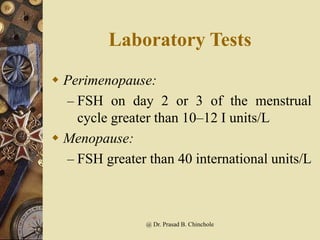
Laboratory Tests
 Perimenopause:
– FSH on day 2 or 3 of the menstrual
cycle greater than 10–12 I units/L
 Menopause:
– FSH greater than 40 international units/L
@ Dr. Prasad B. Chinchole
Hormone Replacement Therapy
 Supplemental hormones: Estrogen, progesterone,
and testosterone.
 Estrogen and progesterone can be made from
plants of from synthetic chemicals.
 Delivery options: pills, patches, creams, inserted
into vagina by means of creams, tablets or ring,
placed under skin by implants or by injection;
future: nasal spray.
@ Dr. Prasad B. Chinchole
Benefits of HRT
 Maintains thickness and vascularity of
vaginal and urethral tissue for comfort and
lubrication during sexual interaction.
 Reduces hot flashes and sleep disturbances
from night sweats.
 Protects against osteoporosis and resultant
fractures, particularly of the hip.
 Reduces risk of colon cancer
@ Dr. Prasad B. Chinchole
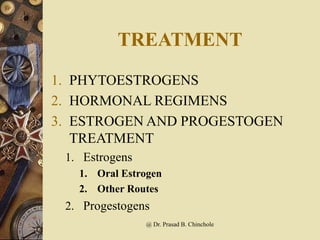
TREATMENT
1. PHYTOESTROGENS
2. HORMONAL REGIMENS
3. ESTROGEN AND PROGESTOGEN
TREATMENT
1. Estrogens
1. Oral Estrogen
2. Other Routes
2. Progestogens
@ Dr. Prasad B. Chinchole
4. Methods of Estrogen and Progestogen
Administration
5. Low-Dose Hormone Therapy
6. ANDROGENS
7. SELECTIVE ESTROGEN RECEPTOR
MODULATORS
8. TIBOLONE
@ Dr. Prasad B. Chinchole
Media Reports of HRT
 Media reports: Hazard Ratio- compares the difference
between numbers of people in each treatment condition
who experienced the health problem or benefit.
Example: “The Scientists found a 29% increase
in strokes, and a 26% increase in breast cancer.”
 Absolute Risk- Compares the actual number of people
who experience the problem or benefit.
Example: Women’s Health Initiative actual report
was 8% increase in strokes, and 8% increase for
breast cancer.
@ Dr. Prasad B. Chinchole
PHYTOESTROGENS
 Phytoestrogens have physiologic effects in
humans.
 They are plant compounds with estrogen-
like biologic activity and relatively weak
estrogen receptor–binding properties.
 Common food sources of phytoestrogens
include soybeans (isoflavones), cereals,
oilseeds such as flaxseed (lignans), and
alfalfa sprouts (coumestans).@ Dr. Prasad B. Chinchole
 Phytoestrogens decrease low-density
lipoprotein(LDL) cholesterol and triglyceride
concentrations with no significant change in
high-density lipoprotein (HDL) cholesterol
concentrations
 Common adverse effects include nausea and
constipation, bloating.
@ Dr. Prasad B. Chinchole
HORMONAL REGIMENS
 Approved indications of hormone therapy
include treatment of menopausal symptoms
and osteoporosis prevention.
 Therapy directed at menopausal symptoms,
such as hot flushes, often is short term.
 However, therapy directed at prevention of
osteoporosis should be long term.
 Consideration should be given to approved
nonestrogen alternatives.
@ Dr. Prasad B. Chinchole
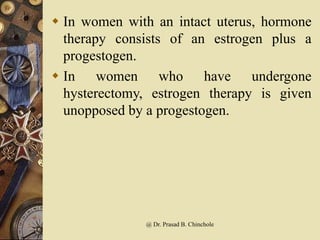
 In women with an intact uterus, hormone
therapy consists of an estrogen plus a
progestogen.
 In women who have undergone
hysterectomy, estrogen therapy is given
unopposed by a progestogen.
@ Dr. Prasad B. Chinchole
ESTROGEN AND
PROGESTOGEN TREATMENT
1. Estrogens
1. Oral Estrogen
2. Other Routes
Adverse Effects
2. Progestogens
Adverse Effects
 Methods of Estrogen and Progestogen
Administration
@ Dr. Prasad B. Chinchole
Estrogens
 To relief of vasomotor symptoms.
 The initial dose should be the lowest
effective dose for symptom control.
 Naturally occurring hormones or synthetic
steroidal or nonsteroidal compounds.
 No evidence indicates that one estrogen
compound is more effective than another in
relieving menopausal symptoms or
preventing osteoporosis.@ Dr. Prasad B. Chinchole
Oral Estrogen
 available for more than 50 years.
 prepared from the urine of pregnant mares
and is composed of estrone sulfate (50%–
60%) and multiple other equine estrogens
such as equilin and 17α-dihydroequilin.
 Estradiol is the predominant and most
active.
 Readily absorbed from the small intestines.
@ Dr. Prasad B. Chinchole
 Estradiol is metabolized by the intestinal mucosa
and the liver.
 Cytochrome P450 3A4
 Gut and liver metabolism converts a large
proportion of estradiol.
 Ethinyl estradiol is a highly potent semisynthetic
estrogen that has similar activity following
administration by the oral or parenteral route.
 Orally administered estrogens stimulate the
synthesis of hepatic proteins and increase the
circulating concentrations of sex hormone
binding globulin,
@ Dr. Prasad B. Chinchole
Other Routes
 Parenteral estrogens including
 Transdermal
 Intranasal
 Vaginal
 Percutaneous preparations (gels, creams,
and emulsions)
 Pellets
 Intranasal 17β-estradiol spray@ Dr. Prasad B. Chinchole
Adverse Effects
 nausea, headache, breast tenderness, and
heavy bleeding.
 increased risk for coronary heart disease,
stroke, venous thromboembolism, breast
cancer, and gallbladder disease.
 breast tenderness, unscheduled bleeding,
 Transdermal estrogen DVT than is oral
estrogen.
@ Dr. Prasad B. Chinchole
Progestogens
 Because of the increased risk of endometrial
hyperplasia and endometrial cancer with estrogen
monotherapy women who have not undergone
hysterectomy should be treated concurrently with
a progestogen in addition to the estrogen.
 Progestogens reduce nuclear estradiol receptor
concentrations, suppress DNA synthesis, and
decrease estrogen bioavailability by increasing
the activity of endometrial 17-hydroxysteroid
dehydrogenase, an enzyme responsible for
converting estradiol to estrone@ Dr. Prasad B. Chinchole
 A minimum of 12 to 14 days of progestogen
therapy each month is required for complete
protection against estrogen-induced endometrial
hyperplasia.
 Four combination estrogen and progestogen
regimens currently in use are continuous-cyclic
(sequential), continuous-combined, continuous
long-cycle (or cyclic withdrawal), and
intermittentcombined (or continuous-pulsed)
hormone therapy.
 The first generation of progestogens included the
C-19 androgenic progestogens norethisterone,
norgestrel, and levonorgestrel.
@ Dr. Prasad B. Chinchole
 More recent preparations have included the
C-21 progestogens dydrogesterone and
medroxyprogesterone acetate, which are
less androgenic.
 Drospirenone, a synthetic progestogen
analog of the potassium-sparing diuretic
spironolactone, has both antiandrogenic
and antialdosterone properties.
 The most commonly used oral
progestogens are medroxyprogesterone
acetate, micronized progesterone, and
norethisterone acetate.
@ Dr. Prasad B. Chinchole
Adverse Effects
 Irritability, depression, and headache.
 Mood swings, bloating, fluid retention
sleep disturbance.
 Increased risk for endometrial cancer.
@ Dr. Prasad B. Chinchole
Methods of Estrogen and
Progestogen Administration
1. Continuous Cyclic Estrogen/Progestogen
(Sequential) Treatment
2. Continuous Combined Estrogen–Progestogen
Treatment
3. Continuous Long-Cycle Estrogen–Progestogen
Treatment
4. Intermittent Combined Estrogen–Progestogen
Treatment
@ Dr. Prasad B. Chinchole
Continuous Cyclic Estrogen/Progestogen
(Sequential) Treatment
 Estrogen daily.
 Progestogen is co-administered for at least
12 to 14 days of a 28-day cycle.
 The progestogen causes scheduled
withdrawal bleeding in approximately 90%
of women.
@ Dr. Prasad B. Chinchole
Continuous Combined Estrogen–
Progestogen Treatment
 This regimen is best reserved for women
who are at least 2 years postmenopause.
 Continuous-combined hormone therapy is
more acceptable than traditional cyclic
therapy.
@ Dr. Prasad B. Chinchole
Continuous Long-Cycle Estrogen–
Progestogen Treatment
 estrogen is given daily
 Progestogen is given six times per year,
every other month for 12 to 14 days,
resulting in six periods per year.
@ Dr. Prasad B. Chinchole
Intermittent Combined Estrogen–
Progestogen Treatment
 The intermittent combined estrogen–
progestogen regimen, also called
continuous-pulsed estrogen–progestogen
or pulsed-progestogen,consists of 3 days of
estrogen therapy alone, followed by 3 days
of combined estrogen and progestogen,
which is then repeated without
interruption.
@ Dr. Prasad B. Chinchole
Low-Dose Hormone Therapy
 CEE 0.45 mg/day
 Medroxyprogesterone acetate 1.5 mg/ day
@ Dr. Prasad B. Chinchole
ANDROGENS
 Pathophysiologic states affecting ovarian
and adrenal function, along with aging,
have been associated with androgen
deficiency in women.
@ Dr. Prasad B. Chinchole
Estrogen Overload?
 Estrogen in the Environment
– Cow and Chicken Farms-Range Feed
– Plastic
– Pesticides
 Diet
 Metabolism
@ Dr. Prasad B. Chinchole
Reducing the amount of Estrogen
 Research looking at lower doses of HTR
 Balance of estrogen and progesterone
– Progesterone Cream
 Stress Relief
 Liver Cleansing
@ Dr. Prasad B. Chinchole
Women’s Health Initiative
2002
 The study
– 16,608 women
– Women ages 50-79
– Purpose was to identify risks and benefits of
long-term HRT use
– Stopped prematurely because of findings
@ Dr. Prasad B. Chinchole
Women’s Health Initiative
2002
 Results
– 26 percent increase of invasive breast cancer
– 29 percent increased risk of death from
coronary heart disease
– 41 percent increased risk of stroke
– 200 percent increased risk of blood clots
– Limitations to the study
@ Dr. Prasad B. Chinchole
Risks of HRT
 Breast cancer
– In 2003 there was 14,000 less cases of breast cancer
possibly due to the decrease in women taking HRT
– If a woman is diagnosed with breast cancer while
taking HRT, she is advised to stop immediately.
 Endometrial cancer
 Cardiovascular disease
 Stroke
 Blood clots
@ Dr. Prasad B. Chinchole
Side Effects of HRT
 Weight gain
 Bloating
 Breast tenderness
 Irregular bleeding
 Some do not take HRT for fear of cancer
 Some physicians recommend a
discontinuation of HRT
@ Dr. Prasad B. Chinchole
Alternative Therapies
 One study indicated 68 percent of women
have tried alternative therapies and 62
percent were satisfied with the results.
 Diet and Exercise are the most common.
@ Dr. Prasad B. Chinchole
Alternative Therapies (Diet)
 Soy isoflavones in soy products
– Relieves a number of symptoms, including hot flashes,
night sweats, fatigue and vaginal dryness
– Soy has also been shown to assist the body in
absorbing and retaining calcium, suppress bone loss,
lower LDL cholesterol and decrease blood clotting
– Recommended daily amount is 25 grams of soy
protein and 30-50 mg of isoflavones as a starting
amount and could gradually increase to two to three
times that amount
– Seen to reduce symptoms in 4 out of 10 women
@ Dr. Prasad B. Chinchole
Alternative Therapies (Diet)
 Black Cohosh
– Has been seen to reduce hot flashes
– Potential for liver damage and shouldn’t take
more than 6 months
 Calcium, magnesium and vitamins D & E
– Magnesium promotes bone density
– RDA is 600 mg, although most Americans
only consume 300 mg
@ Dr. Prasad B. Chinchole
Alternative Therapies
 Smoking cessation
– Reduces risk for pretty much everything!
 Avoiding spicy foods for those who get heartburn
– Can reduce severity and frequency of hot flashes
 Limiting or eliminating caffeine
– Promotes sleep
 Relaxation methods
– Helps with mood swings/irritability
@ Dr. Prasad B. Chinchole
Alternative Therapies
 Acupuncture
 Reflexology
 Controlling weight and avoiding weight
gain
 Preparing for hot weather by wearing
layers of clothing and bringing a small fan
@ Dr. Prasad B. Chinchole

Hrt

  • 1.
    @ Dr. PrasadB. Chinchole
  • 2.
    Hormone Replacement Therapy (HRT) Dr.Prasad B. Chinchole Pharm D. SCOP, Almala @ Dr. Prasad B. Chinchole
  • 3.
    @ Dr. PrasadB. Chinchole
  • 4.
    What is Menopause? Cessation of menstruation as a result of the aging process of or surgical removal of the ovaries; change from fertility to infertility.  Physiological changes that take place within women between the ages of 30 to 60.  Hormone levels change in female body; practically the production of estrogen.  Perimenopause and menopause can last 10 plus years.  Menopause itself begins 12 months after a woman’s final period. @ Dr. Prasad B. Chinchole
  • 5.
  • 6.
    @ Dr. PrasadB. Chinchole
  • 7.
    PHYSIOLOGY  A womanis born with approximately two million primordial follicles in her ovaries.  During a normal reproductive life span, she ovulates fewer than 500 times.  The hypothalamic–pituitary–ovarian axis dynamically controls reproductive physiology throughout the reproductive years. @ Dr. Prasad B. Chinchole
  • 8.
     GnRH  FSH LH  Regulate ovarian function.  Pathophysiologic changes associated with menopause are caused by loss of ovarian follicular activity. @ Dr. Prasad B. Chinchole
  • 9.
     Ovarian primordialfollicle numbers decrease with advancing age, and at the time of the menopause, few follicles remain in the ovary.  Hence the postmenopausal ovary is no longer the primary site of estradiol or progesterone synthesis.  The postmenopausal ovary secretes primarily androstenedione and testosterone. @ Dr. Prasad B. Chinchole
  • 10.
    Symptoms of Perimenopause/Menopause  Cyclesbecome irregular  Erratic or heavy bleeding  Vasomotor symptoms- Hot flashes Night sweats  Decrease in sexual response  Irritability/Mood Swings  Fatigue @ Dr. Prasad B. Chinchole
  • 11.
    Symptoms of Perimenopause/Menopause  Headache Forgetfulness  Vaginal dryness  Dry skin  Bone loss  Urinary incontinence @ Dr. Prasad B. Chinchole
  • 12.
    Signs  Perimenopause: – Dysfunctionaluterine bleeding as a result of anovulatory cycles  Menopause: – Signs of urogenital atrophy @ Dr. Prasad B. Chinchole
  • 13.
    Laboratory Tests  Perimenopause: –FSH on day 2 or 3 of the menstrual cycle greater than 10–12 I units/L  Menopause: – FSH greater than 40 international units/L @ Dr. Prasad B. Chinchole
  • 14.
    Hormone Replacement Therapy Supplemental hormones: Estrogen, progesterone, and testosterone.  Estrogen and progesterone can be made from plants of from synthetic chemicals.  Delivery options: pills, patches, creams, inserted into vagina by means of creams, tablets or ring, placed under skin by implants or by injection; future: nasal spray. @ Dr. Prasad B. Chinchole
  • 15.
    Benefits of HRT Maintains thickness and vascularity of vaginal and urethral tissue for comfort and lubrication during sexual interaction.  Reduces hot flashes and sleep disturbances from night sweats.  Protects against osteoporosis and resultant fractures, particularly of the hip.  Reduces risk of colon cancer @ Dr. Prasad B. Chinchole
  • 16.
    TREATMENT 1. PHYTOESTROGENS 2. HORMONALREGIMENS 3. ESTROGEN AND PROGESTOGEN TREATMENT 1. Estrogens 1. Oral Estrogen 2. Other Routes 2. Progestogens @ Dr. Prasad B. Chinchole
  • 17.
    4. Methods ofEstrogen and Progestogen Administration 5. Low-Dose Hormone Therapy 6. ANDROGENS 7. SELECTIVE ESTROGEN RECEPTOR MODULATORS 8. TIBOLONE @ Dr. Prasad B. Chinchole
  • 18.
    Media Reports ofHRT  Media reports: Hazard Ratio- compares the difference between numbers of people in each treatment condition who experienced the health problem or benefit. Example: “The Scientists found a 29% increase in strokes, and a 26% increase in breast cancer.”  Absolute Risk- Compares the actual number of people who experience the problem or benefit. Example: Women’s Health Initiative actual report was 8% increase in strokes, and 8% increase for breast cancer. @ Dr. Prasad B. Chinchole
  • 19.
    PHYTOESTROGENS  Phytoestrogens havephysiologic effects in humans.  They are plant compounds with estrogen- like biologic activity and relatively weak estrogen receptor–binding properties.  Common food sources of phytoestrogens include soybeans (isoflavones), cereals, oilseeds such as flaxseed (lignans), and alfalfa sprouts (coumestans).@ Dr. Prasad B. Chinchole
  • 20.
     Phytoestrogens decreaselow-density lipoprotein(LDL) cholesterol and triglyceride concentrations with no significant change in high-density lipoprotein (HDL) cholesterol concentrations  Common adverse effects include nausea and constipation, bloating. @ Dr. Prasad B. Chinchole
  • 21.
    HORMONAL REGIMENS  Approvedindications of hormone therapy include treatment of menopausal symptoms and osteoporosis prevention.  Therapy directed at menopausal symptoms, such as hot flushes, often is short term.  However, therapy directed at prevention of osteoporosis should be long term.  Consideration should be given to approved nonestrogen alternatives. @ Dr. Prasad B. Chinchole
  • 22.
     In womenwith an intact uterus, hormone therapy consists of an estrogen plus a progestogen.  In women who have undergone hysterectomy, estrogen therapy is given unopposed by a progestogen. @ Dr. Prasad B. Chinchole
  • 23.
    ESTROGEN AND PROGESTOGEN TREATMENT 1.Estrogens 1. Oral Estrogen 2. Other Routes Adverse Effects 2. Progestogens Adverse Effects  Methods of Estrogen and Progestogen Administration @ Dr. Prasad B. Chinchole
  • 24.
    Estrogens  To reliefof vasomotor symptoms.  The initial dose should be the lowest effective dose for symptom control.  Naturally occurring hormones or synthetic steroidal or nonsteroidal compounds.  No evidence indicates that one estrogen compound is more effective than another in relieving menopausal symptoms or preventing osteoporosis.@ Dr. Prasad B. Chinchole
  • 25.
    Oral Estrogen  availablefor more than 50 years.  prepared from the urine of pregnant mares and is composed of estrone sulfate (50%– 60%) and multiple other equine estrogens such as equilin and 17α-dihydroequilin.  Estradiol is the predominant and most active.  Readily absorbed from the small intestines. @ Dr. Prasad B. Chinchole
  • 26.
     Estradiol ismetabolized by the intestinal mucosa and the liver.  Cytochrome P450 3A4  Gut and liver metabolism converts a large proportion of estradiol.  Ethinyl estradiol is a highly potent semisynthetic estrogen that has similar activity following administration by the oral or parenteral route.  Orally administered estrogens stimulate the synthesis of hepatic proteins and increase the circulating concentrations of sex hormone binding globulin, @ Dr. Prasad B. Chinchole
  • 27.
    @ Dr. PrasadB. Chinchole
  • 28.
    @ Dr. PrasadB. Chinchole
  • 29.
    Other Routes  Parenteralestrogens including  Transdermal  Intranasal  Vaginal  Percutaneous preparations (gels, creams, and emulsions)  Pellets  Intranasal 17β-estradiol spray@ Dr. Prasad B. Chinchole
  • 30.
    Adverse Effects  nausea,headache, breast tenderness, and heavy bleeding.  increased risk for coronary heart disease, stroke, venous thromboembolism, breast cancer, and gallbladder disease.  breast tenderness, unscheduled bleeding,  Transdermal estrogen DVT than is oral estrogen. @ Dr. Prasad B. Chinchole
  • 31.
    Progestogens  Because ofthe increased risk of endometrial hyperplasia and endometrial cancer with estrogen monotherapy women who have not undergone hysterectomy should be treated concurrently with a progestogen in addition to the estrogen.  Progestogens reduce nuclear estradiol receptor concentrations, suppress DNA synthesis, and decrease estrogen bioavailability by increasing the activity of endometrial 17-hydroxysteroid dehydrogenase, an enzyme responsible for converting estradiol to estrone@ Dr. Prasad B. Chinchole
  • 32.
     A minimumof 12 to 14 days of progestogen therapy each month is required for complete protection against estrogen-induced endometrial hyperplasia.  Four combination estrogen and progestogen regimens currently in use are continuous-cyclic (sequential), continuous-combined, continuous long-cycle (or cyclic withdrawal), and intermittentcombined (or continuous-pulsed) hormone therapy.  The first generation of progestogens included the C-19 androgenic progestogens norethisterone, norgestrel, and levonorgestrel. @ Dr. Prasad B. Chinchole
  • 33.
     More recentpreparations have included the C-21 progestogens dydrogesterone and medroxyprogesterone acetate, which are less androgenic.  Drospirenone, a synthetic progestogen analog of the potassium-sparing diuretic spironolactone, has both antiandrogenic and antialdosterone properties.  The most commonly used oral progestogens are medroxyprogesterone acetate, micronized progesterone, and norethisterone acetate. @ Dr. Prasad B. Chinchole
  • 34.
    @ Dr. PrasadB. Chinchole
  • 35.
    Adverse Effects  Irritability,depression, and headache.  Mood swings, bloating, fluid retention sleep disturbance.  Increased risk for endometrial cancer. @ Dr. Prasad B. Chinchole
  • 36.
    Methods of Estrogenand Progestogen Administration 1. Continuous Cyclic Estrogen/Progestogen (Sequential) Treatment 2. Continuous Combined Estrogen–Progestogen Treatment 3. Continuous Long-Cycle Estrogen–Progestogen Treatment 4. Intermittent Combined Estrogen–Progestogen Treatment @ Dr. Prasad B. Chinchole
  • 37.
    Continuous Cyclic Estrogen/Progestogen (Sequential)Treatment  Estrogen daily.  Progestogen is co-administered for at least 12 to 14 days of a 28-day cycle.  The progestogen causes scheduled withdrawal bleeding in approximately 90% of women. @ Dr. Prasad B. Chinchole
  • 38.
    Continuous Combined Estrogen– ProgestogenTreatment  This regimen is best reserved for women who are at least 2 years postmenopause.  Continuous-combined hormone therapy is more acceptable than traditional cyclic therapy. @ Dr. Prasad B. Chinchole
  • 39.
    Continuous Long-Cycle Estrogen– ProgestogenTreatment  estrogen is given daily  Progestogen is given six times per year, every other month for 12 to 14 days, resulting in six periods per year. @ Dr. Prasad B. Chinchole
  • 40.
    Intermittent Combined Estrogen– ProgestogenTreatment  The intermittent combined estrogen– progestogen regimen, also called continuous-pulsed estrogen–progestogen or pulsed-progestogen,consists of 3 days of estrogen therapy alone, followed by 3 days of combined estrogen and progestogen, which is then repeated without interruption. @ Dr. Prasad B. Chinchole
  • 41.
    Low-Dose Hormone Therapy CEE 0.45 mg/day  Medroxyprogesterone acetate 1.5 mg/ day @ Dr. Prasad B. Chinchole
  • 42.
    ANDROGENS  Pathophysiologic statesaffecting ovarian and adrenal function, along with aging, have been associated with androgen deficiency in women. @ Dr. Prasad B. Chinchole
  • 43.
    Estrogen Overload?  Estrogenin the Environment – Cow and Chicken Farms-Range Feed – Plastic – Pesticides  Diet  Metabolism @ Dr. Prasad B. Chinchole
  • 44.
    Reducing the amountof Estrogen  Research looking at lower doses of HTR  Balance of estrogen and progesterone – Progesterone Cream  Stress Relief  Liver Cleansing @ Dr. Prasad B. Chinchole
  • 45.
    Women’s Health Initiative 2002 The study – 16,608 women – Women ages 50-79 – Purpose was to identify risks and benefits of long-term HRT use – Stopped prematurely because of findings @ Dr. Prasad B. Chinchole
  • 46.
    Women’s Health Initiative 2002 Results – 26 percent increase of invasive breast cancer – 29 percent increased risk of death from coronary heart disease – 41 percent increased risk of stroke – 200 percent increased risk of blood clots – Limitations to the study @ Dr. Prasad B. Chinchole
  • 47.
    Risks of HRT Breast cancer – In 2003 there was 14,000 less cases of breast cancer possibly due to the decrease in women taking HRT – If a woman is diagnosed with breast cancer while taking HRT, she is advised to stop immediately.  Endometrial cancer  Cardiovascular disease  Stroke  Blood clots @ Dr. Prasad B. Chinchole
  • 48.
    Side Effects ofHRT  Weight gain  Bloating  Breast tenderness  Irregular bleeding  Some do not take HRT for fear of cancer  Some physicians recommend a discontinuation of HRT @ Dr. Prasad B. Chinchole
  • 49.
    Alternative Therapies  Onestudy indicated 68 percent of women have tried alternative therapies and 62 percent were satisfied with the results.  Diet and Exercise are the most common. @ Dr. Prasad B. Chinchole
  • 50.
    Alternative Therapies (Diet) Soy isoflavones in soy products – Relieves a number of symptoms, including hot flashes, night sweats, fatigue and vaginal dryness – Soy has also been shown to assist the body in absorbing and retaining calcium, suppress bone loss, lower LDL cholesterol and decrease blood clotting – Recommended daily amount is 25 grams of soy protein and 30-50 mg of isoflavones as a starting amount and could gradually increase to two to three times that amount – Seen to reduce symptoms in 4 out of 10 women @ Dr. Prasad B. Chinchole
  • 51.
    Alternative Therapies (Diet) Black Cohosh – Has been seen to reduce hot flashes – Potential for liver damage and shouldn’t take more than 6 months  Calcium, magnesium and vitamins D & E – Magnesium promotes bone density – RDA is 600 mg, although most Americans only consume 300 mg @ Dr. Prasad B. Chinchole
  • 52.
    Alternative Therapies  Smokingcessation – Reduces risk for pretty much everything!  Avoiding spicy foods for those who get heartburn – Can reduce severity and frequency of hot flashes  Limiting or eliminating caffeine – Promotes sleep  Relaxation methods – Helps with mood swings/irritability @ Dr. Prasad B. Chinchole
  • 53.
    Alternative Therapies  Acupuncture Reflexology  Controlling weight and avoiding weight gain  Preparing for hot weather by wearing layers of clothing and bringing a small fan @ Dr. Prasad B. Chinchole