or
Human Resource Planning Model
The HRP Model / Process
⚫Organizational Objectivesand policies:
The starting pointof anyactivity in an organization is
its objectives. HR plan need to be based on
organisational objectives.
Once the organisational objectivesare
defined by the top management, the HR department
must specify its objectives with regard to HR
utilisation in theorganisation.
⚫In developing theseobjectives, HR department has to
formulate specific policies to address the following
questions:
⚫1. Arevacancies to be filled by promotions from within
or by hiring from outside?
⚫2. Howdo the training and developmentobjectives
interfacewith the HRP objectives?
⚫3. What union constraintsare encountered in HRP and
whatpoliciesare needed to handle theseconstraints?
⚫4. How can theemployee’s job be enriched?
⚫5. Howcan onedownsize theorganization to make it
morecompetitive?
⚫6. Howcan oneensurecontinuousavailabilityof
adaptiveand f lexibleworkforce?
⚫7. Towhatextentproductionand operations be
automated and what can be done about those
displaced?
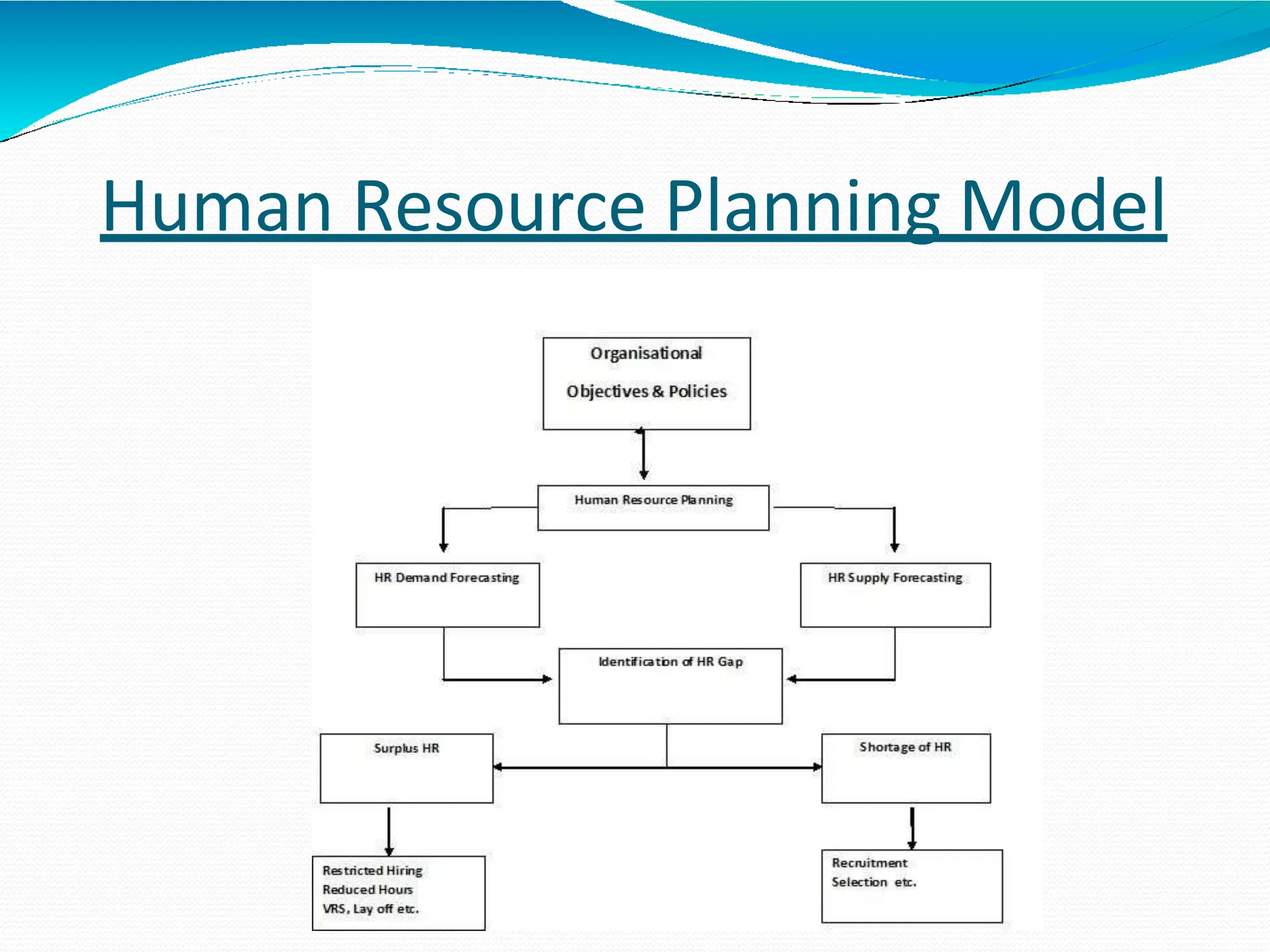
⚫Human Resource Planning:
⚫Taking direction from organizational objectives and
plans and above policy consideration human resource
plan is prepared. The planning process consists of two
majoractivities: forecasting needsof human resources
and forecasting supplyof human resources.
⚫Forecasting needs for human resources and
forecasting supplyof human resources, both taken
together helps to identify gap between human
resources needed and theiravailability.
HR Demand Forecasting
⚫HR demand forecasting is the process of estimating
thequantityand qualityof people required to meet the
future needsof theorganisation.
⚫The basis for forecasting must be based on theannual
budget and long-term corporate plan and translated
intoactivity levels foreach functionand department.
⚫Forexample, in a manufacturing company, the sales
budget would be translated into a production plan
giving the numberand typeof products to be
produced in each period. From this information the
numberof working hoursand skills required can be
determined for each period and from which the
required quality and quantity of personnel can be
determined.
HR Supply Forecasting
⚫HR supply forecasting measures that numberof
people likely to beavailable from within and outside
an organization, after movements and promotions,
wastage and changes in work hours, and other
conditionsof work.
⚫The supplyanalysis covers:
⚫1. Existing human resources,
⚫2. Internal sourcesof supply, and
⚫3. External sourcesof supply.
Identification of Human Resource Gap
⚫Human resourcegap is thedifference between human
resources required ata particularpointof timeand the
human resources being available at that particular
time.
⚫This gap can be identified on the basisof forecasts for
human resources. Based on the analysis of this gap,
action plans must bedeveloped toovercomethisgap.
In the end it may result in reducing the
personnel or increasing and recruiting the personnel
in different categories.
Action Plans
⚫Various action plans are devised to bridge the human
resourcegap. If there is surplusof human resources
either becauseof improper HRP in the pastor because
of change of organisational plan, such as
disinvestmentof businessorclosing down some
businesses because of various reasons, action plans
may be devised to reduce their size through layoff,
voluntary retirement etc. If there is shortage of
human resources, action plans may be devised to
recruitadditional personnel.
Short-term Human
Resource Planning
⚫ This mayarisedue tocertain
immediatevacancies that
have fallen due to sudden
increased production and
large new orders
necessitating more
personnel.
Long-term Human Resource
Planning
⚫ This is based on projections
and long term expansion
programmes. There will be
sufficient time for deep
contemplation,
programming, recruiting and
selection. Both quantitative
and qualitative aspects of
human resources could be
taken care of in long – term
planning and proper tuning.

HRP-Process-1 (1).pptx human resource planning ppt presentation

  • 1.
  • 2.
  • 3.
    The HRP Model/ Process ⚫Organizational Objectivesand policies: The starting pointof anyactivity in an organization is its objectives. HR plan need to be based on organisational objectives. Once the organisational objectivesare defined by the top management, the HR department must specify its objectives with regard to HR utilisation in theorganisation.
  • 4.
    ⚫In developing theseobjectives,HR department has to formulate specific policies to address the following questions: ⚫1. Arevacancies to be filled by promotions from within or by hiring from outside? ⚫2. Howdo the training and developmentobjectives interfacewith the HRP objectives? ⚫3. What union constraintsare encountered in HRP and whatpoliciesare needed to handle theseconstraints?
  • 5.
    ⚫4. How cantheemployee’s job be enriched? ⚫5. Howcan onedownsize theorganization to make it morecompetitive? ⚫6. Howcan oneensurecontinuousavailabilityof adaptiveand f lexibleworkforce? ⚫7. Towhatextentproductionand operations be automated and what can be done about those displaced?
  • 6.
    ⚫Human Resource Planning: ⚫Takingdirection from organizational objectives and plans and above policy consideration human resource plan is prepared. The planning process consists of two majoractivities: forecasting needsof human resources and forecasting supplyof human resources.
  • 7.
    ⚫Forecasting needs forhuman resources and forecasting supplyof human resources, both taken together helps to identify gap between human resources needed and theiravailability.
  • 8.
    HR Demand Forecasting ⚫HRdemand forecasting is the process of estimating thequantityand qualityof people required to meet the future needsof theorganisation.
  • 9.
    ⚫The basis forforecasting must be based on theannual budget and long-term corporate plan and translated intoactivity levels foreach functionand department. ⚫Forexample, in a manufacturing company, the sales budget would be translated into a production plan giving the numberand typeof products to be produced in each period. From this information the numberof working hoursand skills required can be determined for each period and from which the required quality and quantity of personnel can be determined.
  • 10.
    HR Supply Forecasting ⚫HRsupply forecasting measures that numberof people likely to beavailable from within and outside an organization, after movements and promotions, wastage and changes in work hours, and other conditionsof work. ⚫The supplyanalysis covers: ⚫1. Existing human resources, ⚫2. Internal sourcesof supply, and ⚫3. External sourcesof supply.
  • 11.
    Identification of HumanResource Gap ⚫Human resourcegap is thedifference between human resources required ata particularpointof timeand the human resources being available at that particular time. ⚫This gap can be identified on the basisof forecasts for human resources. Based on the analysis of this gap, action plans must bedeveloped toovercomethisgap. In the end it may result in reducing the personnel or increasing and recruiting the personnel in different categories.
  • 12.
    Action Plans ⚫Various actionplans are devised to bridge the human resourcegap. If there is surplusof human resources either becauseof improper HRP in the pastor because of change of organisational plan, such as disinvestmentof businessorclosing down some businesses because of various reasons, action plans may be devised to reduce their size through layoff, voluntary retirement etc. If there is shortage of human resources, action plans may be devised to recruitadditional personnel.
  • 13.
    Short-term Human Resource Planning ⚫This mayarisedue tocertain immediatevacancies that have fallen due to sudden increased production and large new orders necessitating more personnel. Long-term Human Resource Planning ⚫ This is based on projections and long term expansion programmes. There will be sufficient time for deep contemplation, programming, recruiting and selection. Both quantitative and qualitative aspects of human resources could be taken care of in long – term planning and proper tuning.