Human Resources Management
Module 9: Performance Management and Appraisal
Module Learning Outcomes
Performance Management and Appraisal
9.1: Discuss the purpose of performance management
9.2: Discuss the appraisal process
9.3: Discuss ways to improve appraisal effectiveness
The Purpose of Performance Management
Learning Outcomes: Purpose of Performance
Management
9.1: Discuss the purpose of performance management
9.1.1: Discuss the purpose of performance management
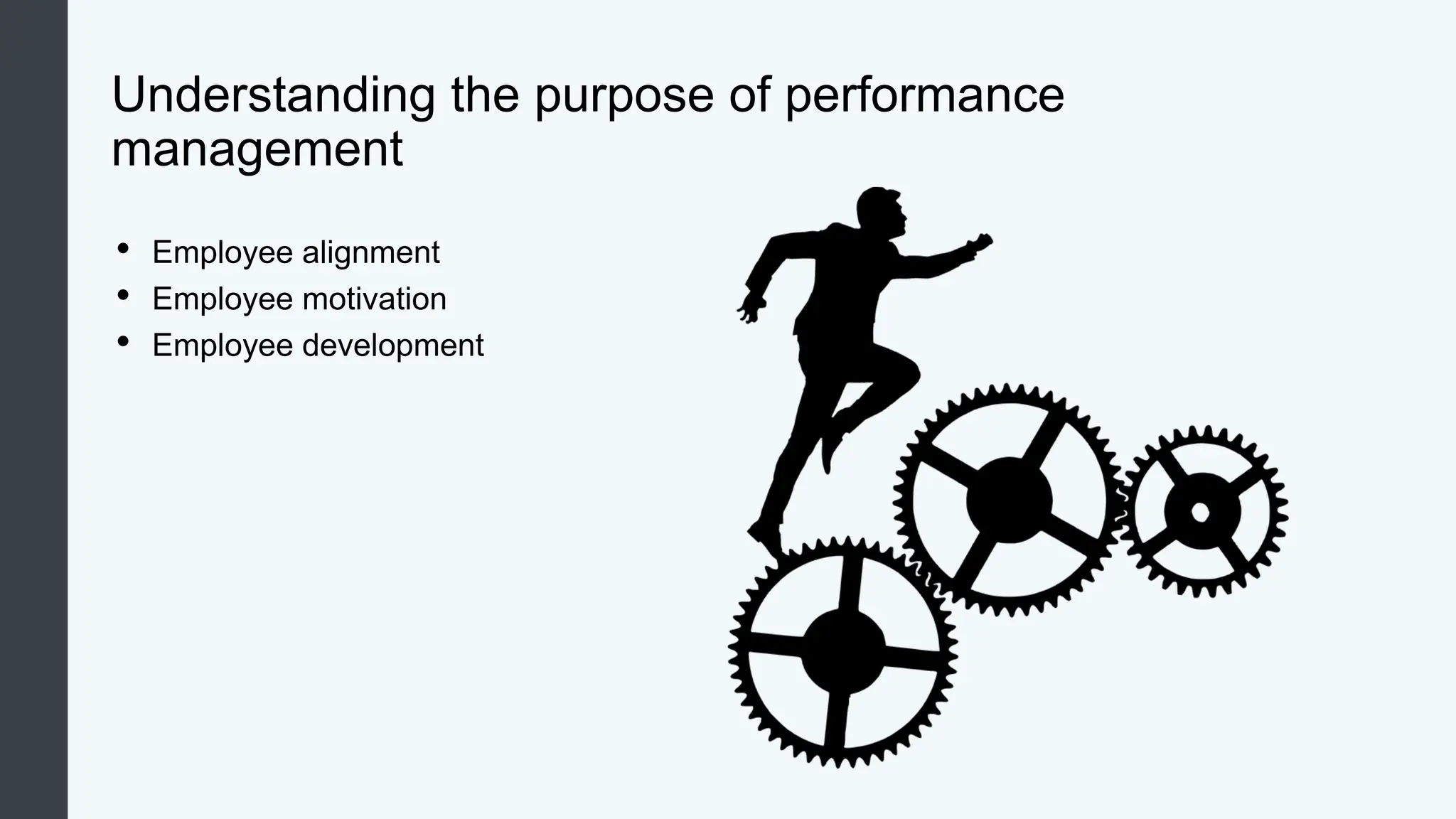
Understanding the purpose of performance
management
• Employee alignment
• Employee motivation
• Employee development
Giving Feedback
• Feedback should be . . .
• Specific
• Helpful
• Timely
• Ongoing
• Actionable
Performance Appraisals Serve an Administrative
Function…
• Supports employee disciplinary action
• Supports employee development
Practice Question 1
Sydelle, a relatively new manager, is preparing for her first employee appraisal and
asks you for perspective; specifically, what are the purposes of performance
management? Which of the following responses is most accurate?
A. The purposes of performance management are to identify and reward high-
potential talent.
B. The purposes of performance management are to identify and remove non-
performing employees.
C. The purposes of performance management are employee alignment, motivation
and development.
D. The purposes of performance management are to achieve departmental and
organizational goals and objectives.
The Appraisal Process
Learning Outcomes: The Appraisal Process
9.2: Discuss the appraisal process
9.2.1: Describe the steps in the appraisal process
9.2.2: Evaluate absolute appraisal methods
9.2.3: Evaluate relative appraisal methods
9.2.4: Discuss management by objectives
9.2.5: Discuss how to present an appraisal
The steps of the appraisal process
1. Establish performance standards
• SMART goals
2. Communicate performance standards
3. Measure performance
4. Compare actual performance to performance standards
5. Discuss the appraisal with the employee
6. Personnel action
Appraisal methods
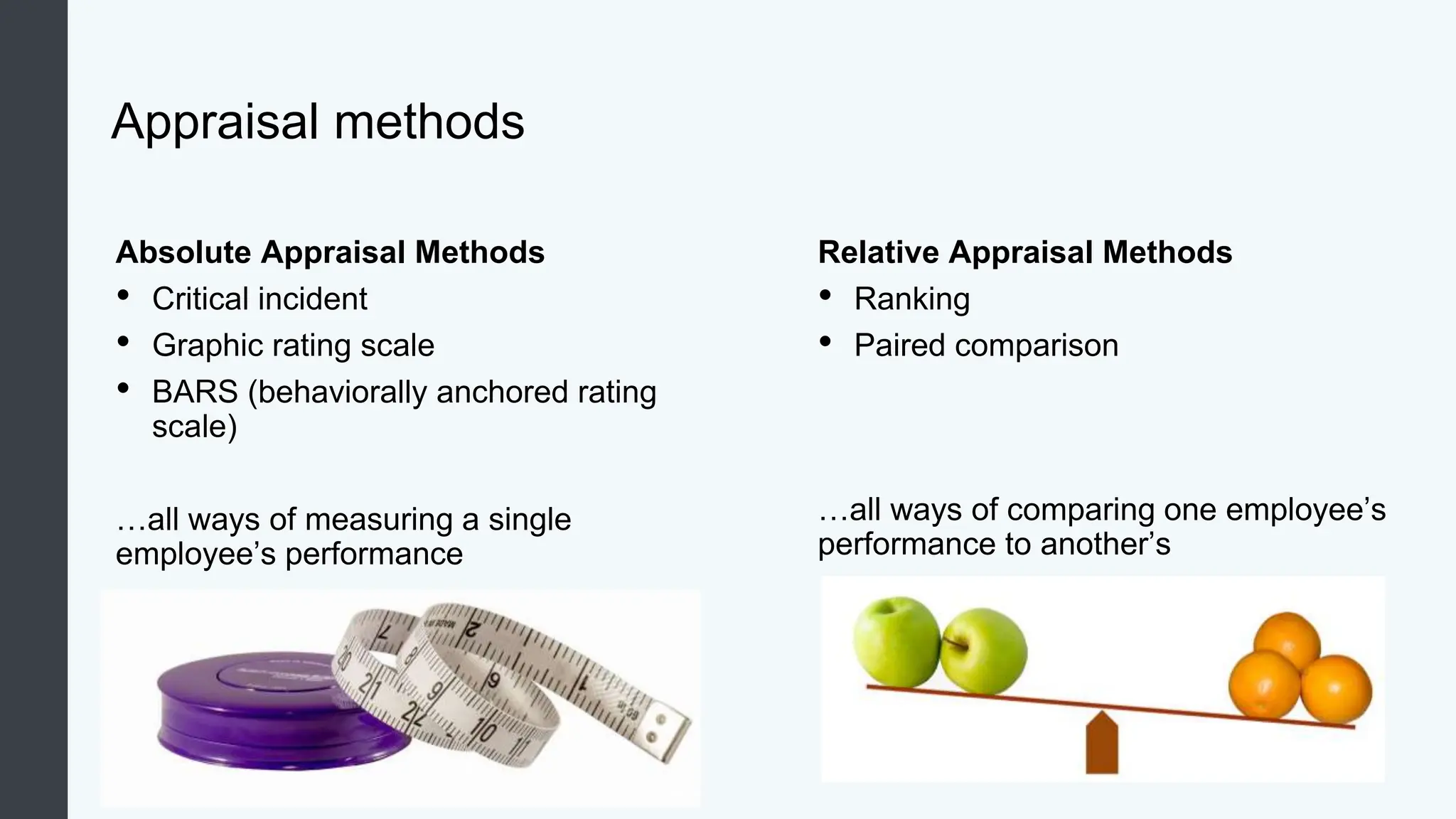
Absolute Appraisal Methods
• Critical incident
• Graphic rating scale
• BARS (behaviorally anchored rating
scale)
…all ways of measuring a single
employee’s performance
Relative Appraisal Methods
• Ranking
• Paired comparison
…all ways of comparing one employee’s
performance to another’s
Management by Objective
• Organizational goals are cascaded down through the organization
• Performance objectives are discussed and agreed to by management and
employees
• Complex and time-consuming method, but results in a clearer understanding of
expectations and greater employee buy-in
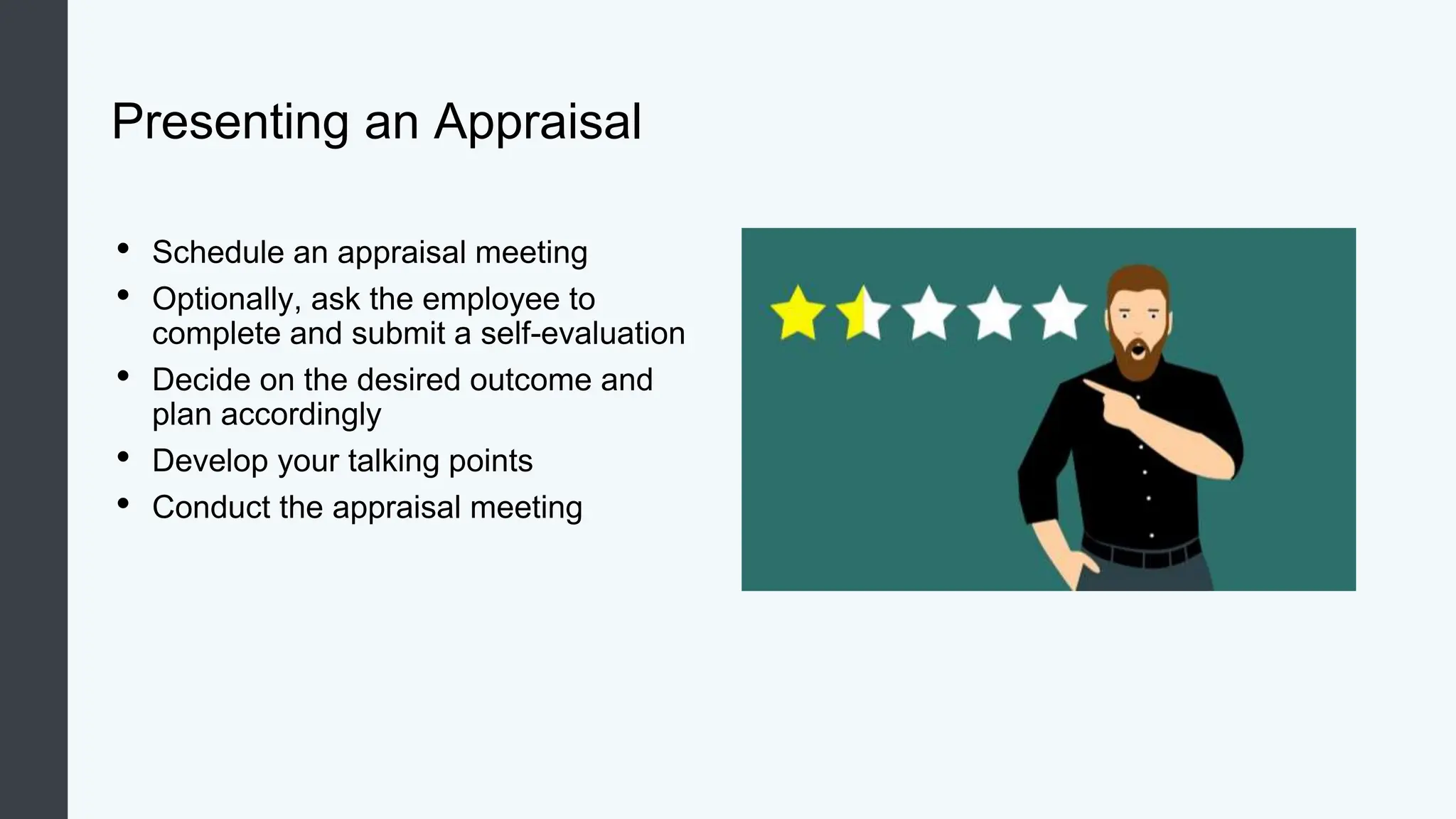
Presenting an Appraisal
• Schedule an appraisal meeting
• Optionally, ask the employee to
complete and submit a self-evaluation
• Decide on the desired outcome and
plan accordingly
• Develop your talking points
• Conduct the appraisal meeting
Practice Question 2
You’re a manager preparing to appraise your employees. Which of the following should
you keep in mind as you do so?
A. Only performance standards that you can observe should be considered.
B. Performance standards should be specific, measurable, achievable, relevant and
time-bound.
C. Only performance that can be expressed in numeric terms should be factored into
the appraisal.
D. To avoid conflict, appraisals should be delivered to employees via email.
Practice Question 3
Managers in your organization generally supervise a staff of 30–50 people. Your CEO
has asked Human Resource management to implement a relative appraisal method
that will eliminate the weakest performers. Which of the following should you
recommend?
A. Paired comparison
B. Critical incident rating
C. 20/70/10 rating
D. BARS
Appraisal Effectiveness
Learning Outcomes: Appraisal Effectiveness
9.3: Discuss ways to improve appraisal effectiveness
9.3.1: Discuss common performance management errors
9.3.2: Identify techniques for improving appraisal effectiveness
Errors in conducting performance appraisals
• The leniency error
• The central tendency error
• The recency error
• The halo effect error
• The horns effect error
• Contrast error
• Past performance error
• Biased rating error
• High potential error
• Similar to me error
• Guilt by association error
Class Activity: What’s your error?
The class should get together in groups of three. One person should be the evaluator,
one should be the employee, and one should be the observer.
Evaluator: Conduct a performance appraisal for the employee. In it, toss in one
“performance appraisal error.” Choose whether the assessment will be favorable or
tough news for the employee and stick with it.
Observer: Try to determine which of the eleven common appraisal mistakes your
evaluator made. What else could the evaluator have done to give a better appraisal?
Switch positions two more times, so everyone has a turn at all three positions. If one
person has given a favorable appraisal, the next can try a difficult one, and so on.
Present: What’s your error?
Avoid Errors!
• Cultivate awareness of potential errors
• Rely on data and documentation you’ve compiled, rather than your perceptions.
Focus on the performance, not the person!
Improving Appraisal Effectiveness
Kim Scott’s Radical Candor
• Criticizing employees when they don’t
perform isn’t just a manager’s job, it’s
a moral obligation
• Be a caring but challenging manager
Lenny Rachitsky’s Performance
Management System
• Set aside time for adequate
preparation
• Development
• Summary
• Concrete examples
• Peer feedback
• Highlight an employee’s “superpower”
Practice Question 4
You’re reviewing appraisal documentation to identify training gaps. Which of the
following scenarios does NOT suggest a perceptual error?
A. A manager who rates every person on the team as “exceeds expectations.”
B. A manager who rates every person on the team as “meets expectations.”
C. A manager who rates staff who are similar to him or her relatively highly.
D. A manager who rates staff at different levels based on documented performance
relative to goals and standards.
Practice Question 5
You’re developing a management training program to improve appraisal effectiveness.
Which of the following points should you emphasize?
A. Giving your employees constructive feedback is not just your job, it’s your moral
obligation.
B. Say something nice or don’t say anything.
C. The single most important thing a boss can do is let employees figure things out on
their own.
D. Feedback should only cover development needs.
Quick Review
• The purpose of performance management is employee alignment, motivation and
development
• Feedback should be specific, actionable, helpful, timely and ongoing
• The steps of the appraisal process are
• Establish performance standards (using SMART goals)
• Communicate performance standards
• Measure performance
• Compare actual performance to performance standards
• Discuss the appraisal with the employee
• Personnel action
• Appraisals can be absolute, relative, or a hybrid formed from management by
objective situations
• Know common errors and strive to give an effective appraisal

HRM_09_PerformanceManagementAndAppraisal.pptx

  • 1.
    Human Resources Management Module9: Performance Management and Appraisal
  • 2.
    Module Learning Outcomes PerformanceManagement and Appraisal 9.1: Discuss the purpose of performance management 9.2: Discuss the appraisal process 9.3: Discuss ways to improve appraisal effectiveness
  • 3.
    The Purpose ofPerformance Management
  • 4.
    Learning Outcomes: Purposeof Performance Management 9.1: Discuss the purpose of performance management 9.1.1: Discuss the purpose of performance management
  • 5.
    Understanding the purposeof performance management • Employee alignment • Employee motivation • Employee development
  • 6.
    Giving Feedback • Feedbackshould be . . . • Specific • Helpful • Timely • Ongoing • Actionable
  • 7.
    Performance Appraisals Servean Administrative Function… • Supports employee disciplinary action • Supports employee development
  • 8.
    Practice Question 1 Sydelle,a relatively new manager, is preparing for her first employee appraisal and asks you for perspective; specifically, what are the purposes of performance management? Which of the following responses is most accurate? A. The purposes of performance management are to identify and reward high- potential talent. B. The purposes of performance management are to identify and remove non- performing employees. C. The purposes of performance management are employee alignment, motivation and development. D. The purposes of performance management are to achieve departmental and organizational goals and objectives.
  • 9.
  • 10.
    Learning Outcomes: TheAppraisal Process 9.2: Discuss the appraisal process 9.2.1: Describe the steps in the appraisal process 9.2.2: Evaluate absolute appraisal methods 9.2.3: Evaluate relative appraisal methods 9.2.4: Discuss management by objectives 9.2.5: Discuss how to present an appraisal
  • 11.
    The steps ofthe appraisal process 1. Establish performance standards • SMART goals 2. Communicate performance standards 3. Measure performance 4. Compare actual performance to performance standards 5. Discuss the appraisal with the employee 6. Personnel action
  • 12.
    Appraisal methods Absolute AppraisalMethods • Critical incident • Graphic rating scale • BARS (behaviorally anchored rating scale) …all ways of measuring a single employee’s performance Relative Appraisal Methods • Ranking • Paired comparison …all ways of comparing one employee’s performance to another’s
  • 13.
    Management by Objective •Organizational goals are cascaded down through the organization • Performance objectives are discussed and agreed to by management and employees • Complex and time-consuming method, but results in a clearer understanding of expectations and greater employee buy-in
  • 14.
    Presenting an Appraisal •Schedule an appraisal meeting • Optionally, ask the employee to complete and submit a self-evaluation • Decide on the desired outcome and plan accordingly • Develop your talking points • Conduct the appraisal meeting
  • 15.
    Practice Question 2 You’rea manager preparing to appraise your employees. Which of the following should you keep in mind as you do so? A. Only performance standards that you can observe should be considered. B. Performance standards should be specific, measurable, achievable, relevant and time-bound. C. Only performance that can be expressed in numeric terms should be factored into the appraisal. D. To avoid conflict, appraisals should be delivered to employees via email.
  • 16.
    Practice Question 3 Managersin your organization generally supervise a staff of 30–50 people. Your CEO has asked Human Resource management to implement a relative appraisal method that will eliminate the weakest performers. Which of the following should you recommend? A. Paired comparison B. Critical incident rating C. 20/70/10 rating D. BARS
  • 17.
  • 18.
    Learning Outcomes: AppraisalEffectiveness 9.3: Discuss ways to improve appraisal effectiveness 9.3.1: Discuss common performance management errors 9.3.2: Identify techniques for improving appraisal effectiveness
  • 19.
    Errors in conductingperformance appraisals • The leniency error • The central tendency error • The recency error • The halo effect error • The horns effect error • Contrast error • Past performance error • Biased rating error • High potential error • Similar to me error • Guilt by association error
  • 20.
    Class Activity: What’syour error? The class should get together in groups of three. One person should be the evaluator, one should be the employee, and one should be the observer. Evaluator: Conduct a performance appraisal for the employee. In it, toss in one “performance appraisal error.” Choose whether the assessment will be favorable or tough news for the employee and stick with it. Observer: Try to determine which of the eleven common appraisal mistakes your evaluator made. What else could the evaluator have done to give a better appraisal? Switch positions two more times, so everyone has a turn at all three positions. If one person has given a favorable appraisal, the next can try a difficult one, and so on.
  • 21.
  • 22.
    Avoid Errors! • Cultivateawareness of potential errors • Rely on data and documentation you’ve compiled, rather than your perceptions. Focus on the performance, not the person!
  • 23.
    Improving Appraisal Effectiveness KimScott’s Radical Candor • Criticizing employees when they don’t perform isn’t just a manager’s job, it’s a moral obligation • Be a caring but challenging manager Lenny Rachitsky’s Performance Management System • Set aside time for adequate preparation • Development • Summary • Concrete examples • Peer feedback • Highlight an employee’s “superpower”
  • 24.
    Practice Question 4 You’rereviewing appraisal documentation to identify training gaps. Which of the following scenarios does NOT suggest a perceptual error? A. A manager who rates every person on the team as “exceeds expectations.” B. A manager who rates every person on the team as “meets expectations.” C. A manager who rates staff who are similar to him or her relatively highly. D. A manager who rates staff at different levels based on documented performance relative to goals and standards.
  • 25.
    Practice Question 5 You’redeveloping a management training program to improve appraisal effectiveness. Which of the following points should you emphasize? A. Giving your employees constructive feedback is not just your job, it’s your moral obligation. B. Say something nice or don’t say anything. C. The single most important thing a boss can do is let employees figure things out on their own. D. Feedback should only cover development needs.
  • 26.
    Quick Review • Thepurpose of performance management is employee alignment, motivation and development • Feedback should be specific, actionable, helpful, timely and ongoing • The steps of the appraisal process are • Establish performance standards (using SMART goals) • Communicate performance standards • Measure performance • Compare actual performance to performance standards • Discuss the appraisal with the employee • Personnel action • Appraisals can be absolute, relative, or a hybrid formed from management by objective situations • Know common errors and strive to give an effective appraisal