MODULE EIGHT
ConsumerAndSocialWell-
being
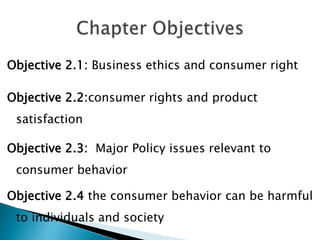
Objective 2.1: Business ethics and consumer right
Objective 2.2:consumer rights and product
satisfaction
Objective 2.3: Major Policy issues relevant to
consumer behavior
Objective 2.4 the consumer behavior can be harmful
to individuals and society
INTRODUCTION
Every business has to observe certain ethical and
moral rules while performing its operations in
the attainment of maximization of its profits.
Today’s business is consumer-oriented and
hence, the business organization which has attracted
this theme(Topic) only can succeed, but within
the framework of ethical principles.
Definition: Business Ethics are rules of conduct
that guide actions in marketplace.
 Business Ethics is the set of moral rules that Rules
how businesses operate, how business decisions
are made and how people are treated
There are the standers which most people in the
culture judge what is rights and what is wrong,
good or bad.
Business ethics can be defined as written and
unwritten codes of principles and values that
govern or rule decisions and actions within
the organization.
In business word, the organization’s culture
sets standards for determining the difference
between good and bad decision making and
behavior.
Business Ethics assures and keeps existing that
the highest legal and moral standards are
observed in your relationships with the people
and your business. This includes the most
important person in your business, your
customer, Consider the problems you might
have if you could not supply what the customer
needs…at the time that they need it.
Ethical behavior is merely making good business
decisions based on an established “code of
ethics”.
Entrepreneurs should establish a written code of
ethics that can serve as a framework for decisions
to be made by other entrepreneurs as well as the
employees. In developing this code of ethics you
should consider the following items:
 Identify your general principles that would lead to
fair business practices
 Apply your code of ethics to a written policy
and procedure.
 Manual identifying the major rules for
operating your business
 Write out specific statements that will assist
you and others in making day-to-day ethical
decisions
Do the marketers Manipulate the Consumer?
The simple response about the question mentioned
above is: Marketers simply do not know enough about
people to manipulate them
Although the people think that the marketers have
endless source of techniques to manipulate them.
in reality the industries entrepreneurs are successful
When they try to sell a good products and unsuccessful
When they sell poor products.
The second question are asked by people is:
Who controls the market? Companies or Customer?
Many people believe that market are somehow ‘set’
or manipulated by large powerful organizations who
conspire to mention prices their way.
Similarly some traders who have been around the
markets for some time do not have a clear
understanding of how they really work, and the
underlying process that determines price
Customers order to companies the type of product
they want and how, when and where, even if they
want to learn about the products also companies
need to develop brand quality in anew way to attract
loyalty to these customers
Therefore people still need companies and companies
need their customers so that, Companies and
Customer dependent each other.
Is Marketing Necessary?
Marketing is one of the most important things a
business can do. Not only does marketing build
brand awareness but it can also increase sales,
grow businesses and attract customers
Products meet existing needs, and marketing actives
help to communication their availability.
Marketing is very important source of consumer
information and also decrease the cost and time
that customer spent to search for products.
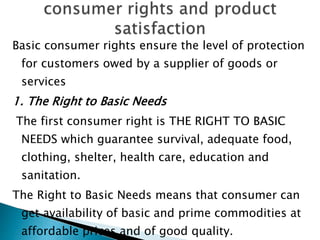
Basic consumer rights ensure the level of protection
for customers owed by a supplier of goods or
services
1. The Right to Basic Needs
The first consumer right is THE RIGHT TO BASIC
NEEDS which guarantee survival, adequate food,
clothing, shelter, health care, education and
sanitation.
The Right to Basic Needs means that consumer can
get availability of basic and prime commodities at
affordable prices and of good quality.
2. The Right to Safety
The second consumer right is THE RIGHT TO
SAFETY which is the right to be protected against
the marketing of goods or the provision of
services that are hazardous to health and life.
Manufacturers of consumer products to undertake
extensive safety and checkup performance before
selling their products in the market
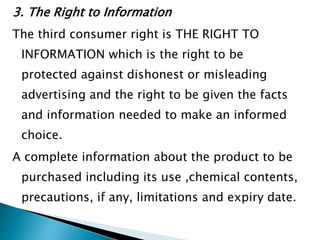
3. The Right to Information
The third consumer right is THE RIGHT TO
INFORMATION which is the right to be
protected against dishonest or misleading
advertising and the right to be given the facts
and information needed to make an informed
choice.
A complete information about the product to be
purchased including its use ,chemical contents,
precautions, if any, limitations and expiry date.
4. The Right to Choose
The fourth consumer right is THE RIGHT TO CHOOSE which
is the right to choose products at competitive prices with
an assurance of satisfactory quality.
A wide array of goods and services which are offered in the
market with diverse brands, sizes, shapes and colors with
differences in the price, quality and use.
consumer has right to choose A wide kinds of goods and
services which are offered in the market with diverse
brands, sizes, shapes and colors with differences in the
price, quality and use.
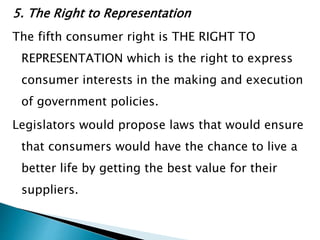
5. The Right to Representation
The fifth consumer right is THE RIGHT TO
REPRESENTATION which is the right to express
consumer interests in the making and execution
of government policies.
Legislators would propose laws that would ensure
that consumers would have the chance to live a
better life by getting the best value for their
suppliers.
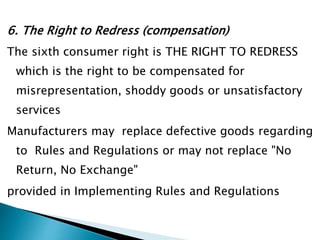
6. The Right to Redress (compensation)
The sixth consumer right is THE RIGHT TO REDRESS
which is the right to be compensated for
misrepresentation, shoddy goods or unsatisfactory
services
Manufacturers may replace defective goods regarding
to Rules and Regulations or may not replace "No
Return, No Exchange"
provided in Implementing Rules and Regulations
7. The Right to Consumer Education
The seventh consumer right is THE RIGHT TO
CONSUMER EDUCATION which is the right to
acquire the knowledge and skills necessary to be
an informed customer.
 There must be series of seminars, conferences,
training campaign through media on consumer-
related issues that consumer should teach more
bout the products
8. The Right to a Healthy Environment
The eight consumer right is THE RIGHT TO A
HEALTHY ENVIRONMENT which is the right to
live and work in an environment which is neither
threatening nor dangerous and which permits a
life of dignity and well-being.
In conclusion the customer has the rights
mentioned above and have to offer Basic
consumer rights owed by the supplier of goods
or services
Next Chapter
Coming Soon

8. CHAPTER EIGHT (CONSUMER BEHAVIOUR).pptx

  • 2.
  • 3.
    Objective 2.1: Businessethics and consumer right Objective 2.2:consumer rights and product satisfaction Objective 2.3: Major Policy issues relevant to consumer behavior Objective 2.4 the consumer behavior can be harmful to individuals and society
  • 4.
    INTRODUCTION Every business hasto observe certain ethical and moral rules while performing its operations in the attainment of maximization of its profits. Today’s business is consumer-oriented and hence, the business organization which has attracted this theme(Topic) only can succeed, but within the framework of ethical principles.
  • 5.
    Definition: Business Ethicsare rules of conduct that guide actions in marketplace.  Business Ethics is the set of moral rules that Rules how businesses operate, how business decisions are made and how people are treated There are the standers which most people in the culture judge what is rights and what is wrong, good or bad.
  • 6.
    Business ethics canbe defined as written and unwritten codes of principles and values that govern or rule decisions and actions within the organization. In business word, the organization’s culture sets standards for determining the difference between good and bad decision making and behavior.
  • 7.
    Business Ethics assuresand keeps existing that the highest legal and moral standards are observed in your relationships with the people and your business. This includes the most important person in your business, your customer, Consider the problems you might have if you could not supply what the customer needs…at the time that they need it.
  • 8.
    Ethical behavior ismerely making good business decisions based on an established “code of ethics”. Entrepreneurs should establish a written code of ethics that can serve as a framework for decisions to be made by other entrepreneurs as well as the employees. In developing this code of ethics you should consider the following items:  Identify your general principles that would lead to fair business practices
  • 9.
     Apply yourcode of ethics to a written policy and procedure.  Manual identifying the major rules for operating your business  Write out specific statements that will assist you and others in making day-to-day ethical decisions
  • 10.
    Do the marketersManipulate the Consumer? The simple response about the question mentioned above is: Marketers simply do not know enough about people to manipulate them Although the people think that the marketers have endless source of techniques to manipulate them. in reality the industries entrepreneurs are successful When they try to sell a good products and unsuccessful When they sell poor products.
  • 11.
    The second questionare asked by people is: Who controls the market? Companies or Customer? Many people believe that market are somehow ‘set’ or manipulated by large powerful organizations who conspire to mention prices their way. Similarly some traders who have been around the markets for some time do not have a clear understanding of how they really work, and the underlying process that determines price
  • 12.
    Customers order tocompanies the type of product they want and how, when and where, even if they want to learn about the products also companies need to develop brand quality in anew way to attract loyalty to these customers Therefore people still need companies and companies need their customers so that, Companies and Customer dependent each other.
  • 13.
    Is Marketing Necessary? Marketingis one of the most important things a business can do. Not only does marketing build brand awareness but it can also increase sales, grow businesses and attract customers Products meet existing needs, and marketing actives help to communication their availability. Marketing is very important source of consumer information and also decrease the cost and time that customer spent to search for products.
  • 14.
    Basic consumer rightsensure the level of protection for customers owed by a supplier of goods or services 1. The Right to Basic Needs The first consumer right is THE RIGHT TO BASIC NEEDS which guarantee survival, adequate food, clothing, shelter, health care, education and sanitation. The Right to Basic Needs means that consumer can get availability of basic and prime commodities at affordable prices and of good quality.
  • 15.
    2. The Rightto Safety The second consumer right is THE RIGHT TO SAFETY which is the right to be protected against the marketing of goods or the provision of services that are hazardous to health and life. Manufacturers of consumer products to undertake extensive safety and checkup performance before selling their products in the market
  • 16.
    3. The Rightto Information The third consumer right is THE RIGHT TO INFORMATION which is the right to be protected against dishonest or misleading advertising and the right to be given the facts and information needed to make an informed choice. A complete information about the product to be purchased including its use ,chemical contents, precautions, if any, limitations and expiry date.
  • 17.
    4. The Rightto Choose The fourth consumer right is THE RIGHT TO CHOOSE which is the right to choose products at competitive prices with an assurance of satisfactory quality. A wide array of goods and services which are offered in the market with diverse brands, sizes, shapes and colors with differences in the price, quality and use. consumer has right to choose A wide kinds of goods and services which are offered in the market with diverse brands, sizes, shapes and colors with differences in the price, quality and use.
  • 18.
    5. The Rightto Representation The fifth consumer right is THE RIGHT TO REPRESENTATION which is the right to express consumer interests in the making and execution of government policies. Legislators would propose laws that would ensure that consumers would have the chance to live a better life by getting the best value for their suppliers.
  • 19.
    6. The Rightto Redress (compensation) The sixth consumer right is THE RIGHT TO REDRESS which is the right to be compensated for misrepresentation, shoddy goods or unsatisfactory services Manufacturers may replace defective goods regarding to Rules and Regulations or may not replace "No Return, No Exchange" provided in Implementing Rules and Regulations
  • 20.
    7. The Rightto Consumer Education The seventh consumer right is THE RIGHT TO CONSUMER EDUCATION which is the right to acquire the knowledge and skills necessary to be an informed customer.  There must be series of seminars, conferences, training campaign through media on consumer- related issues that consumer should teach more bout the products
  • 21.
    8. The Rightto a Healthy Environment The eight consumer right is THE RIGHT TO A HEALTHY ENVIRONMENT which is the right to live and work in an environment which is neither threatening nor dangerous and which permits a life of dignity and well-being. In conclusion the customer has the rights mentioned above and have to offer Basic consumer rights owed by the supplier of goods or services
  • 22.