HRM7000-8 Ali Soylu, Assistant Professor
Human Resource Management ASSIGNMENT 6:
INTERNATIONAL HUMAN RESOURCES
Courtney,
Thank you for submitting your presentation. You have mentioned some important points
about HRM. However, I noted that you are not following the APA 6th ed.. I also noticed
that you have not analyzed the objectives of personnel administration and their impact in
influencing international human resource management. You did not offer recommendations as
to how HR managers can train their employees to work with those from diverse cultures and
did not support your viewpoint with local data. The assignment requires 12-15 slides (with a
separate reference slide) and notes length 200-350 words for each slide. I do not see that you
have met these requirements.
NORTHCENTRAL UNIVERSITY
Cavall, C, HRM7000-8
Assignment 6: International Human Resources
DEVELOP A POWERPOINT PRESENTATION THAT COVERS THE
FOLLOWING
Analyzes the objectives of personnel administration and their impact in
influencing international human resource management and analyze
international human resource function;
• CORPORATE SOCIAL RESPONSIBILITY
• ORGANIZATIONAL JUSTICE
• SRIHRM POLICIES
• HRM
• MNC
Offer recommendations as to how human resource managers can train their
employees to work with those from diverse cultures.
“The continuing commitment by business to behave ethically and contribute to
economic development while improving the quality of life of the workforce and
their families as well as of the local community and society at large”(Baker,
2004)
CORPORATE SOCIAL RESPONSIBILITY
 The Corporate social responsibility concept that on a global scale has developed on a country-by-
country basis has been an “unequal process” (Shen, 2011, p. 1365).
 As cited in Shen (2011) some developing countries have not gained a good reputation regarding
the implementation or proper procedures of CSR, “resulting in little social responsibility-related laws
or regulations” that multinational enterprise are required to follow suit with. (p. 1365).
 Ethical behavior from one country to another may differ in each country depending by “its own
unique culture” (Shen, 2011, p. 1365). For the majority of corporate citizenship, “behaviors that are
beyond legal requirements, and their omission are usually not legally punishable” (Shen, 2011, p.
1352).
ORGANIZATIONAL JUSTICE
Van Buren, (2008) suggested termed fairness in corporations
as “Organizational Justice”; researchers have emphasized theories
that suggest the “idea of fairness” (p. 633) in terms of a utilitarian.
“Management theory is an artifact of the times and social conditions in which it is formulated”
Van Buren, (2008) Five Management Theories –
1. Scientific Management: ‘
2. Administrative Theory
3. Bureaucratic Theory
4. Human Relations
5. Human Resources
MNC
• Morris., Wright,, Trevor, Stiles, Stahl, Snell, & Farndale, (2009) stated “People
alignment is an alignment of goals and direction across an MNC’s subsidiaries”.
• “Multinational corporations (MNCs) able to replicate practices among their
subsidiary units more effectively than their competitors will typically gain a
competitive advantage Research has shown that factors such as national culture
and coordination failure limit transferring and replicating HR practices” (Morris.,
Wright,, Trevor, Stiles, Stahl, Snell, & Farndale 2009, p. 974).
MNC
Shen (2011)Depending on the
country HRM systems
Independent factors are taken
in to account such as;
organizational structure
organizational culture
mode and stage of
internationalization
industry
organization size
reliance on international
markets
international experience
senior managers
HRM
Employees
Development &
Personal Needs
Local Labor
Laws, Local CRS
Business
Partners,
Investors, Clients
Global Labor
Standards,
Global CSR
SRIHRM Contracts
SRIHRM
SRIHRM policies focus on “core labor standards” and give needed attention to “global integration and
local responsiveness”. SRIHRM policies emphasis is towards the “interests and needs of stakeholders”
yet this may require companies to change organizational cultures.
While still taking into account the following;
SRIHRM
Shen, (2011) article stated that SRIHRM places the importance on
“employee oriented policies and practices” (p. p. 1354)
While still taking into account the following;
• Union Recognition
• Workforce Reduction
• Retirement Benefit Program
• Health And Safety
• Work And Family Balance
• Employee Involvement
Global Determinates of the Adoption of SRIHRM
(Shen, 2011, p. 1360)
Country of origin
Resource availability & Industry
Host country
Identity orientation
SRIHRM
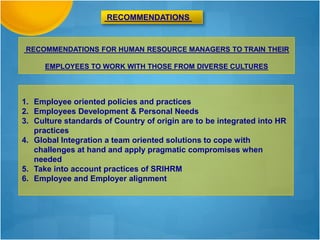
RECOMMENDATIONS FOR HUMAN RESOURCE MANAGERS TO TRAIN THEIR
EMPLOYEES TO WORK WITH THOSE FROM DIVERSE CULTURES
RECOMMENDATIONS
1. Employee oriented policies and practices
2. Employees Development & Personal Needs
3. Culture standards of Country of origin are to be integrated into HR
practices
4. Global Integration a team oriented solutions to cope with
challenges at hand and apply pragmatic compromises when
needed
5. Take into account practices of SRIHRM
6. Employee and Employer alignment
Activity Resources
Baker, M. (2004). Corporate social responsibility - What does it mean? Retrieved on April 22, 2014
from http://www.mallenbaker.net/csr/definition.php
Dwards, T., Marginson, P., & Ferner, A. (2013). Multinational Companies In Cross- National Context:
Integration, Differentiation, And The Interactions Between Mncs
And Nation States. Industrial & Labor Relations Review, 66(3), 547-587.
Morris, S. S., Wright, P. M., Trevor, J., Stiles, P., Stahl, G. K., Snell, S., &, Farndale, E. (2009). Global
challenges to replicating HR: The role of people, processes, and systems. Human Resource
Management, 48(6), 973-995.
Shen, J. (2011). Developing the concept of socially responsible international human resource
management. International Journal Of Human Resource Management, 22(6), 1351-1363. doi:
10.1080/09585192.2011.559104
Van Buren, H., J. (2008). Fairness and the main management theories of The twentieth century: A
historical review, 1900-1965. Journal of Business Ethics, 82(3), 633-644. doi:http://
dx.doi.org/10.1007/s10551-007-9582-2

Compensation trends HR

  • 1.
    HRM7000-8 Ali Soylu,Assistant Professor Human Resource Management ASSIGNMENT 6: INTERNATIONAL HUMAN RESOURCES Courtney, Thank you for submitting your presentation. You have mentioned some important points about HRM. However, I noted that you are not following the APA 6th ed.. I also noticed that you have not analyzed the objectives of personnel administration and their impact in influencing international human resource management. You did not offer recommendations as to how HR managers can train their employees to work with those from diverse cultures and did not support your viewpoint with local data. The assignment requires 12-15 slides (with a separate reference slide) and notes length 200-350 words for each slide. I do not see that you have met these requirements. NORTHCENTRAL UNIVERSITY Cavall, C, HRM7000-8
  • 2.
    Assignment 6: InternationalHuman Resources DEVELOP A POWERPOINT PRESENTATION THAT COVERS THE FOLLOWING Analyzes the objectives of personnel administration and their impact in influencing international human resource management and analyze international human resource function; • CORPORATE SOCIAL RESPONSIBILITY • ORGANIZATIONAL JUSTICE • SRIHRM POLICIES • HRM • MNC Offer recommendations as to how human resource managers can train their employees to work with those from diverse cultures.
  • 3.
    “The continuing commitmentby business to behave ethically and contribute to economic development while improving the quality of life of the workforce and their families as well as of the local community and society at large”(Baker, 2004) CORPORATE SOCIAL RESPONSIBILITY  The Corporate social responsibility concept that on a global scale has developed on a country-by- country basis has been an “unequal process” (Shen, 2011, p. 1365).  As cited in Shen (2011) some developing countries have not gained a good reputation regarding the implementation or proper procedures of CSR, “resulting in little social responsibility-related laws or regulations” that multinational enterprise are required to follow suit with. (p. 1365).  Ethical behavior from one country to another may differ in each country depending by “its own unique culture” (Shen, 2011, p. 1365). For the majority of corporate citizenship, “behaviors that are beyond legal requirements, and their omission are usually not legally punishable” (Shen, 2011, p. 1352).
  • 4.
    ORGANIZATIONAL JUSTICE Van Buren,(2008) suggested termed fairness in corporations as “Organizational Justice”; researchers have emphasized theories that suggest the “idea of fairness” (p. 633) in terms of a utilitarian. “Management theory is an artifact of the times and social conditions in which it is formulated” Van Buren, (2008) Five Management Theories – 1. Scientific Management: ‘ 2. Administrative Theory 3. Bureaucratic Theory 4. Human Relations 5. Human Resources
  • 5.
    MNC • Morris., Wright,,Trevor, Stiles, Stahl, Snell, & Farndale, (2009) stated “People alignment is an alignment of goals and direction across an MNC’s subsidiaries”. • “Multinational corporations (MNCs) able to replicate practices among their subsidiary units more effectively than their competitors will typically gain a competitive advantage Research has shown that factors such as national culture and coordination failure limit transferring and replicating HR practices” (Morris., Wright,, Trevor, Stiles, Stahl, Snell, & Farndale 2009, p. 974). MNC
  • 6.
    Shen (2011)Depending onthe country HRM systems Independent factors are taken in to account such as; organizational structure organizational culture mode and stage of internationalization industry organization size reliance on international markets international experience senior managers HRM
  • 7.
    Employees Development & Personal Needs LocalLabor Laws, Local CRS Business Partners, Investors, Clients Global Labor Standards, Global CSR SRIHRM Contracts SRIHRM SRIHRM policies focus on “core labor standards” and give needed attention to “global integration and local responsiveness”. SRIHRM policies emphasis is towards the “interests and needs of stakeholders” yet this may require companies to change organizational cultures.
  • 8.
    While still takinginto account the following; SRIHRM Shen, (2011) article stated that SRIHRM places the importance on “employee oriented policies and practices” (p. p. 1354) While still taking into account the following; • Union Recognition • Workforce Reduction • Retirement Benefit Program • Health And Safety • Work And Family Balance • Employee Involvement
  • 9.
    Global Determinates ofthe Adoption of SRIHRM (Shen, 2011, p. 1360) Country of origin Resource availability & Industry Host country Identity orientation SRIHRM
  • 10.
    RECOMMENDATIONS FOR HUMANRESOURCE MANAGERS TO TRAIN THEIR EMPLOYEES TO WORK WITH THOSE FROM DIVERSE CULTURES RECOMMENDATIONS 1. Employee oriented policies and practices 2. Employees Development & Personal Needs 3. Culture standards of Country of origin are to be integrated into HR practices 4. Global Integration a team oriented solutions to cope with challenges at hand and apply pragmatic compromises when needed 5. Take into account practices of SRIHRM 6. Employee and Employer alignment
  • 11.
    Activity Resources Baker, M.(2004). Corporate social responsibility - What does it mean? Retrieved on April 22, 2014 from http://www.mallenbaker.net/csr/definition.php Dwards, T., Marginson, P., & Ferner, A. (2013). Multinational Companies In Cross- National Context: Integration, Differentiation, And The Interactions Between Mncs And Nation States. Industrial & Labor Relations Review, 66(3), 547-587. Morris, S. S., Wright, P. M., Trevor, J., Stiles, P., Stahl, G. K., Snell, S., &, Farndale, E. (2009). Global challenges to replicating HR: The role of people, processes, and systems. Human Resource Management, 48(6), 973-995. Shen, J. (2011). Developing the concept of socially responsible international human resource management. International Journal Of Human Resource Management, 22(6), 1351-1363. doi: 10.1080/09585192.2011.559104 Van Buren, H., J. (2008). Fairness and the main management theories of The twentieth century: A historical review, 1900-1965. Journal of Business Ethics, 82(3), 633-644. doi:http:// dx.doi.org/10.1007/s10551-007-9582-2

Editor's Notes

  • #3 Assignment 6   International Human Resources: The workplace is also changing at an international level. Teams, made up of international, multi-national, and transitional workers, are driving our nations economic development is intrinsically linked to our global neighbors. E-commerce, international trade, and immigration have diversified both the workplace and who functions as strategic partners. Understanding other cultures and effectively implementing teamwork to accomplish mutual goals can be a challenge. Most organizations today, to at least some degree, operate on a global scale. It is important for the Human Resource professional to understand the different dynamics of global business and the impact that the different cultures can have on managing the human resource aspect of the organization.
  • #4 Holmes & Watts from The World Business Council for Sustainable Development published Making Good Business Sense by and defined Corporate Social Responsibility as Corporate Social Responsibility defined “The continuing commitment by business to behave ethically and contribute to economic development while improving the quality of life of the workforce and their families as well as of the local community and society at large”(Baker, 2004) .
  • #5 Each Management theory emphasized “distributive and procedural justice to different degrees”, (Van Buren, 2008, p. 642), and each theory had a hint of “absolute managerial autonomy” (Van Buren, 2008, p. 633). Van Buren (2008) suggested that a normative bases in regards ethical business practices organizational justice struggle to find a balance in that realistic application that accounts for manager responsibility of moral and economic practices in the everyday workplace (p. 642).
  • #6 Dward, Marginson, & Ferner, (2013), suggested that people "operate similarly or differently,” and its essential to pay attention to the details of operation and people operate off social control mechanisms.
  • #8 SRIHRM Contracts (Shen, 2011, p. 1360)
  • #11 Documenting the process which works in each company no matter what culture. Future Research To review the work of non-U.S. management theorists with regard to their treatment of justice-related topics (Van Buren, 2008, p. 633)