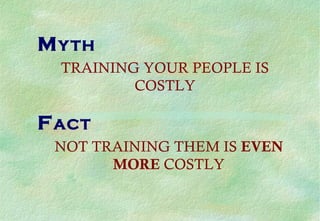
MYTH
TRAINING YOUR PEOPLE IS
COSTLY
NOT TRAINING THEM IS EVEN
MORE COSTLY
FACT
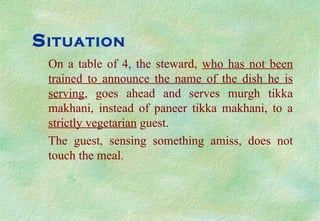
SITUATION
On a table of 4, the steward, who has not been
trained to announce the name of the dish he is
serving, goes ahead and serves murgh tikka
makhani, instead of paneer tikka makhani, to a
strictly vegetarian guest.
The guest, sensing something amiss, does not
touch the meal.
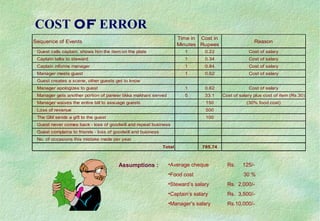
Sequence of Events
Time in
Minutes
Cost in
Rupees
Reason
Guest calls captain, shows him the item on the plate 1 0.22 Cost of salary
Captain talks to steward 1 0.34 Cost of salary
Captain informs manager 1 0.84 Cost of salary
Manager meets guest 1 0.62 Cost of salary
Guest creates a scene, other guests get to know
Manager apologizes to guest 1 0.62 Cost of salary
Manager gets another portion of paneer tikka makhani served 5 33.1 Cost of salary plus cost of item (Rs.30)
Manager waives the entire bill to assuage guests 150 (30% food cost)
Loss of revenue 500
The GM sends a gift to the guest 100
Guest never comes back - loss of goodwill and repeat business
Guest complains to friends - loss of goodwill and business
No. of occasions this mistake made per year
Total 785.74
•Average cheque Rs. 125/-
•Food cost 30 %
•Steward’s salary Rs. 2,000/-
•Captain’s salary Rs. 3,500/-
•Manager’s salary Rs.10,000/-
Assumptions :
COST OF ERROR
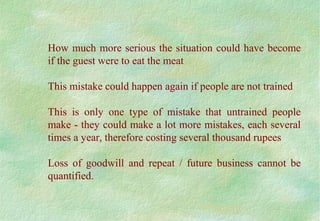
How much more serious the situation could have become
if the guest were to eat the meat
This mistake could happen again if people are not trained
This is only one type of mistake that untrained people
make - they could make a lot more mistakes, each several
times a year, therefore costing several thousand rupees
Loss of goodwill and repeat / future business cannot be
quantified.
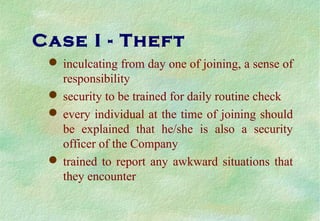
Case I - Theft
 inculcating from day one of joining, a sense of
responsibility
 security to be trained for daily routine check
 every individual at the time of joining should
be explained that he/she is also a security
officer of the Company
 trained to report any awkward situations that
they encounter
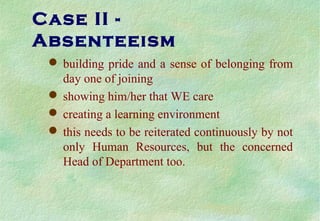
Case II -
Absenteeism
 building pride and a sense of belonging from
day one of joining
 showing him/her that WE care
 creating a learning environment
 this needs to be reiterated continuously by not
only Human Resources, but the concerned
Head of Department too.
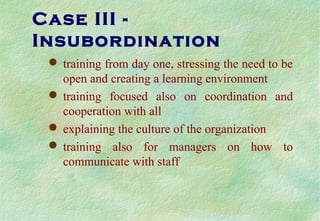
Case III -
Insubordination
 training from day one, stressing the need to be
open and creating a learning environment
 training focused also on coordination and
cooperation with all
 explaining the culture of the organization
 training also for managers on how to
communicate with staff
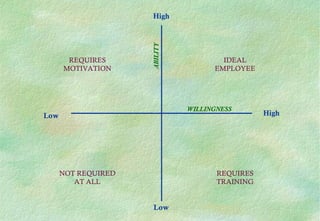
High
High
Low
Low
IDEAL
EMPLOYEE
REQUIRES
MOTIVATION
REQUIRES
TRAINING
NOT REQUIRED
AT ALL
ABILITY
WILLINGNESS
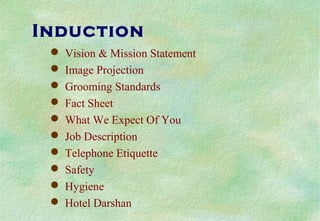
Induction
 Vision & Mission Statement
 Image Projection
 Grooming Standards
 Fact Sheet
 What We Expect Of You
 Job Description
 Telephone Etiquette
 Safety
 Hygiene
 Hotel Darshan
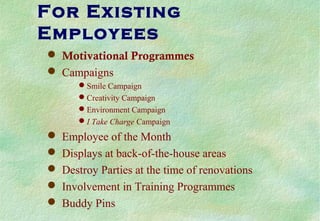
For Existing
Employees
 Motivational Programmes
 Campaigns
Smile Campaign
Creativity Campaign
Environment Campaign
I Take Charge Campaign
 Employee of the Month
 Displays at back-of-the-house areas
 Destroy Parties at the time of renovations
 Involvement in Training Programmes
 Buddy Pins
Buddy Policy
Objective :
To ensure that newly joined employees get the right and
necessary hotel knowledge, as well as a positive attitude
from the right person, in order to adapt themselves quickly
to the new organization.

Hrd by pervin ghanni pps

  • 1.
    MYTH TRAINING YOUR PEOPLEIS COSTLY NOT TRAINING THEM IS EVEN MORE COSTLY FACT
  • 2.
    SITUATION On a tableof 4, the steward, who has not been trained to announce the name of the dish he is serving, goes ahead and serves murgh tikka makhani, instead of paneer tikka makhani, to a strictly vegetarian guest. The guest, sensing something amiss, does not touch the meal.
  • 3.
    Sequence of Events Timein Minutes Cost in Rupees Reason Guest calls captain, shows him the item on the plate 1 0.22 Cost of salary Captain talks to steward 1 0.34 Cost of salary Captain informs manager 1 0.84 Cost of salary Manager meets guest 1 0.62 Cost of salary Guest creates a scene, other guests get to know Manager apologizes to guest 1 0.62 Cost of salary Manager gets another portion of paneer tikka makhani served 5 33.1 Cost of salary plus cost of item (Rs.30) Manager waives the entire bill to assuage guests 150 (30% food cost) Loss of revenue 500 The GM sends a gift to the guest 100 Guest never comes back - loss of goodwill and repeat business Guest complains to friends - loss of goodwill and business No. of occasions this mistake made per year Total 785.74 •Average cheque Rs. 125/- •Food cost 30 % •Steward’s salary Rs. 2,000/- •Captain’s salary Rs. 3,500/- •Manager’s salary Rs.10,000/- Assumptions : COST OF ERROR
  • 4.
    How much moreserious the situation could have become if the guest were to eat the meat This mistake could happen again if people are not trained This is only one type of mistake that untrained people make - they could make a lot more mistakes, each several times a year, therefore costing several thousand rupees Loss of goodwill and repeat / future business cannot be quantified.
  • 5.
    Case I -Theft  inculcating from day one of joining, a sense of responsibility  security to be trained for daily routine check  every individual at the time of joining should be explained that he/she is also a security officer of the Company  trained to report any awkward situations that they encounter
  • 6.
    Case II - Absenteeism building pride and a sense of belonging from day one of joining  showing him/her that WE care  creating a learning environment  this needs to be reiterated continuously by not only Human Resources, but the concerned Head of Department too.
  • 7.
    Case III - Insubordination training from day one, stressing the need to be open and creating a learning environment  training focused also on coordination and cooperation with all  explaining the culture of the organization  training also for managers on how to communicate with staff
  • 8.
  • 9.
    Induction  Vision &Mission Statement  Image Projection  Grooming Standards  Fact Sheet  What We Expect Of You  Job Description  Telephone Etiquette  Safety  Hygiene  Hotel Darshan
  • 10.
    For Existing Employees  MotivationalProgrammes  Campaigns Smile Campaign Creativity Campaign Environment Campaign I Take Charge Campaign  Employee of the Month  Displays at back-of-the-house areas  Destroy Parties at the time of renovations  Involvement in Training Programmes  Buddy Pins
  • 11.
    Buddy Policy Objective : Toensure that newly joined employees get the right and necessary hotel knowledge, as well as a positive attitude from the right person, in order to adapt themselves quickly to the new organization.