Michael Brownstein Presents…
 Barriers associated with
recruiting and
retaining entry level staff
members – of all ages.
 Explore some of the social
and socioeconomic
barriers associated with
staff retention,
communication and
training.
 Learn how to create a
successful playing field
that emphasizes keeping
staff once you've invested
the time and training for
them to be on your team.
 In your chat box… List other “industries” or
professions that also rely on successfully
managing young, entry level staff…
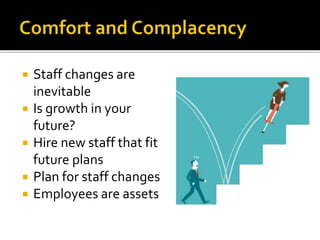
 Staff changes are
inevitable
 Is growth in your
future?
 Hire new staff that fit
future plans
 Plan for staff changes
 Employees are assets
 Frequent voluntary turnover has
a negative impact on employee
morale, productivity and
company revenue.
 Recruiting and training a new
employee requires staff time and
money.
 According to the Bureau of Labor
Statistics, turnover is highest in
industries such as trade and
utilities, construction, retail,
customer service, hospitality, and
service.
 Some studies (such as SHMR) predict that every
time a business replaces a salaried employee, it
costs 6 to 9 months’ salary on average.
 For a manager making $40,000 a year, that's
$20,000 to $30,000 in recruiting and training
expenses.
 But others predict the cost is even more - that
losing a salaried employee can cost as much as
2x their annual salary, especially for a high-
earner or executive level employee.
 16% of annual salary for high-turnover, low-
paying jobs (earning under $30,000 a year). For
example, the cost to replace a $10/hour retail
employee would be $3,328.
 20% of annual salary for mid-range positions
(earning $30,000 to $50,000 a year). For
example, the cost to replace a $40k manager
would be $8,000.
 Up to 213% of annual salary for highly educated
executive positions.
 For example, the cost to replace a $100k CEO is
$213,000.
 Source: Small Business Employee Benefits and HR Blog, Employee Retention -
What are some
of the real costs
of losing an
employee?
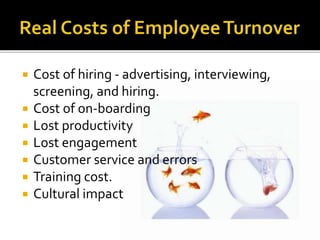
 Cost of hiring - advertising, interviewing,
screening, and hiring.
 Cost of on-boarding
 Lost productivity
 Lost engagement
 Customer service and errors
 Training cost.
 Cultural impact
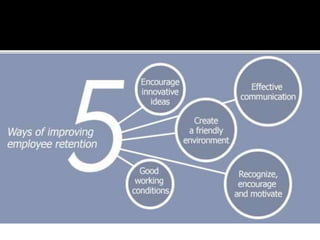
1. Benchmark your employee retention rate
2. Use proven retention strategies, not guesswork
3. Don't assume employees are happy (create a
high-feedback environment)
4. Implement a health benefits program or
wellness program
5. Provide different benefits for different
employees (focusing on the high-value,
expensive to replace employees)
6. Conduct exit interviews
7. Be willing to make changes based on what you
learn
 Attitude
 Aptitude
 Skill set
 Psychological make
up of our team
 Marketable
Transferable Skill
 Integrating with the other
passengers on the bus is a
key to their success.
 Create an Ambassador
Program
 Peer –to-peer training
 Probations vs. Orientation
What doYOU think are
the three most
important words in the
English Language???
Please
ThankYou
We
 Think back to the last time you thanked one of your
workers at the end of the day for a great day.
 Think back to the last time when you asked one of
them to perform as task, you asked them including
the word “please”.
 Think back to the last time you gave a task that was
for the benefit of the organization and you included,
“We” in your instructions. Remember that we are
beings who best work as a village and a team, hence
the importance of “We”.
 What employees expect vs.
What you expect
What can you do to
clarify
expectations for
the next
employee you
hire?
Share 3 of your agency’s
best organizational
practices
Share 2 of your desired
organizational skills and
what has been the barrier
to their implementaion.
How does your organization
show it cares about your
team members?
What might you learn about
your employees or co-workers
that might ultimately improve
your teamwork and
productivity.
 Online
 Off-line
 6 Degrees of Separation
Contact: Michael Brownstein
Phone: (760) 861-6712
email: Cr8tivmnd@aol.com

Jodi theyoungandtherestless

  • 1.
  • 2.
     Barriers associatedwith recruiting and retaining entry level staff members – of all ages.  Explore some of the social and socioeconomic barriers associated with staff retention, communication and training.  Learn how to create a successful playing field that emphasizes keeping staff once you've invested the time and training for them to be on your team.
  • 5.
     In yourchat box… List other “industries” or professions that also rely on successfully managing young, entry level staff…
  • 6.
     Staff changesare inevitable  Is growth in your future?  Hire new staff that fit future plans  Plan for staff changes  Employees are assets
  • 7.
     Frequent voluntaryturnover has a negative impact on employee morale, productivity and company revenue.  Recruiting and training a new employee requires staff time and money.  According to the Bureau of Labor Statistics, turnover is highest in industries such as trade and utilities, construction, retail, customer service, hospitality, and service.
  • 8.
     Some studies(such as SHMR) predict that every time a business replaces a salaried employee, it costs 6 to 9 months’ salary on average.  For a manager making $40,000 a year, that's $20,000 to $30,000 in recruiting and training expenses.  But others predict the cost is even more - that losing a salaried employee can cost as much as 2x their annual salary, especially for a high- earner or executive level employee.
  • 9.
     16% ofannual salary for high-turnover, low- paying jobs (earning under $30,000 a year). For example, the cost to replace a $10/hour retail employee would be $3,328.  20% of annual salary for mid-range positions (earning $30,000 to $50,000 a year). For example, the cost to replace a $40k manager would be $8,000.  Up to 213% of annual salary for highly educated executive positions.  For example, the cost to replace a $100k CEO is $213,000.
  • 10.
     Source: SmallBusiness Employee Benefits and HR Blog, Employee Retention -
  • 11.
    What are some ofthe real costs of losing an employee?
  • 12.
     Cost ofhiring - advertising, interviewing, screening, and hiring.  Cost of on-boarding  Lost productivity  Lost engagement  Customer service and errors  Training cost.  Cultural impact
  • 13.
    1. Benchmark youremployee retention rate 2. Use proven retention strategies, not guesswork 3. Don't assume employees are happy (create a high-feedback environment) 4. Implement a health benefits program or wellness program 5. Provide different benefits for different employees (focusing on the high-value, expensive to replace employees) 6. Conduct exit interviews 7. Be willing to make changes based on what you learn
  • 14.
     Attitude  Aptitude Skill set  Psychological make up of our team  Marketable Transferable Skill
  • 16.
     Integrating withthe other passengers on the bus is a key to their success.  Create an Ambassador Program  Peer –to-peer training  Probations vs. Orientation
  • 19.
    What doYOU thinkare the three most important words in the English Language???
  • 20.
  • 21.
     Think backto the last time you thanked one of your workers at the end of the day for a great day.  Think back to the last time when you asked one of them to perform as task, you asked them including the word “please”.  Think back to the last time you gave a task that was for the benefit of the organization and you included, “We” in your instructions. Remember that we are beings who best work as a village and a team, hence the importance of “We”.
  • 22.
     What employeesexpect vs. What you expect What can you do to clarify expectations for the next employee you hire?
  • 24.
    Share 3 ofyour agency’s best organizational practices
  • 25.
    Share 2 ofyour desired organizational skills and what has been the barrier to their implementaion.
  • 27.
    How does yourorganization show it cares about your team members?
  • 28.
    What might youlearn about your employees or co-workers that might ultimately improve your teamwork and productivity.
  • 30.
     Online  Off-line 6 Degrees of Separation
  • 32.
    Contact: Michael Brownstein Phone:(760) 861-6712 email: Cr8tivmnd@aol.com

Editor's Notes

  • #3 In this session we will discuss barriers associated with recruiting and retaining entry level staff members – of all ages. We’ll explore some of the social and socioeconomic barriers associated with staff retention, communication and training. Learn how to create a successful playing field that emphasizes keeping staff once you've invested the time and training for them to be on your team. Over time we have faced numerous challenges in business, not the least of which is the recruitment and retention of staff. Today we are going to take a look at “Entry Level Staff” and “Re-Entry Staff.”
  • #6 Over the past few years, through good and challenging economic times, regardless of how many folks are looking for jobs, there has been a continuous challenge in finding entry level staff to feed the personnel appetite of a business, regardless of what the business is.
  • #7 We tend to get comfortable with staff….then something happens and we are faced with the need for support, or entry level staff. Now this could be the promotion of a key individual, there is a family member that requires care from one of your staff and they are going to work remotely, but need an additional support person in the office to carry their basic work load, or…we have a staff member who is going to take Family leave as their family expands. While we think of these things at the time we are given notice, seldom have I seen an organization plan for these events. As we look to grow or create scales of economy with our staff it is important that the new staff we hire fit into our “plan.” In these times of economic and political challenge we are forced to plan for staff changes. We of course want the most bang for out buck from each asset we acquire, and while it may sound harsh, employees are assets.
  • #12 What makes it so hard to predict the true cost of employee turnover is there are many intangible, and often untracked, costs associated with employee turnover.
  • #13 In a recent article on employee retention, Josh Bersin of Bersin by Deloitte outlined factors a business should consider in calculating the "real" cost of losing an employee. These factors include: The cost of hiring a new employee including the advertising, interviewing, screening, and hiring. Cost of on-boarding a new person including training and management time. Lost productivity... it may take a new employee 1-2 years to reach the productivity of an existing person. Lost engagement... other employees who see high turnover tend to disengage and lose productivity. Customer service and errors, for example new employees take longer and are often less adept at solving problems. Training cost. For example, over 2-3 years a business likely invests 10-20% of an employee's salary or more in training  Cultural impact... Whenever someone leaves others take time to ask "why?“ One of the reasons the real cost of employee turnover is an unknown, is most companies don't have systems in place to track exit costs, recruiting, interviewing, hiring, orientation and training, lost productivity, potential customer dissatisfaction, reduced or lost business, administrative costs, lost expertise, etc. This takes collaboration among departments (HR, Finance, Operations), ways to measure these costs, and reporting mechanisms.
  • #14 So, what can you do about employee retention? We recently outlined seven tips for employee retention. Some of these employee retention tips include: Benchmark your employee retention rate Use proven retention strategies, not guesswork Don't assume employees are happy (create a high-feedback environment) Implement a health benefits program such as a traditional health plan or defined contribution health benefits Provide different benefits for different employees (focusing on the high-value, expensive to replace employees) Conduct exit interviews Editor's Note: This post was originally published in August 2013. 
  • #15 Let’s now take this to the next level…How do we pick the right passengers for our bus. The first step is to make sure we know the skill set that we are looking for. Obviously….or maybe not so obvious, we want someone who fits into the psychological makeup of our team. As I have said for many years, “I can teach a monkey to do a task, I can’t teach a monkey to have a heart.” “What have you done, and/or what are your interests or hobbies that I can use to advance my team.” These are the skills that are going to come out as you get to know an individual and they are comfortable with you. Watch, Listen and Learn. We tend to ask a lot of questions, because it is easier than the dreaded silence when someone is slow to respond.
  • #16 If you are conducting a conversational interview, the silent spots will be very telling as to the person you are gathering information from. You don’t want them to feel uncomfortable, yet you want to see how do they react and what is their comfort level. Additionally, when they respond after a silent spot, how they respond will tell you a lot about their process. Remember, not everyone is going to be a clone of you.
  • #17 The hiring authority, has by now moved on to other candidates and duties, so having a chain in place for training and performance monitoring serves to ensure the new staff member has the best chance of success. So often when a new person joins the team part of what causes a failure to thrive is a failure to nurture. Think of a new puppy, when you spend time with them you get a lifelong trusted companion. Fail to do that, what do you have….a wild, misbehaved, growling biting pain in the butt. You put a lot of effort into finding the right person, now don’t let them drown.
  • #20 Once the new person has been integrated into your business, how do we go about retaining them? are: We, Please and Thank you. Simple, we say. However, they are generally underused and in times of stress, (which as we know is a daily occurrence regardless of the kind of business we run) completely disappear from language.
  • #23 People want to know what they are going to be doing every day. There is an expectation on the part of the employer that staff is going to be motivated to do their work. Likewise there is an expectation on the part of the employee, that that they are going to have work to do every day. The mutual success of this expectation goes back to the beginning of the relationship, when the candidate is applying for the position. The foundation begins to be set when you give them a job description as part of their application. There should be a written acknowledgement of the job description as a part of their initial application. The job description that is given at the onset of the relationship is that route, including the expected hour of work and breaks, hence the bathroom opportunity analogy. We have an opportunity to mold the new or re-entry individual. They will sense our disorganization, or our organization. Setting a path at the onset of the relationship will make for a much easier journey. This is much like traveling with children. Pack the games and snacks…and above all, plan a route with plenty of bathroom opportunities.
  • #27 Remember that your team can only perform as well as their skill set and that you have an organization to run. In this session we are talking about basic skill sets, often times that rely on life experiences. One of the cardinal rules in task assignment, is “The person has to fit the task….NOT, changing the task to fit the person” So as we look at the life experiences of this work group, or any work group for that matter, we have to remember, that as people we want to be noticed. Eye contact, Hello, are the door openers. When we walk by someone, do we give the, “Hey, how ya do’n?” and walk on….or do we have an earnest interest and ask the question,’ Hi, How are you today?” and stop to hear how they are. Often I hear, “I don’t have time to do that”….to which I respond….do you have time to replace that person because they don’t feel cared about. People don’t usually leave jobs because of money. Certainly, money plays a part in how someone feels about their job, but studies have proven time and time again, that money is seldom the reason why an employee leave and employer. I can’t stress strongly enough, “ people work for people they like and care about and that they feel care about from.
  • #28 Drawing staff together is a great retention tool. Not just for holidays and birthdays, sometimes it’s nice to have something, “just because”. We have to remember that that the staff we are talking about today are generally young and this is their first or second job, and also people who are re-entering the work force. For many this is going to be a change of careers, for some; they have been stay at home parents, and for some; this is going to be a forced change because of an injury sustained in their previous job.   In any case, these new team members have stories to tell and listening to them is going to aid in both your success as a manager and their success as a member of your team. I recently had a conversation with one of my consulting clients about the necessity to take time for staff meeting and part of the agenda is getting to know people for who they are, not what they do for work. My client, responded that they didn’t have the time to do that. My response, was do you have the time to defend an unemployment claim….Well of course the answer was “yes”, then why not have the time to prevent one. By getting to know your team members, not only are you going to increase productivity, because we are people not machines and there are things in life that cause our productivity to suffer. Having some familiarity with your team, will allow you to sense of there is something going on that is affecting their work and to be able to ask if there is something that you can help with. Often times the answer is as simple as they don’t understand their insurance, and they have a child who is sick at home and they don’t know how to access the Dr. for the child to be seen. Having spent 37 years in Healthcare Administration and now 6 years as a Healthcare Advocate, I certainly can tell you this is not an infrequent situation. In fact, not being a betting kind of guy, I would however wager that most of you have encountered some sort of problem accessing care under the new systems. Imaging how a person with less worldly knowledge that you could be frustrated and give up. This is but one example of how knowing your team is beneficial.
  • #29 As we begin to know our team members, we also begin to create opportunities to solidify them as long term members of the team. Statistics show that people don’t leave jobs in most cases because of money, they leave because of working conditions, peer issues and most times because of the person they are working for. This means that as a supervisor, in most cases you are directly responsible for your turnover. Each time a team member leaves, it’s a learning opportunity for the organization. A well conducted Exit Interview will reveal a tremendous amount about your company and help with the development of new tools. After all, you about to spend several thousand dollars to replace the person who is leaving, why not get the most bang for your buck. Even if you are not going to be replacing the person you spent money to recruit and hire them, again you want the most for your money. One of the most import issues to recognize when an employee leaves is for it to be as amicable as possible. Failure to recognize this puts your organization in a position of reputation compromise. Whether the employee is leaving because of “Creative Outplacement” or “Self Termination”, there are a number of social aspects to be conscious of. You have to keep in mind the environment that the person is returning to and how much potential harm can be done to your organizations reputation by what they might share about their experience working with you.
  • #30 Socioeconomic issues play an important role is someone’s employment success and how your organizations reputation is affected. It is important to be aware of how an individual’s support network is comprised. Is it tight knit, meaning family and close friends. Is it, friends who tend to be advice givers. Is it friends who spend a lot of time on social media….these are things you only become aware of by knowing your team members. The very same tools that you used to attract an individual can also be the knife by which you suffer pain from an unhappy team member.
  • #31 Let’s switch gears for a moment, as we discuss where do we look to find our team members. We’ve talked about the process once a candidate is selected, since we have now created an opening in the organization, let’s discuss filling that slot. More specifically, where do we look and what should we expect. Most everyone has had the Craigslist experience….The first thing we think of is; “ Wow, its cheap,” or “Oh, I really don’t want to go to that neighborhood to buy a “Flying Widget.” Not to say anything bad about Craigslist, because I certainly use it for my automotive hobby and to find people to work around my house, however, you have to think about the pool you are drawing from for job recruitment….Free doesn’t always mean low cost. In this time of such emphasis being placed on Social Media, I suggest and have great results using it to network for new team members. Keep in mind the 6 degrees. For those of you who are unfamiliar with that term: If you really think and use your connections and those whom you have met throughout your lifetime, there are 6 steps or less from you to anyone in the world with whom you’d like to connect. Consequently, that same formula works for recruiting staff.