
CHAPTER 11

                                                      COMPENSATION


    PowerPoint Presentation by Charlie Cook
Copyright © 2002 South-Western. All rights reserved
The Importance of Compensation

  • Impacts an employer’s ability to attract and retain
    employees.
  • Ensure optimal levels of employee performance in
    meeting the organization’s strategic objectives.
  • Compensation’s components
          – Direct compensation in the form of wages or salary
                  • Base pay (hourly, weekly, and monthly)
                  • Incentives (sales bonuses and or commissions)
          – Indirect compensation in the form of benefits
                  • Legally required benefits (e.g., Social Security)
                  • Optional (e.g., group health benefits)

Copyright © 2002 South-Western. All rights reserved.                    1–2
Copyright © 2002 South-Western. All rights reserved.   1–3
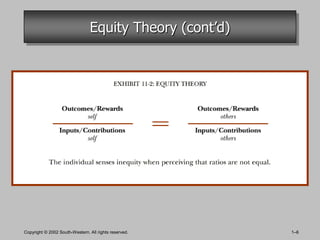
Equity Theory

  • Internal equity
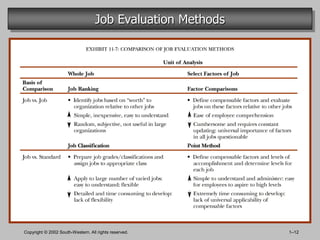
          – Fairness of pay differentials between different jobs in the
            organization can be established by job ranking, job
            classification, point systems and factor comparisons.
  • External equity
          – Fairness of organizational compensation levels relative to
            external compensation is assessed by collecting wage and
            salary information to guide in setting the organization’s pay
            strategy to lead, meet or lag labor market wages.


Copyright © 2002 South-Western. All rights reserved.                        1–4
Equity Theory (cont’d)

  • Individual Equity
          – Fairness about pay differentials among individuals who hold
            the same job in the organization is established by using:
                  • Seniority-based pay systems that reward longevity with the
                    organization.
                  • Merit-based pay systems that reward employee performance.
                  • Incentive plans that allow employees to receive part of their
                    compensation based on their job performance.
                  • Skills-based pay systems where compensation is based on
                    employees possessing skills that the firm values.
                  • Team-based pay plans that encourage cooperation and
                    flexibility in employees.


Copyright © 2002 South-Western. All rights reserved.                                1–5
Equity Theory (cont’d)


Copyright © 2002 South-Western. All rights reserved.     1–6
Equity Theory (cont’d)


Copyright © 2002 South-Western. All rights reserved.     1–7
Copyright © 2002 South-Western. All rights reserved.   1–8
Job Evaluation: Point System Method


Copyright © 2002 South-Western. All rights reserved.   1–9
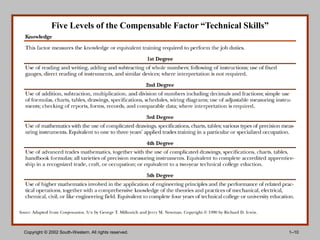
Five Levels of the Compensable Factor “Technical Skills”


Copyright © 2002 South-Western. All rights reserved.                    1–10
Copyright © 2002 South-Western. All rights reserved.   1–11
Job Evaluation Methods


Copyright © 2002 South-Western. All rights reserved.        1–12
Legal Issues in Compensation

  • Title VII of Civil Rights Act of 1964
          – Protects workers rights to fair treatment.
  • Equal Pay Act of 1963
          – Requires equal pay for equal work.
  • Comparable Worth
          – Argues that standards of equal pay for equal work should be
            replaced with the doctrine of equal pay for equal value.
          – Objective, measurable data to support an assessment of the
            value of different jobs is lacking.
          – There is no basis in current law for the arguments of
            comparable worth.
Copyright © 2002 South-Western. All rights reserved.                  1–13
Legal Issues in Compensation (cont’d)

  • Fair Labor Standards
    Act of 1938
        – Regulates the minimum
          wage
        – Sets overtime policy (time
          and one-half after forty
          hours)
        – Establishes exempt
          classes for managers and
          other professional
          employees.

Copyright © 2002 South-Western. All rights reserved.   1–14
Key Strategic Issues in Compensation

  • Determining compensation relative to the market.
  • Striking a balance between fixed and variable
    compensation.
  • Deciding whether or not to utilize team-based
    versus individual pay.
  • Creating the appropriate mix of financial and non-
    financial compensation.
  • Developing a cost-effective compensation
    program that results in high performance.


Copyright © 2002 South-Western. All rights reserved.   1–15
Reading 11.1: Compensating Teams

  • Reasons for tailoring compensation to individuals:
          – Motivation comes from within the individual as opposed to
            the group.
          – The development of skills and behaviors is an individual
            undertaking.
          – Fairness in dealing with teams does not mean equal pay for
            all.
          – Team compensation is not a payoff but a means of nurturing
            behavior that benefits the team.


Copyright © 2002 South-Western. All rights reserved.                     1–16
Reading 11.2:
                New Thinking for the New Millennium

  • Strategic approaches to may compensation (pay)
    systems more responsive:
          – Pay the person for individual worth (knowledge, skills and
            competencies) rather than for the value of a job they
            perform.
          – Reward excellence through a pay for performance
            compensation that establishes a clear relationship between
            a significant amount of pay and attainment of organizational
            objectives.
          – Individualize the pay system to give employees choices in
            how they are rewarded and what reward they receive.

Copyright © 2002 South-Western. All rights reserved.                       1–17

Chapter11 compensation

  • 1.
    CHAPTER 11 COMPENSATION PowerPoint Presentation by Charlie Cook Copyright © 2002 South-Western. All rights reserved
  • 2.
    The Importance ofCompensation • Impacts an employer’s ability to attract and retain employees. • Ensure optimal levels of employee performance in meeting the organization’s strategic objectives. • Compensation’s components – Direct compensation in the form of wages or salary • Base pay (hourly, weekly, and monthly) • Incentives (sales bonuses and or commissions) – Indirect compensation in the form of benefits • Legally required benefits (e.g., Social Security) • Optional (e.g., group health benefits) Copyright © 2002 South-Western. All rights reserved. 1–2
  • 3.
    Copyright © 2002South-Western. All rights reserved. 1–3
  • 4.
    Equity Theory • Internal equity – Fairness of pay differentials between different jobs in the organization can be established by job ranking, job classification, point systems and factor comparisons. • External equity – Fairness of organizational compensation levels relative to external compensation is assessed by collecting wage and salary information to guide in setting the organization’s pay strategy to lead, meet or lag labor market wages. Copyright © 2002 South-Western. All rights reserved. 1–4
  • 5.
    Equity Theory (cont’d) • Individual Equity – Fairness about pay differentials among individuals who hold the same job in the organization is established by using: • Seniority-based pay systems that reward longevity with the organization. • Merit-based pay systems that reward employee performance. • Incentive plans that allow employees to receive part of their compensation based on their job performance. • Skills-based pay systems where compensation is based on employees possessing skills that the firm values. • Team-based pay plans that encourage cooperation and flexibility in employees. Copyright © 2002 South-Western. All rights reserved. 1–5
  • 6.
    Equity Theory (cont’d) Copyright© 2002 South-Western. All rights reserved. 1–6
  • 7.
    Equity Theory (cont’d) Copyright© 2002 South-Western. All rights reserved. 1–7
  • 8.
    Copyright © 2002South-Western. All rights reserved. 1–8
  • 9.
    Job Evaluation: PointSystem Method Copyright © 2002 South-Western. All rights reserved. 1–9
  • 10.
    Five Levels ofthe Compensable Factor “Technical Skills” Copyright © 2002 South-Western. All rights reserved. 1–10
  • 11.
    Copyright © 2002South-Western. All rights reserved. 1–11
  • 12.
    Job Evaluation Methods Copyright© 2002 South-Western. All rights reserved. 1–12
  • 13.
    Legal Issues inCompensation • Title VII of Civil Rights Act of 1964 – Protects workers rights to fair treatment. • Equal Pay Act of 1963 – Requires equal pay for equal work. • Comparable Worth – Argues that standards of equal pay for equal work should be replaced with the doctrine of equal pay for equal value. – Objective, measurable data to support an assessment of the value of different jobs is lacking. – There is no basis in current law for the arguments of comparable worth. Copyright © 2002 South-Western. All rights reserved. 1–13
  • 14.
    Legal Issues inCompensation (cont’d) • Fair Labor Standards Act of 1938 – Regulates the minimum wage – Sets overtime policy (time and one-half after forty hours) – Establishes exempt classes for managers and other professional employees. Copyright © 2002 South-Western. All rights reserved. 1–14
  • 15.
    Key Strategic Issuesin Compensation • Determining compensation relative to the market. • Striking a balance between fixed and variable compensation. • Deciding whether or not to utilize team-based versus individual pay. • Creating the appropriate mix of financial and non- financial compensation. • Developing a cost-effective compensation program that results in high performance. Copyright © 2002 South-Western. All rights reserved. 1–15
  • 16.
    Reading 11.1: CompensatingTeams • Reasons for tailoring compensation to individuals: – Motivation comes from within the individual as opposed to the group. – The development of skills and behaviors is an individual undertaking. – Fairness in dealing with teams does not mean equal pay for all. – Team compensation is not a payoff but a means of nurturing behavior that benefits the team. Copyright © 2002 South-Western. All rights reserved. 1–16
  • 17.
    Reading 11.2: New Thinking for the New Millennium • Strategic approaches to may compensation (pay) systems more responsive: – Pay the person for individual worth (knowledge, skills and competencies) rather than for the value of a job they perform. – Reward excellence through a pay for performance compensation that establishes a clear relationship between a significant amount of pay and attainment of organizational objectives. – Individualize the pay system to give employees choices in how they are rewarded and what reward they receive. Copyright © 2002 South-Western. All rights reserved. 1–17