Michael Pitkanen, B.Comm, MBA
Fall 2015
1. What is Human Resource Management?

2. Introductions
3. Why Study Human Resource Management?
4. Overview of Changing Economy
5. Topics Covered
6. Evaluation
7. Expectations
8. Academic Honesty and Dishonesty
9. Questions
 Human resource management (HRM) is the
strategy and approach to the management of
an organization's most valued assets…
 The people working there who individually and
collectively contribute to the achievement of the
objectives of the business.
 Finding and keeping the right people to make
sure the organization (company) continues
growing and becomes more competitive
 But finding and motivating people is harder than it
sounds
 Once you have them, they are always free to go
elsewhere…let’s just hope they don’t leave with key
customers, technology, or other trade secrets
 Some HR activities include planning, attracting,
placing/developing/evaluating, motivating and
maintaining high performance
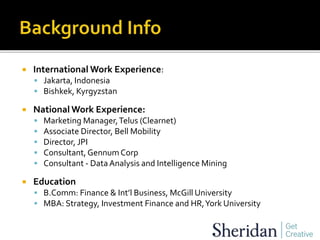
Background Info
 International Work Experience:
 Jakarta, Indonesia
 Bishkek, Kyrgyzstan
 National Work Experience:
 Marketing Manager,Telus (Clearnet)
 Associate Director, Bell Mobility
 Director, JPI
 Consultant,Gennum Corp
 Consultant - DataAnalysis and Intelligence Mining
 Education
 B.Comm: Finance & Int’l Business, McGill University
 MBA: Strategy, Investment Finance and HR,York University
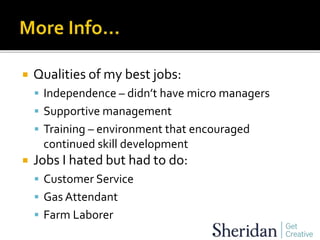
 Qualities of my best jobs:
 Independence – didn’t have micro managers
 Supportive management
 Training – environment that encouraged
continued skill development
 Jobs I hated but had to do:
 Customer Service
 Gas Attendant
 Farm Laborer
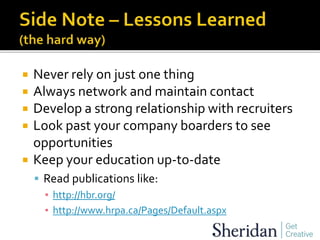
 Never rely on just one thing
 Always network and maintain contact
 Develop a strong relationship with recruiters
 Look past your company boarders to see
opportunities
 Keep your education up-to-date
 Read publications like:
▪ http://hbr.org/
▪ http://www.hrpa.ca/Pages/Default.aspx
NameTents and Ice Breaker
 Write your name on the card stock provided
 Keep the name tent card and bring for next
class
 It may take time, but I want to remember
everyone
 Goal:
 Get to know each other a little better so that you
can begin to think about who you would want as a
potential group member
Discuss in table groups:
 Introduce yourselves :
 Name
 Answer 1 of the 3 questions:
▪ What is something you are proud of or passionate about in
your life?
▪ If you could meet anyone (real or fictional) who is it and why?
▪ What was the last book you read, movie orTV series you
watched and why did you like (or not like) it?
 At the tables, each person will present the other
to the class
Who cares? Why should I come to class and pay attention?
 Who here thinks:
 “I’m only taking this class because I have to!”
 “I don’t need to really pay attention in class
because I’ll never use it afterwards!”
 No matter where you work or what you do, you’ll need to
be able to get the best people possible
 Managers in Finance, Accounting, Supply Chain, Legal will be
making either the final choice or entire choice on who they will
hire
 HR will look to you to be able to write a complete and enticing
job description
▪ Remember, your boss will want the work to get done anyway…she
won’t care if you have to work 26hrs/day…just deliver
 Getting the best qualified people to take care of the “real
work” will let you focus on the “fun work”
 The importance of managing and developing people is
increasing all the time
 The knowledge economy demands good HR Mgmt skills
and knowledge
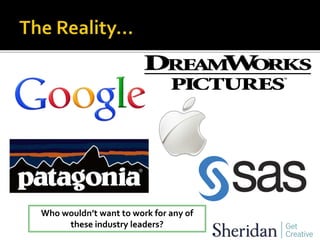
Who wouldn’t want to work for any of
these industry leaders?
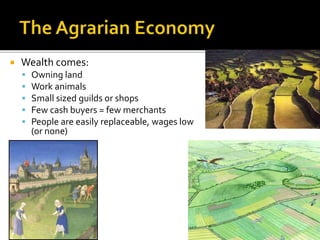
 Wealth comes:
 Owning land
 Work animals
 Small sized guilds or shops
 Few cash buyers = few merchants
 People are easily replaceable, wages low
(or none)
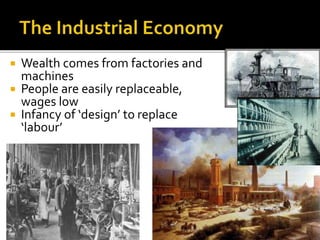
 Wealth comes from factories and
machines
 People are easily replaceable,
wages low
 Infancy of ‘design’ to replace
‘labour’
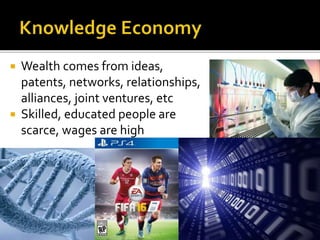
 Wealth comes from ideas,
patents, networks, relationships,
alliances, joint ventures, etc
 Skilled, educated people are
scarce, wages are high
 What’s happening?
 Transition: industrial economy 
knowledge economy
 Globalization
 Technology
 Social pressures
 Pressures on organizations
 Faster, more responsive
 Quality commitment
 Employee involvement: “Your
assets have feet.”
 Customer oriented
 Smaller, flatter, innovative
organizations
 People are no longer “replaceable” – there’s not
enough in the US and Canada!
 80 million Baby Boomers (age 41 – 61)
 46 million Gen X (age 27 – 40)
 70 million GenY (26 and under)
 Technological pace is increasing
 Competition is increasing due to globalization
 Skills and education become more important
 Good talent is hard to find!
 Try keeping it!
 Bottom line: if your company can’t manage its
people well, it will FAIL!
What we will focus on with HR1
 Strategic Importance of HR (ch.1)
 Meeting Legal Requirements (ch.4)
 Job Analysis (ch.2)
 Recruitment (ch.5)
 Candidate Selection (ch.6)
 Performance Appraisal (ch.8)
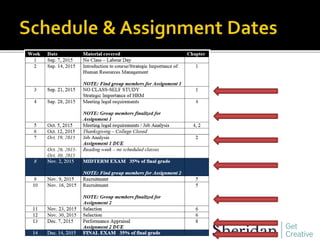
Mid-term, group project and final exam
 Assignment 1 due on Oct.19th (Week 7)
▪ Use the internet to access Human Rights Commissions /Tribunals in
Canada to find 3 employment-related cases and discuss the issues
▪ (15% of grade)
Sign up in Groups of 2 or 3 in SLATE by Sep.28 or I will
assign them
 Assignment 2 due on Dec.7th (Week 13)
▪ Critique and discuss job ads that members of the group are
qualified for
▪ (15% of grade)
Sign up in Groups of 2 or 3 in SLATE by Nov.16 or I will
assign them
 Mid-term – 35% of grade – Nov 2, in class
 Final exam - 35% of grade – Dec 14, in class
 For both:
 ~50 true/false and multiple choice questions
 Choose 2 of 4 open ended questions
 Exam booklets containing test questions
must be handed back
Text, Lectures and Contact Info
 Lecture slides can be found for each class in
the folder “Weekly Course Slides”
 Group project materials will be posted in their
own folder
 Use it to communicate with each other for
projects and assignments
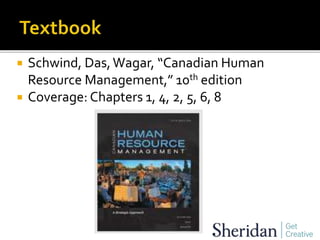
 Schwind, Das,Wagar, “Canadian Human
Resource Management,” 10th edition
 Coverage: Chapters 1, 4, 2, 5, 6, 8
 Mondays: Rm A245
 1 to 4pm
 5 to 8pm
 Mix of textbook review, video clips, case
study examples, etc.
 ALWAYS a break each hour
 Feel free to ask questions
 Throw something at me if I talk too fast!
 Faculty of business offices
 HMC Office Hours:
▪ Mondays: 12pm to 1pm
▪ Wednesday: 11am to 12pm
 Davis Office Hours:
▪ Tuesday: 11am to 12pm
 Always email through Slate
 Incase of problems with Slate or using the “Make Up
Assessment Form” use:
michael.pitkanen@sheridancollege.ca
34
Success depends on…
INSTRUCTOR STUDENTS
 Participate in discussions
 Ask questions
 Apply knowledge through class activities and work
opportunities
 Read ahead to ensure maximum course efficiency
 Complete quality work, on-time
 Attend class
 Ensure on-going feedback and communication
between student and instructor
 Refer to Slate, course outline and PowerPoint material
Treat the classroom like a corporate environment
FirstYear Business Students
 A comprehensive document that outlines
important information
 How to access Sheridan email, view academic
requirements, edit timetables, view grades, apply
to graduate
 Slate environment and Learning Portfolio
 Detailed student and professor expectations
 Academic Integrity – what it is and how to ensure
your work is seen as being original
 Due dates and late penalties –VERY IMPORTANT
▪ How to apply for a Evaluation Make-Up REQUEST
▪ 1st 24 hrs grade reduced by 10%; 2nd 24 hrs additional 20%; 3rd
24 hrs additional 20%; after 3rd grade is 0
 Academic support
▪ Tutoring: improve ESL skills; get feedback on your
assignments PRIOR to submitting it in class
▪ Can get 1.5 hours per week PER COURSE!
 All relevant details can be found in Slate under
the folder “1stYear Handbook & Info”
 IT ISYOUR RESPONSIBILITYTO BE AWARE OFTHE
CONTENT  “I didn’t know” is NOT acceptable
Student Code of Conduct andAcademic Honesty
 https://www.sheridancollege.ca/life-at-
sheridan/student-services/student-
rights.aspx
 Then click on “Student Code of Conduct Policy”
5. Sheridan students have the right to live their lives, study, learn
and work without unreasonable interference, disruption, or
upset caused by the actions of another person.
6. Sheridan students have the responsibility to respect the rights
of other members of the Sheridan community and to refrain
from any acts, intentionally or recklessly, which interfere with,
disrupt or hinder the rights of other members of the Sheridan
community.
7. Sheridan students have the right to be treated in a manner
which is respectful, honest, and free from discrimination or
harassment consistent with the Ontario Human Rights Code and
any applicable Canadian law.
8. Sheridan students have the responsibility to treat other
members of the Sheridan community in a manner which is
honest, respectful and free from discrimination or harassment
consistent with the Ontario Human Rights Code and any
applicable Canadian law.
 What is it:
 Copying text without proper referencing from
another source
 Changing a few words in a sentence to try and
disguise it and make it look like your own work
▪ From outside sources
▪ From other classmates
 Cheating during exams
 http://sheridancollege.libguides.com/academ
ic_integrity
 Just don’t do it – I hate paperwork
 Hold the record for most academic
dishonesty busts in one semester
HR in action
 Examining the elements related to human
resource management:
 While watching the video, take notes and identify
what makes this company so successful
▪ Specifically, take notice of:
▪ Values
▪ Culture
▪ Rewards
▪ Results
Upcoming…
 Read Chapter 1
 Class 2 – “Strategic Importance of HRM”
 What is HR Management?
 Detailed analysis of Strategic HR Management
Model
 HR Management Objectives
 Applications of the above concepts
 Overview of Chapter 1 in text
 As reminder, there is no class – but, you will
have to study chapter 1 on your own
 In Slate, you will find a review quiz that will test
your knowledge and understanding of chapter 1
▪ Due before the beginning of class Sep.28

Hr1 class+2-mon

  • 1.
  • 2.
    1. What isHuman Resource Management? 2. Introductions 3. Why Study Human Resource Management? 4. Overview of Changing Economy 5. Topics Covered 6. Evaluation 7. Expectations 8. Academic Honesty and Dishonesty 9. Questions
  • 3.
     Human resourcemanagement (HRM) is the strategy and approach to the management of an organization's most valued assets…  The people working there who individually and collectively contribute to the achievement of the objectives of the business.
  • 4.
     Finding andkeeping the right people to make sure the organization (company) continues growing and becomes more competitive  But finding and motivating people is harder than it sounds  Once you have them, they are always free to go elsewhere…let’s just hope they don’t leave with key customers, technology, or other trade secrets  Some HR activities include planning, attracting, placing/developing/evaluating, motivating and maintaining high performance
  • 5.
  • 6.
     International WorkExperience:  Jakarta, Indonesia  Bishkek, Kyrgyzstan  National Work Experience:  Marketing Manager,Telus (Clearnet)  Associate Director, Bell Mobility  Director, JPI  Consultant,Gennum Corp  Consultant - DataAnalysis and Intelligence Mining  Education  B.Comm: Finance & Int’l Business, McGill University  MBA: Strategy, Investment Finance and HR,York University
  • 7.
     Qualities ofmy best jobs:  Independence – didn’t have micro managers  Supportive management  Training – environment that encouraged continued skill development  Jobs I hated but had to do:  Customer Service  Gas Attendant  Farm Laborer
  • 8.
     Never relyon just one thing  Always network and maintain contact  Develop a strong relationship with recruiters  Look past your company boarders to see opportunities  Keep your education up-to-date  Read publications like: ▪ http://hbr.org/ ▪ http://www.hrpa.ca/Pages/Default.aspx
  • 9.
  • 10.
     Write yourname on the card stock provided  Keep the name tent card and bring for next class  It may take time, but I want to remember everyone
  • 11.
     Goal:  Getto know each other a little better so that you can begin to think about who you would want as a potential group member
  • 12.
    Discuss in tablegroups:  Introduce yourselves :  Name  Answer 1 of the 3 questions: ▪ What is something you are proud of or passionate about in your life? ▪ If you could meet anyone (real or fictional) who is it and why? ▪ What was the last book you read, movie orTV series you watched and why did you like (or not like) it?  At the tables, each person will present the other to the class
  • 13.
    Who cares? Whyshould I come to class and pay attention?
  • 14.
     Who herethinks:  “I’m only taking this class because I have to!”  “I don’t need to really pay attention in class because I’ll never use it afterwards!”
  • 15.
     No matterwhere you work or what you do, you’ll need to be able to get the best people possible  Managers in Finance, Accounting, Supply Chain, Legal will be making either the final choice or entire choice on who they will hire  HR will look to you to be able to write a complete and enticing job description ▪ Remember, your boss will want the work to get done anyway…she won’t care if you have to work 26hrs/day…just deliver  Getting the best qualified people to take care of the “real work” will let you focus on the “fun work”  The importance of managing and developing people is increasing all the time  The knowledge economy demands good HR Mgmt skills and knowledge
  • 17.
    Who wouldn’t wantto work for any of these industry leaders?
  • 19.
     Wealth comes: Owning land  Work animals  Small sized guilds or shops  Few cash buyers = few merchants  People are easily replaceable, wages low (or none)
  • 20.
     Wealth comesfrom factories and machines  People are easily replaceable, wages low  Infancy of ‘design’ to replace ‘labour’
  • 21.
     Wealth comesfrom ideas, patents, networks, relationships, alliances, joint ventures, etc  Skilled, educated people are scarce, wages are high
  • 22.
     What’s happening? Transition: industrial economy  knowledge economy  Globalization  Technology  Social pressures  Pressures on organizations  Faster, more responsive  Quality commitment  Employee involvement: “Your assets have feet.”  Customer oriented  Smaller, flatter, innovative organizations
  • 23.
     People areno longer “replaceable” – there’s not enough in the US and Canada!  80 million Baby Boomers (age 41 – 61)  46 million Gen X (age 27 – 40)  70 million GenY (26 and under)  Technological pace is increasing  Competition is increasing due to globalization  Skills and education become more important  Good talent is hard to find!  Try keeping it!  Bottom line: if your company can’t manage its people well, it will FAIL!
  • 24.
    What we willfocus on with HR1
  • 25.
     Strategic Importanceof HR (ch.1)  Meeting Legal Requirements (ch.4)  Job Analysis (ch.2)  Recruitment (ch.5)  Candidate Selection (ch.6)  Performance Appraisal (ch.8)
  • 26.
  • 28.
     Assignment 1due on Oct.19th (Week 7) ▪ Use the internet to access Human Rights Commissions /Tribunals in Canada to find 3 employment-related cases and discuss the issues ▪ (15% of grade) Sign up in Groups of 2 or 3 in SLATE by Sep.28 or I will assign them  Assignment 2 due on Dec.7th (Week 13) ▪ Critique and discuss job ads that members of the group are qualified for ▪ (15% of grade) Sign up in Groups of 2 or 3 in SLATE by Nov.16 or I will assign them
  • 29.
     Mid-term –35% of grade – Nov 2, in class  Final exam - 35% of grade – Dec 14, in class  For both:  ~50 true/false and multiple choice questions  Choose 2 of 4 open ended questions  Exam booklets containing test questions must be handed back
  • 30.
    Text, Lectures andContact Info
  • 31.
     Lecture slidescan be found for each class in the folder “Weekly Course Slides”  Group project materials will be posted in their own folder  Use it to communicate with each other for projects and assignments
  • 32.
     Schwind, Das,Wagar,“Canadian Human Resource Management,” 10th edition  Coverage: Chapters 1, 4, 2, 5, 6, 8
  • 33.
     Mondays: RmA245  1 to 4pm  5 to 8pm  Mix of textbook review, video clips, case study examples, etc.  ALWAYS a break each hour  Feel free to ask questions  Throw something at me if I talk too fast!
  • 34.
     Faculty ofbusiness offices  HMC Office Hours: ▪ Mondays: 12pm to 1pm ▪ Wednesday: 11am to 12pm  Davis Office Hours: ▪ Tuesday: 11am to 12pm  Always email through Slate  Incase of problems with Slate or using the “Make Up Assessment Form” use: michael.pitkanen@sheridancollege.ca 34
  • 35.
  • 36.
  • 37.
     Participate indiscussions  Ask questions  Apply knowledge through class activities and work opportunities  Read ahead to ensure maximum course efficiency  Complete quality work, on-time  Attend class  Ensure on-going feedback and communication between student and instructor  Refer to Slate, course outline and PowerPoint material Treat the classroom like a corporate environment
  • 38.
  • 39.
     A comprehensivedocument that outlines important information  How to access Sheridan email, view academic requirements, edit timetables, view grades, apply to graduate  Slate environment and Learning Portfolio  Detailed student and professor expectations  Academic Integrity – what it is and how to ensure your work is seen as being original
  • 40.
     Due datesand late penalties –VERY IMPORTANT ▪ How to apply for a Evaluation Make-Up REQUEST ▪ 1st 24 hrs grade reduced by 10%; 2nd 24 hrs additional 20%; 3rd 24 hrs additional 20%; after 3rd grade is 0  Academic support ▪ Tutoring: improve ESL skills; get feedback on your assignments PRIOR to submitting it in class ▪ Can get 1.5 hours per week PER COURSE!  All relevant details can be found in Slate under the folder “1stYear Handbook & Info”  IT ISYOUR RESPONSIBILITYTO BE AWARE OFTHE CONTENT  “I didn’t know” is NOT acceptable
  • 41.
    Student Code ofConduct andAcademic Honesty
  • 42.
  • 43.
    5. Sheridan studentshave the right to live their lives, study, learn and work without unreasonable interference, disruption, or upset caused by the actions of another person. 6. Sheridan students have the responsibility to respect the rights of other members of the Sheridan community and to refrain from any acts, intentionally or recklessly, which interfere with, disrupt or hinder the rights of other members of the Sheridan community. 7. Sheridan students have the right to be treated in a manner which is respectful, honest, and free from discrimination or harassment consistent with the Ontario Human Rights Code and any applicable Canadian law. 8. Sheridan students have the responsibility to treat other members of the Sheridan community in a manner which is honest, respectful and free from discrimination or harassment consistent with the Ontario Human Rights Code and any applicable Canadian law.
  • 44.
     What isit:  Copying text without proper referencing from another source  Changing a few words in a sentence to try and disguise it and make it look like your own work ▪ From outside sources ▪ From other classmates  Cheating during exams
  • 45.
     http://sheridancollege.libguides.com/academ ic_integrity  Justdon’t do it – I hate paperwork  Hold the record for most academic dishonesty busts in one semester
  • 46.
  • 47.
     Examining theelements related to human resource management:  While watching the video, take notes and identify what makes this company so successful ▪ Specifically, take notice of: ▪ Values ▪ Culture ▪ Rewards ▪ Results
  • 48.
  • 49.
     Read Chapter1  Class 2 – “Strategic Importance of HRM”  What is HR Management?  Detailed analysis of Strategic HR Management Model  HR Management Objectives  Applications of the above concepts  Overview of Chapter 1 in text
  • 50.
     As reminder,there is no class – but, you will have to study chapter 1 on your own  In Slate, you will find a review quiz that will test your knowledge and understanding of chapter 1 ▪ Due before the beginning of class Sep.28