What is Junior Achievement?
A nonprofit dedicated to teaching students about:
• managing money
• working at a job
• owning a business
About Me
• Name
• Place of work
• Family
• Hobbies
JA Our Nation
Today you will learn about:
• Free market economies
• How pricing guides economic
decisions
Free to Choose Your Work
or Business
Lesson One
Discussion
• When you think about your future, what are you
most excited about?
• Do you see yourself someday working for a
company or for yourself? Why?
Discussion
Name some successful businesses.
Goods
Items that can be bought or sold.
Services
Work done for others, like haircuts or car repairs.
Consumer
Someone who buys goods and services.
Producer
Someone who makes goods or provides services
to others.
Free Market Economy
A system in which goods and services are bought
and sold freely with little government
interference.
Business are free to compete, set prices, and earn
a profit.
Profit
The amount of money left after all business
expenses have been paid.
Businesses rely on profits to hire workers, reward
investors, and expand.
Discussion
Name a few things you recently bought at a store.
• Prices guide consumers’ economic decisions.
• Producers respond to consumers’ choices by adjusting
prices.
Competition
Rivalry between two or more businesses striving for the
same customer.
Competition is what makes a free market system unique.
Activity – Prices
1. Each student will receive two sticky notes.
2. Take two items from your desk and place them on your
desktop.
3. Think about the value of each item. How would you price
it if you were to put it up for sale?
4. Decide on a price for each item and secretly write it on the
sticky notes.
5. When directed, play the sticky notes next to your items.
6. Walk around the room and check out the prices. Make a
mental note of what product you would buy based on its
price. Be ready to explain.
Discussion
• Which item would you buy?
• Why would you choose that item over another?
• How might other prices affect your pricing?
• When it comes to pricing, how low can a business go?
What would happen if a business priced an item lower
than it actually paid for it?
• What would happen if there was just one ruler for sale
but a lot of people who wanted it?
• Do you think businesses put a lot of thought into pricing
their goods and services?
Free Market Economy
Goods and services are available at an affordable price for
consumers but at a level that lets businesses make a profit
and grow.
Review
• Goods and services
• Consumers and producers
• Free market economy
• Profit
• The importance of pricing
Next time…
we will learn about entrepreneurship and innovation!
Innovation Nation
Lesson Two
Today we will learn about…
• Entrepreneurship
• How businesses use resources
• STEM skills
• Innovation
Review
• Goods and services
• Producers and consumers
• Free market economy
• Profit
• Why are pricing decisions so important?
Discussion
• Do you have an idea for a product or service that
people might want?
• Could your idea become a business?
Entrepreneur
What is an entrepreneur?
A person who takes a risk to start a business with
the intent of earning a profit.
Think of a few words that describe an
entrepreneur.
Entrepreneurship
What is entrepreneurship?
The innovative thinking needed to start and operate a
business.
A free market system encourages entrepreneurship.
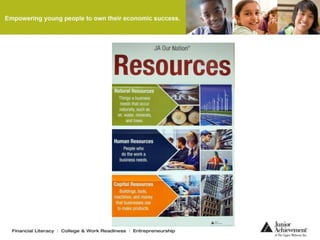
Resources
Capital resources – buildings, tools, machines, and
money that businesses use to make products
Human resources – people who need the work a business
needs
Natural resources – things a business needs that occur
naturally, such as air, water, minerals and trees
Businesses make choices everyday based on resource
needs.
Resources – A Pencil
Capital resources – the plant or factory where it is made
and the actual tools to create it. Money.
Human resources – the people who work the factory
machines and sell the product.
Natural resources – the trees, graphite, and clay to make
the wood shell, core, and rubber eraser.
Skill
Skill: The ability to do something well
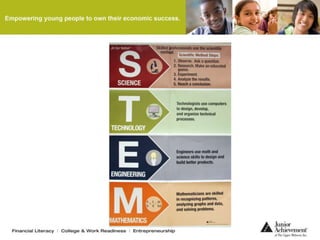
Technical Skill Jobs – defined as those related to science,
technology, engineering, and mathematics, called STEM
skills.
Examples of technical skill jobs:
• Chemist
• Doctor
• Computer software engineer
• Construction manager
• Architect
• Statistician
Innovation
An improvement of an existing product or method.
Can you think of an example of innovation?
Activity - Innovation
Turn to a partner and discuss a product or service that
interests you and then brainstorm a way to improve it.
Activity - Innovation
1. Get into 8 groups. Each group will receive an Our
Innovation Nation Topic Card. Read your card as a
group.
2. Develop a plan to improve a new product or service
based on your card.
a. Define the problem
b. Brainstorm a solution
c. Formulate an idea to develop
3. Sketch a design for your new product.
4. If time allows, we will present our innovations.
Review
• How do entrepreneurs help consumers?
• What is the reward for many entrepreneurs?
• Businesses need resources to make products. Can you
name the 3 types of resources?
• If you had to explain to someone why STEM skills are
important skills for future jobs, what would you say?
• What small experiment could you do to test your
innovation idea?
You are developing skills in school to help you find a
great job in the future!
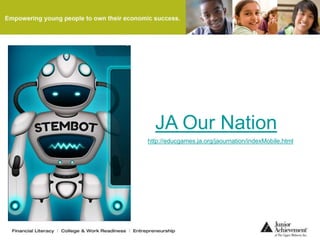
JA Our Nation
http://educgames.ja.org/jaournation/indexMobile.html
Next time…
We will learn about careers and skills!
Career Quest
Lesson Three
Today we will learn about…
• Careers
• The skills necessary for different careers
Review
• Entrepreneurship
• Resources
• STEM Skills
• Innovation
Discussion
• Imagine someone asked you to open a new
elementary school. What jobs would be
necessary?
• What skills do you think a fifth-grade teacher
needs?
• What kind of career do you want to learn more
about?
High-growth, high-demand jobs
Jobs projected to add large numbers of employees
to the workforce
Many of these jobs require the use of technology.
Technology is the use of machinery, equipment,
and processes.
Technology has changed the way most
businesses operate!
Interests
The things you like and enjoy.
You can begin considering the types of careers
that match your interests today!
Two-Minute Interview With A Neighbor
Interview Questions
• What interests you? Why do you enjoy it?
• What is something unique about you that most
people don’t know? Do you have a hobby?
• What job do you see yourself doing in the
future?
Career Clusters
What is a career cluster?
A grouping of jobs and industries related by skills
or products.
Example: Education and Training jobs include: teacher, principal,
librarian, counselor.
Activity – Career Cluster Trading Cards
Career Cluster Trading Cards
1. I will read aloud one of the career cluster titles.
Imagine yourself as a ______.
2. If you may be interested in one of these
careers, stand by me. If you aren’t sure, ask for
more information.
3. I will move on to 3 or 4 more cards. Stand by
the career cards of your choice!
Activity – Career Quest
1. Separate into groups of 3-4.
2. Walk with fliers in hand to the closest card.
3. Read the title and information about two career
clusters.
4. Answer the questions found on Page 3 of your
fliers.
5. Continue to other cards.
6. We will share our answers in about 15 minutes!
7. Career ID Bookmark
Activity – Discussion
• Which career cluster interested you?
• Which job in that cluster had special appeal?
• Does that job match your interests?
• Will you need a college degree or special
training? How long might that take?
Review
• High-growth high-demand jobs
• The effects of technology
• Career clusters
What are three things you are learning in school
today that will help you prepare for a job in the
future?
Next time…
We will learn about applying and interviewing for
jobs!
Get and Keep the Job!
Lesson Four
Today we will learn about…
The necessary skills to apply for jobs!
Review
• High-growth high-demand jobs
• The effects of technology
• Career clusters
Discussion
• Someone has decided to hire you for a job.
Describe the job and why you are perfect for it.
• How will you prove that you are qualified?
• What are some of the qualifications needed for
jobs that your siblings or friends have?
Employees and Employers
Employees: people who work for businesses
Employers: Businesses that hire workers
Resume
A written summary of a person’s education, work
experience, and skills.
Job seekers usually present their skills to a
potential employer with a resume.
Look at the simplified resume on Page 1 of
your flier.
Soft Skills
Personal attributes and abilities that are needed in
most jobs.
Example: Employee cares about the job, works
well with others, and has integrity and discipline.
Communication
A written or spoken exchanges between people to
share information.
Businesses need people with strong
communication skills.
Job Interview
A discussion between a potential employee and
employer to help decide if a job is a good match.
Job Interview
A discussion between a potential employee and
employer to help decide if a job is a good match.
I will need a volunteer for a job interview
demonstration!
Activity – Board Game
1. We will separate into 8 groups.
2. Place game pieces on START. Stack the Get and Keep
the Job! Game Cards on the board.
3. Take turns rolling the die. Player who rolls highest
starts. Play continues clockwise.
4. Record the skills and points gained on Page 2 of your
flier.
5. Follow directions when you land on a Pick a Card
space.
6. Add up the points at the end of play. The player who
collects the most points wins!
Review
• Employees and employers
• Resume
• Soft skills and communication
• Job interview
Next time…
We will learn about global competition!
Global Connections
Lesson Five
Today we will learn about…
The global marketplace and competition!
Review
• Employees and employers
• Resume
• Soft skills and communication
• Job interview
Discussion – Global Marketplace
• 95% of the world’s customers live outside of the
U.S. With the global marketplace in mind, does a
neighborhood bookstore or amazon.com have
more customers? Why?
• What are advantages of a global marketplace to
customers?
• What are the advantages for U.S. businesses?
Trade
The process of buying and selling
Global Connections Exercise
Open your flier to the world map inside.
Listen to the following statements and find the
countries I mention on your map. Draw a line
from the country to the United States.
Global Connections Exercise
Open your flier to the world map inside.
Listen to the following statements and find the
countries I mention on your map. Draw a line
from the country to the United States.
Specialization
Choosing to focus on one or a few products
Example: Florida specializes in growing citrus fruits and making
products from those fruits.
Specialization lowers the cost of production and
allows businesses in many countries to buy and
sell with one another.
Opportunity Cost
The next best alternative given up when making a
choice.

Activity – Mystery Puzzle Cards
1. Each sheet illustrates a single product that
uses resources from six countries
2. Pull out one card. Walk around the room and
search for other students who have a puzzle
card you think matches your own.
3. Once you have discovered your product, stay in
your group and discuss the resources and
countries needed to produce that product.
4. Appoint a spokesperson to share with the
class.
Review
Many products we buy use resources from around
the world and different resources come from
different countries.
Using resources from other countries can lower
business costs of making a product and increase
profit.
JA Our Nation Review
• Free market economy
• Profit
• Entrepreneurship and Innovation
• High-growth high-demand jobs
• Resumes and job interviews
• The global marketplace and trading
• Opportunity cost
JA Our Nation Review
• Free market economy
• Profit
• Entrepreneurship and Innovation
• High-growth high-demand jobs
• Resumes and job interviews
• The global marketplace and trading
• Opportunity cost
Certificate of Achievement

5th grade-Junior Achievement -our-nation-new-curriculum

  • 1.
    What is JuniorAchievement? A nonprofit dedicated to teaching students about: • managing money • working at a job • owning a business
  • 2.
    About Me • Name •Place of work • Family • Hobbies
  • 4.
    JA Our Nation Todayyou will learn about: • Free market economies • How pricing guides economic decisions
  • 5.
    Free to ChooseYour Work or Business Lesson One
  • 6.
    Discussion • When youthink about your future, what are you most excited about? • Do you see yourself someday working for a company or for yourself? Why?
  • 7.
  • 8.
    Goods Items that canbe bought or sold.
  • 9.
    Services Work done forothers, like haircuts or car repairs.
  • 10.
    Consumer Someone who buysgoods and services.
  • 11.
    Producer Someone who makesgoods or provides services to others.
  • 12.
    Free Market Economy Asystem in which goods and services are bought and sold freely with little government interference. Business are free to compete, set prices, and earn a profit.
  • 13.
    Profit The amount ofmoney left after all business expenses have been paid. Businesses rely on profits to hire workers, reward investors, and expand.
  • 14.
    Discussion Name a fewthings you recently bought at a store. • Prices guide consumers’ economic decisions. • Producers respond to consumers’ choices by adjusting prices.
  • 15.
    Competition Rivalry between twoor more businesses striving for the same customer. Competition is what makes a free market system unique.
  • 16.
    Activity – Prices 1.Each student will receive two sticky notes. 2. Take two items from your desk and place them on your desktop. 3. Think about the value of each item. How would you price it if you were to put it up for sale? 4. Decide on a price for each item and secretly write it on the sticky notes. 5. When directed, play the sticky notes next to your items. 6. Walk around the room and check out the prices. Make a mental note of what product you would buy based on its price. Be ready to explain.
  • 17.
    Discussion • Which itemwould you buy? • Why would you choose that item over another? • How might other prices affect your pricing? • When it comes to pricing, how low can a business go? What would happen if a business priced an item lower than it actually paid for it? • What would happen if there was just one ruler for sale but a lot of people who wanted it? • Do you think businesses put a lot of thought into pricing their goods and services?
  • 18.
    Free Market Economy Goodsand services are available at an affordable price for consumers but at a level that lets businesses make a profit and grow.
  • 19.
    Review • Goods andservices • Consumers and producers • Free market economy • Profit • The importance of pricing
  • 20.
    Next time… we willlearn about entrepreneurship and innovation!
  • 21.
  • 22.
    Today we willlearn about… • Entrepreneurship • How businesses use resources • STEM skills • Innovation
  • 23.
    Review • Goods andservices • Producers and consumers • Free market economy • Profit • Why are pricing decisions so important?
  • 24.
    Discussion • Do youhave an idea for a product or service that people might want? • Could your idea become a business?
  • 25.
    Entrepreneur What is anentrepreneur? A person who takes a risk to start a business with the intent of earning a profit. Think of a few words that describe an entrepreneur.
  • 26.
    Entrepreneurship What is entrepreneurship? Theinnovative thinking needed to start and operate a business. A free market system encourages entrepreneurship.
  • 27.
    Resources Capital resources –buildings, tools, machines, and money that businesses use to make products Human resources – people who need the work a business needs Natural resources – things a business needs that occur naturally, such as air, water, minerals and trees Businesses make choices everyday based on resource needs.
  • 29.
    Resources – APencil Capital resources – the plant or factory where it is made and the actual tools to create it. Money. Human resources – the people who work the factory machines and sell the product. Natural resources – the trees, graphite, and clay to make the wood shell, core, and rubber eraser.
  • 30.
    Skill Skill: The abilityto do something well Technical Skill Jobs – defined as those related to science, technology, engineering, and mathematics, called STEM skills. Examples of technical skill jobs: • Chemist • Doctor • Computer software engineer • Construction manager • Architect • Statistician
  • 31.
    Innovation An improvement ofan existing product or method. Can you think of an example of innovation?
  • 32.
    Activity - Innovation Turnto a partner and discuss a product or service that interests you and then brainstorm a way to improve it.
  • 33.
    Activity - Innovation 1.Get into 8 groups. Each group will receive an Our Innovation Nation Topic Card. Read your card as a group. 2. Develop a plan to improve a new product or service based on your card. a. Define the problem b. Brainstorm a solution c. Formulate an idea to develop 3. Sketch a design for your new product. 4. If time allows, we will present our innovations.
  • 34.
    Review • How doentrepreneurs help consumers? • What is the reward for many entrepreneurs? • Businesses need resources to make products. Can you name the 3 types of resources? • If you had to explain to someone why STEM skills are important skills for future jobs, what would you say? • What small experiment could you do to test your innovation idea? You are developing skills in school to help you find a great job in the future!
  • 35.
  • 36.
    Next time… We willlearn about careers and skills!
  • 37.
  • 38.
    Today we willlearn about… • Careers • The skills necessary for different careers
  • 39.
  • 40.
    Discussion • Imagine someoneasked you to open a new elementary school. What jobs would be necessary? • What skills do you think a fifth-grade teacher needs? • What kind of career do you want to learn more about?
  • 41.
    High-growth, high-demand jobs Jobsprojected to add large numbers of employees to the workforce Many of these jobs require the use of technology. Technology is the use of machinery, equipment, and processes. Technology has changed the way most businesses operate!
  • 42.
    Interests The things youlike and enjoy. You can begin considering the types of careers that match your interests today!
  • 43.
    Two-Minute Interview WithA Neighbor Interview Questions • What interests you? Why do you enjoy it? • What is something unique about you that most people don’t know? Do you have a hobby? • What job do you see yourself doing in the future?
  • 44.
    Career Clusters What isa career cluster? A grouping of jobs and industries related by skills or products. Example: Education and Training jobs include: teacher, principal, librarian, counselor.
  • 45.
    Activity – CareerCluster Trading Cards Career Cluster Trading Cards 1. I will read aloud one of the career cluster titles. Imagine yourself as a ______. 2. If you may be interested in one of these careers, stand by me. If you aren’t sure, ask for more information. 3. I will move on to 3 or 4 more cards. Stand by the career cards of your choice!
  • 46.
    Activity – CareerQuest 1. Separate into groups of 3-4. 2. Walk with fliers in hand to the closest card. 3. Read the title and information about two career clusters. 4. Answer the questions found on Page 3 of your fliers. 5. Continue to other cards. 6. We will share our answers in about 15 minutes! 7. Career ID Bookmark
  • 47.
    Activity – Discussion •Which career cluster interested you? • Which job in that cluster had special appeal? • Does that job match your interests? • Will you need a college degree or special training? How long might that take?
  • 48.
    Review • High-growth high-demandjobs • The effects of technology • Career clusters What are three things you are learning in school today that will help you prepare for a job in the future?
  • 49.
    Next time… We willlearn about applying and interviewing for jobs!
  • 50.
    Get and Keepthe Job! Lesson Four
  • 51.
    Today we willlearn about… The necessary skills to apply for jobs!
  • 52.
    Review • High-growth high-demandjobs • The effects of technology • Career clusters
  • 53.
    Discussion • Someone hasdecided to hire you for a job. Describe the job and why you are perfect for it. • How will you prove that you are qualified? • What are some of the qualifications needed for jobs that your siblings or friends have?
  • 54.
    Employees and Employers Employees:people who work for businesses Employers: Businesses that hire workers
  • 55.
    Resume A written summaryof a person’s education, work experience, and skills. Job seekers usually present their skills to a potential employer with a resume. Look at the simplified resume on Page 1 of your flier.
  • 56.
    Soft Skills Personal attributesand abilities that are needed in most jobs. Example: Employee cares about the job, works well with others, and has integrity and discipline.
  • 57.
    Communication A written orspoken exchanges between people to share information. Businesses need people with strong communication skills.
  • 58.
    Job Interview A discussionbetween a potential employee and employer to help decide if a job is a good match.
  • 59.
    Job Interview A discussionbetween a potential employee and employer to help decide if a job is a good match. I will need a volunteer for a job interview demonstration!
  • 60.
    Activity – BoardGame 1. We will separate into 8 groups. 2. Place game pieces on START. Stack the Get and Keep the Job! Game Cards on the board. 3. Take turns rolling the die. Player who rolls highest starts. Play continues clockwise. 4. Record the skills and points gained on Page 2 of your flier. 5. Follow directions when you land on a Pick a Card space. 6. Add up the points at the end of play. The player who collects the most points wins!
  • 61.
    Review • Employees andemployers • Resume • Soft skills and communication • Job interview
  • 62.
    Next time… We willlearn about global competition!
  • 63.
  • 64.
    Today we willlearn about… The global marketplace and competition!
  • 65.
    Review • Employees andemployers • Resume • Soft skills and communication • Job interview
  • 66.
    Discussion – GlobalMarketplace • 95% of the world’s customers live outside of the U.S. With the global marketplace in mind, does a neighborhood bookstore or amazon.com have more customers? Why? • What are advantages of a global marketplace to customers? • What are the advantages for U.S. businesses?
  • 67.
    Trade The process ofbuying and selling
  • 68.
    Global Connections Exercise Openyour flier to the world map inside. Listen to the following statements and find the countries I mention on your map. Draw a line from the country to the United States.
  • 69.
    Global Connections Exercise Openyour flier to the world map inside. Listen to the following statements and find the countries I mention on your map. Draw a line from the country to the United States.
  • 70.
    Specialization Choosing to focuson one or a few products Example: Florida specializes in growing citrus fruits and making products from those fruits. Specialization lowers the cost of production and allows businesses in many countries to buy and sell with one another.
  • 71.
    Opportunity Cost The nextbest alternative given up when making a choice.
  • 72.
    Activity – MysteryPuzzle Cards 1. Each sheet illustrates a single product that uses resources from six countries 2. Pull out one card. Walk around the room and search for other students who have a puzzle card you think matches your own. 3. Once you have discovered your product, stay in your group and discuss the resources and countries needed to produce that product. 4. Appoint a spokesperson to share with the class.
  • 73.
    Review Many products webuy use resources from around the world and different resources come from different countries. Using resources from other countries can lower business costs of making a product and increase profit.
  • 74.
    JA Our NationReview • Free market economy • Profit • Entrepreneurship and Innovation • High-growth high-demand jobs • Resumes and job interviews • The global marketplace and trading • Opportunity cost
  • 75.
    JA Our NationReview • Free market economy • Profit • Entrepreneurship and Innovation • High-growth high-demand jobs • Resumes and job interviews • The global marketplace and trading • Opportunity cost
  • 76.