Interacting with an Inferred
World: The Challenge of
Machine Learning for
Humane Computer
Interaction
+ Aarhus 2015
- Alan F. Blackwell
/김민준
x 2016 Fall
Alan Blackwell
• 	Visual Representation
• 	End-User Development
• 	Interdisciplinary Design
• 	Tangible, Augmented and Embodied Interaction
• 	Psychology of Programming
• 	Computer Music
• 	Critical Theory
1975-1985-1995-2005 — the decennial Aarhus
conferences have traditionally been instrumental
for setting new agendas for critically engaged
thinking about information technology. The
conference series is fundamentally
interdisciplinary and emphasizes thinking that is
firmly anchored in action, intervention, and
scholarly critical practice.
Aarhus Conference
Summary
4
4
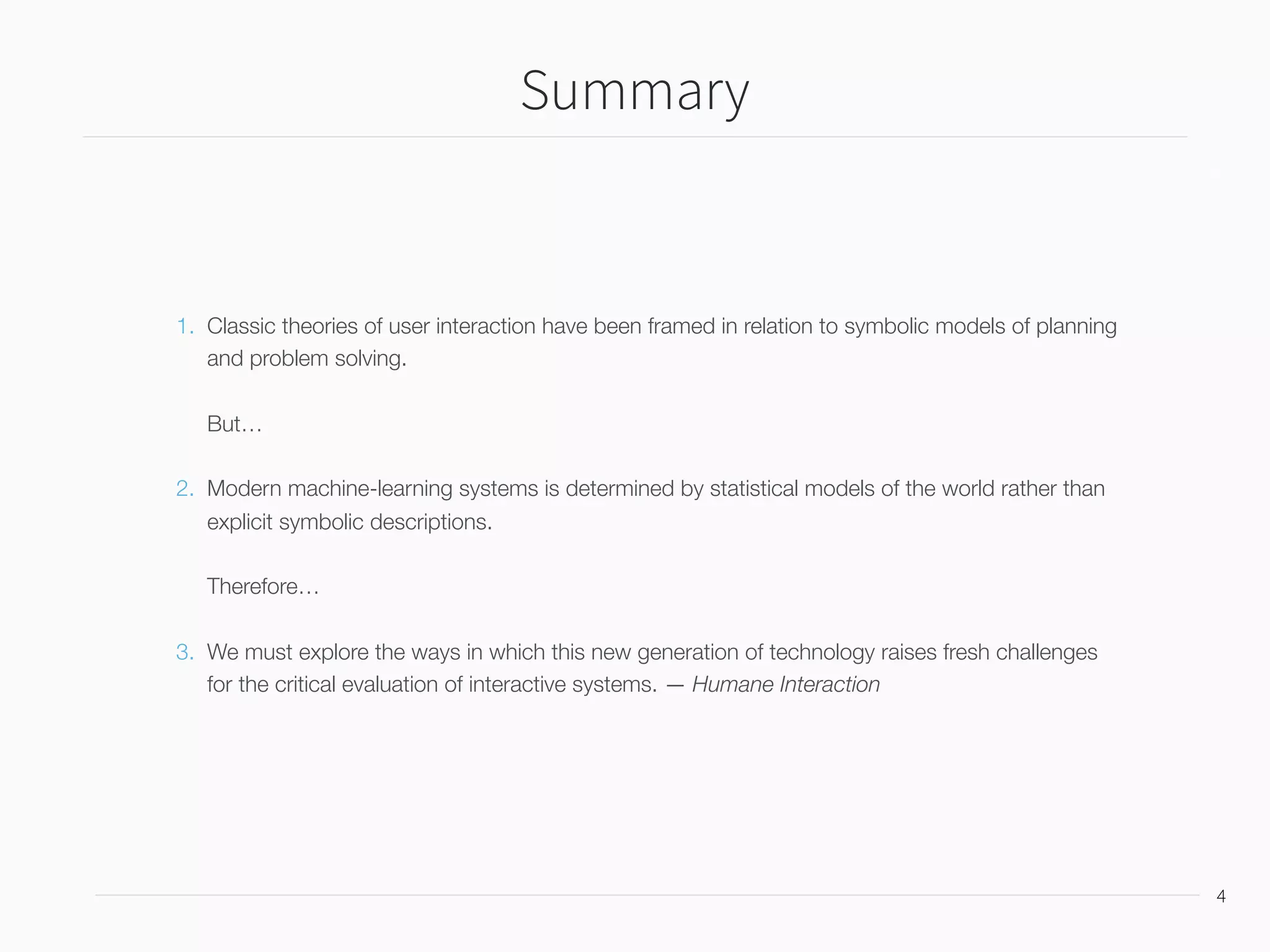
1. Classic theories of user interaction have been framed in relation to symbolic models of planning
and problem solving.


But…

2. Modern machine-learning systems is determined by statistical models of the world rather than
explicit symbolic descriptions.


Therefore…

3. We must explore the ways in which this new generation of technology raises fresh challenges
for the critical evaluation of interactive systems. — Humane Interaction
Presentation Contents
5
Background
The New Critical Landscape
Case Study to Critical Questions
Towards Humane Interaction
1
2
3
4
5 Conclusion
6
Background
6
6
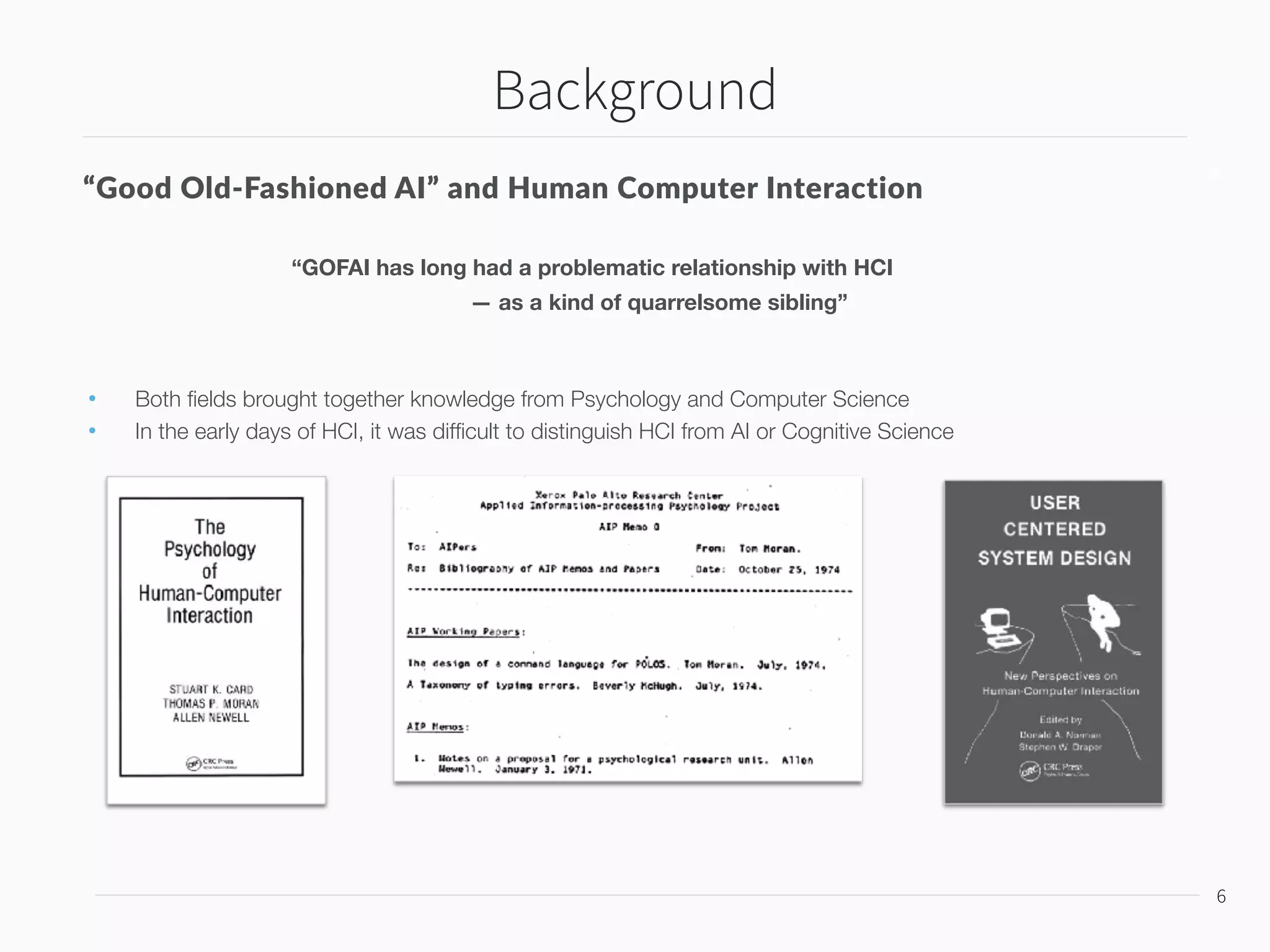
“Good Old-Fashioned AI” and Human Computer Interaction
“GOFAI has long had a problematic relationship with HCI
— as a kind of quarrelsome sibling”
• Both fields brought together knowledge from Psychology and Computer Science
• In the early days of HCI, it was difficult to distinguish HCI from AI or Cognitive Science
Background
7
7
Expert Systems Boom of the 1980s and Critical Reactions
The possibility of a Strong AI
vs.
Symbolic problem-solving algorithms neglect 

issues central in HCI
• Social context
• Physical embodiment
• Action in the world
argued by Winograd, Flores, Gill, Suchman
Situated Cognition
— The failure of formal computational models of planning and action to deal with the complexity of the real world
The Critical Landscape
8
8
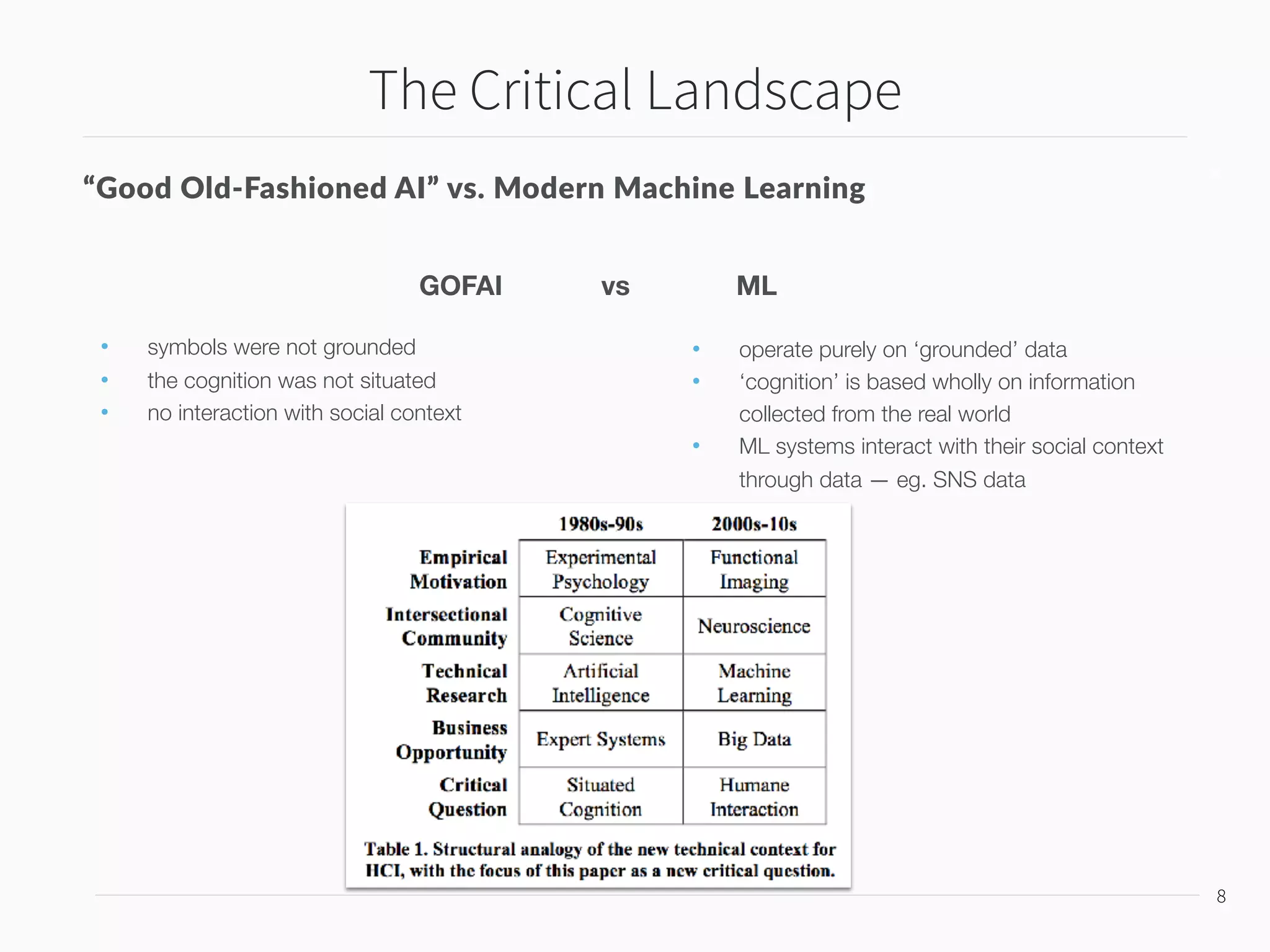
“Good Old-Fashioned AI” vs. Modern Machine Learning
GOFAI vs ML
• symbols were not grounded
• the cognition was not situated
• no interaction with social context
• operate purely on ‘grounded’ data
• ‘cognition’ is based wholly on information
collected from the real world
• ML systems interact with their social context
through data — eg. SNS data
9
9
“Good Old-Fashioned AI” vs. Modern Machine Learning
GOFAI vs ML
• symbols were not grounded
• the cognition was not situated
• no interaction with social context
• operate purely on ‘grounded’ data
• ‘cognition’ is based wholly on information
collected from the real world
• ML systems interact with their social context
through data — eg. SNS data
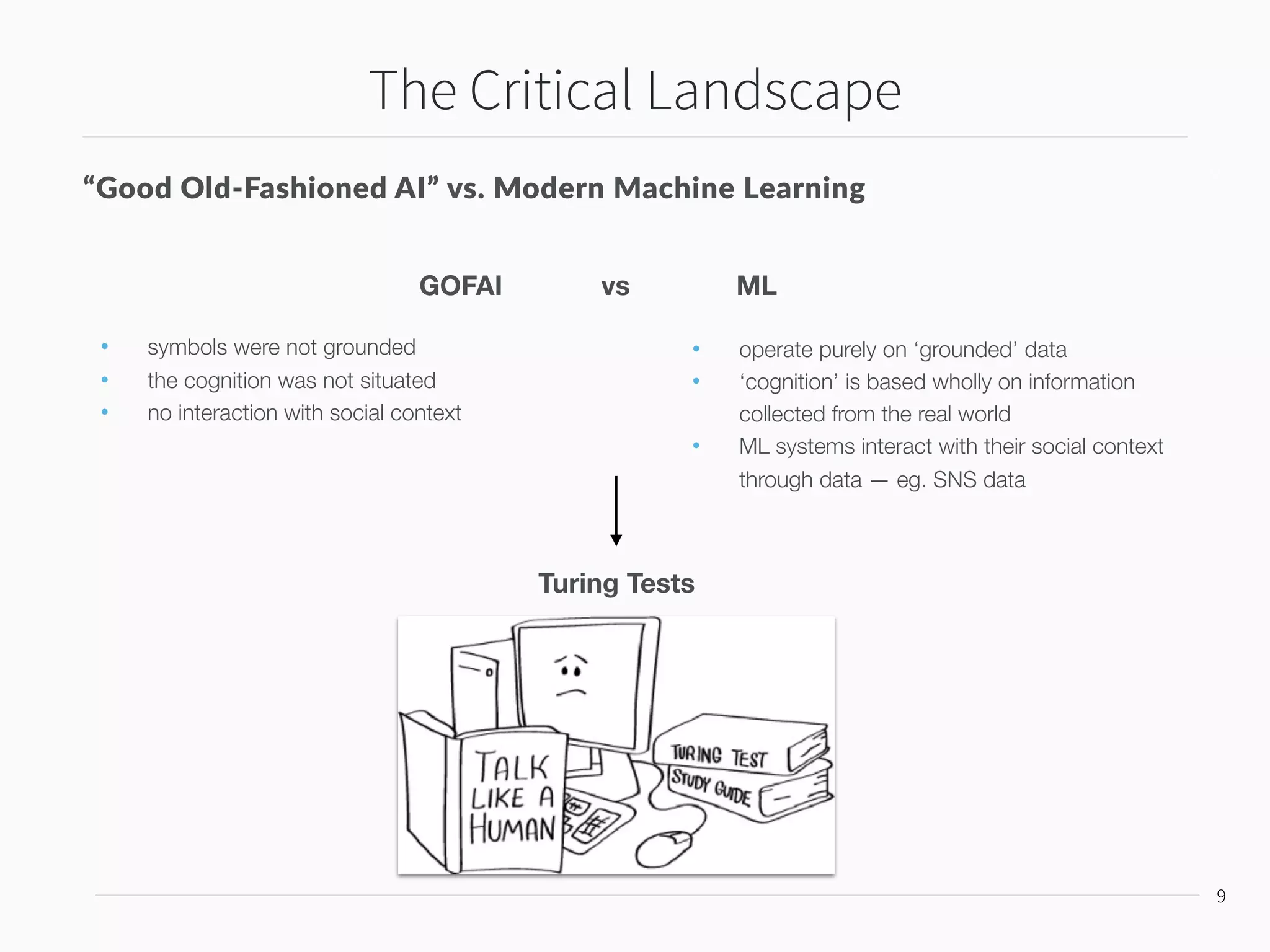
Turing Tests
The Critical Landscape
GOFAI vs ML
• symbols were not grounded
• the cognition was not situated
• no interaction with social context
• operate purely on ‘grounded’ data
• ‘cognition’ is based wholly on information
collected from the real world
• ML systems interact with their social context
through data — eg. SNS data
Turing Tests
The Critical Landscape
“Good Old-Fashioned AI” vs. Modern Machine Learning
10
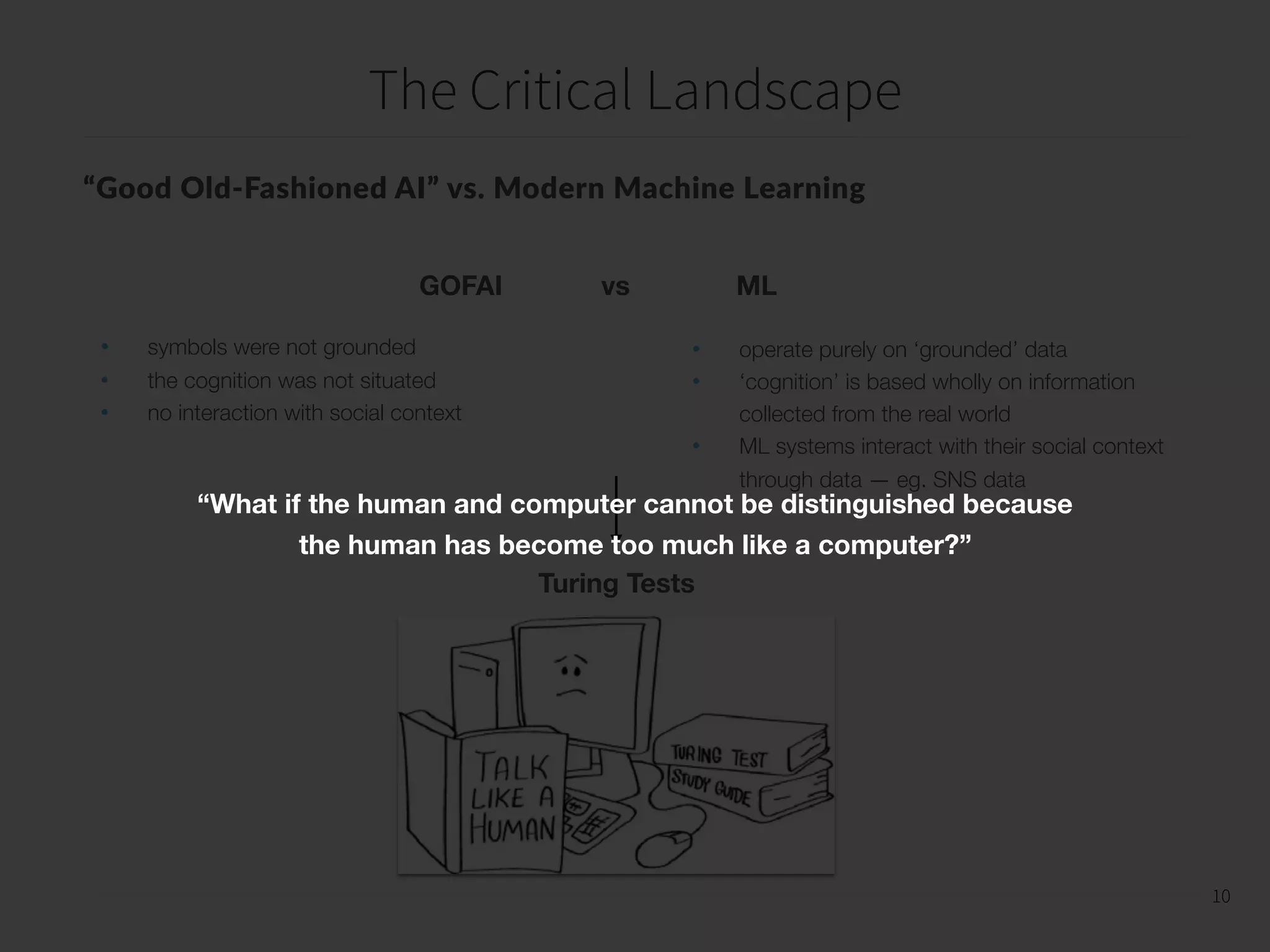
“What if the human and computer cannot be distinguished because
the human has become too much like a computer?”
Background
11
11
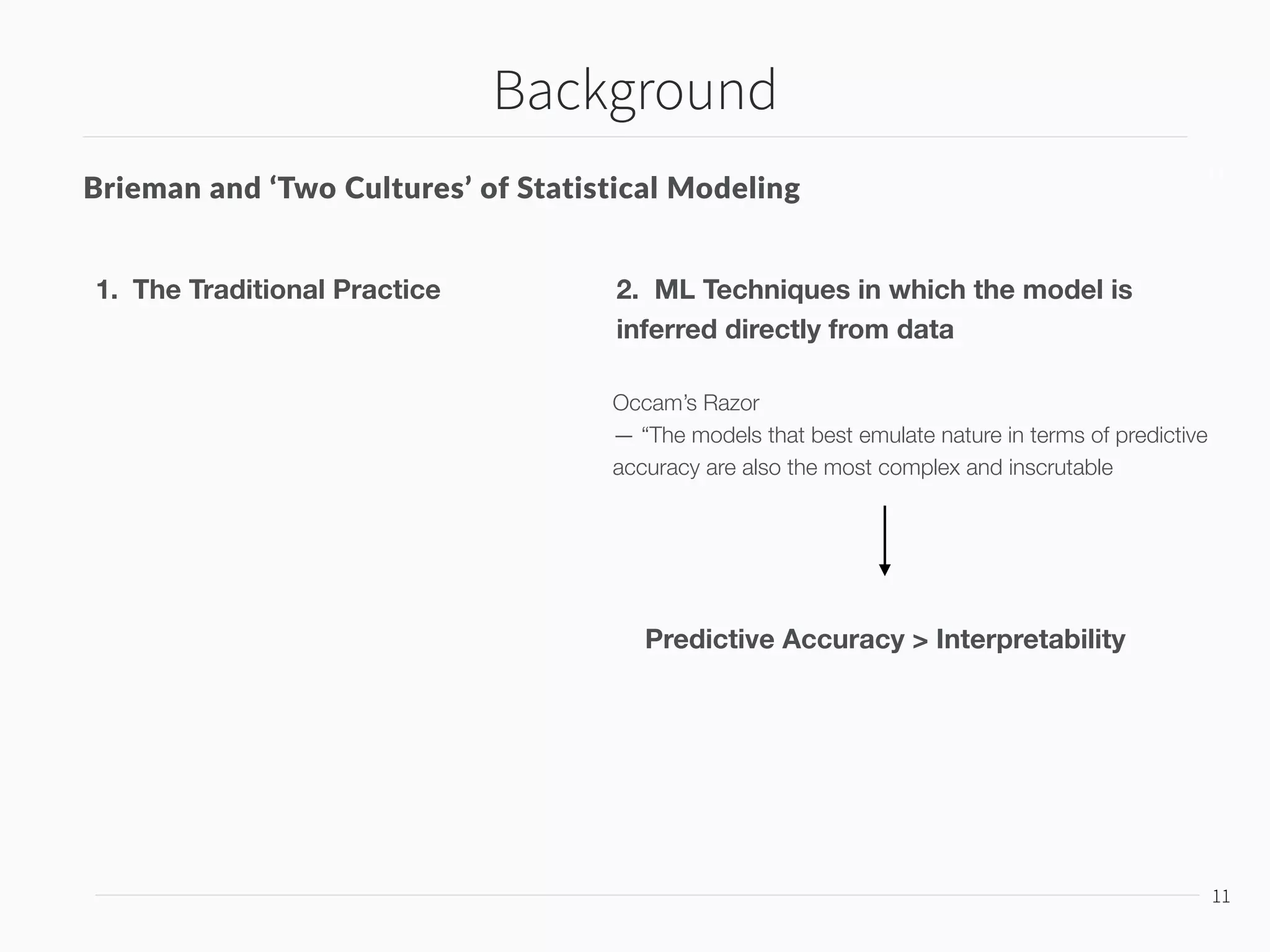
Brieman and ‘Two Cultures’ of Statistical Modeling
1. The Traditional Practice
Predictive Accuracy > Interpretability
2. ML Techniques in which the model is
inferred directly from data
Occam’s Razor
— “The models that best emulate nature in terms of predictive
accuracy are also the most complex and inscrutable
Case Study: Reading the Mind
12
12
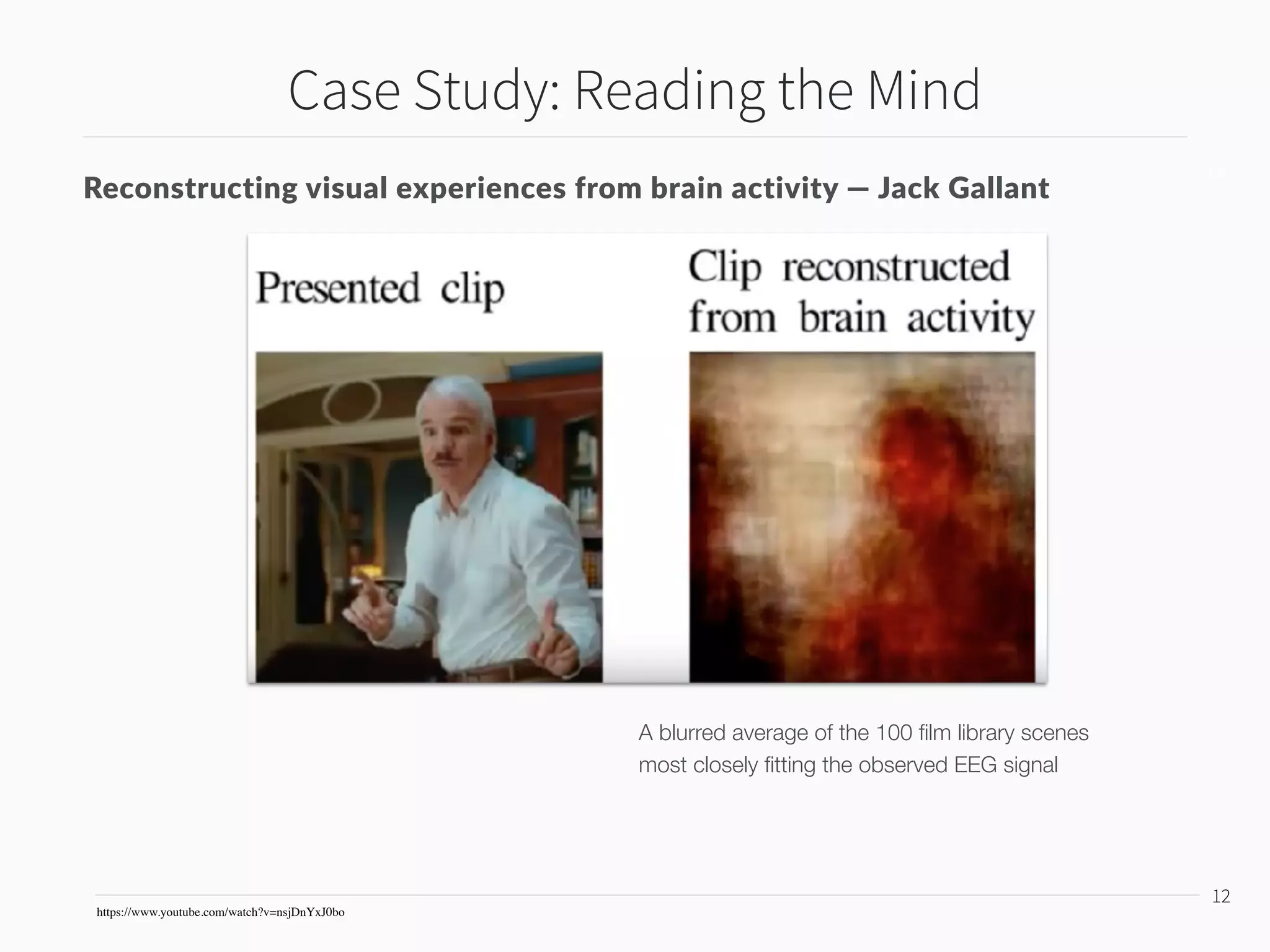
Reconstructing visual experiences from brain activity — Jack Gallant
https://www.youtube.com/watch?v=nsjDnYxJ0bo
A blurred average of the 100 film library scenes
most closely fitting the observed EEG signal
Critical Questions
13
13
Question 1: Authorship
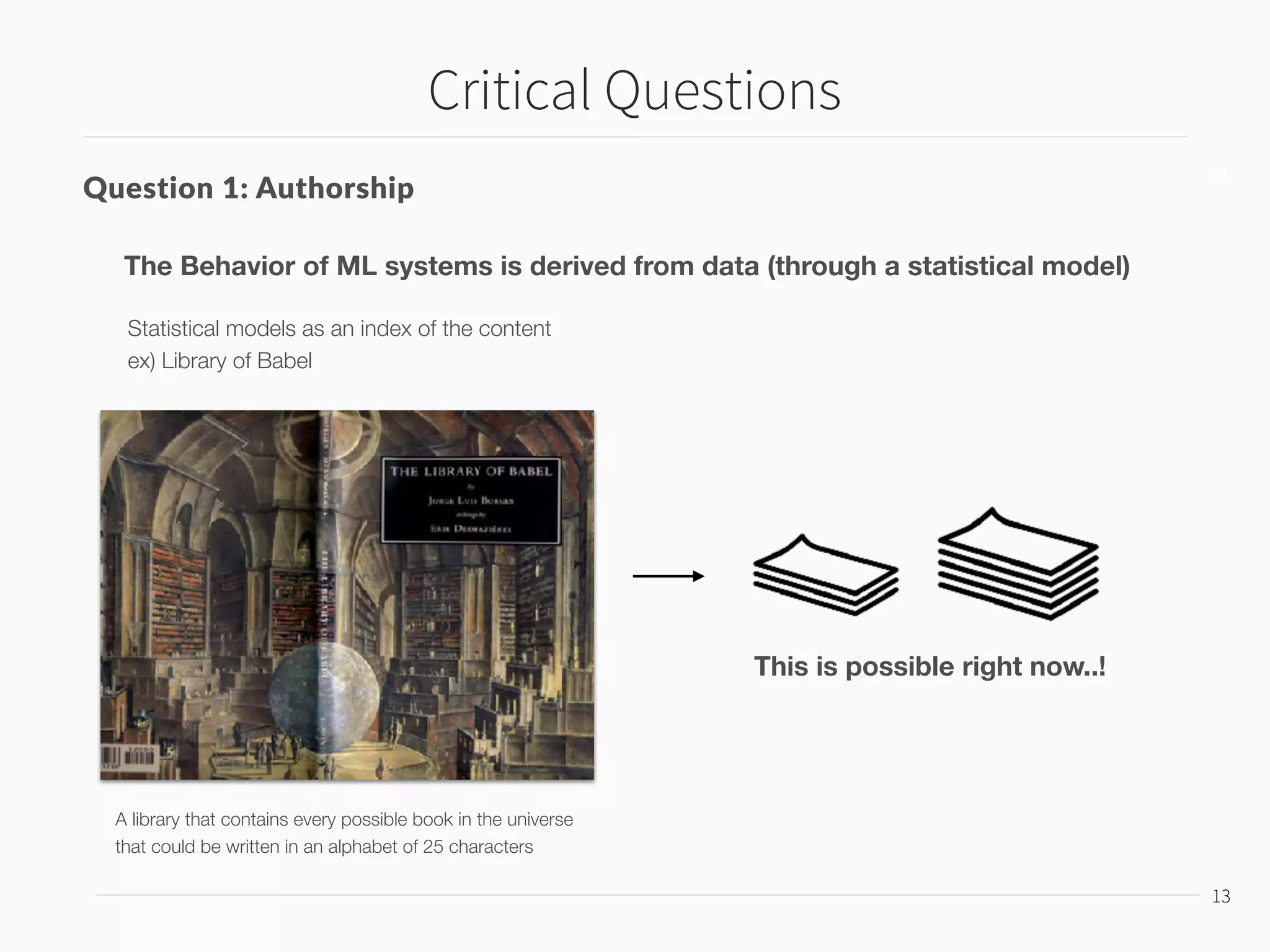
The Behavior of ML systems is derived from data (through a statistical model)
Statistical models as an index of the content
ex) Library of Babel
A library that contains every possible book in the universe
that could be written in an alphabet of 25 characters
This is possible right now..!
Critical Questions
14
14
Question 1: Authorship
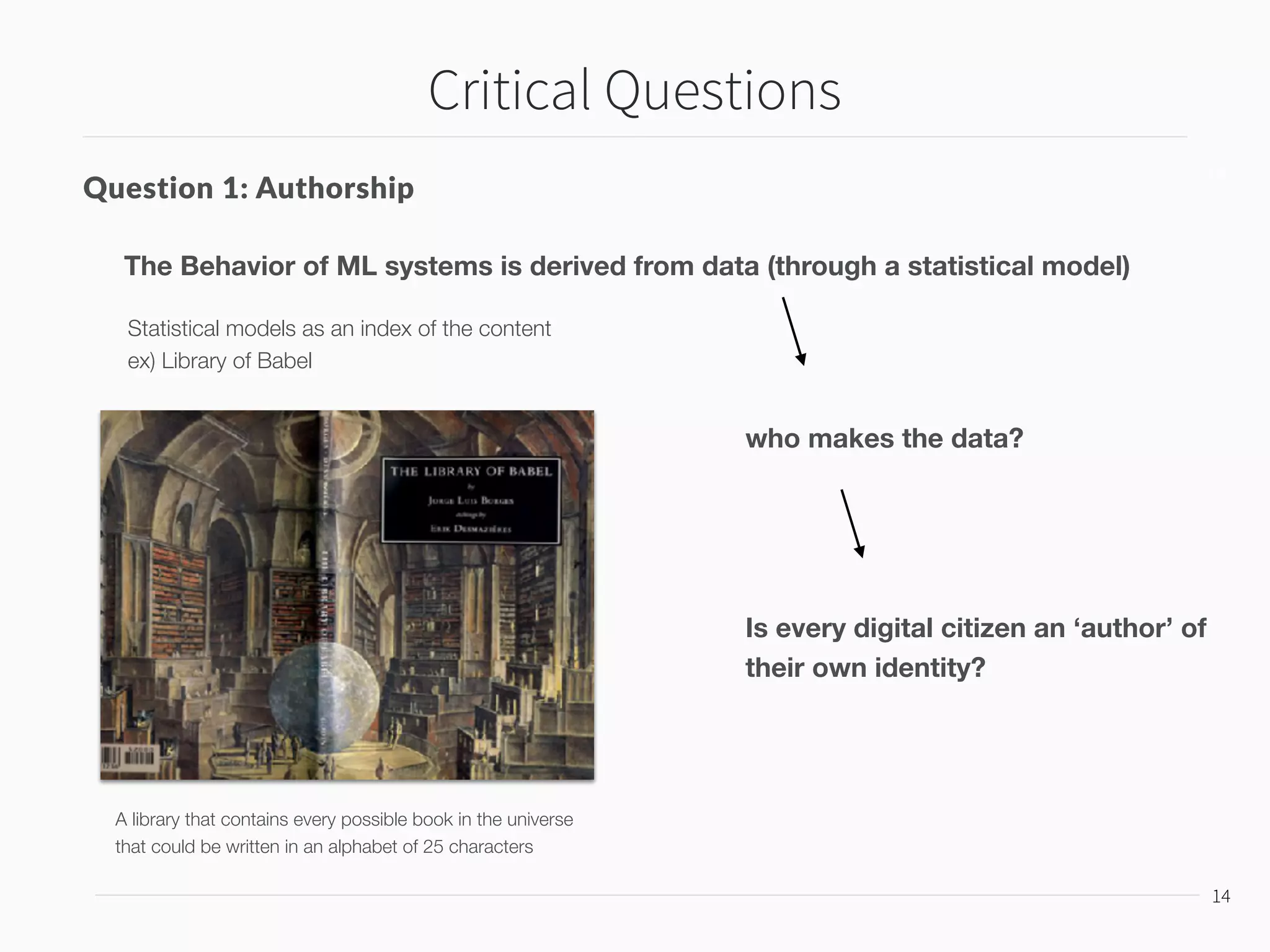
The Behavior of ML systems is derived from data (through a statistical model)
Statistical models as an index of the content
ex) Library of Babel
A library that contains every possible book in the universe
that could be written in an alphabet of 25 characters
Is every digital citizen an ‘author’ of
their own identity?
who makes the data?
Critical Questions
15
15
Question 2: Attribution
Content of the original material captured in an ML model or
index should still be traced to the authors
Digital Copyright?
Critical Questions
16
16
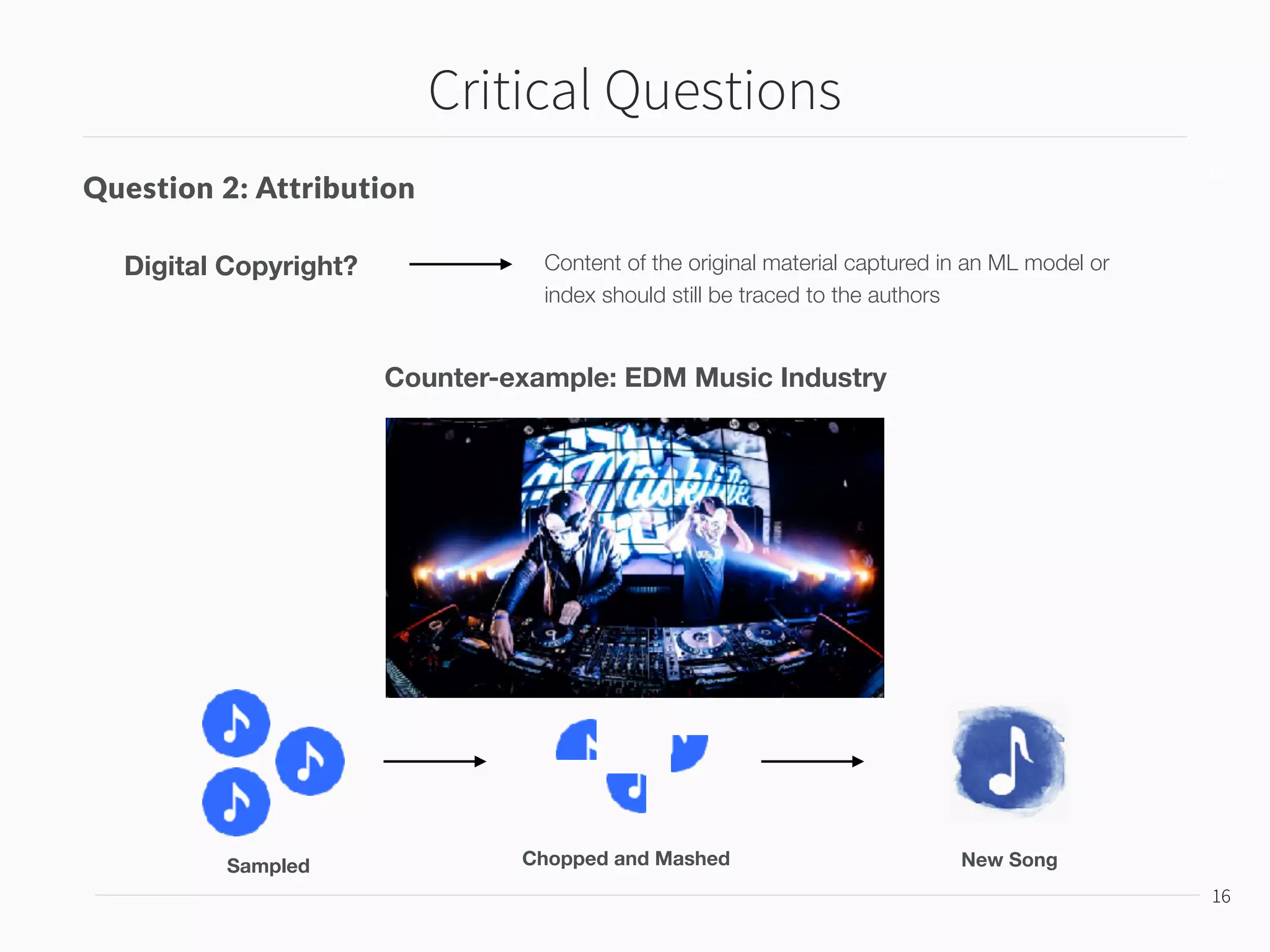
Question 2: Attribution
Counter-example: EDM Music Industry
Content of the original material captured in an ML model or
index should still be traced to the authors
Digital Copyright?
Sampled Chopped and Mashed New Song
Critical Questions
17
17
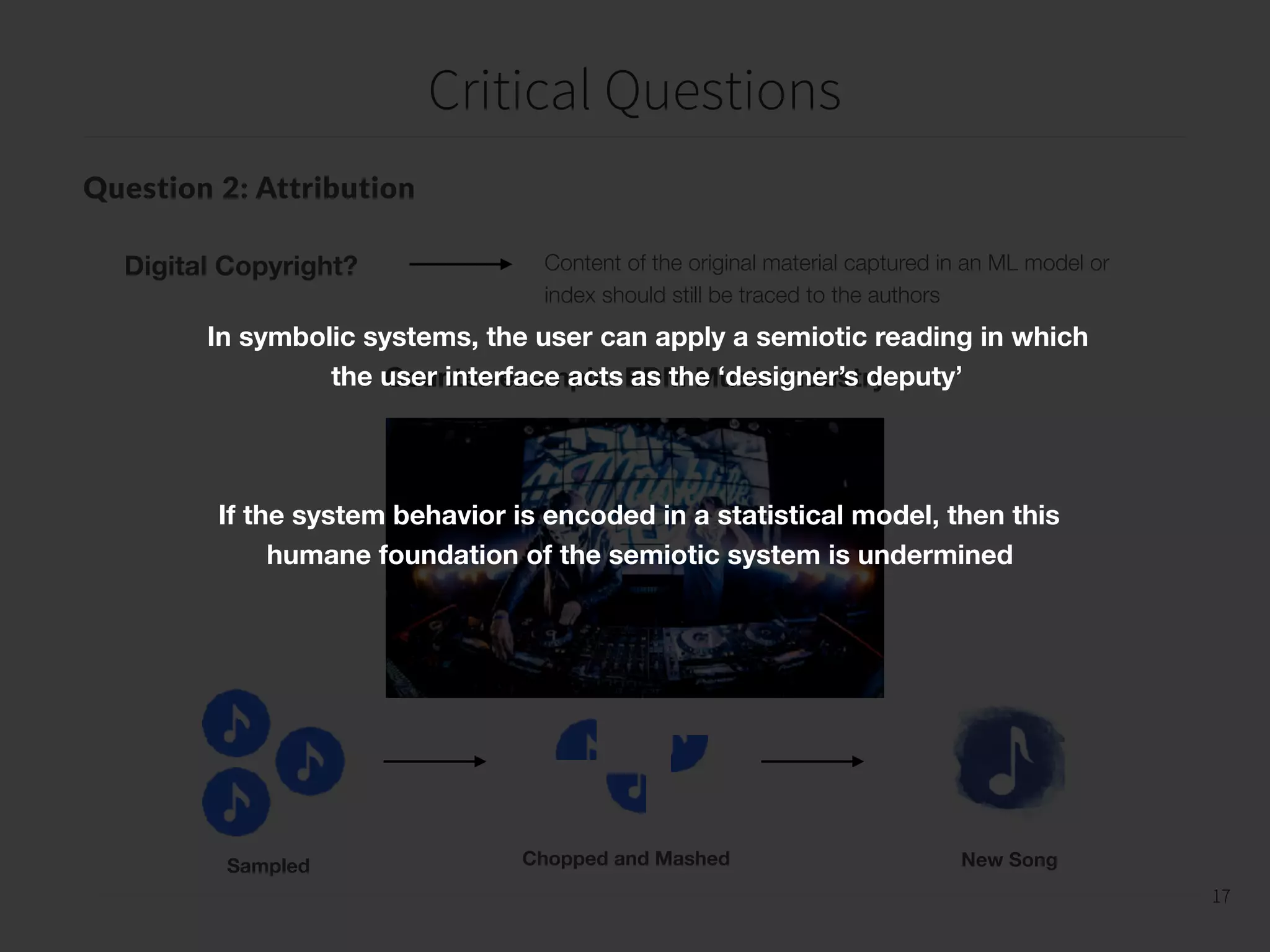
Question 2: Attribution
Counter-example: EDM Music Industry
Content of the original material captured in an ML model or
index should still be traced to the authors
Digital Copyright?
Sampled Chopped and Mashed New Song
In symbolic systems, the user can apply a semiotic reading in which
the user interface acts as the ‘designer’s deputy’
If the system behavior is encoded in a statistical model, then this
humane foundation of the semiotic system is undermined
Critical Questions
18
18
Question 3: Reward
“If you are not paying for it, you’re not the customer;
you’re the product being sold”
Ecosystem Players (Apple, Google, Facebook, Microsoft)
are attempting to establish their control through a combination of storage, behavior, and authentication services
that are starting to rely on indexed models of other people’s data
“The primary mechanism of control over users comes through
statistical index models that are not currently inspected or regulated”
Critical Questions
19
19
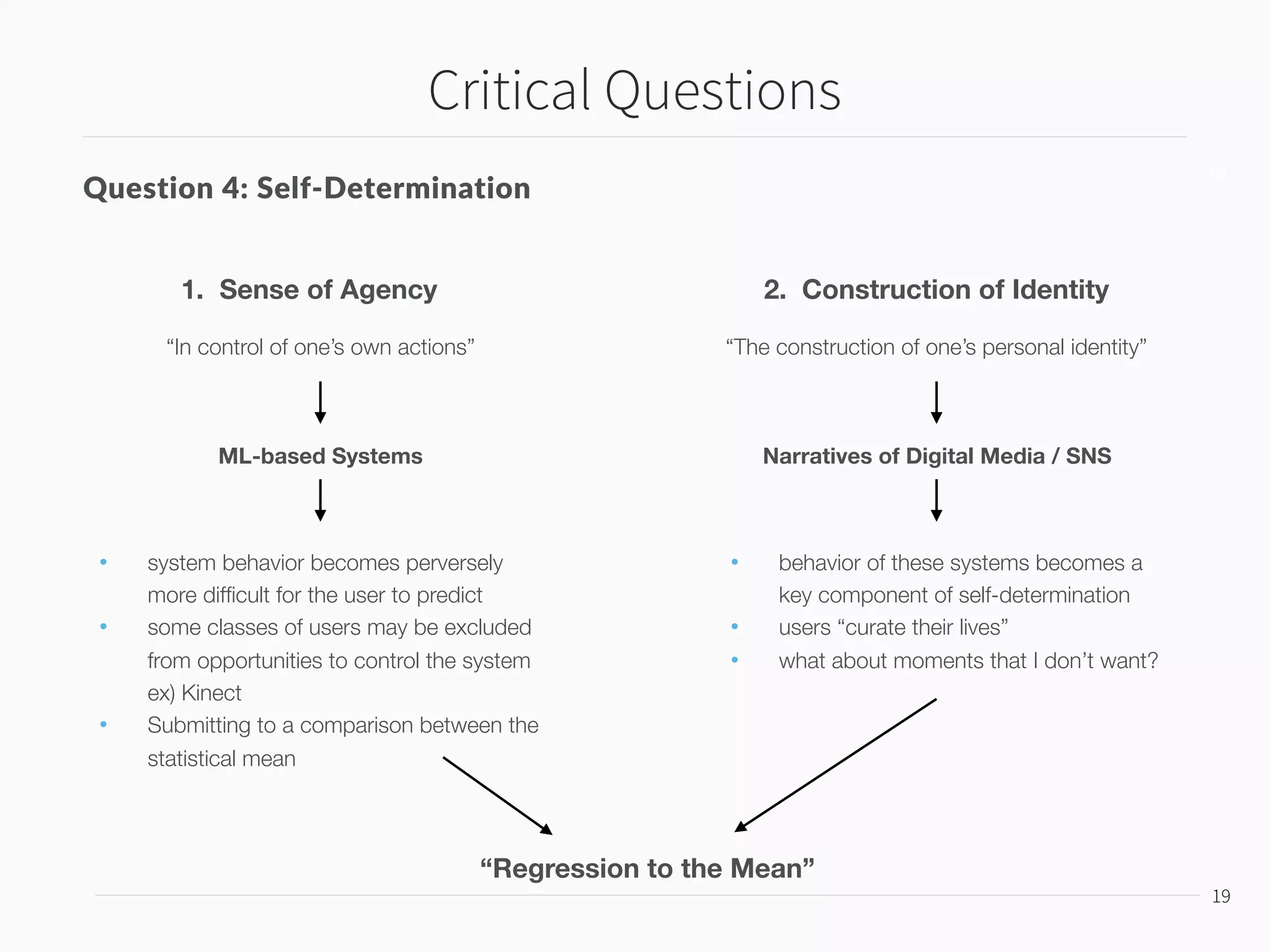
Question 4: Self-Determination
1. Sense of Agency
ML-based Systems
2. Construction of Identity
“In control of one’s own actions”
• system behavior becomes perversely
more difficult for the user to predict
• some classes of users may be excluded
from opportunities to control the system

ex) Kinect
• Submitting to a comparison between the
statistical mean
“The construction of one’s personal identity”
Narratives of Digital Media / SNS
• behavior of these systems becomes a
key component of self-determination
• users “curate their lives”
• what about moments that I don’t want?
“Regression to the Mean”
Critical Questions
20
20
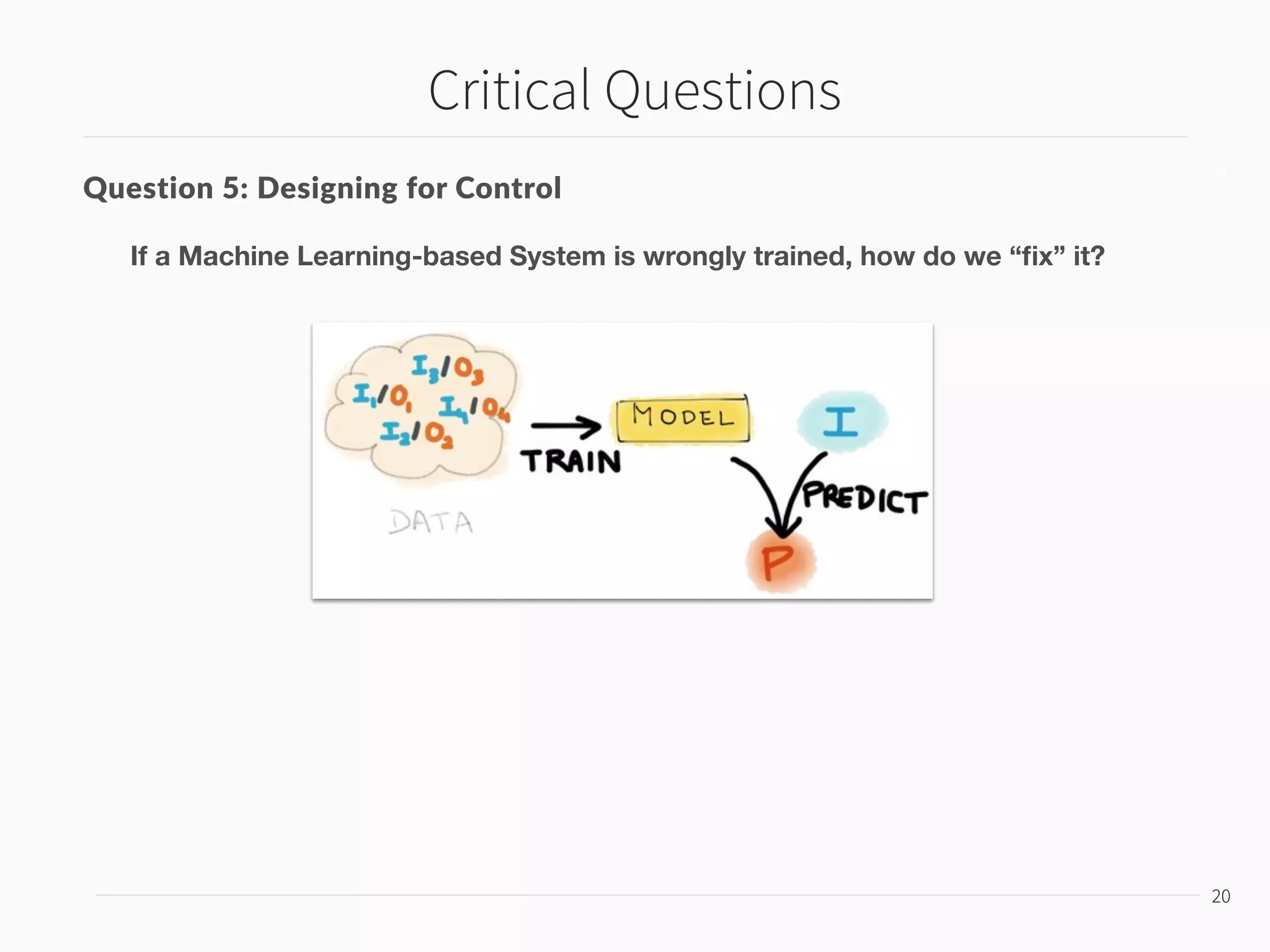
Question 5: Designing for Control
If a Machine Learning-based System is wrongly trained, how do we “fix” it?
Critical Questions
21
21
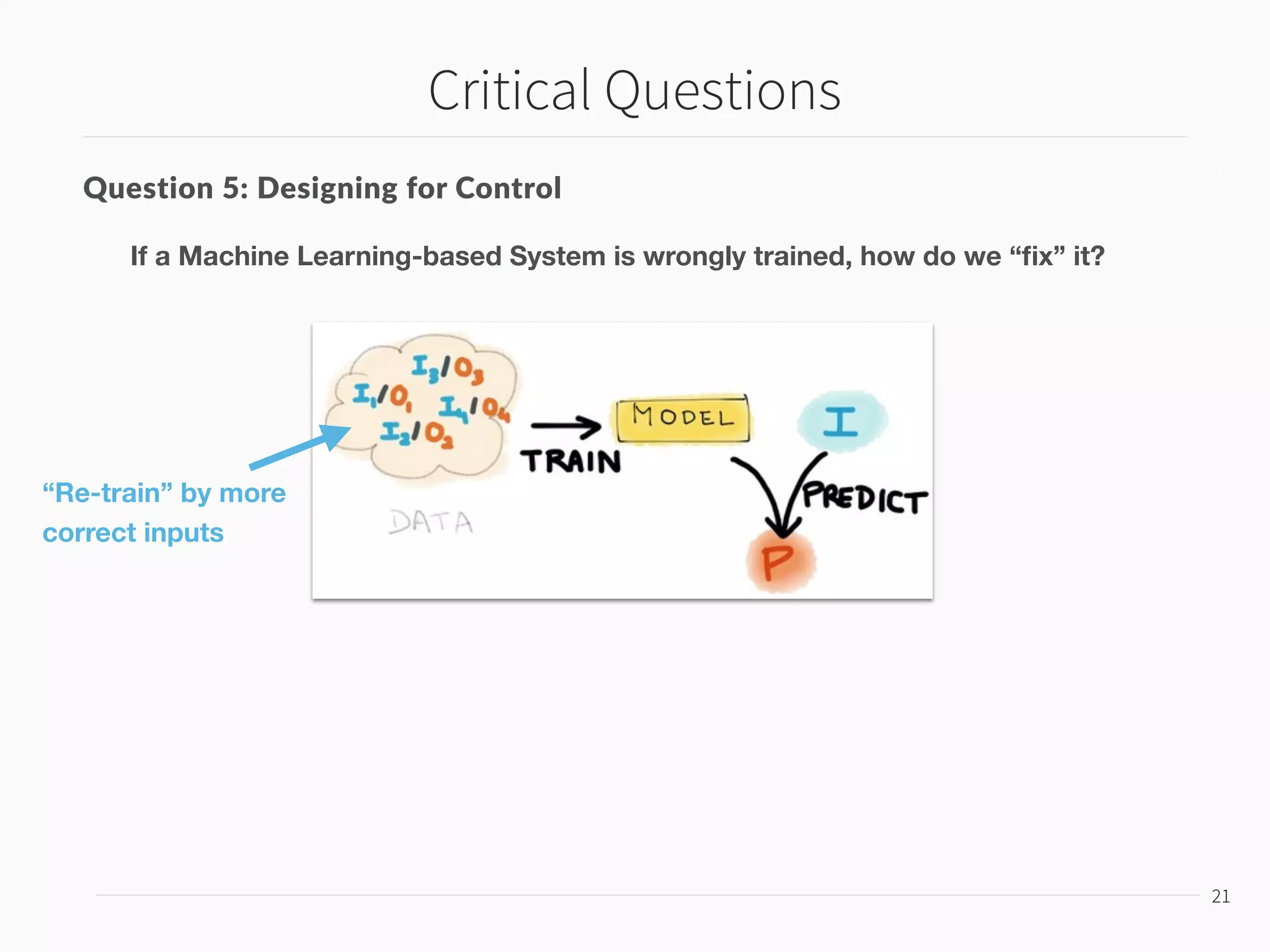
Question 5: Designing for Control
“Re-train” by more
correct inputs
If a Machine Learning-based System is wrongly trained, how do we “fix” it?
Critical Questions
22
22
Question 5: Designing for Control
“Re-train” by more
correct inputs
If a Machine Learning-based System is wrongly trained, how do we “fix” it?
Towards Humane Interaction
23
23
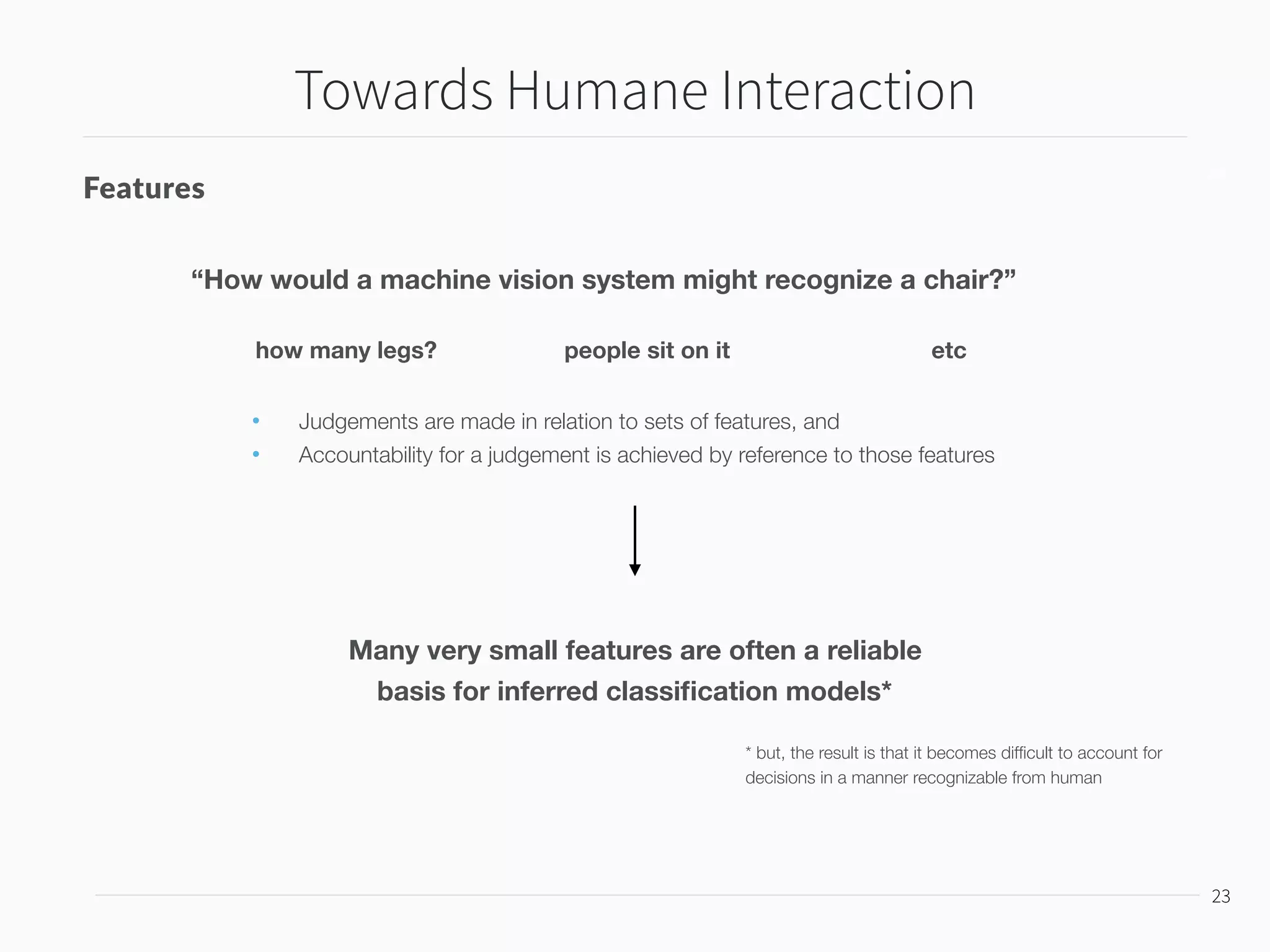
Features
Many very small features are often a reliable
basis for inferred classification models*
“How would a machine vision system might recognize a chair?”
* but, the result is that it becomes difficult to account for
decisions in a manner recognizable from human
• Judgements are made in relation to sets of features, and
• Accountability for a judgement is achieved by reference to those features
how many legs? people sit on it etc
Towards Humane Interaction
24
24
Features
Many very small features are often a reliable
basis for inferred classification models*
“How would a machine vision system might recognize a chair?”
* but, the result is that it becomes difficult to account for
decisions in a manner recognizable from human
• Judgements are made in relation to sets of features, and
• Accountability for a judgement is achieved by reference to those features
how many legs? people sit on it etc
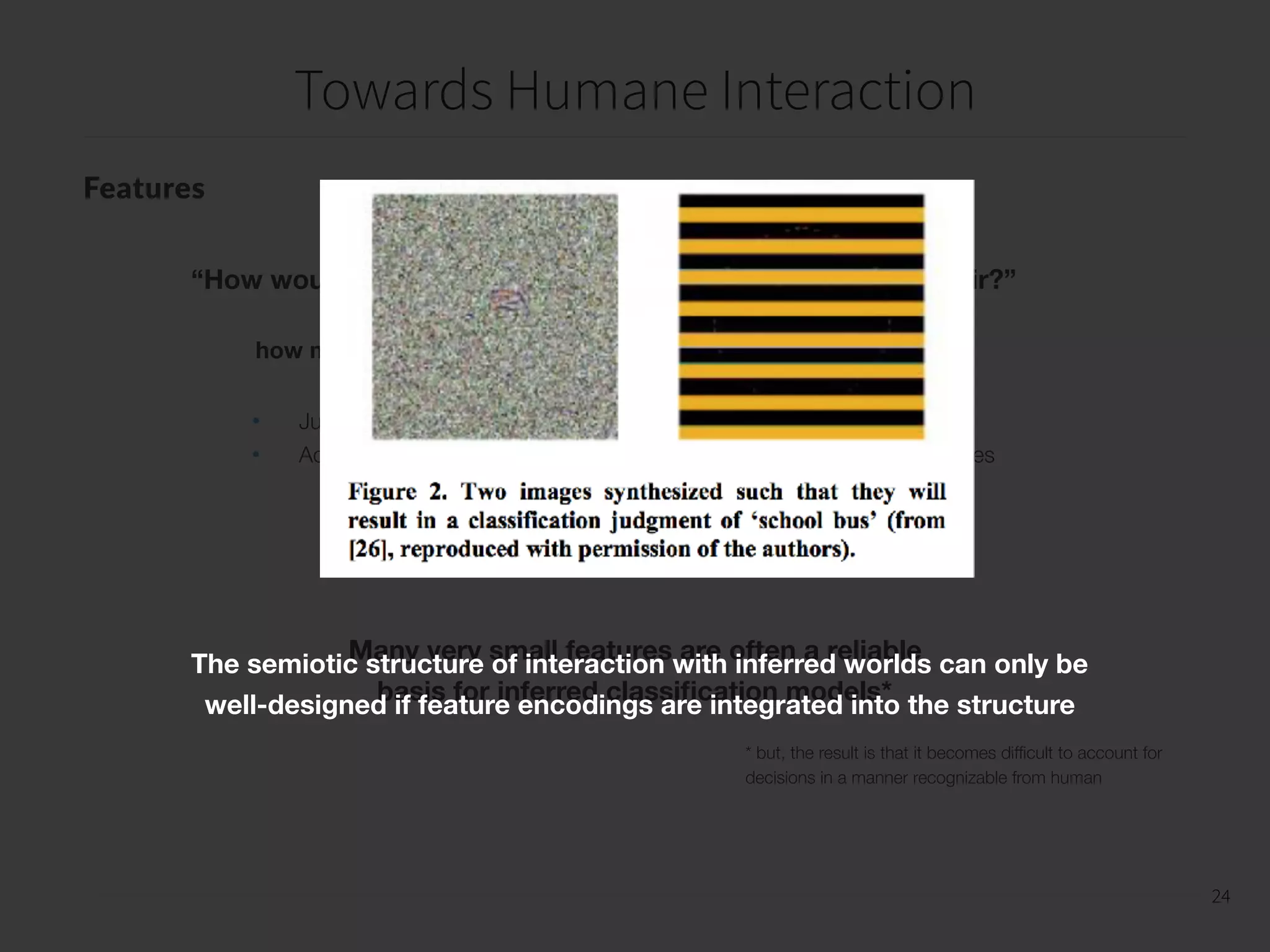
The semiotic structure of interaction with inferred worlds can only be
well-designed if feature encodings are integrated into the structure
Towards Humane Interaction
25
25
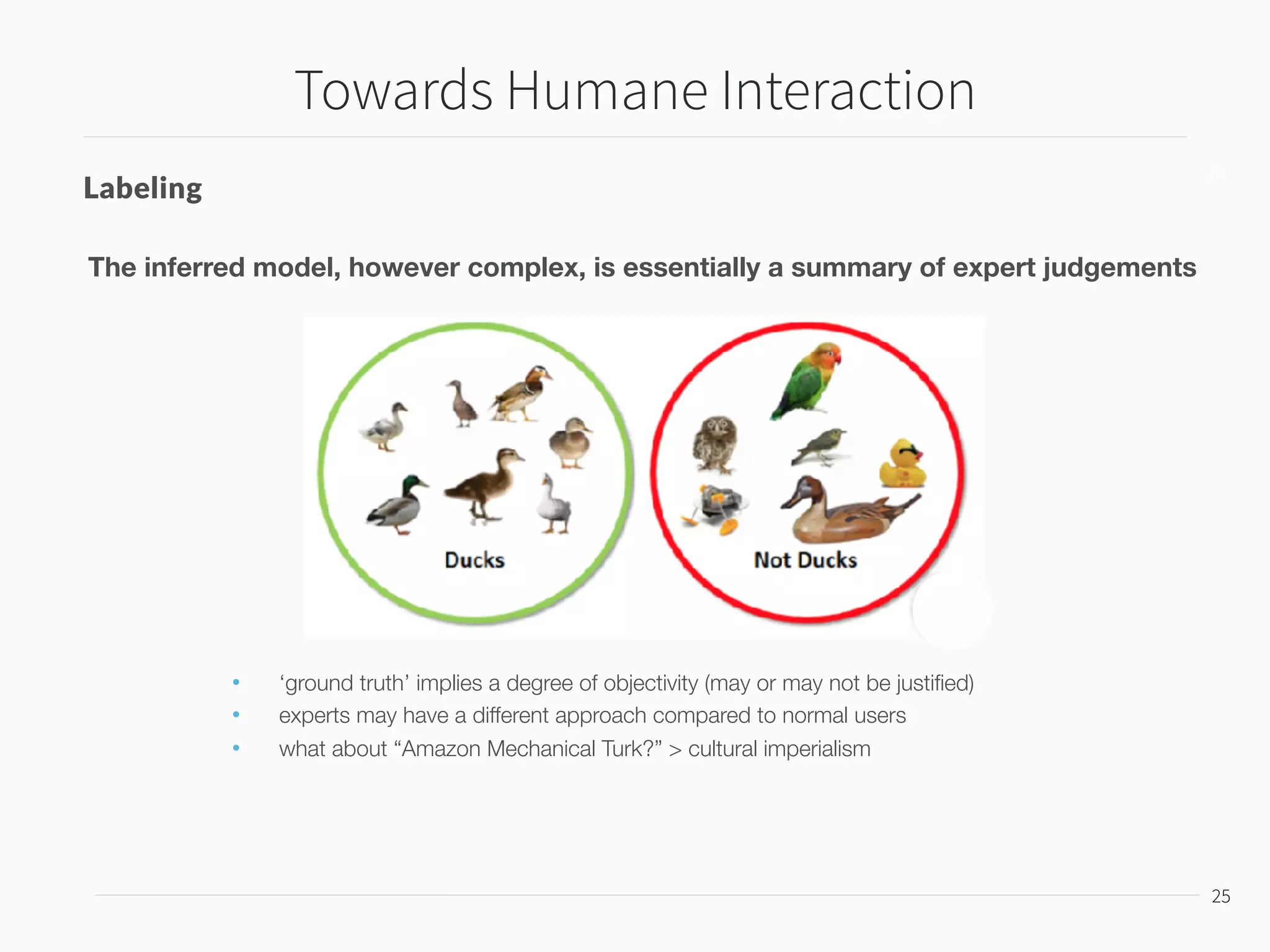
Labeling
The inferred model, however complex, is essentially a summary of expert judgements
• ‘ground truth’ implies a degree of objectivity (may or may not be justified)
• experts may have a different approach compared to normal users
• what about “Amazon Mechanical Turk?” > cultural imperialism
Towards Humane Interaction
26
26
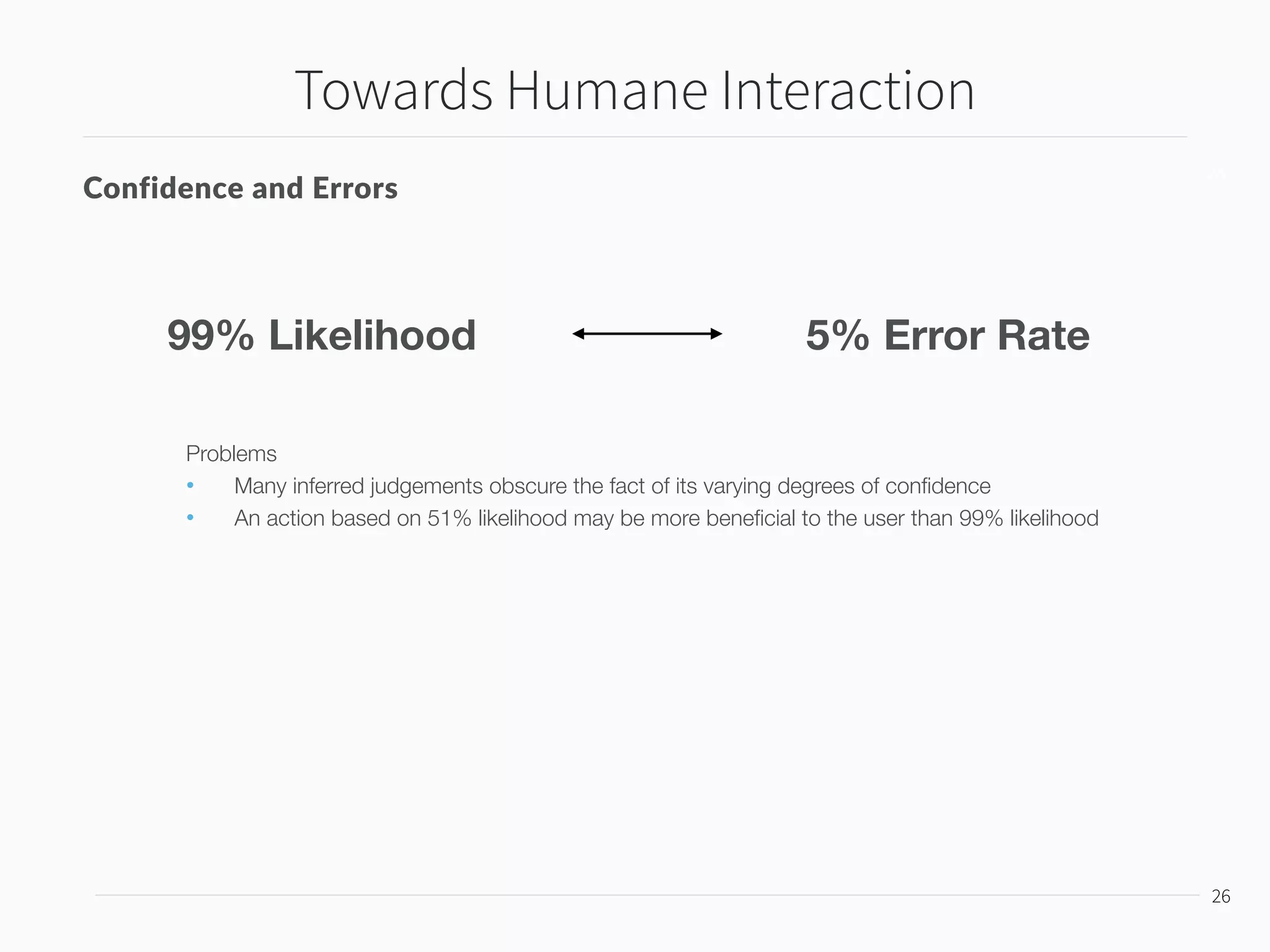
Confidence and Errors
99% Likelihood 5% Error Rate
Problems
• Many inferred judgements obscure the fact of its varying degrees of confidence
• An action based on 51% likelihood may be more beneficial to the user than 99% likelihood
Towards Humane Interaction
27
27
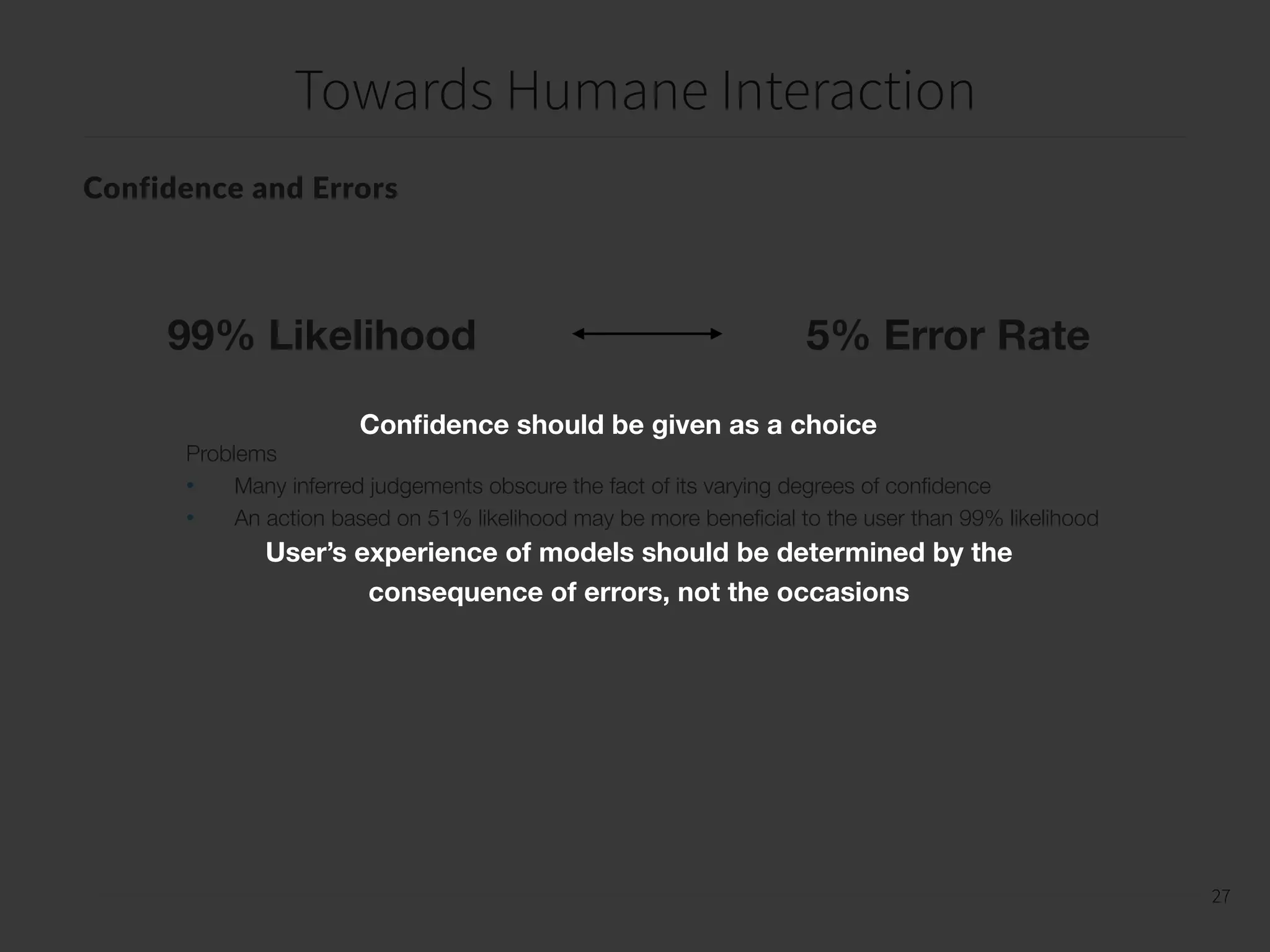
Confidence and Errors
99% Likelihood 5% Error Rate
Problems
• Many inferred judgements obscure the fact of its varying degrees of confidence
• An action based on 51% likelihood may be more beneficial to the user than 99% likelihood
Confidence should be given as a choice
User’s experience of models should be determined by the
consequence of errors, not the occasions
Towards Humane Interaction
28
28
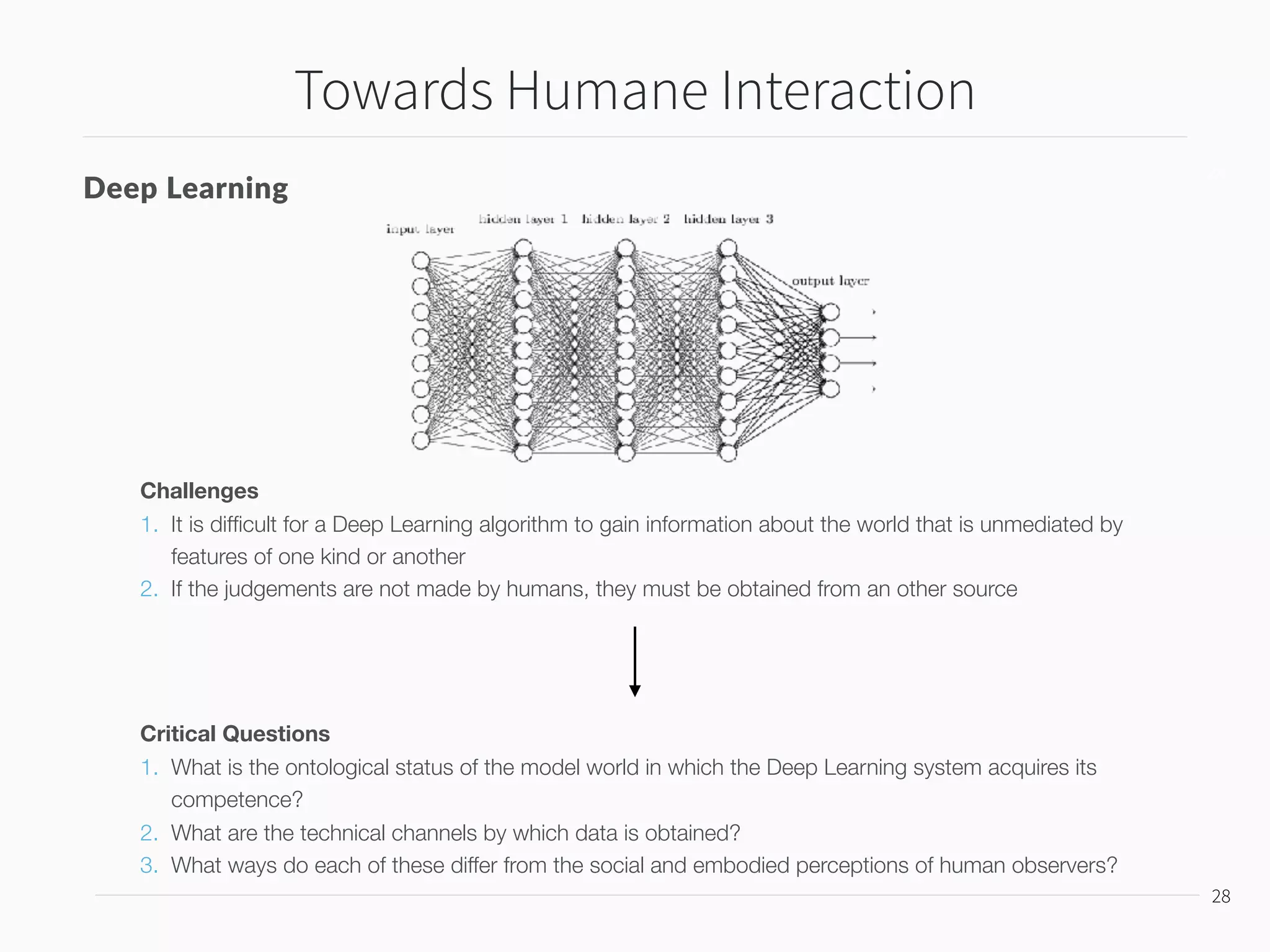
Deep Learning
Challenges
1. It is difficult for a Deep Learning algorithm to gain information about the world that is unmediated by
features of one kind or another
2. If the judgements are not made by humans, they must be obtained from an other source
Critical Questions
1. What is the ontological status of the model world in which the Deep Learning system acquires its
competence?
2. What are the technical channels by which data is obtained?
3. What ways do each of these differ from the social and embodied perceptions of human observers?
Conclusion
29
29
1. Classic theories of user interaction have been framed in relation to symbolic models of planning
and problem solving.


But…

2. Modern machine-learning systems is determined by statistical models of the world rather than
explicit symbolic descriptions.


Therefore…

3. We must explore the ways in which this new generation of technology raises fresh challenges
for the critical evaluation of interactive systems. — Humane Interaction by…
1. Features
2. Labeling
3. Confidence
4. Errors
5. Deep Learning (Machine-based judgement)

Interacting with an Inferred World: the Challenge of Machine Learning for Humane Computer Interaction

  • 1.
    Interacting with anInferred World: The Challenge of Machine Learning for Humane Computer Interaction + Aarhus 2015 - Alan F. Blackwell /김민준 x 2016 Fall
  • 2.
    Alan Blackwell • VisualRepresentation • End-User Development • Interdisciplinary Design • Tangible, Augmented and Embodied Interaction • Psychology of Programming • Computer Music • Critical Theory 1975-1985-1995-2005 — the decennial Aarhus conferences have traditionally been instrumental for setting new agendas for critically engaged thinking about information technology. The conference series is fundamentally interdisciplinary and emphasizes thinking that is firmly anchored in action, intervention, and scholarly critical practice. Aarhus Conference
  • 3.
    Summary 4 4 1. Classic theoriesof user interaction have been framed in relation to symbolic models of planning and problem solving.
 
 But…
 2. Modern machine-learning systems is determined by statistical models of the world rather than explicit symbolic descriptions.
 
 Therefore…
 3. We must explore the ways in which this new generation of technology raises fresh challenges for the critical evaluation of interactive systems. — Humane Interaction
  • 4.
    Presentation Contents 5 Background The NewCritical Landscape Case Study to Critical Questions Towards Humane Interaction 1 2 3 4 5 Conclusion 6
  • 5.
    Background 6 6 “Good Old-Fashioned AI”and Human Computer Interaction “GOFAI has long had a problematic relationship with HCI — as a kind of quarrelsome sibling” • Both fields brought together knowledge from Psychology and Computer Science • In the early days of HCI, it was difficult to distinguish HCI from AI or Cognitive Science
  • 6.
    Background 7 7 Expert Systems Boomof the 1980s and Critical Reactions The possibility of a Strong AI vs. Symbolic problem-solving algorithms neglect 
 issues central in HCI • Social context • Physical embodiment • Action in the world argued by Winograd, Flores, Gill, Suchman Situated Cognition — The failure of formal computational models of planning and action to deal with the complexity of the real world
  • 7.
    The Critical Landscape 8 8 “GoodOld-Fashioned AI” vs. Modern Machine Learning GOFAI vs ML • symbols were not grounded • the cognition was not situated • no interaction with social context • operate purely on ‘grounded’ data • ‘cognition’ is based wholly on information collected from the real world • ML systems interact with their social context through data — eg. SNS data
  • 8.
    9 9 “Good Old-Fashioned AI”vs. Modern Machine Learning GOFAI vs ML • symbols were not grounded • the cognition was not situated • no interaction with social context • operate purely on ‘grounded’ data • ‘cognition’ is based wholly on information collected from the real world • ML systems interact with their social context through data — eg. SNS data Turing Tests The Critical Landscape
  • 9.
    GOFAI vs ML •symbols were not grounded • the cognition was not situated • no interaction with social context • operate purely on ‘grounded’ data • ‘cognition’ is based wholly on information collected from the real world • ML systems interact with their social context through data — eg. SNS data Turing Tests The Critical Landscape “Good Old-Fashioned AI” vs. Modern Machine Learning 10 “What if the human and computer cannot be distinguished because the human has become too much like a computer?”
  • 10.
    Background 11 11 Brieman and ‘TwoCultures’ of Statistical Modeling 1. The Traditional Practice Predictive Accuracy > Interpretability 2. ML Techniques in which the model is inferred directly from data Occam’s Razor — “The models that best emulate nature in terms of predictive accuracy are also the most complex and inscrutable
  • 11.
    Case Study: Readingthe Mind 12 12 Reconstructing visual experiences from brain activity — Jack Gallant https://www.youtube.com/watch?v=nsjDnYxJ0bo A blurred average of the 100 film library scenes most closely fitting the observed EEG signal
  • 12.
    Critical Questions 13 13 Question 1:Authorship The Behavior of ML systems is derived from data (through a statistical model) Statistical models as an index of the content ex) Library of Babel A library that contains every possible book in the universe that could be written in an alphabet of 25 characters This is possible right now..!
  • 13.
    Critical Questions 14 14 Question 1:Authorship The Behavior of ML systems is derived from data (through a statistical model) Statistical models as an index of the content ex) Library of Babel A library that contains every possible book in the universe that could be written in an alphabet of 25 characters Is every digital citizen an ‘author’ of their own identity? who makes the data?
  • 14.
    Critical Questions 15 15 Question 2:Attribution Content of the original material captured in an ML model or index should still be traced to the authors Digital Copyright?
  • 15.
    Critical Questions 16 16 Question 2:Attribution Counter-example: EDM Music Industry Content of the original material captured in an ML model or index should still be traced to the authors Digital Copyright? Sampled Chopped and Mashed New Song
  • 16.
    Critical Questions 17 17 Question 2:Attribution Counter-example: EDM Music Industry Content of the original material captured in an ML model or index should still be traced to the authors Digital Copyright? Sampled Chopped and Mashed New Song In symbolic systems, the user can apply a semiotic reading in which the user interface acts as the ‘designer’s deputy’ If the system behavior is encoded in a statistical model, then this humane foundation of the semiotic system is undermined
  • 17.
    Critical Questions 18 18 Question 3:Reward “If you are not paying for it, you’re not the customer; you’re the product being sold” Ecosystem Players (Apple, Google, Facebook, Microsoft) are attempting to establish their control through a combination of storage, behavior, and authentication services that are starting to rely on indexed models of other people’s data “The primary mechanism of control over users comes through statistical index models that are not currently inspected or regulated”
  • 18.
    Critical Questions 19 19 Question 4:Self-Determination 1. Sense of Agency ML-based Systems 2. Construction of Identity “In control of one’s own actions” • system behavior becomes perversely more difficult for the user to predict • some classes of users may be excluded from opportunities to control the system
 ex) Kinect • Submitting to a comparison between the statistical mean “The construction of one’s personal identity” Narratives of Digital Media / SNS • behavior of these systems becomes a key component of self-determination • users “curate their lives” • what about moments that I don’t want? “Regression to the Mean”
  • 19.
    Critical Questions 20 20 Question 5:Designing for Control If a Machine Learning-based System is wrongly trained, how do we “fix” it?
  • 20.
    Critical Questions 21 21 Question 5:Designing for Control “Re-train” by more correct inputs If a Machine Learning-based System is wrongly trained, how do we “fix” it?
  • 21.
    Critical Questions 22 22 Question 5:Designing for Control “Re-train” by more correct inputs If a Machine Learning-based System is wrongly trained, how do we “fix” it?
  • 22.
    Towards Humane Interaction 23 23 Features Manyvery small features are often a reliable basis for inferred classification models* “How would a machine vision system might recognize a chair?” * but, the result is that it becomes difficult to account for decisions in a manner recognizable from human • Judgements are made in relation to sets of features, and • Accountability for a judgement is achieved by reference to those features how many legs? people sit on it etc
  • 23.
    Towards Humane Interaction 24 24 Features Manyvery small features are often a reliable basis for inferred classification models* “How would a machine vision system might recognize a chair?” * but, the result is that it becomes difficult to account for decisions in a manner recognizable from human • Judgements are made in relation to sets of features, and • Accountability for a judgement is achieved by reference to those features how many legs? people sit on it etc The semiotic structure of interaction with inferred worlds can only be well-designed if feature encodings are integrated into the structure
  • 24.
    Towards Humane Interaction 25 25 Labeling Theinferred model, however complex, is essentially a summary of expert judgements • ‘ground truth’ implies a degree of objectivity (may or may not be justified) • experts may have a different approach compared to normal users • what about “Amazon Mechanical Turk?” > cultural imperialism
  • 25.
    Towards Humane Interaction 26 26 Confidenceand Errors 99% Likelihood 5% Error Rate Problems • Many inferred judgements obscure the fact of its varying degrees of confidence • An action based on 51% likelihood may be more beneficial to the user than 99% likelihood
  • 26.
    Towards Humane Interaction 27 27 Confidenceand Errors 99% Likelihood 5% Error Rate Problems • Many inferred judgements obscure the fact of its varying degrees of confidence • An action based on 51% likelihood may be more beneficial to the user than 99% likelihood Confidence should be given as a choice User’s experience of models should be determined by the consequence of errors, not the occasions
  • 27.
    Towards Humane Interaction 28 28 DeepLearning Challenges 1. It is difficult for a Deep Learning algorithm to gain information about the world that is unmediated by features of one kind or another 2. If the judgements are not made by humans, they must be obtained from an other source Critical Questions 1. What is the ontological status of the model world in which the Deep Learning system acquires its competence? 2. What are the technical channels by which data is obtained? 3. What ways do each of these differ from the social and embodied perceptions of human observers?
  • 28.
    Conclusion 29 29 1. Classic theoriesof user interaction have been framed in relation to symbolic models of planning and problem solving.
 
 But…
 2. Modern machine-learning systems is determined by statistical models of the world rather than explicit symbolic descriptions.
 
 Therefore…
 3. We must explore the ways in which this new generation of technology raises fresh challenges for the critical evaluation of interactive systems. — Humane Interaction by… 1. Features 2. Labeling 3. Confidence 4. Errors 5. Deep Learning (Machine-based judgement)