International Journal of Scientific Research and Engineering Development-– Volume 2 Issue 6, Nov-Dec 2019
Available at www.ijsred.com
ISSN : 2581-7175 ©IJSRED: All Rights are Reserved Page 513
HR Analytics: A Brief study on Predictive Attrition
Ms.PrikshaDalal
HRBP (Hindustan Wellness)
Gurugram
Abstract:
Expansions in Human Resources Management (HRM) are fast being joined with comparable changes
in data and information processing, which are restructuring our industrial pace. The capacity to capture
and successfully pick-up vision from their data have led many enterprises across the world to streamline
their processes and sustain their growth. Data analytics has become the benchmark across functions like
Marketing, Retail, Operations and Finance. However, a domain as vital and as ubiquitous as Human
Resource has only woken up to data analytics in recent times in predictive decision making. While
many HR professionals leverage analytics as part of their general HR role, an increasing number
focus primarily on HR analytics. These specialists work on teams with names like “talent analytics” and
“people analytics”. Generally, HR managers apply two types of analytics to get insights about a
company’s workforce including Descriptive and Predictive Analytics.
Key Words: HR Analytics, Predictive, Talent Analytics, People Analytics
Definitions:
HR Analytics- HR analytics specifically deals with the metrics of the HR function, such as time to
hire, training expense per employee, and time until promotion. All these metrics are managed
exclusively by HR for HR.
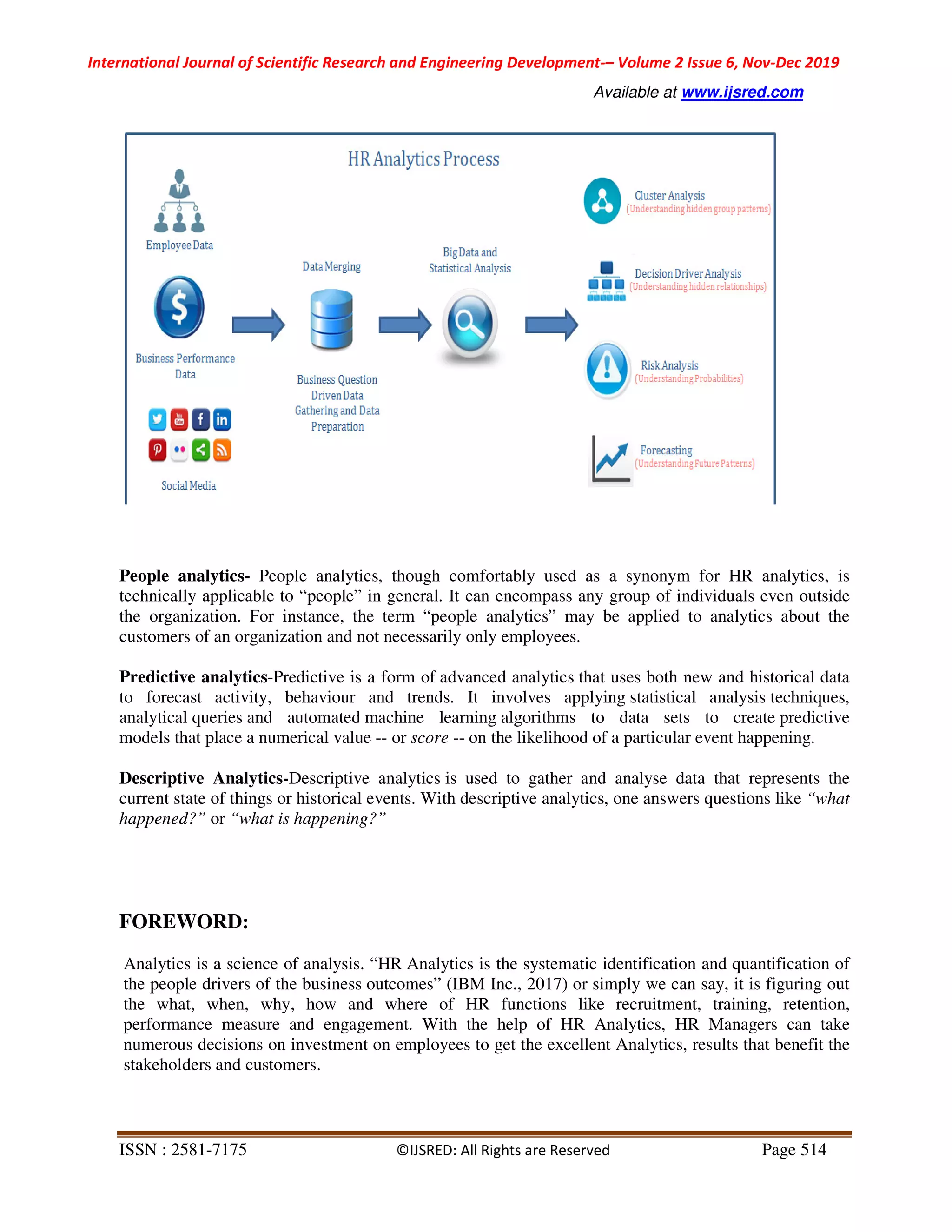
● HR Analytics Process:
RESEARCH ARTICLE OPEN ACCESS
International Journal of Scientific Research and Engineering Development-– Volume 2 Issue 6, Nov-Dec 2019
Available at www.ijsred.com
ISSN : 2581-7175 ©IJSRED: All Rights are Reserved Page 514
People analytics- People analytics, though comfortably used as a synonym for HR analytics, is
technically applicable to “people” in general. It can encompass any group of individuals even outside
the organization. For instance, the term “people analytics” may be applied to analytics about the
customers of an organization and not necessarily only employees.
Predictive analytics-Predictive is a form of advanced analytics that uses both new and historical data
to forecast activity, behaviour and trends. It involves applying statistical analysis techniques,
analytical queries and automated machine learning algorithms to data sets to create predictive
models that place a numerical value -- or score -- on the likelihood of a particular event happening.
Descriptive Analytics-Descriptive analytics is used to gather and analyse data that represents the
current state of things or historical events. With descriptive analytics, one answers questions like “what
happened?” or “what is happening?”
FOREWORD:
Analytics is a science of analysis. “HR Analytics is the systematic identification and quantification of
the people drivers of the business outcomes” (IBM Inc., 2017) or simply we can say, it is figuring out
the what, when, why, how and where of HR functions like recruitment, training, retention,
performance measure and engagement. With the help of HR Analytics, HR Managers can take
numerous decisions on investment on employees to get the excellent Analytics, results that benefit the
stakeholders and customers.
International Journal of Scientific Research and Engineering Development-– Volume 2 Issue 6, Nov-Dec 2019
Available at www.ijsred.com
ISSN : 2581-7175 ©IJSRED: All Rights are Reserved Page 515
According to LinkedIn data, we found that in the last five years in North America, there has been a
3x increase in HR professionals who list analytics skills and keywords on their profiles.
A survey by MIT and IBM reported that companies with a high level of HR analytics had 8% higher
sales growth, 24% higher net operating income, 58% higher sales per employee.
Employee Turnover is the most important determinant that led the huge loss to the company. There are
an ample number of reasons for which the employees leave the company, such as;
● salary dissatisfaction
● stagnant career growth,
● Strained Relationship with managers
● Lack of growth and needs fulfilment
Apart from these, some of the personal factors comprise of Demographics (e.g. age, gender, ethnicity
etc.), and personal issues related to marriage, spouse transfer, medical reasons, higher education and
simply their personality where some people are predisposed to quit more often than others.
If the company can predict the employee attrition in the near future, they can also work on retention
beforehand and avoid the loss of valuable employees. The prediction of attrition and retention is the
part of the HR Analytics.
Using Machine Learning technique, particularly, Predictive Analytics, we can envision the employee
attrition.
It is important to predict employee attrition and analyse retention decision because according to Morrel
(Morrell, 2004), intentional turnover acquires the noteworthy cost, both in terms of:
1. Direct costs (replacement, recruitment and selection, temporary staff, management time).
2. Indirect cost (morale, pressure on remaining staff, costs of learning, product/service
quality, organizational memory) (Morrell, 2004).
LITERATURE REVIEW:
As the challenges grow in gig economy, HR Analytics revamps the HR department with
full automation. HR Analytics transform the raw HR data into comprehensive information for the
strategy formulation and successfully develops a great innovation. HR analytics aids to move the
organization forward and stay ahead of the competition by capitalizing on the insights acquired.
According to people matters report, (Global HR analytics market to grow by 12%), The report
Outlook on the World HR Analytics Market, 2019-2025 predicts that the global HR analytics market
will grow at a CAGR of around 12% during the forecast period 2019-2025.The report reveals that more
and more enterprises are investing in HR analytics to gain meaningful insights necessary for managing
International Journal of Scientific Research and Engineering Development-– Volume 2 Issue 6, Nov-Dec 2019
Available at www.ijsred.com
ISSN : 2581-7175 ©IJSRED: All Rights are Reserved Page 516
their human capital and to enhance ROI. HR analytics software and services focus on the impact of
various HR initiatives on employees. These tools, by using predictive analytics, identify trends and
risks associated with the workforce.
In the article published on LinkedIn, (Rise of analytics), clearly states that industries specialized in
tech-software and finance have been enrolled in HR Analytics but the roles differs. Also, by using data
to identify internal mobility as a key to retention, LinkedIn study defined that employees with a change
in job responsibilities due to promotion or lateral movement within the past two years were much less
likely to leave. Most groups achieved a 5-10% increase in annual retention of their at-risk employees.
Additionally, 39 percent of respondents in the 2017 Deloitte Human Capital Trends report said they
have good quality data for their people-related decision-making, meaning they can make accurate
decisions based on the data they collect. The more companies see the value in HR analytics, the more
they will want to invest further.
From the above literature reviews, it can be concluded that HR Analytics support HR professionals to
take a fact based decision supported by data based evidence. By using HR Analytics, HR can now
justify the investments made to the human resource projects and also predict future outcomes.HR
Analytics has benefits across reactive, proactive, strategic and predictive decision-making.
HR ANALYTICS READY TOOLS:
A research conducted by Bersin by Deloitte in 2014, shows that the HR Analytics software “market
grew by 17% last year and is now over $5 billion in size.” Huge vendors such as Oracle, IBM, SAP and
Workday compete with more specialized players such as People Fluent, Talent Analytics , Saba, Visier
and Cornerstone to deliver HR analytics software as a service.
● SAP offers Success Factors Workforce Analytics and Success Factors Workforce Planning.
They help in predicting retention and provides extensive modelling capabilities for workforce
planning.
● Powered by Watson Analytics, IBM Kenexa Talent Analytics enables HR professionals to
simply type in what they want to see from their talent data and the results are displayed as an
easy to interpret visualization.
● Saba’s cloud-based Intelligent Talent Management solution uses machine learning to improve
the way HR professional hire, develop, engage and inspire people. The solution also comes with
predictive capabilities to cut through the noise and prioritize the most important and relevant
information.
● HiQLabsuses public data, internal company data, or a combination of both for its
International Journal of Scientific Research and Engineering Development-– Volume 2 Issue 6, Nov-Dec 2019
Available at www.ijsred.com
ISSN : 2581-7175 ©IJSRED: All Rights are Reserved Page 517
● predictive models.
● Workday’s on-demand HCM solution unifies HR and Talent Management into a single
system-of-record to help reduce costs, gain operational visibility and prepare organizations
for future shifts.
According to a recent (article published in Dailymail.com) panel discussion with
IBM's CEO, GinniRometty, at a Work Talent and Human Resources Summit in New
York, the company's 'predictive attrition' software is now 95 percent accurate in
determining when an employee is ready to quit.
The company has also rolled out performance-tracking programs that crunches data
on employees' projects, their skills, and weaknesses which they then use to dole out
promotions and 'increase efficiency.'
CASE STUDY:
1. UpYourGame (Bengaluru-based HR tech start up):
The start-up aims to solve the problem of attrition at companies by addressing ‘performance
management’ with an AI and ML-based enterprise solution.
According to UpYourGame’s market research, a common refrain emerged: most employees
happened to leave their organisations within a month or two of the appraisal. Attrition was
the highest during this period. Seeing as how companies end up losing a lot of money when
demotivated employees quit after the appraisal, UpYourGame pitches a financial value
proposition.
UpYourGame’s product helps organisations to easily set goals and track employee
performance in real time. Basic profiles of employees are pre-created in the software. There
is a library of 2,300 goals and key performance indicators (KPIs) that enterprises can choose
from. A recommendation engine that runs on ML algorithms can filter out KPIs that are
irrelevant to an industry.
2. inFeedo (Gurugram based HR start-up):
inFeedo is a SaaS-based people predictive analytics company that redefine employee
engagement. inFeedo is currently focussed on its flagship product Amber, an artificial
intelligence (AI) enabled bot which helps CHROs manage employee engagement, predict
attrition and measure company culture in real time. Amber connects with employees across
organizations to collect actionable insights for HR, in order to enhance employee
engagement, curb potential attrition, and gain a real-time sense of overall sentiment.
Example: Article published in THE WEEK MAGAZINE, OYO's HR team saved 75% at-risk
employees using inFeedo's engagement bot, Amber.
International Journal of Scientific Research and Engineering Development-– Volume 2 Issue 6, Nov-Dec 2019
Available at www.ijsred.com
ISSN : 2581-7175 ©IJSRED: All Rights are Reserved Page 518
3. Predictive Retention at HP:
HP used data science to determine create a ‘flight risk’ indicator for its employees. (Siegel
2014) The program is described to have identified opportunities to save $300M, but there
was also a lot of negative fallout in the PR department once employees realized what was
happening. A good example of the potential of using predictive modelling, but also in the
sensitivity of working with people analytics.
These case studies of applied analytics in the field of Human Resources are only a small array of a
much broader movement in the profession. As a new generation of HR data scientists emerges, and
enhanced optimization programs are identified, it is becoming more and more common to see
organizations move to data driven HR decision models.
ROADBLOCKS TO HR ANALYTICS:
The major impediments to the application of HR analytics identified are (Van Dooren 2012):
● Inconsistent and inaccessibility of data.
● Data quality issues.
● Lack of standard/generic methodologies to analyse HR data.
● Executive buy-in.
● Skill gap in analytical knowledge & experience.
● Funding issues.
● Wrong or not targeting the right analytical opportunities.
● Problems in initiating the project.
● Improper timing.
These factors are true for countries like India, where companies are trying to develop HR analytics
capability. The framework to implement an integrated talent management metric or a HR business
driver analytics requires the usage of advanced statistical tools beyond the usual univariate statistical
tools.
RESULTS AND CONCLUSIONS:
The present research aimed for an exploration of existing literature with the aim of understanding the
relationship between human resource and analytics and understand the role it plays in the reduction
of attrition in today’s job market. The demand for HR analytics is increasing due to multiple factors,
including gaining insights about the enterprise workforce and understanding how an organization's
culture is impacting the workforce productivity and employee performance. Measuring & reducing
the employee turnover rate is also one of the factors boosting the adoption of HR analytics solutions.
The people matters report concluded a detailed segmentation of the global HR analytics market by
component, by application, by organization size, and by region. The report also identifies SAP,
International Journal of Scientific Research and Engineering Development-– Volume 2 Issue 6, Nov-Dec 2019
Available at www.ijsred.com
ISSN : 2581-7175 ©IJSRED: All Rights are Reserved Page 519
Oracle, Micro Strategy, IBM, Tableau, Zoho, Crunchr, Talentsoft, Sisense, and Sage Software as the
major vendors operating in the global HR analytics market.
The proactive use of HR analytics will allow organizations to accurately anticipate rather than react.
With the right information derived from the data, organizations will be able to reduce attrition and
the costs associated with it, retain effective employees and will also be able to reduce the after-effect
of attrition, such as the impact on team morale and client satisfaction and thus, affecting the gig
economy.
FUTURE GROWTH:
According to a study conducted by Economic Times, Analytics specialists are in high demand for
human resource roles as companies in India find talent analytics key to improving effectiveness in
HR. India has seen 77% growth in specialised analytics professionals employed in human resource
functions in the past five years.
MarketsandMarkets forecasts the global HR analytics market size to grow from USD 1.9 billion in
2019 to USD 3.6 billion by 2024, at a Compound Annual Growth Rate (CAGR) of 13.7% during the
forecast period. The growing need among enterprises to reduce the costs associated with HR
processes and streamline the HR processes is expected to drive the growth of market across industry
verticals globally.
A lot of companies including Google, AOL, and Facebook use analytics to gain insights into the
impact of every interview and source of hire. A survey done by Deloitte in 2017 finds 71 percent of
companies see people analytics as a high priority in their organizations. Even, India witnesses a 77%
growth in HR analytics professionals, according to a report by LinkedIn - “The Rise of Analytics in
HR: An era of Talent Intelligence.” Data shows that in India, 14 percent of total jobs in HR are
analytics based which has further led to the rise of HR analytics professionals in India.
REFERENCES:
1. https://www.linkedin.com/pulse/hr-analytics-big-data-through-lens-psychology-part-i-pylin
2. https://esource.dbs.ie/bitstream/handle/10788/3497/msc_salunkhe_t_p_2018.pdf?sequence=
1&isAllowed=y
3. https://pdfs.semanticscholar.org/c2e5/21311773e28485455811e4238cae4f72ba0e.pdf
4. https://business.linkedin.com/content/dam/me/business/en-us/talent-solutions/talent-
intelligence/workforce/pdfs/Final_v2_NAMER_Rise-of-Analytics-Report.pdf
5. http://www.allresearchjournal.com/archives/2016/vol2issue5/PartL/2-5-29-860.pdf
6. https://analyticsindiamag.com/analytics-in-hr-data-driven-decision-making-in-human-
resources/
International Journal of Scientific Research and Engineering Development-– Volume 2 Issue 6, Nov-Dec 2019
Available at www.ijsred.com
ISSN : 2581-7175 ©IJSRED: All Rights are Reserved Page 520
7. https://www.dailymail.co.uk/sciencetech/article-6899983/IBMs-AI-backed-employee-
retention-software-knows-youre-going-quit-95-accuracy.html
8. https://www.peoplematters.in/article/lets-talk-talent/controlling-attrition-through-data-
analytics-14681
9. https://www.peoplematters.in/news/hr-technology/global-hr-analytics-market-to-grow-by-12-
23106
10. https://yourstory.com/2018/11/hr-tech-upyourgame-curb-attrition
11. https://theuncommonleague.com/blog/hr-analytics
12. https://www.hrtechnologist.com/articles/hr-analytics/what-is-hr-analytics/
13. https://searchbusinessanalytics.techtarget.com/definition/predictive-analytics
14. https://www.valdostadailytimes.com/news/business/organic-chemicals-manufacturer-
leverages-hr-analytics-to-drive-savings-through/article_486762c3-0706-54b5-b06b-
a5966e5e3ec4.html
15. https://www.techrepublic.com/article/how-to-leverage-predictive-analytics-for-employee-
retention/
16. https://www.theweek.in/wire-updates/business/2019/10/15/pwr12--infeedo.html
17. https://www.peoplematters.in/article/techhrin/masterclass-fundamentals-of-hr-analytics-
22674
18. https://www.researchgate.net/publication/333238246_HR_ANALYTICS_A_MODERN_TOO
L_IN_HR_FOR_PREDICTIVE_DECISION_MAKING
19. Morrell, K. M., 2004. Organisational change and employee turnover.. Emerald
Group Publishing Limited, 33(DOI 10.1108/00483480410518022).
20. https://www.researchgate.net/publication/301727449_Human_Resource_Analytics-
_Discovering_Research_Issues_Posited_in_its_Milleu_in_India_Organization_Human_Reso
urce_Analytics_HRA
21. https://economictimes.indiatimes.com/jobs/analytics-specialists-in-high-demand-for-hr-roles-
study/articleshow/64165166.cms
22. Joerik Van Dooren (2012). HR Analytics in practice.
International Journal of Scientific Research and Engineering Development-– Volume 2 Issue 6, Nov-Dec 2019
Available at www.ijsred.com
ISSN : 2581-7175 ©IJSRED: All Rights are Reserved Page 521
23. https://www.marketsandmarkets.com/Market-Reports/hr-analytics-market-94472004.html.
24. https://www.peoplemattersglobal.com/article/talent-analytics/hr-analytics-is-a-high-priority-
in-apac-but-the-adoption-is-sluggish-
20532?utm_source=peoplematters&utm_medium=interstitial&utm_campaign=learnings-of-
the-day
25. http://www.talentrics.com/case_studies/

HR Analytics: A Brief study on predictive attrition

  • 1.
    International Journal ofScientific Research and Engineering Development-– Volume 2 Issue 6, Nov-Dec 2019 Available at www.ijsred.com ISSN : 2581-7175 ©IJSRED: All Rights are Reserved Page 513 HR Analytics: A Brief study on Predictive Attrition Ms.PrikshaDalal HRBP (Hindustan Wellness) Gurugram Abstract: Expansions in Human Resources Management (HRM) are fast being joined with comparable changes in data and information processing, which are restructuring our industrial pace. The capacity to capture and successfully pick-up vision from their data have led many enterprises across the world to streamline their processes and sustain their growth. Data analytics has become the benchmark across functions like Marketing, Retail, Operations and Finance. However, a domain as vital and as ubiquitous as Human Resource has only woken up to data analytics in recent times in predictive decision making. While many HR professionals leverage analytics as part of their general HR role, an increasing number focus primarily on HR analytics. These specialists work on teams with names like “talent analytics” and “people analytics”. Generally, HR managers apply two types of analytics to get insights about a company’s workforce including Descriptive and Predictive Analytics. Key Words: HR Analytics, Predictive, Talent Analytics, People Analytics Definitions: HR Analytics- HR analytics specifically deals with the metrics of the HR function, such as time to hire, training expense per employee, and time until promotion. All these metrics are managed exclusively by HR for HR. ● HR Analytics Process: RESEARCH ARTICLE OPEN ACCESS
  • 2.
    International Journal ofScientific Research and Engineering Development-– Volume 2 Issue 6, Nov-Dec 2019 Available at www.ijsred.com ISSN : 2581-7175 ©IJSRED: All Rights are Reserved Page 514 People analytics- People analytics, though comfortably used as a synonym for HR analytics, is technically applicable to “people” in general. It can encompass any group of individuals even outside the organization. For instance, the term “people analytics” may be applied to analytics about the customers of an organization and not necessarily only employees. Predictive analytics-Predictive is a form of advanced analytics that uses both new and historical data to forecast activity, behaviour and trends. It involves applying statistical analysis techniques, analytical queries and automated machine learning algorithms to data sets to create predictive models that place a numerical value -- or score -- on the likelihood of a particular event happening. Descriptive Analytics-Descriptive analytics is used to gather and analyse data that represents the current state of things or historical events. With descriptive analytics, one answers questions like “what happened?” or “what is happening?” FOREWORD: Analytics is a science of analysis. “HR Analytics is the systematic identification and quantification of the people drivers of the business outcomes” (IBM Inc., 2017) or simply we can say, it is figuring out the what, when, why, how and where of HR functions like recruitment, training, retention, performance measure and engagement. With the help of HR Analytics, HR Managers can take numerous decisions on investment on employees to get the excellent Analytics, results that benefit the stakeholders and customers.
  • 3.
    International Journal ofScientific Research and Engineering Development-– Volume 2 Issue 6, Nov-Dec 2019 Available at www.ijsred.com ISSN : 2581-7175 ©IJSRED: All Rights are Reserved Page 515 According to LinkedIn data, we found that in the last five years in North America, there has been a 3x increase in HR professionals who list analytics skills and keywords on their profiles. A survey by MIT and IBM reported that companies with a high level of HR analytics had 8% higher sales growth, 24% higher net operating income, 58% higher sales per employee. Employee Turnover is the most important determinant that led the huge loss to the company. There are an ample number of reasons for which the employees leave the company, such as; ● salary dissatisfaction ● stagnant career growth, ● Strained Relationship with managers ● Lack of growth and needs fulfilment Apart from these, some of the personal factors comprise of Demographics (e.g. age, gender, ethnicity etc.), and personal issues related to marriage, spouse transfer, medical reasons, higher education and simply their personality where some people are predisposed to quit more often than others. If the company can predict the employee attrition in the near future, they can also work on retention beforehand and avoid the loss of valuable employees. The prediction of attrition and retention is the part of the HR Analytics. Using Machine Learning technique, particularly, Predictive Analytics, we can envision the employee attrition. It is important to predict employee attrition and analyse retention decision because according to Morrel (Morrell, 2004), intentional turnover acquires the noteworthy cost, both in terms of: 1. Direct costs (replacement, recruitment and selection, temporary staff, management time). 2. Indirect cost (morale, pressure on remaining staff, costs of learning, product/service quality, organizational memory) (Morrell, 2004). LITERATURE REVIEW: As the challenges grow in gig economy, HR Analytics revamps the HR department with full automation. HR Analytics transform the raw HR data into comprehensive information for the strategy formulation and successfully develops a great innovation. HR analytics aids to move the organization forward and stay ahead of the competition by capitalizing on the insights acquired. According to people matters report, (Global HR analytics market to grow by 12%), The report Outlook on the World HR Analytics Market, 2019-2025 predicts that the global HR analytics market will grow at a CAGR of around 12% during the forecast period 2019-2025.The report reveals that more and more enterprises are investing in HR analytics to gain meaningful insights necessary for managing
  • 4.
    International Journal ofScientific Research and Engineering Development-– Volume 2 Issue 6, Nov-Dec 2019 Available at www.ijsred.com ISSN : 2581-7175 ©IJSRED: All Rights are Reserved Page 516 their human capital and to enhance ROI. HR analytics software and services focus on the impact of various HR initiatives on employees. These tools, by using predictive analytics, identify trends and risks associated with the workforce. In the article published on LinkedIn, (Rise of analytics), clearly states that industries specialized in tech-software and finance have been enrolled in HR Analytics but the roles differs. Also, by using data to identify internal mobility as a key to retention, LinkedIn study defined that employees with a change in job responsibilities due to promotion or lateral movement within the past two years were much less likely to leave. Most groups achieved a 5-10% increase in annual retention of their at-risk employees. Additionally, 39 percent of respondents in the 2017 Deloitte Human Capital Trends report said they have good quality data for their people-related decision-making, meaning they can make accurate decisions based on the data they collect. The more companies see the value in HR analytics, the more they will want to invest further. From the above literature reviews, it can be concluded that HR Analytics support HR professionals to take a fact based decision supported by data based evidence. By using HR Analytics, HR can now justify the investments made to the human resource projects and also predict future outcomes.HR Analytics has benefits across reactive, proactive, strategic and predictive decision-making. HR ANALYTICS READY TOOLS: A research conducted by Bersin by Deloitte in 2014, shows that the HR Analytics software “market grew by 17% last year and is now over $5 billion in size.” Huge vendors such as Oracle, IBM, SAP and Workday compete with more specialized players such as People Fluent, Talent Analytics , Saba, Visier and Cornerstone to deliver HR analytics software as a service. ● SAP offers Success Factors Workforce Analytics and Success Factors Workforce Planning. They help in predicting retention and provides extensive modelling capabilities for workforce planning. ● Powered by Watson Analytics, IBM Kenexa Talent Analytics enables HR professionals to simply type in what they want to see from their talent data and the results are displayed as an easy to interpret visualization. ● Saba’s cloud-based Intelligent Talent Management solution uses machine learning to improve the way HR professional hire, develop, engage and inspire people. The solution also comes with predictive capabilities to cut through the noise and prioritize the most important and relevant information. ● HiQLabsuses public data, internal company data, or a combination of both for its
  • 5.
    International Journal ofScientific Research and Engineering Development-– Volume 2 Issue 6, Nov-Dec 2019 Available at www.ijsred.com ISSN : 2581-7175 ©IJSRED: All Rights are Reserved Page 517 ● predictive models. ● Workday’s on-demand HCM solution unifies HR and Talent Management into a single system-of-record to help reduce costs, gain operational visibility and prepare organizations for future shifts. According to a recent (article published in Dailymail.com) panel discussion with IBM's CEO, GinniRometty, at a Work Talent and Human Resources Summit in New York, the company's 'predictive attrition' software is now 95 percent accurate in determining when an employee is ready to quit. The company has also rolled out performance-tracking programs that crunches data on employees' projects, their skills, and weaknesses which they then use to dole out promotions and 'increase efficiency.' CASE STUDY: 1. UpYourGame (Bengaluru-based HR tech start up): The start-up aims to solve the problem of attrition at companies by addressing ‘performance management’ with an AI and ML-based enterprise solution. According to UpYourGame’s market research, a common refrain emerged: most employees happened to leave their organisations within a month or two of the appraisal. Attrition was the highest during this period. Seeing as how companies end up losing a lot of money when demotivated employees quit after the appraisal, UpYourGame pitches a financial value proposition. UpYourGame’s product helps organisations to easily set goals and track employee performance in real time. Basic profiles of employees are pre-created in the software. There is a library of 2,300 goals and key performance indicators (KPIs) that enterprises can choose from. A recommendation engine that runs on ML algorithms can filter out KPIs that are irrelevant to an industry. 2. inFeedo (Gurugram based HR start-up): inFeedo is a SaaS-based people predictive analytics company that redefine employee engagement. inFeedo is currently focussed on its flagship product Amber, an artificial intelligence (AI) enabled bot which helps CHROs manage employee engagement, predict attrition and measure company culture in real time. Amber connects with employees across organizations to collect actionable insights for HR, in order to enhance employee engagement, curb potential attrition, and gain a real-time sense of overall sentiment. Example: Article published in THE WEEK MAGAZINE, OYO's HR team saved 75% at-risk employees using inFeedo's engagement bot, Amber.
  • 6.
    International Journal ofScientific Research and Engineering Development-– Volume 2 Issue 6, Nov-Dec 2019 Available at www.ijsred.com ISSN : 2581-7175 ©IJSRED: All Rights are Reserved Page 518 3. Predictive Retention at HP: HP used data science to determine create a ‘flight risk’ indicator for its employees. (Siegel 2014) The program is described to have identified opportunities to save $300M, but there was also a lot of negative fallout in the PR department once employees realized what was happening. A good example of the potential of using predictive modelling, but also in the sensitivity of working with people analytics. These case studies of applied analytics in the field of Human Resources are only a small array of a much broader movement in the profession. As a new generation of HR data scientists emerges, and enhanced optimization programs are identified, it is becoming more and more common to see organizations move to data driven HR decision models. ROADBLOCKS TO HR ANALYTICS: The major impediments to the application of HR analytics identified are (Van Dooren 2012): ● Inconsistent and inaccessibility of data. ● Data quality issues. ● Lack of standard/generic methodologies to analyse HR data. ● Executive buy-in. ● Skill gap in analytical knowledge & experience. ● Funding issues. ● Wrong or not targeting the right analytical opportunities. ● Problems in initiating the project. ● Improper timing. These factors are true for countries like India, where companies are trying to develop HR analytics capability. The framework to implement an integrated talent management metric or a HR business driver analytics requires the usage of advanced statistical tools beyond the usual univariate statistical tools. RESULTS AND CONCLUSIONS: The present research aimed for an exploration of existing literature with the aim of understanding the relationship between human resource and analytics and understand the role it plays in the reduction of attrition in today’s job market. The demand for HR analytics is increasing due to multiple factors, including gaining insights about the enterprise workforce and understanding how an organization's culture is impacting the workforce productivity and employee performance. Measuring & reducing the employee turnover rate is also one of the factors boosting the adoption of HR analytics solutions. The people matters report concluded a detailed segmentation of the global HR analytics market by component, by application, by organization size, and by region. The report also identifies SAP,
  • 7.
    International Journal ofScientific Research and Engineering Development-– Volume 2 Issue 6, Nov-Dec 2019 Available at www.ijsred.com ISSN : 2581-7175 ©IJSRED: All Rights are Reserved Page 519 Oracle, Micro Strategy, IBM, Tableau, Zoho, Crunchr, Talentsoft, Sisense, and Sage Software as the major vendors operating in the global HR analytics market. The proactive use of HR analytics will allow organizations to accurately anticipate rather than react. With the right information derived from the data, organizations will be able to reduce attrition and the costs associated with it, retain effective employees and will also be able to reduce the after-effect of attrition, such as the impact on team morale and client satisfaction and thus, affecting the gig economy. FUTURE GROWTH: According to a study conducted by Economic Times, Analytics specialists are in high demand for human resource roles as companies in India find talent analytics key to improving effectiveness in HR. India has seen 77% growth in specialised analytics professionals employed in human resource functions in the past five years. MarketsandMarkets forecasts the global HR analytics market size to grow from USD 1.9 billion in 2019 to USD 3.6 billion by 2024, at a Compound Annual Growth Rate (CAGR) of 13.7% during the forecast period. The growing need among enterprises to reduce the costs associated with HR processes and streamline the HR processes is expected to drive the growth of market across industry verticals globally. A lot of companies including Google, AOL, and Facebook use analytics to gain insights into the impact of every interview and source of hire. A survey done by Deloitte in 2017 finds 71 percent of companies see people analytics as a high priority in their organizations. Even, India witnesses a 77% growth in HR analytics professionals, according to a report by LinkedIn - “The Rise of Analytics in HR: An era of Talent Intelligence.” Data shows that in India, 14 percent of total jobs in HR are analytics based which has further led to the rise of HR analytics professionals in India. REFERENCES: 1. https://www.linkedin.com/pulse/hr-analytics-big-data-through-lens-psychology-part-i-pylin 2. https://esource.dbs.ie/bitstream/handle/10788/3497/msc_salunkhe_t_p_2018.pdf?sequence= 1&isAllowed=y 3. https://pdfs.semanticscholar.org/c2e5/21311773e28485455811e4238cae4f72ba0e.pdf 4. https://business.linkedin.com/content/dam/me/business/en-us/talent-solutions/talent- intelligence/workforce/pdfs/Final_v2_NAMER_Rise-of-Analytics-Report.pdf 5. http://www.allresearchjournal.com/archives/2016/vol2issue5/PartL/2-5-29-860.pdf 6. https://analyticsindiamag.com/analytics-in-hr-data-driven-decision-making-in-human- resources/
  • 8.
    International Journal ofScientific Research and Engineering Development-– Volume 2 Issue 6, Nov-Dec 2019 Available at www.ijsred.com ISSN : 2581-7175 ©IJSRED: All Rights are Reserved Page 520 7. https://www.dailymail.co.uk/sciencetech/article-6899983/IBMs-AI-backed-employee- retention-software-knows-youre-going-quit-95-accuracy.html 8. https://www.peoplematters.in/article/lets-talk-talent/controlling-attrition-through-data- analytics-14681 9. https://www.peoplematters.in/news/hr-technology/global-hr-analytics-market-to-grow-by-12- 23106 10. https://yourstory.com/2018/11/hr-tech-upyourgame-curb-attrition 11. https://theuncommonleague.com/blog/hr-analytics 12. https://www.hrtechnologist.com/articles/hr-analytics/what-is-hr-analytics/ 13. https://searchbusinessanalytics.techtarget.com/definition/predictive-analytics 14. https://www.valdostadailytimes.com/news/business/organic-chemicals-manufacturer- leverages-hr-analytics-to-drive-savings-through/article_486762c3-0706-54b5-b06b- a5966e5e3ec4.html 15. https://www.techrepublic.com/article/how-to-leverage-predictive-analytics-for-employee- retention/ 16. https://www.theweek.in/wire-updates/business/2019/10/15/pwr12--infeedo.html 17. https://www.peoplematters.in/article/techhrin/masterclass-fundamentals-of-hr-analytics- 22674 18. https://www.researchgate.net/publication/333238246_HR_ANALYTICS_A_MODERN_TOO L_IN_HR_FOR_PREDICTIVE_DECISION_MAKING 19. Morrell, K. M., 2004. Organisational change and employee turnover.. Emerald Group Publishing Limited, 33(DOI 10.1108/00483480410518022). 20. https://www.researchgate.net/publication/301727449_Human_Resource_Analytics- _Discovering_Research_Issues_Posited_in_its_Milleu_in_India_Organization_Human_Reso urce_Analytics_HRA 21. https://economictimes.indiatimes.com/jobs/analytics-specialists-in-high-demand-for-hr-roles- study/articleshow/64165166.cms 22. Joerik Van Dooren (2012). HR Analytics in practice.
  • 9.
    International Journal ofScientific Research and Engineering Development-– Volume 2 Issue 6, Nov-Dec 2019 Available at www.ijsred.com ISSN : 2581-7175 ©IJSRED: All Rights are Reserved Page 521 23. https://www.marketsandmarkets.com/Market-Reports/hr-analytics-market-94472004.html. 24. https://www.peoplemattersglobal.com/article/talent-analytics/hr-analytics-is-a-high-priority- in-apac-but-the-adoption-is-sluggish- 20532?utm_source=peoplematters&utm_medium=interstitial&utm_campaign=learnings-of- the-day 25. http://www.talentrics.com/case_studies/