HR Analytics
HR Story
•CEO: Let us invest more in our people.
•CFO: That is a risk! Their marketability will increase.
What if they quit?
•CEO: What if we don’t invest in them and they don’t
quit ? Is it not a bigger risk ?
Challenges in HR
•Recruitment
•Training & Development
•Retention
•Motivation
•Employee engagement
•Performance appraisal
•etc.
What does these require ?
Worries of every company’s HR head
1.What are the Challenges of a HR Manager ?
2.Why is it so difficult to get budget approval for HR ?
(For marketing department it is slightly easy.)
3.So how to prove ?
HR Analytics
What is HR Analytics ?
•HR Analytics is defined as a systematic collection,
analysis, and interpretation of data to improve talent
management decisions.
•HR analytics or people analytics or workforce
science, uses a mix of understanding:
patterns based on data & algorithms and intuition in
making people decisions across an employee life cycle;
typically,80% data-based analysis and 20% intuition
seem to be the rule of thumb.
•HR Analytics provides evidence linking investments in
human resources of the organization to either top-line or
bottom-line performance.
What is NOT HR analytics ?
•HR analytics is not about simply preparing metrics or
dashboards, or analysis of reports of headcount or
employee engagement score or attrition data. These
are simple and general metrics. Not HR Analytics
•HR analytics should include element of predictive and
prescriptive analytics.
Why everyone is dancing about HR analytics
NOW ?
•Computational & data capturing Technology
•“3D data” -Data volume, Data velocity, and Data
variety.
•Cheaper technology
•Peer learning from using analytics in Finance ,
marketing etc
•Data Visualization tools
•Clarity on impact of HR investment on bottom line
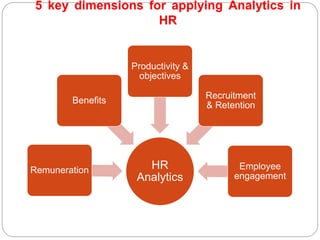
5 key dimensions for applying Analytics in
HR
HR
Analytics
Remuneration
Benefits
Productivity &
objectives
Recruitment
& Retention
Employee
engagement
Understanding KPIs under each dimension
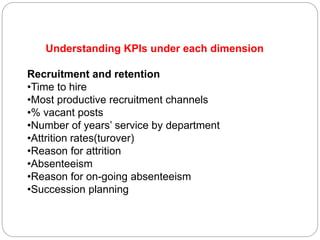
Recruitment and retention
•Time to hire
•Most productive recruitment channels
•% vacant posts
•Number of years’ service by department
•Attrition rates(turover)
•Reason for attrition
•Absenteeism
•Reason for on-going absenteeism
•Succession planning
Productivity and Managing
Objectives
•% achievement of targets
•Profit per full-time-equivalent (FTE)
•Human capital return on investment
•Employee productivity index
•Performance differential rate
•Unscheduled absence rate
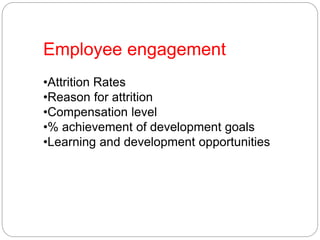
Employee engagement
•Attrition Rates
•Reason for attrition
•Compensation level
•% achievement of development goals
•Learning and development opportunities
Remuneration
•Cost per full time equivalent
•Average remuneration
•% of employees satisfied with remuneration
•% of employees above average salary of their position
•% of high performers who resign for compensation related
reasons
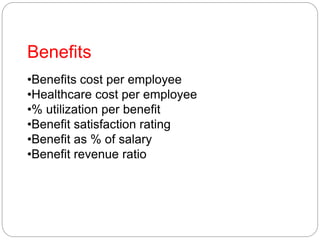
Benefits
•Benefits cost per employee
•Healthcare cost per employee
•% utilization per benefit
•Benefit satisfaction rating
•Benefit as % of salary
•Benefit revenue ratio
That’s too much of theory Lets experience HR Analytics
in action
Case Study –I: Employee Retention
Amazon India Case Study
 Amazon India, one of the top ecommerce company was facing
a business challenge.
 The strength of the company was its Human Resource but the
real challenge was to effectively manage the HR and retain
talent as the competitors try to pouch it’s best talent.
 The attrition rate in the company was high in recent years ,and
this was an ew challenge to behandled by a recently recruited
HR head Miss.Pallavi.
 Pallavi asked Miss.Taniyaa newly recruited HR Analyst in a
team to conduct an employee survey and found that lack of
incentives and low salary hike was one of the major reason
that employees are quoting for high employee turnover.
 However, HR head Pallavi disagreed, her view was, most
employees were note ligible for incentives and salary hike as
their performance was not as satisfactory.
Continue..
•Puzzled Pallavi & Taniya wanted to know what are the
factors which impact the performance and how
performance of the employees can be improved.
•Amazon has decided to hire you as an Analytics expert
to provide insights and recommend strategies.
•As an HR Analyst, you need to address following
issues:
1.What impacts performance? Set priorities for factors.
2.How to predict employee performance before even
hiring–assessing job applicants.
Case study –II: HR impact on stock
price
Story of HR Manager
•CEO&CFO: Mr.HR, we are cancelling the Rs10 Crore
HR Budget.
•Mr.HR: Oh My silly Gosh, why?
•CEO&CFO: We think we are wasting Rs10 crore every
year on training, motivation blah blah.
•Mr.HR: Wrong, HR is our key asset. We need to invest
on them so that the company keeps growing with
profits.
•CEO&CFO: Wed is agree, if we save that
Rs10crore,we can increase EBITDA and then it
increases EPS which results in Increase in stock
price. So our investors will be happy.
•Mr.HR: Sorry Sirs, actually investing Rs10crore on
HR increases EBITDA, EPS and stock price in
longrun. (instead of saving10crores, I can offer
better strategies)
•CEO&CFO: Prove it Open Excel file saved as Data
Case study and solve this HR Analytics
Problem.
Types of Analytics
1. Descriptive Analytics:
 Answers the Question: What happened and why?
 Primary Tools: Data aggregation and data mining
 Limitation: A snapshot of the past may have limited
ability to guide future decisions
 Best Use: Summarize results for all or part of your
business
2. Predictive Analytics :
 Answers the Question: What might happen?
 Primary Tools: Machine learning, statistical
models, and simulation
 Limitations: Estimation of the future
 Best use: Backing of an educated guess for the
results of low complexity decisions
3. Prescriptive Analytics :
 Answers the Question: What should we do?
 Primary Tools: Optimization and heuristics
 Limitations: Most effective where you have
some control over what is being modeled
 Best use: When you need to make important,
interdependent, complex or time-sensitive
decisions
Conducting HR Analytics
 Step 1: determine stakeholder requirements
 Step 2: define HR research and analytics agenda
 Step 3: identify data sources
 Step 4: gather data
 Step 5: transform data
 Step 6: communicate intelligence results
 Step 7: enable strategy and decision-making

HR Analytics module one PPT CHALLENGES In HR

  • 1.
  • 2.
    HR Story •CEO: Letus invest more in our people. •CFO: That is a risk! Their marketability will increase. What if they quit? •CEO: What if we don’t invest in them and they don’t quit ? Is it not a bigger risk ?
  • 3.
    Challenges in HR •Recruitment •Training& Development •Retention •Motivation •Employee engagement •Performance appraisal •etc. What does these require ?
  • 4.
    Worries of everycompany’s HR head 1.What are the Challenges of a HR Manager ? 2.Why is it so difficult to get budget approval for HR ? (For marketing department it is slightly easy.) 3.So how to prove ?
  • 5.
  • 6.
    What is HRAnalytics ? •HR Analytics is defined as a systematic collection, analysis, and interpretation of data to improve talent management decisions. •HR analytics or people analytics or workforce science, uses a mix of understanding: patterns based on data & algorithms and intuition in making people decisions across an employee life cycle; typically,80% data-based analysis and 20% intuition seem to be the rule of thumb. •HR Analytics provides evidence linking investments in human resources of the organization to either top-line or bottom-line performance.
  • 7.
    What is NOTHR analytics ? •HR analytics is not about simply preparing metrics or dashboards, or analysis of reports of headcount or employee engagement score or attrition data. These are simple and general metrics. Not HR Analytics •HR analytics should include element of predictive and prescriptive analytics.
  • 8.
    Why everyone isdancing about HR analytics NOW ? •Computational & data capturing Technology •“3D data” -Data volume, Data velocity, and Data variety. •Cheaper technology •Peer learning from using analytics in Finance , marketing etc •Data Visualization tools •Clarity on impact of HR investment on bottom line
  • 9.
    5 key dimensionsfor applying Analytics in HR HR Analytics Remuneration Benefits Productivity & objectives Recruitment & Retention Employee engagement
  • 10.
    Understanding KPIs undereach dimension Recruitment and retention •Time to hire •Most productive recruitment channels •% vacant posts •Number of years’ service by department •Attrition rates(turover) •Reason for attrition •Absenteeism •Reason for on-going absenteeism •Succession planning
  • 11.
    Productivity and Managing Objectives •%achievement of targets •Profit per full-time-equivalent (FTE) •Human capital return on investment •Employee productivity index •Performance differential rate •Unscheduled absence rate
  • 12.
    Employee engagement •Attrition Rates •Reasonfor attrition •Compensation level •% achievement of development goals •Learning and development opportunities
  • 13.
    Remuneration •Cost per fulltime equivalent •Average remuneration •% of employees satisfied with remuneration •% of employees above average salary of their position •% of high performers who resign for compensation related reasons
  • 14.
    Benefits •Benefits cost peremployee •Healthcare cost per employee •% utilization per benefit •Benefit satisfaction rating •Benefit as % of salary •Benefit revenue ratio
  • 15.
    That’s too muchof theory Lets experience HR Analytics in action
  • 16.
    Case Study –I:Employee Retention Amazon India Case Study  Amazon India, one of the top ecommerce company was facing a business challenge.  The strength of the company was its Human Resource but the real challenge was to effectively manage the HR and retain talent as the competitors try to pouch it’s best talent.  The attrition rate in the company was high in recent years ,and this was an ew challenge to behandled by a recently recruited HR head Miss.Pallavi.  Pallavi asked Miss.Taniyaa newly recruited HR Analyst in a team to conduct an employee survey and found that lack of incentives and low salary hike was one of the major reason that employees are quoting for high employee turnover.  However, HR head Pallavi disagreed, her view was, most employees were note ligible for incentives and salary hike as their performance was not as satisfactory.
  • 17.
    Continue.. •Puzzled Pallavi &Taniya wanted to know what are the factors which impact the performance and how performance of the employees can be improved. •Amazon has decided to hire you as an Analytics expert to provide insights and recommend strategies. •As an HR Analyst, you need to address following issues: 1.What impacts performance? Set priorities for factors. 2.How to predict employee performance before even hiring–assessing job applicants.
  • 18.
    Case study –II:HR impact on stock price
  • 19.
    Story of HRManager •CEO&CFO: Mr.HR, we are cancelling the Rs10 Crore HR Budget. •Mr.HR: Oh My silly Gosh, why? •CEO&CFO: We think we are wasting Rs10 crore every year on training, motivation blah blah. •Mr.HR: Wrong, HR is our key asset. We need to invest on them so that the company keeps growing with profits.
  • 20.
    •CEO&CFO: Wed isagree, if we save that Rs10crore,we can increase EBITDA and then it increases EPS which results in Increase in stock price. So our investors will be happy. •Mr.HR: Sorry Sirs, actually investing Rs10crore on HR increases EBITDA, EPS and stock price in longrun. (instead of saving10crores, I can offer better strategies) •CEO&CFO: Prove it Open Excel file saved as Data Case study and solve this HR Analytics Problem.
  • 21.
    Types of Analytics 1.Descriptive Analytics:  Answers the Question: What happened and why?  Primary Tools: Data aggregation and data mining  Limitation: A snapshot of the past may have limited ability to guide future decisions  Best Use: Summarize results for all or part of your business
  • 22.
    2. Predictive Analytics:  Answers the Question: What might happen?  Primary Tools: Machine learning, statistical models, and simulation  Limitations: Estimation of the future  Best use: Backing of an educated guess for the results of low complexity decisions
  • 23.
    3. Prescriptive Analytics:  Answers the Question: What should we do?  Primary Tools: Optimization and heuristics  Limitations: Most effective where you have some control over what is being modeled  Best use: When you need to make important, interdependent, complex or time-sensitive decisions
  • 24.
    Conducting HR Analytics Step 1: determine stakeholder requirements  Step 2: define HR research and analytics agenda  Step 3: identify data sources  Step 4: gather data  Step 5: transform data  Step 6: communicate intelligence results  Step 7: enable strategy and decision-making