Case study
HP finds big value in HP
Vertica big data solution
Time to analyze clickstream data 				
reduced from days to minutes
Industry
Technology
Objective
Streamline processing of hp.com clickstream data
Approach
Implement big data analytics and storage solutions
IT matters
•	Solution easily accommodates billions of rows 	
of data generated by hp.com visitor clicks
•	Queries returned in minutes instead of days,
allowing users to perform more complex, 		
iterative data analysis
•	Industry-standard SQL ensures user familiarity,
maximizing acceptance and ROI
Business matters
•	Improved ability to identify and correct 		
issues with website hardware or software, 	
which reduces risks of degraded customer
experience and lost sales
•	Improved ability to deliver interactive, 	
personalized website experience, which	
improves sales conversions and drives 		
sales and revenue
“Our clickstream implementation of HP Vertica and 	
Apache Hadoop demonstrates the enormous value 		
of these technologies. We expect more and more HP
customers will follow suit and adopt the same 		
approach for their big data analytics.”
—John Lormand, director, HP.com Technology
Big data has value, but to realize that value, businesses need to
evolve from legacy batch processing technologies to solutions
that support real-time interactive analysis. HP Vertica Analytics
and the open source Apache Hadoop software offer a big data
solution that HP has leveraged internally to improve its
clickstream analytics capabilities.
2
It is true that “time is money.”
But so is data.
And today’s companies are increasingly aware
that the more data they collect, the more
value it has. “Big Data”—the enormous data
sets generated when companies capture
highly granular digital information—can help
companies drive innovation and productivity.
Big data can also help companies identify
new opportunities and markets, and deepen
their understanding of customer needs and
behaviors. And big data can give companies
a competitive edge and help them better
understand risk.
But to mine the value of big data, companies
need cutting-edge technology. They must be
able to analyze data sets that dwarf the size of
traditional databases. And that analysis must
be speedy, to ensure that companies can act
on it in a timely fashion.
That is why HP has integrated its own
technology, the HP Vertica Analytics
Platform, with the open-source Apache
Hadoop software, to create a robust and
comprehensive big data analytics solution.
Billions of clicks
As is true for many companies today, HP’s
public face is its corporate website hp.com.
The site is visited by millions of people each
month and functions as one of the company’s
most important marketing communications
vehicles. The site allows HP to offer thousands
of pages of searchable information about its
products and services directly to the public.
The site also serves as a virtual storefront,
enabling HP to engage customers and 	
transact business with them.
During the course of the millions of
interactions with site visitors, hp.com
generates “clickstream” data, including
information on what pages visitors load,
how much time they spend on each page,
what links they click, and how they exit the
site. Analyzing this clickstream data, in turn,
allows HP to deepen its understanding of
website visitors. The company can better
understand how visitors interact with the site.
As a result, the data can be used to improve
the site itself—making it more usable, for
example, or ensuring visitors can easily find
the information they need.
More broadly, analyzing clickstream data
yields insight into customer behavior, such as
buying behaviors. This enables HP to refine
its sales and marketing campaigns, or even
its products and services themselves. “The
biggest consumer of clickstream data is our
marketing analysts,” notes John Lormand,
director, HP.com Technology. “It is broadly
recognized for its value in helping us refine
how we communicate to the public and
position our solutions.”
At one time, HP stored its clickstream data
using traditional Oracle databases, and
performed modeling and analytics with 	
SAS Analytics software.
But the data sets are enormous, due to a
number of factors.
First is the volume of hp.com traffic and the
number of clicks each visitor makes per visit.
“We capture 11 to 12 billion clicks per month,”
Lormand says. To fully support trending and
comparative analysis, HP must store around
five years’ worth of clickstream data; analysts
typically want to work with about 15 months’
worth at a time to perform year over year
trend analysis. This allows the analysts to
account for seasonality and show correlation
to previous year’s traffic.
The site itself is also extremely complex—
more a collection of services than a single
application—and is not a static environment.
Many pages are generated dynamically,
based on information provided by the visitor
or visitor behavior. “HP.com is an integrated
environment, with some pieces generated by
HP and others served up by service providers,”
Lormand explains.
HP’s clickstream database, in fact, was HP’s
largest Oracle instance.
The sheer volume of the data collected created
issues, however. The database performance
was sluggish; queries could take days to
process. “Query results were taking at least
48 hours after each day’s transactions were
completed,” Lormand notes. “And more
complex analytics were impossible to do, in
practical terms—they simply took too long.
“We knew we needed to improve our
clickstream analytics capabilities.”
Case study | HP Vertica big data solution
3
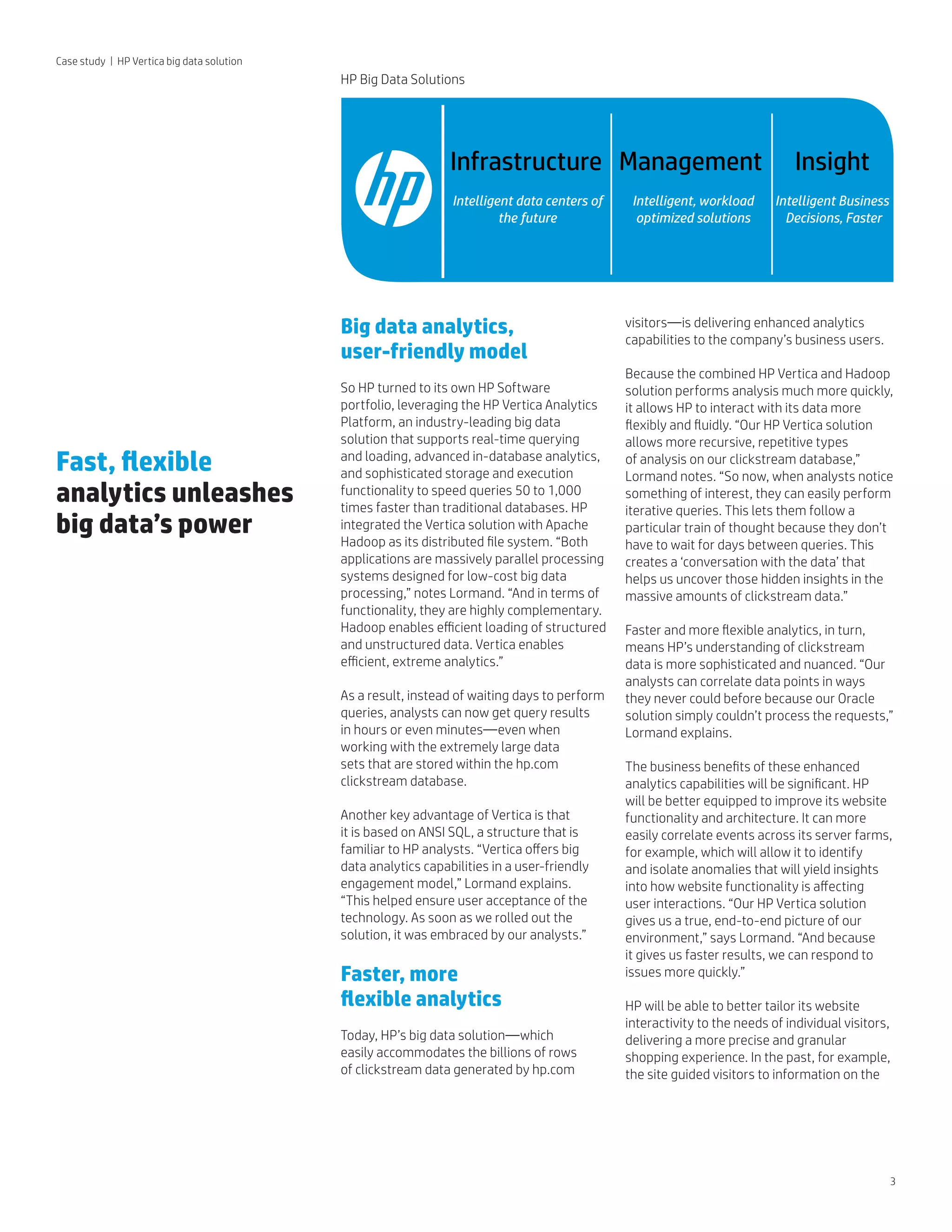
Infrastructure Management Insight
Intelligent data centers of
the future
Intelligent, workload
optimized solutions
Intelligent Business
Decisions, Faster
Case study | HP Vertica big data solution
Big data analytics, 	
user-friendly model
So HP turned to its own HP Software
portfolio, leveraging the HP Vertica Analytics
Platform, an industry-leading big data
solution that supports real-time querying
and loading, advanced in-database analytics,
and sophisticated storage and execution
functionality to speed queries 50 to 1,000
times faster than traditional databases. HP
integrated the Vertica solution with Apache
Hadoop as its distributed file system. “Both
applications are massively parallel processing
systems designed for low-cost big data
processing,” notes Lormand. “And in terms of
functionality, they are highly complementary.
Hadoop enables efficient loading of structured
and unstructured data. Vertica enables
efficient, extreme analytics.”
As a result, instead of waiting days to perform
queries, analysts can now get query results 	
in hours or even minutes—even when 		
working with the extremely large data 		
sets that are stored within the hp.com
clickstream database.
Another key advantage of Vertica is that
it is based on ANSI SQL, a structure that is
familiar to HP analysts. “Vertica offers big
data analytics capabilities in a user-friendly
engagement model,” Lormand explains.
“This helped ensure user acceptance of the
technology. As soon as we rolled out the
solution, it was embraced by our analysts.”
Faster, more 		
flexible analytics
Today, HP’s big data solution—which
easily accommodates the billions of rows
of clickstream data generated by hp.com
visitors—is delivering enhanced analytics
capabilities to the company’s business users.
Because the combined HP Vertica and Hadoop
solution performs analysis much more quickly,
it allows HP to interact with its data more
flexibly and fluidly. “Our HP Vertica solution
allows more recursive, repetitive types
of analysis on our clickstream database,”
Lormand notes. “So now, when analysts notice
something of interest, they can easily perform
iterative queries. This lets them follow a
particular train of thought because they don’t
have to wait for days between queries. This
creates a ‘conversation with the data’ that
helps us uncover those hidden insights in the
massive amounts of clickstream data.”
Faster and more flexible analytics, in turn,
means HP’s understanding of clickstream
data is more sophisticated and nuanced. “Our
analysts can correlate data points in ways
they never could before because our Oracle
solution simply couldn’t process the requests,”
Lormand explains.
The business benefits of these enhanced
analytics capabilities will be significant. HP
will be better equipped to improve its website
functionality and architecture. It can more
easily correlate events across its server farms,
for example, which will allow it to identify
and isolate anomalies that will yield insights
into how website functionality is affecting
user interactions. “Our HP Vertica solution
gives us a true, end-to-end picture of our
environment,” says Lormand. “And because
it gives us faster results, we can respond to
issues more quickly.”
HP will be able to better tailor its website
interactivity to the needs of individual visitors,
delivering a more precise and granular
shopping experience. In the past, for example,
the site guided visitors to information on the
Fast, flexible 	
analytics unleashes
big data’s power
HP Big Data Solutions
Rate this documentShare with colleagues
Sign up for updates
hp.com/go/getupdated
basis of broad categories. If the visitor seemed
to fit the profile of a typical retail customer,
that visitor would be guided to one set of
solutions. Visitors fitting the profile of a 	
home office user would be led to a different
subset of products.
But some visitors don’t always fit neatly 	
into these categories. Now, thanks to the
insight gained via the HP Vertica solution, 	
HP can build website functionality that 	
ensures the site responds appropriately 	
to all kinds of visitors. And this, in turn, will
enhance 	visitor satisfaction and improve 	
sales conversion rates.
HP also uses HP Vertica to analyze channel
rebate data, a task that requires matching
serial numbers on rebate claims to 135 million
rows of shipment data. This has improved
HP’s ability to forecast rebates and to execute
quarter-end financial adjustments.
Given the importance of hp.com to the
company’s revenue and brand, it’s likely that
managing clickstream data will continue to
be an important use of its HP Vertica solution.
“We know that our website must deliver an
interactive and personalized experience to
our visitors,” Lormand concludes. “It’s a key
strategic goal, and HP Vertica gives us critical
capabilities that we need to achieve it.”
Customer at a glance
Application
Big data analytics
Software
HP IT Performance Suite—Information
Management
•	HP Vertica Analytics Platform
•	Apache Hadoop
© Copyright 2013 Hewlett-Packard Development Company, L.P. The information contained herein is subject to change without notice. The only
warranties for HP products and services are set forth in the express warranty statements accompanying such products and services. Nothing herein
should be construed as constituting an additional warranty. HP shall not be liable for technical or editorial errors or omissions contained herein.
4AA4-5388ENW, February 2013
Case study | HP Vertica big data solution

Hp big data_casestudy

  • 1.
    Case study HP findsbig value in HP Vertica big data solution Time to analyze clickstream data reduced from days to minutes Industry Technology Objective Streamline processing of hp.com clickstream data Approach Implement big data analytics and storage solutions IT matters • Solution easily accommodates billions of rows of data generated by hp.com visitor clicks • Queries returned in minutes instead of days, allowing users to perform more complex, iterative data analysis • Industry-standard SQL ensures user familiarity, maximizing acceptance and ROI Business matters • Improved ability to identify and correct issues with website hardware or software, which reduces risks of degraded customer experience and lost sales • Improved ability to deliver interactive, personalized website experience, which improves sales conversions and drives sales and revenue “Our clickstream implementation of HP Vertica and Apache Hadoop demonstrates the enormous value of these technologies. We expect more and more HP customers will follow suit and adopt the same approach for their big data analytics.” —John Lormand, director, HP.com Technology Big data has value, but to realize that value, businesses need to evolve from legacy batch processing technologies to solutions that support real-time interactive analysis. HP Vertica Analytics and the open source Apache Hadoop software offer a big data solution that HP has leveraged internally to improve its clickstream analytics capabilities.
  • 2.
    2 It is truethat “time is money.” But so is data. And today’s companies are increasingly aware that the more data they collect, the more value it has. “Big Data”—the enormous data sets generated when companies capture highly granular digital information—can help companies drive innovation and productivity. Big data can also help companies identify new opportunities and markets, and deepen their understanding of customer needs and behaviors. And big data can give companies a competitive edge and help them better understand risk. But to mine the value of big data, companies need cutting-edge technology. They must be able to analyze data sets that dwarf the size of traditional databases. And that analysis must be speedy, to ensure that companies can act on it in a timely fashion. That is why HP has integrated its own technology, the HP Vertica Analytics Platform, with the open-source Apache Hadoop software, to create a robust and comprehensive big data analytics solution. Billions of clicks As is true for many companies today, HP’s public face is its corporate website hp.com. The site is visited by millions of people each month and functions as one of the company’s most important marketing communications vehicles. The site allows HP to offer thousands of pages of searchable information about its products and services directly to the public. The site also serves as a virtual storefront, enabling HP to engage customers and transact business with them. During the course of the millions of interactions with site visitors, hp.com generates “clickstream” data, including information on what pages visitors load, how much time they spend on each page, what links they click, and how they exit the site. Analyzing this clickstream data, in turn, allows HP to deepen its understanding of website visitors. The company can better understand how visitors interact with the site. As a result, the data can be used to improve the site itself—making it more usable, for example, or ensuring visitors can easily find the information they need. More broadly, analyzing clickstream data yields insight into customer behavior, such as buying behaviors. This enables HP to refine its sales and marketing campaigns, or even its products and services themselves. “The biggest consumer of clickstream data is our marketing analysts,” notes John Lormand, director, HP.com Technology. “It is broadly recognized for its value in helping us refine how we communicate to the public and position our solutions.” At one time, HP stored its clickstream data using traditional Oracle databases, and performed modeling and analytics with SAS Analytics software. But the data sets are enormous, due to a number of factors. First is the volume of hp.com traffic and the number of clicks each visitor makes per visit. “We capture 11 to 12 billion clicks per month,” Lormand says. To fully support trending and comparative analysis, HP must store around five years’ worth of clickstream data; analysts typically want to work with about 15 months’ worth at a time to perform year over year trend analysis. This allows the analysts to account for seasonality and show correlation to previous year’s traffic. The site itself is also extremely complex— more a collection of services than a single application—and is not a static environment. Many pages are generated dynamically, based on information provided by the visitor or visitor behavior. “HP.com is an integrated environment, with some pieces generated by HP and others served up by service providers,” Lormand explains. HP’s clickstream database, in fact, was HP’s largest Oracle instance. The sheer volume of the data collected created issues, however. The database performance was sluggish; queries could take days to process. “Query results were taking at least 48 hours after each day’s transactions were completed,” Lormand notes. “And more complex analytics were impossible to do, in practical terms—they simply took too long. “We knew we needed to improve our clickstream analytics capabilities.” Case study | HP Vertica big data solution
  • 3.
    3 Infrastructure Management Insight Intelligentdata centers of the future Intelligent, workload optimized solutions Intelligent Business Decisions, Faster Case study | HP Vertica big data solution Big data analytics, user-friendly model So HP turned to its own HP Software portfolio, leveraging the HP Vertica Analytics Platform, an industry-leading big data solution that supports real-time querying and loading, advanced in-database analytics, and sophisticated storage and execution functionality to speed queries 50 to 1,000 times faster than traditional databases. HP integrated the Vertica solution with Apache Hadoop as its distributed file system. “Both applications are massively parallel processing systems designed for low-cost big data processing,” notes Lormand. “And in terms of functionality, they are highly complementary. Hadoop enables efficient loading of structured and unstructured data. Vertica enables efficient, extreme analytics.” As a result, instead of waiting days to perform queries, analysts can now get query results in hours or even minutes—even when working with the extremely large data sets that are stored within the hp.com clickstream database. Another key advantage of Vertica is that it is based on ANSI SQL, a structure that is familiar to HP analysts. “Vertica offers big data analytics capabilities in a user-friendly engagement model,” Lormand explains. “This helped ensure user acceptance of the technology. As soon as we rolled out the solution, it was embraced by our analysts.” Faster, more flexible analytics Today, HP’s big data solution—which easily accommodates the billions of rows of clickstream data generated by hp.com visitors—is delivering enhanced analytics capabilities to the company’s business users. Because the combined HP Vertica and Hadoop solution performs analysis much more quickly, it allows HP to interact with its data more flexibly and fluidly. “Our HP Vertica solution allows more recursive, repetitive types of analysis on our clickstream database,” Lormand notes. “So now, when analysts notice something of interest, they can easily perform iterative queries. This lets them follow a particular train of thought because they don’t have to wait for days between queries. This creates a ‘conversation with the data’ that helps us uncover those hidden insights in the massive amounts of clickstream data.” Faster and more flexible analytics, in turn, means HP’s understanding of clickstream data is more sophisticated and nuanced. “Our analysts can correlate data points in ways they never could before because our Oracle solution simply couldn’t process the requests,” Lormand explains. The business benefits of these enhanced analytics capabilities will be significant. HP will be better equipped to improve its website functionality and architecture. It can more easily correlate events across its server farms, for example, which will allow it to identify and isolate anomalies that will yield insights into how website functionality is affecting user interactions. “Our HP Vertica solution gives us a true, end-to-end picture of our environment,” says Lormand. “And because it gives us faster results, we can respond to issues more quickly.” HP will be able to better tailor its website interactivity to the needs of individual visitors, delivering a more precise and granular shopping experience. In the past, for example, the site guided visitors to information on the Fast, flexible analytics unleashes big data’s power HP Big Data Solutions
  • 4.
    Rate this documentSharewith colleagues Sign up for updates hp.com/go/getupdated basis of broad categories. If the visitor seemed to fit the profile of a typical retail customer, that visitor would be guided to one set of solutions. Visitors fitting the profile of a home office user would be led to a different subset of products. But some visitors don’t always fit neatly into these categories. Now, thanks to the insight gained via the HP Vertica solution, HP can build website functionality that ensures the site responds appropriately to all kinds of visitors. And this, in turn, will enhance visitor satisfaction and improve sales conversion rates. HP also uses HP Vertica to analyze channel rebate data, a task that requires matching serial numbers on rebate claims to 135 million rows of shipment data. This has improved HP’s ability to forecast rebates and to execute quarter-end financial adjustments. Given the importance of hp.com to the company’s revenue and brand, it’s likely that managing clickstream data will continue to be an important use of its HP Vertica solution. “We know that our website must deliver an interactive and personalized experience to our visitors,” Lormand concludes. “It’s a key strategic goal, and HP Vertica gives us critical capabilities that we need to achieve it.” Customer at a glance Application Big data analytics Software HP IT Performance Suite—Information Management • HP Vertica Analytics Platform • Apache Hadoop © Copyright 2013 Hewlett-Packard Development Company, L.P. The information contained herein is subject to change without notice. The only warranties for HP products and services are set forth in the express warranty statements accompanying such products and services. Nothing herein should be construed as constituting an additional warranty. HP shall not be liable for technical or editorial errors or omissions contained herein. 4AA4-5388ENW, February 2013 Case study | HP Vertica big data solution