© EduPristine Customer 360
© EduPristine – www.edupristine.com
Project 2
Customer 360
© EduPristine Customer 360
Agenda
 Things you will learn
 Customer 360 introduction
 Key points
 Architecture
 Lab
1
© EduPristine Customer 360
Things you will learn
 After completion of this project, you will learn the following:
• Customer 360
• Customer 360 Architecture
• End to end implementation
• Technologies: MySQL, sqoop, pig, Hbase, Hive
2
© EduPristine Customer 360 3
Reference: cloudera
© EduPristine Customer 360 4
Reference: cloudera
© EduPristine Customer 360
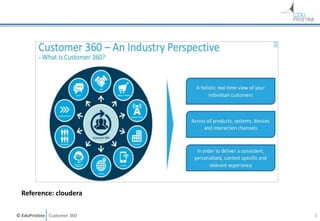
What is customer 360
 Customer 360 refers to summarised information related to customer, at every digital touch point,
which describes the behavior of customer, and predicts what can happen with him in future.
 It can be thought on mega table, which is holding information of all products a customer holds,
summary of all customers transactions, demographic features, CRM information.
 Reference - http://www.slideshare.net/cloudera/using-big-data-to-drive-customer-360
5
© EduPristine Customer 360
Why; Understand Your Customers
 Improve the entire customer lifecycle with a customer 360-degree profile.
 Any marketing team or any other team dealing with customers must leverage technology to:
• collect and analyze customer data
• execute successful omni-channel campaigns
• understand the customer lifecycle
• influence buyers in a congested market.
6
© EduPristine Customer 360
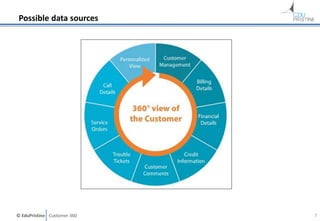
Possible data sources
7
© EduPristine Customer 360
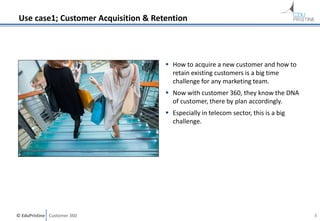
Use case1; Customer Acquisition & Retention
 How to acquire a new customer and how to
retain existing customers is a big time
challenge for any marketing team.
 Now with customer 360, they know the DNA
of customer, there by plan accordingly.
 Especially in telecom sector, this is a big
challenge.
8
© EduPristine Customer 360
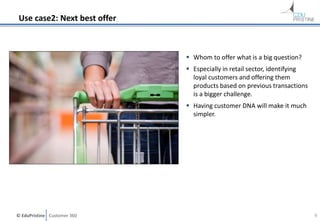
Use case2: Next best offer
 Whom to offer what is a big question?
 Especially in retail sector, identifying
loyal customers and offering them
products based on previous transactions
is a bigger challenge.
 Having customer DNA will make it much
simpler.
9
© EduPristine Customer 360
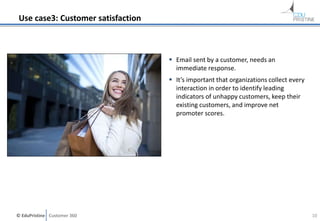
Use case3: Customer satisfaction
 Email sent by a customer, needs an
immediate response.
 It’s important that organizations collect every
interaction in order to identify leading
indicators of unhappy customers, keep their
existing customers, and improve net
promoter scores.
10
© EduPristine Customer 360
Up sell and cross sell recommendations
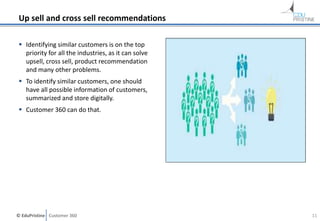
 Identifying similar customers is on the top
priority for all the industries, as it can solve
upsell, cross sell, product recommendation
and many other problems.
 To identify similar customers, one should
have all possible information of customers,
summarized and store digitally.
 Customer 360 can do that.
11
© EduPristine Customer 360
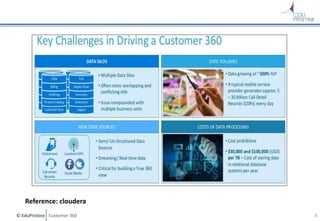
Why hadoop for customer 360?
 Existing systems are costly
 Are not scalable
 Vendor locked
 Slow in processing
12
© EduPristine Customer 360
Key Notes
 To demonstrate this case study, we have created data sets and designed dataflow architectures.
 Students will get to know how to implement customer 360 industrial case study, which is the most
needed technology for many sectors.
 This will improve your profile.
13
© EduPristine Customer 360
Architecture
14
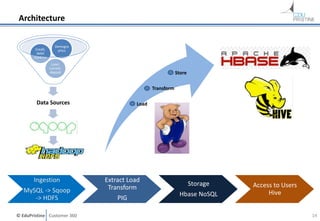
Data Sources
Loan,
current,
deposit
Credit,
debit
Card trx
Demogra
phics
Extract Load
Transform
PIG
Storage
Hbase NoSQL
Access to Users
Hive
Ingestion
MySQL -> Sqoop
-> HDFS
Load
Transform
Store
© EduPristine Customer 360
Step1: Understanding data
 In datasets folder, six datasets are provided:
• Credit card: Credit card account details.
• Credit card trx: Credit card trx details.
• Demographics: Customer demographic details.
• Deposit: Deposit account details.
• Loan: Loan account details.
• Savings: Savings account details.
 Refer to datasets folder.
15
© EduPristine Customer 360
Step2: Load data to MySQL
 To replicate the exact business scenario, data will be first ingested to MySQL.
 Refer to step2.
16
© EduPristine Customer 360
Step3: Data Ingestion
 Sqoop will be used to ingest data from MySQL to HDFS.
 Sqoop is the most preferred tool for data ingestion.
 Refer to:
17
© EduPristine Customer 360
Step4: Customer 360 Mega Table; HBase
 Create a table with following column families:
• Demographics
• Savings
• Loan
• Credit
• Deposit
• credittrxsummary
18
© EduPristine Customer 360
Step5: ELT with Pig
 Pig is the most preferred tool for ELT. It has many capabilities:
• Can create complex projections.
• Can store output in any point of data flow.
• Easy to understand
• Suites well for data flow
 Refer to:
19
© EduPristine Customer 360
Now check hbase
 Now in Hbase, for each customer, all possible information from all different products are at one
place.
 Now how would you provide access to different teams??
20
© EduPristine Customer 360
Providing access; Hive
 Now different teams need different data. Reception office should have access to only account
information. Marketing team needs customer wallet data. Like this, different teams need different
data, to make decisions.
 Using hive, map external tables to required columns in Hbase.
 Refer:
21
© EduPristine Customer 360
Conclusion
 Customer 360 is the most needed project in many banking, telecom and retail sectors.
 With hadoop, entire load on traditional systems can be transferred to hadoop, and there by cost
cuttings.
22
© EduPristine Customer 360
© EduPristine – www.edupristine.com
help@edupristine.com
www.edupristine.com
Thank You!
23

Big Data Hadoop Customer 360 Degree View

  • 1.
    © EduPristine Customer360 © EduPristine – www.edupristine.com Project 2 Customer 360
  • 2.
    © EduPristine Customer360 Agenda  Things you will learn  Customer 360 introduction  Key points  Architecture  Lab 1
  • 3.
    © EduPristine Customer360 Things you will learn  After completion of this project, you will learn the following: • Customer 360 • Customer 360 Architecture • End to end implementation • Technologies: MySQL, sqoop, pig, Hbase, Hive 2
  • 4.
    © EduPristine Customer360 3 Reference: cloudera
  • 5.
    © EduPristine Customer360 4 Reference: cloudera
  • 6.
    © EduPristine Customer360 What is customer 360  Customer 360 refers to summarised information related to customer, at every digital touch point, which describes the behavior of customer, and predicts what can happen with him in future.  It can be thought on mega table, which is holding information of all products a customer holds, summary of all customers transactions, demographic features, CRM information.  Reference - http://www.slideshare.net/cloudera/using-big-data-to-drive-customer-360 5
  • 7.
    © EduPristine Customer360 Why; Understand Your Customers  Improve the entire customer lifecycle with a customer 360-degree profile.  Any marketing team or any other team dealing with customers must leverage technology to: • collect and analyze customer data • execute successful omni-channel campaigns • understand the customer lifecycle • influence buyers in a congested market. 6
  • 8.
    © EduPristine Customer360 Possible data sources 7
  • 9.
    © EduPristine Customer360 Use case1; Customer Acquisition & Retention  How to acquire a new customer and how to retain existing customers is a big time challenge for any marketing team.  Now with customer 360, they know the DNA of customer, there by plan accordingly.  Especially in telecom sector, this is a big challenge. 8
  • 10.
    © EduPristine Customer360 Use case2: Next best offer  Whom to offer what is a big question?  Especially in retail sector, identifying loyal customers and offering them products based on previous transactions is a bigger challenge.  Having customer DNA will make it much simpler. 9
  • 11.
    © EduPristine Customer360 Use case3: Customer satisfaction  Email sent by a customer, needs an immediate response.  It’s important that organizations collect every interaction in order to identify leading indicators of unhappy customers, keep their existing customers, and improve net promoter scores. 10
  • 12.
    © EduPristine Customer360 Up sell and cross sell recommendations  Identifying similar customers is on the top priority for all the industries, as it can solve upsell, cross sell, product recommendation and many other problems.  To identify similar customers, one should have all possible information of customers, summarized and store digitally.  Customer 360 can do that. 11
  • 13.
    © EduPristine Customer360 Why hadoop for customer 360?  Existing systems are costly  Are not scalable  Vendor locked  Slow in processing 12
  • 14.
    © EduPristine Customer360 Key Notes  To demonstrate this case study, we have created data sets and designed dataflow architectures.  Students will get to know how to implement customer 360 industrial case study, which is the most needed technology for many sectors.  This will improve your profile. 13
  • 15.
    © EduPristine Customer360 Architecture 14 Data Sources Loan, current, deposit Credit, debit Card trx Demogra phics Extract Load Transform PIG Storage Hbase NoSQL Access to Users Hive Ingestion MySQL -> Sqoop -> HDFS Load Transform Store
  • 16.
    © EduPristine Customer360 Step1: Understanding data  In datasets folder, six datasets are provided: • Credit card: Credit card account details. • Credit card trx: Credit card trx details. • Demographics: Customer demographic details. • Deposit: Deposit account details. • Loan: Loan account details. • Savings: Savings account details.  Refer to datasets folder. 15
  • 17.
    © EduPristine Customer360 Step2: Load data to MySQL  To replicate the exact business scenario, data will be first ingested to MySQL.  Refer to step2. 16
  • 18.
    © EduPristine Customer360 Step3: Data Ingestion  Sqoop will be used to ingest data from MySQL to HDFS.  Sqoop is the most preferred tool for data ingestion.  Refer to: 17
  • 19.
    © EduPristine Customer360 Step4: Customer 360 Mega Table; HBase  Create a table with following column families: • Demographics • Savings • Loan • Credit • Deposit • credittrxsummary 18
  • 20.
    © EduPristine Customer360 Step5: ELT with Pig  Pig is the most preferred tool for ELT. It has many capabilities: • Can create complex projections. • Can store output in any point of data flow. • Easy to understand • Suites well for data flow  Refer to: 19
  • 21.
    © EduPristine Customer360 Now check hbase  Now in Hbase, for each customer, all possible information from all different products are at one place.  Now how would you provide access to different teams?? 20
  • 22.
    © EduPristine Customer360 Providing access; Hive  Now different teams need different data. Reception office should have access to only account information. Marketing team needs customer wallet data. Like this, different teams need different data, to make decisions.  Using hive, map external tables to required columns in Hbase.  Refer: 21
  • 23.
    © EduPristine Customer360 Conclusion  Customer 360 is the most needed project in many banking, telecom and retail sectors.  With hadoop, entire load on traditional systems can be transferred to hadoop, and there by cost cuttings. 22
  • 24.
    © EduPristine Customer360 © EduPristine – www.edupristine.com help@edupristine.com www.edupristine.com Thank You! 23