 Hoysala architecture is the building style developed
under the rule of the Hoysala Empire between the 11th
and 14th centuries, in the region known today as
Karnataka.
 Hoysala influence was at its peak in the 13th century,
when it dominated the Southern Deccan Plateau
region.
 Large and small temples built during this era remain as
examples of the Hoysala architectural style, including
the Chennakesava Temple at Belur, the Hoysaleswara
Temple at Halebidu, and the Kesava Temple at
Somanathapura.
 Study of the Hoysala architectural style has revealed a
negligible Indo-Aryan influence while the impact of
Southern Indian style is more distinct.
 Some three hundred temples are known to survive in
present-day Karnataka state and many more are
mentioned in inscriptions, though only about seventy
have been documented.
Chennakesava Temple, Belur
Hoysaleswara Temple, Halebidu
Kesava Temple at Somanathapura.
 The Chennakeshava Temple, originally called
Vijayanarayana Temple, was built on the banks of the
Yagachi River in Belur, by the Hoysala Empire King
Vishnuvardhana.
 Belur, which was an early Hoysala capital, is in the
Hassan district of Karnataka state, India.
 It is 40 km from Hassan city and 220 km from
Bangalore.
 Belur is well known for its marvelous temples built
during the rule of the Hoysala dynasty, making it and
nearby Halebidu favored tourist destinations in
Karnataka state.
 These temple complexes have been proposed to be
listed under UNESCO World Heritage Sites.
Chennakeshava
Temple
Shrine outer wall with friezes on vertical sections below eves in
Chennakeshava temple at Belur.
 The temple was commissioned by King Vishnuvardhana
in 1117 AD.
 The main entrance to the complex is crowned by a Rajagopura
(superstructure over entrance) built during the days of the
Vijayanagar empire.
 Within the complex, the Chennakesava temple is at the centre,
facing east, and is flanked by the Kappe Channigraya temple on its
right, and a small Sowmyanayaki (form of the goddess Lakshmi)
temple set slightly back.
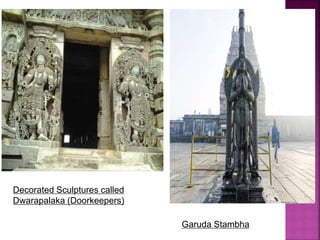
 Two main sthambha (pillar) exist here. The pillar facing the main
temple, the Garuda (eagle) sthambha was erected in the
Vijayanagar period while the pillar on the right, the Deepa sthambha
(pillar with lamp) dates from the Hoysala period.
 This is the first great Hoysala temple, though according to the art
critic and historian Settar, the artistic idiom and signature is still
Western Chalukyan. Hence, the over-decoration which is seen in
later Hoysala temples (including the Hoysaleswara temple at
Halebidu and the Keshava temple at Somanathapura) is not visible
here.
 The Chennakesava temple has three entrances and their doorways
have decorated sculptures called dvarapalaka (doorkeepers) on
either side.
 While the Kappe Channigraya temple is smaller than the
Chennakesava temple, it is architecturally significant, though it lacks
any sculptural features.
Entrance at Chennakesava temple.
Rajagopura (superstructure over
entrance)
Decorated Sculptures called
Dwarapalaka (Doorkeepers)
Garuda Stambha
The Ranganayaki temple The Soumyanayaki temple
Kappe Chennigaraya temple Compact and ornate Veeranarayana
temple
 The building material used in the Chennakesava temple is chloritic
schist, more commonly known as soapstone or potstone,and is
essentially a simple Hoysala plan built with extraordinary detail.
 What differentiates this temple from other Hoysala temples of the
same plan is the unusually large size of the basic parts of the
temple.
 The temple is a ekakuta vimana design (single shrine) of 10.5 m by
10.5 m size.
 A large vestibule connects the shrine to the mandapa (hall) which is
one of the main attractions of the temple. The mandapa has 60
"bays".
 The superstructure (tower or Shikhara) on top of the vimana has
been lost over time.
 The temple is built on a jagati (platform for circumabulation).There is
one flight of steps leading to the jagati and another flight of steps to
the mantapa.
 The mantapa here was originally an open one. A visitor would have
been able to see the ornate pillars of the open mantapa from the
platform.
 The open mantapa was converted into a closed one after about fifty
years, during the Hoysala rule.
BEFORE
Open Mantapa
AFTER
Closed Mantapa
 The pillars inside the hall are an attraction and the most popular one is
the Narasimha pillar.
 According to the historian Kamath, there is a rich diversity about the
pillar styles here.
 While all the forty eight pillars are unique and the many ceiling
sections are well decorated, nothing surpasses the finish of the four
central pillars and the ceiling they support.
 These pillars may have been hand chiseled while the others were
lathe turned.All of these four pillars bear madanikas.
 There are 42 of them in the temple complex, one each on the four
central pillars inside the hall and the remaining 38 are outside,
between the eaves on the outer walls of the hall.They are also called
shilabalika and represent the ideal female form.
Pillars bearing load of Madanika.
Ornate lathe turned pillars in mantapa, a
standard Hoysala idiom
Shilabalika in the Chennakesava temple at Belur.
 Interesting sculptures inside the mantapa are Sthamba buttalika
(pillar with an image in frieze) which is more in the Chola style
indicating that the Hoysalas may have employed Chola craftsman
along with locals.
 At the base of the outer walls are friezes of charging elephants
which symbolize stability and strength, above which are lions which
symbolize courage, and further up are horses which symbolize
speed. Above the horses are panels with floral designs signifying
beauty above which are sculptures with depictions from the Hindu
epics, the Ramayana and the Mahabharata.
 According to Kamath, this style of articulation is called horizontal
treatment with friezes.
 The sculptural style of the wall images bear similarities with wall
sculptures in contemporary temples of northern Karnataka and
adjacent Maharashtra.
Narasimha Gajasursamhara
Garuda
Bhairava
Sun God - Surya Vahara
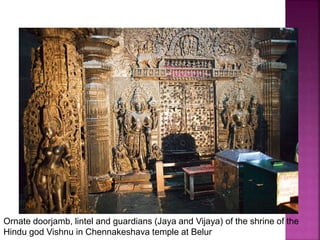
Ornate doorjamb, lintel and guardians (Jaya and Vijaya) of the shrine of the
Hindu god Vishnu in Chennakeshava temple at Belur
Miniature shrines
with Bhumija style
superstructure at
entrance to
Chennakeshava
temple at Belur
Decorative panel comprising miniature towers (aedicule) and Hindu
deities in relief below eves at Chennakeshava temple, Belur
Decorative frieze on moldings at Chennakeshava temple. Belur.

hoysala-architecture-charcteristics.ppt

  • 2.
     Hoysala architectureis the building style developed under the rule of the Hoysala Empire between the 11th and 14th centuries, in the region known today as Karnataka.  Hoysala influence was at its peak in the 13th century, when it dominated the Southern Deccan Plateau region.  Large and small temples built during this era remain as examples of the Hoysala architectural style, including the Chennakesava Temple at Belur, the Hoysaleswara Temple at Halebidu, and the Kesava Temple at Somanathapura.  Study of the Hoysala architectural style has revealed a negligible Indo-Aryan influence while the impact of Southern Indian style is more distinct.  Some three hundred temples are known to survive in present-day Karnataka state and many more are mentioned in inscriptions, though only about seventy have been documented.
  • 3.
  • 4.
  • 5.
    Kesava Temple atSomanathapura.
  • 6.
     The ChennakeshavaTemple, originally called Vijayanarayana Temple, was built on the banks of the Yagachi River in Belur, by the Hoysala Empire King Vishnuvardhana.  Belur, which was an early Hoysala capital, is in the Hassan district of Karnataka state, India.  It is 40 km from Hassan city and 220 km from Bangalore.  Belur is well known for its marvelous temples built during the rule of the Hoysala dynasty, making it and nearby Halebidu favored tourist destinations in Karnataka state.  These temple complexes have been proposed to be listed under UNESCO World Heritage Sites.
  • 7.
  • 8.
    Shrine outer wallwith friezes on vertical sections below eves in Chennakeshava temple at Belur.  The temple was commissioned by King Vishnuvardhana in 1117 AD.
  • 9.
     The mainentrance to the complex is crowned by a Rajagopura (superstructure over entrance) built during the days of the Vijayanagar empire.  Within the complex, the Chennakesava temple is at the centre, facing east, and is flanked by the Kappe Channigraya temple on its right, and a small Sowmyanayaki (form of the goddess Lakshmi) temple set slightly back.  Two main sthambha (pillar) exist here. The pillar facing the main temple, the Garuda (eagle) sthambha was erected in the Vijayanagar period while the pillar on the right, the Deepa sthambha (pillar with lamp) dates from the Hoysala period.  This is the first great Hoysala temple, though according to the art critic and historian Settar, the artistic idiom and signature is still Western Chalukyan. Hence, the over-decoration which is seen in later Hoysala temples (including the Hoysaleswara temple at Halebidu and the Keshava temple at Somanathapura) is not visible here.
  • 10.
     The Chennakesavatemple has three entrances and their doorways have decorated sculptures called dvarapalaka (doorkeepers) on either side.  While the Kappe Channigraya temple is smaller than the Chennakesava temple, it is architecturally significant, though it lacks any sculptural features. Entrance at Chennakesava temple. Rajagopura (superstructure over entrance)
  • 11.
    Decorated Sculptures called Dwarapalaka(Doorkeepers) Garuda Stambha
  • 12.
    The Ranganayaki templeThe Soumyanayaki temple Kappe Chennigaraya temple Compact and ornate Veeranarayana temple
  • 13.
     The buildingmaterial used in the Chennakesava temple is chloritic schist, more commonly known as soapstone or potstone,and is essentially a simple Hoysala plan built with extraordinary detail.  What differentiates this temple from other Hoysala temples of the same plan is the unusually large size of the basic parts of the temple.  The temple is a ekakuta vimana design (single shrine) of 10.5 m by 10.5 m size.  A large vestibule connects the shrine to the mandapa (hall) which is one of the main attractions of the temple. The mandapa has 60 "bays".  The superstructure (tower or Shikhara) on top of the vimana has been lost over time.  The temple is built on a jagati (platform for circumabulation).There is one flight of steps leading to the jagati and another flight of steps to the mantapa.
  • 14.
     The mantapahere was originally an open one. A visitor would have been able to see the ornate pillars of the open mantapa from the platform.  The open mantapa was converted into a closed one after about fifty years, during the Hoysala rule. BEFORE Open Mantapa AFTER Closed Mantapa
  • 16.
     The pillarsinside the hall are an attraction and the most popular one is the Narasimha pillar.  According to the historian Kamath, there is a rich diversity about the pillar styles here.  While all the forty eight pillars are unique and the many ceiling sections are well decorated, nothing surpasses the finish of the four central pillars and the ceiling they support.  These pillars may have been hand chiseled while the others were lathe turned.All of these four pillars bear madanikas.  There are 42 of them in the temple complex, one each on the four central pillars inside the hall and the remaining 38 are outside, between the eaves on the outer walls of the hall.They are also called shilabalika and represent the ideal female form.
  • 17.
  • 18.
    Ornate lathe turnedpillars in mantapa, a standard Hoysala idiom
  • 19.
    Shilabalika in theChennakesava temple at Belur.
  • 20.
     Interesting sculpturesinside the mantapa are Sthamba buttalika (pillar with an image in frieze) which is more in the Chola style indicating that the Hoysalas may have employed Chola craftsman along with locals.  At the base of the outer walls are friezes of charging elephants which symbolize stability and strength, above which are lions which symbolize courage, and further up are horses which symbolize speed. Above the horses are panels with floral designs signifying beauty above which are sculptures with depictions from the Hindu epics, the Ramayana and the Mahabharata.  According to Kamath, this style of articulation is called horizontal treatment with friezes.  The sculptural style of the wall images bear similarities with wall sculptures in contemporary temples of northern Karnataka and adjacent Maharashtra.
  • 21.
  • 22.
  • 23.
    Sun God -Surya Vahara
  • 24.
    Ornate doorjamb, linteland guardians (Jaya and Vijaya) of the shrine of the Hindu god Vishnu in Chennakeshava temple at Belur
  • 25.
    Miniature shrines with Bhumijastyle superstructure at entrance to Chennakeshava temple at Belur
  • 26.
    Decorative panel comprisingminiature towers (aedicule) and Hindu deities in relief below eves at Chennakeshava temple, Belur
  • 27.
    Decorative frieze onmoldings at Chennakeshava temple. Belur.