Hoysala Temples
(Helebid)
B.A. III
Semester IV
Dr.Virag Sontakke
Assistant Professor
A.I.H.C. & Archaeology
Banaras Hindu University,Varanasi
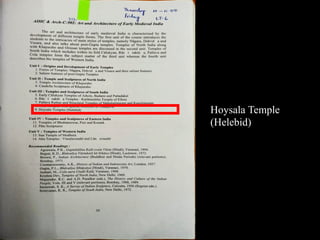
Hoysala Temple
(Helebid)
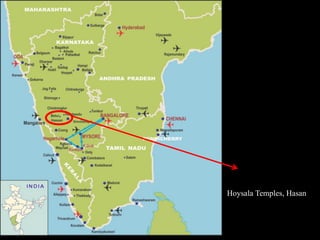
Hoysala Temples, Hasan
Introduction
• The Chalukyans were overthrown by Hoysalas
• The Hoysala period (1026 CE – 1343 CE) was marked by
illustrious achievements in Temple architecture, art, and
culture.
• The nucleus of this activity lay in the Halebidu, Hassan
district of Karnataka.
• The most remarkable accomplishment of this era lies,
undoubtedly, in the field of architecture.
• For 200 years (1100-1300 CE) Hoysala’s constructed too
many temples.
Basic features of the Hoysala Temple
• Multiple Shrine, (one to five )
• Special characteristic features of the Hoyasla temple is the stellate plan.
1. Garbhagriha
2. Antarala (vestibule)
3. Mandapa (a pillared hall known as the navaranga)
• In certain temples there was an open pillared pavilion in front of the Mandapa
referred to as Mukhamandapa.
• Greenish or bluish-black chloritic schist (soapstone) which is much finer
grains. Helpful for intricate carving and decoration
• Temples are stand on high platform
• No square or rectangular on plan
• No Pradakshina Path
• Intricate carving : work of Ivory, Sandalwood, Goldsmith, silver filigree
Basic Elements of the Hoysala Temple
• Sometimes, the Hoysala temple consisted of double, triple, quadruple
and even quintuple garbhagriha.
• Generally the plinth plan was star-shaped,
• The typical Hoysala temple rested on a platform or jagati which was
harmonious with star-shaped nature of the constructions.
• This feature was of immense architectural value for it gave some
sense of height to the temple।
• Mandapa, Pillared hall, Navranga
• Multiple entrances from the platform into the Navranga.
• Nandi mandapa containing a large stone bull.
• Basically situated outside the building and opposite to each shrine
on the east.
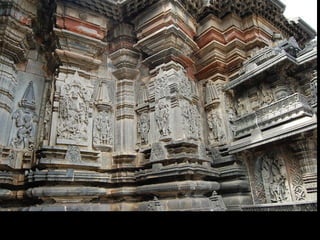
Architecture treatment of the walls
• Lack of Shikhra (not survived)
• Horizontal walls of the structure
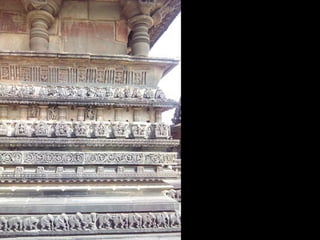
• At the basement (adhisthan 9-10”) of the temple on the platform there
were a number of bands displaying animate sculptured designs, which
ran right round the temple
1. Gajathara
2. Horsemen
3. Floral scroll
4. Kirtimukh
5. Goose
6. Yuli
• The wall surface in order to attain the play of light and shade, and also
to furnish more space for the decorative sculpture
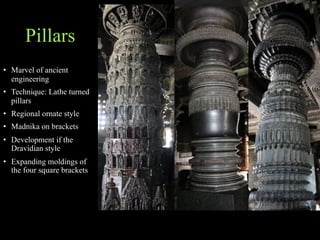
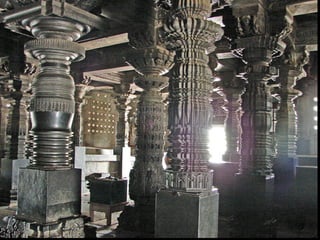
Pillars
• Marvel of ancient
engineering
• Technique: Lathe turned
pillars
• Regional ornate style
• Madnika on brackets
• Development if the
Dravidian style
• Expanding moldings of
the four square brackets
Decorative Aspect
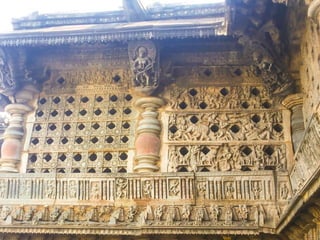
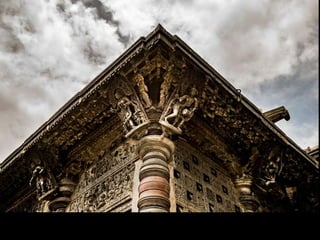
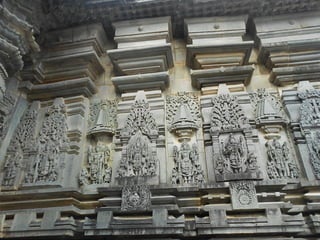
• Ornate niches consist elaborately chiselled images of the
gods within them.
• In decorating these temples the Hoysala sculptor
concentrated only on the exterior surface by varying specific
forms.
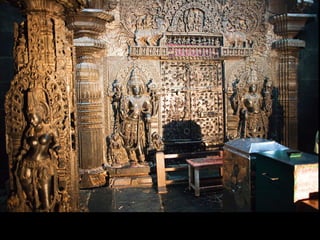
• The Interior walls of the temple were generally left
undecorated.
• A vestibule to the shrine was Indicated by the Sukanasi (a
parrots beak) projection at the front of the shikhara.
• Another significant aspect of the style was the lathe-turned
pillars with their distinctive shape, design and variety.
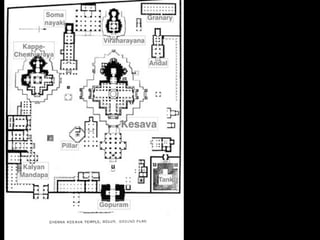
Channa Keshav Temple
• Channa Keshav Temple situated in Belur of Hasan District.
• Constructed in 1117 CE. (Percy Brown)
• Build by Vishnuvardhan to commemorates the Victory over Chola
• Deity called Vijay Narayan, Channa Keshav Temple: handsome Kesava ,
contemporary to Ramanuja.
• Enclosed in Prakara
• It was repeatedly damaged and plundered during wars, repeatedly rebuilt and
repaired over its history.
• Total 118 inscriptions found in the temple complex, dated between 1117 CE to the
18th century, which provide a history of the temple,
• The temple was raided, damaged and its gateway was burnt down in a raid by a
Muslim general Salar and his army working for Muhammed bin Tughlaq (1324-
1351)
• The temple was repaired by the later dynasties
• The complex has a number of shrines.
Basic elements
• Channa Keshav Temple temple is a ekakuta style.
• Size of the temple of 10.5 m by 10.5 m size.
1. Mandapa Antarala
2. Garbhgriha
• Temple stands on high ornamental adhisthan which is open and
wide also act as circumambulatory path around the sanctum.
• Flight of steps leading to the Jagati and
• The Jagati (platform) follows the staggered square design of
the temple mandapa and the star shape of the shrine.
• Also another flight of steps into the mandapa.
• Intricate and abundant artwork both on the outside and inside the
temple.
Mandapa
• Mandapa entry from 3 sides (North, south, East)
• The Mandapa has forty eight pillars.
• Doorways of Mandapa are decorated with dvarapalaka on
either side.
• Initially porch like appearance
• Later Ballal II added pierced stone windows
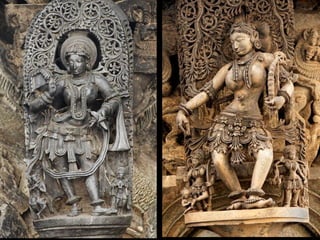
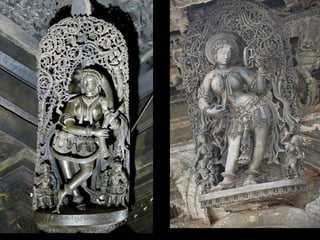
• 40 Madnikas (female sculptures) are shown in pillar
Brackets
• The Madnikas are in various poses like dancing, acting
posture, musicians, dressing, doing make up, a woman with
a parrot, dressing hair etc.
• The navaranga in Kesava temple is the largest of any
Hoysala temple.
Garbhagriha
• The mandapa leads to the Garbhagriha.
• Garbhagriha door flanked by Dwarapala,
• Inside the Garbhagriha the image of Keshava, stands on a
3 feet high platform.
• The temple had a Shikhara, which was damaged and
destroyed
Outer Decoration
• Elaborately Carved
• The bottom band is of elephants
• Above it is an plain layer, followed by cornice work with a
periodic lion face
• Over that a row of horsemen in various riding positions
• Small figurines is a fifth band (female, dancers and
Musicians)
• The bands above pilasters are carved with females and
couples, scenes of the epic Ramayana and Mahabharata,
eroticism and sexual scenes, daily activities of people,
Sculptures
• The temple consist 80 large icons around the
temple.
1. Vishnu 32
2. Avatar 9
3. Shiva 4
4. Surya 4
5. Durga 5
6. Others
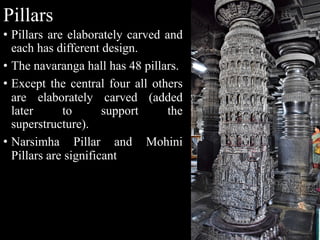
Pillars
• Pillars are elaborately carved and
each has different design.
• The navaranga hall has 48 pillars.
• Except the central four all others
are elaborately carved (added
later to support the
superstructure).
• Narsimha Pillar and Mohini
Pillars are significant
Hoysalesvara Temple at Halebid
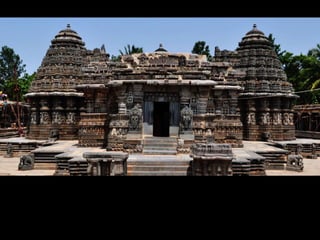
• Hoysalesvara Temple is situated in a small town Halebid.
• It is almost 30 km from Hassan and 210 km from
Bangalore.
• Its stands intact among the ruins of the great city of
Darasamudra, the capital of the Hoysala empire,
• Being the largest monument of the place and perhaps the
greatest ever constructed in Dorasamudra.
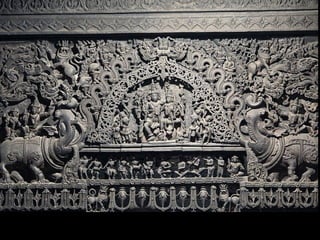
• It is rightly be regarded as a veritable museum of
sculpture; with its thousands of large and small carved
figures.
• These figures depict the condition of art and life during
the reign of the Hoysalas.
• This temple is the largest existing structure of the Hoysala
style.
Backdrop
• Its construction started around 1121 CE and was complete
in 1160 CE.
• Temple dedicated to Shiva
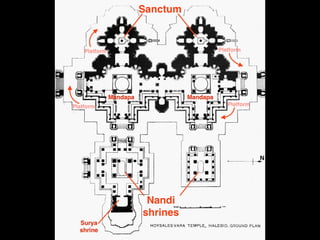
• Dwikuta vimana (plan of twin shrines and two
superstructures)
• Twin Garbhgiha dedicated to the Hoysalesvara and
Santalesvara Lingas.
• The two temples are of the same size, and their sanctums
open to the east,
• Front of the temple has two Nandi Mandapa outside,
Elements
The two sanctums are next to each other in a north-south alignment
1. Cruciform on Plan (four entrances)
2. Girbhgrha (twin)
3. Antaral
4. Mandap (Navrang)
5. Nandi Mandap
6. Share joint platform (15 feet high)
7. No Pradakshina Path
8. Entry from Hoysalesvara Temple
9. Main temple, connected by stone stairs
10. Shikhra now lost must have followed the star shape design of the
shrine.
11. Shuknasika over the Antarala (missing)
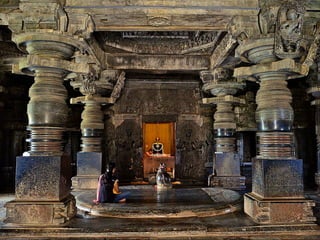
• Both Garbhagriha are of equal size.
• Has three niches on the north, west and south
• The entrance are flanked by dwarapala
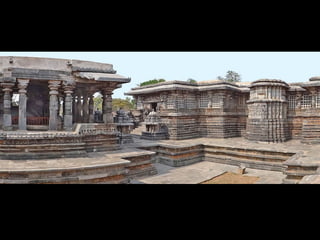
• This large temple built entirely of greyish soapstone is situated on a
high platform
• The temple originally had an open Mandapa, the mantapa was closed
by Hoysala king Narasimha I.
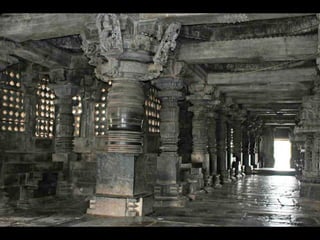
• The interior walls of the temple are quite plain compared to the outer
wall,
• Their outer walls are star-shaped
• There are large niches to the south, west and north of each Garbhagriha
on the interior.
• The pillars are ornate have the Madnikas sculptures in their pillar
brackets.
• Corresponding to these can be seen tall two-storeyed towered niches on
the exterior.
Art
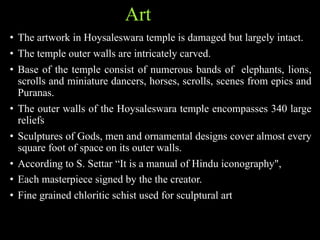
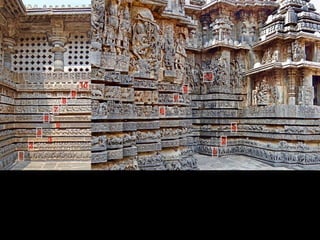
• The artwork in Hoysaleswara temple is damaged but largely intact.
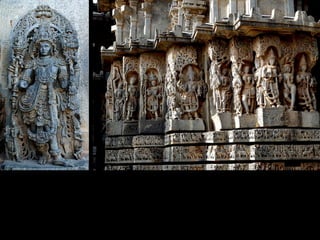
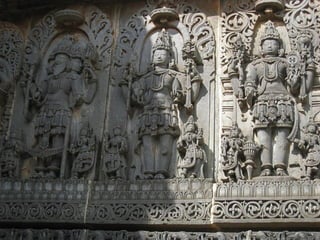
• The temple outer walls are intricately carved.
• Base of the temple consist of numerous bands of elephants, lions,
scrolls and miniature dancers, horses, scrolls, scenes from epics and
Puranas.
• The outer walls of the Hoysaleswara temple encompasses 340 large
reliefs
• Sculptures of Gods, men and ornamental designs cover almost every
square foot of space on its outer walls.
• According to S. Settar “It is a manual of Hindu iconography",
• Each masterpiece signed by the the creator.
• Fine grained chloritic schist used for sculptural art
• It seems that the original structure was composed of two
temples, each of which had an almost similar plan to that of
the Kesava temple at Belur, with nearly the same
dimension.
• Each Grabhagriha had a star shape, while the Navaranga
had straight walls at the back.
• The Navaranga halls is square-shaped.
• Doorways ones guarding the Garbhagrihas.
• There were pillars supporting the eastern half of the
building above the basement and railings.
• These temple must have been a majestic and beautiful
monument, worthy of being the greatest ever, in the imperial
capital.
• Upapitha platform served the purpose of Padrakshina Path
• Great technical skill has been displayed by the sculptor.
• These temples are testimony to the artistic, cultural and
theological perspectives in 12th century South India and the
Hoysala Empire rule.
Conclusion
Pala Sculptures
Pala Sculptures
Introduction
• Pala ruled for more than four hundred years of Pala rule
(8th-12th century CE)
• Pala empire was founded by Gopala in 750 CE.
• The Pala empire was consist eastern part of India
basically Bengal and Bihar.
• The major cities and centers of those times were
Vikramshila, Nalanda, Tamralipta etc.
• They were followers of the Buddhisam, particularly
Tantric schools.
• They built grand temples , monasteries and Universities
• The Pala period is considered one of the golden eras of
eastern India.
Beginning
• Pala sculpture derives its origins from the late Gupta.
• Subsequently deviated from it and established its own style.
• Known as Pala style.
• A large number of early sculptures recovered from Nalanda,
Kurkihar, Bodh-Gaya, and other ancient sites of Magadha
and Bengal.
• Also called as Magadh Style, Vang Style and Eastern Indian
style according to their geographical occurrence.
Source and Subject of the Sculptures
Sr
No
Subject Deities
1 Brahmani
cal
Shaiv, Vaishnav, Sakt
2 Buddha Avlokiteshwar, Tara
3 Jain Tirthankaras
• Source
1. Sadhanmala: main
source of
iconographic rules
2. Shilpshatra
Places of obtaining:
1. Nalanda
2. Bodhgaya
3. Rajgruha
4. Kurkihar
5. Bhagalpur
6. Dinajpur
7. Pahadpur
8. Rajshahi
9. Bengal
10. Bihar
11. Bangladeah
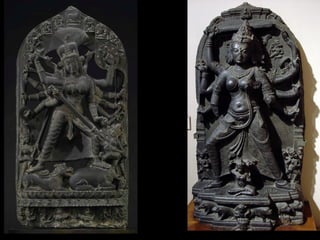
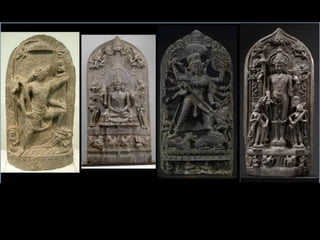
Features
• Face is circular and oval
• Soft facial features
• Deity figures are rigid in posture
• Broad Shoulders
• Often standing with straight legs close together
• Sculptures are shown heavily loaded with jewellery
• Usually have multiple arms
• They hold many attributes and
• Bearing various Mudras
• Clear muscle structure
• Main figure, surrounded by smaller attendant figures
• Emphasis was given on the minute carving
• Too much decoration on crown, excessive ornamentation
• Sculptures are standing and seating (Kamlasan)
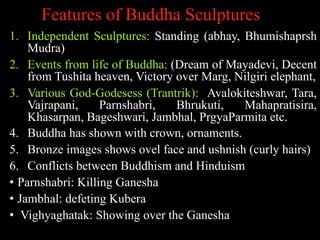
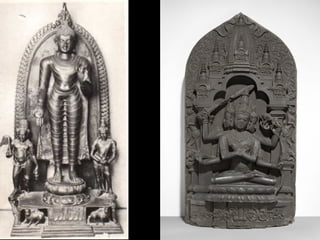
Features of Buddha Sculptures
1. Independent Sculptures: Standing (abhay, Bhumishaprsh
Mudra)
2. Events from life of Buddha: (Dream of Mayadevi, Decent
from Tushita heaven, Victory over Marg, Nilgiri elephant,
3. Various God-Godesess (Trantrik): Avalokiteshwar, Tara,
Vajrapani, Parnshabri, Bhrukuti, Mahapratisira,
Khasarpan, Bageshwari, Jambhal, PrgyaParmita etc.
4. Buddha has shown with crown, ornaments.
5. Bronze images shows ovel face and ushnish (curly hairs)
6. Conflicts between Buddhism and Hinduism
• Parnshabri: Killing Ganesha
• Jambhal: defeting Kubera
• Vighyaghatak: Showing over the Ganesha
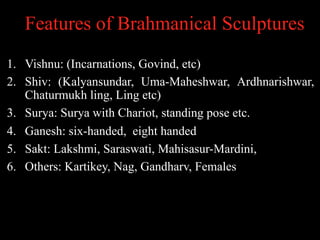
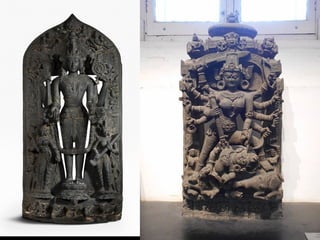
Features of Brahmanical Sculptures
1. Vishnu: (Incarnations, Govind, etc)
2. Shiv: (Kalyansundar, Uma-Maheshwar, Ardhnarishwar,
Chaturmukh ling, Ling etc)
3. Surya: Surya with Chariot, standing pose etc.
4. Ganesh: six-handed, eight handed
5. Sakt: Lakshmi, Saraswati, Mahisasur-Mardini,
6. Others: Kartikey, Nag, Gandharv, Females
Features of Jain Sculptures
• Limited sculptures as compare to Brahmanical and
Buddhist.
• Mainly Jain Tirthankaras
• Standing and seating position
Sculptural Development
1. 8th Century: The images in these sculptures show same stockiness
of body form and similar ornamentation.
2. 9th Century: in this period tendency was fullness of figures. The
images, mostly carved in black stone, impression of soft-textured
flesh and skin.
3. 10th Century: All the male figures have massive body forms,
Almost all the specimens are moulded in high relief.
4. 11th Century: Brahmanical sculptures produced increased. The art
products are marked by the complete assimilation of the different
traits of the local plastic art.
5. 12th Century: Limited sculptures period are mostly stereotyped and
may be regarded as products of a decadent phase
Conclusion
• Produced Buddhist, Bramhanical and Jain sculptures
• Pala sculpture began as a simple and genuine expression of
religious experience
• Although the figures in the early sculptures were heavy,
they were easy moving and exhibit good modelling
quality.
• In the 10th century, costumes and jewellery as well as the
background decoration began to increase slowly.
• The figure became slightly elongated but due emphasis
was paid on the plastic significance of the body form.
• Influence of Pala art can be seen on the sculptures of
South-East Asia.

Hoysala Temples Halebid

  • 1.
    Hoysala Temples (Helebid) B.A. III SemesterIV Dr.Virag Sontakke Assistant Professor A.I.H.C. & Archaeology Banaras Hindu University,Varanasi
  • 2.
  • 3.
  • 4.
    Introduction • The Chalukyanswere overthrown by Hoysalas • The Hoysala period (1026 CE – 1343 CE) was marked by illustrious achievements in Temple architecture, art, and culture. • The nucleus of this activity lay in the Halebidu, Hassan district of Karnataka. • The most remarkable accomplishment of this era lies, undoubtedly, in the field of architecture. • For 200 years (1100-1300 CE) Hoysala’s constructed too many temples.
  • 5.
    Basic features ofthe Hoysala Temple • Multiple Shrine, (one to five ) • Special characteristic features of the Hoyasla temple is the stellate plan. 1. Garbhagriha 2. Antarala (vestibule) 3. Mandapa (a pillared hall known as the navaranga) • In certain temples there was an open pillared pavilion in front of the Mandapa referred to as Mukhamandapa. • Greenish or bluish-black chloritic schist (soapstone) which is much finer grains. Helpful for intricate carving and decoration • Temples are stand on high platform • No square or rectangular on plan • No Pradakshina Path • Intricate carving : work of Ivory, Sandalwood, Goldsmith, silver filigree
  • 6.
    Basic Elements ofthe Hoysala Temple • Sometimes, the Hoysala temple consisted of double, triple, quadruple and even quintuple garbhagriha. • Generally the plinth plan was star-shaped, • The typical Hoysala temple rested on a platform or jagati which was harmonious with star-shaped nature of the constructions. • This feature was of immense architectural value for it gave some sense of height to the temple। • Mandapa, Pillared hall, Navranga • Multiple entrances from the platform into the Navranga. • Nandi mandapa containing a large stone bull. • Basically situated outside the building and opposite to each shrine on the east.
  • 7.
    Architecture treatment ofthe walls • Lack of Shikhra (not survived) • Horizontal walls of the structure • At the basement (adhisthan 9-10”) of the temple on the platform there were a number of bands displaying animate sculptured designs, which ran right round the temple 1. Gajathara 2. Horsemen 3. Floral scroll 4. Kirtimukh 5. Goose 6. Yuli • The wall surface in order to attain the play of light and shade, and also to furnish more space for the decorative sculpture
  • 9.
    Pillars • Marvel ofancient engineering • Technique: Lathe turned pillars • Regional ornate style • Madnika on brackets • Development if the Dravidian style • Expanding moldings of the four square brackets
  • 10.
    Decorative Aspect • Ornateniches consist elaborately chiselled images of the gods within them. • In decorating these temples the Hoysala sculptor concentrated only on the exterior surface by varying specific forms. • The Interior walls of the temple were generally left undecorated. • A vestibule to the shrine was Indicated by the Sukanasi (a parrots beak) projection at the front of the shikhara. • Another significant aspect of the style was the lathe-turned pillars with their distinctive shape, design and variety.
  • 12.
    Channa Keshav Temple •Channa Keshav Temple situated in Belur of Hasan District. • Constructed in 1117 CE. (Percy Brown) • Build by Vishnuvardhan to commemorates the Victory over Chola • Deity called Vijay Narayan, Channa Keshav Temple: handsome Kesava , contemporary to Ramanuja. • Enclosed in Prakara • It was repeatedly damaged and plundered during wars, repeatedly rebuilt and repaired over its history. • Total 118 inscriptions found in the temple complex, dated between 1117 CE to the 18th century, which provide a history of the temple, • The temple was raided, damaged and its gateway was burnt down in a raid by a Muslim general Salar and his army working for Muhammed bin Tughlaq (1324- 1351) • The temple was repaired by the later dynasties • The complex has a number of shrines.
  • 14.
    Basic elements • ChannaKeshav Temple temple is a ekakuta style. • Size of the temple of 10.5 m by 10.5 m size. 1. Mandapa Antarala 2. Garbhgriha • Temple stands on high ornamental adhisthan which is open and wide also act as circumambulatory path around the sanctum. • Flight of steps leading to the Jagati and • The Jagati (platform) follows the staggered square design of the temple mandapa and the star shape of the shrine. • Also another flight of steps into the mandapa. • Intricate and abundant artwork both on the outside and inside the temple.
  • 15.
    Mandapa • Mandapa entryfrom 3 sides (North, south, East) • The Mandapa has forty eight pillars. • Doorways of Mandapa are decorated with dvarapalaka on either side. • Initially porch like appearance • Later Ballal II added pierced stone windows • 40 Madnikas (female sculptures) are shown in pillar Brackets • The Madnikas are in various poses like dancing, acting posture, musicians, dressing, doing make up, a woman with a parrot, dressing hair etc. • The navaranga in Kesava temple is the largest of any Hoysala temple.
  • 17.
    Garbhagriha • The mandapaleads to the Garbhagriha. • Garbhagriha door flanked by Dwarapala, • Inside the Garbhagriha the image of Keshava, stands on a 3 feet high platform. • The temple had a Shikhara, which was damaged and destroyed
  • 18.
    Outer Decoration • ElaboratelyCarved • The bottom band is of elephants • Above it is an plain layer, followed by cornice work with a periodic lion face • Over that a row of horsemen in various riding positions • Small figurines is a fifth band (female, dancers and Musicians) • The bands above pilasters are carved with females and couples, scenes of the epic Ramayana and Mahabharata, eroticism and sexual scenes, daily activities of people,
  • 19.
    Sculptures • The templeconsist 80 large icons around the temple. 1. Vishnu 32 2. Avatar 9 3. Shiva 4 4. Surya 4 5. Durga 5 6. Others
  • 20.
    Pillars • Pillars areelaborately carved and each has different design. • The navaranga hall has 48 pillars. • Except the central four all others are elaborately carved (added later to support the superstructure). • Narsimha Pillar and Mohini Pillars are significant
  • 28.
    Hoysalesvara Temple atHalebid • Hoysalesvara Temple is situated in a small town Halebid. • It is almost 30 km from Hassan and 210 km from Bangalore. • Its stands intact among the ruins of the great city of Darasamudra, the capital of the Hoysala empire, • Being the largest monument of the place and perhaps the greatest ever constructed in Dorasamudra. • It is rightly be regarded as a veritable museum of sculpture; with its thousands of large and small carved figures. • These figures depict the condition of art and life during the reign of the Hoysalas. • This temple is the largest existing structure of the Hoysala style.
  • 30.
    Backdrop • Its constructionstarted around 1121 CE and was complete in 1160 CE. • Temple dedicated to Shiva • Dwikuta vimana (plan of twin shrines and two superstructures) • Twin Garbhgiha dedicated to the Hoysalesvara and Santalesvara Lingas. • The two temples are of the same size, and their sanctums open to the east, • Front of the temple has two Nandi Mandapa outside,
  • 33.
    Elements The two sanctumsare next to each other in a north-south alignment 1. Cruciform on Plan (four entrances) 2. Girbhgrha (twin) 3. Antaral 4. Mandap (Navrang) 5. Nandi Mandap 6. Share joint platform (15 feet high) 7. No Pradakshina Path 8. Entry from Hoysalesvara Temple 9. Main temple, connected by stone stairs 10. Shikhra now lost must have followed the star shape design of the shrine. 11. Shuknasika over the Antarala (missing)
  • 36.
    • Both Garbhagrihaare of equal size. • Has three niches on the north, west and south • The entrance are flanked by dwarapala • This large temple built entirely of greyish soapstone is situated on a high platform • The temple originally had an open Mandapa, the mantapa was closed by Hoysala king Narasimha I. • The interior walls of the temple are quite plain compared to the outer wall, • Their outer walls are star-shaped • There are large niches to the south, west and north of each Garbhagriha on the interior. • The pillars are ornate have the Madnikas sculptures in their pillar brackets. • Corresponding to these can be seen tall two-storeyed towered niches on the exterior.
  • 37.
    Art • The artworkin Hoysaleswara temple is damaged but largely intact. • The temple outer walls are intricately carved. • Base of the temple consist of numerous bands of elephants, lions, scrolls and miniature dancers, horses, scrolls, scenes from epics and Puranas. • The outer walls of the Hoysaleswara temple encompasses 340 large reliefs • Sculptures of Gods, men and ornamental designs cover almost every square foot of space on its outer walls. • According to S. Settar “It is a manual of Hindu iconography", • Each masterpiece signed by the the creator. • Fine grained chloritic schist used for sculptural art
  • 41.
    • It seemsthat the original structure was composed of two temples, each of which had an almost similar plan to that of the Kesava temple at Belur, with nearly the same dimension. • Each Grabhagriha had a star shape, while the Navaranga had straight walls at the back. • The Navaranga halls is square-shaped. • Doorways ones guarding the Garbhagrihas. • There were pillars supporting the eastern half of the building above the basement and railings.
  • 42.
    • These templemust have been a majestic and beautiful monument, worthy of being the greatest ever, in the imperial capital. • Upapitha platform served the purpose of Padrakshina Path • Great technical skill has been displayed by the sculptor. • These temples are testimony to the artistic, cultural and theological perspectives in 12th century South India and the Hoysala Empire rule. Conclusion
  • 43.
  • 44.
  • 45.
    Introduction • Pala ruledfor more than four hundred years of Pala rule (8th-12th century CE) • Pala empire was founded by Gopala in 750 CE. • The Pala empire was consist eastern part of India basically Bengal and Bihar. • The major cities and centers of those times were Vikramshila, Nalanda, Tamralipta etc. • They were followers of the Buddhisam, particularly Tantric schools. • They built grand temples , monasteries and Universities • The Pala period is considered one of the golden eras of eastern India.
  • 46.
    Beginning • Pala sculpturederives its origins from the late Gupta. • Subsequently deviated from it and established its own style. • Known as Pala style. • A large number of early sculptures recovered from Nalanda, Kurkihar, Bodh-Gaya, and other ancient sites of Magadha and Bengal. • Also called as Magadh Style, Vang Style and Eastern Indian style according to their geographical occurrence.
  • 47.
    Source and Subjectof the Sculptures Sr No Subject Deities 1 Brahmani cal Shaiv, Vaishnav, Sakt 2 Buddha Avlokiteshwar, Tara 3 Jain Tirthankaras • Source 1. Sadhanmala: main source of iconographic rules 2. Shilpshatra Places of obtaining: 1. Nalanda 2. Bodhgaya 3. Rajgruha 4. Kurkihar 5. Bhagalpur 6. Dinajpur 7. Pahadpur 8. Rajshahi 9. Bengal 10. Bihar 11. Bangladeah
  • 48.
    Features • Face iscircular and oval • Soft facial features • Deity figures are rigid in posture • Broad Shoulders • Often standing with straight legs close together • Sculptures are shown heavily loaded with jewellery • Usually have multiple arms • They hold many attributes and • Bearing various Mudras • Clear muscle structure • Main figure, surrounded by smaller attendant figures • Emphasis was given on the minute carving • Too much decoration on crown, excessive ornamentation • Sculptures are standing and seating (Kamlasan)
  • 49.
    Features of BuddhaSculptures 1. Independent Sculptures: Standing (abhay, Bhumishaprsh Mudra) 2. Events from life of Buddha: (Dream of Mayadevi, Decent from Tushita heaven, Victory over Marg, Nilgiri elephant, 3. Various God-Godesess (Trantrik): Avalokiteshwar, Tara, Vajrapani, Parnshabri, Bhrukuti, Mahapratisira, Khasarpan, Bageshwari, Jambhal, PrgyaParmita etc. 4. Buddha has shown with crown, ornaments. 5. Bronze images shows ovel face and ushnish (curly hairs) 6. Conflicts between Buddhism and Hinduism • Parnshabri: Killing Ganesha • Jambhal: defeting Kubera • Vighyaghatak: Showing over the Ganesha
  • 51.
    Features of BrahmanicalSculptures 1. Vishnu: (Incarnations, Govind, etc) 2. Shiv: (Kalyansundar, Uma-Maheshwar, Ardhnarishwar, Chaturmukh ling, Ling etc) 3. Surya: Surya with Chariot, standing pose etc. 4. Ganesh: six-handed, eight handed 5. Sakt: Lakshmi, Saraswati, Mahisasur-Mardini, 6. Others: Kartikey, Nag, Gandharv, Females
  • 53.
    Features of JainSculptures • Limited sculptures as compare to Brahmanical and Buddhist. • Mainly Jain Tirthankaras • Standing and seating position
  • 56.
    Sculptural Development 1. 8thCentury: The images in these sculptures show same stockiness of body form and similar ornamentation. 2. 9th Century: in this period tendency was fullness of figures. The images, mostly carved in black stone, impression of soft-textured flesh and skin. 3. 10th Century: All the male figures have massive body forms, Almost all the specimens are moulded in high relief. 4. 11th Century: Brahmanical sculptures produced increased. The art products are marked by the complete assimilation of the different traits of the local plastic art. 5. 12th Century: Limited sculptures period are mostly stereotyped and may be regarded as products of a decadent phase
  • 57.
    Conclusion • Produced Buddhist,Bramhanical and Jain sculptures • Pala sculpture began as a simple and genuine expression of religious experience • Although the figures in the early sculptures were heavy, they were easy moving and exhibit good modelling quality. • In the 10th century, costumes and jewellery as well as the background decoration began to increase slowly. • The figure became slightly elongated but due emphasis was paid on the plastic significance of the body form. • Influence of Pala art can be seen on the sculptures of South-East Asia.