MySQL stuff
About me
• Before REA I worked for a hosting company for 4
years
• Learnt a lot about MySQL during this period
• I started as an OPS engineer at REA and did some
database stuff here
• I havent done much MySQL for two years
!
• In this period we’ve had
• MySQL 5.6 come out
• RDS MySQL improvements
!
!
Today
• High level overview of MySQL
• Look inside MySQL server
• Talk through how InnoDB performs queries
• Schema changes and online schema changes
!
!
Background
• Second biggest relational database in the world
• Anyone know what the biggest is?
!
• Used by many of the big web shops
• Facebook for all feed data
• Etsy for user & data
• Twitter for tweet persistence
• …
!
• Sun bought MySQL AB in 2008, people freaked out
• Oracle bought Sun in 2010, people freaked out
• Big improvements over the past few years (5.5 / 5.6)
!
How it works
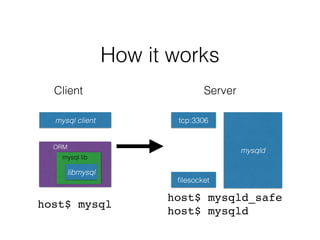
mysqld
mysql client tcp:3306
filesocket
ServerClient
libmysql
mysql lib
ORM
host$ mysql
host$ mysqld_safe!
host$ mysqld
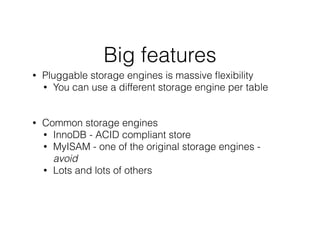
Big features
• Pluggable storage engines is massive flexibility
• You can use a different storage engine per table
!
!
• Common storage engines
• InnoDB - ACID compliant store
• MyISAM - one of the original storage engines -
avoid
• Lots and lots of others
!
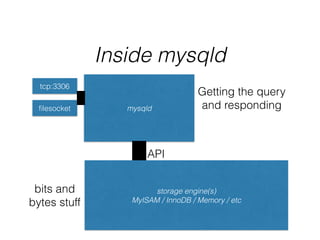
Inside mysqld
mysqld
storage engine(s)
MyISAM / InnoDB / Memory / etc
tcp:3306
filesocket
Getting the query
and responding
bits and
bytes stuff
API
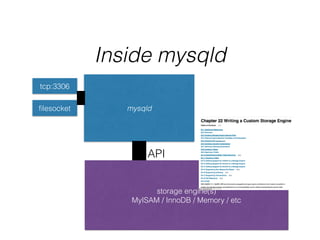
Inside mysqld
mysqld
storage engine(s)
MyISAM / InnoDB / Memory / etc
tcp:3306
filesocket
API
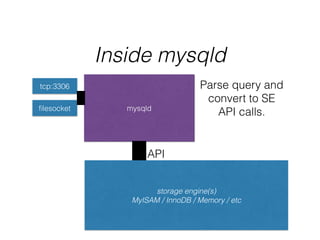
Inside mysqld
mysqld
storage engine(s)
MyISAM / InnoDB / Memory / etc
tcp:3306
filesocket
Parse query and
convert to SE
API calls.
API
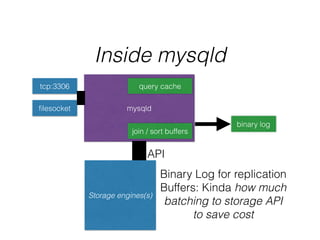
Inside mysqld
mysqld
Storage engines(s)
tcp:3306
filesocket
API
query cache
binary log
join / sort buffers
Binary Log for replication
Buffers: Kinda how much
batching to storage API
to save cost
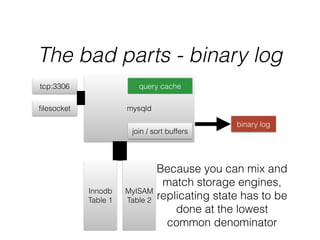
The bad parts - binary log
mysqld
tcp:3306
filesocket
query cache
binary log
join / sort buffers
Because you can mix and
match storage engines,
replicating state has to be
done at the lowest
common denominator
Innodb
Table 1
MyISAM
Table 2
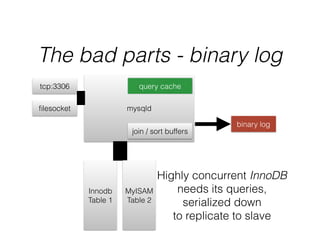
The bad parts - binary log
mysqld
Innodb
Table 1
tcp:3306
filesocket
query cache
binary log
join / sort buffers
Highly concurrent InnoDB
needs its queries,
serialized down
to replicate to slave
MyISAM
Table 2
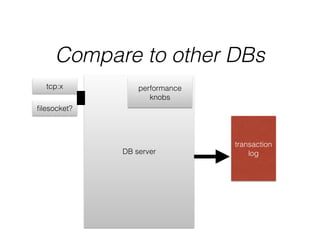
Compare to other DBs
DB server
tcp:x
filesocket?
performance
knobs
transaction
log
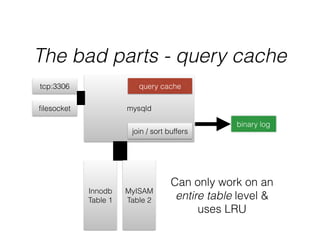
The bad parts - query cache
mysqld
Innodb
Table 1
tcp:3306
filesocket
query cache
binary log
join / sort buffers
Can only work on an
entire table level &
uses LRU
MyISAM
Table 2
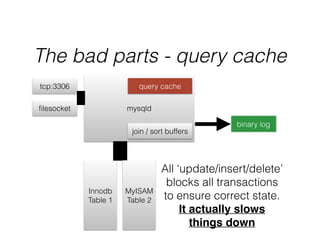
The bad parts - query cache
mysqld
Innodb
Table 1
tcp:3306
filesocket
query cache
binary log
join / sort buffers
All ‘update/insert/delete’
blocks all transactions
to ensure correct state.
It actually slows !
things down
MyISAM
Table 2
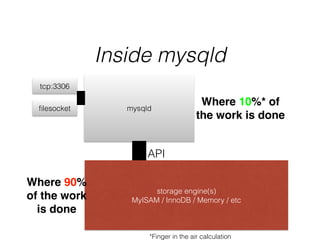
Inside mysqld
mysqld
storage engine(s)
MyISAM / InnoDB / Memory / etc
tcp:3306
filesocket
API
Where 10%* of !
the work is done
Where 90% !
of the work !
is done
*Finger in the air calculation
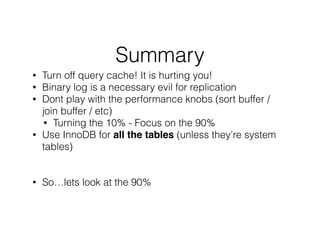
Summary
• Turn off query cache! It is hurting you!
• Binary log is a necessary evil for replication
• Dont play with the performance knobs (sort buffer /
join buffer / etc)
• Turning the 10% - Focus on the 90%
• Use InnoDB for all the tables (unless they’re system
tables)
!
!
• So…lets look at the 90%
!
!
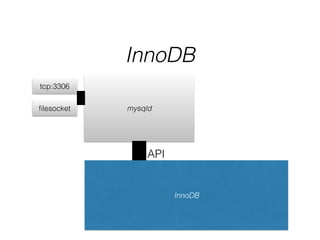
InnoDB
mysqld
InnoDB
tcp:3306
filesocket
API
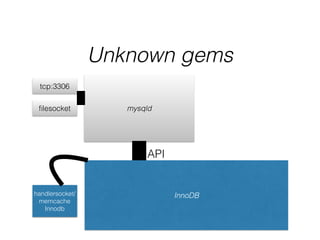
Unknown gems
mysqld
InnoDB
tcp:3306
filesocket
API
handlersocket/
memcache
Innodb
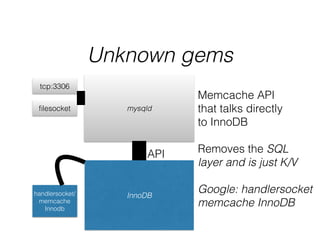
Unknown gems
mysqld
InnoDB
tcp:3306
filesocket
API
handlersocket/
memcache
Innodb
Memcache API
that talks directly
to InnoDB
!
Removes the SQL
layer and is just K/V
!
Google: handlersocket
memcache InnoDB
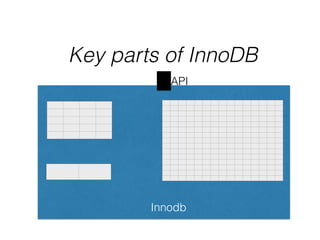
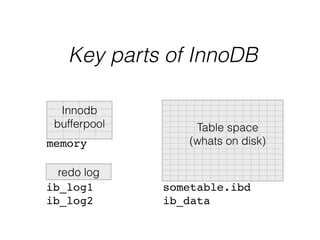
Key parts of InnoDB
Innodb
API
Key parts of InnoDB
Table space
(whats on disk)
redo log
Innodb
bufferpool
memory!
ib_log1!
ib_log2!
sometable.ibd!
ib_data!
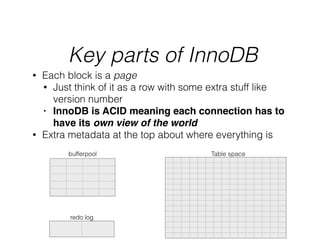
Key parts of InnoDB
Table space
redo log
bufferpool
• Each block is a page
• Just think of it as a row with some extra stuff like
version number
• InnoDB is ACID meaning each connection has to
have its own view of the world!
• Extra metadata at the top about where everything is
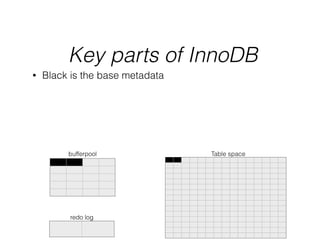
Key parts of InnoDB
Table space
redo log
bufferpool
• Black is the base metadata
What is bufferpool
Table space
redo log
bufferpool
• In memory version of hot tablespace pages
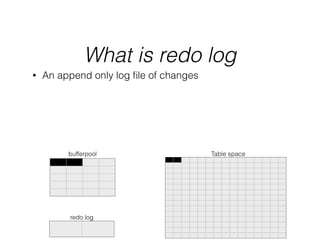
What is redo log
Table space
redo log
bufferpool
• An append only log file of changes
What is table space
Table space
redo log
bufferpool
• The raw files - but it may not be always up-to-date
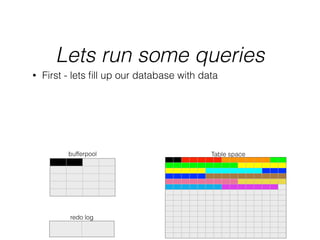
Lets run some queries
Table space
redo log
bufferpool
• First - lets fill up our database with data
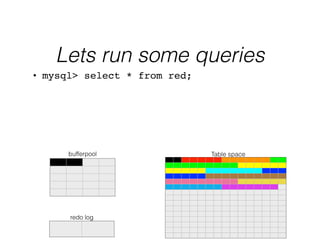
Lets run some queries
Table space
redo log
bufferpool
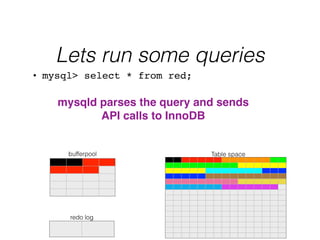
• mysql> select * from red;
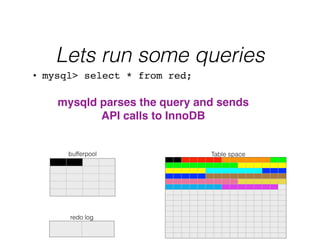
Lets run some queries
Table space
redo log
bufferpool
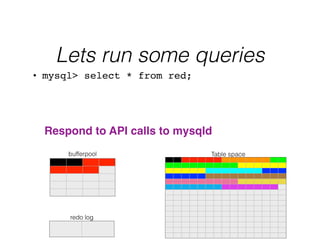
• mysql> select * from red;
mysqld parses the query and sends !
API calls to InnoDB
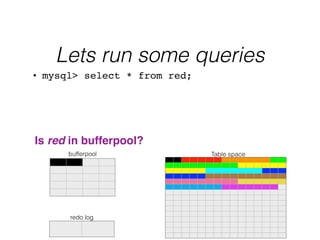
Lets run some queries
Table space
redo log
bufferpool
• mysql> select * from red;
Is red in bufferpool?
Lets run some queries
Table space
redo log
bufferpool
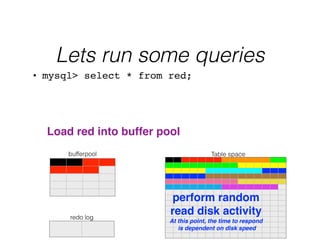
• mysql> select * from red;
Load red into buffer pool
perform random !
read disk activity!
At this point, the time to respond!
is dependent on disk speed!
Lets run some queries
Table space
redo log
bufferpool
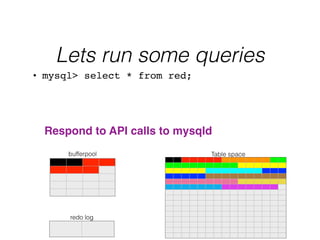
• mysql> select * from red;
Respond to API calls to mysqld
Lets run some queries
Table space
redo log
bufferpool
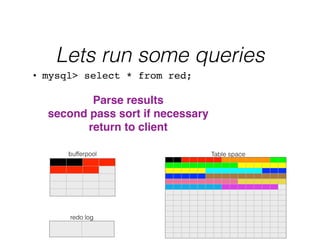
• mysql> select * from red;
Parse results !
second pass sort if necessary !
return to client
Lets run some queries
Table space
redo log
bufferpool
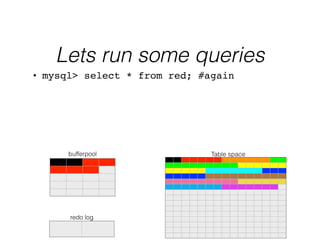
• mysql> select * from red; #again
Lets run some queries
Table space
redo log
bufferpool
• mysql> select * from red;
mysqld parses the query and sends !
API calls to InnoDB
Lets run some queries
Table space
redo log
bufferpool
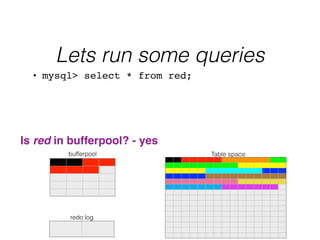
• mysql> select * from red;
Is red in bufferpool? - yes
Lets run some queries
Table space
redo log
bufferpool
• mysql> select * from red;
Respond to API calls to mysqld
Lets run some queries
Table space
redo log
bufferpool
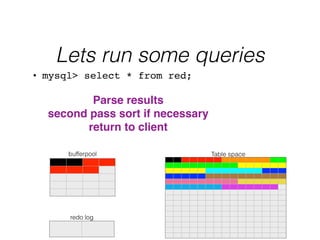
• mysql> select * from red;
Parse results !
second pass sort if necessary !
return to client
Lets run some queries
Table space
redo log
bufferpool
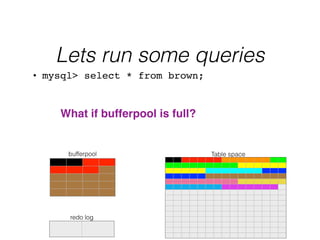
• mysql> select * from brown;
What if bufferpool is full?
Lets run some queries
Table space
redo log
bufferpool
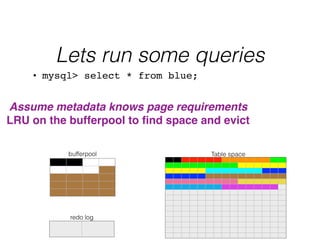
• mysql> select * from blue;
Assume metadata knows page requirements!
LRU on the bufferpool to find space and evict
Lets run some queries
Table space
redo log
bufferpool
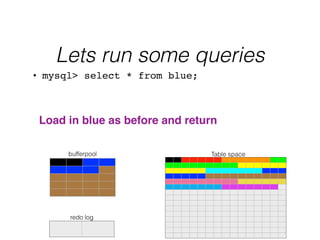
• mysql> select * from blue;
!
Load in blue as before and return
Lets run some queries
Table space
redo log
bufferpool
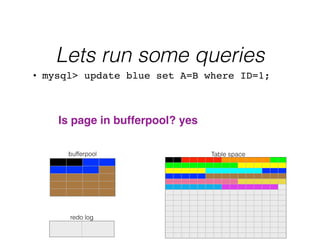
• mysql> update blue set A=B where ID=1;
!
Is page in bufferpool? yes
Lets run some queries
Table space
redo log
bufferpool
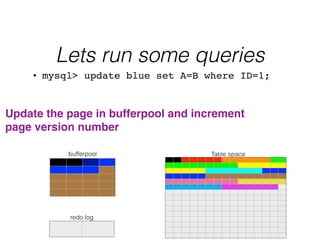
• mysql> update blue set A=B where ID=1;
!
Update the page in bufferpool and increment !
page version number
Lets run some queries
Table space
redo log
bufferpool
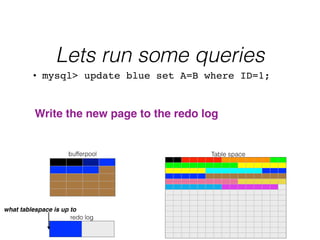
• mysql> update blue set A=B where ID=1;
!
Write the new page to the redo log!
what tablespace is up to!
Lets run some queries
Table space
redo log
bufferpool
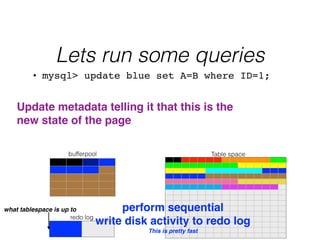
• mysql> update blue set A=B where ID=1;
!
Update metadata telling it that this is the !
new state of the page!
perform sequential !
write disk activity to redo log!
This is pretty fast!
what tablespace is up to!
Lets run some queries
Table space
redo log
bufferpool
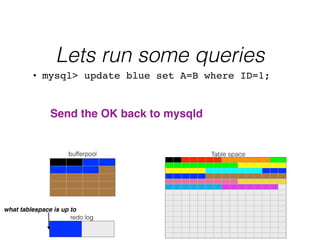
• mysql> update blue set A=B where ID=1;
!
Send the OK back to mysqld!
what tablespace is up to!
Lets run some queries
Table space
redo log
bufferpool
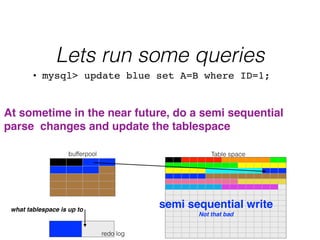
• mysql> update blue set A=B where ID=1;
!
At sometime in the near future, do a semi sequential !
parse changes and update the tablespace
what tablespace is up to!
semi sequential write!
Not that bad !
!
Lets run some queries
Table space
redo log
bufferpool
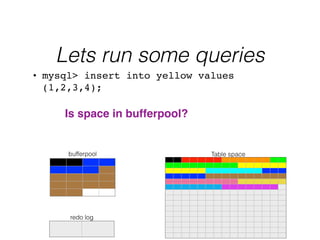
• mysql> insert into yellow values
(1,2,3,4);
!
Is space in bufferpool?!
Lets run some queries
Table space
redo log
bufferpool
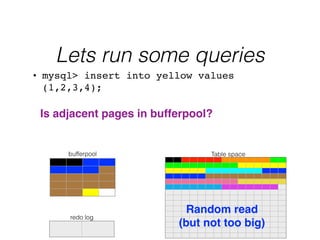
• mysql> insert into yellow values
(1,2,3,4);
!
Is adjacent pages in bufferpool?!
Random read !
(but not too big)
Lets run some queries
Table space
redo log
bufferpool
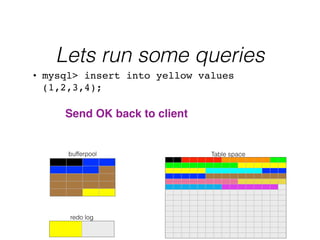
• mysql> insert into yellow values
(1,2,3,4);
!
Send OK back to client!
Key take aways
Table space
redo log
bufferpool
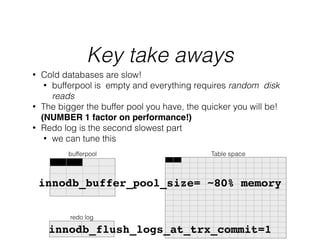
• Cold databases are slow!
• bufferpool is empty and everything requires random disk
reads
• The bigger the buffer pool you have, the quicker you will be!
(NUMBER 1 factor on performance!)!
• Redo log is the second slowest part
• we can tune this
innodb_flush_logs_at_trx_commit=1
innodb_buffer_pool_size= ~80% memory!
Schema changes
• Everyone hates them
• They are not transactional
• They are blocking (well most)
• How do they work?
!
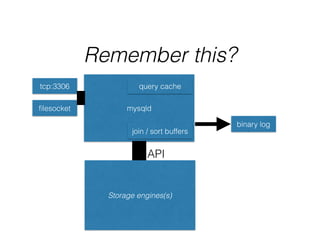
Remember this?
mysqld
Storage engines(s)
tcp:3306
filesocket
API
query cache
binary log
join / sort buffers
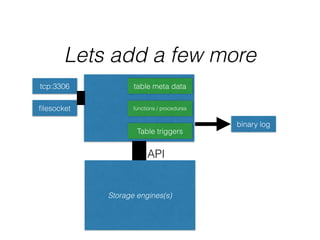
Lets add a few more
Storage engines(s)
tcp:3306
filesocket
API
table meta data
binary log
Table triggers
functions / procedures
mysqld
tcp:3306
filesocket
mytbl
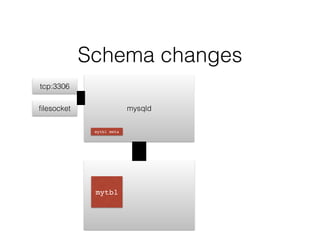
Schema changes
mytbl meta
mytbl
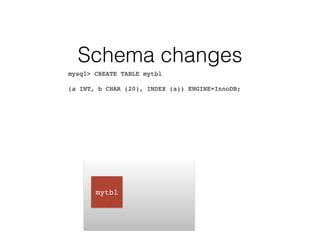
mysql> CREATE TABLE mytbl 

(a INT, b CHAR (20), INDEX (a)) ENGINE=InnoDB;
Schema changes
mytbl
Schema changes
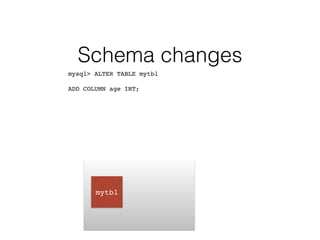
mysql> ALTER TABLE mytbl 

ADD COLUMN age INT;
mytbl
Schema changes
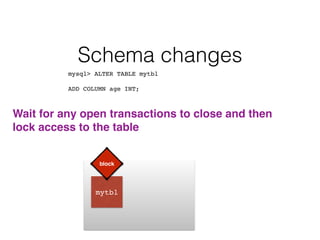
mysql> ALTER TABLE mytbl 

ADD COLUMN age INT;
!
Wait for any open transactions to close and then !
lock access to the table!
block
mytbl
Schema changes
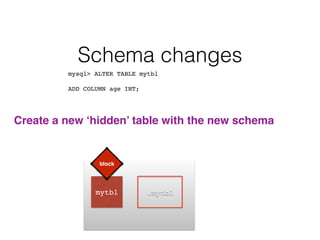
mysql> ALTER TABLE mytbl 

ADD COLUMN age INT;
!
Create a new ‘hidden’ table with the new schema!
block
.mytbl
mytbl
Schema changes
mysql> ALTER TABLE mytbl 

ADD COLUMN age INT;
!
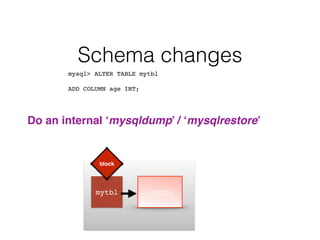
Do an internal ‘mysqldump’ / ‘mysqlrestore’!
block
.mytbl
mytbl
Schema changes
mysql> ALTER TABLE mytbl 

ADD COLUMN age INT;
!
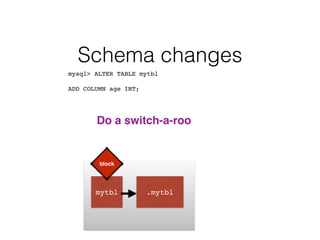
Do a switch-a-roo!
block
.mytbl
Schema changes
mysql> ALTER TABLE mytbl 

ADD COLUMN age INT;
!
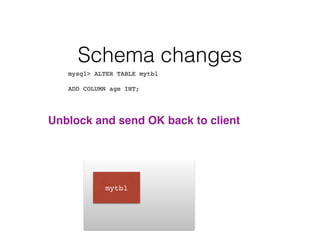
Unblock and send OK back to client!
mytbl
Online schema changes
• Some changes can be done without ‘locking’
• Column additions
• Index additions
!
• Any removal cannot be done online
• Unless you do it yourself
!
mysqld
mytbl
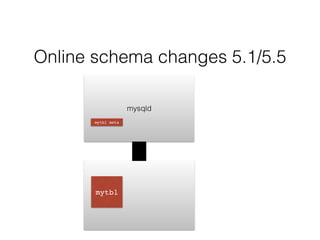
Online schema changes 5.1/5.5
mytbl meta
mysqld
mytbl
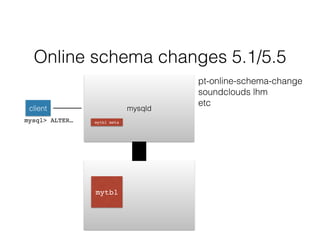
Online schema changes 5.1/5.5
mytbl meta
client
mysql> ALTER…
pt-online-schema-change
soundclouds lhm
etc
mysqld
mytbl
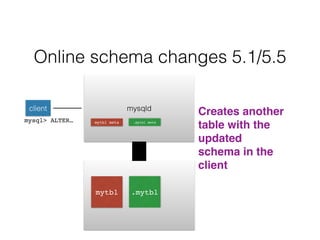
Online schema changes 5.1/5.5
mytbl meta
client
mysql> ALTER… .mytbl meta
.mytbl
!
Creates another
table with the
updated
schema in the
client!
mysqld
mytbl
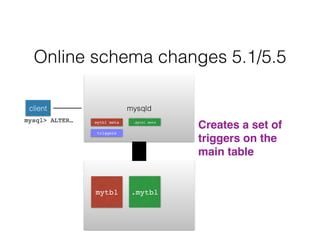
Online schema changes 5.1/5.5
mytbl meta
client
mysql> ALTER… .mytbl meta
.mytbl
!
Creates a set of
triggers on the
main table!
triggers
mysqld
mytbl
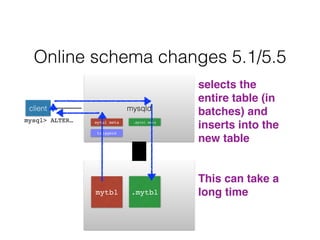
Online schema changes 5.1/5.5
mytbl meta
client
mysql> ALTER… .mytbl meta
.mytbl
!
selects the
entire table (in
batches) and
inserts into the
new table!
!
!
This can take a
long time!
triggers
mysqld
mytbl
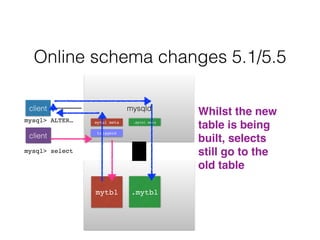
Online schema changes 5.1/5.5
mytbl meta
client
mysql> ALTER… .mytbl meta
.mytbl
triggers
client
mysql> select
!
Whilst the new
table is being
built, selects
still go to the
old table!
mytbl
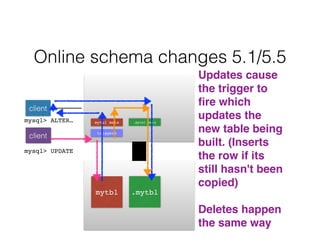
Online schema changes 5.1/5.5
mytbl meta
client
mysql> ALTER… .mytbl meta
.mytbl
triggers
client
mysql> UPDATE
!
Updates cause
the trigger to
fire which
updates the
new table being
built. (Inserts
the row if its
still hasn't been
copied)!
!
Deletes happen
the same way!
mytbl
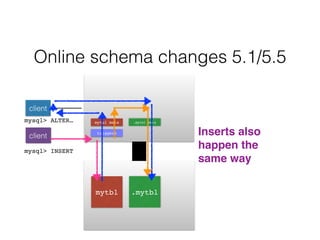
Online schema changes 5.1/5.5
mytbl meta
client
mysql> ALTER… .mytbl meta
.mytbl
triggers
client
mysql> INSERT
!
Inserts also
happen the
same way
mytbl
Online schema changes 5.1/5.5
mytbl meta
client
mysql> ALTER… .mytbl meta
.mytbl
triggers
!
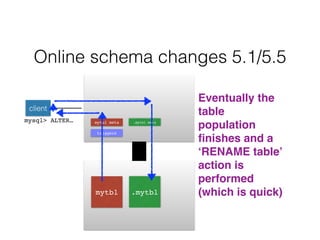
Eventually the
table
population
finishes and a
‘RENAME table’
action is
performed
(which is quick)
mytbl
Online schema changes 5.1/5.5
mytbl meta
client
mysql> ALTER… .mytbl meta
.mytbl
triggers
!
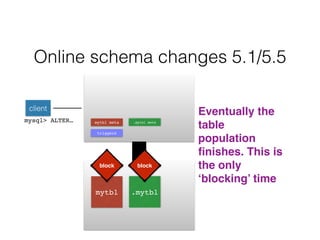
Eventually the
table
population
finishes. This is
the only
‘blocking’ time
block block
mytbl
Online schema changes 5.1/5.5
mytbl meta
client
mysql> ALTER… !
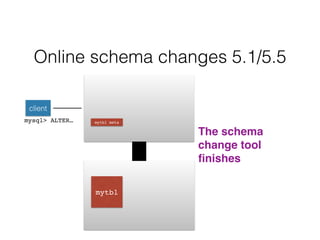
The schema
change tool
finishes
Online schema changes in 5.6
• All that ‘switch-a-roo’ logic is now within mysqld itself
!
Summary about schema changes
• You ‘double your IO’ when you’re online schema
changes!
• Binary log is outside of this - so watch out for your
slaves table locking if you don't use the right flags
!
!

Howmysqlworks

  • 1.
  • 2.
    About me • BeforeREA I worked for a hosting company for 4 years • Learnt a lot about MySQL during this period • I started as an OPS engineer at REA and did some database stuff here • I havent done much MySQL for two years ! • In this period we’ve had • MySQL 5.6 come out • RDS MySQL improvements ! !
  • 3.
    Today • High leveloverview of MySQL • Look inside MySQL server • Talk through how InnoDB performs queries • Schema changes and online schema changes ! !
  • 4.
    Background • Second biggestrelational database in the world • Anyone know what the biggest is? ! • Used by many of the big web shops • Facebook for all feed data • Etsy for user & data • Twitter for tweet persistence • … ! • Sun bought MySQL AB in 2008, people freaked out • Oracle bought Sun in 2010, people freaked out • Big improvements over the past few years (5.5 / 5.6) !
  • 5.
    How it works mysqld mysqlclient tcp:3306 filesocket ServerClient libmysql mysql lib ORM host$ mysql host$ mysqld_safe! host$ mysqld
  • 6.
    Big features • Pluggablestorage engines is massive flexibility • You can use a different storage engine per table ! ! • Common storage engines • InnoDB - ACID compliant store • MyISAM - one of the original storage engines - avoid • Lots and lots of others !
  • 7.
    Inside mysqld mysqld storage engine(s) MyISAM/ InnoDB / Memory / etc tcp:3306 filesocket Getting the query and responding bits and bytes stuff API
  • 8.
    Inside mysqld mysqld storage engine(s) MyISAM/ InnoDB / Memory / etc tcp:3306 filesocket API
  • 9.
    Inside mysqld mysqld storage engine(s) MyISAM/ InnoDB / Memory / etc tcp:3306 filesocket Parse query and convert to SE API calls. API
  • 10.
    Inside mysqld mysqld Storage engines(s) tcp:3306 filesocket API querycache binary log join / sort buffers Binary Log for replication Buffers: Kinda how much batching to storage API to save cost
  • 11.
    The bad parts- binary log mysqld tcp:3306 filesocket query cache binary log join / sort buffers Because you can mix and match storage engines, replicating state has to be done at the lowest common denominator Innodb Table 1 MyISAM Table 2
  • 12.
    The bad parts- binary log mysqld Innodb Table 1 tcp:3306 filesocket query cache binary log join / sort buffers Highly concurrent InnoDB needs its queries, serialized down to replicate to slave MyISAM Table 2
  • 13.
    Compare to otherDBs DB server tcp:x filesocket? performance knobs transaction log
  • 14.
    The bad parts- query cache mysqld Innodb Table 1 tcp:3306 filesocket query cache binary log join / sort buffers Can only work on an entire table level & uses LRU MyISAM Table 2
  • 15.
    The bad parts- query cache mysqld Innodb Table 1 tcp:3306 filesocket query cache binary log join / sort buffers All ‘update/insert/delete’ blocks all transactions to ensure correct state. It actually slows ! things down MyISAM Table 2
  • 16.
    Inside mysqld mysqld storage engine(s) MyISAM/ InnoDB / Memory / etc tcp:3306 filesocket API Where 10%* of ! the work is done Where 90% ! of the work ! is done *Finger in the air calculation
  • 17.
    Summary • Turn offquery cache! It is hurting you! • Binary log is a necessary evil for replication • Dont play with the performance knobs (sort buffer / join buffer / etc) • Turning the 10% - Focus on the 90% • Use InnoDB for all the tables (unless they’re system tables) ! ! • So…lets look at the 90% ! !
  • 18.
  • 19.
  • 20.
    Unknown gems mysqld InnoDB tcp:3306 filesocket API handlersocket/ memcache Innodb Memcache API thattalks directly to InnoDB ! Removes the SQL layer and is just K/V ! Google: handlersocket memcache InnoDB
  • 21.
    Key parts ofInnoDB Innodb API
  • 22.
    Key parts ofInnoDB Table space (whats on disk) redo log Innodb bufferpool memory! ib_log1! ib_log2! sometable.ibd! ib_data!
  • 23.
    Key parts ofInnoDB Table space redo log bufferpool • Each block is a page • Just think of it as a row with some extra stuff like version number • InnoDB is ACID meaning each connection has to have its own view of the world! • Extra metadata at the top about where everything is
  • 24.
    Key parts ofInnoDB Table space redo log bufferpool • Black is the base metadata
  • 25.
    What is bufferpool Tablespace redo log bufferpool • In memory version of hot tablespace pages
  • 26.
    What is redolog Table space redo log bufferpool • An append only log file of changes
  • 27.
    What is tablespace Table space redo log bufferpool • The raw files - but it may not be always up-to-date
  • 28.
    Lets run somequeries Table space redo log bufferpool • First - lets fill up our database with data
  • 29.
    Lets run somequeries Table space redo log bufferpool • mysql> select * from red;
  • 30.
    Lets run somequeries Table space redo log bufferpool • mysql> select * from red; mysqld parses the query and sends ! API calls to InnoDB
  • 31.
    Lets run somequeries Table space redo log bufferpool • mysql> select * from red; Is red in bufferpool?
  • 32.
    Lets run somequeries Table space redo log bufferpool • mysql> select * from red; Load red into buffer pool perform random ! read disk activity! At this point, the time to respond! is dependent on disk speed!
  • 33.
    Lets run somequeries Table space redo log bufferpool • mysql> select * from red; Respond to API calls to mysqld
  • 34.
    Lets run somequeries Table space redo log bufferpool • mysql> select * from red; Parse results ! second pass sort if necessary ! return to client
  • 35.
    Lets run somequeries Table space redo log bufferpool • mysql> select * from red; #again
  • 36.
    Lets run somequeries Table space redo log bufferpool • mysql> select * from red; mysqld parses the query and sends ! API calls to InnoDB
  • 37.
    Lets run somequeries Table space redo log bufferpool • mysql> select * from red; Is red in bufferpool? - yes
  • 38.
    Lets run somequeries Table space redo log bufferpool • mysql> select * from red; Respond to API calls to mysqld
  • 39.
    Lets run somequeries Table space redo log bufferpool • mysql> select * from red; Parse results ! second pass sort if necessary ! return to client
  • 40.
    Lets run somequeries Table space redo log bufferpool • mysql> select * from brown; What if bufferpool is full?
  • 41.
    Lets run somequeries Table space redo log bufferpool • mysql> select * from blue; Assume metadata knows page requirements! LRU on the bufferpool to find space and evict
  • 42.
    Lets run somequeries Table space redo log bufferpool • mysql> select * from blue; ! Load in blue as before and return
  • 43.
    Lets run somequeries Table space redo log bufferpool • mysql> update blue set A=B where ID=1; ! Is page in bufferpool? yes
  • 44.
    Lets run somequeries Table space redo log bufferpool • mysql> update blue set A=B where ID=1; ! Update the page in bufferpool and increment ! page version number
  • 45.
    Lets run somequeries Table space redo log bufferpool • mysql> update blue set A=B where ID=1; ! Write the new page to the redo log! what tablespace is up to!
  • 46.
    Lets run somequeries Table space redo log bufferpool • mysql> update blue set A=B where ID=1; ! Update metadata telling it that this is the ! new state of the page! perform sequential ! write disk activity to redo log! This is pretty fast! what tablespace is up to!
  • 47.
    Lets run somequeries Table space redo log bufferpool • mysql> update blue set A=B where ID=1; ! Send the OK back to mysqld! what tablespace is up to!
  • 48.
    Lets run somequeries Table space redo log bufferpool • mysql> update blue set A=B where ID=1; ! At sometime in the near future, do a semi sequential ! parse changes and update the tablespace what tablespace is up to! semi sequential write! Not that bad ! !
  • 49.
    Lets run somequeries Table space redo log bufferpool • mysql> insert into yellow values (1,2,3,4); ! Is space in bufferpool?!
  • 50.
    Lets run somequeries Table space redo log bufferpool • mysql> insert into yellow values (1,2,3,4); ! Is adjacent pages in bufferpool?! Random read ! (but not too big)
  • 51.
    Lets run somequeries Table space redo log bufferpool • mysql> insert into yellow values (1,2,3,4); ! Send OK back to client!
  • 52.
    Key take aways Tablespace redo log bufferpool • Cold databases are slow! • bufferpool is empty and everything requires random disk reads • The bigger the buffer pool you have, the quicker you will be! (NUMBER 1 factor on performance!)! • Redo log is the second slowest part • we can tune this innodb_flush_logs_at_trx_commit=1 innodb_buffer_pool_size= ~80% memory!
  • 53.
    Schema changes • Everyonehates them • They are not transactional • They are blocking (well most) • How do they work? !
  • 54.
  • 55.
    Lets add afew more Storage engines(s) tcp:3306 filesocket API table meta data binary log Table triggers functions / procedures
  • 56.
  • 57.
    mytbl mysql> CREATE TABLEmytbl 
 (a INT, b CHAR (20), INDEX (a)) ENGINE=InnoDB; Schema changes
  • 58.
    mytbl Schema changes mysql> ALTERTABLE mytbl 
 ADD COLUMN age INT;
  • 59.
    mytbl Schema changes mysql> ALTERTABLE mytbl 
 ADD COLUMN age INT; ! Wait for any open transactions to close and then ! lock access to the table! block
  • 60.
    mytbl Schema changes mysql> ALTERTABLE mytbl 
 ADD COLUMN age INT; ! Create a new ‘hidden’ table with the new schema! block .mytbl
  • 61.
    mytbl Schema changes mysql> ALTERTABLE mytbl 
 ADD COLUMN age INT; ! Do an internal ‘mysqldump’ / ‘mysqlrestore’! block .mytbl
  • 62.
    mytbl Schema changes mysql> ALTERTABLE mytbl 
 ADD COLUMN age INT; ! Do a switch-a-roo! block .mytbl
  • 63.
    Schema changes mysql> ALTERTABLE mytbl 
 ADD COLUMN age INT; ! Unblock and send OK back to client! mytbl
  • 64.
    Online schema changes •Some changes can be done without ‘locking’ • Column additions • Index additions ! • Any removal cannot be done online • Unless you do it yourself !
  • 65.
  • 66.
    mysqld mytbl Online schema changes5.1/5.5 mytbl meta client mysql> ALTER… pt-online-schema-change soundclouds lhm etc
  • 67.
    mysqld mytbl Online schema changes5.1/5.5 mytbl meta client mysql> ALTER… .mytbl meta .mytbl ! Creates another table with the updated schema in the client!
  • 68.
    mysqld mytbl Online schema changes5.1/5.5 mytbl meta client mysql> ALTER… .mytbl meta .mytbl ! Creates a set of triggers on the main table! triggers
  • 69.
    mysqld mytbl Online schema changes5.1/5.5 mytbl meta client mysql> ALTER… .mytbl meta .mytbl ! selects the entire table (in batches) and inserts into the new table! ! ! This can take a long time! triggers
  • 70.
    mysqld mytbl Online schema changes5.1/5.5 mytbl meta client mysql> ALTER… .mytbl meta .mytbl triggers client mysql> select ! Whilst the new table is being built, selects still go to the old table!
  • 71.
    mytbl Online schema changes5.1/5.5 mytbl meta client mysql> ALTER… .mytbl meta .mytbl triggers client mysql> UPDATE ! Updates cause the trigger to fire which updates the new table being built. (Inserts the row if its still hasn't been copied)! ! Deletes happen the same way!
  • 72.
    mytbl Online schema changes5.1/5.5 mytbl meta client mysql> ALTER… .mytbl meta .mytbl triggers client mysql> INSERT ! Inserts also happen the same way
  • 73.
    mytbl Online schema changes5.1/5.5 mytbl meta client mysql> ALTER… .mytbl meta .mytbl triggers ! Eventually the table population finishes and a ‘RENAME table’ action is performed (which is quick)
  • 74.
    mytbl Online schema changes5.1/5.5 mytbl meta client mysql> ALTER… .mytbl meta .mytbl triggers ! Eventually the table population finishes. This is the only ‘blocking’ time block block
  • 75.
    mytbl Online schema changes5.1/5.5 mytbl meta client mysql> ALTER… ! The schema change tool finishes
  • 76.
    Online schema changesin 5.6 • All that ‘switch-a-roo’ logic is now within mysqld itself !
  • 77.
    Summary about schemachanges • You ‘double your IO’ when you’re online schema changes! • Binary log is outside of this - so watch out for your slaves table locking if you don't use the right flags ! !