Innodb Architecture and Internals
                                  Peter Zaitsev
                  Percona Live, Washington DC
                               11 January 2012
-2-


               About Presentation
●   Brief Introduction in Innodb Architecture
    – This area would deserve many books


                                           www.percona.com
Innodb Versions

●   MySQL 5.5 Current GA
    – Lots of improvements compared to previous versions
●   MySQL 5.6 Current development release
    – Will mention some changes
●   Percona Server 5.5
    – Based on MySQL 5.5 with improvements


                                           www.percona.com
-4-


                General Architecture

●   Traditional OLTP Engine
    – “Emulates Oracle Architecture”
●   Implemented using MySQL Storage engine API
●   Row Based Storage. Row Locking. MVCC
●   Data Stored in Tablespaces
●   Log of changes stored in circular log files
●   Data pages as pages in “Buffer Pool”


                                          www.percona.com
-5-


         Storage Files Layout


Physical Structure of Innodb Tabespaces and
                    Logs


                                 www.percona.com
-6-


                 Innodb Tablespaces

●   All data stored in Tablespaces
    – Changes to these databases stored in Circular Logs
    – Changes has to be reflected in tablespace before log
      record is overwritten
●   Single tablespace or multiple tablespace
    – innodb_file_per_table=1
●   System information always in main tablespace
    – Main tablespace can consist of many files
       • They are concatenated

                                             www.percona.com
-7-


                  Tablespace Format

●   Collection of Segments
    – Segment is like a “file”
●   Segment is number of extents
    – Typically 64 of 16K page sizes
    – Smaller extents for very small objects
●   First Tablespace page contains header
    – Tablespace size
    – Tablespace id

                                               www.percona.com
-8-


                   Types of Segments

●   Each table is Set of Indexes
    – Innodb has “index organized tables”
●   Each index has
    – Leaf node segment
    – Non Leaf node segment
●   Special Segments
    – Rollback Segment(s)
    – Insert buffer, etc

                                            www.percona.com
-9-


                 Innodb Log Files

●   Set of log files (ib_logfile?)
    – 2 log files by default. Effectively concatenated
●   Log Header
    – Stores information about last checkpoint
●   Log is NOT organized in pages, but records
    – Records aligned 512 bytes, matching disk sector
●   Log record format “physiological”
    – Stores Page# and operation to do on it
●   Only REDO operations are stored in logs.
                                               www.percona.com
Separate Undo Tablespace
●   MySQL 5.6 allows to store unto tablespace in
    separate set of files
    – innodb_undo_directory
    – innodb_undo_tablespaces
    – innodb_undo_logs
●   Note once you enable these options you can't
    downgrade
●   Offers another flexibility of using fast storage
    (such as SSD)

                                           www.percona.com
-11-


    Innodb Threads Architecture


What threads are there and what they do


                               www.percona.com
-12-


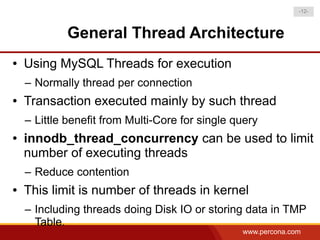
            General Thread Architecture
●   Using MySQL Threads for execution
    – Normally thread per connection
●   Transaction executed mainly by such thread
    – Little benefit from Multi-Core for single query
●   innodb_thread_concurrency can be used to limit
    number of executing threads
    – Reduce contention
●   This limit is number of threads in kernel
    – Including threads doing Disk IO or storing data in TMP
      Table.
                                                 www.percona.com
-13-


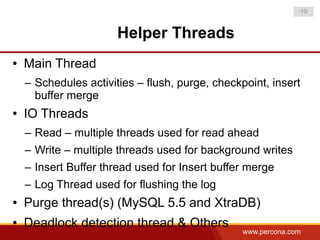
                       Helper Threads
●   Main Thread
    – Schedules activities – flush, purge, checkpoint, insert
      buffer merge
●   IO Threads
    – Read – multiple threads used for read ahead
    – Write – multiple threads used for background writes
    – Insert Buffer thread used for Insert buffer merge
    – Log Thread used for flushing the log
●   Purge thread(s) (MySQL 5.5 and XtraDB)
●   Deadlock detection thread & Others
                                                 www.percona.com
-14-


           Memory Handling


How Innodb Allocates and Manages Memory


                              www.percona.com
-15-


           Memory Allocation Basics

●   Buffer Pool
    – Set by innodb_buffer_pool_size
    – Database cache; Insert Buffer; Locks
    – Takes More memory than specified
       • Extra space needed for Latches, LRU etc
●   Additional Memory Pool
    – Dictionary and other allocations
    – innodb_additional_mem_pool_size
       • Not used in newer releases
●   Log Buffer (innodb_log_buffer_size)
                                                   www.percona.com
-16-


          Disk IO


How Innodb Performs Disk IO


                         www.percona.com
-17-


                          Reads

●   Most reads done by executing threads
●   Read-Ahead performed by background threads
    – Linear
    – Random
    – Do not count on read ahead a lot
●   Insert Buffer merge process causes reads


                                         www.percona.com
-18-


                              Writes
●   Data Writes are Background in Most cases
    – As long as you can flush data fast enough you're good
●   Synchronous flushes can happen if no free
    buffers available
●   Log Writes can by sync or async depending on
    innodb_flush_log_at_trx_commit
    – 1 – fsync log on transaction commit
    – 0 – do not flush. Flushed in background ~ once/sec
    – 2 – Flush to OS cache but do not call fsync()
       • Data safe if MySQL Crashes but OS Survives
                                                  www.percona.com
Flush List Writes

●   Flushing to advance “earliest modify LSN”
    – To free log space so it can be reduced
●   Most of writes typically happen this way
●   Number of pages to flush per cycle depended on
    the load
    – “innodb_adaptive_flushing”
    – Percona Server has more flushing modes
       • See innodb_adaptive_flushing_method
●   If Flushing can't keep up stalls can happen
                                               www.percona.com
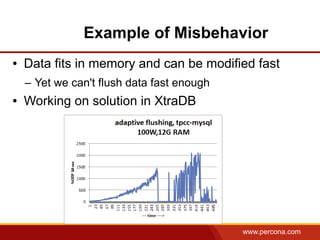
Example of Misbehavior
●   Data fits in memory and can be modified fast
    – Yet we can't flush data fast enough
●   Working on solution in XtraDB


                                            www.percona.com
LRU Flushes
●   Can happen in workloads with data sets larger
    than memory
●   If Innodb is unable to find clean page in 10% of
    LRU list
●   LRU Flushes happen in user threads
●   Hard to see exact number in standard Innodb
    – XtraDB adds
      Innodb_buffer_pool_pages_LRU_flushed


                                           www.percona.com
LRU Flushes in MySQL 5.6
●   MySQL 5.6 adds “page_cleaner” to avoid LRU
    flushes in User Threads
●   innodb_lru_scan_depth=N
    – Controlls how deeply page cleaner will examine Tail
      of LRU for dirty pages
    – Happens once per second


                                             www.percona.com
-23-


                     Page Checksums
●   Protection from corrupted data
    – Bad hardware, OS Bugs, Innodb Bugs
    – Are not completely replaced by Filesystem Checksums
●   Checked when page is Read to Buffer Pool
●   Updated when page is flushed to disk
●   Can be significant overhead
    – Especially for very fast storage
●   Can be disabled by innodb_checksums=0

                                            www.percona.com
-24-


                Double Write Buffer

●   Innodb log requires consistent pages for recovery
●   Page write may complete partially
    – Updating part of 16K and leaving the rest
●   Double Write Buffer is short term page level log
●   The process is:
    – Write pages to double write buffer; Sync
    – Write Pages to their original locations; Sync
    – Pages contain tablespace_id+page_id
●   On crash recovery pages in buffer are compared
    to their original location            www.percona.com
-25-


                   Direct IO Operation

●   Default IO mode for Innodb data is Buffered
●   Good
    – Faster flushes when no write cache
    – Faster warmup on restart
    – Reduce problems with inode locking on EXT3
●   Bad
    – Lost of effective cache memory due to double buffering
    – OS Cache could be used to cache other data
    – Increased tendency to swap due to IO pressure
●   innodb_flush_method=O_DIRECT
                                                   www.percona.com
-26-


                           Log IO

●
    Log are opened in buffered mode
    – Even with innodb_flush_method=O_DIRECT
    – XtraDB can use O_DIRECT for logs
       • innodb_flush_method=ALL_O_DIRECT
●   Flushed by fsync() - default or O_SYNC
●   Logs are often written in 512 byte blocks
    – innodb_log_block_size=4096 in XtraDB
●   Logs which fit in cache may improve performance
    – Small transactions and
      innodb_flush_log_at_trx_commit=1 or 2
                                                www.percona.com
-27-


                Indexes


How Indexes are Implemented in Innodb


                              www.percona.com
-28-


               Everything is the Index
●   Innodb tables are “Index Organized”
    – PRIMARY KEY contains data instead of data pointer
●   Hidden PRIMARY KEY is used if not defined (6b)
●   Data is “Clustered” by PRIMARY KEY
    – Data with close PK value is stored close to each other
    – Clustering is within page ONLY
●   Leaf and Non-Leaf nodes use separate Segments
    – Makes IO more sequential for ordered scans
●   Innodb system tables SYS_TABLES and SYS_INDEXES
    hold information about index “root”
                                                www.percona.com
-29-


                 Index Structure

●   Secondary Indexes refer to rows by Primary Key
    – No update when row is moved to different page
●   Long Primary Keys are expensive
    – Increase size of all Indexes
●   Random Primary Key Inserts are expensive
    – Cause page splits; Fragmentation
    – Make page space utilization low
●   AutoIncrement keys are often better than
    artificial keys, UUIDs, SHA1 etc.
                                           www.percona.com
-30-


           Multi Versioning


Implementation of Multi Versioning and
              Locking


                               www.percona.com
-31-


            Multi Versioning at Glance

●   Multiple versions of row exist at the same time
●   Read Transaction can read old version of row,
    while it is modified
    – No need for locking
●   Locking reads can be performed with SELECT
    FOR UPDATE and LOCK IN SHARE MODE
    Modifiers


                                         www.percona.com
-32-


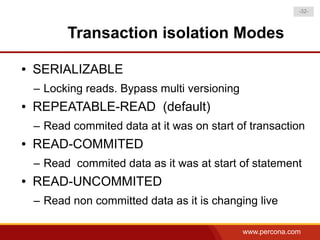
          Transaction isolation Modes

●   SERIALIZABLE
    – Locking reads. Bypass multi versioning
●   REPEATABLE-READ (default)
    – Read commited data at it was on start of transaction
●   READ-COMMITED
    – Read commited data as it was at start of statement
●   READ-UNCOMMITED
    – Read non committed data as it is changing live

                                               www.percona.com
-33-


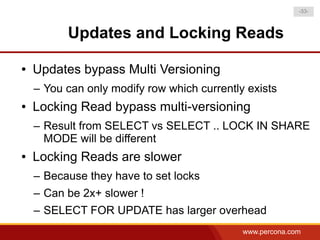
          Updates and Locking Reads

●   Updates bypass Multi Versioning
    – You can only modify row which currently exists
●   Locking Read bypass multi-versioning
    – Result from SELECT vs SELECT .. LOCK IN SHARE
      MODE will be different
●   Locking Reads are slower
    – Because they have to set locks
    – Can be 2x+ slower !
    – SELECT FOR UPDATE has larger overhead
                                             www.percona.com
-34-


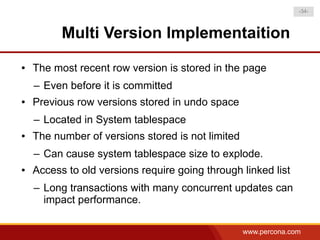
          Multi Version Implementaition
●   The most recent row version is stored in the page
    – Even before it is committed
●   Previous row versions stored in undo space
    – Located in System tablespace
●   The number of versions stored is not limited
    – Can cause system tablespace size to explode.
●   Access to old versions require going through linked list
    – Long transactions with many concurrent updates can
      impact performance.

                                                   www.percona.com
-35-


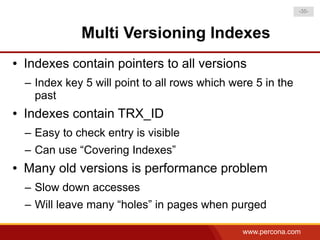
               Multi Versioning Indexes
●   Indexes contain pointers to all versions
    – Index key 5 will point to all rows which were 5 in the
      past
●   Indexes contain TRX_ID
    – Easy to check entry is visible
    – Can use “Covering Indexes”
●   Many old versions is performance problem
    – Slow down accesses
    – Will leave many “holes” in pages when purged

                                                 www.percona.com
-36-


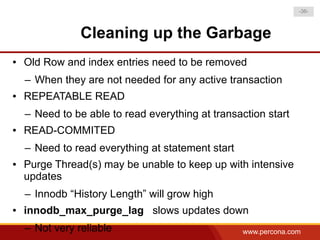
                Cleaning up the Garbage
●   Old Row and index entries need to be removed
    – When they are not needed for any active transaction
●   REPEATABLE READ
    – Need to be able to read everything at transaction start
●   READ-COMMITED
    – Need to read everything at statement start
●   Purge Thread(s) may be unable to keep up with intensive
    updates
    – Innodb “History Length” will grow high
●   innodb_max_purge_lag slows updates down
    – Not very reliable                            www.percona.com
-37-


     Innodb Locking


How Innodb Locking Works


                      www.percona.com
-38-


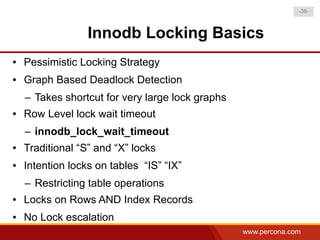
                  Innodb Locking Basics
●   Pessimistic Locking Strategy
●   Graph Based Deadlock Detection
    – Takes shortcut for very large lock graphs
●   Row Level lock wait timeout
    – innodb_lock_wait_timeout
●   Traditional “S” and “X” locks
●   Intention locks on tables “IS” “IX”
    – Restricting table operations
●   Locks on Rows AND Index Records
●   No Lock escalation
                                                  www.percona.com
-39-


                          Gap Locks
●   Innodb does not only locks rows but also gap between them
●   Needed for consistent reads in Locking mode
    – Also used by update statements
●   Innodb has no Phantoms even in Consistent Reads
●   Gap locks often cause complex deadlock situations
●   “infinum”, “supremum” records define bounds of data stored
    on the page
    – May not correspond to actual rows stored
●   Only record lock is needed for PK Update


                                                  www.percona.com
-40-


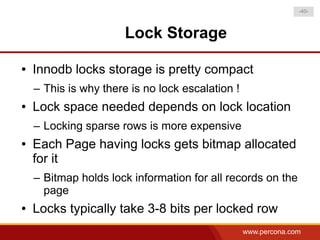
                       Lock Storage

●   Innodb locks storage is pretty compact
    – This is why there is no lock escalation !
●   Lock space needed depends on lock location
    – Locking sparse rows is more expensive
●   Each Page having locks gets bitmap allocated
    for it
    – Bitmap holds lock information for all records on the
      page
●   Locks typically take 3-8 bits per locked row
                                                  www.percona.com
-41-


                Auto Increment Locks
●   Major Changes in MySQL 5.1 !
●   MySQL 5.0 and before
    – Table level AUTO_INC lock for duration of INSERT
    – Even if INSERT provided key value !
    – Serious bottleneck for concurrent Inserts
●   MySQL 5.1 and later
    – innodb_autoinc_lock_mode – set lock behavior
    – “1” - Does not hold lock for simple Inserts
    – “2” - Does not hold lock in any case.
       • Only works with Row level replication
                                                    www.percona.com
-42-


       Latching


Innodb Internal Locks


                        www.percona.com
-43-


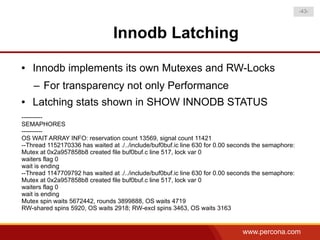
                                Innodb Latching
●   Innodb implements its own Mutexes and RW-Locks
    – For transparency not only Performance
●   Latching stats shown in SHOW INNODB STATUS
----------
SEMAPHORES
----------
OS WAIT ARRAY INFO: reservation count 13569, signal count 11421
--Thread 1152170336 has waited at ./../include/buf0buf.ic line 630 for 0.00 seconds the semaphore:
Mutex at 0x2a957858b8 created file buf0buf.c line 517, lock var 0
waiters flag 0
wait is ending
--Thread 1147709792 has waited at ./../include/buf0buf.ic line 630 for 0.00 seconds the semaphore:
Mutex at 0x2a957858b8 created file buf0buf.c line 517, lock var 0
waiters flag 0
wait is ending
Mutex spin waits 5672442, rounds 3899888, OS waits 4719
RW-shared spins 5920, OS waits 2918; RW-excl spins 3463, OS waits 3163


                                                                               www.percona.com
-44-


             Latching Performance

●   Was improving over the years
●   Still is problem for certain workloads
    – Great improvements in MySQL 5.5,5.6 & XtaDB
    – Still hotspots remain
●   innodb_thread_concurrency
    – Limiting concurrency can reduce contention
    – Introduces contention on its own
●   innodb_sync_spin_loops
    – Trade Spinning for context switching
    – Typically limited production impact
                                              www.percona.com
-45-


     Page Replacement


Page Replacement Flushing and
       Checkpointing


                         www.percona.com
-46-


               Basic Page Replacement
●   Innodb uses LRU for page replacement
    – With Midpoint Insertion
●   Innodb Plugin and XtraDB configure
    – innodb_old_blocks_pct, innodb_old_blocks_time
    – Offers Scan resistance from large full table scans
●   Scan LRU Tail to find clean block for replacement
●   May schedule synchronous flush if no clean pages
    for replacement


                                                www.percona.com
-47-


                         Checkpointing
●   Fuzzy Checkpointing
    – Flush few pages to advance min unflushed LSN
    – Flush List is maintained in this order
●   MySQL 5.1 often has “hiccups”
    – No more space left in log files. Need to wait for flush to
      complete
●   Percona Patches for 5.0 and XtraDB
    – Adaptive checkpointing: innodb_adaptive_checkpoint
●   Innodb Plugin innodb_adaptive_flushing
    – Best behavior depends on worload
                                                    www.percona.com
Percona Live DC Sponsors

          Media Sponsor


     Friends of Percona Sponsor


                                  www.percona.com
MySQL Conference & Expo 2012
    Presented by Percona Live
    The Hyatt Regency Santa Clara & Santa Clara
                Convention Center

                   April 10th-12th, 2012
                     Featured Speakers
   Mark Callaghan (Facebook), Jeremy Zawodny (Craigslist), Marten Mickos
                          (Eucalyptus Systems)

Sarah Novotny (Blue Gecko), Peter Zaitsev (Percona), Baron Schwartz (Percona)


          Learn More at www.percona.com/live/
                                        www.percona.com
Want More MySQL Training?
   Percona Training in Washington DC Next Week

           January 16th-19th, 2012

            MySQL Workshops
             MySQL Developers Training - Monday

               MySQL DBA Training - Tuesday

            MySQL InnoDB / XtraDB - Wednesday

                MySQL Operations – Thursday


Use Discount code DCPL30 to save 30%
          Visit http://bit.ly/dc-training
                                                  www.percona.com
Upcoming Percona MySQL Training

      Washington, DC – January 16, 2012

     Vancouver, Canada - February 6, 2012

     Frankfurt, Germany - February 13, 2012

         Irvine, CA – February 14, 2012

        Denver, CO - February 20, 2012

      San Francisco, CA - March 12, 2012

          Austin, TX - March 19, 2012

     Visit http://percona.com/training
                                           www.percona.com
Percona Live MySQL Conference,
  April 10-12 , Santa Clara,CA


                www.percona.com/live

Pldc2012 innodb architecture and internals

  • 1.
    Innodb Architecture andInternals Peter Zaitsev Percona Live, Washington DC 11 January 2012
  • 2.
    -2- About Presentation ● Brief Introduction in Innodb Architecture – This area would deserve many books www.percona.com
  • 3.
    Innodb Versions ● MySQL 5.5 Current GA – Lots of improvements compared to previous versions ● MySQL 5.6 Current development release – Will mention some changes ● Percona Server 5.5 – Based on MySQL 5.5 with improvements www.percona.com
  • 4.
    -4- General Architecture ● Traditional OLTP Engine – “Emulates Oracle Architecture” ● Implemented using MySQL Storage engine API ● Row Based Storage. Row Locking. MVCC ● Data Stored in Tablespaces ● Log of changes stored in circular log files ● Data pages as pages in “Buffer Pool” www.percona.com
  • 5.
    -5- Storage Files Layout Physical Structure of Innodb Tabespaces and Logs www.percona.com
  • 6.
    -6- Innodb Tablespaces ● All data stored in Tablespaces – Changes to these databases stored in Circular Logs – Changes has to be reflected in tablespace before log record is overwritten ● Single tablespace or multiple tablespace – innodb_file_per_table=1 ● System information always in main tablespace – Main tablespace can consist of many files • They are concatenated www.percona.com
  • 7.
    -7- Tablespace Format ● Collection of Segments – Segment is like a “file” ● Segment is number of extents – Typically 64 of 16K page sizes – Smaller extents for very small objects ● First Tablespace page contains header – Tablespace size – Tablespace id www.percona.com
  • 8.
    -8- Types of Segments ● Each table is Set of Indexes – Innodb has “index organized tables” ● Each index has – Leaf node segment – Non Leaf node segment ● Special Segments – Rollback Segment(s) – Insert buffer, etc www.percona.com
  • 9.
    -9- Innodb Log Files ● Set of log files (ib_logfile?) – 2 log files by default. Effectively concatenated ● Log Header – Stores information about last checkpoint ● Log is NOT organized in pages, but records – Records aligned 512 bytes, matching disk sector ● Log record format “physiological” – Stores Page# and operation to do on it ● Only REDO operations are stored in logs. www.percona.com
  • 10.
    Separate Undo Tablespace ● MySQL 5.6 allows to store unto tablespace in separate set of files – innodb_undo_directory – innodb_undo_tablespaces – innodb_undo_logs ● Note once you enable these options you can't downgrade ● Offers another flexibility of using fast storage (such as SSD) www.percona.com
  • 11.
    -11- Innodb Threads Architecture What threads are there and what they do www.percona.com
  • 12.
    -12- General Thread Architecture ● Using MySQL Threads for execution – Normally thread per connection ● Transaction executed mainly by such thread – Little benefit from Multi-Core for single query ● innodb_thread_concurrency can be used to limit number of executing threads – Reduce contention ● This limit is number of threads in kernel – Including threads doing Disk IO or storing data in TMP Table. www.percona.com
  • 13.
    -13- Helper Threads ● Main Thread – Schedules activities – flush, purge, checkpoint, insert buffer merge ● IO Threads – Read – multiple threads used for read ahead – Write – multiple threads used for background writes – Insert Buffer thread used for Insert buffer merge – Log Thread used for flushing the log ● Purge thread(s) (MySQL 5.5 and XtraDB) ● Deadlock detection thread & Others www.percona.com
  • 14.
    -14- Memory Handling How Innodb Allocates and Manages Memory www.percona.com
  • 15.
    -15- Memory Allocation Basics ● Buffer Pool – Set by innodb_buffer_pool_size – Database cache; Insert Buffer; Locks – Takes More memory than specified • Extra space needed for Latches, LRU etc ● Additional Memory Pool – Dictionary and other allocations – innodb_additional_mem_pool_size • Not used in newer releases ● Log Buffer (innodb_log_buffer_size) www.percona.com
  • 16.
    -16- Disk IO How Innodb Performs Disk IO www.percona.com
  • 17.
    -17- Reads ● Most reads done by executing threads ● Read-Ahead performed by background threads – Linear – Random – Do not count on read ahead a lot ● Insert Buffer merge process causes reads www.percona.com
  • 18.
    -18- Writes ● Data Writes are Background in Most cases – As long as you can flush data fast enough you're good ● Synchronous flushes can happen if no free buffers available ● Log Writes can by sync or async depending on innodb_flush_log_at_trx_commit – 1 – fsync log on transaction commit – 0 – do not flush. Flushed in background ~ once/sec – 2 – Flush to OS cache but do not call fsync() • Data safe if MySQL Crashes but OS Survives www.percona.com
  • 19.
    Flush List Writes ● Flushing to advance “earliest modify LSN” – To free log space so it can be reduced ● Most of writes typically happen this way ● Number of pages to flush per cycle depended on the load – “innodb_adaptive_flushing” – Percona Server has more flushing modes • See innodb_adaptive_flushing_method ● If Flushing can't keep up stalls can happen www.percona.com
  • 20.
    Example of Misbehavior ● Data fits in memory and can be modified fast – Yet we can't flush data fast enough ● Working on solution in XtraDB www.percona.com
  • 21.
    LRU Flushes ● Can happen in workloads with data sets larger than memory ● If Innodb is unable to find clean page in 10% of LRU list ● LRU Flushes happen in user threads ● Hard to see exact number in standard Innodb – XtraDB adds Innodb_buffer_pool_pages_LRU_flushed www.percona.com
  • 22.
    LRU Flushes inMySQL 5.6 ● MySQL 5.6 adds “page_cleaner” to avoid LRU flushes in User Threads ● innodb_lru_scan_depth=N – Controlls how deeply page cleaner will examine Tail of LRU for dirty pages – Happens once per second www.percona.com
  • 23.
    -23- Page Checksums ● Protection from corrupted data – Bad hardware, OS Bugs, Innodb Bugs – Are not completely replaced by Filesystem Checksums ● Checked when page is Read to Buffer Pool ● Updated when page is flushed to disk ● Can be significant overhead – Especially for very fast storage ● Can be disabled by innodb_checksums=0 www.percona.com
  • 24.
    -24- Double Write Buffer ● Innodb log requires consistent pages for recovery ● Page write may complete partially – Updating part of 16K and leaving the rest ● Double Write Buffer is short term page level log ● The process is: – Write pages to double write buffer; Sync – Write Pages to their original locations; Sync – Pages contain tablespace_id+page_id ● On crash recovery pages in buffer are compared to their original location www.percona.com
  • 25.
    -25- Direct IO Operation ● Default IO mode for Innodb data is Buffered ● Good – Faster flushes when no write cache – Faster warmup on restart – Reduce problems with inode locking on EXT3 ● Bad – Lost of effective cache memory due to double buffering – OS Cache could be used to cache other data – Increased tendency to swap due to IO pressure ● innodb_flush_method=O_DIRECT www.percona.com
  • 26.
    -26- Log IO ● Log are opened in buffered mode – Even with innodb_flush_method=O_DIRECT – XtraDB can use O_DIRECT for logs • innodb_flush_method=ALL_O_DIRECT ● Flushed by fsync() - default or O_SYNC ● Logs are often written in 512 byte blocks – innodb_log_block_size=4096 in XtraDB ● Logs which fit in cache may improve performance – Small transactions and innodb_flush_log_at_trx_commit=1 or 2 www.percona.com
  • 27.
    -27- Indexes How Indexes are Implemented in Innodb www.percona.com
  • 28.
    -28- Everything is the Index ● Innodb tables are “Index Organized” – PRIMARY KEY contains data instead of data pointer ● Hidden PRIMARY KEY is used if not defined (6b) ● Data is “Clustered” by PRIMARY KEY – Data with close PK value is stored close to each other – Clustering is within page ONLY ● Leaf and Non-Leaf nodes use separate Segments – Makes IO more sequential for ordered scans ● Innodb system tables SYS_TABLES and SYS_INDEXES hold information about index “root” www.percona.com
  • 29.
    -29- Index Structure ● Secondary Indexes refer to rows by Primary Key – No update when row is moved to different page ● Long Primary Keys are expensive – Increase size of all Indexes ● Random Primary Key Inserts are expensive – Cause page splits; Fragmentation – Make page space utilization low ● AutoIncrement keys are often better than artificial keys, UUIDs, SHA1 etc. www.percona.com
  • 30.
    -30- Multi Versioning Implementation of Multi Versioning and Locking www.percona.com
  • 31.
    -31- Multi Versioning at Glance ● Multiple versions of row exist at the same time ● Read Transaction can read old version of row, while it is modified – No need for locking ● Locking reads can be performed with SELECT FOR UPDATE and LOCK IN SHARE MODE Modifiers www.percona.com
  • 32.
    -32- Transaction isolation Modes ● SERIALIZABLE – Locking reads. Bypass multi versioning ● REPEATABLE-READ (default) – Read commited data at it was on start of transaction ● READ-COMMITED – Read commited data as it was at start of statement ● READ-UNCOMMITED – Read non committed data as it is changing live www.percona.com
  • 33.
    -33- Updates and Locking Reads ● Updates bypass Multi Versioning – You can only modify row which currently exists ● Locking Read bypass multi-versioning – Result from SELECT vs SELECT .. LOCK IN SHARE MODE will be different ● Locking Reads are slower – Because they have to set locks – Can be 2x+ slower ! – SELECT FOR UPDATE has larger overhead www.percona.com
  • 34.
    -34- Multi Version Implementaition ● The most recent row version is stored in the page – Even before it is committed ● Previous row versions stored in undo space – Located in System tablespace ● The number of versions stored is not limited – Can cause system tablespace size to explode. ● Access to old versions require going through linked list – Long transactions with many concurrent updates can impact performance. www.percona.com
  • 35.
    -35- Multi Versioning Indexes ● Indexes contain pointers to all versions – Index key 5 will point to all rows which were 5 in the past ● Indexes contain TRX_ID – Easy to check entry is visible – Can use “Covering Indexes” ● Many old versions is performance problem – Slow down accesses – Will leave many “holes” in pages when purged www.percona.com
  • 36.
    -36- Cleaning up the Garbage ● Old Row and index entries need to be removed – When they are not needed for any active transaction ● REPEATABLE READ – Need to be able to read everything at transaction start ● READ-COMMITED – Need to read everything at statement start ● Purge Thread(s) may be unable to keep up with intensive updates – Innodb “History Length” will grow high ● innodb_max_purge_lag slows updates down – Not very reliable www.percona.com
  • 37.
    -37- Innodb Locking How Innodb Locking Works www.percona.com
  • 38.
    -38- Innodb Locking Basics ● Pessimistic Locking Strategy ● Graph Based Deadlock Detection – Takes shortcut for very large lock graphs ● Row Level lock wait timeout – innodb_lock_wait_timeout ● Traditional “S” and “X” locks ● Intention locks on tables “IS” “IX” – Restricting table operations ● Locks on Rows AND Index Records ● No Lock escalation www.percona.com
  • 39.
    -39- Gap Locks ● Innodb does not only locks rows but also gap between them ● Needed for consistent reads in Locking mode – Also used by update statements ● Innodb has no Phantoms even in Consistent Reads ● Gap locks often cause complex deadlock situations ● “infinum”, “supremum” records define bounds of data stored on the page – May not correspond to actual rows stored ● Only record lock is needed for PK Update www.percona.com
  • 40.
    -40- Lock Storage ● Innodb locks storage is pretty compact – This is why there is no lock escalation ! ● Lock space needed depends on lock location – Locking sparse rows is more expensive ● Each Page having locks gets bitmap allocated for it – Bitmap holds lock information for all records on the page ● Locks typically take 3-8 bits per locked row www.percona.com
  • 41.
    -41- Auto Increment Locks ● Major Changes in MySQL 5.1 ! ● MySQL 5.0 and before – Table level AUTO_INC lock for duration of INSERT – Even if INSERT provided key value ! – Serious bottleneck for concurrent Inserts ● MySQL 5.1 and later – innodb_autoinc_lock_mode – set lock behavior – “1” - Does not hold lock for simple Inserts – “2” - Does not hold lock in any case. • Only works with Row level replication www.percona.com
  • 42.
    -42- Latching Innodb Internal Locks www.percona.com
  • 43.
    -43- Innodb Latching ● Innodb implements its own Mutexes and RW-Locks – For transparency not only Performance ● Latching stats shown in SHOW INNODB STATUS ---------- SEMAPHORES ---------- OS WAIT ARRAY INFO: reservation count 13569, signal count 11421 --Thread 1152170336 has waited at ./../include/buf0buf.ic line 630 for 0.00 seconds the semaphore: Mutex at 0x2a957858b8 created file buf0buf.c line 517, lock var 0 waiters flag 0 wait is ending --Thread 1147709792 has waited at ./../include/buf0buf.ic line 630 for 0.00 seconds the semaphore: Mutex at 0x2a957858b8 created file buf0buf.c line 517, lock var 0 waiters flag 0 wait is ending Mutex spin waits 5672442, rounds 3899888, OS waits 4719 RW-shared spins 5920, OS waits 2918; RW-excl spins 3463, OS waits 3163 www.percona.com
  • 44.
    -44- Latching Performance ● Was improving over the years ● Still is problem for certain workloads – Great improvements in MySQL 5.5,5.6 & XtaDB – Still hotspots remain ● innodb_thread_concurrency – Limiting concurrency can reduce contention – Introduces contention on its own ● innodb_sync_spin_loops – Trade Spinning for context switching – Typically limited production impact www.percona.com
  • 45.
    -45- Page Replacement Page Replacement Flushing and Checkpointing www.percona.com
  • 46.
    -46- Basic Page Replacement ● Innodb uses LRU for page replacement – With Midpoint Insertion ● Innodb Plugin and XtraDB configure – innodb_old_blocks_pct, innodb_old_blocks_time – Offers Scan resistance from large full table scans ● Scan LRU Tail to find clean block for replacement ● May schedule synchronous flush if no clean pages for replacement www.percona.com
  • 47.
    -47- Checkpointing ● Fuzzy Checkpointing – Flush few pages to advance min unflushed LSN – Flush List is maintained in this order ● MySQL 5.1 often has “hiccups” – No more space left in log files. Need to wait for flush to complete ● Percona Patches for 5.0 and XtraDB – Adaptive checkpointing: innodb_adaptive_checkpoint ● Innodb Plugin innodb_adaptive_flushing – Best behavior depends on worload www.percona.com
  • 48.
    Percona Live DCSponsors Media Sponsor Friends of Percona Sponsor www.percona.com
  • 49.
    MySQL Conference &Expo 2012 Presented by Percona Live The Hyatt Regency Santa Clara & Santa Clara Convention Center April 10th-12th, 2012 Featured Speakers Mark Callaghan (Facebook), Jeremy Zawodny (Craigslist), Marten Mickos (Eucalyptus Systems) Sarah Novotny (Blue Gecko), Peter Zaitsev (Percona), Baron Schwartz (Percona) Learn More at www.percona.com/live/ www.percona.com
  • 50.
    Want More MySQLTraining? Percona Training in Washington DC Next Week January 16th-19th, 2012 MySQL Workshops MySQL Developers Training - Monday MySQL DBA Training - Tuesday MySQL InnoDB / XtraDB - Wednesday MySQL Operations – Thursday Use Discount code DCPL30 to save 30% Visit http://bit.ly/dc-training www.percona.com
  • 51.
    Upcoming Percona MySQLTraining Washington, DC – January 16, 2012 Vancouver, Canada - February 6, 2012 Frankfurt, Germany - February 13, 2012 Irvine, CA – February 14, 2012 Denver, CO - February 20, 2012 San Francisco, CA - March 12, 2012 Austin, TX - March 19, 2012 Visit http://percona.com/training www.percona.com
  • 52.
    Percona Live MySQLConference, April 10-12 , Santa Clara,CA www.percona.com/live