Ophthalmic ultrasound report
B scan Ultrasound
How to write a ultrasound report
Prof Dr Nagla Hassan Aly
Professor of ophthalmology
Memorial institute for ophthalmic research
Giza- Egypt
Introduction
B-scan Ultrasonography is an important adjuvant for the
clinical assessment of various ocular and orbital diseases
.
With understanding of the indications and proper examination
technique, one can gain a great amount of information which is not
possible with clinical examination alone
.
B-scan ultrasound is most useful when direct visualization of intraocular structures
is difficult
.
Situations that prevent normal examination includes
:
**
Lid problems (severe edema)
.
**
Corneal opacities ( scars, edema
Name:
ID:
Date: .
Time: .
---------------------------------------------------------------------------------------
--
Dear Sir,
Thank you for referring your patient
.
Contact B and A scan Ultrasonography of the Left eye showed:
** Normal ocular size and contour.
** Lens in place with well delineated posterior capsule
**Vitreous shows Partial PVD with low amplitude amorphous
echoes of vitreous floaters.
**Retina is acoustically in place.
**Normal thickness of choroid
**Normal acoustic appearance of optic nerve shadow.
Thank you
what's your Expectations if the patient is not normal
 size of the globe
Normal -large -small
 Contour of the globe
Normal or disturbed (rupture globe!)
 Lens
-phakic ,pesudophakic
-lens in place with well delineated posterior capsule
- dropped lens -rupture capsule
-if pesudophakia, droped IOL!
 Vitreous
-Clear
-opacities (Hgs or exudates)
-PVD
-Sub hyaloid Hgs
-Endophthalmitis
-Uveitits
-Organized vitreous Hgs
-vitreal membranes -traction bands on the surface of the retina!
 Retina
-in place
-localized -total -subtotal RD
-good mobility on kinetic scanning -poor mobility with thickened
retina leaves
 Choroid
-Normal thickness
- thickness
-choroidal mass! size-transverse and longitudinal diameters
 ONH
-normal optic nerve head shadow
-coloboma-swelling-drusen-cupping (advanced)
; ID; Date; Time:
------------------------------------------------------------------------
A and B scans of the left eye showed ultrasonography.
* Normal ocular size and contour
* Lens could not be detected.
* Vitreous shows moderate to high echoes of amorphous vitreous opacities
denoting vitreous Hemorrhages or exudates; however, there is evidence of Loculi
* Retina is in place
*Acoustic evidence of thickened choroid
* Normal acoustic appearance of optic nerve shadow.
* NB clinical picture in endophthalmitis should be correlated
------------------------------------------------------------------------
A and B scan Ultrasonography of the right eye showed:
* Normal ocular size and contour.
* Lens acoustically in place.
* Vitreous shows mild amplitude amorphous echoes of vitreous floaters.
* Retina acoustically showed total retinal detachment in an open funnel with
thickened retinal leaves with good mobility on the kinetic scan.
* Normal thickness of the choroid
* Normal acoustic appearance of optic nerve shadow.
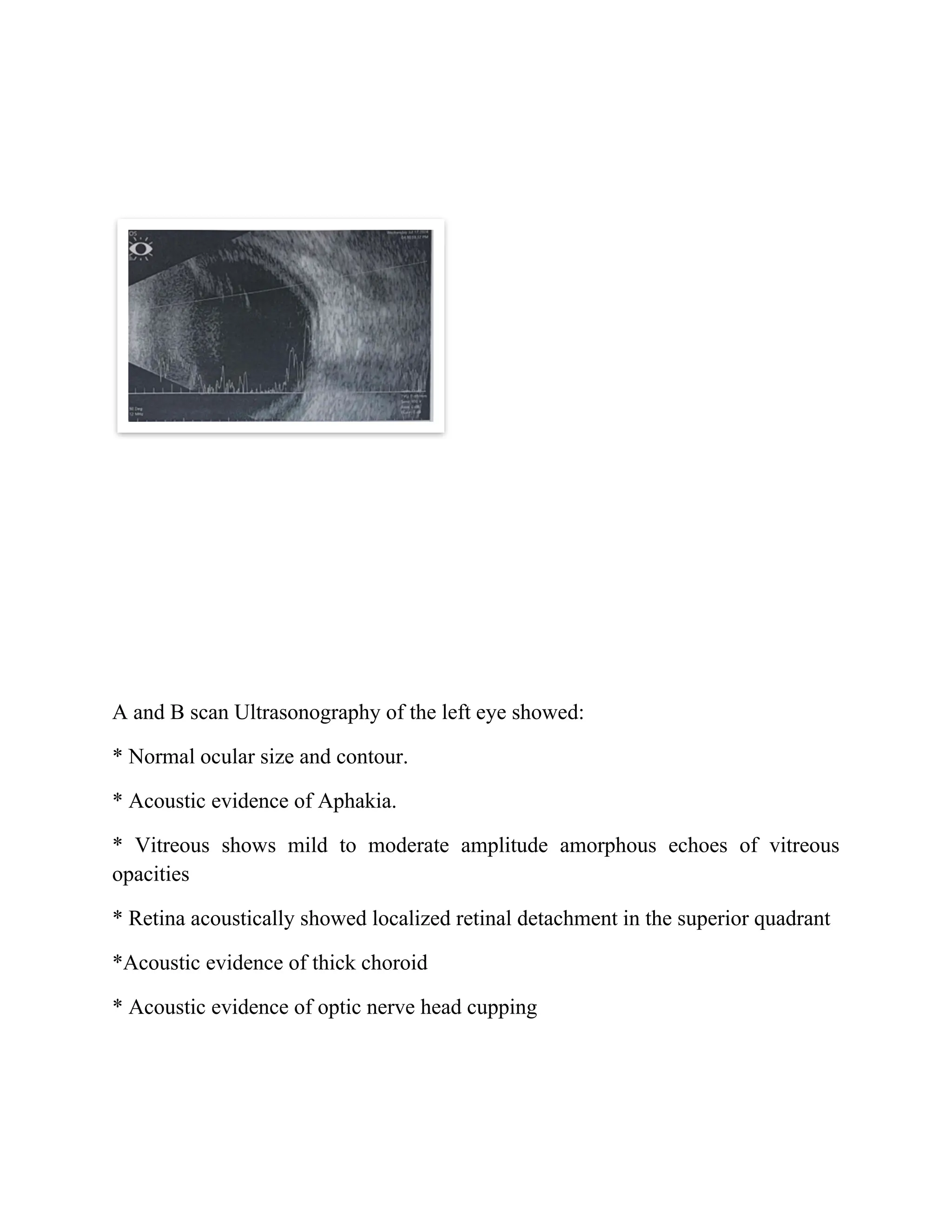
A and B scan Ultrasonography of the left eye showed:
* Normal ocular size and contour.
* Acoustic evidence of Aphakia.
* Vitreous shows mild to moderate amplitude amorphous echoes of vitreous
opacities
* Retina acoustically showed localized retinal detachment in the superior quadrant
*Acoustic evidence of thick choroid
* Acoustic evidence of optic nerve head cupping
A and B scan Ultrasonography of the left eye showed:
* Normal ocular size and contour.
* Lens acoustically is in place.
*Vitreous shows moderate amplitude amorphous echoes of vitreous opacities.
* Retina acoustically showed total closed funnel retinal detachment with thickened
retinal leaves, which showed low mobility on the kinetic scan.
* Acoustic evidence of thick choroid
* Acoustic evidence of normal optic nerve head shadow.
how to write ophthalmic US -Reports.docx

how to write ophthalmic US -Reports.docx

  • 1.
    Ophthalmic ultrasound report Bscan Ultrasound How to write a ultrasound report Prof Dr Nagla Hassan Aly Professor of ophthalmology Memorial institute for ophthalmic research Giza- Egypt
  • 2.
    Introduction B-scan Ultrasonography isan important adjuvant for the clinical assessment of various ocular and orbital diseases .
  • 3.
    With understanding ofthe indications and proper examination technique, one can gain a great amount of information which is not possible with clinical examination alone . B-scan ultrasound is most useful when direct visualization of intraocular structures is difficult . Situations that prevent normal examination includes : ** Lid problems (severe edema) . ** Corneal opacities ( scars, edema
  • 9.
    Name: ID: Date: . Time: . --------------------------------------------------------------------------------------- -- DearSir, Thank you for referring your patient . Contact B and A scan Ultrasonography of the Left eye showed: ** Normal ocular size and contour.
  • 10.
    ** Lens inplace with well delineated posterior capsule **Vitreous shows Partial PVD with low amplitude amorphous echoes of vitreous floaters. **Retina is acoustically in place. **Normal thickness of choroid **Normal acoustic appearance of optic nerve shadow. Thank you
  • 11.
    what's your Expectationsif the patient is not normal  size of the globe Normal -large -small  Contour of the globe Normal or disturbed (rupture globe!)  Lens -phakic ,pesudophakic -lens in place with well delineated posterior capsule - dropped lens -rupture capsule -if pesudophakia, droped IOL!  Vitreous -Clear -opacities (Hgs or exudates)
  • 12.
    -PVD -Sub hyaloid Hgs -Endophthalmitis -Uveitits -Organizedvitreous Hgs -vitreal membranes -traction bands on the surface of the retina!  Retina -in place -localized -total -subtotal RD -good mobility on kinetic scanning -poor mobility with thickened retina leaves  Choroid -Normal thickness - thickness -choroidal mass! size-transverse and longitudinal diameters  ONH -normal optic nerve head shadow -coloboma-swelling-drusen-cupping (advanced) ; ID; Date; Time: ------------------------------------------------------------------------ A and B scans of the left eye showed ultrasonography. * Normal ocular size and contour * Lens could not be detected. * Vitreous shows moderate to high echoes of amorphous vitreous opacities denoting vitreous Hemorrhages or exudates; however, there is evidence of Loculi * Retina is in place *Acoustic evidence of thickened choroid
  • 13.
    * Normal acousticappearance of optic nerve shadow. * NB clinical picture in endophthalmitis should be correlated ------------------------------------------------------------------------ A and B scan Ultrasonography of the right eye showed: * Normal ocular size and contour. * Lens acoustically in place. * Vitreous shows mild amplitude amorphous echoes of vitreous floaters. * Retina acoustically showed total retinal detachment in an open funnel with thickened retinal leaves with good mobility on the kinetic scan. * Normal thickness of the choroid * Normal acoustic appearance of optic nerve shadow.
  • 14.
    A and Bscan Ultrasonography of the left eye showed: * Normal ocular size and contour. * Acoustic evidence of Aphakia. * Vitreous shows mild to moderate amplitude amorphous echoes of vitreous opacities * Retina acoustically showed localized retinal detachment in the superior quadrant *Acoustic evidence of thick choroid * Acoustic evidence of optic nerve head cupping
  • 15.
    A and Bscan Ultrasonography of the left eye showed: * Normal ocular size and contour. * Lens acoustically is in place. *Vitreous shows moderate amplitude amorphous echoes of vitreous opacities. * Retina acoustically showed total closed funnel retinal detachment with thickened retinal leaves, which showed low mobility on the kinetic scan. * Acoustic evidence of thick choroid
  • 16.
    * Acoustic evidenceof normal optic nerve head shadow.