VISUAL FIELD CHANGES IN MS
Nagla Hassan
MIOR
WHAT IS M.S. ?
 Multiple sclerosis (MS) is a chronic
complex neurodegenerative disease that
attacks the central nervous system and
has autoimmune nature.
 The main pathological feature of MS is
the periventricular inflammatory lesions
with a formation of demyelinating
plaques .
 Earlier in the disease, axons are not
affected followed by irreversible axonal
damage and finally neurological insults
occur.
 Relapsing-remitting multiple sclerosis (RRMS)
is the most common presentation of MS,
representing about 85% of MS patients.
 It is characterized by relapses or exacerbations
followed by periods of partial or total inactivity
of the disease that are called remissions.
 Optic neuritis (ON) may be the first presentation
of MS in 20% of patients. Furthermore, it may
occur in about 50% of cases during the disease .
VISUAL FIELD (VF) CHANGES IN M.S. PATIENTS
 One of the unexplained features of multiple sclerosis
(MS) is the predilection which the disease shows for
the anterior visual pathway—the optic nerves,
chiasm and |tracts.
 Symptoms referable to the anterior visual pathway
are by no means universal in MS, a typical attack
of optic neuritis occurring in only between 27 % of
and 62 % of MS patients according to different
series. Some other patients have mild and often ill-
remembered symptoms but many give no history
whatsoever of visual disturbance.
 Because of this discrepancy between the
clinical and pathological findings which has led
to the recent interest in visual field of detecting
subclinical visual involvement in patients
suspected of having MS. Such detection, in
confirming or strengthening a diagnosis of MS,
aids the management of the individual patient
and increases understanding of the natural
history and epidemiology of the disease.
 Three-quarters of the MS patients with no
history of visual symptoms had abnormal
fields. The commonest defect found was an
arcuate scotoma.
CRITERIA OF ABNORMALITIES :
 A scotoma was only regarded as being
significant if it crossed at least two adjacent
radii 15° apart, if it was greater than 1° in
breadth, and if it could be demonstrated
repeatedly.
 An arcuate defect was defined as an absolute or
relative scotoma between 10° and 25°
eccentricity which was arched about the point
of fixation.
 Abnormal depression of the visual field was
taken to be present when the isoptre for the 2
mm test object fell within 15° of fixation. A
paracentral scotoma was one within 10° of the
fixation point but which did not involve it.
 The commonest defect found was an
arcuate scotoma.
 Depression of the visual field was the
most common abnormality .
 And although a paracentral scotoma as
well as depression in some fields .
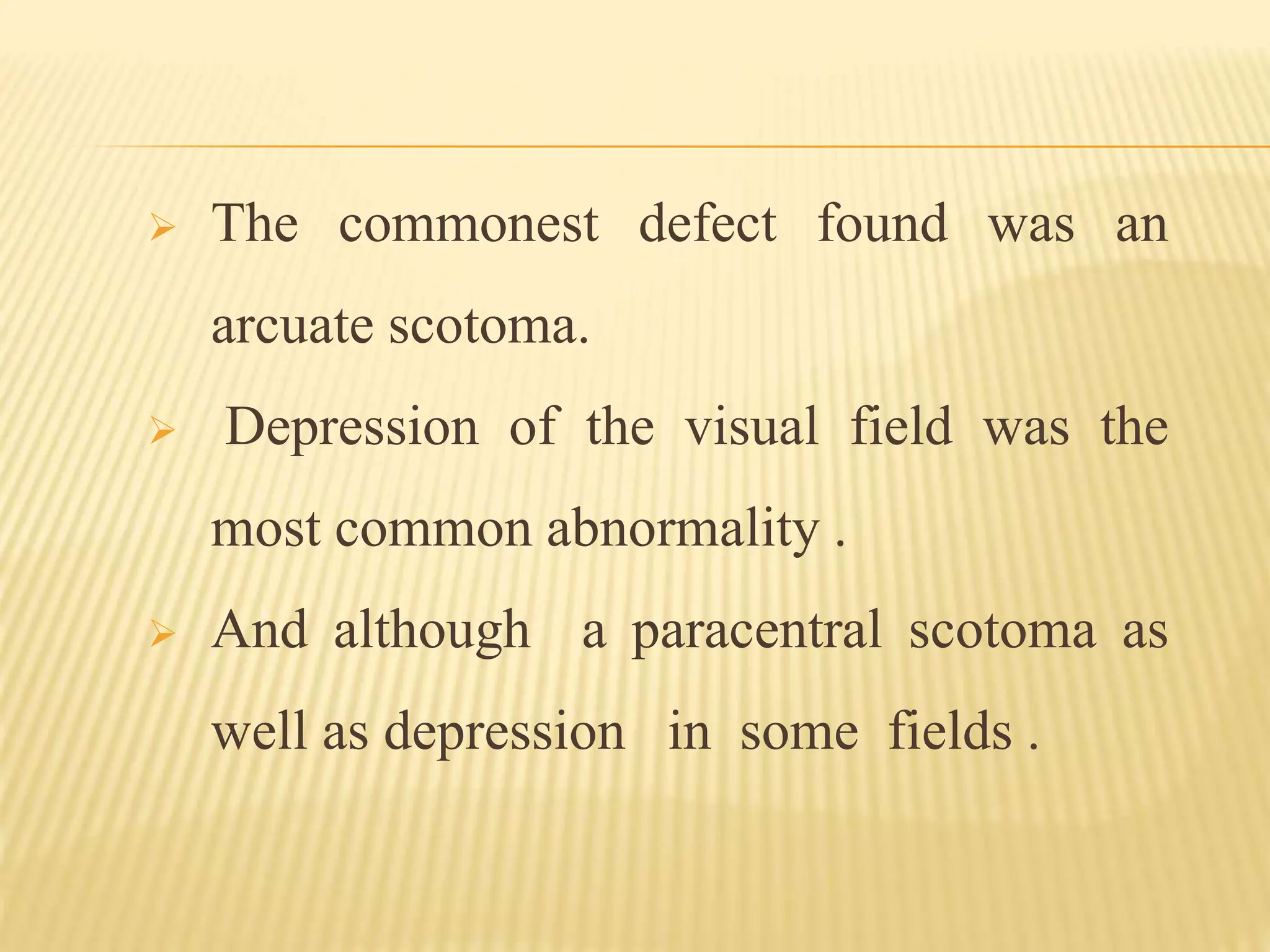
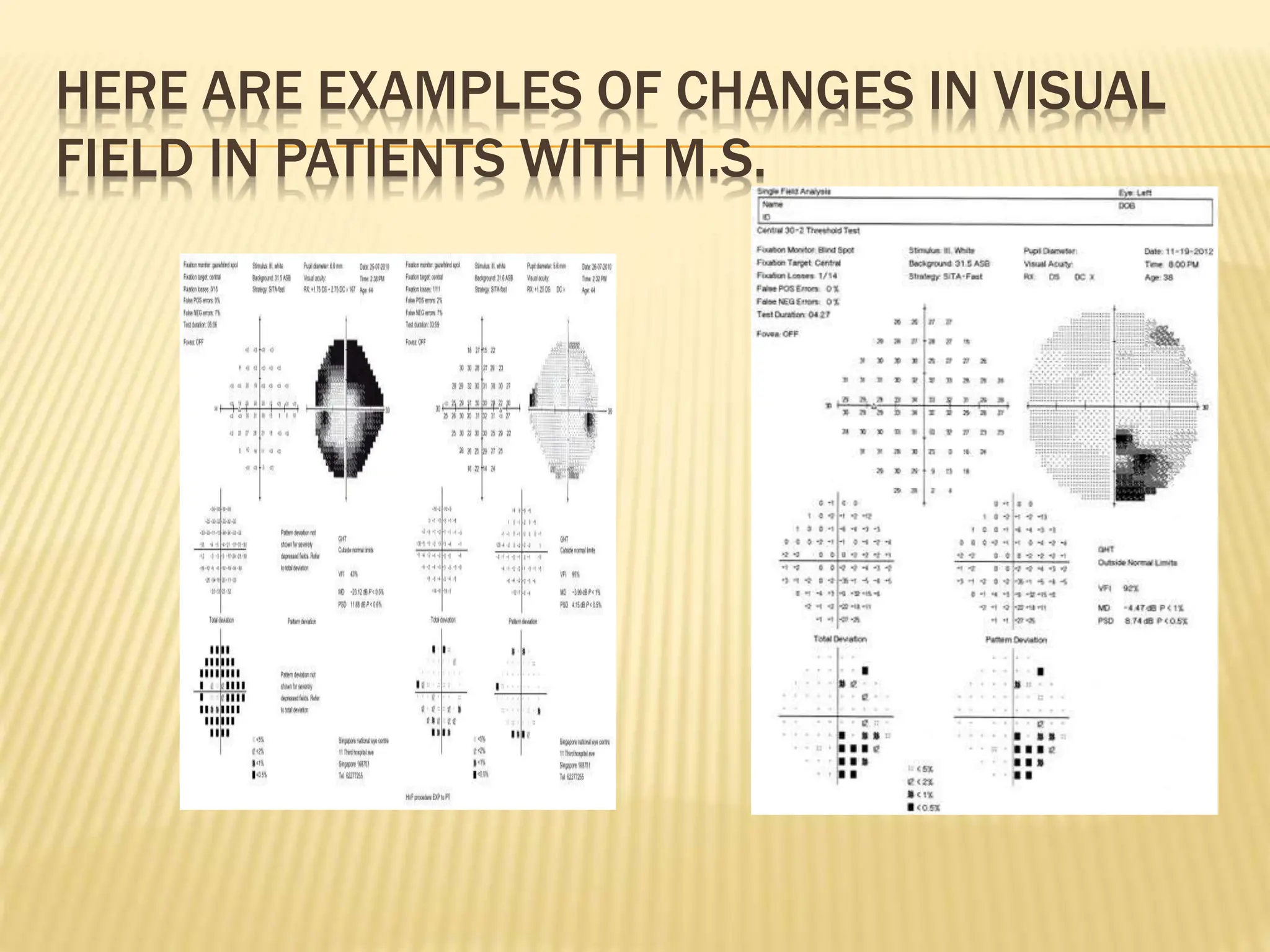
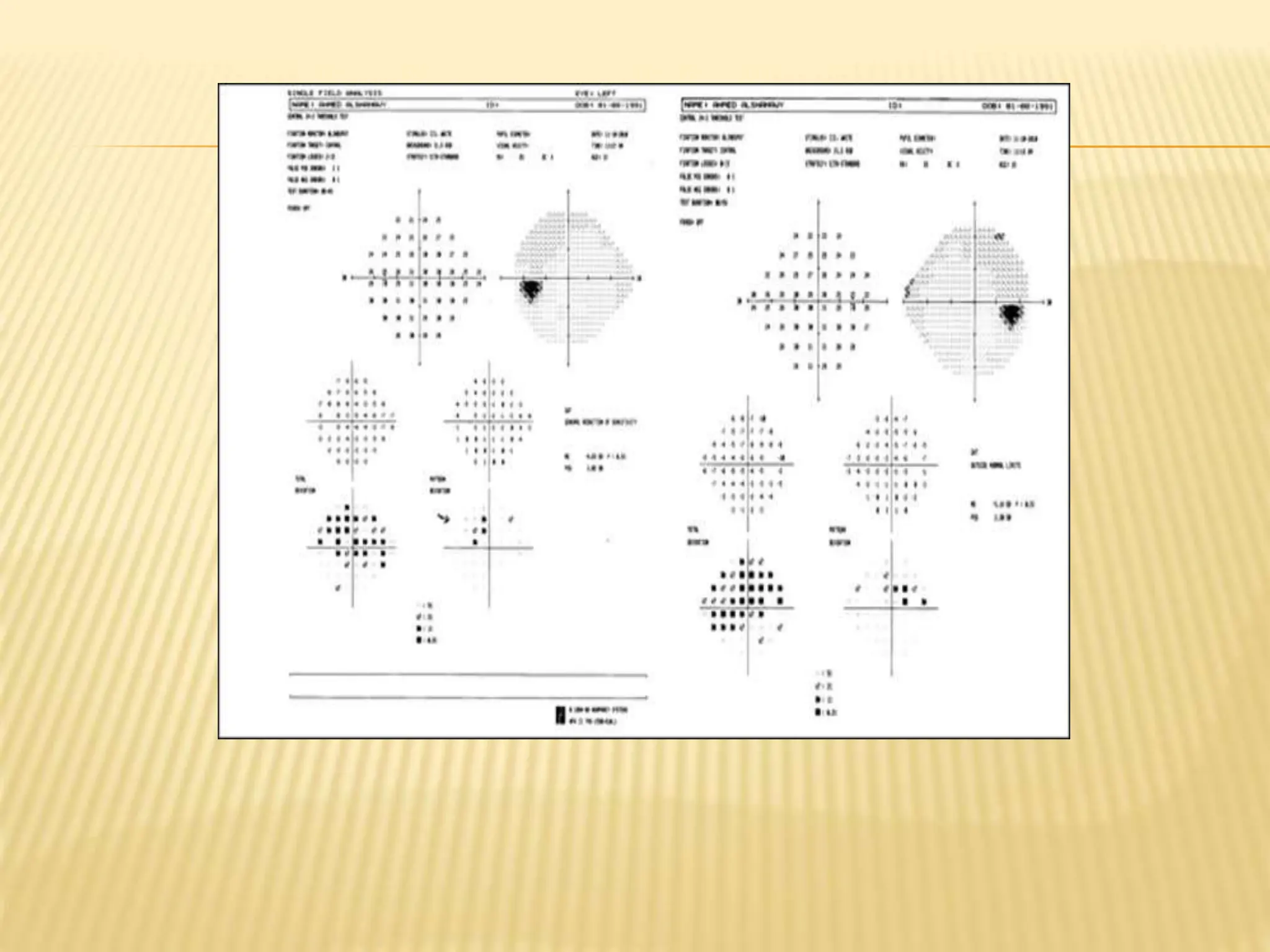
HERE ARE EXAMPLES OF CHANGES IN VISUAL
FIELD IN PATIENTS WITH M.S.
MS VF.pptx
MS VF.pptx
MS VF.pptx
MS VF.pptx
MS VF.pptx

MS VF.pptx

  • 1.
    VISUAL FIELD CHANGESIN MS Nagla Hassan MIOR
  • 3.
    WHAT IS M.S.?  Multiple sclerosis (MS) is a chronic complex neurodegenerative disease that attacks the central nervous system and has autoimmune nature.  The main pathological feature of MS is the periventricular inflammatory lesions with a formation of demyelinating plaques .  Earlier in the disease, axons are not affected followed by irreversible axonal damage and finally neurological insults occur.
  • 4.
     Relapsing-remitting multiplesclerosis (RRMS) is the most common presentation of MS, representing about 85% of MS patients.  It is characterized by relapses or exacerbations followed by periods of partial or total inactivity of the disease that are called remissions.  Optic neuritis (ON) may be the first presentation of MS in 20% of patients. Furthermore, it may occur in about 50% of cases during the disease .
  • 5.
    VISUAL FIELD (VF)CHANGES IN M.S. PATIENTS  One of the unexplained features of multiple sclerosis (MS) is the predilection which the disease shows for the anterior visual pathway—the optic nerves, chiasm and |tracts.  Symptoms referable to the anterior visual pathway are by no means universal in MS, a typical attack of optic neuritis occurring in only between 27 % of and 62 % of MS patients according to different series. Some other patients have mild and often ill- remembered symptoms but many give no history whatsoever of visual disturbance.
  • 6.
     Because ofthis discrepancy between the clinical and pathological findings which has led to the recent interest in visual field of detecting subclinical visual involvement in patients suspected of having MS. Such detection, in confirming or strengthening a diagnosis of MS, aids the management of the individual patient and increases understanding of the natural history and epidemiology of the disease.  Three-quarters of the MS patients with no history of visual symptoms had abnormal fields. The commonest defect found was an arcuate scotoma.
  • 7.
    CRITERIA OF ABNORMALITIES:  A scotoma was only regarded as being significant if it crossed at least two adjacent radii 15° apart, if it was greater than 1° in breadth, and if it could be demonstrated repeatedly.  An arcuate defect was defined as an absolute or relative scotoma between 10° and 25° eccentricity which was arched about the point of fixation.  Abnormal depression of the visual field was taken to be present when the isoptre for the 2 mm test object fell within 15° of fixation. A paracentral scotoma was one within 10° of the fixation point but which did not involve it.
  • 8.
     The commonestdefect found was an arcuate scotoma.  Depression of the visual field was the most common abnormality .  And although a paracentral scotoma as well as depression in some fields .
  • 10.
    HERE ARE EXAMPLESOF CHANGES IN VISUAL FIELD IN PATIENTS WITH M.S.