Narrative Writing
A Review – 10 Things to Remember
When Writing a Narrative
Number 1 – Your Story Beginning
Your story needs a strong beginning. You can
achieve this using one of the following methods:
 Dialogue (Conversation)
 A Question
 A Vivid Description
 An Interesting Fact
 Sound Effects
http://www.learnnc.org/lp/pages/2992
Dialogue
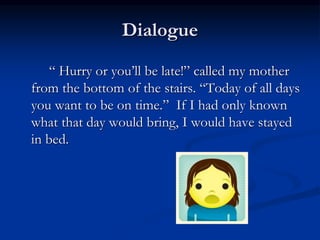
“ Hurry or you’ll be late!” called my mother
from the bottom of the stairs. “Today of all days
you want to be on time.” If I had only known
what that day would bring, I would have stayed
in bed.
A Question
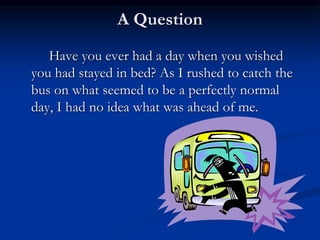
Have you ever had a day when you wished
you had stayed in bed? As I rushed to catch the
bus on what seemed to be a perfectly normal
day, I had no idea what was ahead of me.
A Vivid Description
The sun was warm on my back as I raced
toward the waiting yellow school bus. As I
nestled into the worn leather seat, I was greeted
by the friendly voices of other excited children.
The look on my face was one of confidence and
contentment. With a jerk, the bus rumbled down
the road, and I was on my way into one of the
worst days of my life.
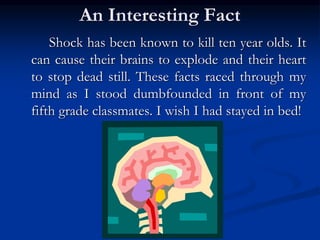
An Interesting Fact
Shock has been known to kill ten year olds. It
can cause their brains to explode and their heart
to stop dead still. These facts raced through my
mind as I stood dumbfounded in front of my
fifth grade classmates. I wish I had stayed in bed!
Sound Effects
“Buzzzzzz!” The sound of my alarm clock
droned in my ears as I struggled to come awake.
With a start, I sat straight up in my bed. This
was my big day, and I had to be on time.
Number 2 - Paragraphs
Be sure your story has paragraphs. They tell when
you're switching time, place, topic or speaker,
and they help break the page up so it is not just
a solid block of writing.
How Do I Know When To Start a
New Paragraph?
There are a few standard times to make a new
paragraph:
 When you start in on a new topic
 When you skip to a new time
 When you skip to a new place
 When a new person begins to speak
 When you want to produce a dramatic effect
http://www.saidsimple.com/content/When-to-Make-a-New-Paragraph
Number 3 - Capitalization &
Punctuation
 Capitalize
 Beginnings of Sentences
 Proper Nouns
 Punctuate
 End Marks (question mark, period, exclamation
marks)
 Commas when joining two sentences with a
conjunction, addressing a person, with quotations,
etc.
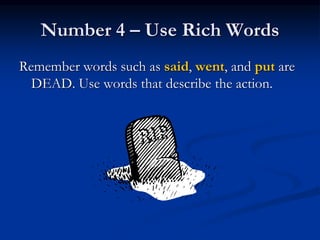
Number 4 – Use Rich Words
Remember words such as said, went, and put are
DEAD. Use words that describe the action.
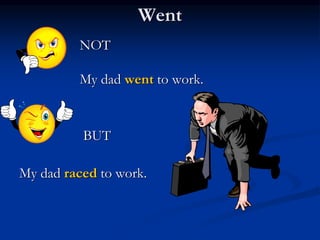
Went
NOT
My dad went to work.
BUT
My dad raced to work.
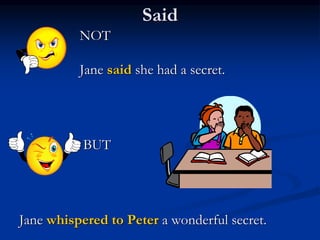
Said
NOT
Jane said she had a secret.
BUT
Jane whispered to Peter a wonderful secret.
Number 5 - Wow Words
Show your reader that you have a high-quality,
first-class, superior, excellent, exceptional,
outstanding, brilliant, extraordinary,
incomparable vocabulary by using 5th grade
vocabulary words.
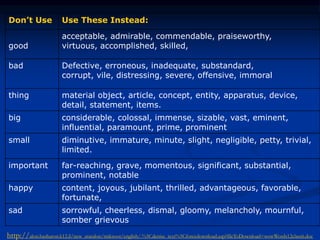
Don’t Use Use These Instead:
good
acceptable, admirable, commendable, praiseworthy,
virtuous, accomplished, skilled,
bad Defective, erroneous, inadequate, substandard,
corrupt, vile, distressing, severe, offensive, immoral
thing material object, article, concept, entity, apparatus, device,
detail, statement, items.
big considerable, colossal, immense, sizable, vast, eminent,
influential, paramount, prime, prominent
small diminutive, immature, minute, slight, negligible, petty, trivial,
limited.
important far-reaching, grave, momentous, significant, substantial,
prominent, notable
happy content, joyous, jubilant, thrilled, advantageous, favorable,
fortunate,
sad sorrowful, cheerless, dismal, gloomy, melancholy, mournful,
somber grievous
http://alon.hasharon.k12.il/new_ataralon/mikzoot/english/.%5Cdenise_text%5Cforcedownload.asp?fileToDownload=wowWords12class6.doc
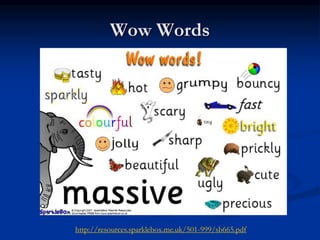
Wow Words
http://resources.sparklebox.me.uk/501-999/sb665.pdf
Number 6 - Show, Don’t Tell
The Show, Don’t Tell method of writing is when
the writer is able to create a picture in the
reader's mind, to get away from the repetition of
such empty words like went, big, or said.
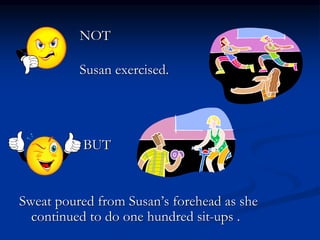
NOT
Susan exercised.
BUT
Sweat poured from Susan’s forehead as she
continued to do one hundred sit-ups .
Number 7 - Conversation
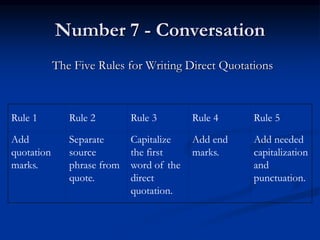
The Five Rules for Writing Direct Quotations
Rule 1 Rule 2 Rule 3 Rule 4 Rule 5
Add
quotation
marks.
Separate
source
phrase from
quote.
Capitalize
the first
word of the
direct
quotation.
Add end
marks.
Add needed
capitalization
and
punctuation.
Conversation
Remember
You must make a new paragraph every time a
different person speaks!!!!
Number 8 - Sentences
 Vary your sentences.
 Are some of your sentences long and others short?
 Do you start the beginnings differently?
 Do some sentences start with a part of speech other
than a noun or pronoun?
Number 9 – Figurative Language
Use a little figurative language to add interest to
your story.
 Simile
 Metaphor
 Alliteration
 Onomatopoeia
Simile
comparison between two unlike things that have
something in common using like or as
Examples
 It's been a hard day's night and I've been working like a
dog. - The Beatles
 My heart is like an open highway. - Jon Bon Jovi
 like two peas in a pod
like Christmas in summer
 as hungry as a bear
as nutty as a fruitcake
as quick as lightning
Metaphor
Metaphor– comparison between two unlike things
that have something in common without using
like or as
Examples
Patty was a raging tiger when she lost her lunch
money.
During the night, the forest was a dark, frightening
battlefield.
Alliteration
repetition of usually initial consonant sounds in
two or more neighboring words or syllables
Examples
down in the dumps
do or die
right as rain
sink or swim
pay the price
back to the basics
green as grass
live the life
Onomatopoeia
the imitation of natural sounds in word form.
These words help us form mental pictures about
the things, people, or places that are described
Examples
buzz
hiss
roar
woof
bang
pop
hiss
sizzle
Number 10 - Plot Structure
http://www.learner.org/interactives/story/ci
nderella.html
 a plot, including setting and characters
 a climax (This is when the plot is solved.)
 an ending
United Streaming
 Parts of a Story: Huck and Jim [05:34]
http://player.discoveryeducation.com/index.cfm?
guidAssetId=20D49155-2509-447F-8C47-
69C9B3D2128A&blnFromSearch=1&productc
ode=US
Beginning
 In the beginning of your story, you should
introduce your characters.
 The reader should also know about the world
your characters live in (the setting) and the
something about each of the characters in your
story.
 The beginning of your story is also the place
where your plot (the problem) is first
introduced.
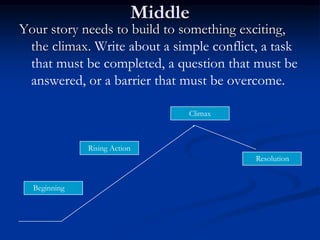
Middle
Your story needs to build to something exciting,
the climax. Write about a simple conflict, a task
that must be completed, a question that must be
answered, or a barrier that must be overcome.
Rising Action
Climax
Beginning
Resolution
Middle
 Include
 Actions
 Dialogue
 Sensory Details
 Thoughts and Feelings
 Suspense (Remember to build to a climax.)
The End
This is the big finish. The end should reveal how
you overcame your problem. All conflicts are
resolved and everything goes back to normal.

Narrative Writing.ppt

  • 1.
    Narrative Writing A Review– 10 Things to Remember When Writing a Narrative
  • 2.
    Number 1 –Your Story Beginning Your story needs a strong beginning. You can achieve this using one of the following methods:  Dialogue (Conversation)  A Question  A Vivid Description  An Interesting Fact  Sound Effects http://www.learnnc.org/lp/pages/2992
  • 3.
    Dialogue “ Hurry oryou’ll be late!” called my mother from the bottom of the stairs. “Today of all days you want to be on time.” If I had only known what that day would bring, I would have stayed in bed.
  • 4.
    A Question Have youever had a day when you wished you had stayed in bed? As I rushed to catch the bus on what seemed to be a perfectly normal day, I had no idea what was ahead of me.
  • 5.
    A Vivid Description Thesun was warm on my back as I raced toward the waiting yellow school bus. As I nestled into the worn leather seat, I was greeted by the friendly voices of other excited children. The look on my face was one of confidence and contentment. With a jerk, the bus rumbled down the road, and I was on my way into one of the worst days of my life.
  • 6.
    An Interesting Fact Shockhas been known to kill ten year olds. It can cause their brains to explode and their heart to stop dead still. These facts raced through my mind as I stood dumbfounded in front of my fifth grade classmates. I wish I had stayed in bed!
  • 7.
    Sound Effects “Buzzzzzz!” Thesound of my alarm clock droned in my ears as I struggled to come awake. With a start, I sat straight up in my bed. This was my big day, and I had to be on time.
  • 8.
    Number 2 -Paragraphs Be sure your story has paragraphs. They tell when you're switching time, place, topic or speaker, and they help break the page up so it is not just a solid block of writing.
  • 9.
    How Do IKnow When To Start a New Paragraph? There are a few standard times to make a new paragraph:  When you start in on a new topic  When you skip to a new time  When you skip to a new place  When a new person begins to speak  When you want to produce a dramatic effect http://www.saidsimple.com/content/When-to-Make-a-New-Paragraph
  • 10.
    Number 3 -Capitalization & Punctuation  Capitalize  Beginnings of Sentences  Proper Nouns  Punctuate  End Marks (question mark, period, exclamation marks)  Commas when joining two sentences with a conjunction, addressing a person, with quotations, etc.
  • 11.
    Number 4 –Use Rich Words Remember words such as said, went, and put are DEAD. Use words that describe the action.
  • 12.
    Went NOT My dad wentto work. BUT My dad raced to work.
  • 13.
    Said NOT Jane said shehad a secret. BUT Jane whispered to Peter a wonderful secret.
  • 14.
    Number 5 -Wow Words Show your reader that you have a high-quality, first-class, superior, excellent, exceptional, outstanding, brilliant, extraordinary, incomparable vocabulary by using 5th grade vocabulary words.
  • 15.
    Don’t Use UseThese Instead: good acceptable, admirable, commendable, praiseworthy, virtuous, accomplished, skilled, bad Defective, erroneous, inadequate, substandard, corrupt, vile, distressing, severe, offensive, immoral thing material object, article, concept, entity, apparatus, device, detail, statement, items. big considerable, colossal, immense, sizable, vast, eminent, influential, paramount, prime, prominent small diminutive, immature, minute, slight, negligible, petty, trivial, limited. important far-reaching, grave, momentous, significant, substantial, prominent, notable happy content, joyous, jubilant, thrilled, advantageous, favorable, fortunate, sad sorrowful, cheerless, dismal, gloomy, melancholy, mournful, somber grievous http://alon.hasharon.k12.il/new_ataralon/mikzoot/english/.%5Cdenise_text%5Cforcedownload.asp?fileToDownload=wowWords12class6.doc
  • 16.
  • 17.
    Number 6 -Show, Don’t Tell The Show, Don’t Tell method of writing is when the writer is able to create a picture in the reader's mind, to get away from the repetition of such empty words like went, big, or said.
  • 18.
    NOT Susan exercised. BUT Sweat pouredfrom Susan’s forehead as she continued to do one hundred sit-ups .
  • 19.
    Number 7 -Conversation The Five Rules for Writing Direct Quotations Rule 1 Rule 2 Rule 3 Rule 4 Rule 5 Add quotation marks. Separate source phrase from quote. Capitalize the first word of the direct quotation. Add end marks. Add needed capitalization and punctuation.
  • 20.
    Conversation Remember You must makea new paragraph every time a different person speaks!!!!
  • 21.
    Number 8 -Sentences  Vary your sentences.  Are some of your sentences long and others short?  Do you start the beginnings differently?  Do some sentences start with a part of speech other than a noun or pronoun?
  • 22.
    Number 9 –Figurative Language Use a little figurative language to add interest to your story.  Simile  Metaphor  Alliteration  Onomatopoeia
  • 23.
    Simile comparison between twounlike things that have something in common using like or as Examples  It's been a hard day's night and I've been working like a dog. - The Beatles  My heart is like an open highway. - Jon Bon Jovi  like two peas in a pod like Christmas in summer  as hungry as a bear as nutty as a fruitcake as quick as lightning
  • 24.
    Metaphor Metaphor– comparison betweentwo unlike things that have something in common without using like or as Examples Patty was a raging tiger when she lost her lunch money. During the night, the forest was a dark, frightening battlefield.
  • 25.
    Alliteration repetition of usuallyinitial consonant sounds in two or more neighboring words or syllables Examples down in the dumps do or die right as rain sink or swim pay the price back to the basics green as grass live the life
  • 26.
    Onomatopoeia the imitation ofnatural sounds in word form. These words help us form mental pictures about the things, people, or places that are described Examples buzz hiss roar woof bang pop hiss sizzle
  • 27.
    Number 10 -Plot Structure http://www.learner.org/interactives/story/ci nderella.html  a plot, including setting and characters  a climax (This is when the plot is solved.)  an ending
  • 28.
    United Streaming  Partsof a Story: Huck and Jim [05:34] http://player.discoveryeducation.com/index.cfm? guidAssetId=20D49155-2509-447F-8C47- 69C9B3D2128A&blnFromSearch=1&productc ode=US
  • 29.
    Beginning  In thebeginning of your story, you should introduce your characters.  The reader should also know about the world your characters live in (the setting) and the something about each of the characters in your story.  The beginning of your story is also the place where your plot (the problem) is first introduced.
  • 30.
    Middle Your story needsto build to something exciting, the climax. Write about a simple conflict, a task that must be completed, a question that must be answered, or a barrier that must be overcome. Rising Action Climax Beginning Resolution
  • 31.
    Middle  Include  Actions Dialogue  Sensory Details  Thoughts and Feelings  Suspense (Remember to build to a climax.)
  • 32.
    The End This isthe big finish. The end should reveal how you overcame your problem. All conflicts are resolved and everything goes back to normal.