How to Write a
Proposal
Jemica M.
Colasito
Part One:
Planning Your
Proposal
Define your audience
You need to make sure that
you think about your audience
and what they might already
know or not know about your
topic before you begin writing.
Define your issue
By setting your issue
properly, you start
convincing the reader that
you are the right person to
take care of it.
Define your solution
Your proposal needs to
define a problem and offer a
solution that will convince
uninterested, skeptical
readers to support it.
Keep elements of style in mind
Convincing proposals can
use emotional appeals, but
should always rely on facts
as the bedrock of the
argument.
Make an outline
Your outline should consist
of your problem, your
solution, how you'll solve it,
why your solution is best,
and a conclusion.
Part Two:
Writing Your Own
Proposal
Start with a firm introduction
Ideally, you want your
readers enraptured from
point one. Make your
proposal as purposeful and
useful as possible
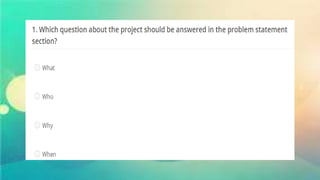
State the problem
Emphasize why your
problem needs to be solved
and needs to be solved now.
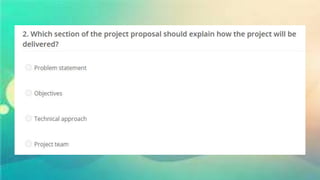
Propose solutions
The solutions section is
where you get into how you
will address the problem,
why you will do it in this
way, and what the outcomes
will be.
Include a schedule and budget
Your proposal represents an
investment. In order to convince your
readers that you're a good
investment, provide as much detailed,
concrete information about your
timeline and budget as possible.
Wrap up with a conclusion
Summarize the benefits of
your proposal and drive
home that the benefits
outweigh the costs.
Edit your work
Revise as necessary to make it
clear and concise, ask others to
critique and edit it, and make
sure the presentation is
attractive and engaging as well
as well organized and helpful.
Proofread your work
Proofreading makes sure that
your content is free of
mistakes. Go over your
proposal carefully to catch any
spelling, grammar, or
punctuation errors

How to Write a Project Proposal. Secondary Students

  • 1.
    How to Writea Proposal Jemica M. Colasito
  • 5.
  • 6.
    Define your audience Youneed to make sure that you think about your audience and what they might already know or not know about your topic before you begin writing.
  • 7.
    Define your issue Bysetting your issue properly, you start convincing the reader that you are the right person to take care of it.
  • 8.
    Define your solution Yourproposal needs to define a problem and offer a solution that will convince uninterested, skeptical readers to support it.
  • 9.
    Keep elements ofstyle in mind Convincing proposals can use emotional appeals, but should always rely on facts as the bedrock of the argument.
  • 10.
    Make an outline Youroutline should consist of your problem, your solution, how you'll solve it, why your solution is best, and a conclusion.
  • 11.
  • 12.
    Start with afirm introduction Ideally, you want your readers enraptured from point one. Make your proposal as purposeful and useful as possible
  • 13.
    State the problem Emphasizewhy your problem needs to be solved and needs to be solved now.
  • 14.
    Propose solutions The solutionssection is where you get into how you will address the problem, why you will do it in this way, and what the outcomes will be.
  • 15.
    Include a scheduleand budget Your proposal represents an investment. In order to convince your readers that you're a good investment, provide as much detailed, concrete information about your timeline and budget as possible.
  • 16.
    Wrap up witha conclusion Summarize the benefits of your proposal and drive home that the benefits outweigh the costs.
  • 17.
    Edit your work Reviseas necessary to make it clear and concise, ask others to critique and edit it, and make sure the presentation is attractive and engaging as well as well organized and helpful.
  • 18.
    Proofread your work Proofreadingmakes sure that your content is free of mistakes. Go over your proposal carefully to catch any spelling, grammar, or punctuation errors