www.uscsinstitute.org
© Copyright 2025. United States Cybersecurity Institute (USCSI ). All Rights Reserved.
®
INFORMATION
SECURITY-
GOALS, CHALLENGES, AND
BEST PRACTICES DISCUSSED
www.uscsinstitute.org
© Copyright 2025. United States Cybersecurity Institute (USCSI ). All Rights Reserved.
®
In today's digital age, information is an asset that requires protection from unauthorized access, use, disclosure,
disruption, modification, or destruction. Information security refers to the practices, technologies, and processes
designed to safeguard digital information from various threats. This exploratory read shall investigate the goals,
types, and applications of information security in greater depth. We are sure as you go through the read, you will
have a clear understanding of the critical fact of why appointing seasoned Cybersecurity Specialists is pivotal for
your business’s uninterrupted growth. So, let’s get the basics right!
What is Information Security?
Information security is a set of strategies, policies, and procedures aimed at protecting digital information from
various types of threats. These threats can be intentional, such as hacking or phishing, or unintentional, such as
natural disasters or equipment failure. Information security involves identifying, assessing, and mitigating risks to
ensure the confidentiality, integrity, and availability of digital information. Chief information security officers
(CISOs) who oversee information security efforts have become a fixture of corporate C-suites.
Is Information Security the Same as Cybersecurity?
Information security differs from cybersecurity in both scope and purpose. The two terms are often used
interchangeably, but more accurately, cybersecurity is a subcategory of information security. Information security is
a broad field that covers many areas such as physical security, endpoint security, data encryption, and network
security. It is also closely related to information assurance, which protects information from threats such as natural
disasters and server failures.
Cybersecurity primarily addresses technology-related threats, with practices and tools that can prevent or mitigate
them. Another related category is data security, which focuses on protecting an organization’s data from accidental
or malicious exposure to unauthorized parties.
The CIA Triad: Core Guiding Principles
The CIA triad forms the foundation of information security:
C
o
n
f
i
d
e
n
t
i
a
l
i
t
y
I
n
t
e
g
r
i
t
y
Availability
Data
Protected
by CIA Traid
www.uscsinstitute.org
© Copyright 2025. United States Cybersecurity Institute (USCSI ). All Rights Reserved.
®
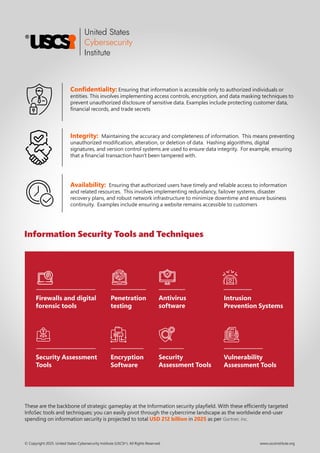
Information Security Tools and Techniques
These are the backbone of strategic gameplay at the Information security playfield. With these efficiently targeted
InfoSec tools and techniques; you can easily pivot through the cybercrime landscape as the worldwide end-user
spending on information security is projected to total USD 212 billion in 2025 as per Gartner, Inc.
Firewalls and digital
forensic tools
Security Assessment
Tools
Penetration
testing
Encryption
Software
Antivirus
software
Security
Assessment Tools
Intrusion
Prevention Systems
Vulnerability
Assessment Tools
Confidentiality: Ensuring that information is accessible only to authorized individuals or
entities. This involves implementing access controls, encryption, and data masking techniques to
prevent unauthorized disclosure of sensitive data. Examples include protecting customer data,
financial records, and trade secrets
Integrity: Maintaining the accuracy and completeness of information. This means preventing
unauthorized modification, alteration, or deletion of data. Hashing algorithms, digital
signatures, and version control systems are used to ensure data integrity. For example, ensuring
that a financial transaction hasn't been tampered with.
Availability: Ensuring that authorized users have timely and reliable access to information
and related resources. This involves implementing redundancy, failover systems, disaster
recovery plans, and robust network infrastructure to minimize downtime and ensure business
continuity. Examples include ensuring a website remains accessible to customers
www.uscsinstitute.org
© Copyright 2025. United States Cybersecurity Institute (USCSI ). All Rights Reserved.
®
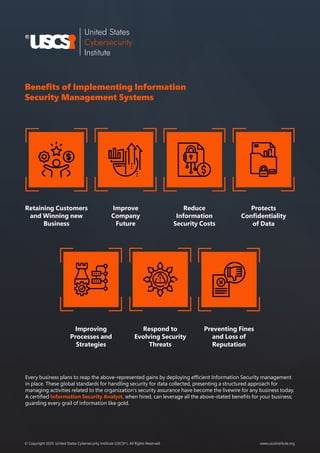
Benefits of Implementing Information
Security Management Systems
Retaining Customers
and Winning new
Business
Improve
Company
Future
Reduce
Information
Security Costs
Protects
Confidentiality
of Data
Improving
Processes and
Strategies
Respond to
Evolving Security
Threats
Preventing Fines
and Loss of
Reputation
Every business plans to reap the above-represented gains by deploying efficient Information Security management
in place. These global standards for handling security for data collected, presenting a structured approach for
managing activities related to the organization’s security assurance have become the livewire for any business today.
A certified Information Security Analyst, when hired, can leverage all the above-stated benefits for your business;
guarding every grail of information like gold.
www.uscsinstitute.org
© Copyright 2025. United States Cybersecurity Institute (USCSI ). All Rights Reserved.
®
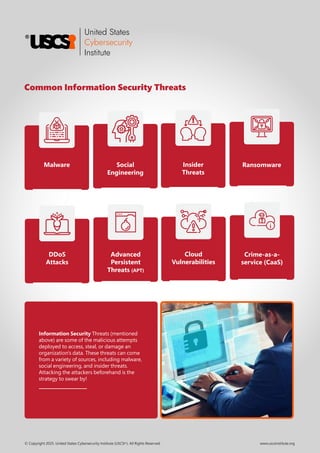
Common Information Security Threats
Information Security Threats (mentioned
above) are some of the malicious attempts
deployed to access, steal, or damage an
organization's data. These threats can come
from a variety of sources, including malware,
social engineering, and insider threats.
Attacking the attackers beforehand is the
strategy to swear by!
Malware Social
Engineering
Insider
Threats
Ransomware
DDoS
Attacks
Advanced
Persistent
Threats (APT)
Cloud
Vulnerabilities
Crime-as-a-
service (CaaS)
www.uscsinstitute.org
© Copyright 2025. United States Cybersecurity Institute (USCSI ). All Rights Reserved.
®
Information Security Goals Discussed
Information security aims to achieve several key goals:
• Risk Management: Identifying, assessing, and mitigating information security risks to an
acceptable level. This involves understanding potential threats and vulnerabilities and implementing
appropriate controls to minimize their impact.
• Compliance: Adhering to relevant laws, regulations, and industry standards related to data
protection and privacy. This includes regulations like GDPR, HIPAA, and PCI DSS.
• Business Continuity: Ensuring that critical business operations can continue in the event of a
security incident or disaster. This involves developing and testing disaster recovery plans and business
continuity strategies.
• Reputation Management: Protecting the organization's reputation by preventing security
breaches that could damage trust and lead to financial losses.
• Data Protection: Safeguarding sensitive data from unauthorized access, use, or disclosure. This
includes personal data, financial information, intellectual property, and other confidential information
Types of Information Security
There are several types of information security, including:
• Network Security: Protecting computer networks from unauthorized access, use, disclosure,
disruption, modification, or destruction. This involves firewalls, intrusion detection systems, virtual
private networks, and wireless security protocols.
• Application Security: Securing software applications from vulnerabilities and threats. This
involves secure coding practices, vulnerability scanning, and penetration testing.
• Data Security: Protecting data at rest, in transit, and in use; from unauthorized access, use,
disclosure, disruption, modification, or destruction. This involves access controls, data masking, and
data loss prevention tools.
• Endpoint Security: Securing endpoint devices, such as laptops, desktops, and mobile devices.
This includes antivirus software, endpoint detection and response solutions, and mobile device
management systems.
• Cloud Security: Securing cloud-based infrastructure, platforms, and applications. This involves
understanding the security responsibilities of the cloud provider and implementing appropriate
security controls.
• Physical Security: Protecting physical assets such as servers, data centers, and office buildings
from unauthorized access, theft, and damage. This includes access control systems, surveillance
cameras, and environmental monitoring.
www.uscsinstitute.org
© Copyright 2025. United States Cybersecurity Institute (USCSI ). All Rights Reserved.
®
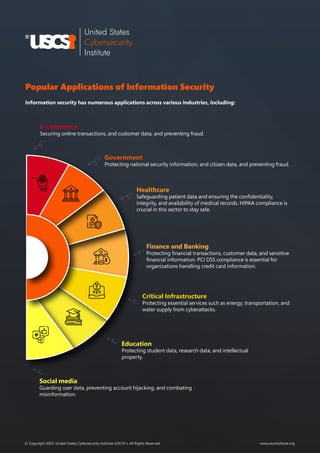
Popular Applications of Information Security
Information security has numerous applications across various industries, including:
Finance and Banking
Protecting financial transactions, customer data, and sensitive
financial information. PCI DSS compliance is essential for
organizations handling credit card information.
Critical Infrastructure
Protecting essential services such as energy, transportation, and
water supply from cyberattacks.
Education
Protecting student data, research data, and intellectual
property.
Social media
Guarding user data, preventing account hijacking, and combating
misinformation.
Healthcare
Safeguarding patient data and ensuring the confidentiality,
integrity, and availability of medical records. HIPAA compliance is
crucial in this sector to stay safe.
Government
Protecting national security information, and citizen data, and preventing fraud.
E-commerce
Securing online transactions, and customer data, and preventing fraud.
www.uscsinstitute.org
© Copyright 2025. United States Cybersecurity Institute (USCSI ). All Rights Reserved.
®
Challenges Faced in Information Security
Information security faces several challenges:
• Evolving threats: The threat landscape is constantly evolving, with new and sophisticated
attacks emerging regularly.
• Human error: Human error is a major factor in security breaches. Employees may fall victim
to phishing scams or make mistakes that compromise security.
• Resource constraints: Many organizations face budget and resource constraints, making
it difficult to implement comprehensive security measures.
• Complexity: Information systems are becoming increasingly complex, making it
challenging to secure all components.
• Cloud Computing: The adoption of cloud computing introduces new security challenges,
as organizations rely on third-party providers for some aspects of security.
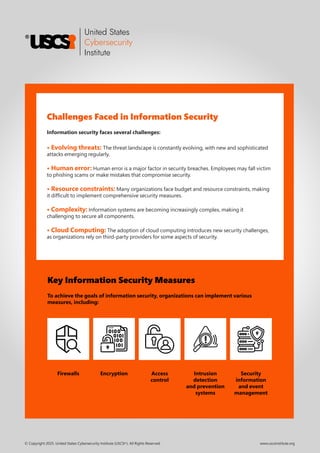
Key Information Security Measures
To achieve the goals of information security, organizations can implement various
measures, including:
Firewalls Encryption Access
control
Intrusion
detection
and prevention
systems
Security
information
and event
management
www.uscsinstitute.org
© Copyright 2025. United States Cybersecurity Institute (USCSI ). All Rights Reserved.
®
Best Practices for Solid Information Security
Implementing a robust information security program requires a multi-layered approach. Some of the best
practices look like:
Developing a security policy
A comprehensive security policy should outline the organizational security goals, responsibilities,
and procedures.
Conducting risk assessment
Regularly assessing information security risks to identify vulnerabilities and prioritize security efforts.
Implementing security controls
Implementing appropriate security controls including technical controls (firewalls, encryption),
administrative controls (policies and procedures), and physical controls (access control systems).
Providing security training
Educating employees about the security best practices and the importance of information security
via best information security certifications is a must in today’s volatile cyber threat landscape.
Monitoring Security
Continuously monitoring security systems and logs to detect and respond to security incidents.
Incident response planning
Developing and testing incident response plans to ensure that the organization can effectively
respond to security breaches.
Regular updates and patching
Keeping software and systems up-to-date with the latest security patches is crucial to prevent the
exploitation of known vulnerabilities.
Information Security is an ongoing process that requires continuous vigilance and adaptation. By understanding
the goals, types, and applications of information security, organizations and individuals can take steps to protect
their valuable information assets in today's digital world.
www.uscsinstitute.org
© Copyright 2025. United States Cybersecurity Institute (USCSI ). All Rights Reserved.
®
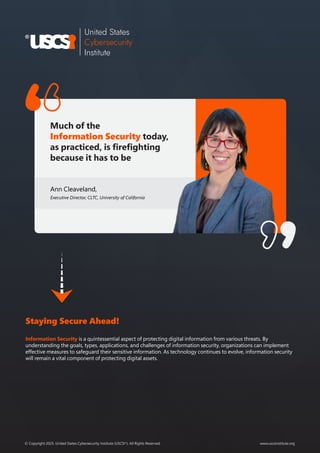
Much of the
Information Security today,
as practiced, is firefighting
because it has to be
Ann Cleaveland,
Executive Director, CLTC, University of California
Staying Secure Ahead!
Information Security is a quintessential aspect of protecting digital information from various threats. By
understanding the goals, types, applications, and challenges of information security, organizations can implement
effective measures to safeguard their sensitive information. As technology continues to evolve, information security
will remain a vital component of protecting digital assets.
www.uscsinstitute.org
© Copyright 2025. United States Cybersecurity Institute (USCSI ). All Rights Reserved.
®
You May Also Like:
What are the Information
Security Principles to
Enhance Business Security?
Is IoT Security A
Challenge? Surefire Target
Plan Explained
An Expert Guide on
Cybersecurity vs
Information Security
Factsheet: Cybersecurity
Career Gateway 2025
Who is a CISO and what
makes the Role Critical
for Business Security?
Unmasking Top 8
Deadly Malware for a
Cybersafe 2024
Discover More Discover More Discover More
www.uscsinstitute.org
No
REGISTER NOW
About USCSI®
LOCATIONS
info@uscs .org | www.uscs .org
institute institute
Arizona
1345 E. Chandler BLVD.,
Suite 111-D Phoenix,
AZ 85048,
info.az@uscsinstitute.org
Connecticut
Connecticut 680 E Main Street
#699, Stamford, CT 06901
info.ct@uscsinstitute.org
Illinois
1 East Erie St, Suite 525
Chicago, IL 60611
info.il@uscsinstitute.org
Singapore
No 7 Temasek Boulevard#12-07
Suntec Tower One, Singapore, 038987
Singapore, info.sg@uscsinstitute.org
United Kingdom
29 Whitmore Road, Whitnash
Learmington Spa, Warwickshire,
United Kingdom CV312JQ
info.uk@uscsinstitute.org
The United States Cybersecurity Institute (USCSI®
)
is a world-renowned cybersecurity certification
body offering the best-in-the-world certifications
for students and professionals around the globe
across industries. Whether a beginner looking to
step on cybersecurity career path or a seasoned
expert, it validates their cybersecurity expertise
to ace this domain.
ENROLL IN
CERTIFICATION
NOW
© 2025. United States Cybersecurity Institute (USCSI ). All Rights Reserved.
®

Information Security - Goals, Challenges, and Best Practices Discussed | USCSI®

  • 1.
    www.uscsinstitute.org © Copyright 2025.United States Cybersecurity Institute (USCSI ). All Rights Reserved. ® INFORMATION SECURITY- GOALS, CHALLENGES, AND BEST PRACTICES DISCUSSED
  • 2.
    www.uscsinstitute.org © Copyright 2025.United States Cybersecurity Institute (USCSI ). All Rights Reserved. ® In today's digital age, information is an asset that requires protection from unauthorized access, use, disclosure, disruption, modification, or destruction. Information security refers to the practices, technologies, and processes designed to safeguard digital information from various threats. This exploratory read shall investigate the goals, types, and applications of information security in greater depth. We are sure as you go through the read, you will have a clear understanding of the critical fact of why appointing seasoned Cybersecurity Specialists is pivotal for your business’s uninterrupted growth. So, let’s get the basics right! What is Information Security? Information security is a set of strategies, policies, and procedures aimed at protecting digital information from various types of threats. These threats can be intentional, such as hacking or phishing, or unintentional, such as natural disasters or equipment failure. Information security involves identifying, assessing, and mitigating risks to ensure the confidentiality, integrity, and availability of digital information. Chief information security officers (CISOs) who oversee information security efforts have become a fixture of corporate C-suites. Is Information Security the Same as Cybersecurity? Information security differs from cybersecurity in both scope and purpose. The two terms are often used interchangeably, but more accurately, cybersecurity is a subcategory of information security. Information security is a broad field that covers many areas such as physical security, endpoint security, data encryption, and network security. It is also closely related to information assurance, which protects information from threats such as natural disasters and server failures. Cybersecurity primarily addresses technology-related threats, with practices and tools that can prevent or mitigate them. Another related category is data security, which focuses on protecting an organization’s data from accidental or malicious exposure to unauthorized parties. The CIA Triad: Core Guiding Principles The CIA triad forms the foundation of information security: C o n f i d e n t i a l i t y I n t e g r i t y Availability Data Protected by CIA Traid
  • 3.
    www.uscsinstitute.org © Copyright 2025.United States Cybersecurity Institute (USCSI ). All Rights Reserved. ® Information Security Tools and Techniques These are the backbone of strategic gameplay at the Information security playfield. With these efficiently targeted InfoSec tools and techniques; you can easily pivot through the cybercrime landscape as the worldwide end-user spending on information security is projected to total USD 212 billion in 2025 as per Gartner, Inc. Firewalls and digital forensic tools Security Assessment Tools Penetration testing Encryption Software Antivirus software Security Assessment Tools Intrusion Prevention Systems Vulnerability Assessment Tools Confidentiality: Ensuring that information is accessible only to authorized individuals or entities. This involves implementing access controls, encryption, and data masking techniques to prevent unauthorized disclosure of sensitive data. Examples include protecting customer data, financial records, and trade secrets Integrity: Maintaining the accuracy and completeness of information. This means preventing unauthorized modification, alteration, or deletion of data. Hashing algorithms, digital signatures, and version control systems are used to ensure data integrity. For example, ensuring that a financial transaction hasn't been tampered with. Availability: Ensuring that authorized users have timely and reliable access to information and related resources. This involves implementing redundancy, failover systems, disaster recovery plans, and robust network infrastructure to minimize downtime and ensure business continuity. Examples include ensuring a website remains accessible to customers
  • 4.
    www.uscsinstitute.org © Copyright 2025.United States Cybersecurity Institute (USCSI ). All Rights Reserved. ® Benefits of Implementing Information Security Management Systems Retaining Customers and Winning new Business Improve Company Future Reduce Information Security Costs Protects Confidentiality of Data Improving Processes and Strategies Respond to Evolving Security Threats Preventing Fines and Loss of Reputation Every business plans to reap the above-represented gains by deploying efficient Information Security management in place. These global standards for handling security for data collected, presenting a structured approach for managing activities related to the organization’s security assurance have become the livewire for any business today. A certified Information Security Analyst, when hired, can leverage all the above-stated benefits for your business; guarding every grail of information like gold.
  • 5.
    www.uscsinstitute.org © Copyright 2025.United States Cybersecurity Institute (USCSI ). All Rights Reserved. ® Common Information Security Threats Information Security Threats (mentioned above) are some of the malicious attempts deployed to access, steal, or damage an organization's data. These threats can come from a variety of sources, including malware, social engineering, and insider threats. Attacking the attackers beforehand is the strategy to swear by! Malware Social Engineering Insider Threats Ransomware DDoS Attacks Advanced Persistent Threats (APT) Cloud Vulnerabilities Crime-as-a- service (CaaS)
  • 6.
    www.uscsinstitute.org © Copyright 2025.United States Cybersecurity Institute (USCSI ). All Rights Reserved. ® Information Security Goals Discussed Information security aims to achieve several key goals: • Risk Management: Identifying, assessing, and mitigating information security risks to an acceptable level. This involves understanding potential threats and vulnerabilities and implementing appropriate controls to minimize their impact. • Compliance: Adhering to relevant laws, regulations, and industry standards related to data protection and privacy. This includes regulations like GDPR, HIPAA, and PCI DSS. • Business Continuity: Ensuring that critical business operations can continue in the event of a security incident or disaster. This involves developing and testing disaster recovery plans and business continuity strategies. • Reputation Management: Protecting the organization's reputation by preventing security breaches that could damage trust and lead to financial losses. • Data Protection: Safeguarding sensitive data from unauthorized access, use, or disclosure. This includes personal data, financial information, intellectual property, and other confidential information Types of Information Security There are several types of information security, including: • Network Security: Protecting computer networks from unauthorized access, use, disclosure, disruption, modification, or destruction. This involves firewalls, intrusion detection systems, virtual private networks, and wireless security protocols. • Application Security: Securing software applications from vulnerabilities and threats. This involves secure coding practices, vulnerability scanning, and penetration testing. • Data Security: Protecting data at rest, in transit, and in use; from unauthorized access, use, disclosure, disruption, modification, or destruction. This involves access controls, data masking, and data loss prevention tools. • Endpoint Security: Securing endpoint devices, such as laptops, desktops, and mobile devices. This includes antivirus software, endpoint detection and response solutions, and mobile device management systems. • Cloud Security: Securing cloud-based infrastructure, platforms, and applications. This involves understanding the security responsibilities of the cloud provider and implementing appropriate security controls. • Physical Security: Protecting physical assets such as servers, data centers, and office buildings from unauthorized access, theft, and damage. This includes access control systems, surveillance cameras, and environmental monitoring.
  • 7.
    www.uscsinstitute.org © Copyright 2025.United States Cybersecurity Institute (USCSI ). All Rights Reserved. ® Popular Applications of Information Security Information security has numerous applications across various industries, including: Finance and Banking Protecting financial transactions, customer data, and sensitive financial information. PCI DSS compliance is essential for organizations handling credit card information. Critical Infrastructure Protecting essential services such as energy, transportation, and water supply from cyberattacks. Education Protecting student data, research data, and intellectual property. Social media Guarding user data, preventing account hijacking, and combating misinformation. Healthcare Safeguarding patient data and ensuring the confidentiality, integrity, and availability of medical records. HIPAA compliance is crucial in this sector to stay safe. Government Protecting national security information, and citizen data, and preventing fraud. E-commerce Securing online transactions, and customer data, and preventing fraud.
  • 8.
    www.uscsinstitute.org © Copyright 2025.United States Cybersecurity Institute (USCSI ). All Rights Reserved. ® Challenges Faced in Information Security Information security faces several challenges: • Evolving threats: The threat landscape is constantly evolving, with new and sophisticated attacks emerging regularly. • Human error: Human error is a major factor in security breaches. Employees may fall victim to phishing scams or make mistakes that compromise security. • Resource constraints: Many organizations face budget and resource constraints, making it difficult to implement comprehensive security measures. • Complexity: Information systems are becoming increasingly complex, making it challenging to secure all components. • Cloud Computing: The adoption of cloud computing introduces new security challenges, as organizations rely on third-party providers for some aspects of security. Key Information Security Measures To achieve the goals of information security, organizations can implement various measures, including: Firewalls Encryption Access control Intrusion detection and prevention systems Security information and event management
  • 9.
    www.uscsinstitute.org © Copyright 2025.United States Cybersecurity Institute (USCSI ). All Rights Reserved. ® Best Practices for Solid Information Security Implementing a robust information security program requires a multi-layered approach. Some of the best practices look like: Developing a security policy A comprehensive security policy should outline the organizational security goals, responsibilities, and procedures. Conducting risk assessment Regularly assessing information security risks to identify vulnerabilities and prioritize security efforts. Implementing security controls Implementing appropriate security controls including technical controls (firewalls, encryption), administrative controls (policies and procedures), and physical controls (access control systems). Providing security training Educating employees about the security best practices and the importance of information security via best information security certifications is a must in today’s volatile cyber threat landscape. Monitoring Security Continuously monitoring security systems and logs to detect and respond to security incidents. Incident response planning Developing and testing incident response plans to ensure that the organization can effectively respond to security breaches. Regular updates and patching Keeping software and systems up-to-date with the latest security patches is crucial to prevent the exploitation of known vulnerabilities. Information Security is an ongoing process that requires continuous vigilance and adaptation. By understanding the goals, types, and applications of information security, organizations and individuals can take steps to protect their valuable information assets in today's digital world.
  • 10.
    www.uscsinstitute.org © Copyright 2025.United States Cybersecurity Institute (USCSI ). All Rights Reserved. ® Much of the Information Security today, as practiced, is firefighting because it has to be Ann Cleaveland, Executive Director, CLTC, University of California Staying Secure Ahead! Information Security is a quintessential aspect of protecting digital information from various threats. By understanding the goals, types, applications, and challenges of information security, organizations can implement effective measures to safeguard their sensitive information. As technology continues to evolve, information security will remain a vital component of protecting digital assets.
  • 11.
    www.uscsinstitute.org © Copyright 2025.United States Cybersecurity Institute (USCSI ). All Rights Reserved. ® You May Also Like: What are the Information Security Principles to Enhance Business Security? Is IoT Security A Challenge? Surefire Target Plan Explained An Expert Guide on Cybersecurity vs Information Security Factsheet: Cybersecurity Career Gateway 2025 Who is a CISO and what makes the Role Critical for Business Security? Unmasking Top 8 Deadly Malware for a Cybersafe 2024 Discover More Discover More Discover More Discover More Discover More Discover More
  • 12.
    www.uscsinstitute.org No REGISTER NOW About USCSI® LOCATIONS info@uscs.org | www.uscs .org institute institute Arizona 1345 E. Chandler BLVD., Suite 111-D Phoenix, AZ 85048, info.az@uscsinstitute.org Connecticut Connecticut 680 E Main Street #699, Stamford, CT 06901 info.ct@uscsinstitute.org Illinois 1 East Erie St, Suite 525 Chicago, IL 60611 info.il@uscsinstitute.org Singapore No 7 Temasek Boulevard#12-07 Suntec Tower One, Singapore, 038987 Singapore, info.sg@uscsinstitute.org United Kingdom 29 Whitmore Road, Whitnash Learmington Spa, Warwickshire, United Kingdom CV312JQ info.uk@uscsinstitute.org The United States Cybersecurity Institute (USCSI® ) is a world-renowned cybersecurity certification body offering the best-in-the-world certifications for students and professionals around the globe across industries. Whether a beginner looking to step on cybersecurity career path or a seasoned expert, it validates their cybersecurity expertise to ace this domain. ENROLL IN CERTIFICATION NOW © 2025. United States Cybersecurity Institute (USCSI ). All Rights Reserved. ®