How to MakeHow to Make
More MoneyMore Money
Part 2Part 2
presented bypresented by
Chaim Yudkowsky, CPAChaim Yudkowsky, CPA
Grabush, Newman & Co., P.A.Grabush, Newman & Co., P.A.
410-296-6300 www.gnco.com www.byteofadvice.com
““Show me the money!”Show me the money!”
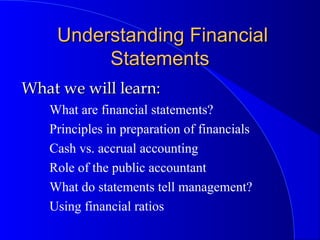
Understanding FinancialUnderstanding Financial
StatementsStatements
What are financial statements?
Principles in preparation of financials
Cash vs. accrual accounting
Role of the public accountant
What do statements tell management?
Using financial ratios
What we will learn:What we will learn:
What Are FinancialWhat Are Financial
Statements?Statements?
A picture in time of the financial resultsA picture in time of the financial results
of the operations of the business.of the operations of the business.
Underlying Principles in theUnderlying Principles in the
Preparation of thePreparation of the
Financial StatementsFinancial Statements
G.A.A.P.
(Generally Accepted Accounting Principles)
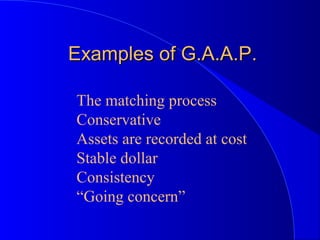
Examples of G.A.A.P.Examples of G.A.A.P.
The matching process
Conservative
Assets are recorded at cost
Stable dollar
Consistency
“Going concern”
Methods of AccountingMethods of Accounting
CashCash
vs.vs.
AccrualAccrual
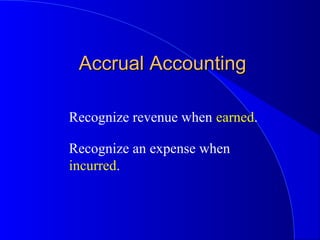
Accrual AccountingAccrual Accounting
Recognize revenue when earned.
Recognize an expense when
incurred.
Cash AccountingCash Accounting
Recognize revenue when
received.
Recognize an expense when
paid.
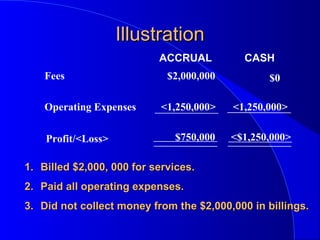
1.1. Billed $2,000, 000 for services.Billed $2,000, 000 for services.
2.2. Paid all operating expenses.Paid all operating expenses.
3.3. Did not collect money from the $2,000,000 in billings.Did not collect money from the $2,000,000 in billings.
ACCRUAL CASH
Fees $2,000,000 $0
Operating Expenses <1,250,000> <1,250,000>
Profit/<Loss> $750,000 <$1,250,000>
IllustrationIllustration
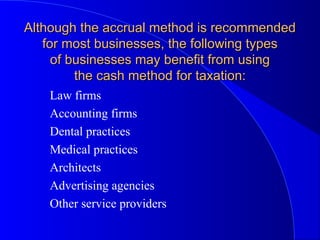
Although the accrual method is recommendedAlthough the accrual method is recommended
for most businesses, the following typesfor most businesses, the following types
of businesses may benefit from usingof businesses may benefit from using
the cash method for taxation:the cash method for taxation:
Law firms
Accounting firms
Dental practices
Medical practices
Architects
Advertising agencies
Other service providers
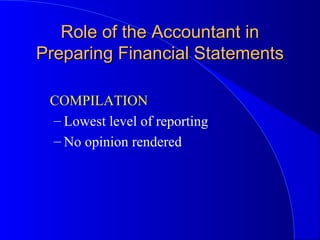
Role of the Accountant inRole of the Accountant in
Preparing Financial StatementsPreparing Financial Statements
COMPILATION
– Lowest level of reporting
– No opinion rendered
Compilation Report -Compilation Report -
Accrual BasisAccrual Basis
“. . .
A compilation is limited to presenting in the form of
financial statements information that is the representation of
management. We have not audited or reviewed the
accompanying financial statements [and supplementary
schedules] and, accordingly, do not express an opinion or
any other form of assurance on them.
. . .”
REVIEW
– Negative assurances rendered
Role of the Accountant inRole of the Accountant in
Preparing Financial StatementsPreparing Financial Statements
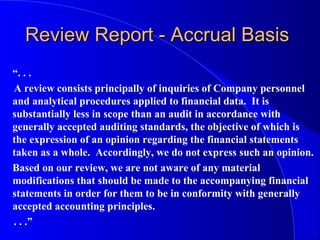
Review Report - Accrual BasisReview Report - Accrual Basis
“. . .
A review consists principally of inquiries of Company personnel
and analytical procedures applied to financial data. It is
substantially less in scope than an audit in accordance with
generally accepted auditing standards, the objective of which is
the expression of an opinion regarding the financial statements
taken as a whole. Accordingly, we do not express such an opinion.
Based on our review, we are not aware of any material
modifications that should be made to the accompanying financial
statements in order for them to be in conformity with generally
accepted accounting principles.
. . .”
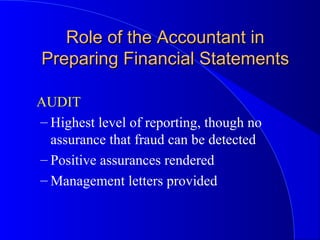
AUDIT
– Highest level of reporting, though no
assurance that fraud can be detected
– Positive assurances rendered
– Management letters provided
Role of the Accountant inRole of the Accountant in
Preparing Financial StatementsPreparing Financial Statements
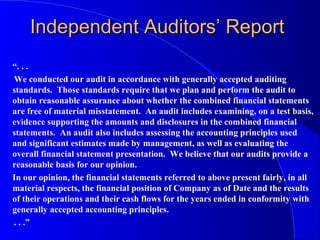
Independent Auditors’ ReportIndependent Auditors’ Report
“. . .
We conducted our audit in accordance with generally accepted auditing
standards. Those standards require that we plan and perform the audit to
obtain reasonable assurance about whether the combined financial statements
are free of material misstatement. An audit includes examining, on a test basis,
evidence supporting the amounts and disclosures in the combined financial
statements. An audit also includes assessing the accounting principles used
and significant estimates made by management, as well as evaluating the
overall financial statement presentation. We believe that our audits provide a
reasonable basis for our opinion.
In our opinion, the financial statements referred to above present fairly, in all
material respects, the financial position of Company as of Date and the results
of their operations and their cash flows for the years ended in conformity with
generally accepted accounting principles.
. . .”
The Financial StatementsThe Financial Statements
Disclose to Management…Disclose to Management…
What assets have we
accumulated?
and
What liabilities have we
incurred?
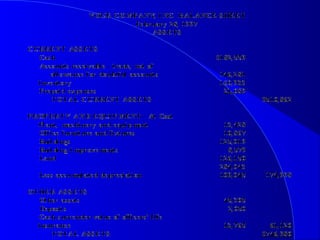
Current AssetsCurrent Assets
Current assets are those assets
that will turn into cash within a
12 month period
Current LiabilitiesCurrent Liabilities
Current liabilities are those
liabilities that will be paid within
12 months
The Financial StatementsThe Financial Statements
Disclose to Management…Disclose to Management…
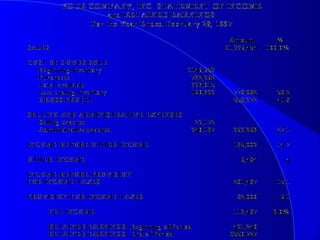
Did we make a profit?
The Financial StatementsThe Financial Statements
Disclose to Management…Disclose to Management…
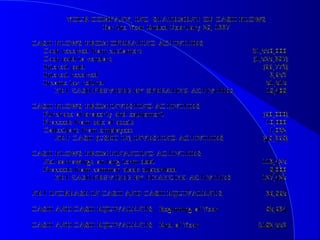
Where did our cash come
from and go?
A Poetic PerspectiveA Poetic Perspective
Never ask of money spent
Where the spender thinks it went.
Nobody was ever meant
To remember or invent
What he did with every cent.
--Robert Frost
Questions?Questions?

How to make more money - Part 2 -circa 1997

  • 1.
    How to MakeHowto Make More MoneyMore Money Part 2Part 2 presented bypresented by Chaim Yudkowsky, CPAChaim Yudkowsky, CPA Grabush, Newman & Co., P.A.Grabush, Newman & Co., P.A. 410-296-6300 www.gnco.com www.byteofadvice.com
  • 2.
    ““Show me themoney!”Show me the money!”
  • 3.
    Understanding FinancialUnderstanding Financial StatementsStatements Whatare financial statements? Principles in preparation of financials Cash vs. accrual accounting Role of the public accountant What do statements tell management? Using financial ratios What we will learn:What we will learn:
  • 4.
    What Are FinancialWhatAre Financial Statements?Statements? A picture in time of the financial resultsA picture in time of the financial results of the operations of the business.of the operations of the business.
  • 5.
    Underlying Principles intheUnderlying Principles in the Preparation of thePreparation of the Financial StatementsFinancial Statements G.A.A.P. (Generally Accepted Accounting Principles)
  • 6.
    Examples of G.A.A.P.Examplesof G.A.A.P. The matching process Conservative Assets are recorded at cost Stable dollar Consistency “Going concern”
  • 7.
    Methods of AccountingMethodsof Accounting CashCash vs.vs. AccrualAccrual
  • 8.
    Accrual AccountingAccrual Accounting Recognizerevenue when earned. Recognize an expense when incurred.
  • 9.
    Cash AccountingCash Accounting Recognizerevenue when received. Recognize an expense when paid.
  • 10.
    1.1. Billed $2,000,000 for services.Billed $2,000, 000 for services. 2.2. Paid all operating expenses.Paid all operating expenses. 3.3. Did not collect money from the $2,000,000 in billings.Did not collect money from the $2,000,000 in billings. ACCRUAL CASH Fees $2,000,000 $0 Operating Expenses <1,250,000> <1,250,000> Profit/<Loss> $750,000 <$1,250,000> IllustrationIllustration
  • 11.
    Although the accrualmethod is recommendedAlthough the accrual method is recommended for most businesses, the following typesfor most businesses, the following types of businesses may benefit from usingof businesses may benefit from using the cash method for taxation:the cash method for taxation: Law firms Accounting firms Dental practices Medical practices Architects Advertising agencies Other service providers
  • 12.
    Role of theAccountant inRole of the Accountant in Preparing Financial StatementsPreparing Financial Statements COMPILATION – Lowest level of reporting – No opinion rendered
  • 13.
    Compilation Report -CompilationReport - Accrual BasisAccrual Basis “. . . A compilation is limited to presenting in the form of financial statements information that is the representation of management. We have not audited or reviewed the accompanying financial statements [and supplementary schedules] and, accordingly, do not express an opinion or any other form of assurance on them. . . .”
  • 14.
    REVIEW – Negative assurancesrendered Role of the Accountant inRole of the Accountant in Preparing Financial StatementsPreparing Financial Statements
  • 15.
    Review Report -Accrual BasisReview Report - Accrual Basis “. . . A review consists principally of inquiries of Company personnel and analytical procedures applied to financial data. It is substantially less in scope than an audit in accordance with generally accepted auditing standards, the objective of which is the expression of an opinion regarding the financial statements taken as a whole. Accordingly, we do not express such an opinion. Based on our review, we are not aware of any material modifications that should be made to the accompanying financial statements in order for them to be in conformity with generally accepted accounting principles. . . .”
  • 16.
    AUDIT – Highest levelof reporting, though no assurance that fraud can be detected – Positive assurances rendered – Management letters provided Role of the Accountant inRole of the Accountant in Preparing Financial StatementsPreparing Financial Statements
  • 17.
    Independent Auditors’ ReportIndependentAuditors’ Report “. . . We conducted our audit in accordance with generally accepted auditing standards. Those standards require that we plan and perform the audit to obtain reasonable assurance about whether the combined financial statements are free of material misstatement. An audit includes examining, on a test basis, evidence supporting the amounts and disclosures in the combined financial statements. An audit also includes assessing the accounting principles used and significant estimates made by management, as well as evaluating the overall financial statement presentation. We believe that our audits provide a reasonable basis for our opinion. In our opinion, the financial statements referred to above present fairly, in all material respects, the financial position of Company as of Date and the results of their operations and their cash flows for the years ended in conformity with generally accepted accounting principles. . . .”
  • 18.
    The Financial StatementsTheFinancial Statements Disclose to Management…Disclose to Management… What assets have we accumulated? and What liabilities have we incurred?
  • 19.
    Current AssetsCurrent Assets Currentassets are those assets that will turn into cash within a 12 month period
  • 21.
    Current LiabilitiesCurrent Liabilities Currentliabilities are those liabilities that will be paid within 12 months
  • 23.
    The Financial StatementsTheFinancial Statements Disclose to Management…Disclose to Management… Did we make a profit?
  • 25.
    The Financial StatementsTheFinancial Statements Disclose to Management…Disclose to Management… Where did our cash come from and go?
  • 27.
    A Poetic PerspectiveAPoetic Perspective Never ask of money spent Where the spender thinks it went. Nobody was ever meant To remember or invent What he did with every cent. --Robert Frost
  • 28.