UN Special Procedures
How to use them for smart Internet
Activism
By: Renata Avila
@avilarenata
Center for Media, Data & Society
Central European University // Budapest
Summer 2015
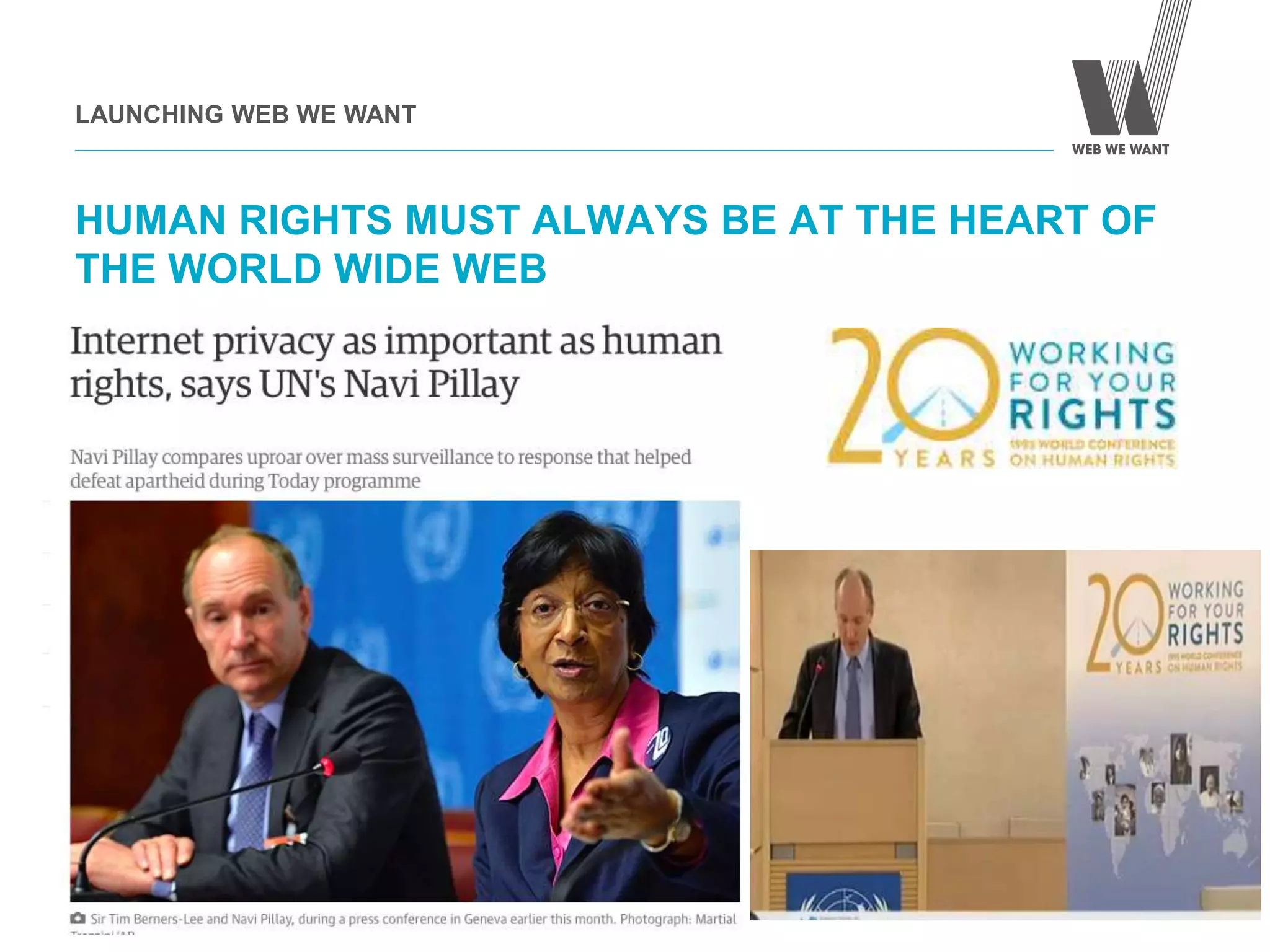
HUMAN RIGHTS MUST ALWAYS BE AT THE HEART OF
THE WORLD WIDE WEB
LAUNCHING WEB WE WANT
WEB WE
WANT
WWW.WEBWEWANT.ORG
UN HUMAN RIGHTS
COUNCIL
UN SPECIAL RAPPORTEURS
SPECIFIC MANDATES
WEB WE
WANT
WWW.WEBWEWANT.ORG
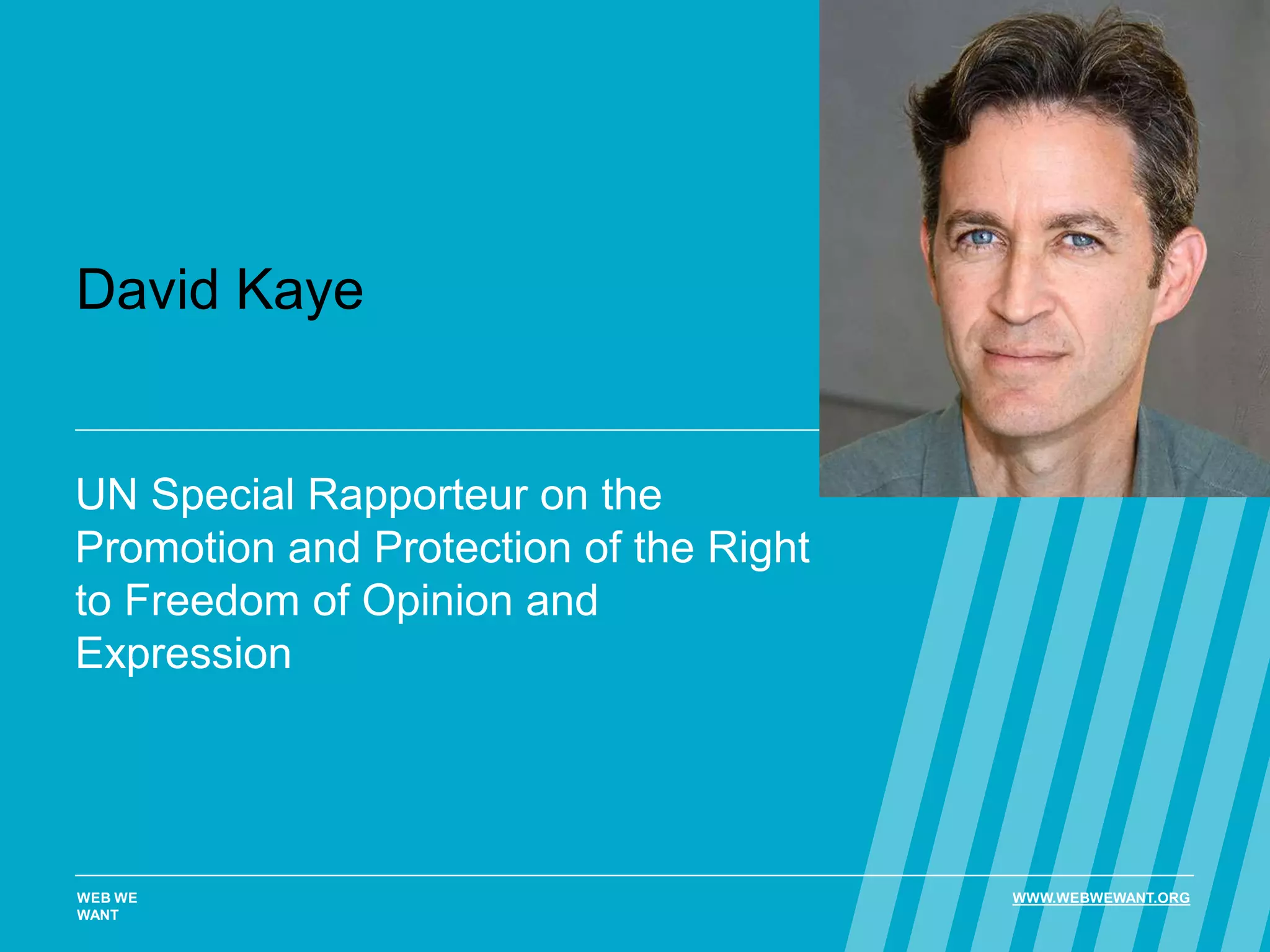
David Kaye
UN Special Rapporteur on the
Promotion and Protection of the Right
to Freedom of Opinion and
Expression
WEB WE
WANT
WWW.WEBWEWANT.ORG
MANDATE
WEB WE
WANT
WWW.WEBWEWANT.ORG
(a) To gather all relevant information, wherever it may occur, relating to violations of the right to freedom
of opinion and expression, discrimination against, threats or use of violence, harassment, persecution or
intimidation directed at persons seeking to exercise or to promote the exercise of the right to freedom of
opinion and expression, including, as a matter of high priority, against journalists or other professionals in
the field of information;
(b) To seek, receive and respond to credible and reliable information from Governments, non-
governmental organizations and any other parties who have knowledge of these cases;
(c) To make recommendations and provide suggestions on ways and means to better promote and
protect the right to freedom of opinion and expression in all its manifestations; and
(d) To contribute to the provision of technical assistance or advisory services by the Office of the United
Nations High Commissioner for Human Rights to better promote and protect the right to freedom of
opinion and expression.
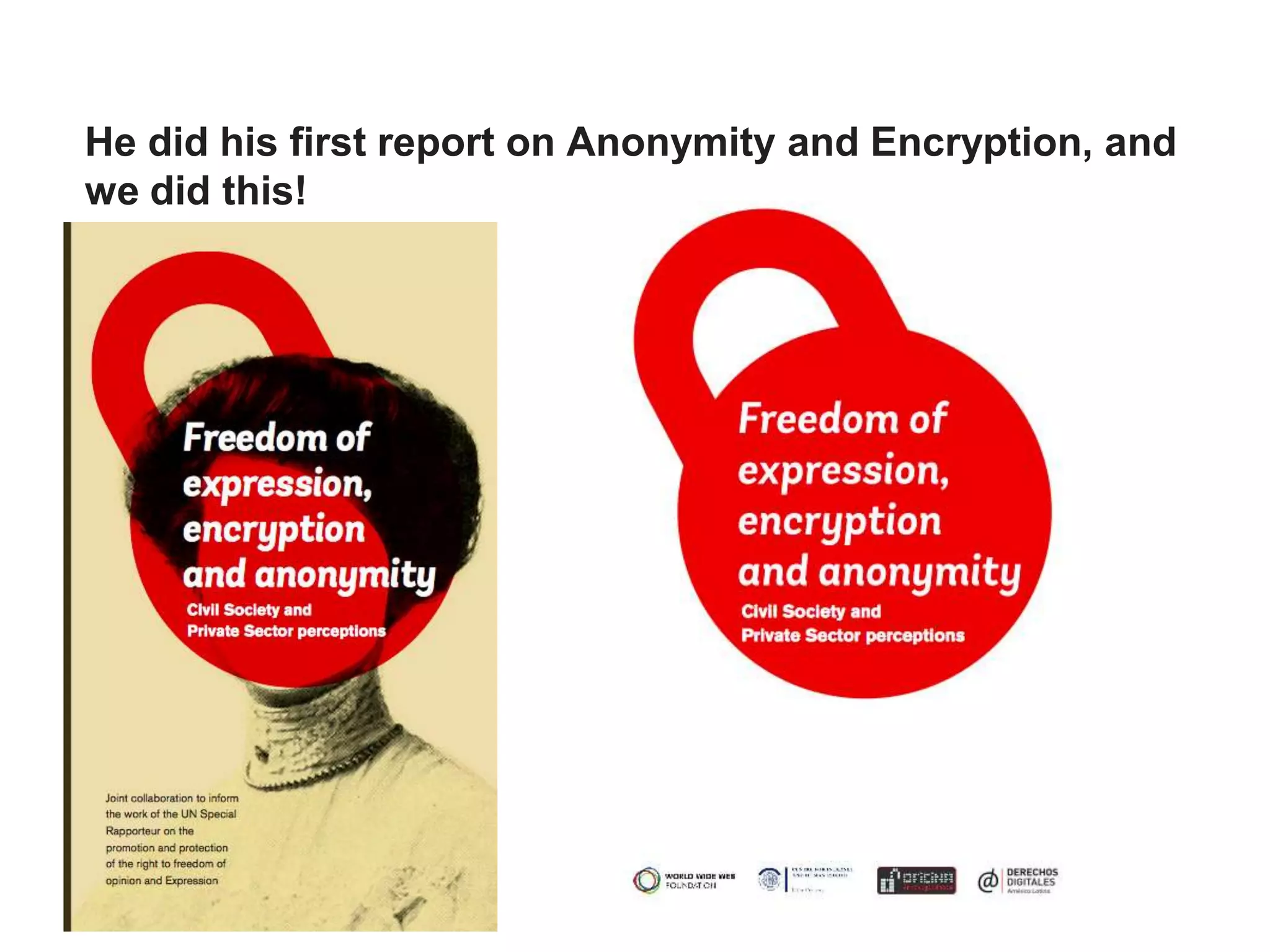
He did his first report on Anonymity and Encryption, and
we did this!
CONCLUSIONS OF REPORT
Anonymity and encryption are fundamental tools to
exercise our rights in digital age.
CSOs, NGOs, IOS should protect online security
Gov should not limit generally, only case by case
WEB WE
WANT
WWW.WEBWEWANT.ORG
SCOPE OF CURRENT REPORT:
Protection of whistleblowers and sources
WEB WE
WANT
WWW.WEBWEWANT.ORG
How is Digital changing the protection of
whistleblowers and sources in your country?
a. Compelled disclosure of confidential
sources of information
b. Protections available to
whistleblowers
Examples of existing national laws, jurisprudence
and practices as well as references to concrete
situations which exemplify the challenges faced by
sources and whistleblowers are particularly useful
in this research.
WEB WE
WANT
WWW.WEBWEWANT.ORG
SHARING STORIES
IS DIGITAL LEADING TO MORE
PROSECUTIONS?
IS DIGITAL ENABLING SOURCES
AND WHISTLEBLOWING?
ARE THERE NEW LAWS?
WEB WE
WANT
WWW.WEBWEWANT.ORG
IT ALSO INSPIRED DEDICATED COVERAGES ON OVER 2500 MEDIA OUTLETS
The outreach and voice of Sir Tim Berners Lee and the Web
Foundation was massive and always connected to the Web We Want
message: a Web for all respecting core human rights.
WEB WE
WANT
WWW.WEBWEWANT.ORG
http://www.ohchr.org/Documents/Publications/NgoHandbook/ngohandbook6.pdf
LETS READ MORE
ABOUT IT
WEB WE
WANT
WWW.WEBWEWANT.ORG

How to hack UN Special Procedures for good?

  • 1.
    UN Special Procedures Howto use them for smart Internet Activism By: Renata Avila @avilarenata Center for Media, Data & Society Central European University // Budapest Summer 2015
  • 2.
    HUMAN RIGHTS MUSTALWAYS BE AT THE HEART OF THE WORLD WIDE WEB LAUNCHING WEB WE WANT WEB WE WANT WWW.WEBWEWANT.ORG
  • 3.
    UN HUMAN RIGHTS COUNCIL UNSPECIAL RAPPORTEURS SPECIFIC MANDATES WEB WE WANT WWW.WEBWEWANT.ORG
  • 4.
    David Kaye UN SpecialRapporteur on the Promotion and Protection of the Right to Freedom of Opinion and Expression WEB WE WANT WWW.WEBWEWANT.ORG
  • 5.
    MANDATE WEB WE WANT WWW.WEBWEWANT.ORG (a) Togather all relevant information, wherever it may occur, relating to violations of the right to freedom of opinion and expression, discrimination against, threats or use of violence, harassment, persecution or intimidation directed at persons seeking to exercise or to promote the exercise of the right to freedom of opinion and expression, including, as a matter of high priority, against journalists or other professionals in the field of information; (b) To seek, receive and respond to credible and reliable information from Governments, non- governmental organizations and any other parties who have knowledge of these cases; (c) To make recommendations and provide suggestions on ways and means to better promote and protect the right to freedom of opinion and expression in all its manifestations; and (d) To contribute to the provision of technical assistance or advisory services by the Office of the United Nations High Commissioner for Human Rights to better promote and protect the right to freedom of opinion and expression.
  • 6.
    He did hisfirst report on Anonymity and Encryption, and we did this!
  • 7.
    CONCLUSIONS OF REPORT Anonymityand encryption are fundamental tools to exercise our rights in digital age. CSOs, NGOs, IOS should protect online security Gov should not limit generally, only case by case WEB WE WANT WWW.WEBWEWANT.ORG
  • 8.
    SCOPE OF CURRENTREPORT: Protection of whistleblowers and sources WEB WE WANT WWW.WEBWEWANT.ORG How is Digital changing the protection of whistleblowers and sources in your country?
  • 9.
    a. Compelled disclosureof confidential sources of information b. Protections available to whistleblowers Examples of existing national laws, jurisprudence and practices as well as references to concrete situations which exemplify the challenges faced by sources and whistleblowers are particularly useful in this research. WEB WE WANT WWW.WEBWEWANT.ORG
  • 10.
    SHARING STORIES IS DIGITALLEADING TO MORE PROSECUTIONS? IS DIGITAL ENABLING SOURCES AND WHISTLEBLOWING? ARE THERE NEW LAWS? WEB WE WANT WWW.WEBWEWANT.ORG
  • 11.
    IT ALSO INSPIREDDEDICATED COVERAGES ON OVER 2500 MEDIA OUTLETS The outreach and voice of Sir Tim Berners Lee and the Web Foundation was massive and always connected to the Web We Want message: a Web for all respecting core human rights. WEB WE WANT WWW.WEBWEWANT.ORG
  • 12.

Editor's Notes

  • #3 Through the year, the Web We Want engaged with different and broader constituencies and listened to the concerns and hopes of Internet users in different regions of the World. The position and current alliances of the World Wide Web Foundation and other partners helped extend bridges and forged alliances of key actors for the future of the Web.   The year of “Web at 25” celebrations created a basic network composed by over hundred organizations from up to 62 countries, which included traditional human rights organizations, hacker spaces, collectives, labs, universities, arts and culture centres and the most engaged internet rights organizations.   The Web We Want efforts were supported through the year by Bertha Foundation and Ford Foundation, with in kind contributions from Thoughtworks and the South Bank Centre. The governments of Brazil through its Presidency and Germany through its Ministry of Foreign Affairs, UNESCO, the UNHCHR and the Council of Europe also supported and were following our developments.   We are presenting here what we have been doing and our perspectives for the future to continue building a movement to protect, defend and engage Internet users, to defend human rights for all, regardless the technology they use to exercise their rights and a more just and fair society for all.