Critical Information Infrastructure Protection:  Threats & Challenges for Developing Countries Dr Martin Koyabe  Security Futures Practice, BT Innovate & Design CTO, Cyber Security Forum, London,UK  17-18 th  June 2010
Basic Understanding of CII  [1/2] Critical Information Infrastructures (CII)  communications and/or information services whose availability, reliability and resilience are essential to the functioning of a modern economy CII also includes: telecommunications, power distribution, water supply, public health services, national defense, law enforcement, government services, and emergency services
Basic Understanding of CII  [2/2] Critical Information Infrastructure Protection (CIIP)  Focuses on protection of IT systems and assets Telecommunication, computers/software, Internet, Satellite, interconnected computers/networks (Internet) & services they provide  Ensures  C onfidentiality,  I ntegrity and  A vailability Required 27/4 (365 days) Part of the daily modern economy and the existence of any country Confidentiality Integrity Availability
Key levels of CII risks Technical Complexity and interdependencies Increased dependencies    increased vulnerabilities Trust relationships increasingly complex End-to-End mitigation can be difficult Actor State-sponsored actors Ideological and political extremist actors Frustrated insiders/social-engineering Organised criminal agents/individuals Supported by underworld economy
Global trends towards CIIP  Increased awareness for CIIP & cyber security Countries aware that risks to CIIP need to be managed Whether at National, Regional or International level Cyber security & CIIP becoming essential tools For supporting national security & social-economic well-being At national level Increased need to share responsibilities & co-ordination Among stakeholders in prevention, preparation, response & recovery At regional & international level Increased need for co-operation & co-ordination with partners In order to formulate and implement effective CIIP frameworks
How about developed economies? Key Cybersecurity threat(s) are diverse, but related “ Established capable states...” Source:  UK Cyber Security Strategy [2009] “ The role of nations in exploiting information networks...” Source:  US Cyberspace Policy Review [2009] “ The dangers from IT crime, threat to government agencies...” Source:  Swedish Emergency Management Agency (SEMA) [2008] “ Financial incentive for online criminal behaviour...” Source:  Towards a Belgian strategy on Information Security [2008]
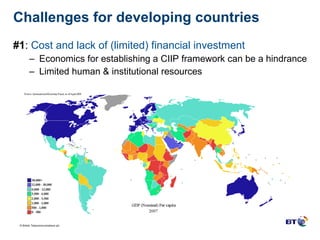
Challenges for developing countries #1 :  Cost and lack of (limited) financial investment Economics for establishing a CIIP framework can be a hindrance Limited  human & institutional resources
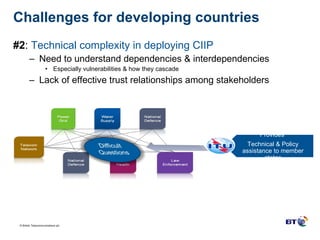
Challenges for developing countries  #2 :  Technical complexity in deploying CIIP Need to understand dependencies & interdependencies Especially vulnerabilities & how they cascade  Lack of effective trust relationships among stakeholders  Provides  Technical & Policy assistance to member states
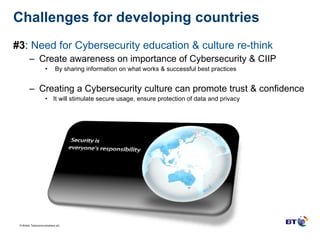
Challenges for developing countries  #3 :  Need for Cybersecurity education & culture re-think Create awareness on importance of Cybersecurity & CIIP By sharing information on what works & successful best practices Creating a Cybersecurity culture can promote trust & confidence It will stimulate secure usage, ensure protection of data and privacy
Challenges for developing countries  #4 :  Lack of relevant CII policies & legal framework Needs Cybercrime legislation & enforcement mechanisms Setup policies to encourage co-operation among stakeholders Especially through Public-Private-Partnerships (PPP) #5 :  Lack of information sharing & knowledge transfer It is important at ALL levels National, Regional & International  Necessary for developing trust relationships among stakeholders Including CERT teams
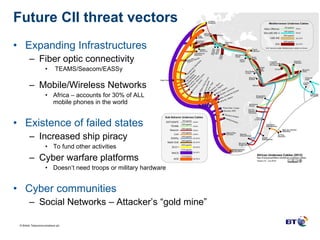
Future CII threat vectors Expanding Infrastructures Fiber optic connectivity  TEAMS/Seacom/EASSy Mobile/Wireless Networks Africa – accounts for 30% of ALL  mobile phones in the world Existence of failed states Increased ship piracy To fund other activities  Cyber warfare platforms Doesn’t need troops or military hardware Cyber communities Social Networks – Attacker’s “gold mine”
Summary CIIP deployment in developing countries is working progress Despite the challenges, there are also success stories too E.g. TUNISIA (CERT/TCC) CIIP/Cybersecurity is a 24/7 (365 days) business It’s costly, but doing without it is even worse Co-ordination & co-operation among stake holders is crucial Encourages trust, knowledge sharing & skills transfer Future threat vectors need our full attention Dependencies & interdependencies will become more complex
Q&A Session Thank You [email_address]
 

CTO-Cybersecurity-2010-Dr. Martin Koyabe

  • 1.
    Critical Information InfrastructureProtection: Threats & Challenges for Developing Countries Dr Martin Koyabe Security Futures Practice, BT Innovate & Design CTO, Cyber Security Forum, London,UK 17-18 th June 2010
  • 2.
    Basic Understanding ofCII [1/2] Critical Information Infrastructures (CII) communications and/or information services whose availability, reliability and resilience are essential to the functioning of a modern economy CII also includes: telecommunications, power distribution, water supply, public health services, national defense, law enforcement, government services, and emergency services
  • 3.
    Basic Understanding ofCII [2/2] Critical Information Infrastructure Protection (CIIP) Focuses on protection of IT systems and assets Telecommunication, computers/software, Internet, Satellite, interconnected computers/networks (Internet) & services they provide Ensures C onfidentiality, I ntegrity and A vailability Required 27/4 (365 days) Part of the daily modern economy and the existence of any country Confidentiality Integrity Availability
  • 4.
    Key levels ofCII risks Technical Complexity and interdependencies Increased dependencies  increased vulnerabilities Trust relationships increasingly complex End-to-End mitigation can be difficult Actor State-sponsored actors Ideological and political extremist actors Frustrated insiders/social-engineering Organised criminal agents/individuals Supported by underworld economy
  • 5.
    Global trends towardsCIIP Increased awareness for CIIP & cyber security Countries aware that risks to CIIP need to be managed Whether at National, Regional or International level Cyber security & CIIP becoming essential tools For supporting national security & social-economic well-being At national level Increased need to share responsibilities & co-ordination Among stakeholders in prevention, preparation, response & recovery At regional & international level Increased need for co-operation & co-ordination with partners In order to formulate and implement effective CIIP frameworks
  • 6.
    How about developedeconomies? Key Cybersecurity threat(s) are diverse, but related “ Established capable states...” Source: UK Cyber Security Strategy [2009] “ The role of nations in exploiting information networks...” Source: US Cyberspace Policy Review [2009] “ The dangers from IT crime, threat to government agencies...” Source: Swedish Emergency Management Agency (SEMA) [2008] “ Financial incentive for online criminal behaviour...” Source: Towards a Belgian strategy on Information Security [2008]
  • 7.
    Challenges for developingcountries #1 : Cost and lack of (limited) financial investment Economics for establishing a CIIP framework can be a hindrance Limited human & institutional resources
  • 8.
    Challenges for developingcountries #2 : Technical complexity in deploying CIIP Need to understand dependencies & interdependencies Especially vulnerabilities & how they cascade Lack of effective trust relationships among stakeholders Provides Technical & Policy assistance to member states
  • 9.
    Challenges for developingcountries #3 : Need for Cybersecurity education & culture re-think Create awareness on importance of Cybersecurity & CIIP By sharing information on what works & successful best practices Creating a Cybersecurity culture can promote trust & confidence It will stimulate secure usage, ensure protection of data and privacy
  • 10.
    Challenges for developingcountries #4 : Lack of relevant CII policies & legal framework Needs Cybercrime legislation & enforcement mechanisms Setup policies to encourage co-operation among stakeholders Especially through Public-Private-Partnerships (PPP) #5 : Lack of information sharing & knowledge transfer It is important at ALL levels National, Regional & International Necessary for developing trust relationships among stakeholders Including CERT teams
  • 11.
    Future CII threatvectors Expanding Infrastructures Fiber optic connectivity TEAMS/Seacom/EASSy Mobile/Wireless Networks Africa – accounts for 30% of ALL mobile phones in the world Existence of failed states Increased ship piracy To fund other activities Cyber warfare platforms Doesn’t need troops or military hardware Cyber communities Social Networks – Attacker’s “gold mine”
  • 12.
    Summary CIIP deploymentin developing countries is working progress Despite the challenges, there are also success stories too E.g. TUNISIA (CERT/TCC) CIIP/Cybersecurity is a 24/7 (365 days) business It’s costly, but doing without it is even worse Co-ordination & co-operation among stake holders is crucial Encourages trust, knowledge sharing & skills transfer Future threat vectors need our full attention Dependencies & interdependencies will become more complex
  • 13.
    Q&A Session ThankYou [email_address]
  • 14.

Editor's Notes

  • #3 Key point – understanding CII
  • #4 Key point – understanding CII
  • #5 Key point – Understand the two levels of security risks facing CII
  • #6 Key point – Description of the global trends towards CIIP
  • #7 Key point – Description of the global trends towards CIIP
  • #8 Key point – Lack of financial investment in developing CIIP
  • #9 Key point – Description of the global trends towards CIIP
  • #10 Key point – Description of the global trends towards CIIP
  • #11 Key point – Description of the global trends towards CIIP
  • #12 Key point – Description of the global trends towards CIIP
  • #13 Key point – Description of the global trends towards CIIP