-

www.facebook.com/sahil2441
  www.getup4change.org
                   ?[      2(i) & (j)]
 Definition of a Public Authority. [Sec 2(h)]
 Request of Information under Section 4 or 6
 RTI Application                        ?
      6(3)
 Disposal of Request
 Fees(     )
                                  -      2(h)
 Format of the Application

 1st Appeal
 2nd Appeal
 Penalties
Section 2(i): "record" includes—
 (a) any document, manuscript and file;
 (b) any microfilm, microfiche and facsimile copy
  of a document;
 (c) any reproduction of image or images
  embodied in such microfilm (whether enlarged
  or not); and
 (d) any other material produced by a computer
  or any other device;
   Section 2(h):
     "public authority" means any authority or body or
    institution of self- government established or
    constituted—
   (a) by or under the Constitution          ;
   (b) by any other law made by Parliament         ;
   (c) by any other law made by State Legislature
                     ;
   (d) by notification issued or order made by the
    appropriate Government,

and includes any—
 (i) body owned, controlled or substantially financed;
 (ii) non-Government organization
                      substantially financed,

   directly or indirectly by funds provided by the
    appropriate Government;
 Suo   Moto Disclosures-    4

 17 points under Section 4(b) defines the Suo
 moto disclosures.
 E.g.


 Otherwise, any citizen of India can file a RTI
 application under section 6.
 Every Govt. Dept. has a Public Information
  Officer(PIO) -                           for this
  purpose.
 CPIO                                at the
  Centre Govt. Departments and
  SPIO                               at State
  Govt. departments.
 You can find this out easily from the
  internet.
 Incase you do not know who PIO is, you can
  just address it to the ‘Public Info. Officer,
  Name of the Department’.
Section 6(3):

                —

 (i)                    ;
 (ii)


                    (Transfer)


                         5
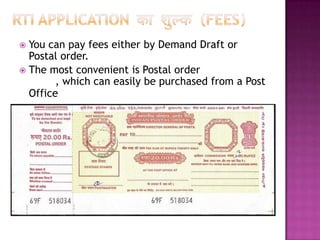
 You can pay fees either by Demand Draft or
  Postal order.
 The most convenient is Postal order
        , which can easily be purchased from a Post
  Office
2(h)                               -


 (i) inspection of work, documents, records;
 (ii) taking notes, extracts or certified
  copies of documents or records;
 (iii)
    taking certified samples of material
 (iv) obtaining information in the form of
  diskettes, floppies, tapes, video cassettes
  or in any other electronic mode or through
  printouts where such information is stored
  in a computer or in any other device;
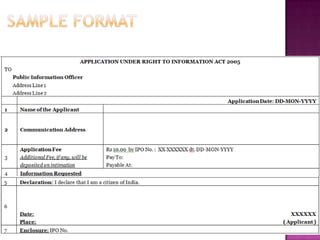
 You can draft your application in English,
  Hindi or any regional language.
 You can draft in on a simple blank page.
 Some departments have already made a
  sample format on their website, but it’s
  not mandatory.
 Mention duration of the Information
  required.
 Any number of questions can be asked.
 Questions should be precise an to the
  point.
 Ask   for the unique file number, in your
  RTI.
 You can also mention an inspection
  clause.
 Information asked must be on record.
 Always remember to take a photocopy of
  your application and DD/IPO before filing
  a RTI.
 Always send it through speed post or
  Registered post.
 If possible, attach a Acknowledgement
  with the RTI.
 Rs 10 is the fees for obtaining information
  from any Central Govt. Office/ Department.
 However, some State Govt. have amended
  the RTI Act.
 This can be checked on the internet.
 No fees shall be charged from people who
  are of BPL(Below Poverty line).
 At maximum, information should be provided
  within 30 days.
 Section 7(3): Further fees of Rs 2/page and
  Rs 50/CD shall be charged.
Section 19(1):
 Besides the Public Information Officer, every
  Public Authority must appoint an officer to
  whom 1st appeal be made.
 If you do not get the reply to your RTI within
  30 days, or, you are not satisfied with the
  reply, you can make a appeal to the 1st
  Appellate Authority within 30 days from such
  decision.
 The reply of 1st appeal must come within 30
  days.
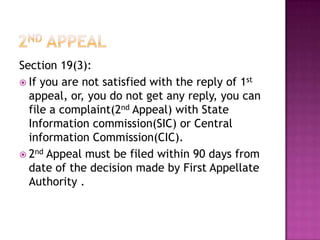
Section 19(3):
 If you are not satisfied with the reply of 1st
  appeal, or, you do not get any reply, you can
  file a complaint(2nd Appeal) with State
  Information commission(SIC) or Central
  information Commission(CIC).
 2nd Appeal must be filed within 90 days from
  date of the decision made by First Appellate
  Authority .
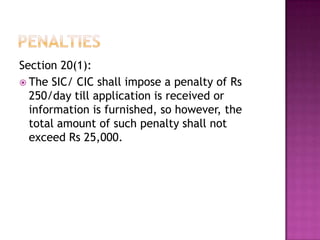
Section 20(1):
 The SIC/ CIC shall impose a penalty of Rs
  250/day till application is received or
  information is furnished, so however, the
  total amount of such penalty shall not
  exceed Rs 25,000.
How to file a RTI (HINDI)

How to file a RTI (HINDI)

  • 1.
  • 2.
    ?[ 2(i) & (j)]  Definition of a Public Authority. [Sec 2(h)]  Request of Information under Section 4 or 6  RTI Application ?  6(3)  Disposal of Request  Fees( )  - 2(h)  Format of the Application   1st Appeal  2nd Appeal  Penalties
  • 3.
    Section 2(i): "record"includes—  (a) any document, manuscript and file;  (b) any microfilm, microfiche and facsimile copy of a document;  (c) any reproduction of image or images embodied in such microfilm (whether enlarged or not); and  (d) any other material produced by a computer or any other device;
  • 4.
    Section 2(h): "public authority" means any authority or body or institution of self- government established or constituted—  (a) by or under the Constitution ;  (b) by any other law made by Parliament ;  (c) by any other law made by State Legislature ;  (d) by notification issued or order made by the appropriate Government, and includes any—  (i) body owned, controlled or substantially financed;  (ii) non-Government organization substantially financed,  directly or indirectly by funds provided by the appropriate Government;
  • 5.
     Suo Moto Disclosures- 4 17 points under Section 4(b) defines the Suo moto disclosures. E.g.  Otherwise, any citizen of India can file a RTI application under section 6.
  • 6.
     Every Govt.Dept. has a Public Information Officer(PIO) - for this purpose.  CPIO at the Centre Govt. Departments and SPIO at State Govt. departments.  You can find this out easily from the internet.  Incase you do not know who PIO is, you can just address it to the ‘Public Info. Officer, Name of the Department’.
  • 7.
    Section 6(3): —  (i) ;  (ii) (Transfer) 5
  • 8.
     You canpay fees either by Demand Draft or Postal order.  The most convenient is Postal order , which can easily be purchased from a Post Office
  • 9.
    2(h) -  (i) inspection of work, documents, records;  (ii) taking notes, extracts or certified copies of documents or records;  (iii) taking certified samples of material  (iv) obtaining information in the form of diskettes, floppies, tapes, video cassettes or in any other electronic mode or through printouts where such information is stored in a computer or in any other device;
  • 10.
     You candraft your application in English, Hindi or any regional language.  You can draft in on a simple blank page.  Some departments have already made a sample format on their website, but it’s not mandatory.  Mention duration of the Information required.  Any number of questions can be asked.  Questions should be precise an to the point.
  • 11.
     Ask for the unique file number, in your RTI.  You can also mention an inspection clause.  Information asked must be on record.  Always remember to take a photocopy of your application and DD/IPO before filing a RTI.  Always send it through speed post or Registered post.  If possible, attach a Acknowledgement with the RTI.
  • 13.
     Rs 10is the fees for obtaining information from any Central Govt. Office/ Department.  However, some State Govt. have amended the RTI Act.  This can be checked on the internet.  No fees shall be charged from people who are of BPL(Below Poverty line).  At maximum, information should be provided within 30 days.  Section 7(3): Further fees of Rs 2/page and Rs 50/CD shall be charged.
  • 14.
    Section 19(1):  Besidesthe Public Information Officer, every Public Authority must appoint an officer to whom 1st appeal be made.  If you do not get the reply to your RTI within 30 days, or, you are not satisfied with the reply, you can make a appeal to the 1st Appellate Authority within 30 days from such decision.  The reply of 1st appeal must come within 30 days.
  • 15.
    Section 19(3):  Ifyou are not satisfied with the reply of 1st appeal, or, you do not get any reply, you can file a complaint(2nd Appeal) with State Information commission(SIC) or Central information Commission(CIC).  2nd Appeal must be filed within 90 days from date of the decision made by First Appellate Authority .
  • 16.
    Section 20(1):  TheSIC/ CIC shall impose a penalty of Rs 250/day till application is received or information is furnished, so however, the total amount of such penalty shall not exceed Rs 25,000.