THE RIGHT TO INFORMATION
(RTI) ACT 2005
The RTI Act 2005: Why-n-What
An Act to provide for setting out the practical regime of
Right to Information for citizens to secure access to
information under the control of public authorities, in
order to promote transparency and accountability in the
working of every public authority, the constitution of a
Central Information Commission and State Information
Commissions and for matters connected therewith or
incidental thereto.
The RTI Act 2005: When-n-Where
This Act may be called the Right to Information Act,
2005.
The RTI act 2005 was enacted by permission and
authority of His Excellency, President of India. This act
was enacted by the Parliament on 15.06.2005 and
notified in the Gazette of India dated 21.06.2005.
It extends to the whole of India except the State of
Jammu and Kashmir.
The RTI Act 2005: Who
Who can exercise his / her right under The RTI
Act 2005?
The answer is:
Subject to the provisions of this Act, all citizens
shall have the right to information.
The RTI Act 2005: Definitions
What is Information?
Information means any material in any form, including
records, documents, memos, e-mails, opinions,
advices, press releases, circulars, orders, logbooks,
contracts, reports, papers, samples, models, data
material held in any electronic form and information
relating to any private body which can be accessed by a
public authority under any other law for the time being
in force.
The RTI Act 2005: Definitions
What is Record?
Record includes
• Any document, manuscript and file
•Any microfilm, microfiche and facsimile copy of a
document
•Any reproduction of image or images embodied in such
microfilm (whether enlarged or not); and
•Any other material produced by a computer or any
other device
The RTI Act 2005: Definitions
Who is Public Authority?
It is any authority or body or institution of self government
established or constituted.
• By or under the Constitution
• By any other law made by Parliament
• By any other law made by State Legislature
• By notification issued or order made by the
appropriate Government, and includes any-body
owned, controlled or substantially financed, non-
Government organization substantially financed,
directly or indirectly by funds provided by the Govt.
The RTI Act 2005: How
How To Request Information?
A person, who desires to obtain any information under
this Act, shall make a request in writing or through
electronic means in English or Hindi or in the official
language of the area in which the application is being
made, accompanying such fee as may be prescribed, to
public authority by providing contact details.
The RTI Act 2005: Fee
Is There Any Fee To Seek Information?
FEE TO BE ACCOMPANIED WITH THE RTI APPLICATION
• In case of central govt. departments, INR 10.00 by
way of cash under proper receipt, demand draft,
bankers cheque, Indian postal order, money order or
cash deposited at designated post offices.
• In case of state govt. departments, particularly in
Maharashtra state, INR 10.00 by way of cash under
proper receipt, demand draft, banker’s cheque,
money order or court fee stamp.
The RTI Act 2005: Process
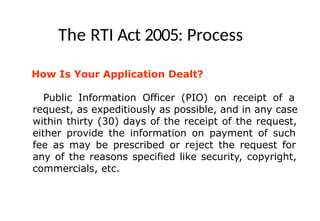
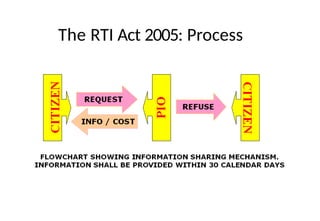
How Is Your Application Dealt?
Public Information Officer (PIO) on receipt of a
request, as expeditiously as possible, and in any case
within thirty (30) days of the receipt of the request,
either provide the information on payment of such
fee as may be prescribed or reject the request for
any of the reasons specified like security, copyright,
commercials, etc.
The RTI Act 2005: Process
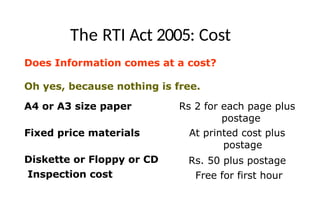
The RTI Act 2005: Cost
Does Information comes at a cost?
Oh yes, because nothing is free.
A4 or A3 size paper Rs 2 for each page plus
postage
At printed cost plus
postage
Rs. 50 plus postage
Free for first hour
Fixed price materials
Diskette or Floppy or CD
Inspection cost
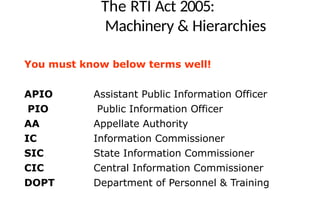
The RTI Act 2005:
Machinery & Hierarchies
APIO
PIO
AA
IC
SIC
CIC
DOPT
Assistant Public Information Officer
Public Information Officer
Appellate Authority
Information Commissioner
State Information Commissioner
Central Information Commissioner
Department of Personnel & Training
You must know below terms well!
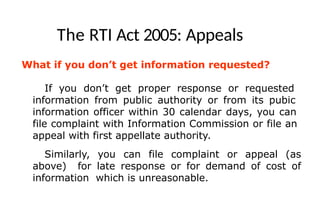
The RTI Act 2005: Appeals
What if you don’t get information requested?
If you don’t get proper response or requested
information from public authority or from its pubic
information officer within 30 calendar days, you can
file complaint with Information Commission or file an
appeal with first appellate authority.
Similarly, you can file complaint or appeal (as
above) for late response or for demand of cost of
information which is unreasonable.
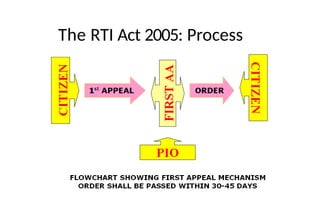
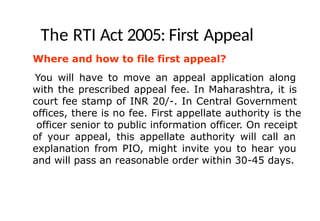
The RTI Act 2005: First Appeal
Where and how to file first appeal?
You will have to move an appeal application along
with the prescribed appeal fee. In Maharashtra, it is
court fee stamp of INR 20/-. In Central Government
offices, there is no fee. First appellate authority is the
officer senior to public information officer. On receipt
of your appeal, this appellate authority will call an
explanation from PIO, might invite you to hear you
and will pass an reasonable order within 30-45 days.
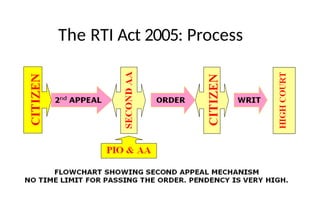
The RTI Act 2005: Second Appeal
Where and how to file Second appeal?
If you are not satisfied with response of public
information officer and order passed on your appeal
by first appellate authority of particular public
authority, you can file second appeal with State
Information Commissioner or Central Information
Commissioner, as the case may be.
There is no prescribed time limit for getting response
or order at this level. Too many cases are piled up
with these offices.
The RTI Act 2005: Imp. Sections
The RTI Act has more than 30 sections and its
subsections. In order to get response every
time, one must study all sections and
amendments in the act from time to time.
Section 3: All citizens have the right
Section 4: Proactive disclosures by authorities
Section 6: Request for obtaining information
Section 7: How your requests will be treated
Section 8: Exemptions
Section 19 (1): First appeal
Section 19 (3): Second appeal
Section 20: Penalties and Disciplinary actions
Section 4: Obligation of PA
Every PA shall maintain all its records duly
catalogued and indexed in a manner and the
form which facilitates the right to information
under this act and ensure that all the records
that are appropriate to be computerized are,
within a reasonable time and subject to
availability of resources, computerized and
connected through a network all over the
country on different systems so that access to
such records is facilitated.
Section 4: Publish within 120 days
1) Particulars of organization, function and duties
2) The powers and duties of its officers and employees
•3) process, including channels of supervision and
The procedurefollowed in the decision making
• accountability
4) The norms set by it for the discharge of its functions
5) The rules, regulations, instructions, manuals, and records,
held by it or under its control or used by its
employees for discharging it functions
6) A statement of categories of documents that
are held by it or under its control
Section 4: Publish within 120 days
7. The particulars of any arrangement that exists for
consultation with, or representation by, the
members of the public in relation to the formulation
of its policy or implementation thereof.
8. A statement of the boards, councils, committees and
other bodies consisting of two or more persons
constituted as its part or for the purpose of its
advice, and as to whether meetings of those boards,
councils, committees and other bodies are open to
the public or the minutes of such meetings are
accessible for public
9. A directory of its officers and employees
Section 4: Publish within 120 days
10. The monthly remuneration received by each of its
officers and employees, including the system of
compensation as provided in its regulations
11. The budget allocated to each of its agency, indicating
the particulars of all plans, proposed expenditures,
and reports on disbursements made
12. The manner of execution of subsidy programs
including the amounts allocated and the details of
beneficiaries of such programs.
13. Particulars of recipients of concessions, permits or
authorization granted by it.
Section 4: Publish within 120 days
14. Details in respect of the information, available to or
held by it, reduced in an electronic form
15. The particulars of facilities available to citizens for
obtaining information, including the working hours of
a library room, if maintained for public use.
16. The names, designations and other particulars of the
Public Information Officers
17. Such other information as may be prescribed; and
thereafter update this publication every year.
Section 8: Exempted Organizations
 IB, RAW of the Cabinet Secretariat
 DRI, Central Economic Intelligence Bureau
 Directorate of Enforcement
 Narcotic Control Bureau
 Aviation Research Centre, Special Frontier Force,
 BSF, CRPF, ITBP, CISF, NSG,
 Assam Rifles, Special Service Bureau
 Special Branch (CID) Andaman & Nikobar
 The Crime Branch (CID-CB) Dadra and Nagar Haveli
 Special Branch, Lakshadweep Police
Information can not be shared
 Sovereignty and Integrity Of India
 Prevented by courts
 Breach of privilege of Parliament
 Trade secret, Intellectual property
 Fiduciary relationship
 Info received from foreign Government
 Life and physical safety of any person
 Issues under investigation
 Cabinet papers
 Invasion in privacy
Designation of Public Information Officers.—
(1) Every public authority shall, within one hundred days of the enactment of this
Act, designate as many officers as the Central Public Information Officers or
State Public Information Officers, as the case may be, in all administrative units
or offices under it as may be necessary to provide information to persons
requesting for the information under this Act.
(2) Without prejudice to the provisions of sub-section (1), every public authority
shall designate an officer, within one hundred days of the enactment of this Act, at
each sub-divisional level or other sub district level as a Central Assistant Public
Information Officer or a State Assistant Public Information Officer, as the case may
be, to receive the applications for information or appeals under this Act for
forwarding the same forthwith to the Central Public Information Officer or the
State Public Information Officer or senior officer specified under sub-section (1) of
section 19 or the Central Information Commission or the State Information
Commission, as
the case may be: Provided that where an application for information or appeal is
given to a Central Assistant Public Information Officer or a State Assistant Public
Information Officer, as the case may be, a period of five days shall be added in
computing the period for response specified under sub-section (1) of section 7.
(3) Every Central Public Information Officer or State Public Information Officer, as
the case may be, shall deal with requests from persons seeking information and
render reasonable assistance to the persons seeking such information.
(4) The Central Public Information Officer or State Public Information Officer, as the
case may be, may seek the assistance of any other officer as he or she considers it
necessary for the proper discharge of his or her duties.
(5) Any officer, whose assistance has been sought under sub-section (4), shall
render all assistance to the Central Public Information Officer or State Public
Information Officer, as the case may be, seeking his or her assistance and for the
purposes of any contravention of the provisions of this Act, such other officer shall
be treated as a Central Public Information Officer or State Public Information
Officer, as the case may be
Constitution of Central Information commissions
—
(1) The Central Government shall, by notification in the Official Gazette, constitute a body
to be known as the Central Information Commission to exercise the powers conferred on,
and to perform the functions assigned to, it under this Act.
(2) The Central Information Commission shall consist of—
(a) the Chief Information Commissioner; and
(b) such number of Central Information Commissioners, not exceeding ten, as may be
deemed necessary.
(3) The Chief Information Commissioner and Information Commissioners shall be
appointed by the President on the recommendation of a committee consisting of—
(i) the Prime Minister, who shall be the Chairperson of the committee;
(ii) the Leader of Opposition in the LokSabha; and
(iii) a Union Cabinet Minister to be nominated by the Prime Minister.
(4) The general superintendence, direction and management of the affairs of the Central
Information Commission shall vest in the Chief Information Commissioner who shall be
assisted by the Information Commissioners and may exercise all such powers and do all
such acts and things which may be exercised or done by the Central Information
Commission autonomously without being subjected to directions by any other authority
under this Act.
(5) The Chief Information Commissioner and Information Commissioners shall be
persons of eminence in public life with wide knowledge and experience in law,
science and technology, social service, management, journalism, mass media or
administration and governance.
(6) The Chief Information Commissioner or an Information Commissioner shall
not be a Member of Parliament or Member of the Legislature of any State or
Union territory, as the case may be, or hold any other office of profit or
connected with any political party or carrying on any business or pursuing any
profession.
7) The headquarters of the Central Information Commission shall be at Delhi and
the Central Information Commission may, with the previous approval of the
Central Government, establish offices at other places in India.

Right to information act.pptx Pharmacy j

  • 1.
    THE RIGHT TOINFORMATION (RTI) ACT 2005
  • 2.
    The RTI Act2005: Why-n-What An Act to provide for setting out the practical regime of Right to Information for citizens to secure access to information under the control of public authorities, in order to promote transparency and accountability in the working of every public authority, the constitution of a Central Information Commission and State Information Commissions and for matters connected therewith or incidental thereto.
  • 3.
    The RTI Act2005: When-n-Where This Act may be called the Right to Information Act, 2005. The RTI act 2005 was enacted by permission and authority of His Excellency, President of India. This act was enacted by the Parliament on 15.06.2005 and notified in the Gazette of India dated 21.06.2005. It extends to the whole of India except the State of Jammu and Kashmir.
  • 4.
    The RTI Act2005: Who Who can exercise his / her right under The RTI Act 2005? The answer is: Subject to the provisions of this Act, all citizens shall have the right to information.
  • 5.
    The RTI Act2005: Definitions What is Information? Information means any material in any form, including records, documents, memos, e-mails, opinions, advices, press releases, circulars, orders, logbooks, contracts, reports, papers, samples, models, data material held in any electronic form and information relating to any private body which can be accessed by a public authority under any other law for the time being in force.
  • 6.
    The RTI Act2005: Definitions What is Record? Record includes • Any document, manuscript and file •Any microfilm, microfiche and facsimile copy of a document •Any reproduction of image or images embodied in such microfilm (whether enlarged or not); and •Any other material produced by a computer or any other device
  • 7.
    The RTI Act2005: Definitions Who is Public Authority? It is any authority or body or institution of self government established or constituted. • By or under the Constitution • By any other law made by Parliament • By any other law made by State Legislature • By notification issued or order made by the appropriate Government, and includes any-body owned, controlled or substantially financed, non- Government organization substantially financed, directly or indirectly by funds provided by the Govt.
  • 8.
    The RTI Act2005: How How To Request Information? A person, who desires to obtain any information under this Act, shall make a request in writing or through electronic means in English or Hindi or in the official language of the area in which the application is being made, accompanying such fee as may be prescribed, to public authority by providing contact details.
  • 9.
    The RTI Act2005: Fee Is There Any Fee To Seek Information? FEE TO BE ACCOMPANIED WITH THE RTI APPLICATION • In case of central govt. departments, INR 10.00 by way of cash under proper receipt, demand draft, bankers cheque, Indian postal order, money order or cash deposited at designated post offices. • In case of state govt. departments, particularly in Maharashtra state, INR 10.00 by way of cash under proper receipt, demand draft, banker’s cheque, money order or court fee stamp.
  • 10.
    The RTI Act2005: Process How Is Your Application Dealt? Public Information Officer (PIO) on receipt of a request, as expeditiously as possible, and in any case within thirty (30) days of the receipt of the request, either provide the information on payment of such fee as may be prescribed or reject the request for any of the reasons specified like security, copyright, commercials, etc.
  • 11.
    The RTI Act2005: Process
  • 12.
    The RTI Act2005: Process
  • 13.
    The RTI Act2005: Process
  • 14.
    The RTI Act2005: Cost Does Information comes at a cost? Oh yes, because nothing is free. A4 or A3 size paper Rs 2 for each page plus postage At printed cost plus postage Rs. 50 plus postage Free for first hour Fixed price materials Diskette or Floppy or CD Inspection cost
  • 15.
    The RTI Act2005: Machinery & Hierarchies APIO PIO AA IC SIC CIC DOPT Assistant Public Information Officer Public Information Officer Appellate Authority Information Commissioner State Information Commissioner Central Information Commissioner Department of Personnel & Training You must know below terms well!
  • 16.
    The RTI Act2005: Appeals What if you don’t get information requested? If you don’t get proper response or requested information from public authority or from its pubic information officer within 30 calendar days, you can file complaint with Information Commission or file an appeal with first appellate authority. Similarly, you can file complaint or appeal (as above) for late response or for demand of cost of information which is unreasonable.
  • 17.
    The RTI Act2005: First Appeal Where and how to file first appeal? You will have to move an appeal application along with the prescribed appeal fee. In Maharashtra, it is court fee stamp of INR 20/-. In Central Government offices, there is no fee. First appellate authority is the officer senior to public information officer. On receipt of your appeal, this appellate authority will call an explanation from PIO, might invite you to hear you and will pass an reasonable order within 30-45 days.
  • 18.
    The RTI Act2005: Second Appeal Where and how to file Second appeal? If you are not satisfied with response of public information officer and order passed on your appeal by first appellate authority of particular public authority, you can file second appeal with State Information Commissioner or Central Information Commissioner, as the case may be. There is no prescribed time limit for getting response or order at this level. Too many cases are piled up with these offices.
  • 19.
    The RTI Act2005: Imp. Sections The RTI Act has more than 30 sections and its subsections. In order to get response every time, one must study all sections and amendments in the act from time to time. Section 3: All citizens have the right Section 4: Proactive disclosures by authorities Section 6: Request for obtaining information Section 7: How your requests will be treated Section 8: Exemptions Section 19 (1): First appeal Section 19 (3): Second appeal Section 20: Penalties and Disciplinary actions
  • 20.
    Section 4: Obligationof PA Every PA shall maintain all its records duly catalogued and indexed in a manner and the form which facilitates the right to information under this act and ensure that all the records that are appropriate to be computerized are, within a reasonable time and subject to availability of resources, computerized and connected through a network all over the country on different systems so that access to such records is facilitated.
  • 21.
    Section 4: Publishwithin 120 days 1) Particulars of organization, function and duties 2) The powers and duties of its officers and employees •3) process, including channels of supervision and The procedurefollowed in the decision making • accountability 4) The norms set by it for the discharge of its functions 5) The rules, regulations, instructions, manuals, and records, held by it or under its control or used by its employees for discharging it functions 6) A statement of categories of documents that are held by it or under its control
  • 22.
    Section 4: Publishwithin 120 days 7. The particulars of any arrangement that exists for consultation with, or representation by, the members of the public in relation to the formulation of its policy or implementation thereof. 8. A statement of the boards, councils, committees and other bodies consisting of two or more persons constituted as its part or for the purpose of its advice, and as to whether meetings of those boards, councils, committees and other bodies are open to the public or the minutes of such meetings are accessible for public 9. A directory of its officers and employees
  • 23.
    Section 4: Publishwithin 120 days 10. The monthly remuneration received by each of its officers and employees, including the system of compensation as provided in its regulations 11. The budget allocated to each of its agency, indicating the particulars of all plans, proposed expenditures, and reports on disbursements made 12. The manner of execution of subsidy programs including the amounts allocated and the details of beneficiaries of such programs. 13. Particulars of recipients of concessions, permits or authorization granted by it.
  • 24.
    Section 4: Publishwithin 120 days 14. Details in respect of the information, available to or held by it, reduced in an electronic form 15. The particulars of facilities available to citizens for obtaining information, including the working hours of a library room, if maintained for public use. 16. The names, designations and other particulars of the Public Information Officers 17. Such other information as may be prescribed; and thereafter update this publication every year.
  • 25.
    Section 8: ExemptedOrganizations  IB, RAW of the Cabinet Secretariat  DRI, Central Economic Intelligence Bureau  Directorate of Enforcement  Narcotic Control Bureau  Aviation Research Centre, Special Frontier Force,  BSF, CRPF, ITBP, CISF, NSG,  Assam Rifles, Special Service Bureau  Special Branch (CID) Andaman & Nikobar  The Crime Branch (CID-CB) Dadra and Nagar Haveli  Special Branch, Lakshadweep Police
  • 26.
    Information can notbe shared  Sovereignty and Integrity Of India  Prevented by courts  Breach of privilege of Parliament  Trade secret, Intellectual property  Fiduciary relationship  Info received from foreign Government  Life and physical safety of any person  Issues under investigation  Cabinet papers  Invasion in privacy
  • 27.
    Designation of PublicInformation Officers.— (1) Every public authority shall, within one hundred days of the enactment of this Act, designate as many officers as the Central Public Information Officers or State Public Information Officers, as the case may be, in all administrative units or offices under it as may be necessary to provide information to persons requesting for the information under this Act. (2) Without prejudice to the provisions of sub-section (1), every public authority shall designate an officer, within one hundred days of the enactment of this Act, at each sub-divisional level or other sub district level as a Central Assistant Public Information Officer or a State Assistant Public Information Officer, as the case may be, to receive the applications for information or appeals under this Act for forwarding the same forthwith to the Central Public Information Officer or the State Public Information Officer or senior officer specified under sub-section (1) of section 19 or the Central Information Commission or the State Information Commission, as
  • 28.
    the case maybe: Provided that where an application for information or appeal is given to a Central Assistant Public Information Officer or a State Assistant Public Information Officer, as the case may be, a period of five days shall be added in computing the period for response specified under sub-section (1) of section 7. (3) Every Central Public Information Officer or State Public Information Officer, as the case may be, shall deal with requests from persons seeking information and render reasonable assistance to the persons seeking such information. (4) The Central Public Information Officer or State Public Information Officer, as the case may be, may seek the assistance of any other officer as he or she considers it necessary for the proper discharge of his or her duties. (5) Any officer, whose assistance has been sought under sub-section (4), shall render all assistance to the Central Public Information Officer or State Public Information Officer, as the case may be, seeking his or her assistance and for the purposes of any contravention of the provisions of this Act, such other officer shall be treated as a Central Public Information Officer or State Public Information Officer, as the case may be
  • 29.
    Constitution of CentralInformation commissions — (1) The Central Government shall, by notification in the Official Gazette, constitute a body to be known as the Central Information Commission to exercise the powers conferred on, and to perform the functions assigned to, it under this Act. (2) The Central Information Commission shall consist of— (a) the Chief Information Commissioner; and (b) such number of Central Information Commissioners, not exceeding ten, as may be deemed necessary. (3) The Chief Information Commissioner and Information Commissioners shall be appointed by the President on the recommendation of a committee consisting of— (i) the Prime Minister, who shall be the Chairperson of the committee; (ii) the Leader of Opposition in the LokSabha; and (iii) a Union Cabinet Minister to be nominated by the Prime Minister. (4) The general superintendence, direction and management of the affairs of the Central Information Commission shall vest in the Chief Information Commissioner who shall be assisted by the Information Commissioners and may exercise all such powers and do all such acts and things which may be exercised or done by the Central Information Commission autonomously without being subjected to directions by any other authority under this Act.
  • 30.
    (5) The ChiefInformation Commissioner and Information Commissioners shall be persons of eminence in public life with wide knowledge and experience in law, science and technology, social service, management, journalism, mass media or administration and governance. (6) The Chief Information Commissioner or an Information Commissioner shall not be a Member of Parliament or Member of the Legislature of any State or Union territory, as the case may be, or hold any other office of profit or connected with any political party or carrying on any business or pursuing any profession. 7) The headquarters of the Central Information Commission shall be at Delhi and the Central Information Commission may, with the previous approval of the Central Government, establish offices at other places in India.