PRESENTED BY-
SIMRAN KAUR
What is RTI Act?
• Provides a legal framework of citizens’ democratic
right to access to information under the control of
public authorities
• The Act applies to all States and Union Territories
of India, except the State of Jammu and Kashmir -
which is covered under a State-level law.
Who is a Public Authority?
• “Public Authority” means any authority or body or
• institution established or constituted
• By or under the constitution;
• By any other law made by Parliament;
• By any other law made by State Legislature;
• By notification issued or order made by the
appropriate
• Government and includes any
i) body owned, controlled or substantially financed,
ii) non - Government organization substantially
financed directly or indirectly by funds provided by
the appropriate Government;
What does
‘Information’ mean ?
 Records
 Documents
 Memos
 Opinions & advices
 Press releases
 Circulars, orders & logbooks
 Contracts
 Reports, papers, samples & models
Need for RTI Act
• Promote openness, transparency and accountability
in the working of every public authority.
• Empowerment of Citizens.
• Building capacity of government officials as
information providers
• Democracy requires an informed citizen
• Preservation of confidentiality of sensitive
Information.
• Strengthen the foundations of democracy
• Bride the gap between providers and recipient of
public services
Procedure for
requesting information
• Apply in writing or through electronic means in
English or Hindi or in the official language of the
area, to the Public Information Officer [PIO],
specifying the particulars of the information
sought for.
• Reason for seeking information are not required to
be given;
• Pay fees as may be prescribed.
FEES AND CHARGES
• Application fee Rs. 10/- .
• If information is required in electronic media –
floppy /CD, etc. additional charges will be
applicable.
• Photocopy charges of Rs. 2/- per page.
• Inspection charges of relevant files, documents and
records –
• * No fee for first hour of inspection.
• * Rs. 5/- for every subsequent hour or fraction
thereof.
Role of PIO and APIO
 PIO-provides information to anyone
requesting for it
 APIO-receives applications and forwards
them to PIO
Functions of PIO
• Deal with requests for information
• Offer reasonable assistance to applicant
• Provide access-enabling assistance to sensorily
disabled
• Seek assistance from any other officer as
considered necessary
• For the purpose of contravention of this act, such
other officer will be treated as PIO.
Time limits to get the
information
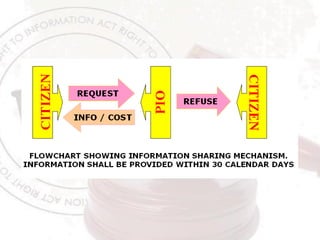
 30 days if application is filed with the PIO.
 35 days in case it is filed with the Assistant
PIO.
 48 hours in case the matter to which the
information pertains affects the life and
liberty of an individual.
EXEMPTIONS FROM DISCLOSURE OF
INFORMATION
(a) National security
(b) Contempt of court
(c) Parliamentary privilege
(d) Trade secrecy
(e) Fiduciary relationship
(f) Foreign government
(g) Safety of informer in law enforcement
(h) Investigation
(i) Cabinet papers
(j) Privacy
(K) Copyright - disclosure which would involve an
infringement of copyright subsisting in a person other
than the State may be rejected. [Section 9]
Appeals
• If you don’t get proper response or requested
information from public authority or from its pubic
information officer within 30 calendar days
• you can file complaint with Information Commission
or file an appeal with first appellate authority.
• Similarly, you can file complaint or appeal for late
response or for demand of cost of information
which is unreasonable.
First Appeal
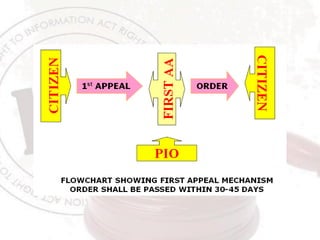
• You will have to move an appeal application along
with the prescribed appeal fee. In Maharashtra, it is
court fee stamp of INR 20/-.
• In Central Government offices, there is no fee.
• First appellate authority is the officer senior to
public information officer.
• On receipt of your appeal, this appellate authority
will call an explanation from PIO, might invite you to
hear you and will pass an reasonable order within
30-45 days.
Second Appeal
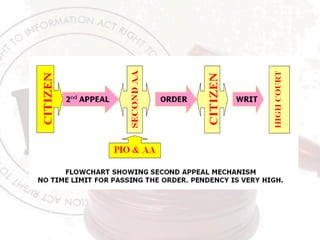
• If you are not satisfied with response of public
information officer and order passed on your
appeal by first appellate authority of particular
public authority, you can file second appeal with
State Information Commissioner or Central
Information Commissioner, as the case may be.
• There is no prescribed time limit for getting
response or order at this level. Too many cases are
piled up with these offices.
Thank you

RTI- Right To Information Act

  • 1.
  • 2.
    What is RTIAct? • Provides a legal framework of citizens’ democratic right to access to information under the control of public authorities • The Act applies to all States and Union Territories of India, except the State of Jammu and Kashmir - which is covered under a State-level law.
  • 3.
    Who is aPublic Authority? • “Public Authority” means any authority or body or • institution established or constituted • By or under the constitution; • By any other law made by Parliament; • By any other law made by State Legislature; • By notification issued or order made by the appropriate • Government and includes any i) body owned, controlled or substantially financed, ii) non - Government organization substantially financed directly or indirectly by funds provided by the appropriate Government;
  • 4.
    What does ‘Information’ mean?  Records  Documents  Memos  Opinions & advices  Press releases  Circulars, orders & logbooks  Contracts  Reports, papers, samples & models
  • 5.
    Need for RTIAct • Promote openness, transparency and accountability in the working of every public authority. • Empowerment of Citizens. • Building capacity of government officials as information providers • Democracy requires an informed citizen • Preservation of confidentiality of sensitive Information. • Strengthen the foundations of democracy • Bride the gap between providers and recipient of public services
  • 6.
    Procedure for requesting information •Apply in writing or through electronic means in English or Hindi or in the official language of the area, to the Public Information Officer [PIO], specifying the particulars of the information sought for. • Reason for seeking information are not required to be given; • Pay fees as may be prescribed.
  • 7.
    FEES AND CHARGES •Application fee Rs. 10/- . • If information is required in electronic media – floppy /CD, etc. additional charges will be applicable. • Photocopy charges of Rs. 2/- per page. • Inspection charges of relevant files, documents and records – • * No fee for first hour of inspection. • * Rs. 5/- for every subsequent hour or fraction thereof.
  • 8.
    Role of PIOand APIO  PIO-provides information to anyone requesting for it  APIO-receives applications and forwards them to PIO
  • 9.
    Functions of PIO •Deal with requests for information • Offer reasonable assistance to applicant • Provide access-enabling assistance to sensorily disabled • Seek assistance from any other officer as considered necessary • For the purpose of contravention of this act, such other officer will be treated as PIO.
  • 10.
    Time limits toget the information  30 days if application is filed with the PIO.  35 days in case it is filed with the Assistant PIO.  48 hours in case the matter to which the information pertains affects the life and liberty of an individual.
  • 11.
    EXEMPTIONS FROM DISCLOSUREOF INFORMATION (a) National security (b) Contempt of court (c) Parliamentary privilege (d) Trade secrecy (e) Fiduciary relationship (f) Foreign government (g) Safety of informer in law enforcement (h) Investigation (i) Cabinet papers (j) Privacy (K) Copyright - disclosure which would involve an infringement of copyright subsisting in a person other than the State may be rejected. [Section 9]
  • 13.
    Appeals • If youdon’t get proper response or requested information from public authority or from its pubic information officer within 30 calendar days • you can file complaint with Information Commission or file an appeal with first appellate authority. • Similarly, you can file complaint or appeal for late response or for demand of cost of information which is unreasonable.
  • 14.
    First Appeal • Youwill have to move an appeal application along with the prescribed appeal fee. In Maharashtra, it is court fee stamp of INR 20/-. • In Central Government offices, there is no fee. • First appellate authority is the officer senior to public information officer. • On receipt of your appeal, this appellate authority will call an explanation from PIO, might invite you to hear you and will pass an reasonable order within 30-45 days.
  • 16.
    Second Appeal • Ifyou are not satisfied with response of public information officer and order passed on your appeal by first appellate authority of particular public authority, you can file second appeal with State Information Commissioner or Central Information Commissioner, as the case may be. • There is no prescribed time limit for getting response or order at this level. Too many cases are piled up with these offices.
  • 18.