How to Explore Library Resources:
www.youtube.com/c/info
mrk
A Guide to Exploring Library Resources
Digital Learning YouTube Channel
Definitions of Library Resources
Kenneth J. Varnum: "Library Resources encompass the broad spectrum of
materials and tools available within a library, including print and electronic
books, periodicals, audiovisual materials, databases, and other resources curated
to facilitate learning, research, and discovery." Reference: Varnum, K. J. (2019). The
Top Technologies Every Librarian Needs to Know: A LITA Guide. Rowman &
Littlefield Publishers.
Thomas Mann: "Library resources encompass the diverse array of materials, both
physical and digital, accessible within a library, including books, periodicals,
multimedia materials, electronic databases, and archives, organized and curated to
support research, learning, and intellectual inquiry." Reference: Mann, T. (2015). The
Oxford Guide to Library Research (4th ed.). Oxford University Press.
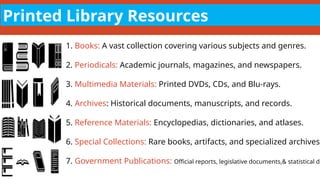
1. Books: A vast collection covering various subjects and genres.
2. Periodicals: Academic journals, magazines, and newspapers.
3. Multimedia Materials: Printed DVDs, CDs, and Blu-rays.
4. Archives: Historical documents, manuscripts, and records.
5. Reference Materials: Encyclopedias, dictionaries, and atlases.
6. Special Collections: Rare books, artifacts, and specialized archives.
7. Government Publications: Official reports, legislative documents,& statistical da
Printed Library Resources
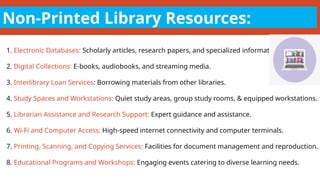
Non-Printed Library Resources:
1. Electronic Databases: Scholarly articles, research papers, and specialized information.
2. Digital Collections: E-books, audiobooks, and streaming media.
3. Interlibrary Loan Services: Borrowing materials from other libraries.
4. Study Spaces and Workstations: Quiet study areas, group study rooms, & equipped workstations.
5. Librarian Assistance and Research Support: Expert guidance and assistance.
6. Wi-Fi and Computer Access: High-speed internet connectivity and computer terminals.
7. Printing, Scanning, and Copying Services: Facilities for document management and reproduction.
8. Educational Programs and Workshops: Engaging events catering to diverse learning needs.
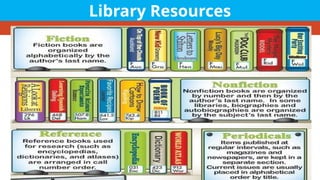
Library Resources
Library Resources
Q&A
Thanks
for Watching
Infomrk

how to explore library resources a guide

  • 1.
    How to ExploreLibrary Resources: www.youtube.com/c/info mrk A Guide to Exploring Library Resources Digital Learning YouTube Channel
  • 2.
    Definitions of LibraryResources Kenneth J. Varnum: "Library Resources encompass the broad spectrum of materials and tools available within a library, including print and electronic books, periodicals, audiovisual materials, databases, and other resources curated to facilitate learning, research, and discovery." Reference: Varnum, K. J. (2019). The Top Technologies Every Librarian Needs to Know: A LITA Guide. Rowman & Littlefield Publishers. Thomas Mann: "Library resources encompass the diverse array of materials, both physical and digital, accessible within a library, including books, periodicals, multimedia materials, electronic databases, and archives, organized and curated to support research, learning, and intellectual inquiry." Reference: Mann, T. (2015). The Oxford Guide to Library Research (4th ed.). Oxford University Press.
  • 3.
    1. Books: Avast collection covering various subjects and genres. 2. Periodicals: Academic journals, magazines, and newspapers. 3. Multimedia Materials: Printed DVDs, CDs, and Blu-rays. 4. Archives: Historical documents, manuscripts, and records. 5. Reference Materials: Encyclopedias, dictionaries, and atlases. 6. Special Collections: Rare books, artifacts, and specialized archives. 7. Government Publications: Official reports, legislative documents,& statistical da Printed Library Resources
  • 4.
    Non-Printed Library Resources: 1.Electronic Databases: Scholarly articles, research papers, and specialized information. 2. Digital Collections: E-books, audiobooks, and streaming media. 3. Interlibrary Loan Services: Borrowing materials from other libraries. 4. Study Spaces and Workstations: Quiet study areas, group study rooms, & equipped workstations. 5. Librarian Assistance and Research Support: Expert guidance and assistance. 6. Wi-Fi and Computer Access: High-speed internet connectivity and computer terminals. 7. Printing, Scanning, and Copying Services: Facilities for document management and reproduction. 8. Educational Programs and Workshops: Engaging events catering to diverse learning needs.
  • 5.
  • 6.