How to Create Pyramids in C
Learn Creating Pyramids
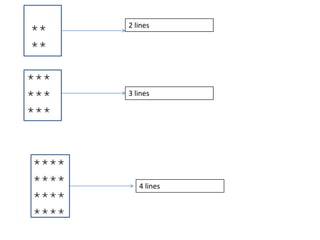
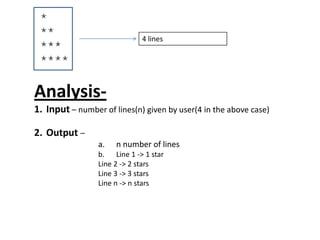
2 lines
3 lines
4 lines
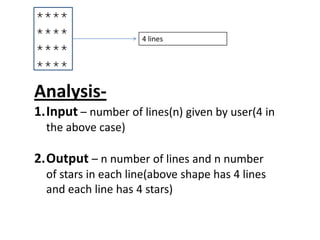
Analysis-
1.Input – number of lines(n) given by user(4 in
the above case)
2.Output – n number of lines and n number
of stars in each line(above shape has 4 lines
and each line has 4 stars)
4 lines
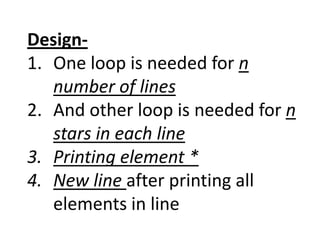
Design-
1. One loop is needed for n
number of lines
2. And other loop is needed for n
stars in each line
3. Printing element *
4. New line after printing all
elements in line
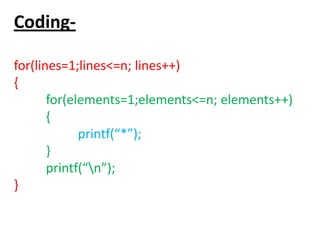
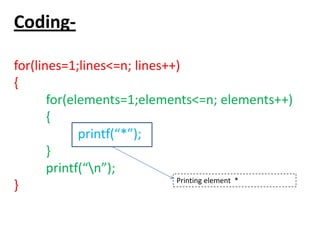
Coding-
for(lines=1;lines<=n; lines++)
{
for(elements=1;elements<=n; elements++)
{
printf(“*”);
}
printf(“n”);
}
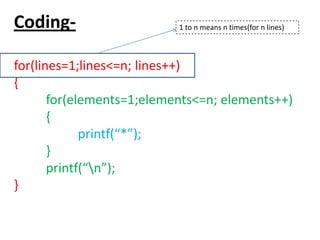
Coding-
for(lines=1;lines<=n; lines++)
{
for(elements=1;elements<=n; elements++)
{
printf(“*”);
}
printf(“n”);
}
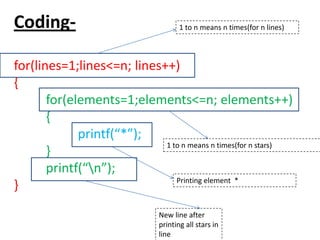
1 to n means n times(for n lines)
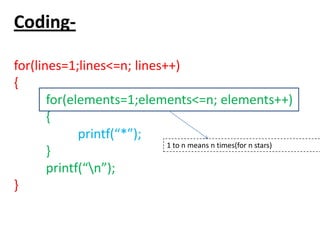
Coding-
for(lines=1;lines<=n; lines++)
{
for(elements=1;elements<=n; elements++)
{
printf(“*”);
}
printf(“n”);
}
1 to n means n times(for n stars)
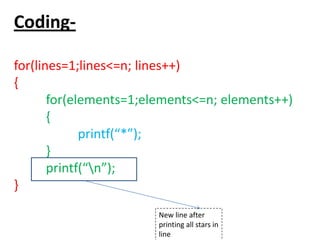
Coding-
for(lines=1;lines<=n; lines++)
{
for(elements=1;elements<=n; elements++)
{
printf(“*”);
}
printf(“n”);
}
New line after
printing all stars in
line
Coding-
for(lines=1;lines<=n; lines++)
{
for(elements=1;elements<=n; elements++)
{
printf(“*”);
}
printf(“n”);
} Printing element *
Coding-
for(lines=1;lines<=n; lines++)
{
for(elements=1;elements<=n; elements++)
{
printf(“*”);
}
printf(“n”);
}
1 to n means n times(for n lines)
1 to n means n times(for n stars)
New line after
printing all stars in
line
Printing element *
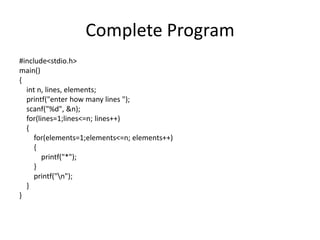
Complete Program
#include<stdio.h>
main()
{
int n, lines, elements;
printf("enter how many lines ");
scanf("%d", &n);
for(lines=1;lines<=n; lines++)
{
for(elements=1;elements<=n; elements++)
{
printf("*");
}
printf("n");
}
}
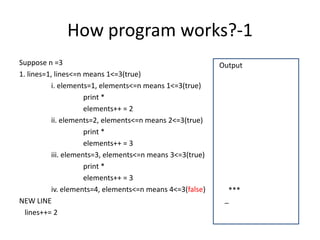
How program works?-1
Suppose n =3
1. lines=1, lines<=n means 1<=3(true)
i. elements=1, elements<=n means 1<=3(true)
print *
elements++ = 2
ii. elements=2, elements<=n means 2<=3(true)
print *
elements++ = 3
iii. elements=3, elements<=n means 3<=3(true)
print *
elements++ = 3
iv. elements=4, elements<=n means 4<=3(false)
NEW LINE
lines++= 2
Output
***
_
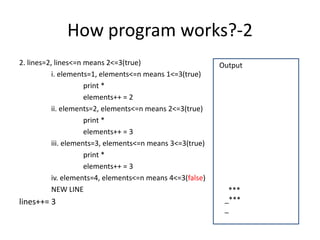
How program works?-2
2. lines=2, lines<=n means 2<=3(true)
i. elements=1, elements<=n means 1<=3(true)
print *
elements++ = 2
ii. elements=2, elements<=n means 2<=3(true)
print *
elements++ = 3
iii. elements=3, elements<=n means 3<=3(true)
print *
elements++ = 3
iv. elements=4, elements<=n means 4<=3(false)
NEW LINE
lines++= 3
Output
***
_***
_
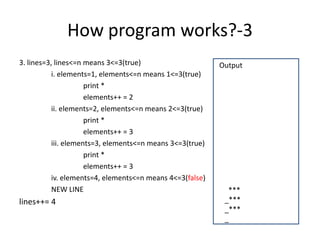
How program works?-3
3. lines=3, lines<=n means 3<=3(true)
i. elements=1, elements<=n means 1<=3(true)
print *
elements++ = 2
ii. elements=2, elements<=n means 2<=3(true)
print *
elements++ = 3
iii. elements=3, elements<=n means 3<=3(true)
print *
elements++ = 3
iv. elements=4, elements<=n means 4<=3(false)
NEW LINE
lines++= 4
Output
***
_***
_***
_
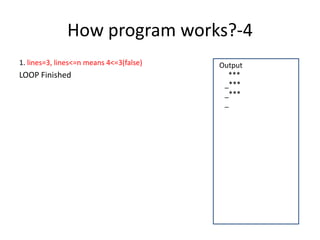
How program works?-4
1. lines=3, lines<=n means 4<=3(false)
LOOP Finished
Output
***
_***
_***
_
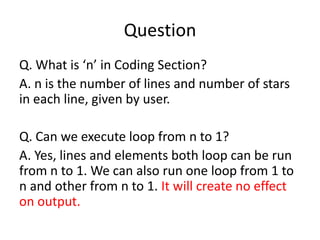
Question
Q. What is ‘n’ in Coding Section?
A. n is the number of lines and number of stars
in each line, given by user.
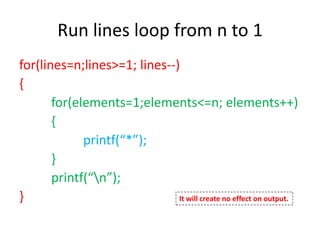
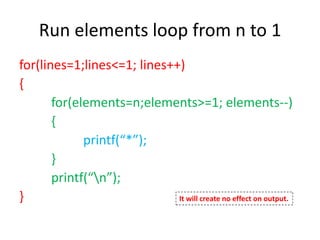
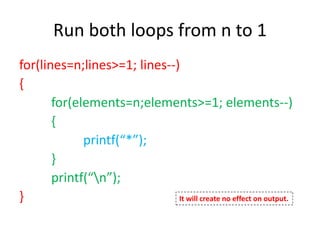
Q. Can we execute loop from n to 1?
A. Yes, lines and elements both loop can be run
from n to 1. We can also run one loop from 1 to
n and other from n to 1. It will create no effect
on output.
Run lines loop from n to 1
for(lines=n;lines>=1; lines--)
{
for(elements=1;elements<=n; elements++)
{
printf(“*”);
}
printf(“n”);
} It will create no effect on output.
Run elements loop from n to 1
for(lines=1;lines<=1; lines++)
{
for(elements=n;elements>=1; elements--)
{
printf(“*”);
}
printf(“n”);
} It will create no effect on output.
Run both loops from n to 1
for(lines=n;lines>=1; lines--)
{
for(elements=n;elements>=1; elements--)
{
printf(“*”);
}
printf(“n”);
} It will create no effect on output.
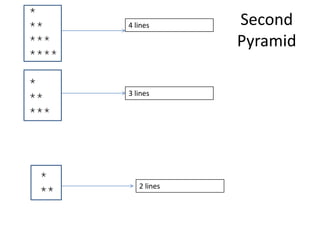
Second
Pyramid
4 lines
3 lines
2 lines
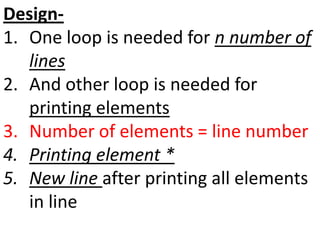
Analysis-
1. Input – number of lines(n) given by user(4 in the above case)
2. Output –
a. n number of lines
b. Line 1 -> 1 star
Line 2 -> 2 stars
Line 3 -> 3 stars
Line n -> n stars
4 lines
Design-
1. One loop is needed for n number of
lines
2. And other loop is needed for
printing elements
3. Number of elements = line number
4. Printing element *
5. New line after printing all elements
in line
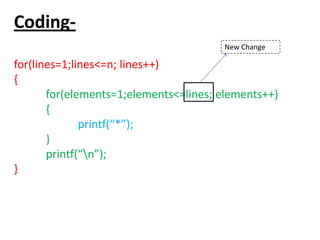
Coding-
for(lines=1;lines<=n; lines++)
{
for(elements=1;elements<=lines; elements++)
{
printf(“*”);
}
printf(“n”);
}
New Change
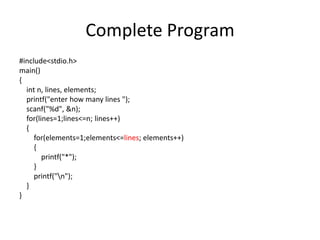
Complete Program
#include<stdio.h>
main()
{
int n, lines, elements;
printf("enter how many lines ");
scanf("%d", &n);
for(lines=1;lines<=n; lines++)
{
for(elements=1;elements<=lines; elements++)
{
printf("*");
}
printf("n");
}
}
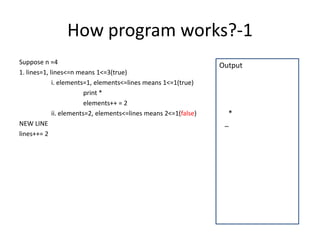
How program works?-1
Suppose n =4
1. lines=1, lines<=n means 1<=3(true)
i. elements=1, elements<=lines means 1<=1(true)
print *
elements++ = 2
ii. elements=2, elements<=lines means 2<=1(false)
NEW LINE
lines++= 2
Output
*
_
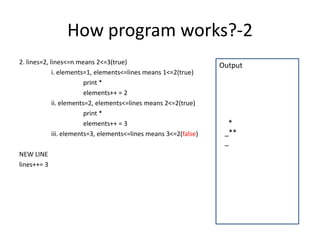
How program works?-2
2. lines=2, lines<=n means 2<=3(true)
i. elements=1, elements<=lines means 1<=2(true)
print *
elements++ = 2
ii. elements=2, elements<=lines means 2<=2(true)
print *
elements++ = 3
iii. elements=3, elements<=lines means 3<=2(false)
NEW LINE
lines++= 3
Output
*
_**
_
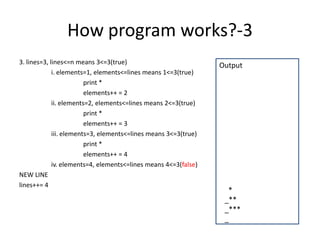
How program works?-3
3. lines=3, lines<=n means 3<=3(true)
i. elements=1, elements<=lines means 1<=3(true)
print *
elements++ = 2
ii. elements=2, elements<=lines means 2<=3(true)
print *
elements++ = 3
iii. elements=3, elements<=lines means 3<=3(true)
print *
elements++ = 4
iv. elements=4, elements<=lines means 4<=3(false)
NEW LINE
lines++= 4
Output
*
_**
_***
_
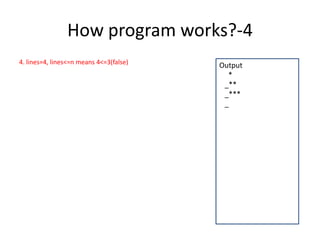
How program works?-4
4. lines=4, lines<=n means 4<=3(false) Output
*
_**
_***
_

Learn How to create pyramids in c