How to Create New Business Models
with Big Data & Analytics

               Aki Balogh
           Calpont Corporation
Agenda
1.   What is Driving Big Data?
2.   What is Big Data?
3.   What is Analytics?
4.   What can you do with Big Data & Analytics?
What is Driving Big Data?
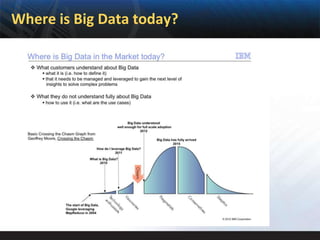
Where is Big Data today?
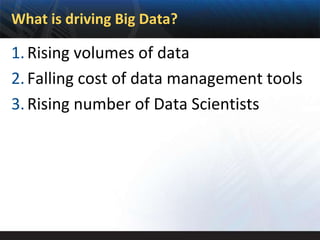
What is driving Big Data?

1. Rising volumes of data
2. Falling cost of data management tools
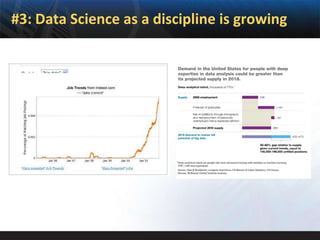
3. Rising number of Data Scientists
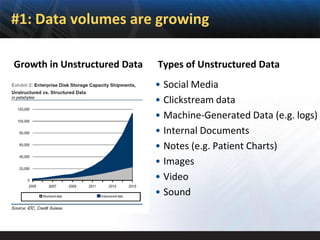
#1: Data volumes are growing

Growth in Unstructured Data   Types of Unstructured Data
                              • Social Media
                              • Clickstream data
                              • Machine-Generated Data (e.g. logs)
                              • Internal Documents
                              • Notes (e.g. Patient Charts)
                              • Images
                              • Video
                              • Sound
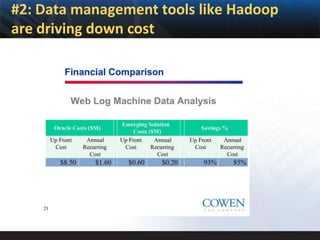
#2: Data management tools like Hadoop
are driving down cost
#3: Data Science as a discipline is growing
What is Big Data?
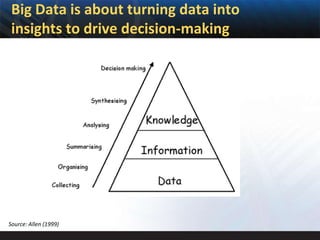
Big Data is about turning data into
 insights to drive decision-making


Source: Allen (1999)
A Simple Framework: 3 Vs of Big Data

•Volume
•Variety
•Velocity


                     11
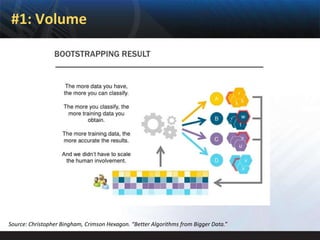
#1: Volume


Source: Christopher Bingham, Crimson Hexagon. “Better Algorithms from Bigger Data.”
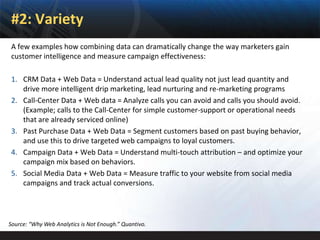
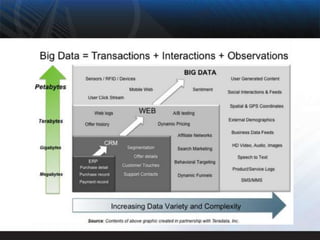
#2: Variety
 A few examples how combining data can dramatically change the way marketers gain
 customer intelligence and measure campaign effectiveness:

 1. CRM Data + Web Data = Understand actual lead quality not just lead quantity and
    drive more intelligent drip marketing, lead nurturing and re-marketing programs
 2. Call-Center Data + Web data = Analyze calls you can avoid and calls you should avoid.
    (Example; calls to the Call-Center for simple customer-support or operational needs
    that are already serviced online)
 3. Past Purchase Data + Web Data = Segment customers based on past buying behavior,
    and use this to drive targeted web campaigns to loyal customers.
 4. Campaign Data + Web Data = Understand multi-touch attribution – and optimize your
    campaign mix based on behaviors.
 5. Social Media Data + Web Data = Measure traffic to your website from social media
    campaigns and track actual conversions.


Source: “Why Web Analytics is Not Enough.” Quantivo.
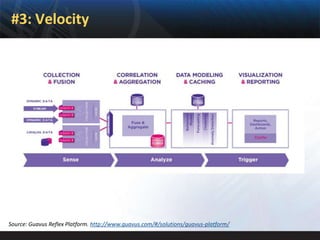
#3: Velocity


Source: Guavus Reflex Platform. http://www.guavus.com/#/solutions/guavus-platform/
What is Analytics?
A Simple Framework for Analytics


•Descriptive

•Predictive

•Prescriptive
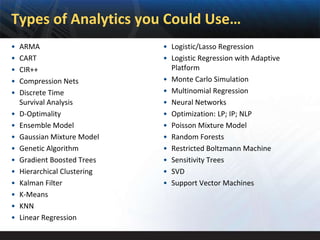
Types of Analytics you Could Use…
•   ARMA                      • Logistic/Lasso Regression
•   CART                      • Logistic Regression with Adaptive
•   CIR++                       Platform
•   Compression Nets          • Monte Carlo Simulation
•   Discrete Time             • Multinomial Regression
    Survival Analysis         • Neural Networks
•   D-Optimality              • Optimization: LP; IP; NLP
•   Ensemble Model            • Poisson Mixture Model
•   Gaussian Mixture Model    • Random Forests
•   Genetic Algorithm         • Restricted Boltzmann Machine
•   Gradient Boosted Trees    • Sensitivity Trees
•   Hierarchical Clustering   • SVD
•   Kalman Filter             • Support Vector Machines
•   K-Means
•   KNN
•   Linear Regression
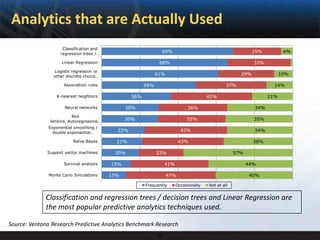
Analytics that are Actually Used
                     Classification and
                    regression trees /…
                                                                69%                                          25%          6%

                     Linear Regression                         66%                                           33%
                 Logistic regression or
                 other discrete choice…
                                                              61%                                      29%               10%

                      Association rules                 49%                                      37%                 14%

                  K-nearest neighbors             36%                                   42%                        21%

                      Neural networks           30%                           36%                            34%
                          Box
               Jenkins, Autoregressive…
                                                30%                           35%                            35%
               Exponential smoothing /
                 double exponential…
                                            22%                            43%                               34%

                          Naïve Bayes       21%                           43%                                36%

              Support vector machines      20%                23%                                    57%

                      Survival analysis   15%                      41%                                     44%

               Monte Carlo Simulations    13%                       47%                                     40%

                                                        Frequently       Occasionally   Not at all


              Classification and regression trees / decision trees and Linear Regression are
              the most popular predictive analytics techniques used.

Source: Ventana Research Predictive Analytics Benchmark Research
                                                              18
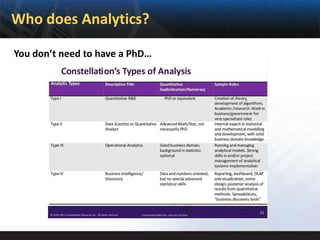
Who does Analytics?

You don’t need to have a PhD…
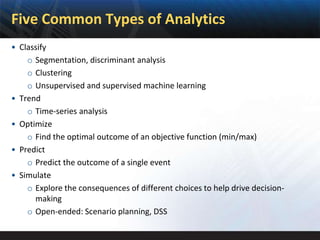
Five Common Types of Analytics
• Classify
    o Segmentation, discriminant analysis
    o Clustering
    o Unsupervised and supervised machine learning
• Trend
    o Time-series analysis
• Optimize
    o Find the optimal outcome of an objective function (min/max)
• Predict
    o Predict the outcome of a single event
• Simulate
    o Explore the consequences of different choices to help drive decision-
      making
    o Open-ended: Scenario planning, DSS
So, what is Analytics?


•Descriptive

•Predictive

•Prescriptive
What can you do with Big Data & Analytics?
What does Big Data Analytics require?

Data: data availability + storage + integration + data management
  tools
+
Analytics: analytic formulas + statistical integrity + analytic
  applications
+
Interpretation: business problem + domain expertise + visualization
  + decision-making

This typically requires a team of people with different skillsets.
What can you do with Big Data & Analytics?
1. New revenue models
   o Ex: Rapleaf scraping the web, collecting contact information and
     selling full datasets


1. New user experiences
   o Ex: Gmail recommendations for people to CC: on your email

2. Cost optimization (i.e. deliver same product or service at less
   cost)
   o Ex: Give your financial advisors tools to help automate your
     investment decisions
How to create new business models with Big Data and Analytics

How to create new business models with Big Data and Analytics

  • 1.
    How to CreateNew Business Models with Big Data & Analytics Aki Balogh Calpont Corporation
  • 2.
    Agenda 1. What is Driving Big Data? 2. What is Big Data? 3. What is Analytics? 4. What can you do with Big Data & Analytics?
  • 3.
    What is DrivingBig Data?
  • 4.
    Where is BigData today?
  • 5.
    What is drivingBig Data? 1. Rising volumes of data 2. Falling cost of data management tools 3. Rising number of Data Scientists
  • 6.
    #1: Data volumesare growing Growth in Unstructured Data Types of Unstructured Data • Social Media • Clickstream data • Machine-Generated Data (e.g. logs) • Internal Documents • Notes (e.g. Patient Charts) • Images • Video • Sound
  • 7.
    #2: Data managementtools like Hadoop are driving down cost
  • 8.
    #3: Data Scienceas a discipline is growing
  • 9.
  • 10.
    Big Data isabout turning data into insights to drive decision-making Source: Allen (1999)
  • 11.
    A Simple Framework:3 Vs of Big Data •Volume •Variety •Velocity 11
  • 12.
    #1: Volume Source: ChristopherBingham, Crimson Hexagon. “Better Algorithms from Bigger Data.”
  • 13.
    #2: Variety Afew examples how combining data can dramatically change the way marketers gain customer intelligence and measure campaign effectiveness: 1. CRM Data + Web Data = Understand actual lead quality not just lead quantity and drive more intelligent drip marketing, lead nurturing and re-marketing programs 2. Call-Center Data + Web data = Analyze calls you can avoid and calls you should avoid. (Example; calls to the Call-Center for simple customer-support or operational needs that are already serviced online) 3. Past Purchase Data + Web Data = Segment customers based on past buying behavior, and use this to drive targeted web campaigns to loyal customers. 4. Campaign Data + Web Data = Understand multi-touch attribution – and optimize your campaign mix based on behaviors. 5. Social Media Data + Web Data = Measure traffic to your website from social media campaigns and track actual conversions. Source: “Why Web Analytics is Not Enough.” Quantivo.
  • 14.
    #3: Velocity Source: GuavusReflex Platform. http://www.guavus.com/#/solutions/guavus-platform/
  • 15.
  • 16.
    A Simple Frameworkfor Analytics •Descriptive •Predictive •Prescriptive
  • 17.
    Types of Analyticsyou Could Use… • ARMA • Logistic/Lasso Regression • CART • Logistic Regression with Adaptive • CIR++ Platform • Compression Nets • Monte Carlo Simulation • Discrete Time • Multinomial Regression Survival Analysis • Neural Networks • D-Optimality • Optimization: LP; IP; NLP • Ensemble Model • Poisson Mixture Model • Gaussian Mixture Model • Random Forests • Genetic Algorithm • Restricted Boltzmann Machine • Gradient Boosted Trees • Sensitivity Trees • Hierarchical Clustering • SVD • Kalman Filter • Support Vector Machines • K-Means • KNN • Linear Regression
  • 18.
    Analytics that areActually Used Classification and regression trees /… 69% 25% 6% Linear Regression 66% 33% Logistic regression or other discrete choice… 61% 29% 10% Association rules 49% 37% 14% K-nearest neighbors 36% 42% 21% Neural networks 30% 36% 34% Box Jenkins, Autoregressive… 30% 35% 35% Exponential smoothing / double exponential… 22% 43% 34% Naïve Bayes 21% 43% 36% Support vector machines 20% 23% 57% Survival analysis 15% 41% 44% Monte Carlo Simulations 13% 47% 40% Frequently Occasionally Not at all Classification and regression trees / decision trees and Linear Regression are the most popular predictive analytics techniques used. Source: Ventana Research Predictive Analytics Benchmark Research 18
  • 19.
    Who does Analytics? Youdon’t need to have a PhD…
  • 20.
    Five Common Typesof Analytics • Classify o Segmentation, discriminant analysis o Clustering o Unsupervised and supervised machine learning • Trend o Time-series analysis • Optimize o Find the optimal outcome of an objective function (min/max) • Predict o Predict the outcome of a single event • Simulate o Explore the consequences of different choices to help drive decision- making o Open-ended: Scenario planning, DSS
  • 21.
    So, what isAnalytics? •Descriptive •Predictive •Prescriptive
  • 22.
    What can youdo with Big Data & Analytics?
  • 23.
    What does BigData Analytics require? Data: data availability + storage + integration + data management tools + Analytics: analytic formulas + statistical integrity + analytic applications + Interpretation: business problem + domain expertise + visualization + decision-making This typically requires a team of people with different skillsets.
  • 24.
    What can youdo with Big Data & Analytics? 1. New revenue models o Ex: Rapleaf scraping the web, collecting contact information and selling full datasets 1. New user experiences o Ex: Gmail recommendations for people to CC: on your email 2. Cost optimization (i.e. deliver same product or service at less cost) o Ex: Give your financial advisors tools to help automate your investment decisions

Editor's Notes

  • #9 In-DB analytics is a trend that is a realityIt makes sense for our product. If they want to use us for analytics but they can’t do in-DB analytics, we’re not a full packageEx: algorithm doing time-series analysis in SAS, customer wants to do time-series algorithm in InfiniDB, we don’t want to code all of the algorithms. We want to integrate with the tools out there