Vishal Patel
June 2017
Exploring the Data Science Process
 Vishal Patel
 Data Science Consultant
 Founder of DERIVE, LLC
 Fully Automated Advanced Analytics products
 Data Science services
 MS in Computer Science, and MS in Decision Sciences
 Richmond, VA
w w w. d e r i v e . i o
Data
Science
HOW TO BUILD
A MACHINE LEARNING MODEL
IN THREE QUICK AND EASY STEPS
USING [XXX]!!!
– Most tutorials
1
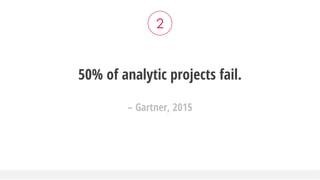
50% of analytic projects fail.
– Gartner, 2015
2
On September 21, 2009, the grand prize of US$1,000,000 was given to the BellKor's
Pragmatic Chaos team which bested Netflix's own algorithm for predicting ratings by 10.06%.
“[T]he additional accuracy gains that we measured did not seem to justify the
engineering effort needed to bring them into a production environment.”
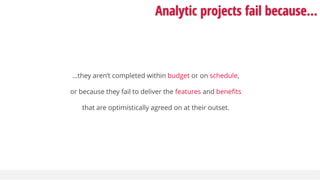
Analytic projects fail because…
…they aren’t completed within budget or on schedule,
or because they fail to deliver the features and benefits
that are optimistically agreed on at their outset.
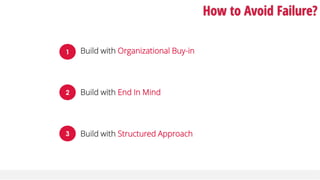
How to Avoid Failure?
1 Build with Organizational Buy-in
2 Build with End In Mind
3 Build with Structured Approach
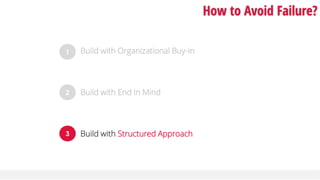
How to Avoid Failure?
1 Build with Organizational Buy-in
2 Build with End In Mind
3 Build with Structured Approach
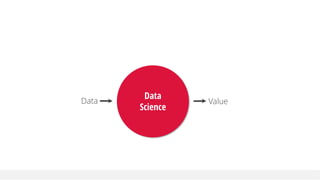
Data
Data
Science
Value
Data
Data
Science
Value
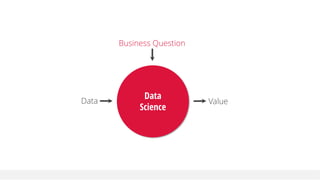
Business Question
Data
Science
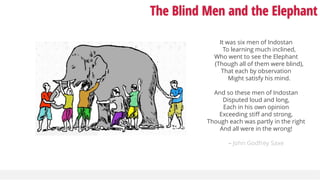
The Blind Men and the Elephant
It was six men of Indostan
To learning much inclined,
Who went to see the Elephant
(Though all of them were blind),
That each by observation
Might satisfy his mind.
And so these men of Indostan
Disputed loud and long,
Each in his own opinion
Exceeding stiff and strong,
Though each was partly in the right
And all were in the wrong!
– John Godfrey Saxe
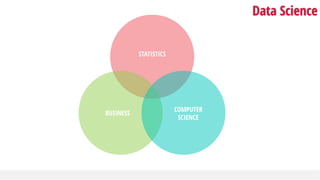
Data Science
STATISTICS
BUSINESS
COMPUTER
SCIENCE
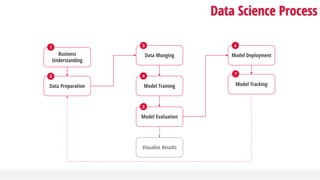
Data Munging
Model Training
Model Deployment
Data Preparation Model Tracking
Business
Understanding
Model Evaluation
Visualize Results
Data Science Process
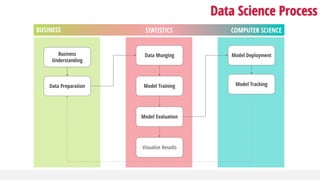
STATISTICSBUSINESS COMPUTER SCIENCE
1
2
3
4
5
6
7
Data Munging
Model Training
Model Deployment
Data Preparation Model Tracking
Business
Understanding
Model Evaluation
Visualize Results
Data Science Process
STATISTICSBUSINESS COMPUTER SCIENCE
Business
Understanding
Data
Preparation
Data
Munging
Model
Training
Model
Evaluation
Model
Deployment
Model
Tracking
Business
Understanding
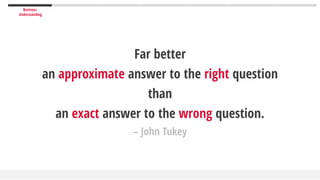
Far better
an approximate answer to the right question
than
an exact answer to the wrong question.
– John Tukey
Business
Understanding
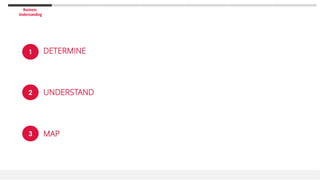
1
2
3
DETERMINE
UNDERSTAND
MAP
Business
Understanding
1
2
3
DETERMINE
UNDERSTAND
MAP
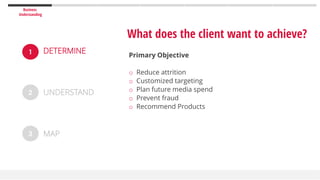
What does the client want to achieve?
Primary Objective
o Reduce attrition
o Customized targeting
o Plan future media spend
o Prevent fraud
o Recommend Products
Business
Understanding
1
2
3
DETERMINE
UNDERSTAND
MAP
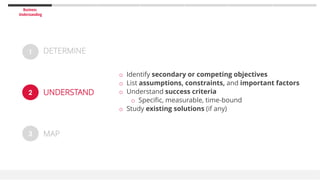
o Identify secondary or competing objectives
o List assumptions, constraints, and important factors
o Understand success criteria
o Specific, measurable, time-bound
o Study existing solutions (if any)
Business
Understanding
1
2
3
DETERMINE
UNDERSTAND
MAP
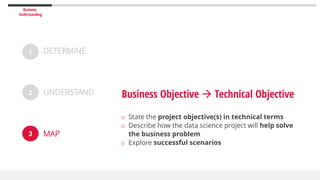
o State the project objective(s) in technical terms
o Describe how the data science project will help solve
the business problem
o Explore successful scenarios
Business Objective  Technical Objective
Business
Understanding
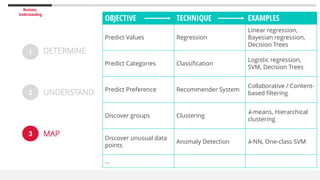
OBJECTIVE TECHNIQUE EXAMPLES
Predict Values Regression
Linear regression,
Bayesian regression,
Decision Trees
Predict Categories Classification
Logistic regression,
SVM, Decision Trees
Predict Preference Recommender System
Collaborative / Content-
based filtering
Discover groups Clustering
k-means, Hierarchical
clustering
Discover unusual data
points
Anomaly Detection k-NN, One-class SVM
…
1
2
3
DETERMINE
UNDERSTAND
MAP
If all you have is a hammer
then everything looks like a nail.
Business
Understanding
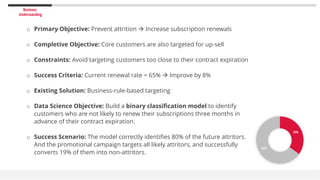
o Primary Objective: Prevent attrition  Increase subscription renewals
o Completive Objective: Core customers are also targeted for up-sell
o Constraints: Avoid targeting customers too close to their contract expiration
o Success Criteria: Current renewal rate = 65%  Improve by 8%
o Existing Solution: Business-rule-based targeting
o Data Science Objective: Build a binary classification model to identify
customers who are not likely to renew their subscriptions three months in
advance of their contract expiration.
o Success Scenario: The model correctly identifies 80% of the future attritors.
And the promotional campaign targets all likely attritors, and successfully
converts 19% of them into non-attritors.
Business
Understanding
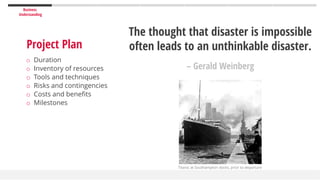
o Duration
o Inventory of resources
o Tools and techniques
o Risks and contingencies
o Costs and benefits
o Milestones
The thought that disaster is impossible
often leads to an unthinkable disaster.
– Gerald Weinberg
Project Plan
Titanic at Southampton docks, prior to departure
Data
Preparation
1 IDENTIFY
2 COLLECT
3 ASSESS
4 VECTORIZE
Data
Preparation
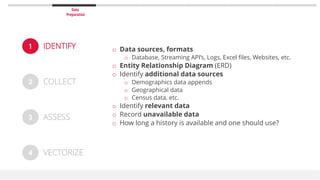
o Data sources, formats
o Database, Streaming API’s, Logs, Excel files, Websites, etc.
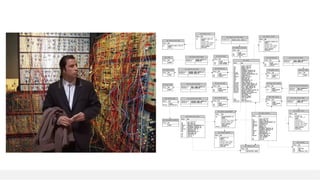
o Entity Relationship Diagram (ERD)
o Identify additional data sources
o Demographics data appends
o Geographical data
o Census data, etc.
o Identify relevant data
o Record unavailable data
o How long a history is available and one should use?
1 IDENTIFY
2 COLLECT
3 ASSESS
4 VECTORIZE
Data
Preparation
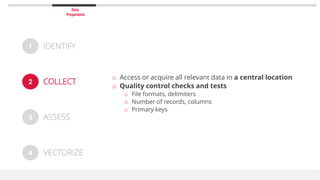
o Access or acquire all relevant data in a central location
o Quality control checks and tests
o File formats, delimiters
o Number of records, columns
o Primary keys
1 IDENTIFY
2 COLLECT
3 ASSESS
4 VECTORIZE
Data
Preparation
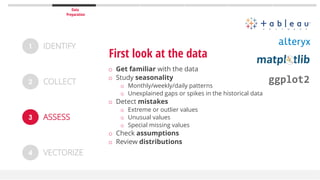
First look at the data
o Get familiar with the data
o Study seasonality
o Monthly/weekly/daily patterns
o Unexplained gaps or spikes in the historical data
o Detect mistakes
o Extreme or outlier values
o Unusual values
o Special missing values
o Check assumptions
o Review distributions
1 IDENTIFY
3 ASSESS
4 VECTORIZE
2 COLLECT
Tidy dataset are all alike;
Every messy dataset is messy in its own way.
Data
Preparation
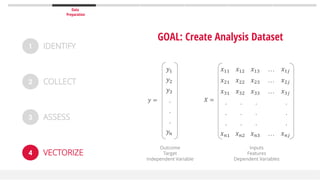
GOAL: Create Analysis Dataset
1 IDENTIFY
4 VECTORIZE
2 COLLECT
3 ASSESS
𝑦1
𝑦2
𝑦3
.
.
.
𝑦𝑛
𝑥11 𝑥12 𝑥13 … 𝑥1𝑗
𝑥21 𝑥22 𝑥23 … 𝑥2𝑗
𝑥31 𝑥32 𝑥33 … 𝑥3𝑗
. . . .
. . . .
. . . .
𝑥 𝑛1 𝑥 𝑛2 𝑥 𝑛3 … 𝑥 𝑛𝑗
𝑦 = 𝑋 =
Outcome
Target
Independent Variable
Inputs
Features
Dependent Variables
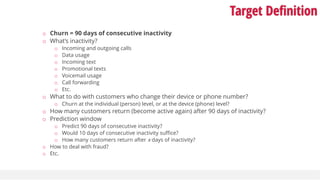
Target Definition
o Churn = 90 days of consecutive inactivity
o What’s inactivity?
o Incoming and outgoing calls
o Data usage
o Incoming text
o Promotional texts
o Voicemail usage
o Call forwarding
o Etc.
o What to do with customers who change their device or phone number?
o Churn at the individual (person) level, or at the device (phone) level?
o How many customers return (become active again) after 90 days of inactivity?
o Prediction window
o Predict 90 days of consecutive inactivity?
o Would 10 days of consecutive inactivity suffice?
o How many customers return after x days of inactivity?
o How to deal with fraud?
o Etc.
Modeling Sample
o Historical trends and seasonality
o Are there certain timeframes that should be discarded?
o The model should be generalizable for future targeting purposes
o Eligible, relevant population
o Must align with the business goals
o Eligible, relevant markets (e.g., US vs. International)
o Must align with the business goals
o Outdated products
Selection Bias
Abraham Wald's Work on Aircraft Survivability
Journal of the American Statistical Association Vol. 79, No. 386 (Jun., 1984)
Information Leakage
… Sep Oct Nov Dec Jan Feb Mar Apr
…to predict whether customers
will [do something]
Use all available information
(“Leading Indicators”)
as of the end of Jan…
OBSERVATION WIDOW PREDICTION WIDOW
o The leading indicators must be calculated from the timeframe leading up to the event
– it must not overlap with the prediction window.
o Beware of proxy events, e.g., future bookings
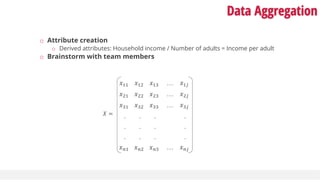
Data Aggregation
o Attribute creation
o Derived attributes: Household income / Number of adults = Income per adult
o Brainstorm with team members
𝑥11 𝑥12 𝑥13 … 𝑥1𝑗
𝑥21 𝑥22 𝑥23 … 𝑥2𝑗
𝑥31 𝑥32 𝑥33 … 𝑥3𝑗
. . . .
. . . .
. . . .
𝑥 𝑛1 𝑥 𝑛2 𝑥 𝑛3 … 𝑥 𝑛𝑗
𝑋 =
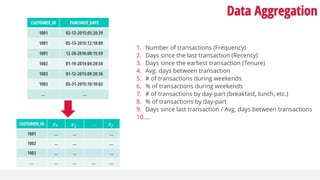
Data Aggregation
CUSTOMER_ID PURCHASE_DATE
1001 02-12-2015:05:20:39
1001 05-13-2015:12:18:09
1001 12-20-2016:00:15:59
1002 01-19-2014:04:28:54
1003 01-12-2015:09:20:36
1003 05-31-2015:10:10:02
… …
1. Number of transactions (Frequency)
2. Days since the last transaction (Recency)
3. Days since the earliest transaction (Tenure)
4. Avg. days between transaction
5. # of transactions during weekends
6. % of transactions during weekends
7. # of transactions by day-part (breakfast, lunch, etc.)
8. % of transactions by day-part
9. Days since last transaction / Avg. days between transactions
10.…
CUSTOMER_ID 𝑥1 𝑥2 … 𝑥𝑗
1001 … … …
1002 … … …
1003 … … …
… … … … …
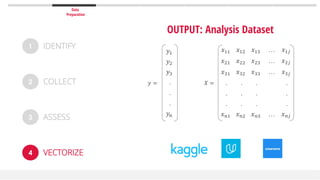
Data
Preparation
1 IDENTIFY
4 VECTORIZE
2 COLLECT
3 ASSESS
OUTPUT: Analysis Dataset
𝑦1
𝑦2
𝑦3
.
.
.
𝑦𝑛
𝑥11 𝑥12 𝑥13 … 𝑥1𝑗
𝑥21 𝑥22 𝑥23 … 𝑥2𝑗
𝑥31 𝑥32 𝑥33 … 𝑥3𝑗
. . . .
. . . .
. . . .
𝑥 𝑛1 𝑥 𝑛2 𝑥 𝑛3 … 𝑥 𝑛𝑗
𝑦 = 𝑋 =
Entity Relationship Diagram
(ERD)
Data
Munging
Model
Training
Model
Evaluation
Model
Deployment
Model
Tracking
Data
Preparation
Business
Understanding
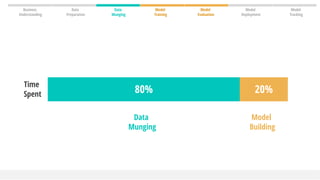
80% 20%
Data
Munging
Model
Building
Time
Spent
Give me six hours to chop down a tree
and I will spend the first four sharpening the axe.
– Abraham Lincoln
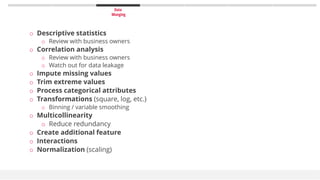
Data
Munging
o Descriptive statistics
o Review with business owners
o Correlation analysis
o Review with business owners
o Watch out for data leakage
o Impute missing values
o Trim extreme values
o Process categorical attributes
o Transformations (square, log, etc.)
o Binning / variable smoothing
o Multicollinearity
o Reduce redundancy
o Create additional feature
o Interactions
o Normalization (scaling)
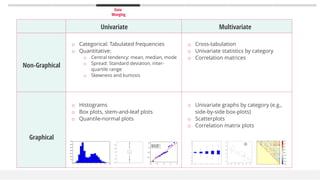
Univariate Multivariate
Non-Graphical
Graphical
o Cross-tabulation
o Univariate statistics by category
o Correlation matrices
o Histograms
o Box plots, stem-and-leaf plots
o Quantile-normal plots
o Categorical: Tabulated frequencies
o Quantitative:
o Central tendency: mean, median, mode
o Spread: Standard deviation, inter-
quartile range
o Skewness and kurtosis
o Univariate graphs by category (e.g.,
side-by-side box-plots)
o Scatterplots
o Correlation matrix plots
Data
Munging
Data
Munging
 Feature Reduction: The process of selecting a subset of features for use in model construction
 Useful for both supervised and unsupervised learning problems
Art is the elimination of the unnecessary.
– Pablo Picasso
Data
Munging
 True dimensionality <<< Observed dimensionality
 The abundance of redundant and irrelevant features
 Curse of dimensionality
 With a fixed number of training samples, the predictive power reduces as the dimensionality
increases. [Hughes phenomenon]
 With 𝑑 binary variables, the number of possible combinations is 𝑂(2 𝑑
).
 Value of Analytics
 Descriptive  Diagnostic  Predictive  Prescriptive
 Law of Parsimony [Occam’s Razor]
 Other things being equal, simpler explanations are generally better than complex ones.
 Overfitting
 Execution time (Algorithm and data)
Hindsight Insight Foresight
Feature Reduction: Why
Data
Munging
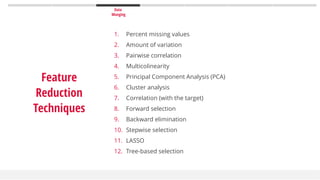
1. Percent missing values
2. Amount of variation
3. Pairwise correlation
4. Multicolinearity
5. Principal Component Analysis (PCA)
6. Cluster analysis
7. Correlation (with the target)
8. Forward selection
9. Backward elimination
10. Stepwise selection
11. LASSO
12. Tree-based selection
Feature
Reduction
Techniques
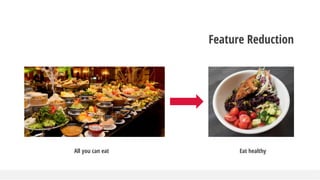
All you can eat Eat healthy
Feature Reduction
Model
Training
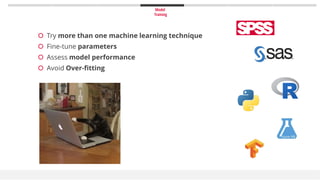
 Try more than one machine learning technique
 Fine-tune parameters
 Assess model performance
 Avoid Over-fitting
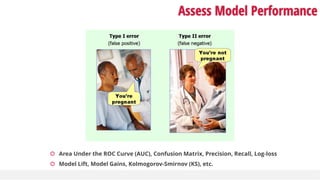
Assess Model Performance
 Area Under the ROC Curve (AUC), Confusion Matrix, Precision, Recall, Log-loss
 Model Lift, Model Gains, Kolmogorov-Smirnov (KS), etc.
When a measure becomes a target,
it ceases to be a good measure.
Goodhart's law
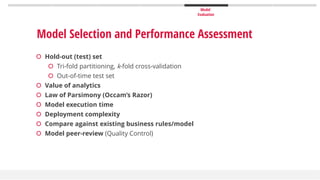
Model
Evaluation
 Hold-out (test) set
 Tri-fold partitioning, k-fold cross-validation
 Out-of-time test set
 Value of analytics
 Law of Parsimony (Occam’s Razor)
 Model execution time
 Deployment complexity
 Compare against existing business rules/model
 Model peer-review (Quality Control)
Model Selection and Performance Assessment
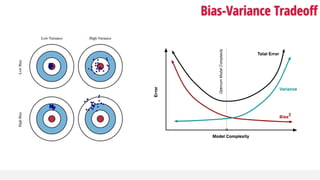
Bias-Variance Tradeoff
Model
Evaluation
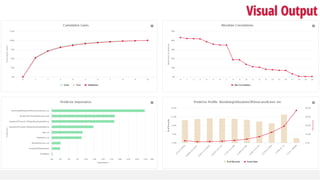
 AUC
 Cumulative Gains chart
 Model usage recommendations
 Decile reports
 How many deciles should be targeted?
 Predictor Importance
 Each predictor’s relationship with the target
 Interpret results as they relate to the business application
Visualization of Modeling Results
 Primary bullet
 Secondary bullet
Visual Output
. . . . . . . . . .
Model
Deployment
 Model production cycle (daily, weekly, monthly, etc.)
 Scoring code, or publish model as a web service
 Model Documentation (Technical Specifications)
 Data preparation, transformations, imputations, parameter settings, etc.
 Reproducibility
 Docker containers, etc.
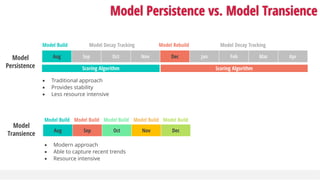
 Model Persistence vs. Model Transience
Model Persistence vs. Model Transience
Aug Sep Oct Nov Dec Jan Feb Mar Apr
Model Build Model Decay Tracking Model Rebuild Model Decay Tracking
Scoring Algorithm Scoring Algorithm
Model
Persistence
Aug Sep Oct Nov Dec
Model Build
Model
Transience
Model Build Model Build Model Build Model Build
• Traditional approach
• Provides stability
• Less resource intensive
• Modern approach
• Able to capture recent trends
• Resource intensive
Model
Tracking
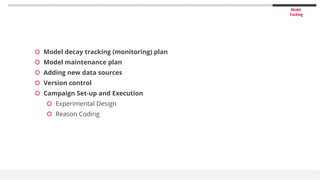
 Model decay tracking (monitoring) plan
 Model maintenance plan
 Adding new data sources
 Version control
 Campaign Set-up and Execution
 Experimental Design
 Reason Coding
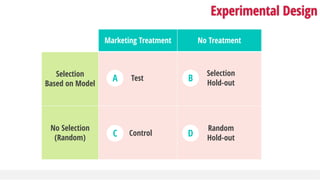
No Selection
(Random)
Experimental Design
Marketing Treatment No Treatment
Selection
Based on Model
A Test
C Control
B
Selection
Hold-out
D
Random
Hold-out
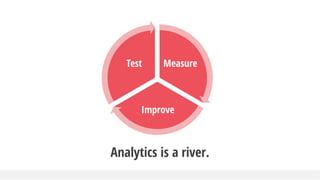
Measure
Improve
Test
Analytics is a river.
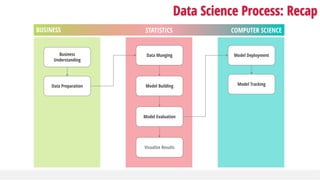
Data Munging
Model Building
Model Deployment
Data Preparation Model Tracking
Business
Understanding
Model Evaluation
Visualize Results
Data Science Process: Recap
STATISTICSBUSINESS COMPUTER SCIENCE
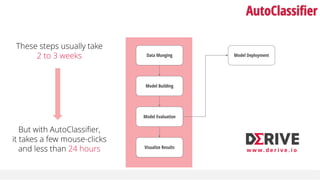
Data Munging
Model Building
Model Deployment
Model Evaluation
Visualize Results
AutoClassifier
These steps usually take
2 to 3 weeks
But with AutoClassifier,
it takes a few mouse-clicks
and less than 24 hours w w w . d e r i v e . i o
Process as Proxy
Good process serves you so you can serve customers.
But if you’re not watchful, the process can become the proxy for the result you want.
You stop looking at outcomes and just make sure you’re doing the process right.
Gulp.
It’s always worth asking, do we own the process or does the process own us?
– Jeff Bezos
THANK YOU!
vishal@derive.io
www.linkedIn.com/in/VishalJP
w w w . d e r i v e . i o

Exploring the Data science Process

  • 1.
    Vishal Patel June 2017 Exploringthe Data Science Process
  • 2.
     Vishal Patel Data Science Consultant  Founder of DERIVE, LLC  Fully Automated Advanced Analytics products  Data Science services  MS in Computer Science, and MS in Decision Sciences  Richmond, VA w w w. d e r i v e . i o
  • 3.
  • 4.
    HOW TO BUILD AMACHINE LEARNING MODEL IN THREE QUICK AND EASY STEPS USING [XXX]!!! – Most tutorials 1
  • 5.
    50% of analyticprojects fail. – Gartner, 2015 2
  • 6.
    On September 21,2009, the grand prize of US$1,000,000 was given to the BellKor's Pragmatic Chaos team which bested Netflix's own algorithm for predicting ratings by 10.06%.
  • 7.
    “[T]he additional accuracygains that we measured did not seem to justify the engineering effort needed to bring them into a production environment.”
  • 8.
    Analytic projects failbecause… …they aren’t completed within budget or on schedule, or because they fail to deliver the features and benefits that are optimistically agreed on at their outset.
  • 9.
    How to AvoidFailure? 1 Build with Organizational Buy-in 2 Build with End In Mind 3 Build with Structured Approach
  • 10.
    How to AvoidFailure? 1 Build with Organizational Buy-in 2 Build with End In Mind 3 Build with Structured Approach
  • 11.
  • 12.
  • 13.
  • 14.
    The Blind Menand the Elephant It was six men of Indostan To learning much inclined, Who went to see the Elephant (Though all of them were blind), That each by observation Might satisfy his mind. And so these men of Indostan Disputed loud and long, Each in his own opinion Exceeding stiff and strong, Though each was partly in the right And all were in the wrong! – John Godfrey Saxe
  • 15.
  • 16.
    Data Munging Model Training ModelDeployment Data Preparation Model Tracking Business Understanding Model Evaluation Visualize Results Data Science Process STATISTICSBUSINESS COMPUTER SCIENCE 1 2 3 4 5 6 7
  • 17.
    Data Munging Model Training ModelDeployment Data Preparation Model Tracking Business Understanding Model Evaluation Visualize Results Data Science Process STATISTICSBUSINESS COMPUTER SCIENCE
  • 18.
  • 19.
    Business Understanding Far better an approximateanswer to the right question than an exact answer to the wrong question. – John Tukey
  • 20.
  • 21.
    Business Understanding 1 2 3 DETERMINE UNDERSTAND MAP What does theclient want to achieve? Primary Objective o Reduce attrition o Customized targeting o Plan future media spend o Prevent fraud o Recommend Products
  • 22.
    Business Understanding 1 2 3 DETERMINE UNDERSTAND MAP o Identify secondaryor competing objectives o List assumptions, constraints, and important factors o Understand success criteria o Specific, measurable, time-bound o Study existing solutions (if any)
  • 23.
    Business Understanding 1 2 3 DETERMINE UNDERSTAND MAP o State theproject objective(s) in technical terms o Describe how the data science project will help solve the business problem o Explore successful scenarios Business Objective  Technical Objective
  • 24.
    Business Understanding OBJECTIVE TECHNIQUE EXAMPLES PredictValues Regression Linear regression, Bayesian regression, Decision Trees Predict Categories Classification Logistic regression, SVM, Decision Trees Predict Preference Recommender System Collaborative / Content- based filtering Discover groups Clustering k-means, Hierarchical clustering Discover unusual data points Anomaly Detection k-NN, One-class SVM … 1 2 3 DETERMINE UNDERSTAND MAP
  • 26.
    If all youhave is a hammer then everything looks like a nail.
  • 27.
    Business Understanding o Primary Objective:Prevent attrition  Increase subscription renewals o Completive Objective: Core customers are also targeted for up-sell o Constraints: Avoid targeting customers too close to their contract expiration o Success Criteria: Current renewal rate = 65%  Improve by 8% o Existing Solution: Business-rule-based targeting o Data Science Objective: Build a binary classification model to identify customers who are not likely to renew their subscriptions three months in advance of their contract expiration. o Success Scenario: The model correctly identifies 80% of the future attritors. And the promotional campaign targets all likely attritors, and successfully converts 19% of them into non-attritors.
  • 28.
    Business Understanding o Duration o Inventoryof resources o Tools and techniques o Risks and contingencies o Costs and benefits o Milestones The thought that disaster is impossible often leads to an unthinkable disaster. – Gerald Weinberg Project Plan Titanic at Southampton docks, prior to departure
  • 29.
  • 30.
    Data Preparation o Data sources,formats o Database, Streaming API’s, Logs, Excel files, Websites, etc. o Entity Relationship Diagram (ERD) o Identify additional data sources o Demographics data appends o Geographical data o Census data, etc. o Identify relevant data o Record unavailable data o How long a history is available and one should use? 1 IDENTIFY 2 COLLECT 3 ASSESS 4 VECTORIZE
  • 31.
    Data Preparation o Access oracquire all relevant data in a central location o Quality control checks and tests o File formats, delimiters o Number of records, columns o Primary keys 1 IDENTIFY 2 COLLECT 3 ASSESS 4 VECTORIZE
  • 32.
    Data Preparation First look atthe data o Get familiar with the data o Study seasonality o Monthly/weekly/daily patterns o Unexplained gaps or spikes in the historical data o Detect mistakes o Extreme or outlier values o Unusual values o Special missing values o Check assumptions o Review distributions 1 IDENTIFY 3 ASSESS 4 VECTORIZE 2 COLLECT
  • 33.
    Tidy dataset areall alike; Every messy dataset is messy in its own way.
  • 34.
    Data Preparation GOAL: Create AnalysisDataset 1 IDENTIFY 4 VECTORIZE 2 COLLECT 3 ASSESS 𝑦1 𝑦2 𝑦3 . . . 𝑦𝑛 𝑥11 𝑥12 𝑥13 … 𝑥1𝑗 𝑥21 𝑥22 𝑥23 … 𝑥2𝑗 𝑥31 𝑥32 𝑥33 … 𝑥3𝑗 . . . . . . . . . . . . 𝑥 𝑛1 𝑥 𝑛2 𝑥 𝑛3 … 𝑥 𝑛𝑗 𝑦 = 𝑋 = Outcome Target Independent Variable Inputs Features Dependent Variables
  • 35.
    Target Definition o Churn= 90 days of consecutive inactivity o What’s inactivity? o Incoming and outgoing calls o Data usage o Incoming text o Promotional texts o Voicemail usage o Call forwarding o Etc. o What to do with customers who change their device or phone number? o Churn at the individual (person) level, or at the device (phone) level? o How many customers return (become active again) after 90 days of inactivity? o Prediction window o Predict 90 days of consecutive inactivity? o Would 10 days of consecutive inactivity suffice? o How many customers return after x days of inactivity? o How to deal with fraud? o Etc.
  • 36.
    Modeling Sample o Historicaltrends and seasonality o Are there certain timeframes that should be discarded? o The model should be generalizable for future targeting purposes o Eligible, relevant population o Must align with the business goals o Eligible, relevant markets (e.g., US vs. International) o Must align with the business goals o Outdated products
  • 37.
    Selection Bias Abraham Wald'sWork on Aircraft Survivability Journal of the American Statistical Association Vol. 79, No. 386 (Jun., 1984)
  • 38.
    Information Leakage … SepOct Nov Dec Jan Feb Mar Apr …to predict whether customers will [do something] Use all available information (“Leading Indicators”) as of the end of Jan… OBSERVATION WIDOW PREDICTION WIDOW o The leading indicators must be calculated from the timeframe leading up to the event – it must not overlap with the prediction window. o Beware of proxy events, e.g., future bookings
  • 39.
    Data Aggregation o Attributecreation o Derived attributes: Household income / Number of adults = Income per adult o Brainstorm with team members 𝑥11 𝑥12 𝑥13 … 𝑥1𝑗 𝑥21 𝑥22 𝑥23 … 𝑥2𝑗 𝑥31 𝑥32 𝑥33 … 𝑥3𝑗 . . . . . . . . . . . . 𝑥 𝑛1 𝑥 𝑛2 𝑥 𝑛3 … 𝑥 𝑛𝑗 𝑋 =
  • 40.
    Data Aggregation CUSTOMER_ID PURCHASE_DATE 100102-12-2015:05:20:39 1001 05-13-2015:12:18:09 1001 12-20-2016:00:15:59 1002 01-19-2014:04:28:54 1003 01-12-2015:09:20:36 1003 05-31-2015:10:10:02 … … 1. Number of transactions (Frequency) 2. Days since the last transaction (Recency) 3. Days since the earliest transaction (Tenure) 4. Avg. days between transaction 5. # of transactions during weekends 6. % of transactions during weekends 7. # of transactions by day-part (breakfast, lunch, etc.) 8. % of transactions by day-part 9. Days since last transaction / Avg. days between transactions 10.… CUSTOMER_ID 𝑥1 𝑥2 … 𝑥𝑗 1001 … … … 1002 … … … 1003 … … … … … … … …
  • 41.
    Data Preparation 1 IDENTIFY 4 VECTORIZE 2COLLECT 3 ASSESS OUTPUT: Analysis Dataset 𝑦1 𝑦2 𝑦3 . . . 𝑦𝑛 𝑥11 𝑥12 𝑥13 … 𝑥1𝑗 𝑥21 𝑥22 𝑥23 … 𝑥2𝑗 𝑥31 𝑥32 𝑥33 … 𝑥3𝑗 . . . . . . . . . . . . 𝑥 𝑛1 𝑥 𝑛2 𝑥 𝑛3 … 𝑥 𝑛𝑗 𝑦 = 𝑋 =
  • 42.
  • 43.
  • 44.
    Give me sixhours to chop down a tree and I will spend the first four sharpening the axe. – Abraham Lincoln
  • 45.
    Data Munging o Descriptive statistics oReview with business owners o Correlation analysis o Review with business owners o Watch out for data leakage o Impute missing values o Trim extreme values o Process categorical attributes o Transformations (square, log, etc.) o Binning / variable smoothing o Multicollinearity o Reduce redundancy o Create additional feature o Interactions o Normalization (scaling)
  • 46.
    Univariate Multivariate Non-Graphical Graphical o Cross-tabulation oUnivariate statistics by category o Correlation matrices o Histograms o Box plots, stem-and-leaf plots o Quantile-normal plots o Categorical: Tabulated frequencies o Quantitative: o Central tendency: mean, median, mode o Spread: Standard deviation, inter- quartile range o Skewness and kurtosis o Univariate graphs by category (e.g., side-by-side box-plots) o Scatterplots o Correlation matrix plots Data Munging
  • 47.
    Data Munging  Feature Reduction:The process of selecting a subset of features for use in model construction  Useful for both supervised and unsupervised learning problems Art is the elimination of the unnecessary. – Pablo Picasso
  • 48.
    Data Munging  True dimensionality<<< Observed dimensionality  The abundance of redundant and irrelevant features  Curse of dimensionality  With a fixed number of training samples, the predictive power reduces as the dimensionality increases. [Hughes phenomenon]  With 𝑑 binary variables, the number of possible combinations is 𝑂(2 𝑑 ).  Value of Analytics  Descriptive  Diagnostic  Predictive  Prescriptive  Law of Parsimony [Occam’s Razor]  Other things being equal, simpler explanations are generally better than complex ones.  Overfitting  Execution time (Algorithm and data) Hindsight Insight Foresight Feature Reduction: Why
  • 49.
    Data Munging 1. Percent missingvalues 2. Amount of variation 3. Pairwise correlation 4. Multicolinearity 5. Principal Component Analysis (PCA) 6. Cluster analysis 7. Correlation (with the target) 8. Forward selection 9. Backward elimination 10. Stepwise selection 11. LASSO 12. Tree-based selection Feature Reduction Techniques
  • 50.
    All you caneat Eat healthy Feature Reduction
  • 51.
    Model Training  Try morethan one machine learning technique  Fine-tune parameters  Assess model performance  Avoid Over-fitting
  • 52.
    Assess Model Performance Area Under the ROC Curve (AUC), Confusion Matrix, Precision, Recall, Log-loss  Model Lift, Model Gains, Kolmogorov-Smirnov (KS), etc.
  • 53.
    When a measurebecomes a target, it ceases to be a good measure. Goodhart's law
  • 54.
    Model Evaluation  Hold-out (test)set  Tri-fold partitioning, k-fold cross-validation  Out-of-time test set  Value of analytics  Law of Parsimony (Occam’s Razor)  Model execution time  Deployment complexity  Compare against existing business rules/model  Model peer-review (Quality Control) Model Selection and Performance Assessment
  • 55.
  • 56.
    Model Evaluation  AUC  CumulativeGains chart  Model usage recommendations  Decile reports  How many deciles should be targeted?  Predictor Importance  Each predictor’s relationship with the target  Interpret results as they relate to the business application Visualization of Modeling Results
  • 57.
     Primary bullet Secondary bullet Visual Output . . . . . . . . . .
  • 58.
    Model Deployment  Model productioncycle (daily, weekly, monthly, etc.)  Scoring code, or publish model as a web service  Model Documentation (Technical Specifications)  Data preparation, transformations, imputations, parameter settings, etc.  Reproducibility  Docker containers, etc.  Model Persistence vs. Model Transience
  • 59.
    Model Persistence vs.Model Transience Aug Sep Oct Nov Dec Jan Feb Mar Apr Model Build Model Decay Tracking Model Rebuild Model Decay Tracking Scoring Algorithm Scoring Algorithm Model Persistence Aug Sep Oct Nov Dec Model Build Model Transience Model Build Model Build Model Build Model Build • Traditional approach • Provides stability • Less resource intensive • Modern approach • Able to capture recent trends • Resource intensive
  • 60.
    Model Tracking  Model decaytracking (monitoring) plan  Model maintenance plan  Adding new data sources  Version control  Campaign Set-up and Execution  Experimental Design  Reason Coding
  • 61.
    No Selection (Random) Experimental Design MarketingTreatment No Treatment Selection Based on Model A Test C Control B Selection Hold-out D Random Hold-out
  • 62.
  • 63.
    Data Munging Model Building ModelDeployment Data Preparation Model Tracking Business Understanding Model Evaluation Visualize Results Data Science Process: Recap STATISTICSBUSINESS COMPUTER SCIENCE
  • 64.
    Data Munging Model Building ModelDeployment Model Evaluation Visualize Results AutoClassifier These steps usually take 2 to 3 weeks But with AutoClassifier, it takes a few mouse-clicks and less than 24 hours w w w . d e r i v e . i o
  • 65.
    Process as Proxy Goodprocess serves you so you can serve customers. But if you’re not watchful, the process can become the proxy for the result you want. You stop looking at outcomes and just make sure you’re doing the process right. Gulp. It’s always worth asking, do we own the process or does the process own us? – Jeff Bezos
  • 66.