









How Do Courts Decide
 Legal Competency?
Presenter: Lorie Eber, JD, Gerontologist,
Certified Personal Trainer

 Keynote Speaker on Healthy Living,
  Healthy Aging, Aging-in-Place & Elder Care

 Instructor of Gerontology, Coastline
  Community College

 Boomer Blogger on Health and Aging

 Website: AgingBeatsTheAlternative.com
My Dad

0 In this presentation, I use the example of my
  Dad, who is 93 years-old and has been
  suffering from vascular dementia for 10+
  years, to explain how courts determine legal
  competency.
It depends…..
Legal Competency
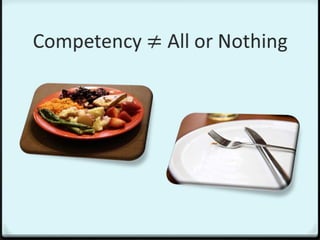
Decided on an Issue-by-Issue basis
Fully
            Competent


 Not Competent to Manage Financial Affairs


    Not Competent to Enter into Contracts


Not Competent to Make Certain Medical Decisions


               Not Competent to Sign Will


     Not Competent
       to Decide
      Care Needs
1940


Fully Competent on Every Issue
         Imaginable
2000


Fully Competent, but Depressed
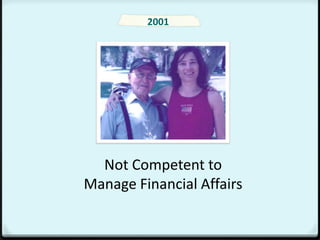
2001


  Not Competent to
Manage Financial Affairs
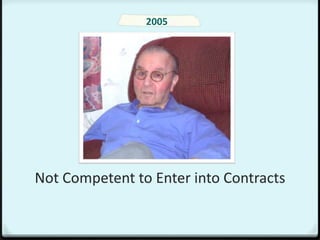
2005


Not Competent to Enter into Contracts
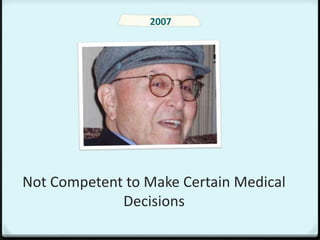
2007


Not Competent to Make Certain Medical
             Decisions
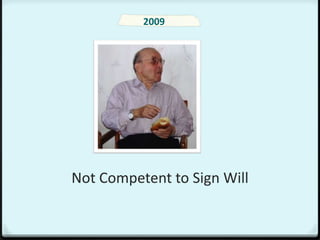
2009


Not Competent to Sign Will
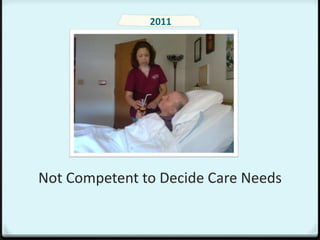
2011


Not Competent to Decide Care Needs
Legal Test for Competency
        Not that clear
A Better Idea…
0 Make plans for the future while you’re still competent


0 Execute a power of attorney
0 Execute an Advance Health Care Directive
0 Establish a trust


0 Save time and money and control your future!
Welcome to the Legal World
Learn what’s involved in filing for a conservatorship
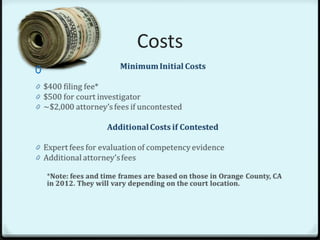
Expensive
Costs
0
Ongoing Costs

           Professional fiduciary’s fees

0 Range from $75 to $125 per hour
0 Court has discretion to award less
0 Paid from the estate
Time Consuming
Time
0 If uncontested—about 6-8 weeks in Orange County


0 If contested—about one year to hearing


0 Can get temporary conservatorship within 5 days if
 can prove irreparable harm
Types of Conservatorships
0 Probate: for a person who court finds to be
 incompetent; in emergency may get a temporary
 conservatorship

0 LPS (Lanterman Petris Short): for severe mental
 illness; not for dementia

0 Limited: for developmentally disabled
Probate Conservatorships
                Some Important Facts

0 Court must find the person legally “incompetent”


0 May be incompetent to handle finances, but
 competent to make medical decisions

0 “Least restrictive environment”
Legalese Translated
Conservatorship
  0 A court process which results in an order appointing a
   responsible person to make certain decisions for
   someone who can no longer do so
Conservator
  0 The person appointed by a court to manage the
   incompetent person’s affairs
Conservatee
  0 The person who the court has determined is
   incompetent and needs another to manage his/her
   affairs
Who May File a
      Conservatorship Case?
0 Typically filed by family or professional fiduciary ,
 (must be bondable if for estate) but

0 “any other interested person or friend” may file,
 except

0 A creditor may not file
Two Types of Conservatorships
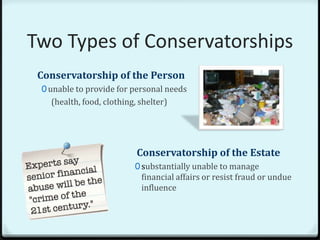
 Conservatorship of the Person
 0 unable to provide for personal needs
   (health, food, clothing, shelter)


                           Conservatorship of the Estate
                          0 substantially unable to manage
                            financial affairs or resist fraud or undue
                            influence
Conservatorship Steps
0 Hire a lawyer
0 File a petition with the court
0 File the required supporting documents
0 Have a physician complete a capacity declaration
0 Talk to a court investigator
0 Attend a competency hearing
Court Investigator
           Court Social Worker’s duties

0 Make sure there’s a need for a conservator
0 Make sure the proposed conservator is qualified
0 Determine if anyone will object
Law Presumes Competency
     Extra protections for proposed conservatee

0 Standard of proof is higher than in a typical civil case (clear
  and convincing evidence)

0 Entitled to have an attorney appointed by the court

0 Petitioner must prove that a conservatorship is the “least
  restrictive environment” (no other alternative)

0 Proof of a mental disorder alone not sufficient

0 Right to demand a jury trial
General Competency Test
A person lacks capacity to make a decision unless
she can communicate the decision and
understand and appreciate all of the following:

  0 The rights, duties and responsibilities created by or
    affected by the decision
  0 The probable consequences for the decision maker and
    persons affected by the decision
  0 The significant, risks, benefits and reasonable alternatives
    involved in the decision
Must Prove a Deficit
in at least one of the following mental functions
and evidence of a correlation between the
deficit(s) and the decision or acts in question:

  1. Alertness and attention
  2. Information processing
  3. Thought processes/disorders
  4. Ability to modulate mood and affect
Effect of the Deficit
o Must be a correlation between the deficit(s)
  and the decision or acts in question

o Must significantly impair person’s ability to
  understand and appreciate the consequences of
  his/her actions with regard to the type of act or
  decision in question

o Court takes into consideration the severity,
  frequency and duration of the deficit(s)
Competency Evidence
0 Capacity Declaration from physician
0 Report from court investigator
0 Confidential Supplemental Information filed with
  petition
0 Forensic reports, if necessary
0 Possible testimony given by proposed conservatee
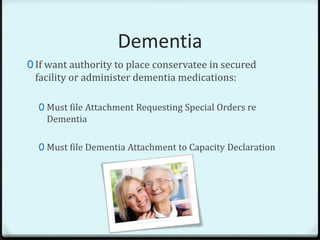
Dementia
0 If want authority to place conservatee in secured
 facility or administer dementia medications:

  0 Must file Attachment Requesting Special Orders re
    Dementia

  0 Must file Dementia Attachment to Capacity Declaration
Capacity to Consent to Medical
          Treatment
           Requires proof of the following:
0 Respond intelligently to medical treatment
0 Rationally participate in treatment
0 Understand all of the following:
  1. Nature and seriousness of the illness
  2. Nature of recommended treatment
  3. Benefits and risks of treatment or lack of treatment
  4. Risks of reasonable alternative treatments
Orders re Medical Treatment
0 Must be separately requested
0 Must be supported by a physician’s capacity
 declaration
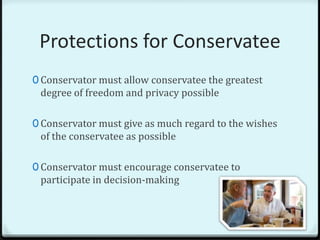
Protections for Conservatee
0 Conservator must allow conservatee the greatest
 degree of freedom and privacy possible

0 Conservator must give as much regard to the wishes
 of the conservatee as possible

0 Conservator must encourage conservatee to
 participate in decision-making
Rights Retained by Conservatee
0 To be represented by an attorney
0 Ask judge to replace conservator
0 Ask judge to end conservatorship
0 Make or change will
0 Directly receive and control salary
0 Control an allowance


                  And there’s more….
More Rights of Conservatee
    Unless right has been limited or taken away by court

0 Receive personal mail
0 Vote
0 Marry or take domestic partner
0 Make own medical decisions
0 Enter into transactions for necessities of life for
  self, children, spouse
0 Engage in activities permitted by court
How Courts Determine Legal Competency

How Courts Determine Legal Competency

  • 1.
    How Do CourtsDecide Legal Competency? Presenter: Lorie Eber, JD, Gerontologist, Certified Personal Trainer  Keynote Speaker on Healthy Living, Healthy Aging, Aging-in-Place & Elder Care  Instructor of Gerontology, Coastline Community College  Boomer Blogger on Health and Aging  Website: AgingBeatsTheAlternative.com
  • 2.
    My Dad 0 Inthis presentation, I use the example of my Dad, who is 93 years-old and has been suffering from vascular dementia for 10+ years, to explain how courts determine legal competency.
  • 3.
  • 4.
    Legal Competency Decided onan Issue-by-Issue basis
  • 5.
    Fully Competent Not Competent to Manage Financial Affairs Not Competent to Enter into Contracts Not Competent to Make Certain Medical Decisions Not Competent to Sign Will Not Competent to Decide Care Needs
  • 6.
    1940 Fully Competent onEvery Issue Imaginable
  • 7.
  • 8.
    2001 NotCompetent to Manage Financial Affairs
  • 9.
    2005 Not Competent toEnter into Contracts
  • 10.
    2007 Not Competent toMake Certain Medical Decisions
  • 11.
  • 12.
    2011 Not Competent toDecide Care Needs
  • 14.
    Legal Test forCompetency Not that clear
  • 15.
    A Better Idea… 0Make plans for the future while you’re still competent 0 Execute a power of attorney 0 Execute an Advance Health Care Directive 0 Establish a trust 0 Save time and money and control your future!
  • 16.
    Welcome to theLegal World Learn what’s involved in filing for a conservatorship
  • 17.
  • 18.
  • 19.
    Ongoing Costs Professional fiduciary’s fees 0 Range from $75 to $125 per hour 0 Court has discretion to award less 0 Paid from the estate
  • 20.
  • 21.
    Time 0 If uncontested—about6-8 weeks in Orange County 0 If contested—about one year to hearing 0 Can get temporary conservatorship within 5 days if can prove irreparable harm
  • 22.
    Types of Conservatorships 0Probate: for a person who court finds to be incompetent; in emergency may get a temporary conservatorship 0 LPS (Lanterman Petris Short): for severe mental illness; not for dementia 0 Limited: for developmentally disabled
  • 23.
    Probate Conservatorships Some Important Facts 0 Court must find the person legally “incompetent” 0 May be incompetent to handle finances, but competent to make medical decisions 0 “Least restrictive environment”
  • 24.
    Legalese Translated Conservatorship 0 A court process which results in an order appointing a responsible person to make certain decisions for someone who can no longer do so Conservator 0 The person appointed by a court to manage the incompetent person’s affairs Conservatee 0 The person who the court has determined is incompetent and needs another to manage his/her affairs
  • 25.
    Who May Filea Conservatorship Case? 0 Typically filed by family or professional fiduciary , (must be bondable if for estate) but 0 “any other interested person or friend” may file, except 0 A creditor may not file
  • 26.
    Two Types ofConservatorships Conservatorship of the Person 0 unable to provide for personal needs (health, food, clothing, shelter) Conservatorship of the Estate 0 substantially unable to manage financial affairs or resist fraud or undue influence
  • 27.
    Conservatorship Steps 0 Hirea lawyer 0 File a petition with the court 0 File the required supporting documents 0 Have a physician complete a capacity declaration 0 Talk to a court investigator 0 Attend a competency hearing
  • 28.
    Court Investigator Court Social Worker’s duties 0 Make sure there’s a need for a conservator 0 Make sure the proposed conservator is qualified 0 Determine if anyone will object
  • 29.
    Law Presumes Competency Extra protections for proposed conservatee 0 Standard of proof is higher than in a typical civil case (clear and convincing evidence) 0 Entitled to have an attorney appointed by the court 0 Petitioner must prove that a conservatorship is the “least restrictive environment” (no other alternative) 0 Proof of a mental disorder alone not sufficient 0 Right to demand a jury trial
  • 30.
    General Competency Test Aperson lacks capacity to make a decision unless she can communicate the decision and understand and appreciate all of the following: 0 The rights, duties and responsibilities created by or affected by the decision 0 The probable consequences for the decision maker and persons affected by the decision 0 The significant, risks, benefits and reasonable alternatives involved in the decision
  • 31.
    Must Prove aDeficit in at least one of the following mental functions and evidence of a correlation between the deficit(s) and the decision or acts in question: 1. Alertness and attention 2. Information processing 3. Thought processes/disorders 4. Ability to modulate mood and affect
  • 32.
    Effect of theDeficit o Must be a correlation between the deficit(s) and the decision or acts in question o Must significantly impair person’s ability to understand and appreciate the consequences of his/her actions with regard to the type of act or decision in question o Court takes into consideration the severity, frequency and duration of the deficit(s)
  • 33.
    Competency Evidence 0 CapacityDeclaration from physician 0 Report from court investigator 0 Confidential Supplemental Information filed with petition 0 Forensic reports, if necessary 0 Possible testimony given by proposed conservatee
  • 34.
    Dementia 0 If wantauthority to place conservatee in secured facility or administer dementia medications: 0 Must file Attachment Requesting Special Orders re Dementia 0 Must file Dementia Attachment to Capacity Declaration
  • 35.
    Capacity to Consentto Medical Treatment Requires proof of the following: 0 Respond intelligently to medical treatment 0 Rationally participate in treatment 0 Understand all of the following: 1. Nature and seriousness of the illness 2. Nature of recommended treatment 3. Benefits and risks of treatment or lack of treatment 4. Risks of reasonable alternative treatments
  • 36.
    Orders re MedicalTreatment 0 Must be separately requested 0 Must be supported by a physician’s capacity declaration
  • 37.
    Protections for Conservatee 0Conservator must allow conservatee the greatest degree of freedom and privacy possible 0 Conservator must give as much regard to the wishes of the conservatee as possible 0 Conservator must encourage conservatee to participate in decision-making
  • 38.
    Rights Retained byConservatee 0 To be represented by an attorney 0 Ask judge to replace conservator 0 Ask judge to end conservatorship 0 Make or change will 0 Directly receive and control salary 0 Control an allowance And there’s more….
  • 39.
    More Rights ofConservatee Unless right has been limited or taken away by court 0 Receive personal mail 0 Vote 0 Marry or take domestic partner 0 Make own medical decisions 0 Enter into transactions for necessities of life for self, children, spouse 0 Engage in activities permitted by court

Editor's Notes