

LearningWorks
for Kids
Teaching Executive Functioning Skills
Using Google Tools and Apps
Randy Kulman
Email: randy@learningworks for kids.com
Twitter: @rkulman
Pinterest: pinterest.com/rkulman
EdTechTeam New England Summit
Take-Aways
• Brief review of Executive Functions (EFs) /
Thinking Skills
• Why EFs are crucial, particularly to kids with
ADHD, LD, ASD, and Alternative Learners
• How games, apps And Google Tools can
support, practice, and help acquire EFs
• Why we want to use Google Tools and apps to
teach EFs with Alternative Learners
• Why games and apps are not enough
• How to transfer game –based skills to real world
activities
What are Executive Functions?
• Cognitive capacities that enable independent,
purposeful, goal-directed behavior
• The CEO or the conductor of
the brain
• A collection of brain processes
that guide thought and behavior
• Located primarily in the prefrontal
cortex but involving other neural
networks
Executive Functions in Daily Life
• Infancy; when a child can keep an object in
mind while playing hide-and-seek
• Preschoolers; learning to inhibit behavior such
as not touching a hot stove and developing
basic social skills
• Adolescence; learning to develop planning,
emotional regulation, and organizational skills
• EFs develop slowly in many psychiatric
disorders, and in particular ADHD
Dawson and Guare Model of
Executive/Thinking Skills
Focus Task Persistence
Sustained attention
Task initiation
Self-Awareness Metacognition
Social thinking
Self-Control Regulation of affect
Response inhibition
Working Memory
Organization
Planning
Flexibility
Time Management
Executive/Thinking Skills
in Daily Life
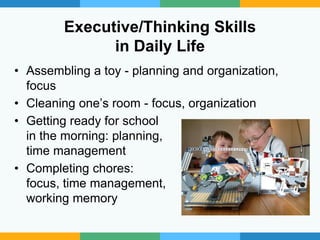
• Assembling a toy - planning and organization,
focus
• Cleaning one’s room - focus, organization
• Getting ready for school
in the morning: planning,
time management
• Completing chores:
focus, time management,
working memory
Executive/Thinking Skills
in School
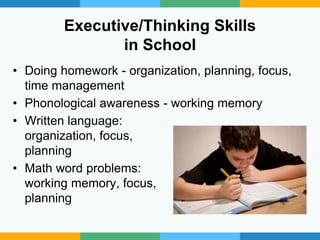
• Doing homework - organization, planning, focus,
time management
• Phonological awareness - working memory
• Written language:
organization, focus,
planning
• Math word problems:
working memory, focus,
planning
The Importance of Teaching
Thinking and Executive Skills
• Preschoolers who learn EF’s perform better
academically (Diamond, McClelland)
• Improving working memory enhances reading,
reduces ADHD symptoms (Cogmed research)
• Self Control enhances future life success
(Marshmallow test)
• Protects children from mental health issues
Train Your Brain for Success
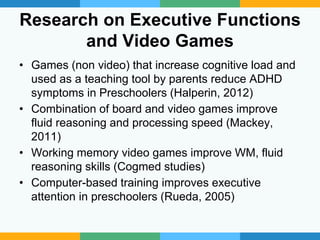
Research on Executive Functions
and Video Games
• Games (non video) that increase cognitive load and
used as a teaching tool by parents reduce ADHD
symptoms in Preschoolers (Halperin, 2012)
• Combination of board and video games improve
fluid reasoning and processing speed (Mackey,
2011)
• Working memory video games improve WM, fluid
reasoning skills (Cogmed studies)
• Computer-based training improves executive
attention in preschoolers (Rueda, 2005)
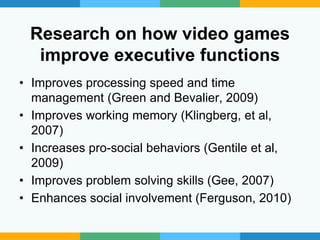
Research on how video games
improve executive functions
• Improves processing speed and time
management (Green and Bevalier, 2009)
• Improves working memory (Klingberg, et al,
2007)
• Increases pro-social behaviors (Gentile et al,
2009)
• Improves problem solving skills (Gee, 2007)
• Enhances social involvement (Ferguson, 2010)
Why use video games and digital media to help
Alternative Learners?
Kids with Learning or
Attention Difficulties
Video Games and Digital Media
May become easily bored and
unable to sustain attention
Good video games and digital media are
often multi modal, requiring ever-changing
skills and employing video, sounds, words,
and actions that help keep kids interested
and engaged.
Often require immediate
reinforcement or consequence to
stay focused on a task.
Video games provide clear and immediate
feedback, constantly letting the player know
what he is doing wrong, and what he is doing
right.
Often require that their body or
mind to be actively engaged.
Video games and digital media are extremely
engaging and many require physical and
cognitive involvement.
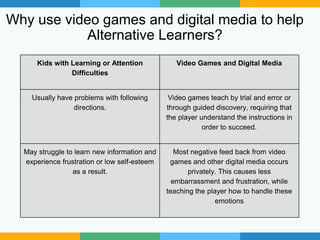
Why use video games and digital media to help
Alternative Learners?
Kids with Learning or Attention
Difficulties
Video Games and Digital Media
Usually have problems with following
directions.
Video games teach by trial and error or
through guided discovery, requiring that
the player understand the instructions in
order to succeed.
May struggle to learn new information and
experience frustration or low self-esteem
as a result.
Most negative feed back from video
games and other digital media occurs
privately. This causes less
embarrassment and frustration, while
teaching the player how to handle these
emotions
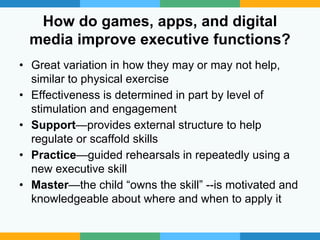
How do games, apps, and digital
media improve executive functions?
• Great variation in how they may or may not help,
similar to physical exercise
• Effectiveness is determined in part by level of
stimulation and engagement
• Support—provides external structure to help
regulate or scaffold skills
• Practice—guided rehearsals in repeatedly using a
new executive skill
• Master—the child “owns the skill” --is motivated and
knowledgeable about where and when to apply it
How do digital technologies
teach executive functions?
The LearningWorks for Kids model:
• Games as a vehicle for "engaging the gears" of a
child's brain
• Opportunities for children to practice an executive skill
in a fun and engaging fashion
• A teaching opportunity for parents, teachers, and
clinicians
• An opportunity to detect, reflect, and connect on the
use of executive skills
• A "new literacy," an understanding of ways of doing,
thinking, and valuing things in the context of
relationships and school practices (James Paul Gee)
How well do game based skills
transfer to the real world?
• Game play alone results in modest
improvements in real-world executive skills
• Children with learning and attention problems
have problems in generalizing strategies
• Kids like to talk about playing video games and
may be willing to learn from that
• Games prompt partnering and motivation to
learn executive skills
• Practice and rehearsal of executive skills
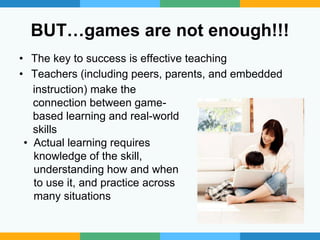
BUT…games are not enough!!!
• The key to success is effective teaching
• Teachers (including peers, parents, and embedded
instruction) make the
connection between game-
based learning and real-world
skills
• Actual learning requires
knowledge of the skill,
understanding how and when
to use it, and practice across
many situations
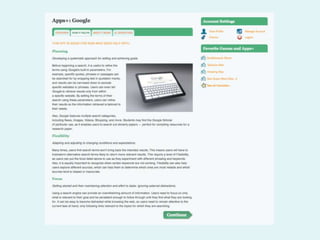
Executive Skills Questionnaire
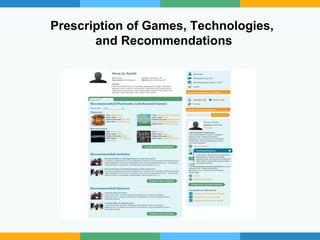
Prescription of Games, Technologies,
and Recommendations
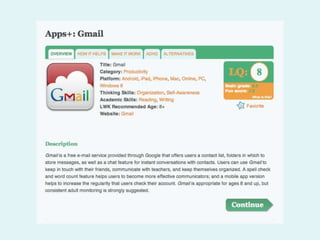
Quizzes and Assessments
Thank You
Randy Kulman, Ph.D
randy@learningworksforkids.com
@rkulman on Twitter
www.pinterest.com/rkulman
www.learningworksforkids.com

Teaching Executive Functioning Skills Using Google Tools and Apps

  • 1.
    LearningWorks for Kids Teaching ExecutiveFunctioning Skills Using Google Tools and Apps Randy Kulman Email: randy@learningworks for kids.com Twitter: @rkulman Pinterest: pinterest.com/rkulman EdTechTeam New England Summit
  • 2.
    Take-Aways • Brief reviewof Executive Functions (EFs) / Thinking Skills • Why EFs are crucial, particularly to kids with ADHD, LD, ASD, and Alternative Learners • How games, apps And Google Tools can support, practice, and help acquire EFs • Why we want to use Google Tools and apps to teach EFs with Alternative Learners • Why games and apps are not enough • How to transfer game –based skills to real world activities
  • 3.
    What are ExecutiveFunctions? • Cognitive capacities that enable independent, purposeful, goal-directed behavior • The CEO or the conductor of the brain • A collection of brain processes that guide thought and behavior • Located primarily in the prefrontal cortex but involving other neural networks
  • 4.
    Executive Functions inDaily Life • Infancy; when a child can keep an object in mind while playing hide-and-seek • Preschoolers; learning to inhibit behavior such as not touching a hot stove and developing basic social skills • Adolescence; learning to develop planning, emotional regulation, and organizational skills • EFs develop slowly in many psychiatric disorders, and in particular ADHD
  • 5.
    Dawson and GuareModel of Executive/Thinking Skills Focus Task Persistence Sustained attention Task initiation Self-Awareness Metacognition Social thinking Self-Control Regulation of affect Response inhibition Working Memory Organization Planning Flexibility Time Management
  • 6.
    Executive/Thinking Skills in DailyLife • Assembling a toy - planning and organization, focus • Cleaning one’s room - focus, organization • Getting ready for school in the morning: planning, time management • Completing chores: focus, time management, working memory
  • 7.
    Executive/Thinking Skills in School •Doing homework - organization, planning, focus, time management • Phonological awareness - working memory • Written language: organization, focus, planning • Math word problems: working memory, focus, planning
  • 8.
    The Importance ofTeaching Thinking and Executive Skills • Preschoolers who learn EF’s perform better academically (Diamond, McClelland) • Improving working memory enhances reading, reduces ADHD symptoms (Cogmed research) • Self Control enhances future life success (Marshmallow test) • Protects children from mental health issues
  • 9.
    Train Your Brainfor Success
  • 10.
    Research on ExecutiveFunctions and Video Games • Games (non video) that increase cognitive load and used as a teaching tool by parents reduce ADHD symptoms in Preschoolers (Halperin, 2012) • Combination of board and video games improve fluid reasoning and processing speed (Mackey, 2011) • Working memory video games improve WM, fluid reasoning skills (Cogmed studies) • Computer-based training improves executive attention in preschoolers (Rueda, 2005)
  • 11.
    Research on howvideo games improve executive functions • Improves processing speed and time management (Green and Bevalier, 2009) • Improves working memory (Klingberg, et al, 2007) • Increases pro-social behaviors (Gentile et al, 2009) • Improves problem solving skills (Gee, 2007) • Enhances social involvement (Ferguson, 2010)
  • 12.
    Why use videogames and digital media to help Alternative Learners? Kids with Learning or Attention Difficulties Video Games and Digital Media May become easily bored and unable to sustain attention Good video games and digital media are often multi modal, requiring ever-changing skills and employing video, sounds, words, and actions that help keep kids interested and engaged. Often require immediate reinforcement or consequence to stay focused on a task. Video games provide clear and immediate feedback, constantly letting the player know what he is doing wrong, and what he is doing right. Often require that their body or mind to be actively engaged. Video games and digital media are extremely engaging and many require physical and cognitive involvement.
  • 13.
    Why use videogames and digital media to help Alternative Learners? Kids with Learning or Attention Difficulties Video Games and Digital Media Usually have problems with following directions. Video games teach by trial and error or through guided discovery, requiring that the player understand the instructions in order to succeed. May struggle to learn new information and experience frustration or low self-esteem as a result. Most negative feed back from video games and other digital media occurs privately. This causes less embarrassment and frustration, while teaching the player how to handle these emotions
  • 14.
    How do games,apps, and digital media improve executive functions? • Great variation in how they may or may not help, similar to physical exercise • Effectiveness is determined in part by level of stimulation and engagement • Support—provides external structure to help regulate or scaffold skills • Practice—guided rehearsals in repeatedly using a new executive skill • Master—the child “owns the skill” --is motivated and knowledgeable about where and when to apply it
  • 15.
    How do digitaltechnologies teach executive functions? The LearningWorks for Kids model: • Games as a vehicle for "engaging the gears" of a child's brain • Opportunities for children to practice an executive skill in a fun and engaging fashion • A teaching opportunity for parents, teachers, and clinicians • An opportunity to detect, reflect, and connect on the use of executive skills • A "new literacy," an understanding of ways of doing, thinking, and valuing things in the context of relationships and school practices (James Paul Gee)
  • 16.
    How well dogame based skills transfer to the real world? • Game play alone results in modest improvements in real-world executive skills • Children with learning and attention problems have problems in generalizing strategies • Kids like to talk about playing video games and may be willing to learn from that • Games prompt partnering and motivation to learn executive skills • Practice and rehearsal of executive skills
  • 17.
    BUT…games are notenough!!! • The key to success is effective teaching • Teachers (including peers, parents, and embedded instruction) make the connection between game- based learning and real-world skills • Actual learning requires knowledge of the skill, understanding how and when to use it, and practice across many situations
  • 28.
  • 29.
    Prescription of Games,Technologies, and Recommendations
  • 30.
  • 31.
    Thank You Randy Kulman,Ph.D randy@learningworksforkids.com @rkulman on Twitter www.pinterest.com/rkulman www.learningworksforkids.com