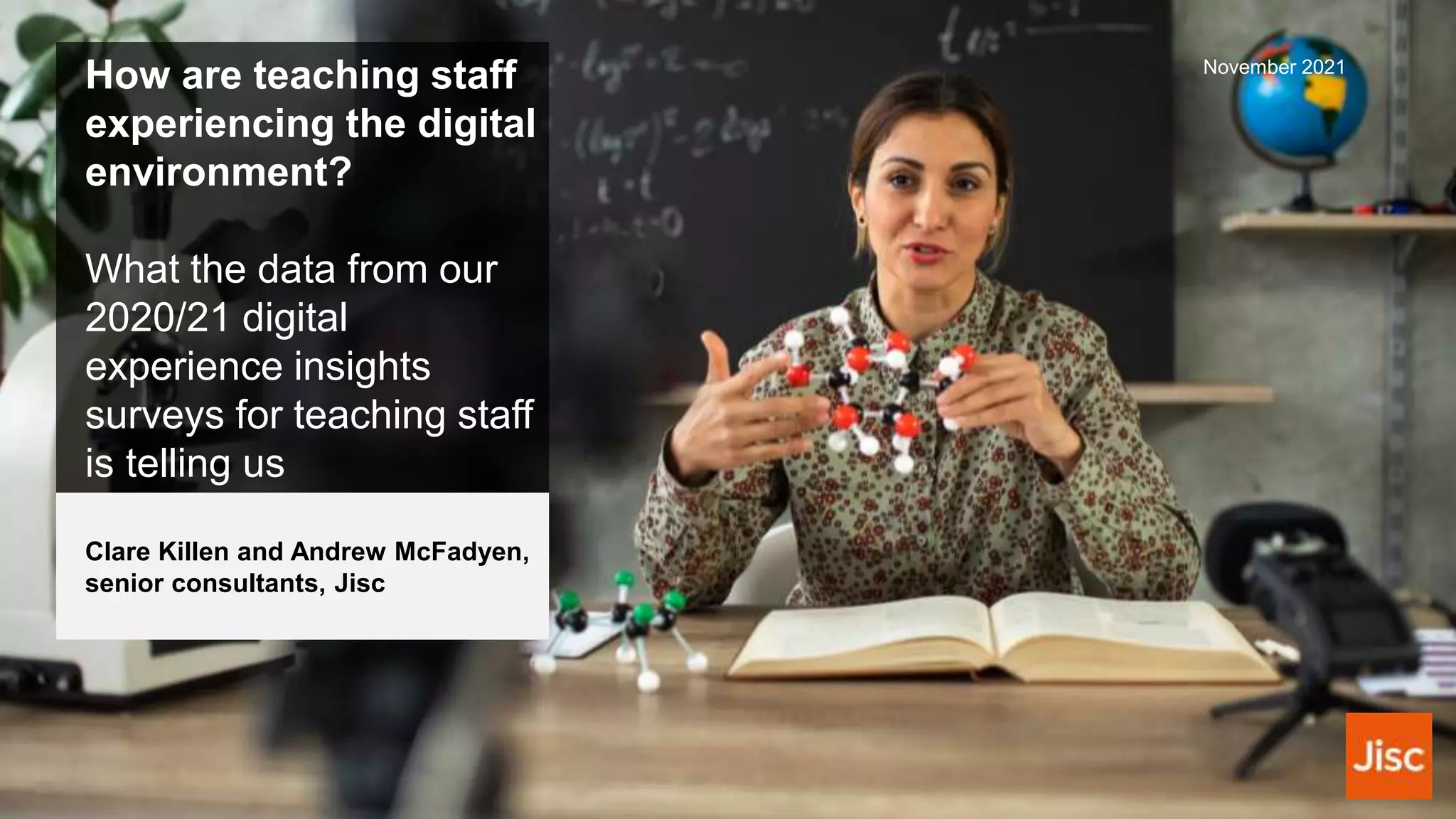
How are teaching staff
experiencing the digital
environment?
What the data from our
2020/21 digital
experience insights
surveys for teaching staff
is telling us
November 2021
Clare Killen and Andrew McFadyen,
senior consultants, Jisc
See the digital experience through the eyes
of your students and staff
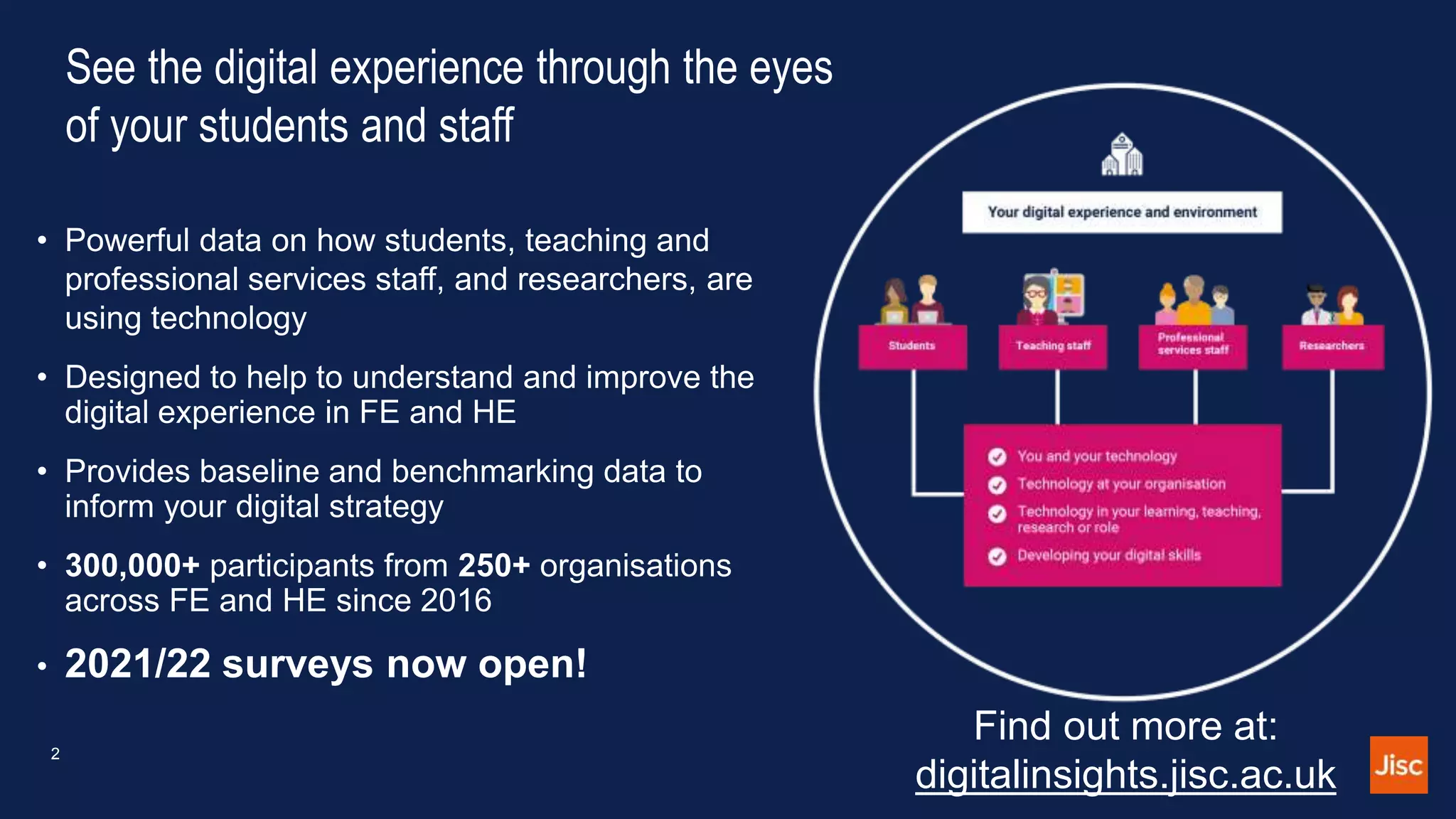
• Powerful data on how students, teaching and
professional services staff, and researchers, are
using technology
• Designed to help to understand and improve the
digital experience in FE and HE
• Provides baseline and benchmarking data to
inform your digital strategy
• 300,000+ participants from 250+ organisations
across FE and HE since 2016
• 2021/22 surveys now open!
2
Find out more at:
digitalinsights.jisc.ac.uk
Hearing what teaching staff have to say
(October 2020 – July 2021 – focus on learning teaching)
6,551 responses from teaching staff to our
2020/21 digital experience insights surveys
• 2,822 FE teaching staff from 29 colleges
across the UK
• 3,729 HE teaching staff from 24 universities
and one college across the UK
Full reports available from:
https://digitalinsights.jisc.ac.uk/reports-and-briefings/our-
reports/
3
Theme one:
you and your
current teaching
situation
How and where were teachers teaching?
FE
How
• 31% physically on site
• 30% a mix of physically on site and
online teaching
• 39% online teaching (on your own/ with
others in your department)
Where
• 75% at home
• 25% on campus in your office, work
spaces, libraries etc
• 11% had not been teaching online
HE
How
• 2% physically on site
• 16% a mix of physically on site and
online teaching
• 82% online teaching (on your own/with
others in your department)
Where
• 94% at home
• 13% on campus in your office, work
spaces, libraries etc
• 2% had not been teaching online
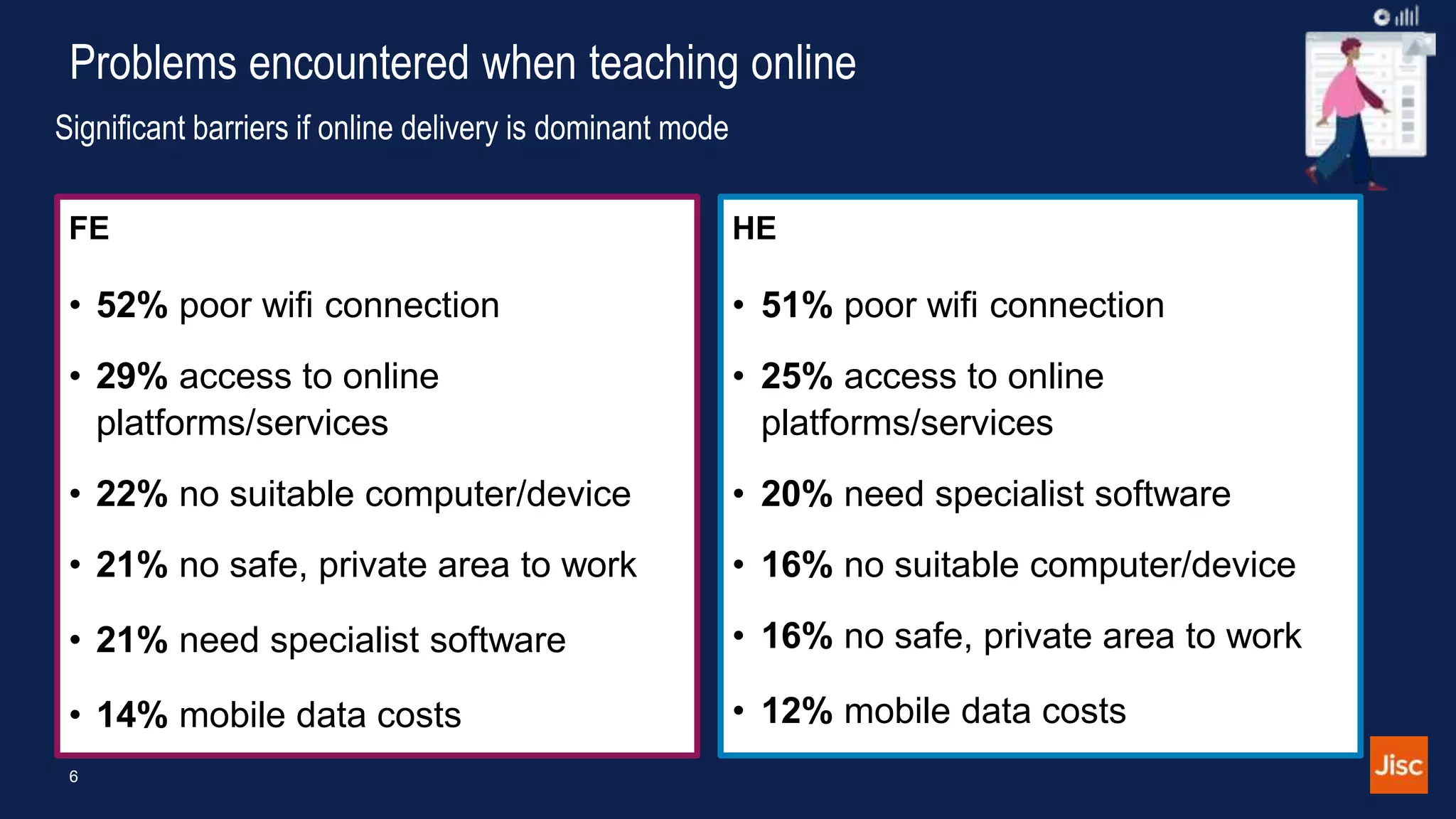
Problems encountered when teaching online
Significant barriers if online delivery is dominant mode
FE
• 52% poor wifi connection
• 29% access to online
platforms/services
• 22% no suitable computer/device
• 21% no safe, private area to work
• 21% need specialist software
• 14% mobile data costs
HE
• 51% poor wifi connection
• 25% access to online
platforms/services
• 20% need specialist software
• 16% no suitable computer/device
• 16% no safe, private area to work
• 12% mobile data costs
6
Theme two:
digital platforms
and services
at your
organisation
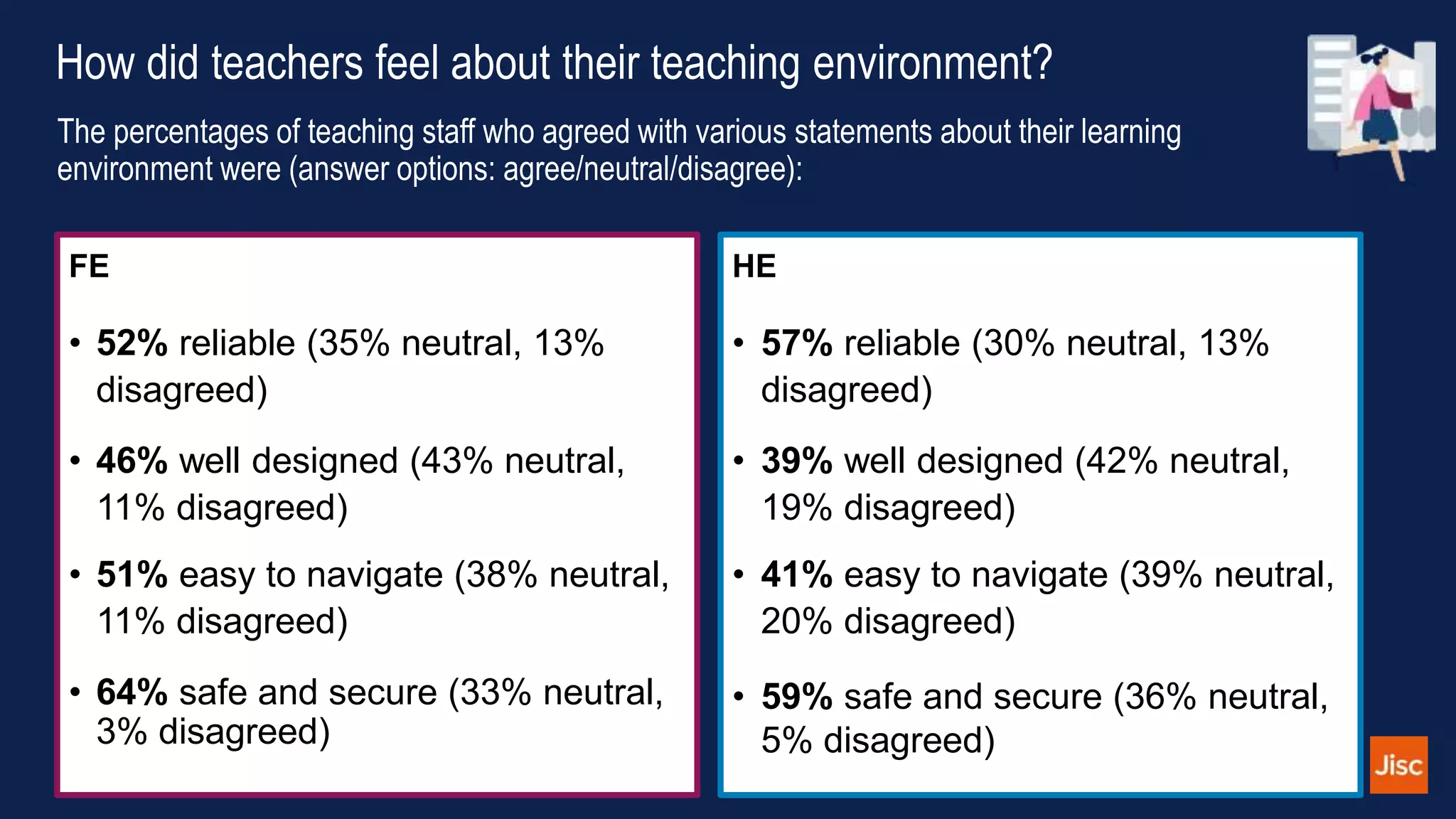
How did teachers feel about their teaching environment?
FE
• 52% reliable (35% neutral, 13%
disagreed)
• 46% well designed (43% neutral,
11% disagreed)
• 51% easy to navigate (38% neutral,
11% disagreed)
• 64% safe and secure (33% neutral,
3% disagreed)
HE
• 57% reliable (30% neutral, 13%
disagreed)
• 39% well designed (42% neutral,
19% disagreed)
• 41% easy to navigate (39% neutral,
20% disagreed)
• 59% safe and secure (36% neutral,
5% disagreed)
The percentages of teaching staff who agreed with various statements about their learning
environment were (answer options: agree/neutral/disagree):
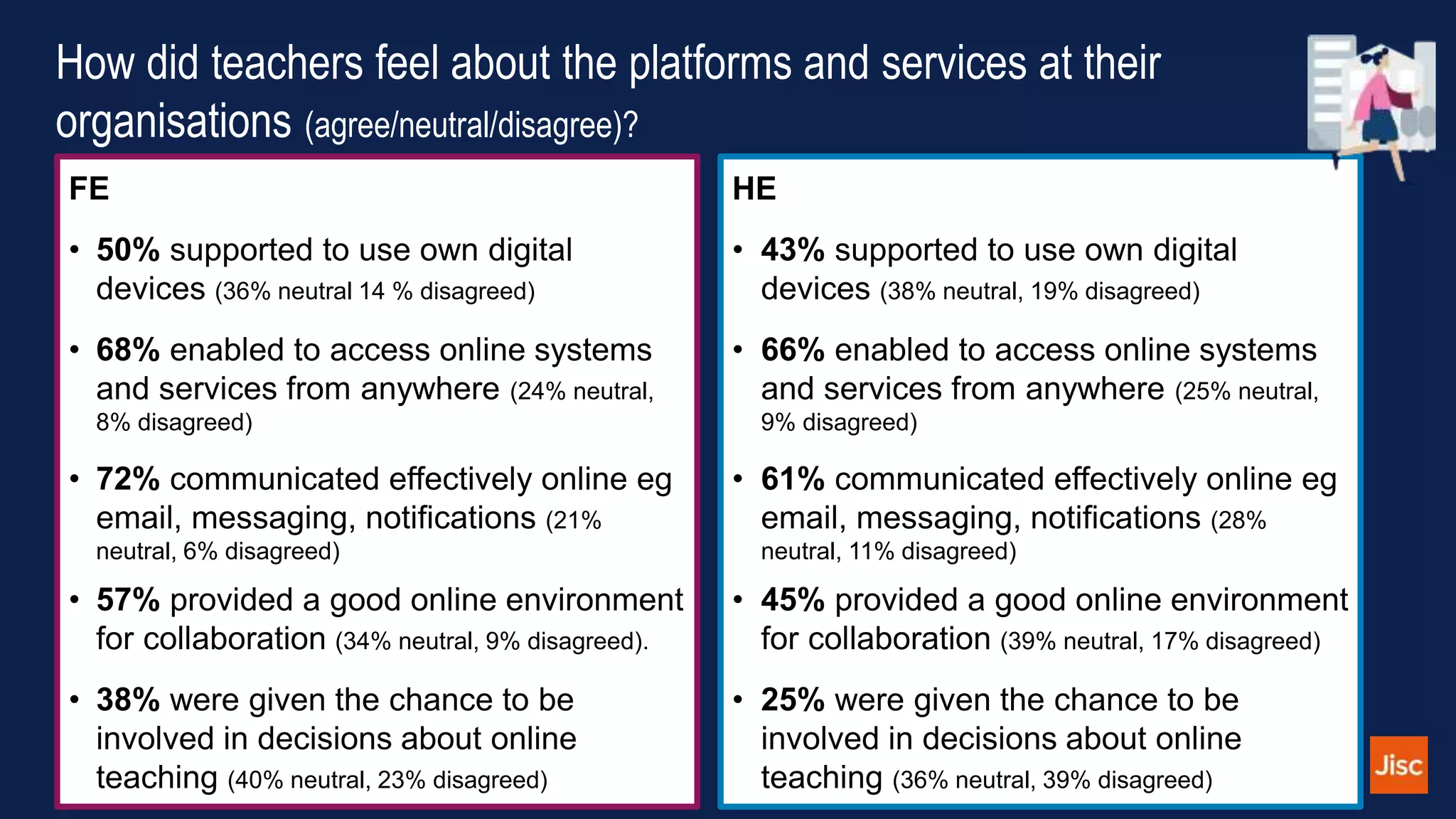
How did teachers feel about the platforms and services at their
organisations (agree/neutral/disagree)?
FE
• 50% supported to use own digital
devices (36% neutral 14 % disagreed)
• 68% enabled to access online systems
and services from anywhere (24% neutral,
8% disagreed)
• 72% communicated effectively online eg
email, messaging, notifications (21%
neutral, 6% disagreed)
• 57% provided a good online environment
for collaboration (34% neutral, 9% disagreed).
• 38% were given the chance to be
involved in decisions about online
teaching (40% neutral, 23% disagreed)
HE
• 43% supported to use own digital
devices (38% neutral, 19% disagreed)
• 66% enabled to access online systems
and services from anywhere (25% neutral,
9% disagreed)
• 61% communicated effectively online eg
email, messaging, notifications (28%
neutral, 11% disagreed)
• 45% provided a good online environment
for collaboration (39% neutral, 17% disagreed)
• 25% were given the chance to be
involved in decisions about online
teaching (36% neutral, 39% disagreed)
Theme three:
technology in
your teaching
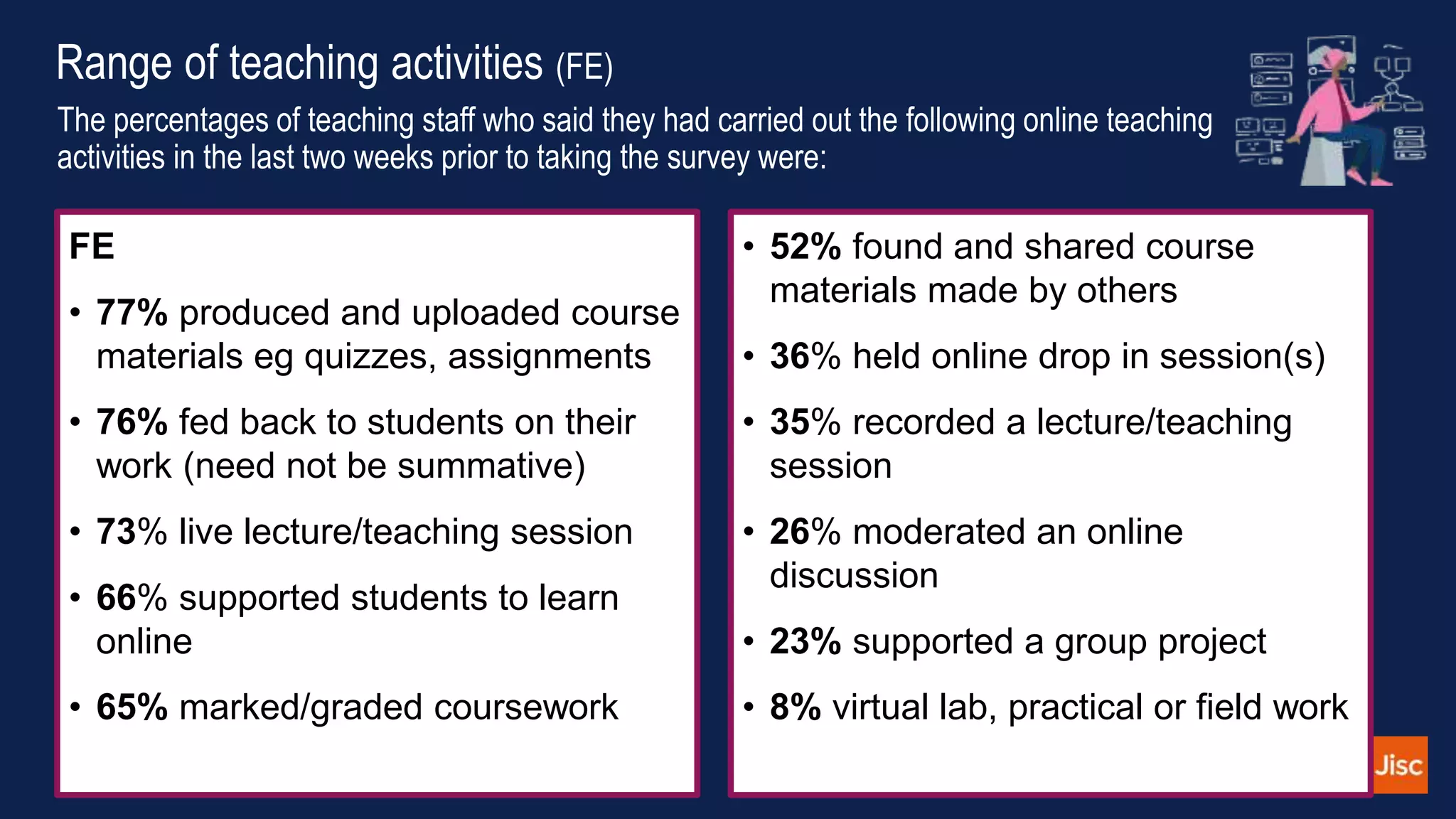
Range of teaching activities (FE)
The percentages of teaching staff who said they had carried out the following online teaching
activities in the last two weeks prior to taking the survey were:
FE
• 77% produced and uploaded course
materials eg quizzes, assignments
• 76% fed back to students on their
work (need not be summative)
• 73% live lecture/teaching session
• 66% supported students to learn
online
• 65% marked/graded coursework
• 52% found and shared course
materials made by others
• 36% held online drop in session(s)
• 35% recorded a lecture/teaching
session
• 26% moderated an online
discussion
• 23% supported a group project
• 8% virtual lab, practical or field work
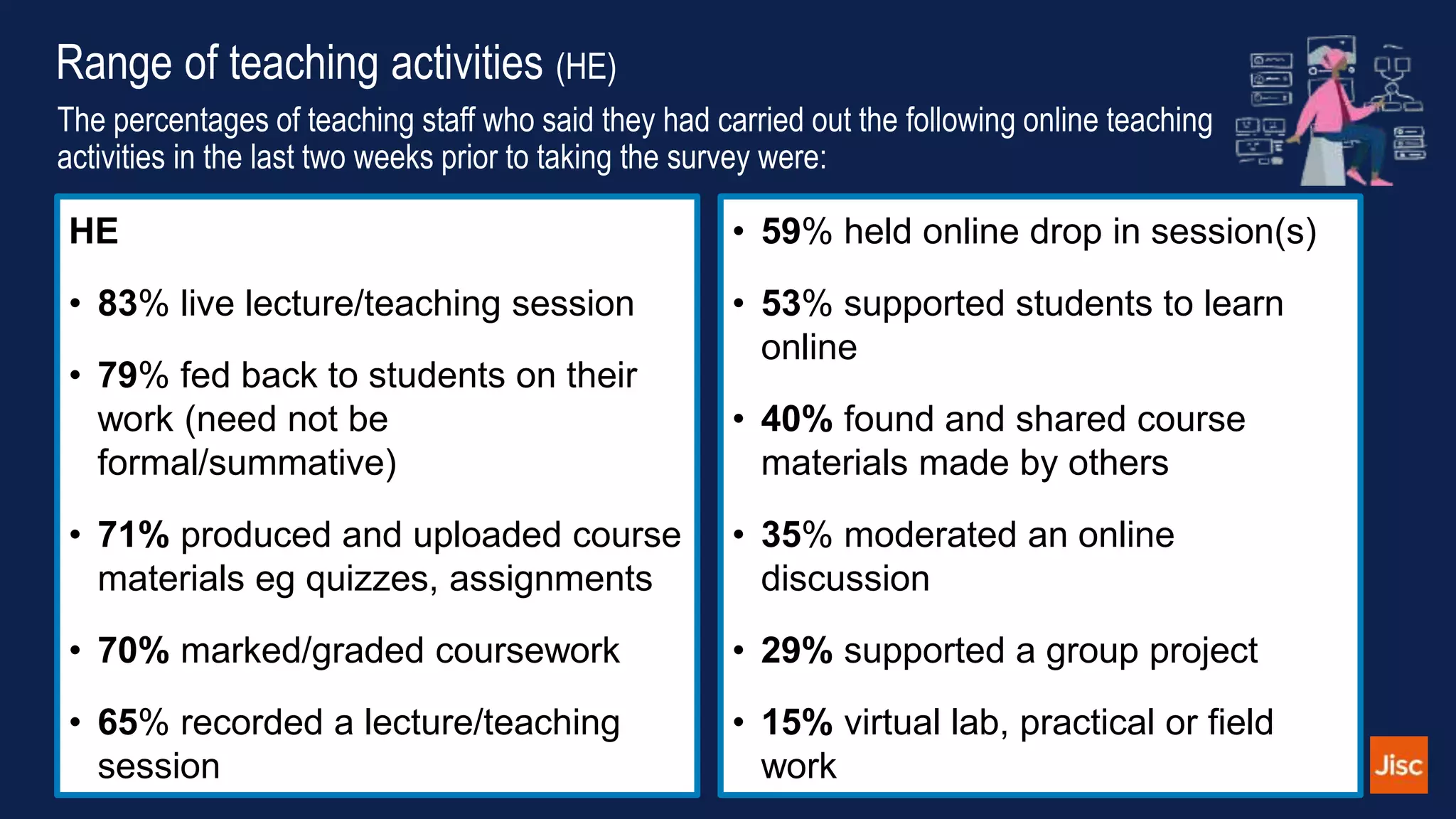
Range of teaching activities (HE)
The percentages of teaching staff who said they had carried out the following online teaching
activities in the last two weeks prior to taking the survey were:
HE
• 83% live lecture/teaching session
• 79% fed back to students on their
work (need not be
formal/summative)
• 71% produced and uploaded course
materials eg quizzes, assignments
• 70% marked/graded coursework
• 65% recorded a lecture/teaching
session
• 59% held online drop in session(s)
• 53% supported students to learn
online
• 40% found and shared course
materials made by others
• 35% moderated an online
discussion
• 29% supported a group project
• 15% virtual lab, practical or field
work
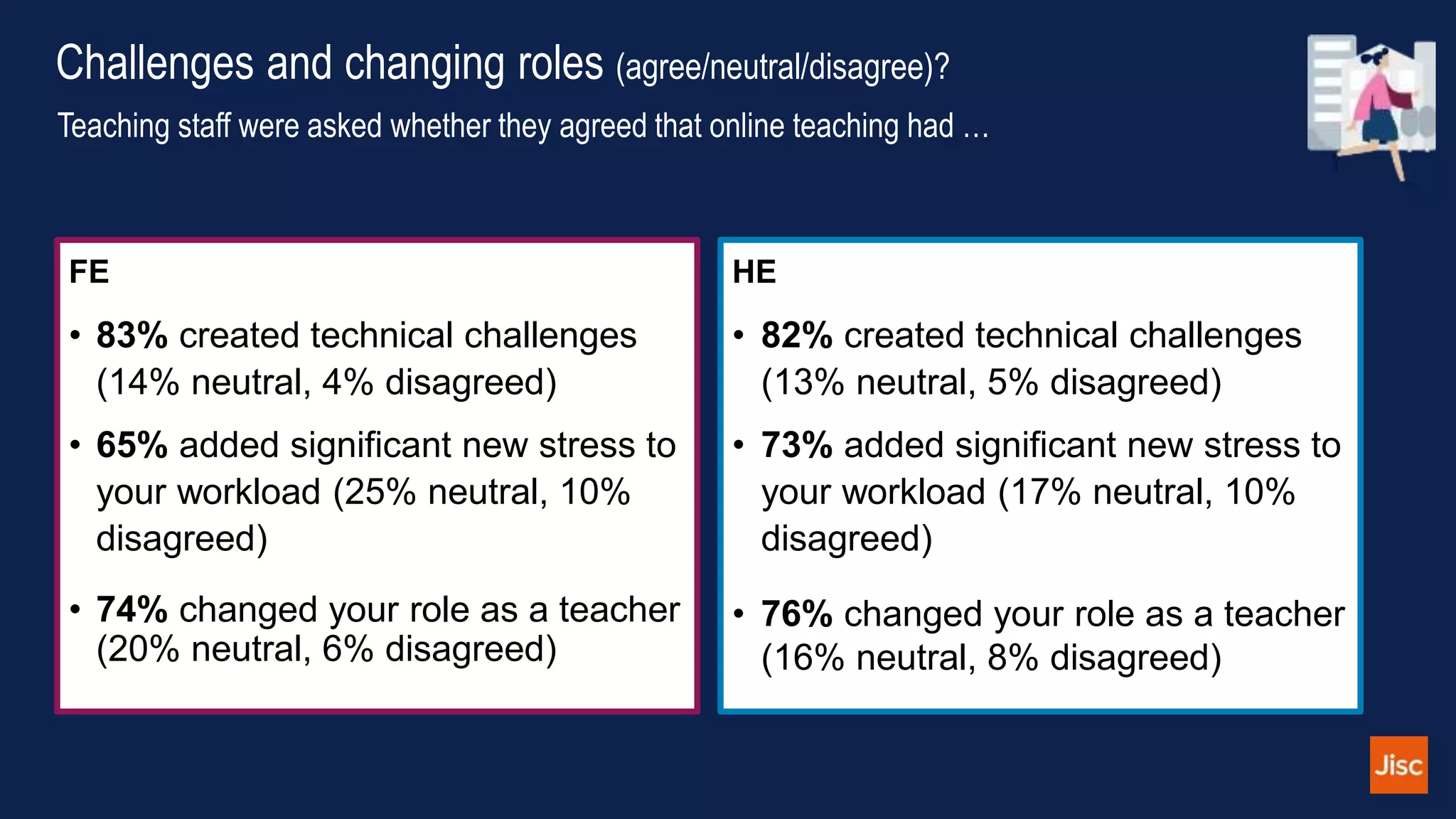
Challenges and changing roles (agree/neutral/disagree)?
FE
• 83% created technical challenges
(14% neutral, 4% disagreed)
• 65% added significant new stress to
your workload (25% neutral, 10%
disagreed)
• 74% changed your role as a teacher
(20% neutral, 6% disagreed)
HE
• 82% created technical challenges
(13% neutral, 5% disagreed)
• 73% added significant new stress to
your workload (17% neutral, 10%
disagreed)
• 76% changed your role as a teacher
(16% neutral, 8% disagreed)
Teaching staff were asked whether they agreed that online teaching had …
Theme four:
your digital
development
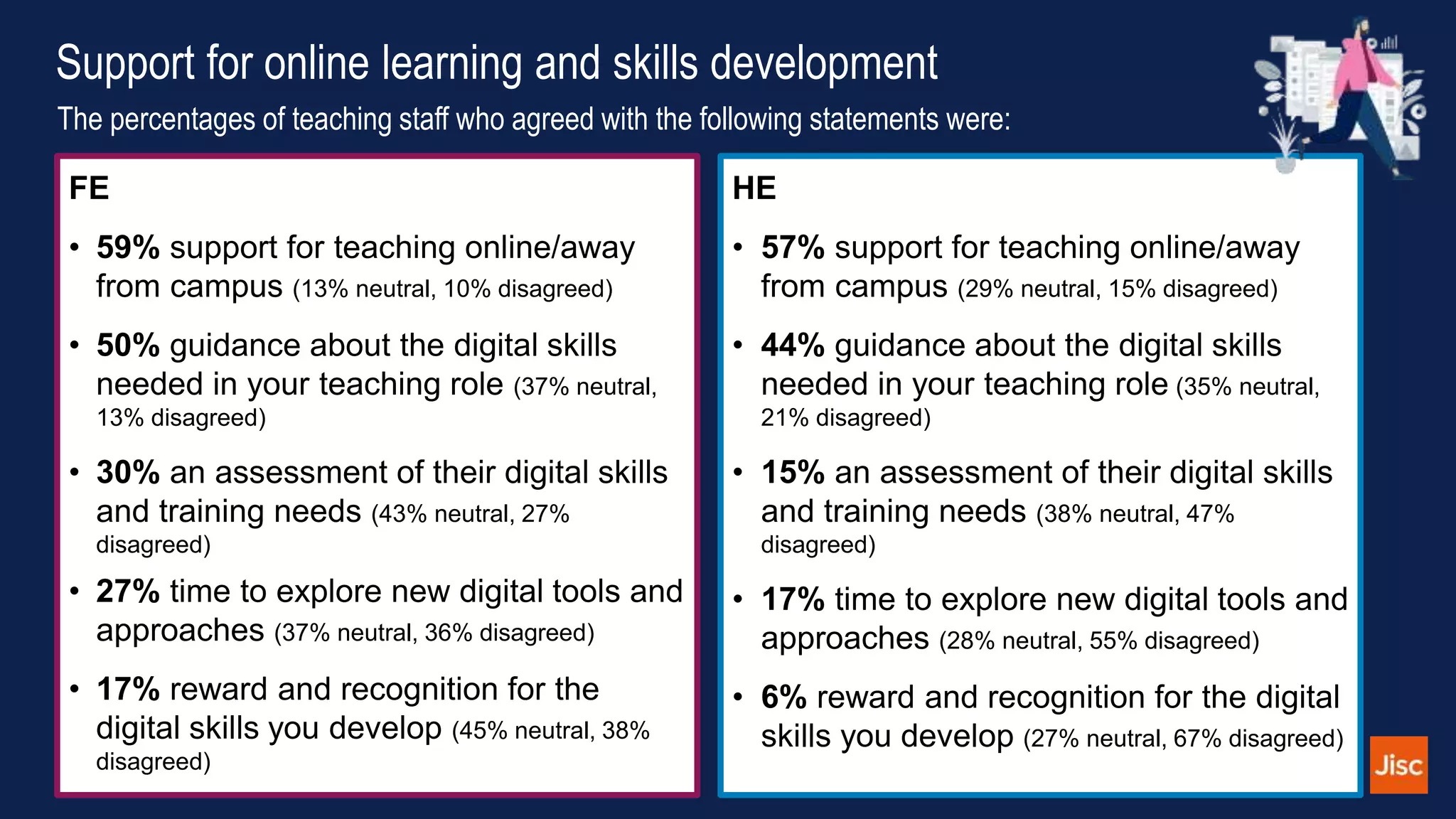
Support for online learning and skills development
FE
• 59% support for teaching online/away
from campus (13% neutral, 10% disagreed)
• 50% guidance about the digital skills
needed in your teaching role (37% neutral,
13% disagreed)
• 30% an assessment of their digital skills
and training needs (43% neutral, 27%
disagreed)
• 27% time to explore new digital tools and
approaches (37% neutral, 36% disagreed)
• 17% reward and recognition for the
digital skills you develop (45% neutral, 38%
disagreed)
HE
• 57% support for teaching online/away
from campus (29% neutral, 15% disagreed)
• 44% guidance about the digital skills
needed in your teaching role (35% neutral,
21% disagreed)
• 15% an assessment of their digital skills
and training needs (38% neutral, 47%
disagreed)
• 17% time to explore new digital tools and
approaches (28% neutral, 55% disagreed)
• 6% reward and recognition for the digital
skills you develop (27% neutral, 67% disagreed)
The percentages of teaching staff who agreed with the following statements were:
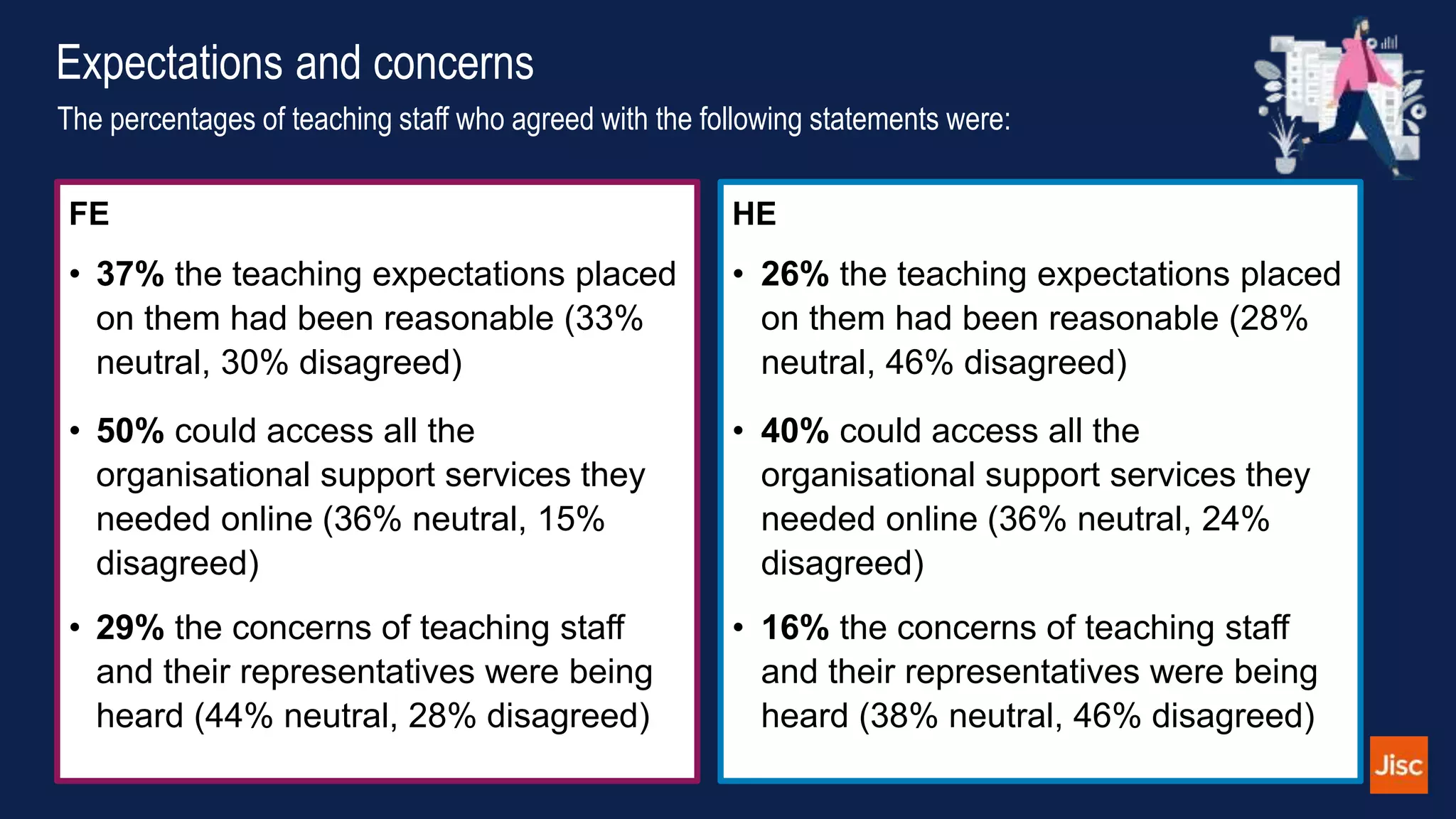
Expectations and concerns
FE
• 37% the teaching expectations placed
on them had been reasonable (33%
neutral, 30% disagreed)
• 50% could access all the
organisational support services they
needed online (36% neutral, 15%
disagreed)
• 29% the concerns of teaching staff
and their representatives were being
heard (44% neutral, 28% disagreed)
HE
• 26% the teaching expectations placed
on them had been reasonable (28%
neutral, 46% disagreed)
• 40% could access all the
organisational support services they
needed online (36% neutral, 24%
disagreed)
• 16% the concerns of teaching staff
and their representatives were being
heard (38% neutral, 46% disagreed)
The percentages of teaching staff who agreed with the following statements were:
Hearing what teaching
staff have to say
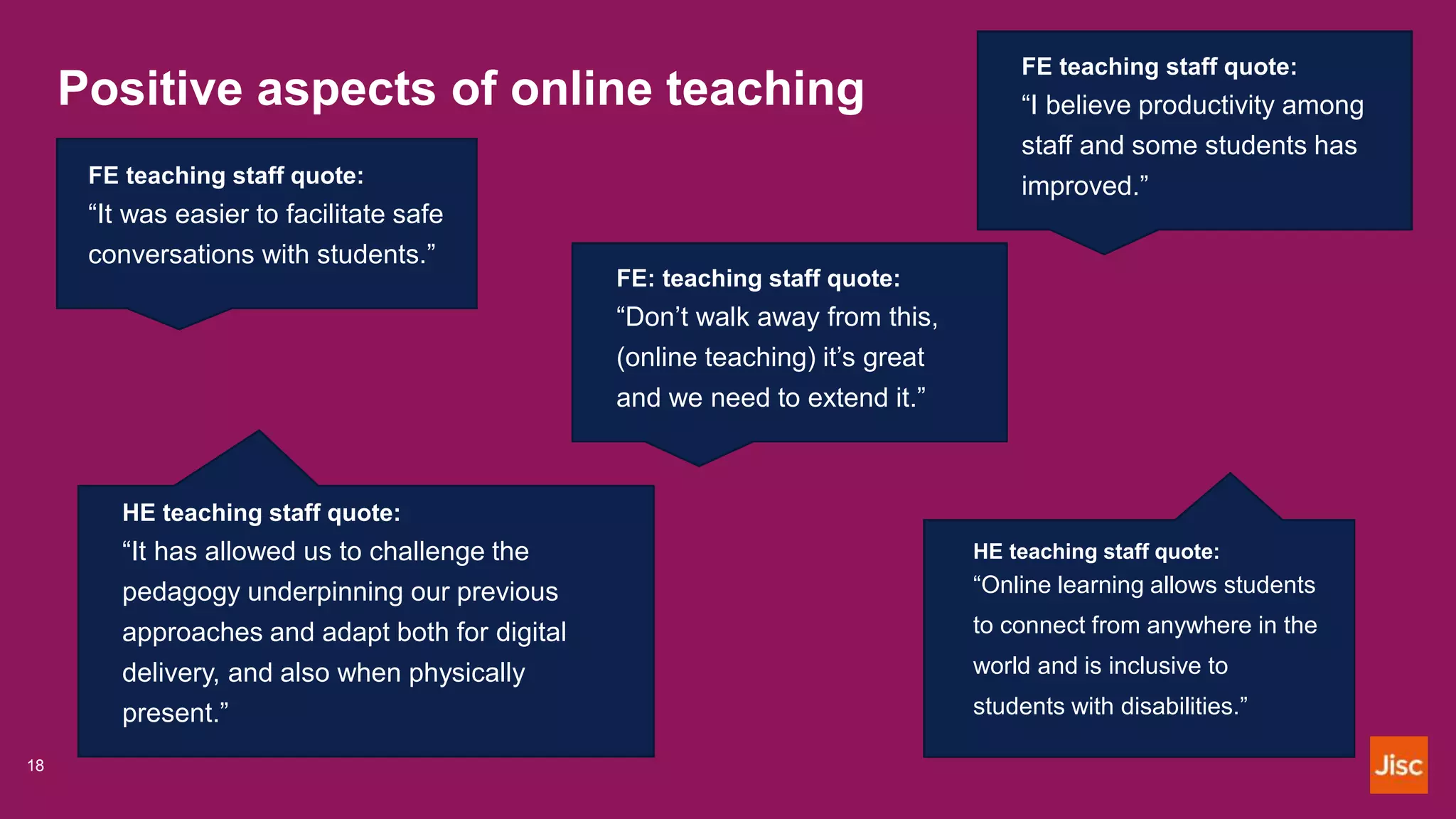
Positive aspects of online teaching
18
FE teaching staff quote:
“It was easier to facilitate safe
conversations with students.”
FE: teaching staff quote:
“Don’t walk away from this,
(online teaching) it’s great
and we need to extend it.”
FE teaching staff quote:
“I believe productivity among
staff and some students has
improved.”
HE teaching staff quote:
“It has allowed us to challenge the
pedagogy underpinning our previous
approaches and adapt both for digital
delivery, and also when physically
present.”
HE teaching staff quote:
“Online learning allows students
to connect from anywhere in the
world and is inclusive to
students with disabilities.”
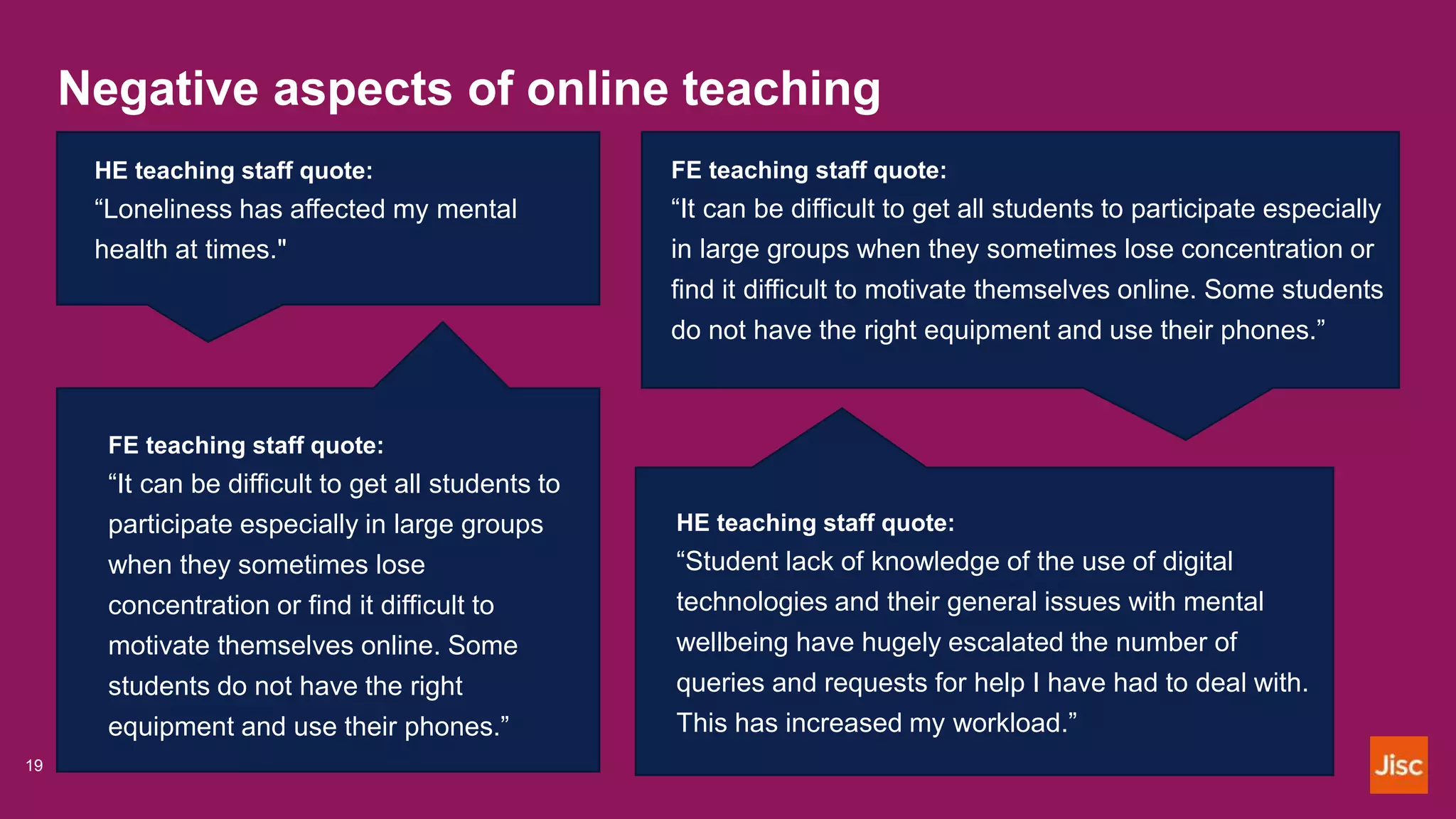
Negative aspects of online teaching
HE teaching staff quote:
“Loneliness has affected my mental
health at times."
FE teaching staff quote:
“It can be difficult to get all students to
participate especially in large groups
when they sometimes lose
concentration or find it difficult to
motivate themselves online. Some
students do not have the right
equipment and use their phones.”
19
FE teaching staff quote:
“It can be difficult to get all students to participate especially
in large groups when they sometimes lose concentration or
find it difficult to motivate themselves online. Some students
do not have the right equipment and use their phones.”
HE teaching staff quote:
“Student lack of knowledge of the use of digital
technologies and their general issues with mental
wellbeing have hugely escalated the number of
queries and requests for help I have had to deal with.
This has increased my workload.”
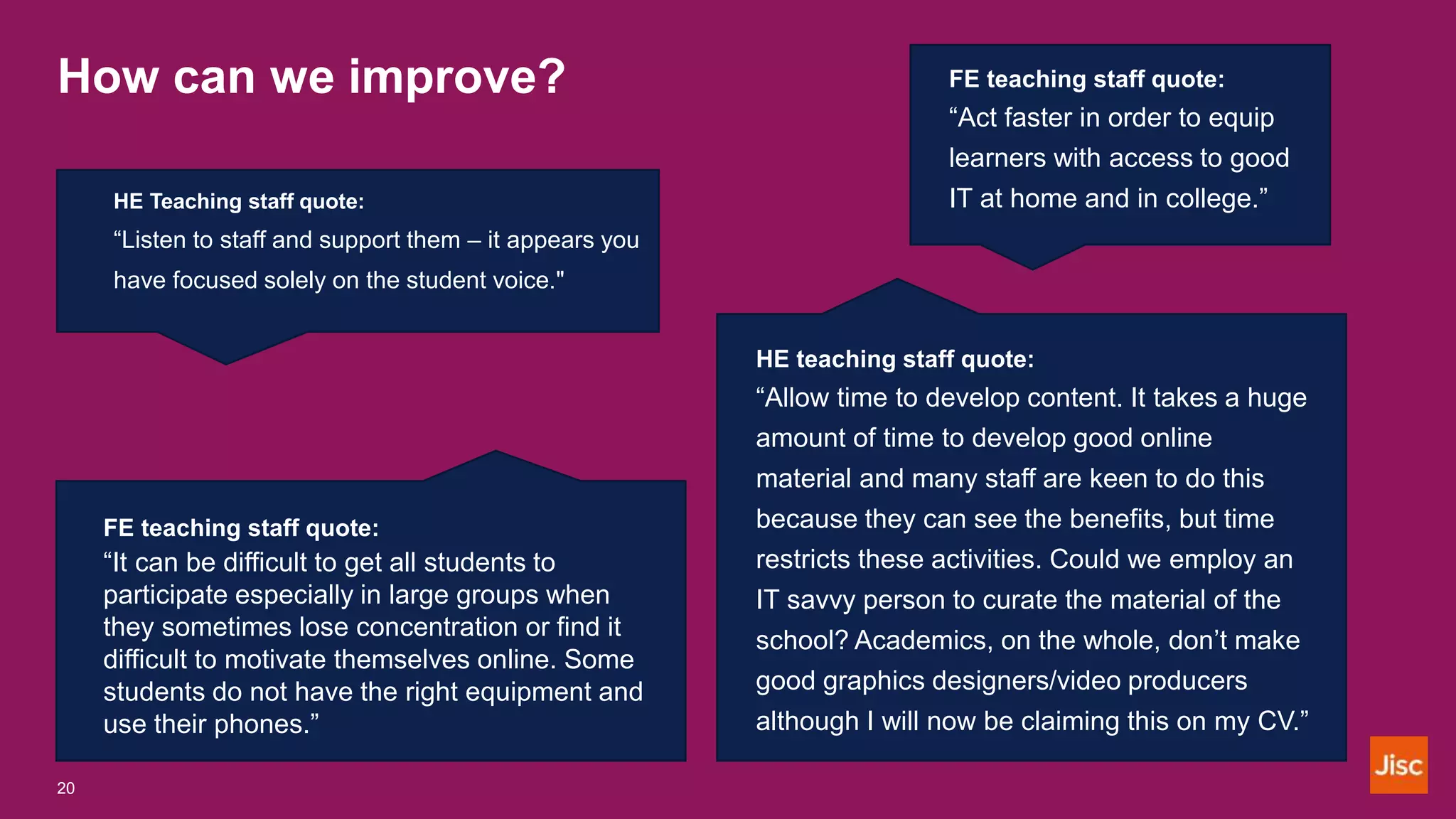
How can we improve?
HE Teaching staff quote:
“Listen to staff and support them – it appears you
have focused solely on the student voice."
FE teaching staff quote:
“Act faster in order to equip
learners with access to good
IT at home and in college.”
FE teaching staff quote:
“It can be difficult to get all students to
participate especially in large groups when
they sometimes lose concentration or find it
difficult to motivate themselves online. Some
students do not have the right equipment and
use their phones.”
HE teaching staff quote:
“Allow time to develop content. It takes a huge
amount of time to develop good online
material and many staff are keen to do this
because they can see the benefits, but time
restricts these activities. Could we employ an
IT savvy person to curate the material of the
school? Academics, on the whole, don’t make
good graphics designers/video producers
although I will now be claiming this on my CV.”
20
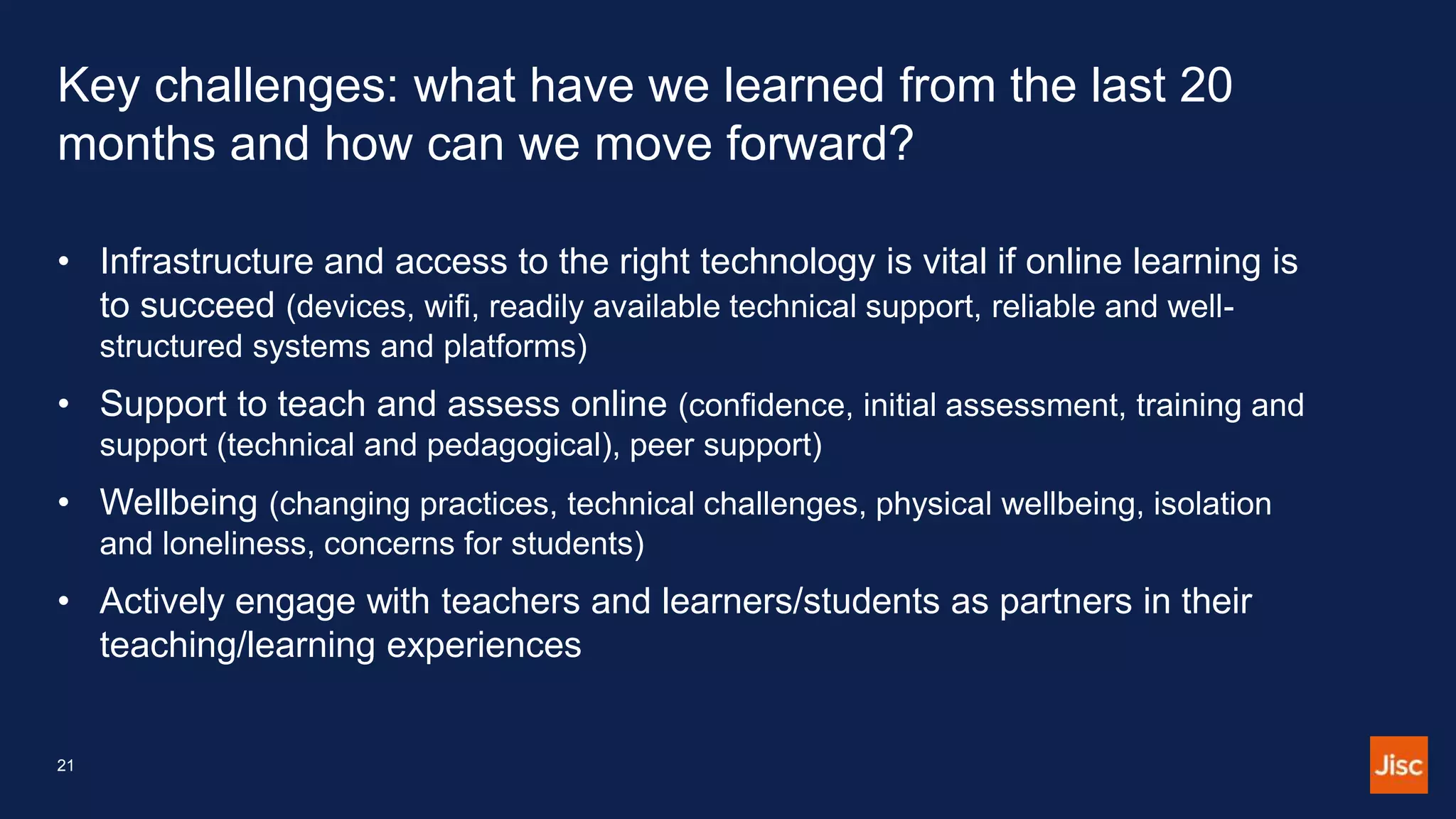
Key challenges: what have we learned from the last 20
months and how can we move forward?
• Infrastructure and access to the right technology is vital if online learning is
to succeed (devices, wifi, readily available technical support, reliable and well-
structured systems and platforms)
• Support to teach and assess online (confidence, initial assessment, training and
support (technical and pedagogical), peer support)
• Wellbeing (changing practices, technical challenges, physical wellbeing, isolation
and loneliness, concerns for students)
• Actively engage with teachers and learners/students as partners in their
teaching/learning experiences
21
Getting the most out of your surveys
https://digitalinsights.jisc.ac.uk/running-insights-surveys/
• Revised question sets for 2021/22
• Updated guidance on all aspects
• Briefings and toolkits (including benchmarking the online
learner/student experience)
• Posters to help you promote your surveys
• Analysis templates to share your findings
We will also be restarting webinar series
early in 2022 – what topics would you like
to see on the agenda?
22
Get in touch …
Digital experience insights
digitalinsights.jisc.ac.uk
help@jisc.ac.uk
Clare Killen
clare.killen@jisc.ac.uk
Andrew McFadyen
andrew.mcfadyen@jisc.ac.uk
Except where otherwise noted,
this work is licensed under CC-BY

How are teaching staff experiencing the digital environment

  • 1.
    How are teachingstaff experiencing the digital environment? What the data from our 2020/21 digital experience insights surveys for teaching staff is telling us November 2021 Clare Killen and Andrew McFadyen, senior consultants, Jisc
  • 2.
    See the digitalexperience through the eyes of your students and staff • Powerful data on how students, teaching and professional services staff, and researchers, are using technology • Designed to help to understand and improve the digital experience in FE and HE • Provides baseline and benchmarking data to inform your digital strategy • 300,000+ participants from 250+ organisations across FE and HE since 2016 • 2021/22 surveys now open! 2 Find out more at: digitalinsights.jisc.ac.uk
  • 3.
    Hearing what teachingstaff have to say (October 2020 – July 2021 – focus on learning teaching) 6,551 responses from teaching staff to our 2020/21 digital experience insights surveys • 2,822 FE teaching staff from 29 colleges across the UK • 3,729 HE teaching staff from 24 universities and one college across the UK Full reports available from: https://digitalinsights.jisc.ac.uk/reports-and-briefings/our- reports/ 3
  • 4.
    Theme one: you andyour current teaching situation
  • 5.
    How and wherewere teachers teaching? FE How • 31% physically on site • 30% a mix of physically on site and online teaching • 39% online teaching (on your own/ with others in your department) Where • 75% at home • 25% on campus in your office, work spaces, libraries etc • 11% had not been teaching online HE How • 2% physically on site • 16% a mix of physically on site and online teaching • 82% online teaching (on your own/with others in your department) Where • 94% at home • 13% on campus in your office, work spaces, libraries etc • 2% had not been teaching online
  • 6.
    Problems encountered whenteaching online Significant barriers if online delivery is dominant mode FE • 52% poor wifi connection • 29% access to online platforms/services • 22% no suitable computer/device • 21% no safe, private area to work • 21% need specialist software • 14% mobile data costs HE • 51% poor wifi connection • 25% access to online platforms/services • 20% need specialist software • 16% no suitable computer/device • 16% no safe, private area to work • 12% mobile data costs 6
  • 7.
    Theme two: digital platforms andservices at your organisation
  • 8.
    How did teachersfeel about their teaching environment? FE • 52% reliable (35% neutral, 13% disagreed) • 46% well designed (43% neutral, 11% disagreed) • 51% easy to navigate (38% neutral, 11% disagreed) • 64% safe and secure (33% neutral, 3% disagreed) HE • 57% reliable (30% neutral, 13% disagreed) • 39% well designed (42% neutral, 19% disagreed) • 41% easy to navigate (39% neutral, 20% disagreed) • 59% safe and secure (36% neutral, 5% disagreed) The percentages of teaching staff who agreed with various statements about their learning environment were (answer options: agree/neutral/disagree):
  • 9.
    How did teachersfeel about the platforms and services at their organisations (agree/neutral/disagree)? FE • 50% supported to use own digital devices (36% neutral 14 % disagreed) • 68% enabled to access online systems and services from anywhere (24% neutral, 8% disagreed) • 72% communicated effectively online eg email, messaging, notifications (21% neutral, 6% disagreed) • 57% provided a good online environment for collaboration (34% neutral, 9% disagreed). • 38% were given the chance to be involved in decisions about online teaching (40% neutral, 23% disagreed) HE • 43% supported to use own digital devices (38% neutral, 19% disagreed) • 66% enabled to access online systems and services from anywhere (25% neutral, 9% disagreed) • 61% communicated effectively online eg email, messaging, notifications (28% neutral, 11% disagreed) • 45% provided a good online environment for collaboration (39% neutral, 17% disagreed) • 25% were given the chance to be involved in decisions about online teaching (36% neutral, 39% disagreed)
  • 10.
  • 11.
    Range of teachingactivities (FE) The percentages of teaching staff who said they had carried out the following online teaching activities in the last two weeks prior to taking the survey were: FE • 77% produced and uploaded course materials eg quizzes, assignments • 76% fed back to students on their work (need not be summative) • 73% live lecture/teaching session • 66% supported students to learn online • 65% marked/graded coursework • 52% found and shared course materials made by others • 36% held online drop in session(s) • 35% recorded a lecture/teaching session • 26% moderated an online discussion • 23% supported a group project • 8% virtual lab, practical or field work
  • 12.
    Range of teachingactivities (HE) The percentages of teaching staff who said they had carried out the following online teaching activities in the last two weeks prior to taking the survey were: HE • 83% live lecture/teaching session • 79% fed back to students on their work (need not be formal/summative) • 71% produced and uploaded course materials eg quizzes, assignments • 70% marked/graded coursework • 65% recorded a lecture/teaching session • 59% held online drop in session(s) • 53% supported students to learn online • 40% found and shared course materials made by others • 35% moderated an online discussion • 29% supported a group project • 15% virtual lab, practical or field work
  • 13.
    Challenges and changingroles (agree/neutral/disagree)? FE • 83% created technical challenges (14% neutral, 4% disagreed) • 65% added significant new stress to your workload (25% neutral, 10% disagreed) • 74% changed your role as a teacher (20% neutral, 6% disagreed) HE • 82% created technical challenges (13% neutral, 5% disagreed) • 73% added significant new stress to your workload (17% neutral, 10% disagreed) • 76% changed your role as a teacher (16% neutral, 8% disagreed) Teaching staff were asked whether they agreed that online teaching had …
  • 14.
  • 15.
    Support for onlinelearning and skills development FE • 59% support for teaching online/away from campus (13% neutral, 10% disagreed) • 50% guidance about the digital skills needed in your teaching role (37% neutral, 13% disagreed) • 30% an assessment of their digital skills and training needs (43% neutral, 27% disagreed) • 27% time to explore new digital tools and approaches (37% neutral, 36% disagreed) • 17% reward and recognition for the digital skills you develop (45% neutral, 38% disagreed) HE • 57% support for teaching online/away from campus (29% neutral, 15% disagreed) • 44% guidance about the digital skills needed in your teaching role (35% neutral, 21% disagreed) • 15% an assessment of their digital skills and training needs (38% neutral, 47% disagreed) • 17% time to explore new digital tools and approaches (28% neutral, 55% disagreed) • 6% reward and recognition for the digital skills you develop (27% neutral, 67% disagreed) The percentages of teaching staff who agreed with the following statements were:
  • 16.
    Expectations and concerns FE •37% the teaching expectations placed on them had been reasonable (33% neutral, 30% disagreed) • 50% could access all the organisational support services they needed online (36% neutral, 15% disagreed) • 29% the concerns of teaching staff and their representatives were being heard (44% neutral, 28% disagreed) HE • 26% the teaching expectations placed on them had been reasonable (28% neutral, 46% disagreed) • 40% could access all the organisational support services they needed online (36% neutral, 24% disagreed) • 16% the concerns of teaching staff and their representatives were being heard (38% neutral, 46% disagreed) The percentages of teaching staff who agreed with the following statements were:
  • 17.
  • 18.
    Positive aspects ofonline teaching 18 FE teaching staff quote: “It was easier to facilitate safe conversations with students.” FE: teaching staff quote: “Don’t walk away from this, (online teaching) it’s great and we need to extend it.” FE teaching staff quote: “I believe productivity among staff and some students has improved.” HE teaching staff quote: “It has allowed us to challenge the pedagogy underpinning our previous approaches and adapt both for digital delivery, and also when physically present.” HE teaching staff quote: “Online learning allows students to connect from anywhere in the world and is inclusive to students with disabilities.”
  • 19.
    Negative aspects ofonline teaching HE teaching staff quote: “Loneliness has affected my mental health at times." FE teaching staff quote: “It can be difficult to get all students to participate especially in large groups when they sometimes lose concentration or find it difficult to motivate themselves online. Some students do not have the right equipment and use their phones.” 19 FE teaching staff quote: “It can be difficult to get all students to participate especially in large groups when they sometimes lose concentration or find it difficult to motivate themselves online. Some students do not have the right equipment and use their phones.” HE teaching staff quote: “Student lack of knowledge of the use of digital technologies and their general issues with mental wellbeing have hugely escalated the number of queries and requests for help I have had to deal with. This has increased my workload.”
  • 20.
    How can weimprove? HE Teaching staff quote: “Listen to staff and support them – it appears you have focused solely on the student voice." FE teaching staff quote: “Act faster in order to equip learners with access to good IT at home and in college.” FE teaching staff quote: “It can be difficult to get all students to participate especially in large groups when they sometimes lose concentration or find it difficult to motivate themselves online. Some students do not have the right equipment and use their phones.” HE teaching staff quote: “Allow time to develop content. It takes a huge amount of time to develop good online material and many staff are keen to do this because they can see the benefits, but time restricts these activities. Could we employ an IT savvy person to curate the material of the school? Academics, on the whole, don’t make good graphics designers/video producers although I will now be claiming this on my CV.” 20
  • 21.
    Key challenges: whathave we learned from the last 20 months and how can we move forward? • Infrastructure and access to the right technology is vital if online learning is to succeed (devices, wifi, readily available technical support, reliable and well- structured systems and platforms) • Support to teach and assess online (confidence, initial assessment, training and support (technical and pedagogical), peer support) • Wellbeing (changing practices, technical challenges, physical wellbeing, isolation and loneliness, concerns for students) • Actively engage with teachers and learners/students as partners in their teaching/learning experiences 21
  • 22.
    Getting the mostout of your surveys https://digitalinsights.jisc.ac.uk/running-insights-surveys/ • Revised question sets for 2021/22 • Updated guidance on all aspects • Briefings and toolkits (including benchmarking the online learner/student experience) • Posters to help you promote your surveys • Analysis templates to share your findings We will also be restarting webinar series early in 2022 – what topics would you like to see on the agenda? 22
  • 23.
    Get in touch… Digital experience insights digitalinsights.jisc.ac.uk help@jisc.ac.uk Clare Killen clare.killen@jisc.ac.uk Andrew McFadyen andrew.mcfadyen@jisc.ac.uk Except where otherwise noted, this work is licensed under CC-BY

Editor's Notes

  • #2 How are you gathering data on the experiences of your teaching staff? Discussion prompt – while presenting please use the chat to share with us: whether the findings resonate with your experiences, anything that surprises you or stands out and any questions. We will pick these up at the end.
  • #3 All of the information you need is freely available from the website Analysis of professional services staff and researchers survey findings is underway and will be published in the new year Visit the website to see how you can get find out more about how to run surveys with your students and staff from October 2021
  • #4 The survey questions focus around 4 themes which cover individual and organisational use of technology, how technology is used in learning, teaching and research and support for developing digital skills. The 2020/21 survey focused on online teaching and participants were asked to respond based on experiences over two weeks immediately prior to taking the survey. We would like to share some extracts from the reports with you and discuss your findings, your approaches to addressing some of the challenges.
  • #6 The majority of FE teachers were teaching from home with many teaching online although some on site teaching was still taking place. For HE, 94% of teaching staff were teaching from home and very few were physically on site.
  • #7  Over half of teaching staff experienced problems with wifi. Overall, 60% of FE teaching staff and 64% of HE teaching staff said they had encountered one or more of the problems we asked them about.
  • #9 Teaching staff generally felt safe and secure when working online but only just over 50% felt it was reliable and not all felt it was well designed or easy to navigate.
  • #10 FE: The majority of teaching staff agreed with these statements but only half agreed that their college supported them to use their own digital devices. HE: While approximately two thirds of teaching staff agreed they were able to access online systems and services from anywhere and that their organisation communicated effectively online, less than half felt the online environment supported collaboration or that they were supported to use their own digital devices.
  • #12 Overall, teaching staff were positive about the quality of online and digital learning their courses provided. 78% of FE teachers rated it as ‘best imaginable’, ‘excellent’ or ‘good’. In FE roughly three-quarters of teaching staff engaged in key practical activities designed to engage learners but only half found and shared course materials made by others. Few staff engaged learners in some of the more collaborative activities.
  • #13 Overall, teaching staff were positive about the quality of online and digital learning their courses provided. 84% of HE teachers rated it as ‘best imaginable’, ‘excellent’ or ‘good’. In HE high numbers delivered online sessions but few found and shared course materials made by others or offered students to opportunities to engage in collaborative activities.
  • #14 FE: The impact of delivering online learning on teaching staff is apparent. For many, the technical challenges were not just their own, but those of their learners, and trying to manage these while delivering teaching, as well as working in a change of role and was extremely stressful. HE: High numbers of teaching staff agreed that online teaching had an impact on their role as a teacher, had created technical challenges and added significant stress to their workload. This will clearly have an impact on their wellbeing and is a major concern.
  • #16 61% of both FE and HE teaching staff rated the support they received to teach online as being either ‘best imaginable’, ‘excellent’ or ‘good’. FE: Only half of teaching staff agreed they had been given guidance about the digital skills needed in their teaching role. Given the situation, this is lower than is desirable. Less than a third had an assessment of their digital skills and training needs – a vital guide to them as individuals and for their organisation in understanding skills gaps and their ability to provide targeted support. HE: Less that half of teaching staff agreed they had received guidance about the digital skills needed in their role and very few agreed they had an assessment of their digital skills and training needs, high numbers disagreed. High numbers also disagreed that they had time to explore new digital skills and approaches.
  • #17 FE: Half of the teaching staff agreed that they could access all the organisational support services they needed online, but fewer numbers agreed that the teaching expectations placed on them were reasonable and high numbers disagreed. Staff were divided as to whether their concerns were being heard. HE: Less than half of teaching staff agreed that they could access all the organisational support services they needed online and high numbers disagreed that the teaching expectations placed upon them had been reasonable. High numbers also disagreed that their concerns were being heard.
  • #19 Key positives for FE included: Having the chance to learn new skills Creative approaches to teaching (quizzes, guest lectures, recorded lessons) led to an increase in student engagement Sharing live documents facilitated one-to-one discussions Breakout rooms enabled small group or 1:1 support Ability to deliver varied assessments Efficient use of time Easy access to resources Increased inclusion Communication with learners Flexibility Similar positives for HE New and flexible ways of teaching Being able to record live sessions and develop flexible resource banks Positive for students in improving student access to learning and supporting them to revisit content, go at own pace, fit learning around other commitments) Increased student engagement More options to support students Improved options for formative assessment Convenience and improved productivity
  • #20 What some teaching staff liked, others did not. For FE, the most negative aspects were: Technical difficulties - own and those of students Not having appropriate equipment and software Slow/insufficient broadband Find it hard to deliver practical sessions Difficulties judging when learners needed support Feeling overwhelmed/work overload Missing the rapport and physical interaction A decline in student engagement and interaction For HE, the most negative aspects were: Reduced student interaction and engagement Managing group work with large groups The impact of online learning on students – watching them struggle Technical and access issues (poor wifi, not being able to access the equipment and software needed, having to purchase equipment at own expense Increased workload (materials, assessments, supporting split class delivery modes) Trying to resolve own and students technical difficulties Feeling ‘thrown in at the deep end’ A decline in mental and physical wellbeing
  • #21 For FE the suggestions from teaching staff included: Improve access to equipment, systems and support Improve the quality of resources – consistency, designed for digital Review staff working practices Provide more flexible and personalised training For HE the suggestions from teaching included: Recognise and support teachers to address the challenges in moving so swiftly to online Address digital poverty and improve infrastructure Improve platforms and information management Encourage online collaboration between peers Facilitate student interaction and engagement More training, support and guidance Recognise and support staff wellbeing
  • #22 Online learning is not a new concept – many universities and colleges have been researching, developing and supporting new practices for decades. It was the scale and pace of the shift that was different and the fact that all teaching staff needed to embrace it, regardless of previous experience. As the primary mode of delivery, online learning presented new opportunities and alternative approaches although some found it daunting. Having to learn how to facilitate learning, teaching and assessment in an online environment meant upskilling for some. This, combined with the need to troubleshoot their own technical problems as well as those of their students, while continuing to deliver high class teaching, was challenging and pushed some staff outside of their comfort zones.
  • #23 Revised question sets for 2021/22 – reflect a change away from the focus on purely online learning in 2020/21 to reference