Applied Housing and Home
Management
 HOUSING
 DIFFERENCE BETWEEN HOUSE AND
HOME
 NEED/IMPORTANCE OF A HOME
 TYPES OF ACCOMMODATION
 CONCLUSION
Housing
Housing refers to
 houses or buildings collectively;
 accommodation of people;
 planning or provision of accommodation by an
authority;
and related meanings.
Difference between house and home
House
A house is a building that functions as a home.
 Simple dwellings such as rudimentary huts of nomadic
tribes and shacks in shantytowns
 Complex, fixed structures of wood, brick, concrete or
other materials containing plumbing, ventilation and
electrical systems.
Areas of a house
 Roofing systems to keep precipitation such as rain from getting into the dwelling space.
 Doors or locks to secure the dwelling space and protect its inhabitants and contents from
burglars or other trespassers.
 One or more bedrooms and bathrooms, a kitchen or cooking area, and a living room
 A separate dining room, or the eating area may be integrated into another room
 A recreation room.
 Domestic animals such as chickens or larger livestock (like cattle) may share part of the
house with humans: a pen (In traditional agriculture-oriented societies)
The social unit that lives in a house is known as a household.
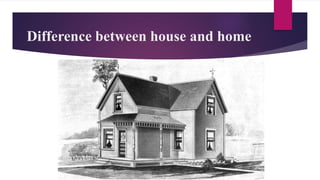
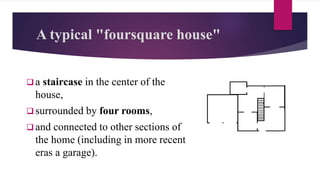
A typical "foursquare house"
 a staircase in the center of the
house,
 surrounded by four rooms,
 and connected to other sections of
the home (including in more recent
eras a garage).
Home
A home or domicile is a dwelling-place used as a
permanent or semi-permanent residence for an individual,
family, household or several families in a tribe.
It is often a house, apartment, or other building, or
alternatively a mobile home, houseboat, yurt or any other
portable shelter.
Need/importance of home
 Our homes say a lot about who we are and what we think is important in life.
 You do not have to be wealthy or have a large house to create a space that
constantly reminds you of your own deepest values and hopes.
 Home means sanctuary, the place we can rest, relax, enjoy time with friends, learn,
grow … and just be.
 Our homes say a lot about who we are and what we think is important in life.
 Homes typically provide areas and facilities for sleeping, preparing food, eating and
hygiene.
 Home is where the heart is but it goes deeper than that. Our connections to home
are basic threads in our lives that pop up automatically in casual conversation. We
use the word home to identify where we’re from (hometown), cheer on players who
represent us in sports (home teams), describe a level of comfort (at home), relate to
our national identity (homeland), and at the end of a vacation, name it as our
favorite next destination (“There’s no place like home.”).
Types of housing/accommodation
 Hut
 Nomadic tribes
 nursing home
 children's home/orphanage
 convent
 homestead (agricultural land and facilities) for domesticated animals
 Shacks found in slums and shanty towns
 Villas
Huts
 a primitive dwelling, constructed of various local materials
 built of readily available materials such as wood, snow, ice, stone, grass, palm leaves,
branches, hides, fabric, or mud using techniques passed down through the generations a
shape of a lower quality than a house (durable, well built dwelling)
 but higher quality than a shelter (place of refuge or safety) such as a tent
 is used as temporary or seasonal shelter or in primitive societies as a permanent
dwelling
 exist in practically all nomadic cultures
 Some are transportable and can stand most conditions of weather.
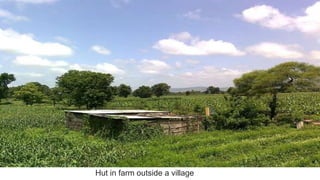
Hut in farm outside a village
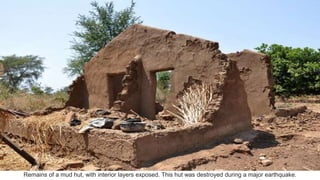
Remains of a mud hut, with interior layers exposed. This hut was destroyed during a major earthquake.
Nomad
A nomad is a member of a community of people who lives in different
locations, moving from one place to another in search of grasslands for their
animals.
Among the various ways nomads relate to their environment, one can
distinguish
 the hunter-gatherer,
 the pastoral nomad owning livestock, or
 the "modern" peripatetic nomad.
As of 1995, there were an estimated 30–40 million nomads in the world.
Nursing Home
Nursing homes are a type of residential care that provide
around-the-clock nursing care for elderly people. Twenty-four-
hour nursing care is available.
Nursing homes will provide short-term rehabilitative stays
following a surgery, illness or injury which may require physical
therapy, occupational therapy or speech-language therapy.
Nursing homes offer other services such as planned activities
and daily housekeeping services.
Children's home/Orphanage
An orphanage is a residential institution devoted to
the care of orphans—children whose biological parents are
deceased or otherwise unable or unwilling to take care of them.
Biological parents, and sometimes biological grandparents, are
legally responsible for supporting children, but in the absence of
these, no named godparent, or other relatives willing to care for
the children, they become a ward of the state, and orphanages are
one way of providing for their care, housing and education.
Convent
A convent is either a community
of priests, religious brothers, religious sisters,
or nuns; or the building used by the
community, particularly in the Roman
Catholic Church.
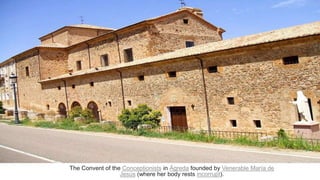
The Convent of the Conceptionists in Ágreda founded by Venerable María de
Jesús (where her body rests incorrupt).
Homestead
A homestead originally meant a farmhouse and its adjacent outbuildings. By extension,
it can mean any small cluster of houses.
Homestead may refer specifically to:
 Homestead (unit): a unit of measurement equal to 160 acres
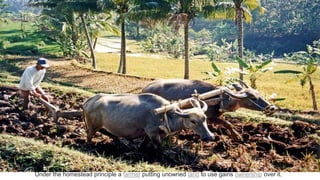
 Homestead principle: a legal concept that one can establish ownership of unowned
property through living on it
 Homestead exemption: (U.S. law), a legal program to protect the value of a residence
from expenses and/or forced sale arising from the death of a spouse
 Homesteading: a lifestyle of agrarian self-sufficiency as practiced by a modern
homesteader or urban homesteader
Under the homestead principle a farmer putting unowned land to use gains ownership over it.
Shacks
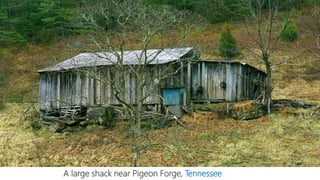
 A shack is a type of small, often primitive shelter or dwelling.
 Like huts, shacks are constructed by hand using available materials;
 however, whereas huts are usually rural and made of natural materials (mud, rocks,
sticks, etc.) shacks are generally composed of scavenged man-made materials like
abandoned construction debris, repurposed consumer waste and other useful discarded
objects that can be quickly acquired at little or no cost and fashioned into a small
dwelling.
 In areas of high population density and high poverty, shacks are often the most prevalent
form of housing; it is possible that up to a billion people worldwide live in shacks.
 Fire is a significant hazard in tight-knit shack settlements. Settlements composed mostly
or entirely of shacks are known as slums or shanty towns.
A large shack near Pigeon Forge, Tennessee
Slums in major cities
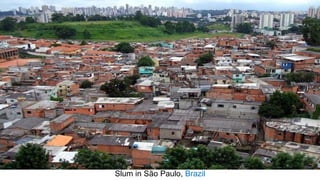
 A slum is a highly populated urban residential area consisting mostly of
closely packed, decrepit housing units in a situation of deteriorated or
incomplete infrastructure, inhabited primarily by impoverished persons.
 While slums differ in size and other characteristics, most lack reliable
sanitation services, supply of clean water, reliable electricity, law
enforcement and other basic services.
 Slum residences vary from shanty houses to professionally built
dwellings which, because of poor-quality construction or provision of
basic maintenance, have deteriorated.
Slum in São Paulo, Brazil
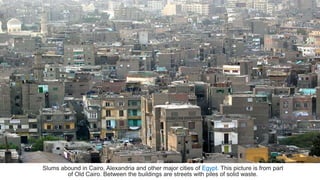
Slums abound in Cairo, Alexandria and other major cities of Egypt. This picture is from part
of Old Cairo. Between the buildings are streets with piles of solid waste.
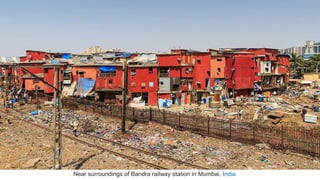
Near surroundings of Bandra railway station in Mumbai, India
Shanty towns
 A shanty town or squatter area is a settlement of improvised housing which is
known as shanties or shacks, made of plywood, corrugated metal, sheets of
plastic, and cardboard boxes.
 Such settlements are usually found on the periphery of cities, in public parks, or
near railroad tracks, rivers, lagoons or city trash dump sites.
 Sometimes called a squatter, informal or spontaneous settlement, a typical shanty
town often lacks adequate infrastructure, including proper sanitation, safe
water supply, electricity, hygienic streets, or other basic necessities to support
human settlements.
 Shanty towns are mostly found in developing nations, but also in some parts of
developed nations.
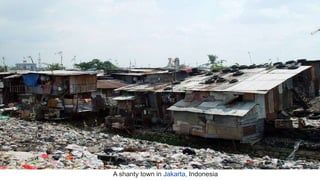
A shanty town in Jakarta, Indonesia
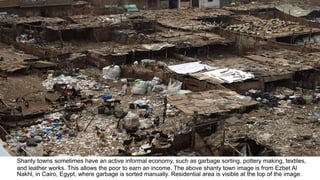
Shanty towns sometimes have an active informal economy, such as garbage sorting, pottery making, textiles,
and leather works. This allows the poor to earn an income. The above shanty town image is from Ezbet Al
Nakhl, in Cairo, Egypt, where garbage is sorted manually. Residential area is visible at the top of the image.
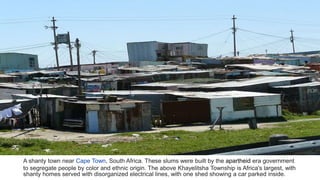
A shanty town near Cape Town, South Africa. These slums were built by the apartheid era government
to segregate people by color and ethnic origin. The above Khayelitsha Township is Africa's largest, with
shanty homes served with disorganized electrical lines, with one shed showing a car parked inside.
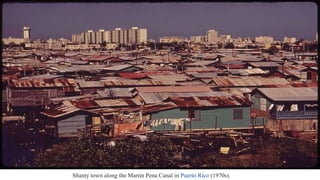
Shanty town along the Martin Pena Canal in Puerto Rico (1970s).
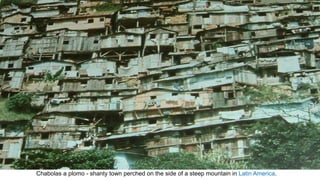
Chabolas a plomo - shanty town perched on the side of a steep mountain in Latin America.
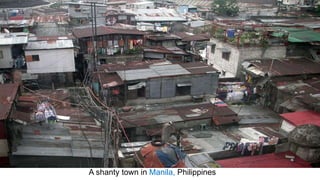
A shanty town in Manila, Philippines
Squats
Squatting is the action of occupying an abandoned or
unoccupied area of land or a building, usually residential, that
the squatter does not own, rent or otherwise have lawful
permission to use.
Author Robert Neuwirth suggested in 2004 that there were one
billion squatters globally. He forecasts there will be two billion by
2030 and three billion by 2050. Yet, according to Kesia Reeve,
"squatting is largely absent from policy and academic debate and is
rarely conceptualised, as a problem, as a symptom, or as a social or
housing movement."
The international
squatters' symbol
Pavement dwellers
Pavement dwellers refers to dwellings built on the
footpaths/pavements of city streets, which use the walls or
fences which separate building compounds from the
pavement and street outside. Materials include cloth,
corrugated iron, cardboard, wood, plastic, and sometimes
also bricks or cement.
Homelessness
Homelessness is the condition of people without a permanent dwelling, such
as a house or apartment. People who are homeless are most often unable to
acquire and maintain regular, safe, secure and adequate housing.
The legal definition of homeless varies from country to country, or among
different jurisdictions in the same country or region. The term homeless may also
include people whose primary night-time residence is in a homeless shelter,
a domestic violence shelter, long-term residence in a motel, a
vehicle, squatting, cardboard boxes, a tent city, shanty town structures made of
discarded building materials.
According to the UK homelessness charity Crisis, a home is not just a physical
space: it also provides roots, identity, security, a sense of belonging and a place of
emotional wellbeing. United States government homeless enumeration studies also
include people who sleep in a public or private place not designed for use as a
regular sleeping accommodation for human beings. There are a number of
organizations who provide help for the homeless.
In 2005, an estimated 100 million (1 in 65 at the time) people worldwide were
homeless and as many as 1 billion people live as squatters, refugees or in temporary
shelter, all lacking adequate housing. In Western countries, the large majority of
homeless are men (75–80%), with single males particularly overrepresented.
Conclusion
 The social issue is of ensuring that members of society have a home in which to
live, whether this is a house, or some other kind of dwelling, lodging, or shelter.
Many governments have one or more housing authorities, sometimes also called a
housing ministry, or housing department.
 More generally, "home" may be considered to be a geographic area, such as a
town, village, suburb, city, or country.
 Transitory accommodation in a treatment facility for a few weeks is not normally
considered permanent enough to replace a more stable location as 'home'.
 In 2005, 100 million people worldwide were estimated to be homeless.

Housing

  • 1.
    Applied Housing andHome Management  HOUSING  DIFFERENCE BETWEEN HOUSE AND HOME  NEED/IMPORTANCE OF A HOME  TYPES OF ACCOMMODATION  CONCLUSION
  • 2.
    Housing Housing refers to houses or buildings collectively;  accommodation of people;  planning or provision of accommodation by an authority; and related meanings.
  • 3.
  • 4.
    House A house isa building that functions as a home.  Simple dwellings such as rudimentary huts of nomadic tribes and shacks in shantytowns  Complex, fixed structures of wood, brick, concrete or other materials containing plumbing, ventilation and electrical systems.
  • 5.
    Areas of ahouse  Roofing systems to keep precipitation such as rain from getting into the dwelling space.  Doors or locks to secure the dwelling space and protect its inhabitants and contents from burglars or other trespassers.  One or more bedrooms and bathrooms, a kitchen or cooking area, and a living room  A separate dining room, or the eating area may be integrated into another room  A recreation room.  Domestic animals such as chickens or larger livestock (like cattle) may share part of the house with humans: a pen (In traditional agriculture-oriented societies) The social unit that lives in a house is known as a household.
  • 6.
    A typical "foursquarehouse"  a staircase in the center of the house,  surrounded by four rooms,  and connected to other sections of the home (including in more recent eras a garage).
  • 7.
    Home A home ordomicile is a dwelling-place used as a permanent or semi-permanent residence for an individual, family, household or several families in a tribe. It is often a house, apartment, or other building, or alternatively a mobile home, houseboat, yurt or any other portable shelter.
  • 8.
  • 9.
     Our homessay a lot about who we are and what we think is important in life.  You do not have to be wealthy or have a large house to create a space that constantly reminds you of your own deepest values and hopes.  Home means sanctuary, the place we can rest, relax, enjoy time with friends, learn, grow … and just be.  Our homes say a lot about who we are and what we think is important in life.  Homes typically provide areas and facilities for sleeping, preparing food, eating and hygiene.  Home is where the heart is but it goes deeper than that. Our connections to home are basic threads in our lives that pop up automatically in casual conversation. We use the word home to identify where we’re from (hometown), cheer on players who represent us in sports (home teams), describe a level of comfort (at home), relate to our national identity (homeland), and at the end of a vacation, name it as our favorite next destination (“There’s no place like home.”).
  • 11.
    Types of housing/accommodation Hut  Nomadic tribes  nursing home  children's home/orphanage  convent  homestead (agricultural land and facilities) for domesticated animals  Shacks found in slums and shanty towns  Villas
  • 12.
    Huts  a primitivedwelling, constructed of various local materials  built of readily available materials such as wood, snow, ice, stone, grass, palm leaves, branches, hides, fabric, or mud using techniques passed down through the generations a shape of a lower quality than a house (durable, well built dwelling)  but higher quality than a shelter (place of refuge or safety) such as a tent  is used as temporary or seasonal shelter or in primitive societies as a permanent dwelling  exist in practically all nomadic cultures  Some are transportable and can stand most conditions of weather.
  • 13.
    Hut in farmoutside a village
  • 14.
    Remains of amud hut, with interior layers exposed. This hut was destroyed during a major earthquake.
  • 15.
    Nomad A nomad isa member of a community of people who lives in different locations, moving from one place to another in search of grasslands for their animals. Among the various ways nomads relate to their environment, one can distinguish  the hunter-gatherer,  the pastoral nomad owning livestock, or  the "modern" peripatetic nomad. As of 1995, there were an estimated 30–40 million nomads in the world.
  • 16.
    Nursing Home Nursing homesare a type of residential care that provide around-the-clock nursing care for elderly people. Twenty-four- hour nursing care is available. Nursing homes will provide short-term rehabilitative stays following a surgery, illness or injury which may require physical therapy, occupational therapy or speech-language therapy. Nursing homes offer other services such as planned activities and daily housekeeping services.
  • 17.
    Children's home/Orphanage An orphanageis a residential institution devoted to the care of orphans—children whose biological parents are deceased or otherwise unable or unwilling to take care of them. Biological parents, and sometimes biological grandparents, are legally responsible for supporting children, but in the absence of these, no named godparent, or other relatives willing to care for the children, they become a ward of the state, and orphanages are one way of providing for their care, housing and education.
  • 18.
    Convent A convent iseither a community of priests, religious brothers, religious sisters, or nuns; or the building used by the community, particularly in the Roman Catholic Church.
  • 19.
    The Convent ofthe Conceptionists in Ágreda founded by Venerable María de Jesús (where her body rests incorrupt).
  • 20.
    Homestead A homestead originallymeant a farmhouse and its adjacent outbuildings. By extension, it can mean any small cluster of houses. Homestead may refer specifically to:  Homestead (unit): a unit of measurement equal to 160 acres  Homestead principle: a legal concept that one can establish ownership of unowned property through living on it  Homestead exemption: (U.S. law), a legal program to protect the value of a residence from expenses and/or forced sale arising from the death of a spouse  Homesteading: a lifestyle of agrarian self-sufficiency as practiced by a modern homesteader or urban homesteader
  • 21.
    Under the homesteadprinciple a farmer putting unowned land to use gains ownership over it.
  • 22.
    Shacks  A shackis a type of small, often primitive shelter or dwelling.  Like huts, shacks are constructed by hand using available materials;  however, whereas huts are usually rural and made of natural materials (mud, rocks, sticks, etc.) shacks are generally composed of scavenged man-made materials like abandoned construction debris, repurposed consumer waste and other useful discarded objects that can be quickly acquired at little or no cost and fashioned into a small dwelling.  In areas of high population density and high poverty, shacks are often the most prevalent form of housing; it is possible that up to a billion people worldwide live in shacks.  Fire is a significant hazard in tight-knit shack settlements. Settlements composed mostly or entirely of shacks are known as slums or shanty towns.
  • 23.
    A large shacknear Pigeon Forge, Tennessee
  • 24.
    Slums in majorcities  A slum is a highly populated urban residential area consisting mostly of closely packed, decrepit housing units in a situation of deteriorated or incomplete infrastructure, inhabited primarily by impoverished persons.  While slums differ in size and other characteristics, most lack reliable sanitation services, supply of clean water, reliable electricity, law enforcement and other basic services.  Slum residences vary from shanty houses to professionally built dwellings which, because of poor-quality construction or provision of basic maintenance, have deteriorated.
  • 25.
    Slum in SãoPaulo, Brazil
  • 26.
    Slums abound inCairo, Alexandria and other major cities of Egypt. This picture is from part of Old Cairo. Between the buildings are streets with piles of solid waste.
  • 27.
    Near surroundings ofBandra railway station in Mumbai, India
  • 28.
    Shanty towns  Ashanty town or squatter area is a settlement of improvised housing which is known as shanties or shacks, made of plywood, corrugated metal, sheets of plastic, and cardboard boxes.  Such settlements are usually found on the periphery of cities, in public parks, or near railroad tracks, rivers, lagoons or city trash dump sites.  Sometimes called a squatter, informal or spontaneous settlement, a typical shanty town often lacks adequate infrastructure, including proper sanitation, safe water supply, electricity, hygienic streets, or other basic necessities to support human settlements.  Shanty towns are mostly found in developing nations, but also in some parts of developed nations.
  • 29.
    A shanty townin Jakarta, Indonesia
  • 30.
    Shanty towns sometimeshave an active informal economy, such as garbage sorting, pottery making, textiles, and leather works. This allows the poor to earn an income. The above shanty town image is from Ezbet Al Nakhl, in Cairo, Egypt, where garbage is sorted manually. Residential area is visible at the top of the image.
  • 31.
    A shanty townnear Cape Town, South Africa. These slums were built by the apartheid era government to segregate people by color and ethnic origin. The above Khayelitsha Township is Africa's largest, with shanty homes served with disorganized electrical lines, with one shed showing a car parked inside.
  • 32.
    Shanty town alongthe Martin Pena Canal in Puerto Rico (1970s).
  • 33.
    Chabolas a plomo- shanty town perched on the side of a steep mountain in Latin America.
  • 34.
    A shanty townin Manila, Philippines
  • 35.
    Squats Squatting is theaction of occupying an abandoned or unoccupied area of land or a building, usually residential, that the squatter does not own, rent or otherwise have lawful permission to use. Author Robert Neuwirth suggested in 2004 that there were one billion squatters globally. He forecasts there will be two billion by 2030 and three billion by 2050. Yet, according to Kesia Reeve, "squatting is largely absent from policy and academic debate and is rarely conceptualised, as a problem, as a symptom, or as a social or housing movement." The international squatters' symbol
  • 36.
    Pavement dwellers Pavement dwellersrefers to dwellings built on the footpaths/pavements of city streets, which use the walls or fences which separate building compounds from the pavement and street outside. Materials include cloth, corrugated iron, cardboard, wood, plastic, and sometimes also bricks or cement.
  • 37.
    Homelessness Homelessness is thecondition of people without a permanent dwelling, such as a house or apartment. People who are homeless are most often unable to acquire and maintain regular, safe, secure and adequate housing. The legal definition of homeless varies from country to country, or among different jurisdictions in the same country or region. The term homeless may also include people whose primary night-time residence is in a homeless shelter, a domestic violence shelter, long-term residence in a motel, a vehicle, squatting, cardboard boxes, a tent city, shanty town structures made of discarded building materials.
  • 38.
    According to theUK homelessness charity Crisis, a home is not just a physical space: it also provides roots, identity, security, a sense of belonging and a place of emotional wellbeing. United States government homeless enumeration studies also include people who sleep in a public or private place not designed for use as a regular sleeping accommodation for human beings. There are a number of organizations who provide help for the homeless. In 2005, an estimated 100 million (1 in 65 at the time) people worldwide were homeless and as many as 1 billion people live as squatters, refugees or in temporary shelter, all lacking adequate housing. In Western countries, the large majority of homeless are men (75–80%), with single males particularly overrepresented.
  • 39.
    Conclusion  The socialissue is of ensuring that members of society have a home in which to live, whether this is a house, or some other kind of dwelling, lodging, or shelter. Many governments have one or more housing authorities, sometimes also called a housing ministry, or housing department.  More generally, "home" may be considered to be a geographic area, such as a town, village, suburb, city, or country.  Transitory accommodation in a treatment facility for a few weeks is not normally considered permanent enough to replace a more stable location as 'home'.  In 2005, 100 million people worldwide were estimated to be homeless.